 ETHORITY®

Enterprise AI Opportunity Case
Before a large AI investment, a business case shows what would make it pay.
Establish whether an AI opportunity deserves your investment.
Priced after scoping
Standard 4 weeks · Extended 6 weeks.

What you receive
A business case on your volumes, a comparison with real alternatives and a signed decision record.
The business objective, the decision owner, known constraints and the operating data you already hold and permit us to use. ETHORITY builds the baseline and the economics and asks focused questions where figures are missing.
The ETHORITY Promise
The ETHORITY Promise
We make the value clear. We take responsibility for our delivery. We make results transparent.
- A specific expected outcome, with its basis and assumptions.
- Defined deliverables, price, timing and acceptance criteria.
- Supporting evidence, accountable ownership and measurement where included.
You receive a clear recommendation, an agreed delivery commitment and transparent results. We explain the value you can expect, the basis for that assessment and what ETHORITY takes responsibility for.
- Expected value
- You make an evidence-based decision before your next AI investment: proceed, test, change or stop.
- Your deliverable
- Full costs, value and risks at your own volumes, compared across three to five genuine alternatives, always including doing nothing.
- Responsibility
- A signed recommendation setting out the conditions for a limited test and a clearly owned next step, within the scope agreed in the written proposal.
- Evidence
- Every assumption is labelled, the assumptions that could tip the result are identified, and value, investment and time period are shown separately.
- Price
- agreed in a written proposal after scoping
- Duration
- Standard 4 weeks · Extended 6 weeks
The value receipt runs through the whole assignment: the expected value before you order, then the agreed commitment, and the proof on delivery.
Scenario figures are assumed; your own figures are established in your assignment.Scope, responsibilities and evidence
- 3–5
- real options compared, always including doing nothingOffer terms · AI Opportunity Case →
- €200k +
- AI investment size the case is built for, not its priceOffer terms · AI Opportunity Case →
- 4 | 6
- weeks: Standard or Extended packageOffer terms · AI Opportunity Case →
Your decision at a glance
- You receive
- A business case on your volumes, a comparison with real alternatives and a signed decision record.
- Price
- Priced after scoping
- Duration
- Standard 4 weeks · Extended 6 weeks.
- What we need from you to get started
- The business objective, the decision owner, known constraints and the operating data you already hold and permit us to use. ETHORITY builds the baseline and the economics and asks focused questions where figures are missing.
- Next step
- Request this scope. Sten confirms the scope and next steps with you.
Tell us the problem.
What ETHORITY delivers
- Three to five real options, always including doing nothing
- Full costs and the assumptions that can flip the result
- The economics on your figures
- A signed recommendation and decision record
What we need from you to get started
- The business objective, the decision owner, known constraints and the operating data you already hold and permit us to use. ETHORITY builds the baseline and the economics and asks focused questions where figures are missing.
The business objective, the decision owner, known constraints and the operating data you already hold and permit us to use. ETHORITY builds the baseline and the economics and asks focused questions where figures are missing.
Don’t know something yet? Say so. ETHORITY clarifies it with you as part of the work.
Your decision
- Start, change, test first or stop
- Whether to invest, and how much
Work starts after confirmed payment and receipt of the start inputs; within the agreed scope, ETHORITY gathers everything else.
- Real alternatives compared, always including doing nothing.
- Full costs and the assumptions that can flip the result.
- A signed recommendation with conditions for a bounded test.
What you receive
- A scoped comparison of options and evidence, including relevant non-AI or process alternatives.
- Economics where supportable, with explicit inputs, cost categories and sensitivities.
- Accountable next steps and decision conditions for the agreed enterprise question.
The decision this helps you make
Should we proceed, test, redesign, defer or stop, and which assumptions could change that decision?
For a leadership team facing a consequential AI investment and needing a defensible choice between alternatives.
What to bring
the business objective, the decision owner, known constraints and the operating data you already hold and permit us to use. ETHORITY builds the baseline and the economics and asks focused questions where figures are missing. Sten Franke sets out the enterprise scope, deliverables, schedule and responsibilities in the proposal; you approve them.
How the work runs
- Step 1
Frame the decision ETHORITY frames the problem with you and agrees the decision owner, constraints and baseline.
- Step 2
Examine alternatives ETHORITY compares relevant approaches, source-backed conditions and implementation dependencies.
- Step 3
Test the economics ETHORITY separates prices, assumptions, potential capacity and realised value, and names the assumptions that would reverse the choice.
- Step 4
Decide the next proof ETHORITY reviews the evidence with the responsible people and recommends the next decision or bounded test; you decide.
Packages and price
Standard
Priced after scoping · net
4 weeks; three options including no AI; three-year model with best case, expected case and stress case; facts from ETHORITY's directory and two vendor calls; pilot outline.
Scope and delivery by agreement
See what this package includes →Request this package →Extended
Priced after scoping · net
6 weeks; up to five options; plus sensitivity analysis, structured demo scoring, measurement of key assumptions on real cases and a detailed pilot plan.
Scope and delivery by agreement
See what this package includes →Request this package →Timing, terms and scope
Sten Franke proposes the scope, delivery date and responsibilities in writing before work starts; you approve them.
This enterprise engagement is proposal-based. This enquiry leads to a written proposal, in which Standard (four weeks) and Extended (six weeks) are priced.
The result and the standard it meets
An evidence-grounded enterprise decision with visible assumptions, owners and next steps.
- Alternatives address the same decision and use comparable cost categories.
- Key assumptions and open evidence are named.
- The next step has an accountable owner and agreed decision conditions.
Who is accountable for the result

Sten Franke
Founder & CEO
Sten Franke designs and builds AI systems, from model testing and cloud setup to the interfaces people use. He connects business decisions, software architecture and practical implementation.
AI architecture · Model testing · Cloud engineering · UX
His work spans programming, LLM evaluation, Google Cloud and AWS environments, and web applications built with Next.js and React. He connects business requirements, software architecture and practical implementation. Creator of the Good AI Prism, he brings market intelligence into AI decisions. Earlier, he created the Social Media Prisma, led a BVDW Social Media working group and contributed to its Social Media Kompass. His entrepreneurial work includes ethority, Gridpatrol and mediatime, following a practical foundation in electronics and industrial robotics.
sten@ethority.aiLeads the decision workshop and signs the board presentation. Willing to recommend "not yet" or "stop", and paid the same either way.
Real offerings we compare against
Customer service is where most large AI bets are made today. Three voice and agent platforms show the facts each option is compared on: Cognigy with EU hosting, PolyAI voice agents and NFON VoiceBot on German servers. The Customer Service topic area holds the rest.

Cognigy
NiCE (Cognigy GmbH) · Product
A platform to build and run AI agents for contact centres by phone, chat and messaging, plus a copilot for service staff.
- How it is billed
- Where data is stored
- Does it train AI on your data?
- Certificates and audit reports

PolyAI
PolyAI Ltd · Product
AI agents that answer customer phone calls and can continue the same conversation in chat, SMS and messaging.
- How it is billed
- Where data is stored
- Does it train AI on your data?
- Certificates and audit reports
NFON AI VoiceBot
NFON · Agent
AI reception and voicebot integrated into NFON cloud telephony that greets callers, answers frequent questions and routes calls around the clock.
- How it is billed
- Where data is stored
- Does it train AI on your data?
- Certificates and audit reports
Read before you decide
Market context for a large investment: build the case around your process, your costs and the results you expect.
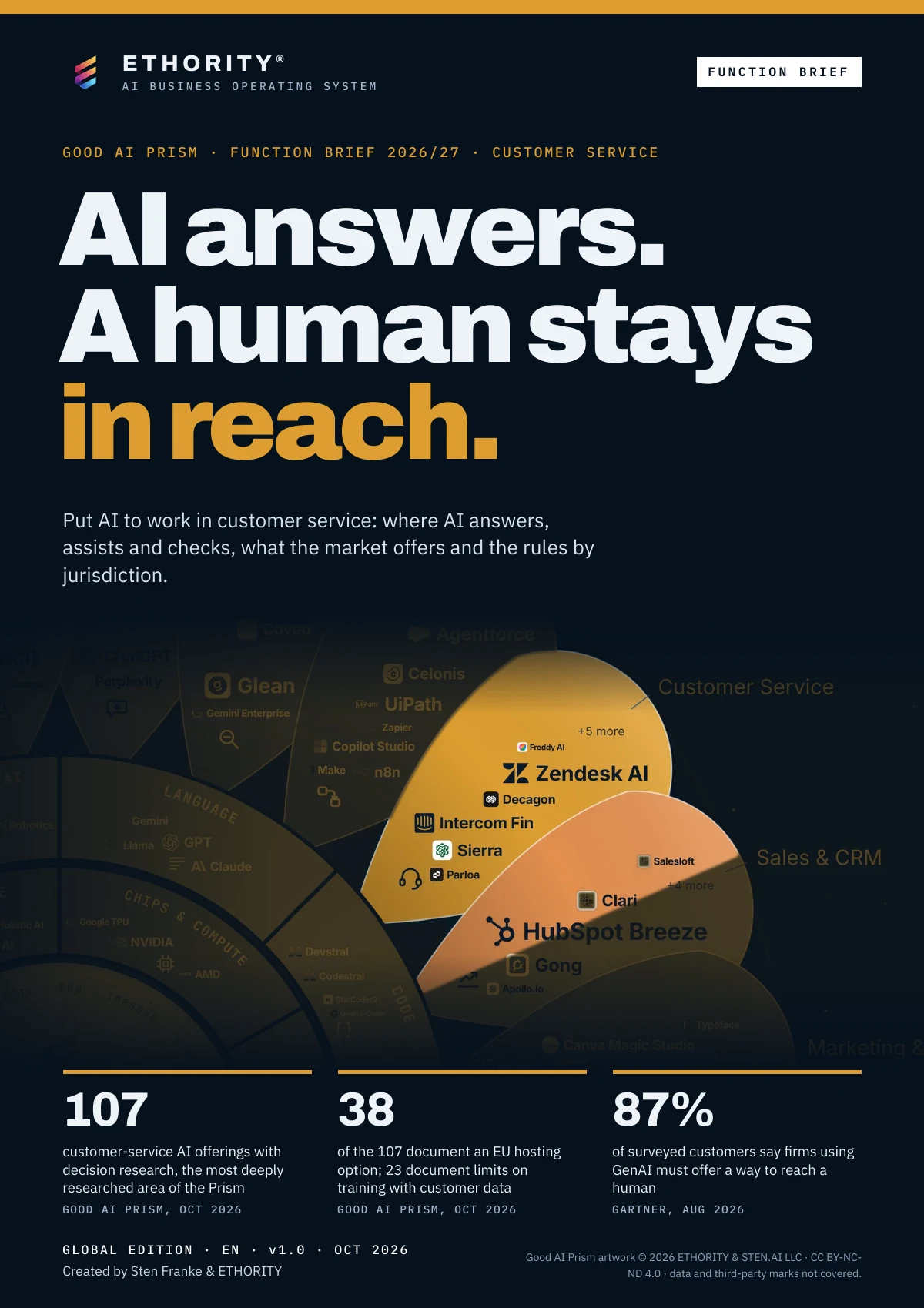
Global edition · EN
AI answers. A human stays in reach.
Answered is not solved: 87% of surveyed customers want a way to reach a human. Where AI answers, assists and checks, what 107 offerings do and the rules.
Version 1.0 · 42 pages
Open the study →
AI spending is forecast to rise by half. 37% of surveyed organisations see an effect on profit.
Sourced figures for 2025–26 on AI spending, adoption, models, energy and value, for your 2027 planning.
See the map on one page →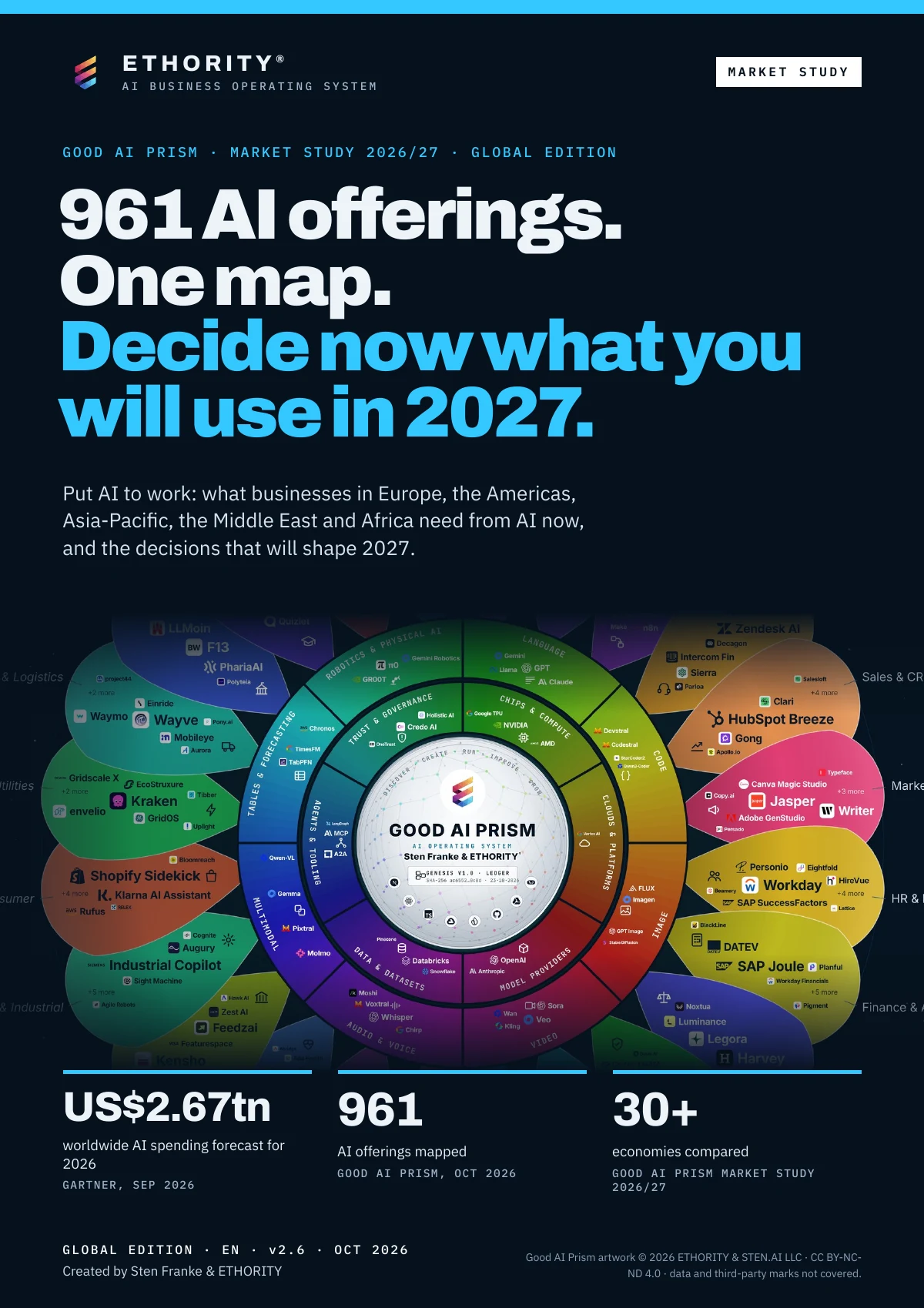
Global edition · EN
961 AI offerings. One map. Decide now what you will use in 2027.
The Good AI Prism helps you find useful AI and compare the evidence behind your options. For organisations already using AI, the question is moving from whether to use AI to which AI, how safely and whether it pays. This Global edition brings together 961 AI offerings across 24 topic areas, 8 data types and 6 technology layers, with sources, dates and limits to guide your next decision.
Version 2.6 · 90 pages
Open the study →
Trusting AI and going all-in are one job.
Why speed and responsible AI are no longer competing choices. An essay by Sten Franke.
See the map on one page →The economics, calculated on an industrial case
An industrial case shows the logic of an Opportunity Case: value, cost and the assumption that decides it.
Capacity Conversion calculator
Shows how much of the time AI saves becomes money, including the 36-second checking test as a Scenario.
Pilot version · Scenario calculator
Open the calculator →Total Cost of AI Ownership calculator
All six cost blocks over 36 months, compared with today's cost per accepted result, and the month the investment pays back.
Pilot version · Scenario calculator
Open the calculator →Compare three offerings
Puts two to four offerings side by side in the same units, each fact with its source and the date it was checked.
Questions buyers ask
Why is there no fixed price?
Scope varies with the question, the number of options and the evidence available. You receive a written proposal after a scoping call, before any work starts.
What if the answer is no?
Then the Decision Record says so, with reasons. A clear stop is a valid result, and the fee does not change.
What should we bring to the first call?
The decision you face, the process, the business objective, an accountable owner and any volume, handling-time or cost data. Where data is missing, we plan how to measure it.
How does ETHORITY stay independent?
ETHORITY sets editorial order by stated evidence criteria and discloses any vendor relationship in the proposal.
What comes after a "test first"?
A pilot plan with success and stop criteria; the AI Trust Pilot can run it.
Can we test our numbers first?
Yes. The Capacity Conversion and Total Cost of AI Ownership calculators show which assumption moves the result; bring that to the scoping call.
ETHORITY · LONG READ
The case for an AI investment is only as strong as its weakest assumption.
Vendors show the best case and internal teams want their project to go ahead. A defensible decision compares real options on the same basis and names the number that would change it.
Most AI business cases are built to be approved. They start from a vendor demo, take the vendor's productivity figure, multiply it by headcount and stop there. What they rarely include is the cost of checking the AI's work, the cost of doing nothing differently, or the point at which the case stops paying.
The AI Opportunity Case is built the other way round. It starts with the decision a leadership team actually faces and compares three to five real options on the same basis: current performance, full costs, expected quality, review and operating effort, and accountability for exceptions. Improving the process without AI always belongs in that comparison.
The economics carry the assumptions that can break them. A Scenario from customer service shows why. On the planning assumptions, an AI reply assistant returns +€11,336 in the best case. Add 36 seconds of human checking per AI-written reply, and the same case turns to −€1,624. Nothing about the tool changed. One assumption did. The Extended package measures such assumptions on real cases before the final decision, a point the insight on why saved hours are not value develops further.
Options come from the market, not from one proposal. The Good AI Prism market study reviewed 107 customer-service offerings in depth , and those dated facts feed the long list. Each fact keeps its evidence label, so the board sees what is a vendor claim and what has been measured.
The result is a Decision Record: the recommendation, its conditions, named owners, review dates and stop criteria. Four answers are possible: start, change, test first or stop. The fee is the same for each, and it is agreed in a written proposal after scoping.
Sources and further reading
Scenario
A worked example
- The questionAbout €200,000 or more at stake. What would make it pay?
- Your numbersBuilt on your volumes, with every assumption written down.
- The optionsReal alternatives, including doing nothing.
- The recommendationStart, change, test first or stop.
- Your next stepA personal recommendation from Sten Franke for what to do next.
From the deliverable
Enterprise AI Opportunity Case
A business case on your volumes, a comparison with real alternatives and a signed decision record.
Explore the evidence and full sample pages
Read the example as text
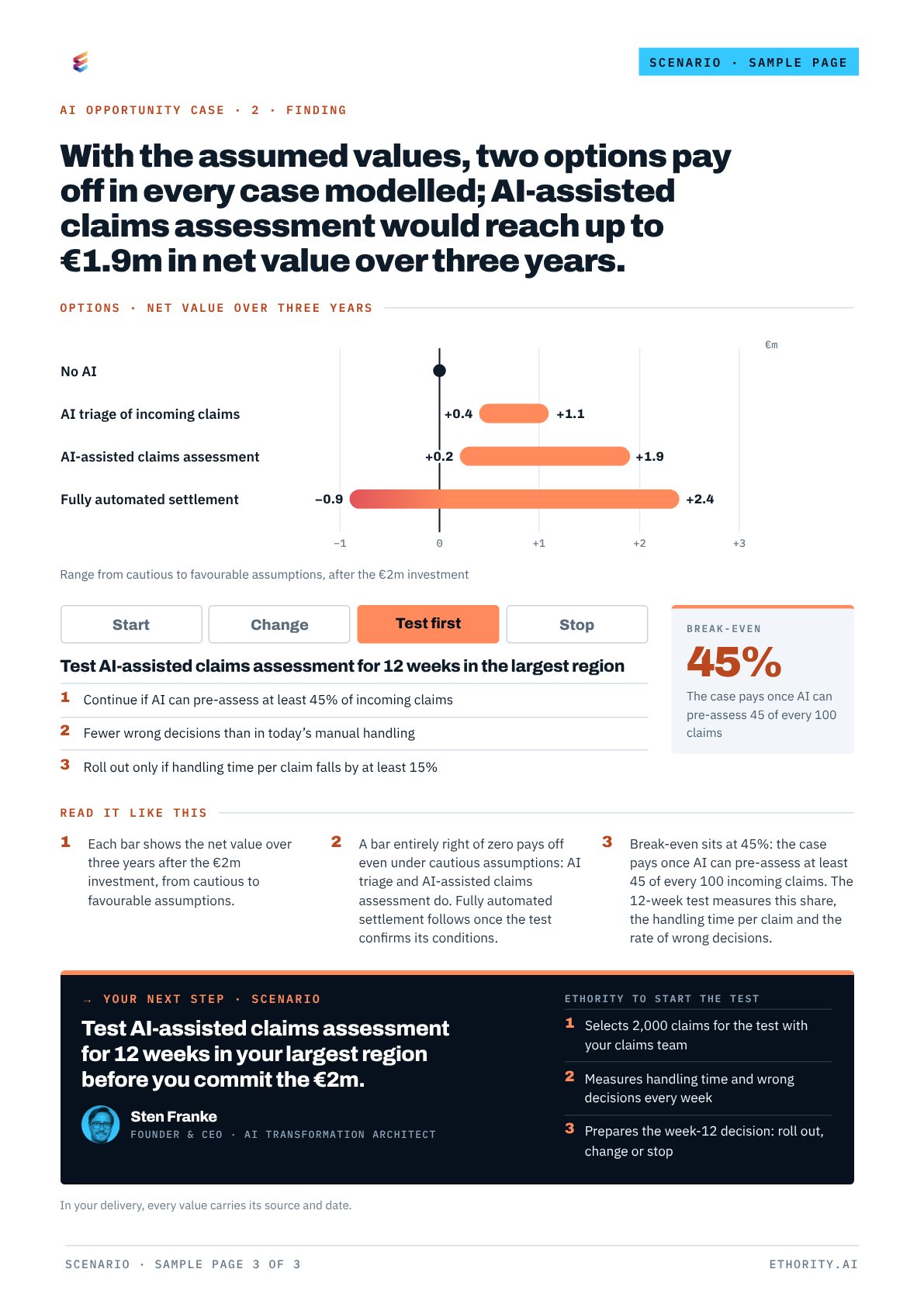
AI Opportunity Case, decision record (Scenario): With the assumed values, two options pay off in every case modelled; AI-assisted claims assessment would reach up to €1.9m in net value over three years. No AI: 0 – 0 €m; AI triage of incoming claims: 0.4 – 1.1 €m; AI-assisted claims assessment: 0.2 – 1.9 €m; Fully automated settlement: -0.9 – 2.4 €m. Recommendation: Test first, Test AI-assisted claims assessment for 12 weeks in the largest region; Continue if AI can pre-assess at least 45% of incoming claims; Fewer wrong decisions than in today’s manual handling; Roll out only if handling time per claim falls by at least 15%.
1 / 5 · The question
About €200,000 or more at stake. What would make it pay?
Scenario
Read exhibit data
Scenario inputs and conditional examples; not a delivered client result or released recommendation.
AI Opportunity Case · Investment question · Scenario
We plan €2m for AI in claims handling across three regions. Under which conditions does it pay?
- Who asks: Insurer
- Regions: Europe, North America, Asia-Pacific
- Decision in: 6 weeks
See 3 sample pages · Scenario
What the deliverable looks like
Scenario: the sample shows structure, detail and questions; it is not a client result.
- An independent business case built on your volumes
- A comparison with real alternatives, including doing nothing
- A clear recommendation: start, change, test first or stop
- A signed decision record
Page 1 / 3
Read sample data
AI Opportunity Case · Sample page 1 of 3 · Scenario
Know what would make an AI investment of about €200,000 or more pay.
Scenario: a global insurer plans a €2m investment in AI-assisted claims handling across Europe, North America and Asia-Pacific.
Prepared by Sten Franke · ETHORITY · Standard 4 weeks · Extended 6 weeks
Enterprise AI Opportunity Case
Priced after scoping