 ETHORITY®
In this article
Terms used in this article
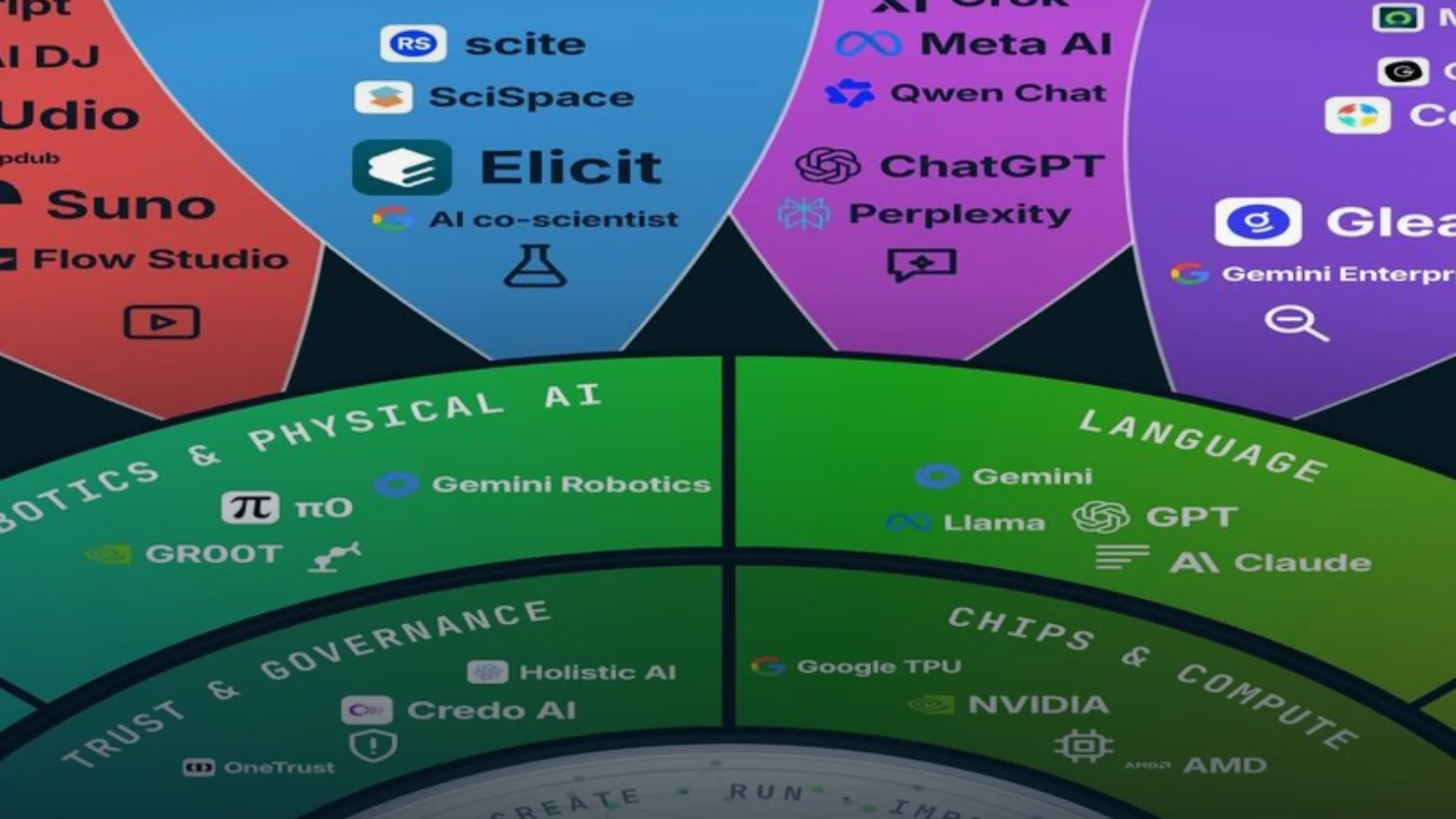
Good AI Prism v3.12 · full spectrum, close-up · Good AI Prism artwork © 2026 ETHORITY & STEN.AI LLC · CC BY-NC-ND 4.0 · data and third-party marks not covered.
Good AI Prism v3.12 · Sten Franke & ETHORITY
Source study · v2.1 · page 63 · Figure published: 25 Oct 2026
Read figure text, sources and rights
Good AI Prism v3.12 · full spectrum, close-up · Good AI Prism artwork © 2026 ETHORITY & STEN.AI LLC · CC BY-NC-ND 4.0 · data and third-party marks not covered.
ETHORITY figure. Rights in cited data and third-party marks remain with their owners. The Prism artwork licence applies where stated on the figure.
A few years ago, the AI conversation often sounded like a choice.
Move fast—or be responsible. Innovate—or regulate. Trust AI—or hold it back.
I never found that framing convincing.
If AI is as consequential as we believe, then the organizations that create the most value will not be the ones that choose one side. They will learn to move faster because they can understand, govern and improve what they are doing.
That was the tension behind an ETHORITY paper I began in 2024: Can We Trust AI versus All-In on AI. The question has become more urgent since then. AI has moved from models that mostly generated content to systems that retrieve enterprise data, write code, use tools, coordinate agents and enter daily operations.
So I would phrase the question differently now:
Can we build organizations that are ambitious enough to go all-in on AI—and disciplined enough to know what is actually happening?
“All-in” should not mean “AI everywhere”
Going all-in on AI does not mean forcing a model into every process.
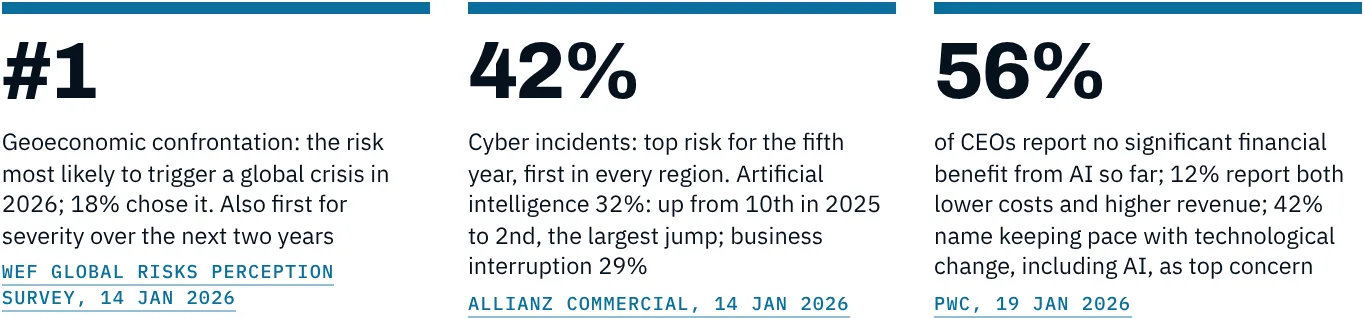
What leaders are trying to avoid.
WEF GLOBAL RISKS PERCEPTION SURVEY, 14 JAN 2026 · ALLIANZ COMMERCIAL, 14 JAN 2026 · PWC, 19 JAN 2026
Source study · v2.1 · page 56 · Figure published: 25 Oct 2026
Read figure text, sources and rights
#1 Geoeconomic confrontation: the risk most likely to trigger a global crisis in 2026; 18% chose it. Also first for severity over the next two years WEF GLOBAL RISKS PERCEPTION SURVEY, 14 JAN 2026 42% Cyber incidents: top risk for the fifth year, first in every region. Artificial intelligence 32%: up from 10th in 2025 to 2nd, the largest jump; business interruption 29% ALLIANZ COMMERCIAL, 14 JAN 2026 56% of CEOs report no significant financial benefit from AI so far; 12% report both lower costs and higher revenue; 42% name keeping pace with technological change, including AI, as top concern PWC, 19 JAN 2026
Source links on the cited study page
ETHORITY figure. Rights in cited data and third-party marks remain with their owners. The Prism artwork licence applies where stated on the figure.
Sometimes the right answer is automation without AI. Sometimes the right answer is measurement first. Sometimes it is a better rule, workflow or database. Sometimes human judgment should remain central. And sometimes AI is the obvious step-change.
An AI-first organization is therefore not an organization that maximizes AI usage. It is one that can repeatedly answer:
Where can AI create material value? What should we build, buy or connect? What should remain human? What data and authority does the system need? What evidence supports the decision? What will it cost? What outcome are we trying to change? What did we actually observe?
That is a much more demanding definition than “we have Copilot licenses.”
Trust is not a score
The word trust is dangerous because it sounds binary.
Trusted. Not trusted. Green. Red. Safe. Unsafe.
Real organizations do not work that way.
A model can be suitable for summarizing public documents and unsuitable for making a high-consequence employment recommendation. An agent can be allowed to draft a customer response but not send it. A vendor can have strong security documentation and weak transparency about evaluation data. A business case can look attractive while still depending on an unmeasured baseline.
Trust, in practice, is contextual and temporal.
At ETHORITY we increasingly use distinctions that sound simple but change behavior:
These distinctions prevent organizations from talking themselves into confidence they have not earned.
Responsible AI is not a brake if it is designed into the work
The worst governance experience is governance that arrives after the decision.
A team spends three months prototyping. Then legal, security, risk and governance arrive with separate questionnaires. Nobody can trace the data sources. Nobody knows which version of the model was tested. The original business case is already outdated. The pilot becomes a political argument.
That is not responsible AI. It is bad operating design.
Governance then becomes part of how the organization moves, not a parallel bureaucracy.
ISO/IEC 42001 is useful here because it frames AI governance as a management system that must be established, maintained and continually improved. UNESCO’s readiness work is useful for a different reason: it treats readiness as multi-dimensional—legal, social, economic, scientific/educational and technical—and asks whether systems and policies are effective, not only whether they exist.
Source context: ISO/IEC 42001:2023 ↗
But no external framework can operate the company for us. The company still has to build the behavior.
Going all-in should include the economics
One of the most surprising gaps in AI governance is how often business value is treated as somebody else’s problem.
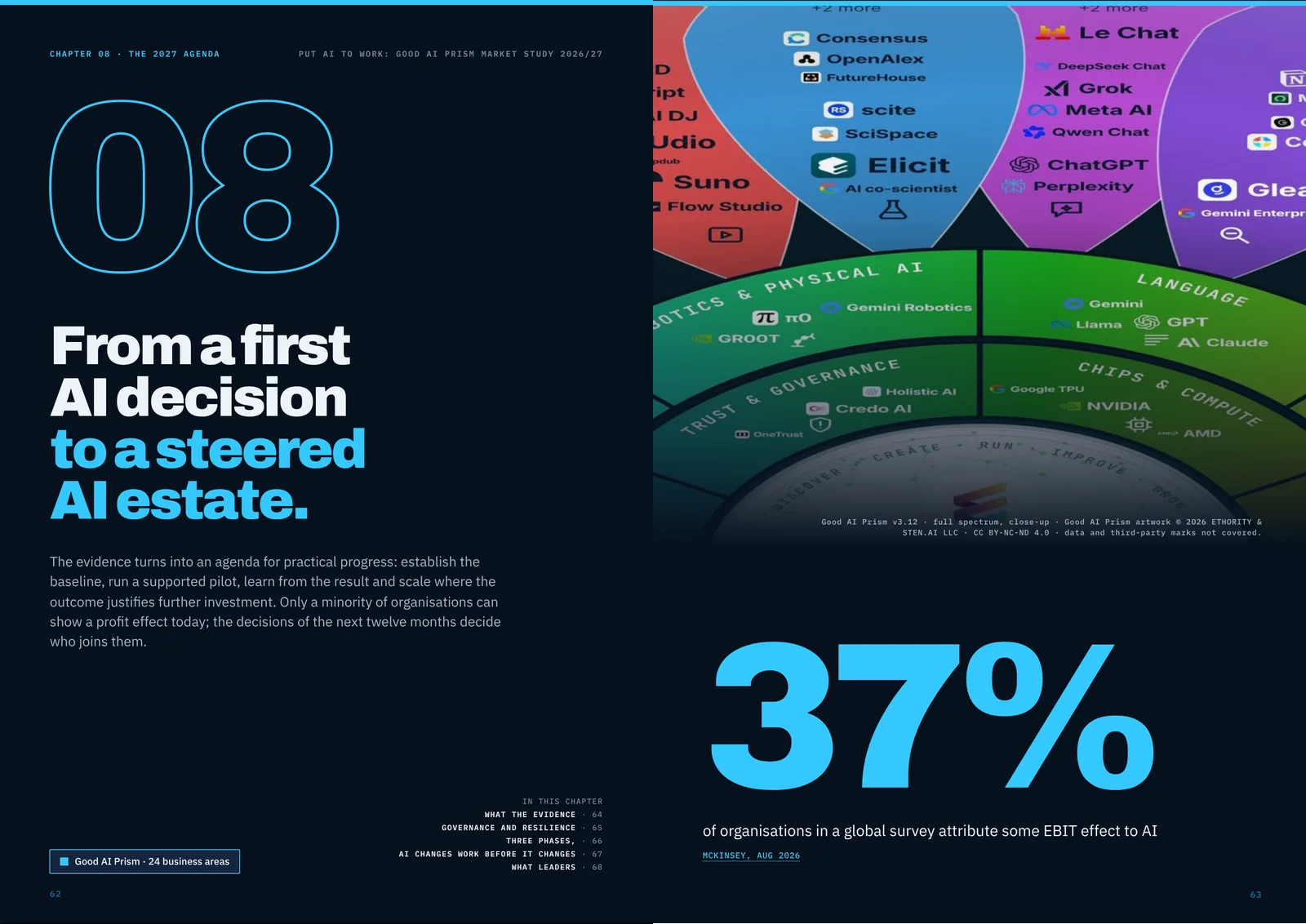
37% — of organisations in a global survey attribute some EBIT effect to AI
MCKINSEY, AUG 2026
Source study · v2.1 · page 62-63 · Figure published: 25 Oct 2026
Read figure text, sources and rights
CHAPTER 08 · THE 2027 AGENDA PUT AI TO WORK: GOOD AI PRISM MARKET STUDY 2026/27 08 From a first AI decision to a steered AI estate. The evidence turns into an agenda for practical progress: establish the baseline, run a supported pilot, learn from the result and scale where the outcome justifies further investment. Only a minority of organisations can show a profit effect today; the decisions of the next twelve months decide who joins them. Good AI Prism · 24 business areas IN THIS CHAPTER WHAT THE EVIDENCE · 64 GOVERNANCE AND RESILIENCE · 65 THREE PHASES, · 66 AI CHANGES WORK BEFORE IT CHANGES · 67 WHAT LEADERS · 68 62 Good AI Prism v3.12 · full spectrum, close-up · Good AI Prism artwork © 2026 ETHORITY & STEN.AI LLC · CC BY-NC-ND 4.0 · data and third-party marks not covered. 37% of organisations in a global survey attribute some EBIT effect to AI MCKINSEY, AUG 2026 63
Source links on the cited study page
ETHORITY figure. Rights in cited data and third-party marks remain with their owners. The Prism artwork licence applies where stated on the figure.
Governance teams ask about risk. Technology teams ask about capability. Finance asks about cost. Business teams ask about growth or savings.
Then everybody uses a different model of reality.
If we want responsible AI to survive contact with executive decision-making, economics belongs in the same loop.
An AI project should have a business objective, a baseline, a value hypothesis, a cost model, evidence requirements and a path from modeled value to observed and attributed value.
Otherwise governance can protect a project that should never have been funded—or kill a project because nobody articulated its value clearly enough.
Replace a binary trust decision with a bounded commitment
An organisation does not need one answer to “Do we trust AI?” It needs an answer for a particular task under particular conditions. The same system may be useful for preparing a meeting summary, unsuitable for independently settling a disputed claim and unacceptable for exposing confidential records. Those are different decisions about evidence, permissions and consequence. A single trust label hides the differences.
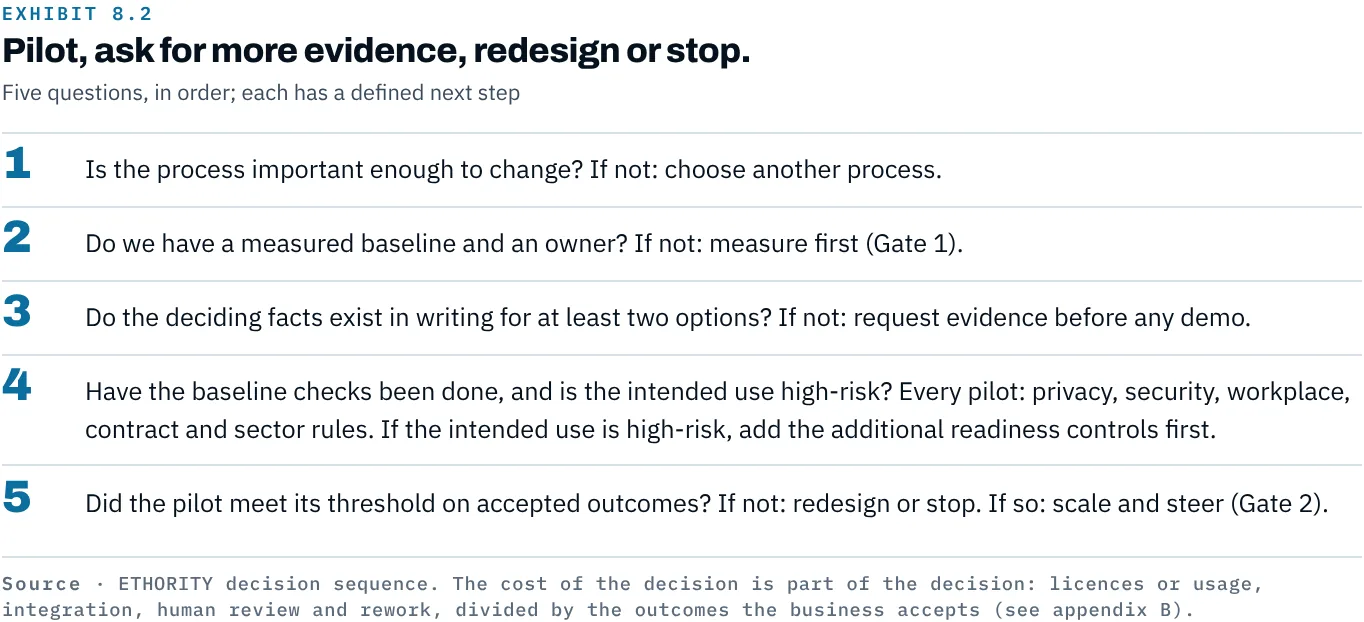
Pilot, ask for more evidence, redesign or stop.
ETHORITY decision sequence. The cost of the decision is part of the decision: licences or usage, integration, human review and rework, divided by the outcomes the business accepts (see appendix B).
Source study · v2.1 · page 66 · Figure published: 25 Oct 2026
Read figure text, sources and rights
EXHIBIT 8.2 Pilot, ask for more evidence, redesign or stop. Five questions, in order; each has a defined next step Is the process important enough to change? If not: choose another process. Do we have a measured baseline and an owner? If not: measure first (Gate 1). Do the deciding facts exist in writing for at least two options? If not: request evidence before any demo. Have the baseline checks been done, and is the intended use high-risk? Every pilot: privacy, security, workplace, contract and sector rules. If the intended use is high-risk, add the additional readiness controls first. Did the pilot meet its threshold on accepted outcomes? If not: redesign or stop. If so: scale and steer (Gate 2). Source · ETHORITY decision sequence. The cost of the decision is part of the decision: licences or usage, integration, human review and rework, divided by the outcomes the business accepts (see appendix B).
ETHORITY figure. Rights in cited data and third-party marks remain with their owners. The Prism artwork licence applies where stated on the figure.
Begin by choosing the commitment you are considering. Are you permitting staff to explore a tool, buying a subscription, connecting internal data, accepting recommendations or authorising actions? Each step changes the questions that matter. A successful experiment with public information should not automatically justify access to customer data. A useful recommendation should not automatically justify execution.
This bounded approach supports ambition. Teams can move quickly where the task is reversible and the evidence is adequate, while taking more care where people or assets face greater consequences. The aim is to make the next permission explicit. It is easier to improve a specific boundary than debate whether a technology deserves universal confidence.
A management example: assistance before autonomous action
Imagine a hypothetical service business preparing responses to contract-renewal enquiries. Initially, the assistant retrieves approved terms and drafts a reply. A person checks the source and sends the message. The team measures whether the drafts are complete, accurate and worth reviewing. It also records cases where the assistant appropriately asks for clarification.
If the evidence is encouraging, the next step might be a narrower automatic response for simple requests. That requires a separate decision: which requests qualify, what the system may disclose, how the recipient is identified and when a human takes over. The previous draft-only evaluation provides useful context but does not prove the safety or legality of this new action.
The organisation should also test a wrong customer match, conflicting contract versions and an unavailable document store. These failures reveal whether the system respects the intended boundary. A good result may be a helpful explanation that the request needs human handling. Counting every escalation as failure would reward the assistant for making unsupported decisions instead of protecting the relationship.
Keep an evidence ladder rather than a confidence slogan
A provider statement establishes what the provider says. A technical test establishes what happened under the tested conditions. A controlled operational observation adds evidence about a particular workflow. A business result requires another connection to quality, cost, demand or risk. Moving between these levels requires an explanation; the strength of the wording should follow the strength of the support.
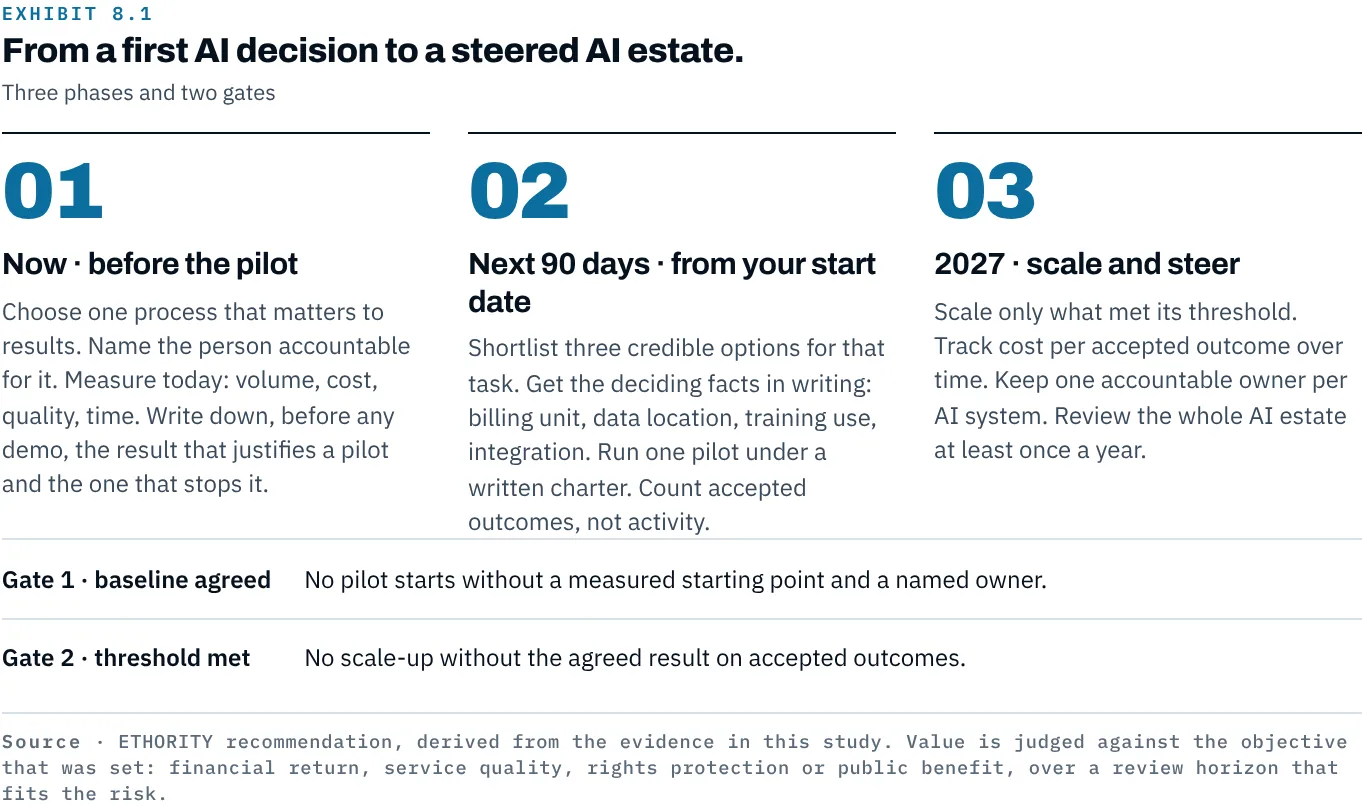
From a first AI decision to a steered AI estate.
ETHORITY recommendation, derived from the evidence in this study. Value is judged against the objective that was set: financial return, service quality, rights protection or public benefit, over a review horizon that fits the risk.
Source study · v2.1 · page 66 · Figure published: 25 Oct 2026
Read figure text, sources and rights
EXHIBIT 8.1 From a first AI decision to a steered AI estate. Three phases and two gates 01 Now · before the pilot Choose one process that matters to results. Name the person accountable for it. Measure today: volume, cost, quality, time. Write down, before any demo, the result that justifies a pilot and the one that stops it. 02 Next 90 days · from your start date Shortlist three credible options for that task. Get the deciding facts in writing: billing unit, data location, training use, integration. Run one pilot under a written charter. Count accepted outcomes, not activity. 03 2027 · scale and steer Scale only what met its threshold. Track cost per accepted outcome over time. Keep one accountable owner per AI system. Review the whole AI estate at least once a year. Gate 1 · baseline agreed No pilot starts without a measured starting point and a named owner. Gate 2 · threshold met No scale-up without the agreed result on accepted outcomes. Source · ETHORITY recommendation, derived from the evidence in this study. Value is judged against the objective that was set: financial return, service quality, rights protection or public benefit, over a review horizon that fits the risk.
ETHORITY figure. Rights in cited data and third-party marks remain with their owners. The Prism artwork licence applies where stated on the figure.
For example, a time saving in a defined task does not establish a company-wide productivity gain. A successful customer-service study does not establish the same result in a different language, industry or operating model. The NBER work on generative assistance is valuable precisely when its setting and outcome remain attached to the finding. Read the original study before importing a percentage into a business case.
Use uncertainty to identify the next test. If staff acceptance is unknown, observe the work. If contractual deletion is unclear, obtain the relevant terms. If the critical issue is a permission boundary, test it independently. A generic caution that AI can make mistakes is less useful than naming the error that would change the decision and the evidence needed to control it.
Allocate a learning budget with a stopping rule
A serious commitment can be staged. Set a budget for discovery, a defined pilot and a decision about expansion. Name the assumptions each stage must resolve. This creates room for learning without treating every sunk cost as a reason to continue. The team should be allowed to discover that an approach is inappropriate and still have completed useful work.
The stopping rule should include quality, affected people and operating burden. A scenario may look attractive until the required review makes it uneconomic. Another may justify itself through better access or service quality even when direct cost reduction is modest. Agree which objective matters rather than changing the definition of value after seeing the result.
Retain an ordinary working alternative. Staff should know how to proceed during a provider outage or a paused integration. The fallback should not depend on the same component that failed. If a system has already taken an external action, recovery must begin by establishing what actually happened. Replaying an uncertain action without reconciliation can turn a small failure into a larger one.
Ask whether the organisation can sustain the choice
Trust in a deployment includes the capacity to maintain it. Who owns the source documents? Who reviews provider changes? Who handles a complaint? Who can withdraw a permission? A tool that performs well in a supported pilot may be a poor choice if these responsibilities disappear after the project team leaves.
Check the economics of that support. Include usage growth, human review, training, maintenance and exit. Keep the same period and unit when comparing alternatives. Potential capacity gains should remain distinct from realised savings. A lower cost per accepted outcome is meaningful only if the definition of accepted and the included costs are stable.
The economics page can help explore the scenario. The Good AI Prism can help inspect candidate offerings and their documented conditions. Neither replaces a decision about your own deployment. Their useful role is to make the question and its dependencies clearer before a larger commitment.
Ask what would change your mind
A useful commitment includes the evidence that would cause the organisation to reconsider it. Name a quality failure, a material change in terms or a consequence outside the permitted boundary. This is stronger than saying the project will be monitored, because it connects observation to a decision someone can make.
Also name what would justify more responsibility. A pilot that can only prove itself wrong may be safe but unproductive; one that can only generate positive evidence is uninformative. Agree the quality and operating conditions for a bounded expansion. Keep the same standard when enthusiasm or commercial pressure rises.
At the review, distinguish a missing fact from a failed test. Missing information may call for a supplier question. A demonstrated permission failure calls for a correction and retest. Different responses help the organisation remain ambitious while treating evidence seriously. Confidence then grows from a sequence of explainable decisions, rather than from the absence of reported problems.
Choose an assisted next step that fits the uncertainty
An AI Decision Brief suits a focused question about options. An AI Trust Record addresses the evidence and responsibilities around one named system. An AI Trust Pilot concerns a bounded use case with agreed review conditions. These services have different purposes; none sells a universal trust verdict.
Bring a specific task, the consequence of an error and the decision you need to make. A useful conversation can end with a smaller trial, a request for evidence, a process change or a decision not to use AI. Going all-in should mean committing to an organisation that can learn and act responsibly. It should not mean giving every tool every permission or treating enthusiasm as proof.
The next competitive advantage is organizational
Models will keep improving. Tools will become easier to access. Agent protocols will make integration more standardized. The cost of creating software is already changing.
The scarce capability will increasingly be organizational:
Can we discover the right opportunities? Can we assemble the right systems? Can we give AI enough authority to be useful without giving it unlimited permission? Can we prove what matters? Can we see when something changes? Can we convert technical capability into durable economic outcomes? Can we learn faster than the environment changes?
That is what I now mean by an AI-first organization.
And it is why I no longer see “Can We Trust AI?” and “Should We Go All-In?” as competing questions.
The organizations that win will have to answer both.