 ETHORITY®

Task
A defined activity is faster, better or less effort-intensive.
Experiment, field study or workflow observation.Does not establish organisation-wide productivity or profit.
EVIDENCE SYNTHESIS · 14 OCTOBER 2026
Original methods, structured evidence synthesis and proposed application studies. Each has its own question, source edition, method and limits.
ETHORITY
What the evidence says about AI productivity, business value and the decisions leaders can defend.
Evidence synthesis · 14 October 2026
The study separates bounded task improvement, reported employee benefit, workflow change and enterprise value. Its original contribution is the maintained record that connects a capacity destination, an outcome acceptor, claim-level evidence and an explicit management decision.
The Saved Hours study is a structured evidence synthesis, not a meta-analysis. It reviews primary research, official surveys, identified consultancy studies and established management approaches selected for their relationship to task performance, worker experience, enterprise outcomes or economic and strategic value.
Different samples, questions, units, countries and periods prevent a single pooled percentage. Survey responses remain attributed observations. Commercial interests in vendor and consultancy studies stay visible. The service calculation is a scenario; governing a method does not establish its empirical performance.
The method builds on Theory of Constraints, benefits-realisation management, productivity J-curve research and work redesign. ETHORITY does not claim to have discovered the general gap between AI investment and value.
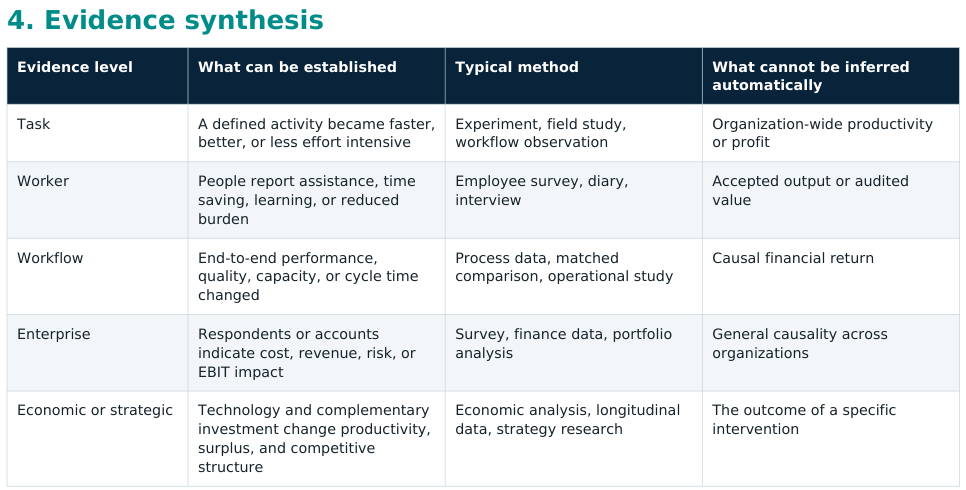
A defined activity is faster, better or less effort-intensive.
Experiment, field study or workflow observation.Does not establish organisation-wide productivity or profit.
People report assistance, time saving, learning or reduced burden.
Employee survey, diary or interview.Does not establish accepted output or audited value.
End-to-end performance, quality, capacity or cycle time changes.
Process data, matched comparison or operational study.Does not establish causal financial return.
Respondents or accounts indicate cost, revenue, risk or EBIT impact.
Survey, finance data or portfolio analysis.Does not establish general causality across organisations.
Technology and complementary investment change productivity, surplus or market structure.
Economic analysis, longitudinal data or strategy research.Does not establish the outcome of a specific intervention.
S0 Hypothesised → S1 Released → S2 Usable → S3 Destination bound → S4 Enabled → S5 Converted → S6 Attributed
Cash released; cost avoided; throughput and growth; quality and customer; risk and resilience; workforce and learning; strategic option. State the recipient.
E1 Claimed · E2 Measured · E3 Checked · E4 Corroborated · E5 Counterfactual-tested
An accepted outcome at S5 does not upgrade its evidence code.
PILOT · REDESIGN · EXPAND · STOP
The action follows the evidence and authority. HOLD is a temporary workflow state. These are explanatory method dimensions, not an automated assessment.
Prospective applications must test whether reviewers assign stages consistently, usable capacity is actually redeployed, named destinations improve realisation, outcome acceptors prevent false claims and the record changes decisions. Include stopped and negative cases, high-volume operations, knowledge work and workforce or risk benefits.
Small reversible decisions need proportionate depth. Attribution may remain below E5. Slack can create non-cash value. A record can become bureaucracy. M1 Light, M2 Standard and M3 Full scale with materiality, reversibility and consequence—not the price of a service. No proprietary benchmark result is claimed in this edition.
ETHORITY · 15 Oct 2026
Did faster work become an accepted business result? Record the evidence and the responsible decision.
Do not value the hour. Value the accepted outcome.
Each stage needs its own evidence: claimed, measured, checked, corroborated or tested against a counterfactual. Accepting an outcome does not strengthen its evidence.
© 2026 ETHORITY & STEN.AI LLC
The original one-page record asks for the workflow, owner, outcome acceptor, baseline, planned and realised capacity destination, evidence and next decision. It is a blank method instrument, not a completed customer record.
Download worksheet · PDF ↗Worksheet adapted for readable web and print use from the source method. Request the applicable rights for redistribution or adaptation.
ETHORITY offers advisory and implementation services based on this method. That interest is disclosed; it does not alter an evidence code or justify a favourable result. Independent review is identified separately from ETHORITY’s own analysis.