 ETHORITY®
ETHORITY · Products & services
Seven services, from the first check to everyday use.
Start with the free market map, an entry offer from €195 net or a founder-led service with published terms. Further products keep your AI running once it is in use.
Build, operate, improve
Seven services take you in four steps from a first check to AI that runs.
Know where you stand and what the rules require.
 Where you stand with AI: one workshop day, then a written assessment.
AI Readiness & Maturity Check
€3,500 one-time netExplore the service → Know which AI you use and what the EU AI Act requires of you.
AI Act Readiness Sprint
€6,900 one-time netExplore the service →Set the rules, map your AI, price the big bet.
 Give every AI decision an owner and a working process.
AI Governance Setup
€19,500 one-time netExplore the service → See the whole AI estate before the next budget decision.
AI Estate Audit & Mapping
€25,000 one-time netExplore the service → Make a consequential AI investment decision you can explain.
AI Opportunity Case
Priced after scopingExplore the service →Your team uses AI well and safely.
 Help people use AI with confidence, rules and evidence.
AI Literacy & Adoption
€2,400 one-time netExplore the service →Keep your AI rules and decisions up to date.
 Keep governance working after the project ends.
AI Governance Retainer
€2,500 / month netExplore the service →Portfolio, evidence and full scope
- 7
- founder-led services with published termsETHORITY Commercial Strategy, 16 Oct 2026
- €3,500
- for the AI Readiness & Maturity Check (one workshop day, then the written assessment), credited against a follow-onETHORITY price list, 16 Oct 2026
- 2 Dec 2027
- Annex III high-risk obligations of the AI Act applyReg. (EU) 2026/1744 · White & Case, Aug 2026 · whitecase.com ↗
- 100,000+
- records in the ETHORITY AI Registry and AI UniverseETHORITY AI Registry, Oct 2026
High-risk duties now have a date.
The Omnibus set 2 December 2027 for Annex III obligations; 2027 budgets are planned now.
White & Case, Aug 2026
The first step costs less than a tender.
The Readiness & Maturity Check is credited in full against a follow-on started within 60 days.
ETHORITY price list, 16 Oct 2026
Every answer is backed by a live market map.
Vendor facts come from the AI Registry and AI Universe, each with a source and date.
ETHORITY AI Registry, Oct 2026
The seven services
AI Readiness & Maturity Check
€3,500 one-time · net
One founder-led workshop day: a maturity score on seven pillars, your five most valuable AI uses and a 90-day plan with owners.
Date and place by agreement
See what this package includes →AI Act Readiness Sprint
€6,900 one-time · net
Every AI system you use, classified under the AI Act, with gaps, evidence and a costed roadmap to 2 Dec 2027. Two to three weeks.
Date and place by agreement
See what this package includes →AI Literacy & Adoption
€2,400 one-time · net
Role-based training on the tools your people actually use, an AI usage policy and an evidence file for Article 4. One day to three months.
Scope and delivery by agreement
See what this package includes →AI Governance Setup
€19,500 one-time · net
Roles, decision rights, an approval workflow, a maintained AI register and policies, mapped to the AI Act, ISO/IEC 42001 and NIST AI RMF.
Scope and delivery by agreement
See what this package includes →AI Estate Audit & Mapping
€25,000 one-time · net
Every AI tool, agent, pilot and licence mapped with cost, usage, vendor facts and risk, ending in a scale, fix, consolidate or stop decision.
Date and place by agreement
See what this package includes →AI Opportunity Case
Priced after scoping
A business case for one large AI investment of about €200,000 or more, compared with real alternatives including no AI, with full economics and a signed decision record. Four to six weeks.
Scope and delivery by agreement
See what this package includes →AI Governance Retainer
€2,500 / month · net
Register updates, regulatory and vendor change watch, new-case reviews and a quarterly board report, with direct access to Sten Franke.
Scope and delivery by agreement
See what this package includes →Evidence behind the services
Global edition · EN
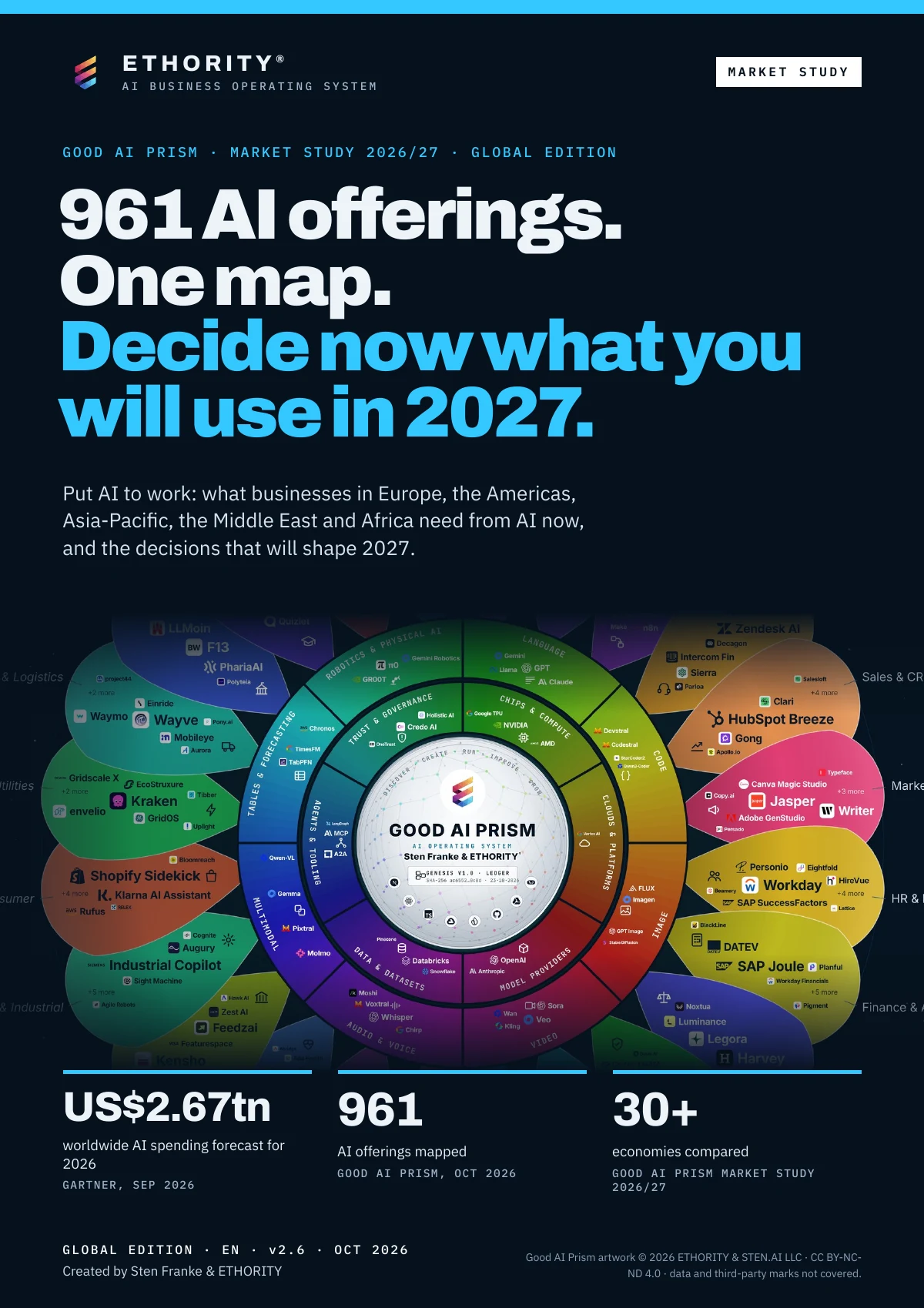
961 AI offerings. One map. Decide now what you will use in 2027.
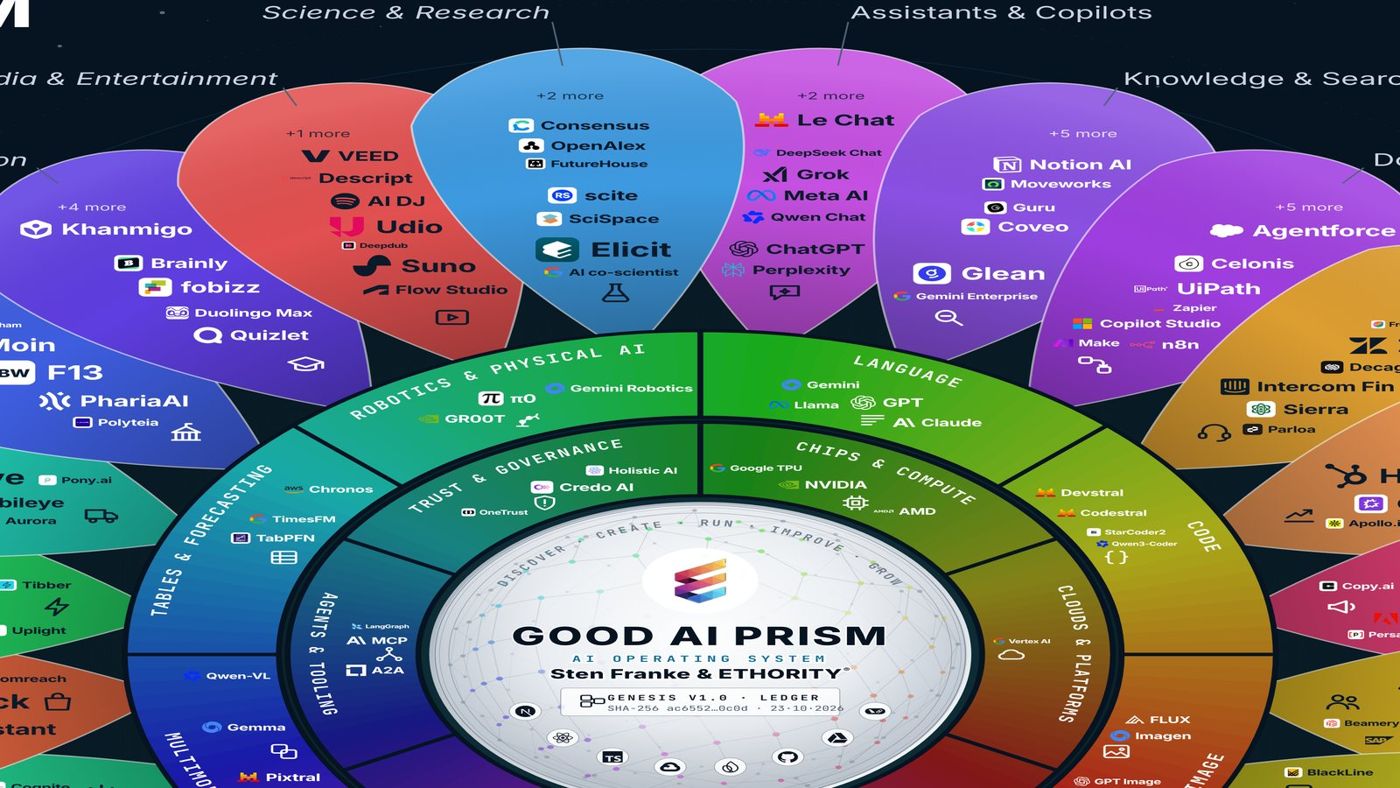
The Good AI Prism helps you find useful AI and compare the evidence behind your options. For organisations already using AI, the question is moving from whether to use AI to which AI, how safely and whether it pays. This Global edition brings together 961 AI offerings across 24 topic areas, 8 data types and 6 technology layers, with sources, dates and limits to guide your next decision.
Version 2.6 · 90 pages
Open the study →
Preparing for the EU AI Act is the start; control happens in daily operation.
How to connect each EU AI Act duty to your systems, controls, evidence, monitoring and regular reassessment.
See the map on one page →
AI rules move from documents into daily operation.
Why AI agents, tools and constant change move AI governance – the rules and responsibilities for AI – into the systems that run your AI every day.
See the map on one page →Test your numbers first
Each service has a matching calculator: Opportunity Map for the check, Act Navigator for the sprint, total cost for the audit. All tools sit in the ETHORITY AI calculator suite.
AI Opportunity Map calculator
Ranks up to six candidate AI uses across the 24 topic areas of the Good AI Prism by the hours at stake, how ready you are and who is affected.
Pilot version · Scenario calculator
Open the calculator →EU AI Act Navigator
Seven questions give an indicative risk class, your duties, the dates and the missing evidence, ready to take to your lawyer.
Pilot version · Scenario calculator
Open the calculator →Total Cost of AI Ownership calculator
All six cost blocks over 36 months, compared with today's cost per accepted result, and the month the investment pays back.
Pilot version · Scenario calculator
Open the calculator →From first call to signed answer
- Call
30 minutes to frame the question and choose the service.
- Scope
Package, dates and inputs confirmed in writing.
- Work
One day to eight weeks, with workshops and working files you keep.
- Sign
Final presentation and a summary signed by Sten Franke.
Sten Franke leads every project.

Sten Franke
Founder & CEO
Sten Franke designs and builds AI systems, from model testing and cloud setup to the interfaces people use. He connects business decisions, software architecture and practical implementation.
AI architecture · Model testing · Cloud engineering · UX
His work spans programming, LLM evaluation, Google Cloud and AWS environments, and web applications built with Next.js and React. He connects business requirements, software architecture and practical implementation. Creator of the Good AI Prism, he brings market intelligence into AI decisions. Earlier, he created the Social Media Prisma, led a BVDW Social Media working group and contributed to its Social Media Kompass. His entrepreneurial work includes ethority, Gridpatrol and mediatime, following a practical foundation in electronics and industrial robotics.
sten@ethority.aiQuestions buyers ask
Where should a Mittelstand company start?
Usually with the Readiness & Maturity Check, then the AI Act Sprint, literacy and a retainer.
Where should an enterprise start?
With the AI Act Sprint or the AI Estate Audit, then Governance Setup and an Opportunity Case for the biggest bet.
Are prices fixed?
Six services have published net prices. The AI Opportunity Case is agreed in a written proposal after scoping.
How do you work with our lawyers?
Each service delivers the technical and organisational assessment; where a legal opinion is needed, we work alongside your counsel.
Who delivers the work?
Sten Franke leads every service and signs the result, bringing in specialists for each question.
Next step
Book a 30-minute call. Unsure where to begin? The AI Act Readiness Sprint fixes the deadline question first.
ETHORITY · LONG READ
Three questions every leadership team now has to answer about AI
Are we allowed to? What does it cost us? Can our people use it safely? The seven enterprise services exist because most leadership teams cannot yet answer all three, and the deadlines no longer wait.
Most German leadership teams are not short of AI ideas. They are short of answers to three plain questions. Are we allowed to use this? What does our AI actually cost us, and what does it return? Can our people use it safely, and can we show that they do? The seven enterprise services are built around those three questions, and each one ends in a document a board can sign.
Are we allowed to?
The legal frame changed twice in two years. The AI literacy duty has applied since February 2025. The transparency duties under Article 50 have applied since August 2026. In July 2026 the Omnibus set 2 December 2027 as the date for Annex III high-risk obligations, according to White & Case's summary. That date sits inside the next budget cycle.
The AI Act Readiness Sprint answers the first question for every system a company runs, including the ones nobody approved. The AI Governance Setup then turns the answer into an operating model: who may introduce AI, who approves it, who monitors it and who answers for it. Both are technical and organisational assessments that hand borderline cases to your counsel with the reasoning attached.
What does it cost us?
After two or three years of pilots, many large companies cannot say how much they spend on AI, let alone what it returns. Licences sit in IT, usage fees in business units, and agent features arrive inside software already paid for. The AI Estate Audit & Mapping maps all of it, with costs, usage and vendor facts, and ends with a decision for each item: scale, fix, consolidate or stop.
For the single largest bet, the AI Opportunity Case builds the business case properly. It compares real options, including doing nothing, and models full costs with the assumptions that can flip the result. A customer-service Scenario shows why that matters: a best case of +€11,336 becomes −€1,624 when each AI-written reply needs 36 more seconds of human checking.
Can our people use it safely?
People already use AI, approved or not. AI Literacy & Adoption trains them by role on the tools they actually use, writes a usage policy the works council can review, and documents everything in an evidence file. The AI Readiness & Maturity Check gives leadership one shared picture across all three questions in a single day, and the AI Governance Retainer keeps that picture current every quarter.
How the services connect
The services are designed as a path rather than a menu. A Mittelstand company typically moves from the Check to the Sprint, then to literacy and a retainer. An enterprise often starts with the Sprint or the Estate Audit, builds governance, runs an Opportunity Case for its biggest bet and keeps everything current through the retainer. The register built in one service is reused in the next. It belongs to the client throughout.
Every service draws on the same market intelligence: the AI Registry and AI Universe, which hold more than 100,000 records and thousands of dated changes, and the Good AI Prism market study, which maps 961 offerings . That is why vendor facts in an ETHORITY deliverable carry a source and a date rather than a sales claim.
Who answers for the result
Sten Franke leads the work and signs every result. Specialists join by engagement, from leadership alignment to the human oversight that has to work on a Monday morning. Prices are published, net, with 50% at order and 50% on delivery, and travel within Germany is included. The Opportunity Case is agreed in a written proposal after scoping, because its scope depends on the decision.
What the first conversation looks like
Every engagement starts with a 30-minute call. Bring the question that is actually on the table: an auditor's request, a works council letter, a vendor proposal, a budget line for 2027. Sten Franke will say which service fits, which one does not, and what you would need to prepare. Sometimes the honest answer is a smaller step, such as an AI Decision Brief for a shortlist, and the call says so.
What follows is a written scope with the package, the dates, the people needed on your side and the acceptance criteria. Those criteria are concrete: every known AI use in the register, every use case with an owner, every key assumption with a source. They are what the result is checked against before it is signed.
The common thread is accountability. Each service ends with a named owner, a decision and a date for the next review. That is the difference between an AI policy and AI that an organisation can run.
Sources and further reading
YOUR NEXT STEP
Discuss your question with Sten Franke.
Bring your business question or the figures you already know. ETHORITY investigates within the agreed scope; together with Sten Franke you agree the next piece of work.