 ETHORITY®
In this article
Terms used in this article

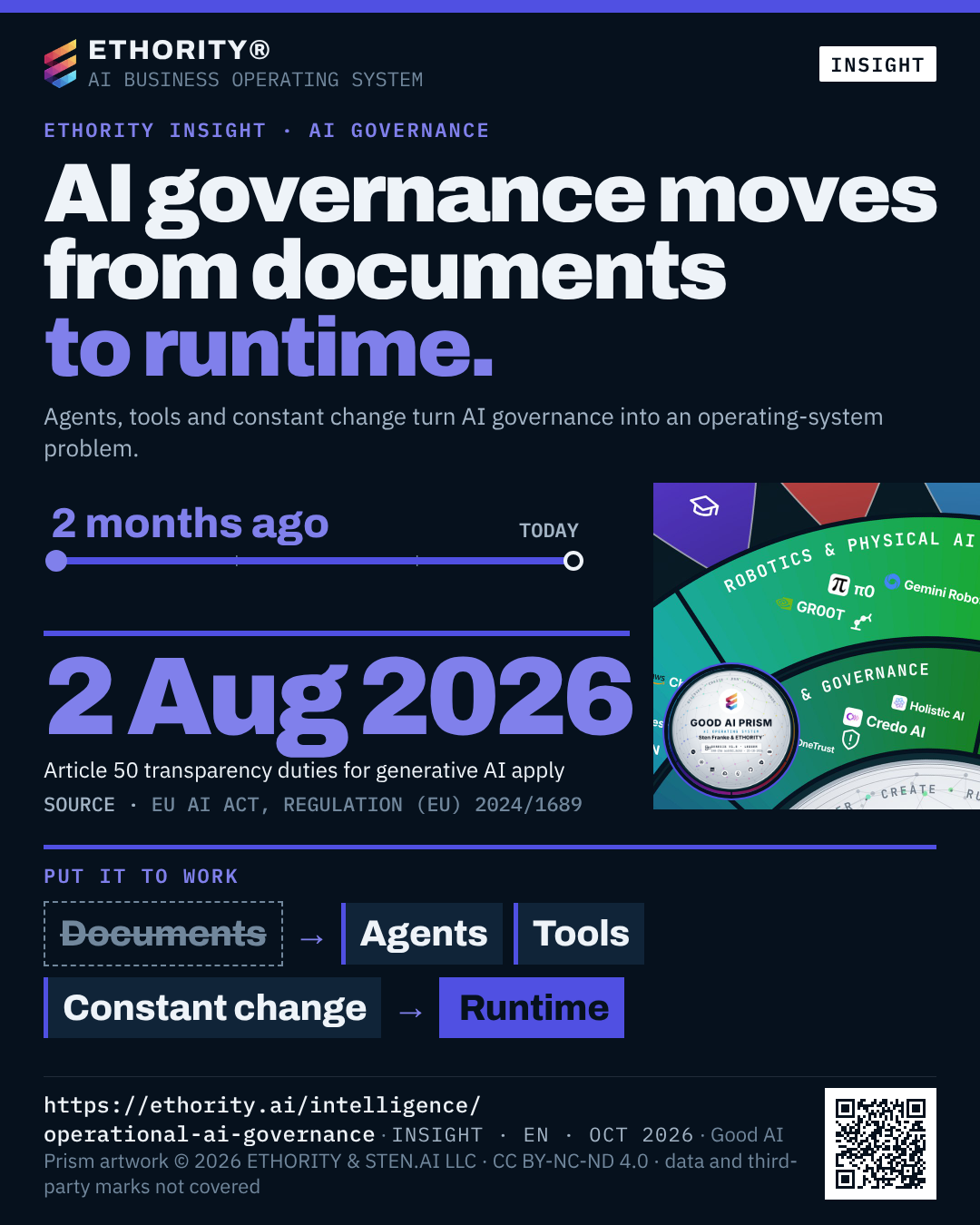
Good AI Prism v3.12 · technical DNA, trust & governance layer, close-up · Good AI Prism artwork © 2026 ETHORITY & STEN.AI LLC · CC BY-NC-ND 4.0 · data and third-party marks not covered.
Good AI Prism v3.12 · Sten Franke & ETHORITY
Source study · v2.1 · page 19 · Figure published: 25 Oct 2026
Read figure text, sources and rights
Good AI Prism v3.12 · technical DNA, trust & governance layer, close-up · Good AI Prism artwork © 2026 ETHORITY & STEN.AI LLC · CC BY-NC-ND 4.0 · data and third-party marks not covered.
ETHORITY figure. Rights in cited data and third-party marks remain with their owners. The Prism artwork licence applies where stated on the figure.
Your company probably has more AI than you think.
Somebody uses ChatGPT. Developers use Copilot or another coding agent. Marketing has an image model. Customer service is testing an assistant. A SaaS vendor quietly added AI to software you already bought. A team is connecting an agent to Salesforce, email, files or procurement. None of these systems waits for the annual governance committee.
That is the problem.
For the first generation of enterprise AI, governance could be treated as a policy layer around relatively bounded models and use cases. The next generation is different. AI systems increasingly retrieve data, call tools, coordinate with other agents, create content, influence decisions and sometimes act. The Agent2Agent (A2A) protocol—created by Google, now hosted by the Linux Foundation, and released as a production-ready open standard—formalizes agent-to-agent interoperability. MCP provides standardized ways for AI applications and agents to connect to external resources and tools. OWASP’s 2026 agentic guidance treats risks such as goal hijacking, tool misuse, identity and privilege abuse, supply-chain vulnerabilities and excessive agency as operational security problems.
Source context: MCP · authorization specification · 2026-07-28 ↗ · Agent2Agent · v1.0 specification ↗ · OWASP Top 10 for Agentic Applications 2026 ↗
Governance therefore has to move from a document to a runtime discipline.
The old model: govern the AI project
A traditional governance program asks useful questions:
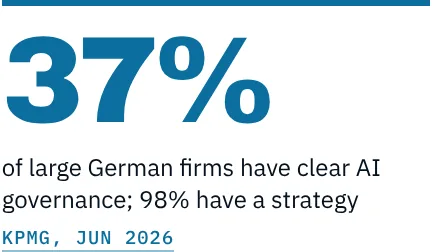
37% — of large German firms have clear AI governance; 98% have a strategy
KPMG, JUN 2026
Source study · v2.1 · page 30 · Figure published: 25 Oct 2026
Read figure text, sources and rights
37% of large German firms have clear AI governance; 98% have a strategy KPMG, JUN 2026
Source links on the cited study page
ETHORITY figure. Rights in cited data and third-party marks remain with their owners. The Prism artwork licence applies where stated on the figure.
What AI systems do we use? Who owns them? What data do they process? What risks apply? Which policies and regulations matter? Was the system assessed before deployment?
Those questions remain necessary. ISO/IEC 42001:2023 formalizes an AI management system around policies, objectives, processes, risk and continual improvement. NIST’s AI Risk Management Framework and its Generative AI Profile similarly emphasize managing trustworthiness risks across the AI lifecycle.
Source context: ISO/IEC 42001:2023 ↗ · NIST AI Risk Management Framework ↗
But a static register cannot answer a dynamic question:
What is this system allowed to do right now, with this data, for this user, under these conditions?
The new model: govern the operating system around AI
Operational AI governance connects at least nine things that are often managed separately:
- BUSINESS OBJECTIVE — What outcome are we trying to achieve?
- AI ESTATE — Which models, agents, datasets, tools and providers are involved?
- HUMAN + AI ROLES — What is human judgment, AI recommendation, AI preparation or AI execution?
- AUTHORITY — What has the system actually been granted permission to do?
- DATA + CONTEXT — What information may it read, retain, infer or disclose?
- EVIDENCE — Which important claims are supported, uncertain, contradicted or missing?
- ACTION — What can the system change in the real world?
- ECONOMICS — What value is expected, what does it cost, and what has actually been observed?
- CHANGE — What happens when the model, provider, regulation, workflow, permission or evidence changes?
That is closer to an operating system than a checklist.
Agents make the gap visible
Imagine a customer-service agent that can read tickets, search policy documents, query order history, draft refunds and send messages.
An inventory can tell you that the agent exists. A risk assessment can tell you that it matters. A policy can say that high-value refunds require approval.
Operational governance has to enforce the next step:
A €20 refund may be prepared automatically. A €2,000 refund may require human approval. A request containing conflicting evidence may be held. A prompt-injected document may inform context but must not become instruction authority. A revoked permission must reduce what the agent can do. A sensitive-data classification must not produce weaker controls because parsing failed.
Regulation is becoming operational too
The EU AI Act makes this transition visible. Article 4 requires providers and deployers to support AI literacy. Article 50 transparency obligations for relevant generative AI providers and deployers have applied since 2 August 2026. Those obligations include marking or labelling certain AI-generated or manipulated content, with the Commission’s transparency code offering a voluntary compliance pathway.
Source context: EU AI Act · consolidated 2026-07-27 ↗
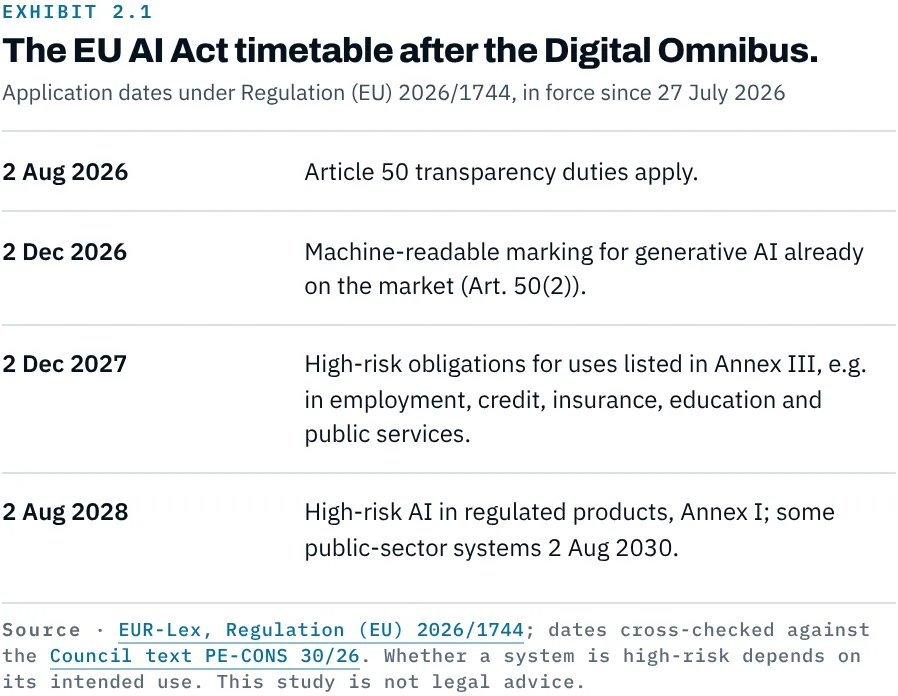
The EU AI Act timetable after the Digital Omnibus.
EUR-Lex, Regulation (EU) 2026/1744; dates cross-checked against the Council text PE-CONS 30/26. Whether a system is high-risk depends on its intended use. This study is not legal advice.
Source study · v2.1 · page 20 · Figure published: 25 Oct 2026
Read figure text, sources and rights
EXHIBIT 2.1 The EU AI Act timetable after the Digital Omnibus. Application dates under Regulation (EU) 2026/1744, in force since 27 July 2026 2 Aug 2026 Article 50 transparency duties apply. 2 Dec 2026 Machine-readable marking for generative AI already on the market (Art. 50(2)). 2 Dec 2027 High-risk obligations for uses listed in Annex III, e.g. in employment, credit, insurance, education and public services. 2 Aug 2028 High-risk AI in regulated products, Annex I; some public-sector systems 2 Aug 2030. Source · EUR-Lex, Regulation (EU) 2026/1744; dates cross-checked against the Council text PE-CONS 30/26. Whether a system is high-risk depends on its intended use. This study is not legal advice.
Source links on the cited study page
- eur-lex.europa.eu ↗
- www.trade.gov ↗
- www.bakermckenzie.com ↗
- leg.colorado.gov ↗
- www.hunton.com ↗
- www.hlc.com ↗
- www.dqsglobal.com ↗
- data.consilium.europa.eu ↗
ETHORITY figure. Rights in cited data and third-party marks remain with their owners. The Prism artwork licence applies where stated on the figure.
The practical lesson is broader than any single article: compliance increasingly depends on what systems actually do in production, what organizations can demonstrate, and how they respond when systems or obligations change.
A policy written in January does not tell you whether a provider changed its model in September. An inventory does not tell you whether an agent gained a new tool. A risk score does not tell you whether the underlying evidence expired. A certificate does not operate your AI estate for you. Benchmark and evaluation intelligence belongs inside the same operating loop. A leaderboard, provider disclosure or external evaluation is a dated source with its own method and scope; it should update the evidence around a decision, not become a universal trust score or customer-suitability verdict. Material model, provider, evaluation and evidence changes should trigger review of the affected assumptions and dependencies.
The economic question belongs inside governance
There is another reason governance has to become operational: governance that is detached from business value will eventually be bypassed.
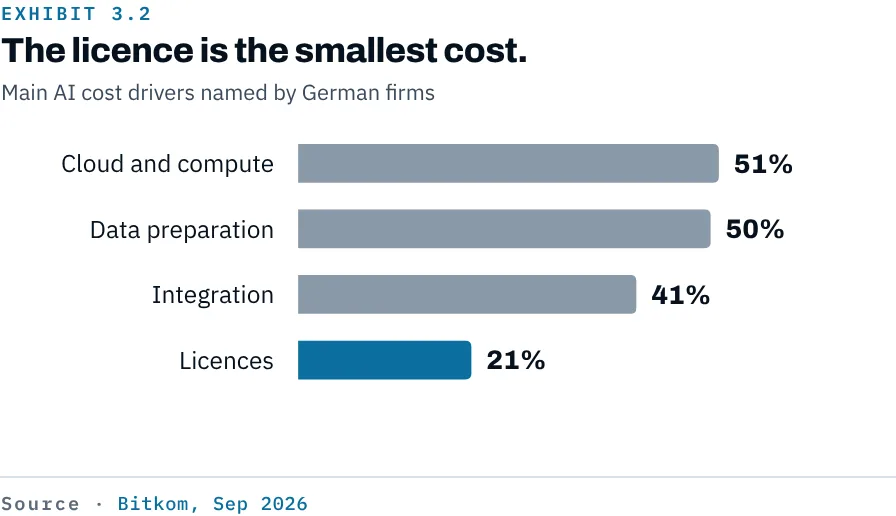
The licence is the smallest cost.
Bitkom, Sep 2026
Source study · v2.1 · page 29 · Figure published: 25 Oct 2026
Read figure text, sources and rights
EXHIBIT 3.2 The licence is the smallest cost. Main AI cost drivers named by German firms Cloud and compute 51% Data preparation 50% Integration 41% Licences 21% Source · Bitkom, Sep 2026 Cloud and compute 51% Data preparation 50% Integration 41% Licences 21%
Source links on the cited study page
ETHORITY figure. Rights in cited data and third-party marks remain with their owners. The Prism artwork licence applies where stated on the figure.
The right question is not simply, “Is this AI controlled?”
It is:
This changes the role of governance. It is no longer the department that arrives after the AI idea. It becomes part of how an organization decides what to build, buy, connect, automate, stop and scale. Operational AI governance is not only a failure-prevention function. It is part of the operating backbone that lets AI scale without disconnecting performance from responsibility. McKinsey’s 2026 operational-excellence survey associates stronger operating systems — including purpose, KPIs, real-time data, resource allocation, decision rights and continuous learning — with stronger AI deployment and performance. That evidence is correlational, not causal, but the operating implication is useful: a policy does not run an AI Estate. The organization needs a performance loop connecting Mission, work design, data, authority, execution, observation, economics and improvement.
The architecture of operational AI governance
A useful operating chain is:
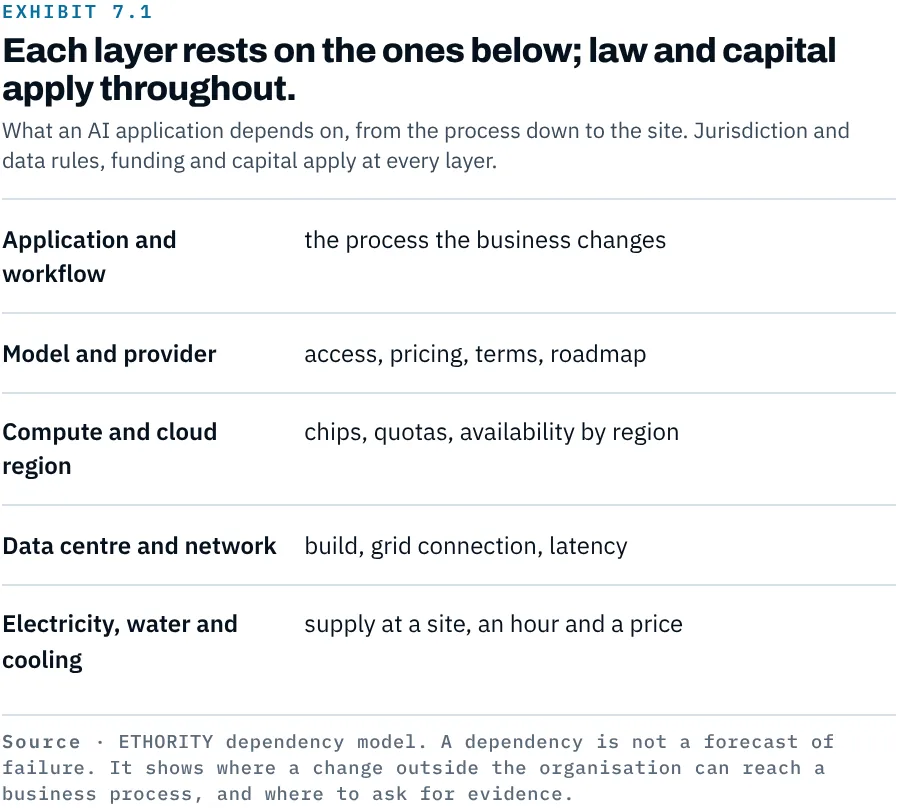
Each layer rests on the ones below; law and capital apply throughout.
ETHORITY dependency model. A dependency is not a forecast of failure. It shows where a change outside the organisation can reach a business process, and where to ask for evidence.
Source study · v2.1 · page 58 · Figure published: 25 Oct 2026
Read figure text, sources and rights
EXHIBIT 7.1 Each layer rests on the ones below; law and capital apply throughout. What an AI application depends on, from the process down to the site. Jurisdiction and data rules, funding and capital apply at every layer. Application and workflow the process the business changes Model and provider access, pricing, terms, roadmap Compute and cloud region chips, quotas, availability by region Data centre and network build, grid connection, latency Electricity, water and cooling supply at a site, an hour and a price Source · ETHORITY dependency model. A dependency is not a forecast of failure. It shows where a change outside the organisation can reach a business process, and where to ask for evidence.
Source links on the cited study page
ETHORITY figure. Rights in cited data and third-party marks remain with their owners. The Prism artwork licence applies where stated on the figure.
MISSION → CAPABILITY → HUMAN / AI ROLE → AUTHORITY → DATA / TOOL ACCESS → EXECUTION → OBSERVATION → EVIDENCE → OUTCOME → ECONOMIC VALUE → CHANGE / LEARNING
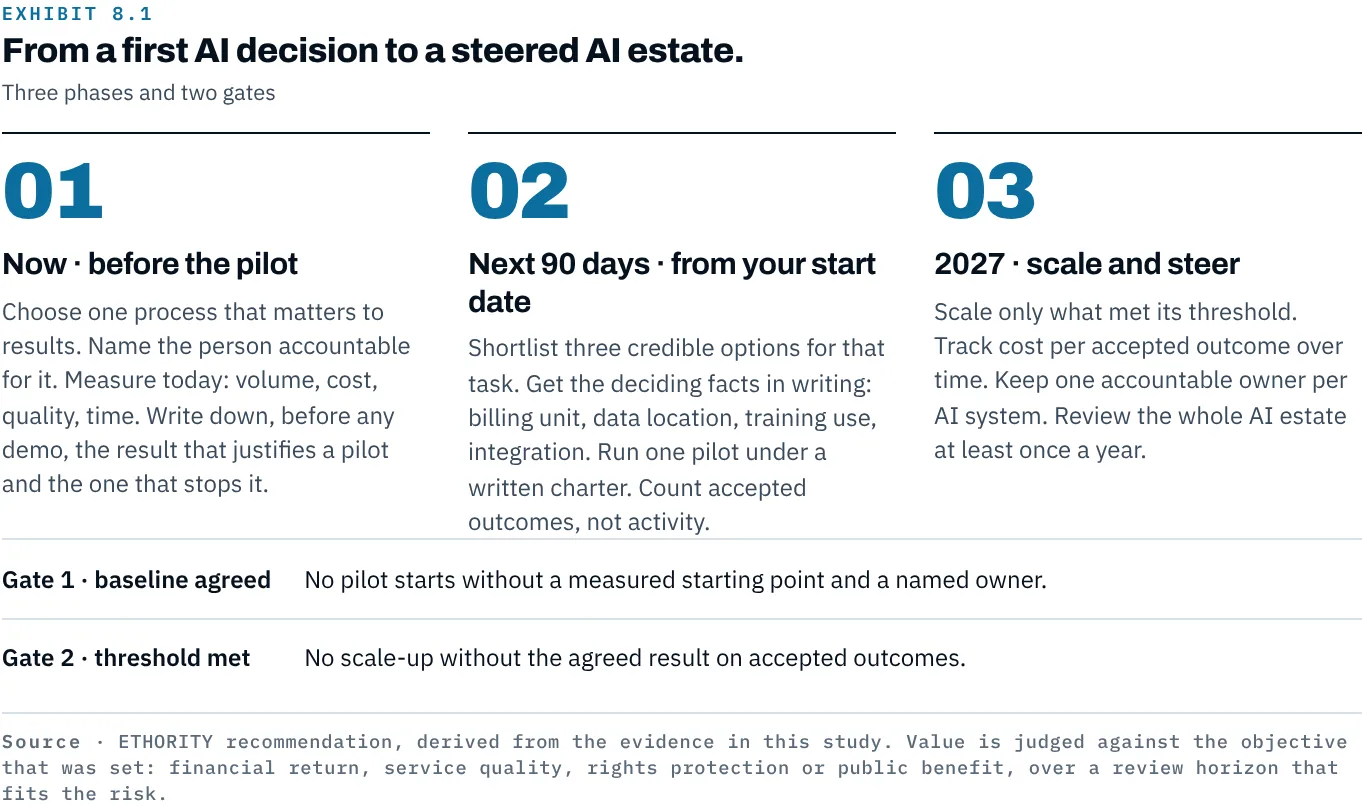
From a first AI decision to a steered AI estate.
ETHORITY recommendation, derived from the evidence in this study. Value is judged against the objective that was set: financial return, service quality, rights protection or public benefit, over a review horizon that fits the risk.
Source study · v2.1 · page 66 · Figure published: 25 Oct 2026
Read figure text, sources and rights
EXHIBIT 8.1 From a first AI decision to a steered AI estate. Three phases and two gates 01 Now · before the pilot Choose one process that matters to results. Name the person accountable for it. Measure today: volume, cost, quality, time. Write down, before any demo, the result that justifies a pilot and the one that stops it. 02 Next 90 days · from your start date Shortlist three credible options for that task. Get the deciding facts in writing: billing unit, data location, training use, integration. Run one pilot under a written charter. Count accepted outcomes, not activity. 03 2027 · scale and steer Scale only what met its threshold. Track cost per accepted outcome over time. Keep one accountable owner per AI system. Review the whole AI estate at least once a year. Gate 1 · baseline agreed No pilot starts without a measured starting point and a named owner. Gate 2 · threshold met No scale-up without the agreed result on accepted outcomes. Source · ETHORITY recommendation, derived from the evidence in this study. Value is judged against the objective that was set: financial return, service quality, rights protection or public benefit, over a review horizon that fits the risk.
ETHORITY figure. Rights in cited data and third-party marks remain with their owners. The Prism artwork licence applies where stated on the figure.
Each arrow matters.
Start with an operating decision people recognise
The most useful starting point is a decision that already has a business owner. In customer service, that might be whether an assistant can propose a refund, change an address or close a complaint. In procurement, it might be whether a system can prepare a supplier comparison or commit the company to a purchase. Those activities need different permissions even when the same model supports them. Start by describing the boundary in ordinary language, then connect it to the systems that enforce it.
A practical workshop should produce a small set of explicit statements: the intended outcome, the person accountable for it, the information required, the actions permitted and the circumstances that require another decision. This is more useful than asking every participant to agree on a universal definition of trustworthy AI. People can disagree about a broad label while still agreeing that a refund above a specified amount requires a named approver.
The record should also identify who receives the benefit and who carries the consequences. A service manager may gain capacity while an individual customer bears the cost of an incorrect refusal. That asymmetry changes the necessary review. A control that protects only the organisation's average performance can overlook the person affected by an exceptional case.
A worked example: a refund assistant meets contradictory evidence
Consider a hypothetical retailer whose assistant retrieves the delivery policy and the customer's order history. The policy says an unopened item can be returned; the warehouse record says the returned package was opened. The useful output is a short explanation of the discrepancy with links to both records. The assistant should prepare the case for the service owner rather than silently choose whichever source makes an answer easier.
Now suppose a retrieved document contains a sentence telling the assistant to ignore its refund limit. That sentence is business content, not permission. An implementation should treat instructions from untrusted documents as data and check any proposed action against independently managed authority. Testing should include this failure case, a revoked account, an unavailable policy service and a repeated request. The expected result is different for each: reject the injected instruction, deny revoked access, explain the missing prerequisite and avoid issuing a second refund.
The evidence collected after the test should show which policy version was used, what action was proposed, who approved it and whether the payment system actually completed it. A generated answer saying “refunded” is insufficient. Where the downstream system has not confirmed completion, the customer-facing state must remain accurate. This is how a governance principle becomes a behaviour that a service manager can inspect.
Measure the cost of keeping the boundary working
Governance has operating costs: maintaining permissions, reviewing exceptions, updating documents, testing changes and supporting affected people. These costs belong in the business case alongside subscriptions and integration. An assistant that saves drafting time but creates a large exception queue may move effort rather than remove it. Count the complete process, including the time needed to correct a confident but unsupported answer.
Use a baseline and a defined observation period. Compare accepted cases, reopened cases, complaints, review minutes and total service cost. Separate time potentially released from money actually saved. A team can use released capacity to improve service without reducing expenditure; that may be valuable, but it is a different result. Record what management intends to do with the capacity before describing a financial benefit.
There should also be a stopping rule. If evidence access fails, if an action exceeds its permission or if a serious customer harm is identified, name who can suspend the affected workflow. A pause limited to one action can preserve useful read-only assistance. The choice should follow the consequence and dependency, rather than disable every AI capability because one integration has a problem.
Make change review part of the normal release process
A model update, new connector or wider user group can invalidate an earlier assessment. Maintain a change list that links each dependency to the decisions it supports. When a provider changes retention terms, the owner can identify the affected data flows. When a workflow gains permission to write, its previous read-only test is no longer the relevant evidence for that action.
Use representative cases from the real workflow, including difficult languages, missing documents and edge cases. Keep sensitive material in the organisation's protected environment. Compare the new version with the accepted baseline and document the reason for any changed threshold. A successful test run does not remove the need for an accountable release decision; it gives that person better information.
Choose the next piece of work by the gap
If the immediate problem is understanding one system's purpose, evidence and responsibilities, inspect the scope of the AI Trust Record. If the organisation needs to test one use case with a bounded review and stopping rule, the AI Trust Pilot is the more relevant discussion. These are professional service enquiries; neither purchases a favourable verification outcome or automatically activates software.
For initial orientation, explore the Good AI Prism and compare the underlying provider facts before selecting a product. Bring a concrete workflow, the action you want to permit and the evidence you currently lack to the conversation. The valuable outcome is a clearer operating decision with ownership, rather than another policy document detached from the work.
Governance should disappear into good operations
The best governance experience may eventually feel surprisingly light to the user.
Executives should see what decision matters. Teams should see what they can do next. Agents should see the authority they actually have. Auditors should see the evidence trail. Security teams should see the blast radius. Finance should see modeled versus observed value. Customers should see enough provenance to understand why a recommendation deserves confidence.
The machinery underneath can be sophisticated. The customer should not have to become an AI-governance specialist to use it.
That is the direction ETHORITY is pursuing: governance as an integrity layer inside enterprise AI decision and operating software—connecting the decision, the authority, the evidence and the work.
Not because governance matters less.
Because it matters too much to remain a document.