 ETHORITY®

ETHORITY · ADVISORY SERVICE · FROM €25,000 NET · 4–8 WEEKS
See the AI your company runs, what it costs and what to keep.
Large companies can run dozens or hundreds of AI tools, agents and pilots. The audit maps those within the agreed scope, with cost and usage, including AI used without approval (shadow AI) that interviews and samples of log data reveal. It ends in a decision that your CFO and CIO both sign. ETHORITY calls this the AI Estate Audit & Mapping.
- €25,000
- Focus package, up to 60 AI items, 4 weeksETHORITY price list, 16 Oct 2026
- 300
- AI items in the Group+ packageETHORITY price list, 16 Oct 2026
- 95%
- of known AI spend mapped to items (acceptance criterion)ETHORITY product sheet, 16 Oct 2026
- 100,000+
- records in the ETHORITY AI Registry and AI UniverseETHORITY AI Registry, Oct 2026
At least 95% of your known AI spend assigned to named tools and licences.
Every item ends with an owner and a decision: scale, fix, consolidate or stop.
ETHORITY product sheet, 16 Oct 2026
Vendor facts drawn from more than 100,000 records in ETHORITY's market database.
Internal teams rarely have time to research vendors in that depth.
ETHORITY AI Registry, Oct 2026
You keep control of your systems: ETHORITY works from exports you provide.
You provide read-only exports and usage reports; ETHORITY works from those and from interviews.
ETHORITY product sheet, 16 Oct 2026
Who it is for
CIOs, CDOs, CFOs and heads of AI transformation in companies with more than 1,000 employees; organisations after two or three years of pilots and growing licence spend; companies before a budget round, a reduction in the number of vendors or a platform decision such as Copilot, Agentforce, Gemini or an in-house model.
The question it answers
What AI do we actually run, what does it cost, what does it deliver, and what should we scale, fix, consolidate or stop?
What you receive
Select a result to see it in a scenario.
Scenario: a group with 4,200 employees and 132 AI items in scope (Group package).
- 1
Map of your AI (your AI Estate): an interactive overview by business unit, category, vendor and model provider, using the same structure as ETHORITY's directory of AI offerings.
Map of your AI
Read as text
AI Estate Audit & Mapping · Your AI Estate · 132 items · Scenario
Scenario: a group with 4,200 employees and 132 AI items in scope (Group package).
- Writing and chat assistants: 31
- Customer service: 18
- Documents and workflow: 22
- Analytics: 17
- Software development: 14
- Sales and marketing: 16
- HR: 8
- Other: 6
19 found without approval
Across 5 business units · 41 vendors · 9 model providers
- 22
Inventory with owners, users, data, contracts and dependencies, including shadow AI found through survey and log samples.
- 3
Cost and usage analysis: total AI spend, cost per active user, unused and overlapping licences.
Cost and usage
Read as text
AI Estate Audit & Mapping · Cost and usage · per year · Scenario
Scenario: a group with 4,200 employees and 132 AI items in scope (Group package).
AI spend a year: €2.4m
- per active user a month: €71
- of licences unused in 90 days: 34%
- writing assistants doing the same job: 5
- Writing and chat assistants: 0.82 €m
- Documents and workflow: 0.51 €m
- Customer service: 0.44 €m
- Analytics: 0.31 €m
- Other: 0.32 €m
- 44
Vendor intelligence per product (category, pricing model, model provider, data location, documentation), each with a Trust Chain label.
- 5
Risk view: AI Act classification and key risks per system.
Risk view
Read as text
AI Estate Audit & Mapping · Risk view · Scenario
Scenario: a group with 4,200 employees and 132 AI items in scope (Group package).
- High-risk · Annex III: 4
- Transparency · Article 50: 15
- Minimal: 113
Key risks:
- Customer data in 7 tools without a data agreement
- 3 vendors train on your data by default
- Credit pre-check without documented oversight
- 19 tools without approval
- 6
Portfolio decision for each item, with savings and value potential.
Portfolio decision
Read as text
AI Estate Audit & Mapping · Portfolio decision · 132 items · Scenario
Scenario: a group with 4,200 employees and 132 AI items in scope (Group package).
- Scale: 14
- Fix: 23
- Consolidate: 41
- Stop: 54
savings a year: €640–780k
- 5 writing assistants → 1
- 54 items with no active use stopped
- Credit pre-check fixed before scaling
- 77
Board presentation and a summary signed by Sten Franke.
1 / 4 · Map of your AI
By business unit, category, vendor and model provider.
Scenario: a group with 4,200 employees and 132 AI items in scope (Group package).
Read as text
AI Estate Audit & Mapping · Your AI Estate · 132 items · Scenario
Scenario: a group with 4,200 employees and 132 AI items in scope (Group package).
- Writing and chat assistants: 31
- Customer service: 18
- Documents and workflow: 22
- Analytics: 17
- Software development: 14
- Sales and marketing: 16
- HR: 8
- Other: 6
19 found without approval
Across 5 business units · 41 vendors · 9 model providers
How it works
- Week 0
Scoping: scope, data list, NDA, sponsor and data owners.
- Week 1 · Collect
Kick-off, data requests, staff and manager survey, first interviews with CIO office, procurement, security and data protection.
- Weeks 2–3 · Inventory and enrich
We merge the sources and remove duplicates, find AI built into existing software and, as far as interviews and samples of log data reveal it, AI used without approval (shadow AI), check every product against ETHORITY's directory of AI offerings and list alternatives per category.
- Weeks 3–4 · Cost, usage, risk
Spend per item, usage per user, overlaps and unused licences; AI Act classification, data and vendor risks.
- Weeks 5–6 · Decide and hand over
Portfolio workshop with CIO, CFO and business leads; map of your AI, board presentation and signed summary. The register is handed to the people who govern your AI. The Group+ package adds two weeks for AI agents and the models behind them.
Packages and price
Focus
€25,000 one-time · net
Up to 60 AI items, one business unit or country, 4 weeks: licence and contract costs, AI Act quick classification, registry facts.
Date and place by agreement
See what this package includes →Request this package →Group
€45,000 one-time · net
Up to 150 items, group-wide, 6 weeks: plus usage data, full classification and alternatives per category.
Date and place by agreement
See what this package includes →Request this package →Group+
€75,000 one-time · net
Up to 300 items, several countries, 8 weeks: plus AI agents and the models behind them, cloud and API usage, mapping to ISO 42001 (the international standard for managing AI) and negotiation points per vendor.
Date and place by agreement
See what this package includes →Request this package →Terms
Net prices. Work starts after confirmed payment and complete agreed inputs. Data needed: licence and contract lists, SaaS management or procurement exports, read-only usage reports from the main platforms, cloud billing for AI services, plus interviews.
What the audit covers
An independent audit that ends in a decision on every item. Security testing, legal opinions and implementation follow as scoped next steps with named specialists.
Who is accountable for the result

Sten Franke
Founder & CEO
Sten Franke designs and builds AI systems, from model testing and cloud setup to the interfaces people use. He connects business decisions, software architecture and practical implementation.
AI architecture · Model testing · Cloud engineering · UX
His work spans programming, LLM evaluation, Google Cloud and AWS environments, and web applications built with Next.js and React. He connects business requirements, software architecture and practical implementation. Creator of the Good AI Prism, he brings market intelligence into AI decisions. Earlier, he created the Social Media Prisma, led a BVDW Social Media working group and contributed to its Social Media Kompass. His entrepreneurial work includes ethority, Gridpatrol and mediatime, following a practical foundation in electronics and industrial robotics.
sten@ethority.aiReal offerings we compare against
Agent platforms are where estates grow fastest and overlap most. Three profiles show the facts the audit attaches to each item: Workato Genies for automation, Dust for internal agents and Agentforce Service in support.
Workato Genies
Workato · Agent
According to Workato: “Workato Genies go beyond traditional AI agents – they can be customized with unique KPIs”
- Published price
- How it is billed
- Where data is stored
- Does it train AI on your data?
Dust
Dust · Platform
Dust lets company teams build shared AI agents over connected knowledge sources and tools, choosing among 20+ models per task, with stake-level approvals before agents take actions like sending email.
- Published price
- How it is billed
- Where data is stored
- Does it train AI on your data?

Agentforce Service
Salesforce · Product
Salesforce’s AI for customer service. The service AI page leads with: “AI in the flow of work and your unmetered employee agent, all in one.”
- Published price
- How it is billed
- Does it train AI on your data?
- Certificates and audit reports
Read before you decide
Why inventories alone fall short: inventories list agents, not governance. Infrastructure costs sit in the AI compute brief.

A list of AI agents does not control them.
What controls AI agents in daily operation: clear rights, a record of how well each fact is supported, checks matched to the risk, data limits and alerts when something changes.
See the map on one page →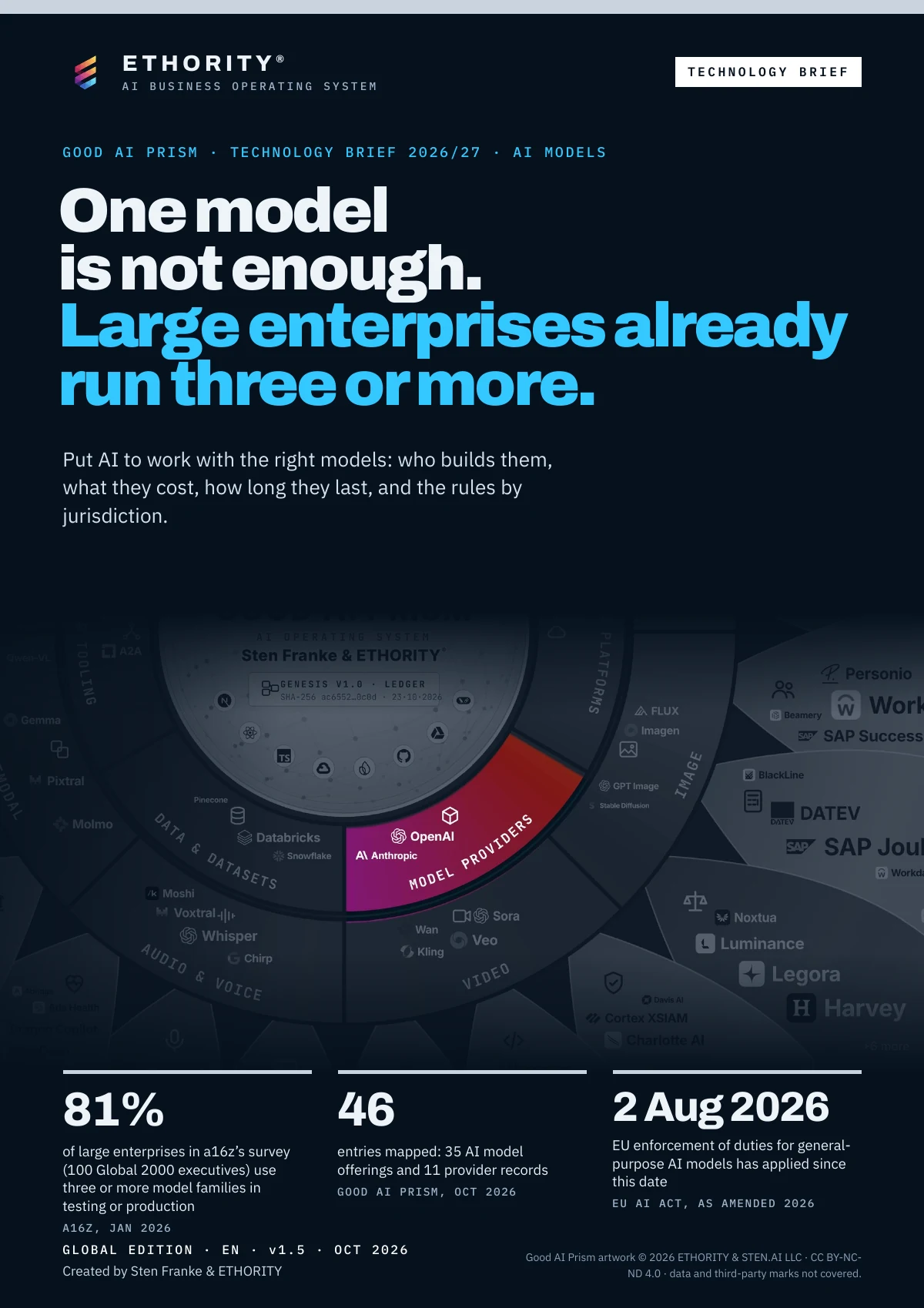
Global edition · EN
One model is not enough. Large enterprises already run three or more.
81% of large enterprises use three or more model families. Who builds AI models, what they cost, how long they last, and the rules by jurisdiction.
Version 1.5 · 38 pages
Open the study →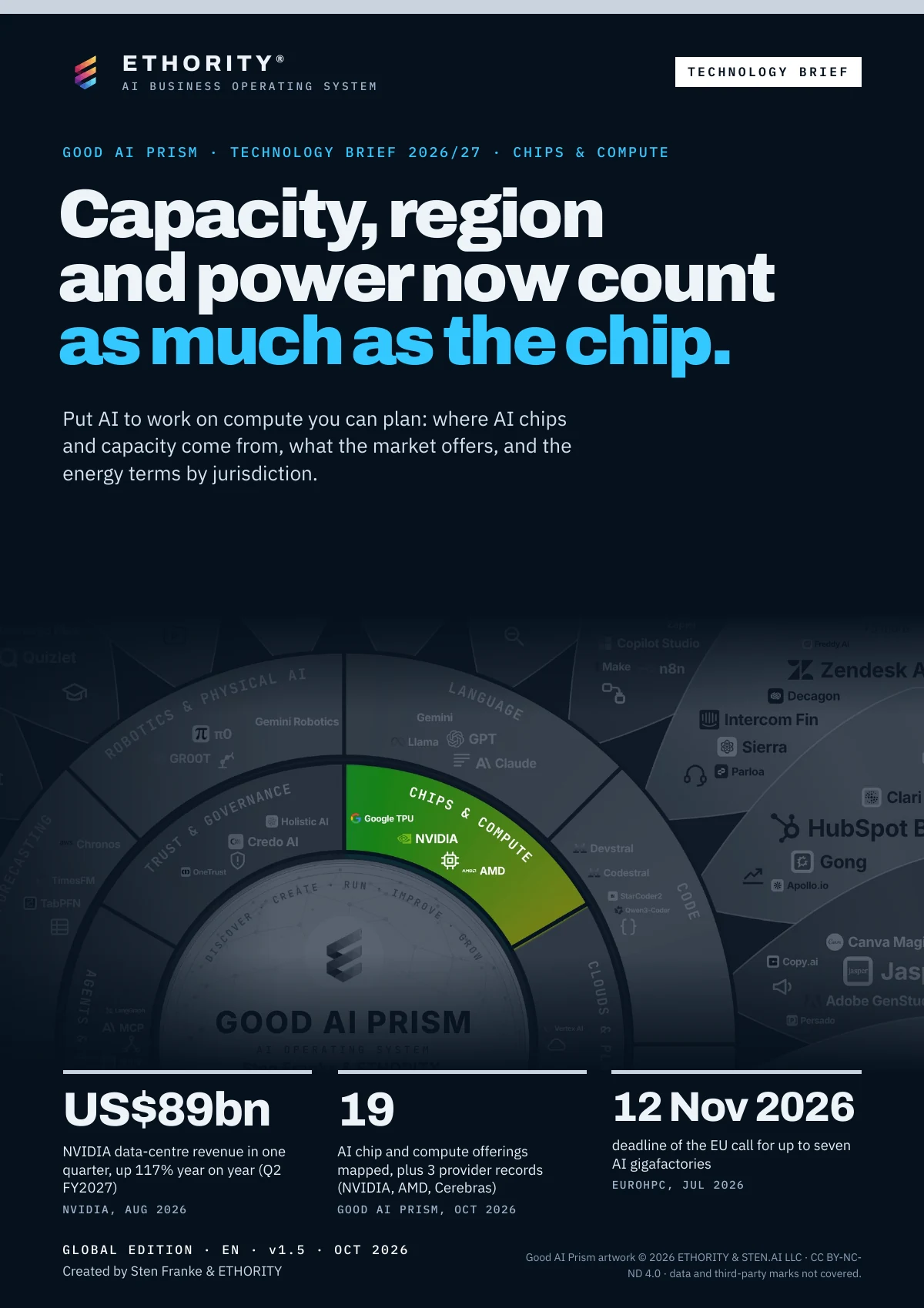
Global edition · EN
Compute that fits the work you run.
Capacity, region and energy terms count as much as chip performance. Where AI chips and capacity come from, what the market offers and the energy terms by jurisdiction.
Version 1.5 · 40 pages
Open the study →Test your numbers first
The matching calculator is Total Cost of AI Ownership: the audit reports the same cost per accepted outcome, item by item. All tools sit in the ETHORITY AI calculator suite.
Total Cost of AI Ownership calculator
All six cost blocks over 36 months, compared with today's cost per accepted result, and the month the investment pays back.
Pilot version · Scenario calculator
Open the calculator →Model Cost Estimator
Estimates the monthly cost of your workload on 17 AI models, with announced price changes and end-of-service dates.
Pilot version · Scenario calculator
Open the calculator →Compare three offerings
Puts two to four offerings side by side in the same units, each fact with its source and the date it was checked.
Questions buyers ask
What access do you need?
Read-only exports and usage reports you provide, plus interviews. We work from those.
How do you find AI used without approval (shadow AI)?
Through a staff and manager survey and samples of logs you provide, compared with the licence list.
Which package fits us?
Count your known AI items and countries. Up to 60 items in one unit is Focus; group-wide up to 150 is Group; agents, models and several countries point to Group+.
Who checks the savings estimate?
Your Finance team. Reviewing the savings and value estimates with Finance is an acceptance criterion.
What happens to the inventory?
It is handed into governance, typically through the AI Governance Setup.
Next step
Discuss your estate in a 30-minute call. For the biggest bet the audit surfaces, the AI Opportunity Case builds the full business case.
ETHORITY · LONG READ
After three years of pilots, the AI question is a portfolio question.
Large companies now run dozens to hundreds of AI tools, agents and pilots. Licences overlap, costs sit in several budgets and nobody can say which ones deliver.
Most large organisations did not plan their AI estate. It accumulated. A platform licence came with a CRM renewal, a business unit bought a document tool, IT approved two assistants, and every vendor added agent features over the last year. The Good AI Prism market study maps 961 offerings , and many of them now arrive inside software a company already pays for.
The AI Estate Audit & Mapping turns that accumulation into one view. It starts with what the company can export: licence and contract lists, procurement data, usage reports and cloud bills. It adds what exports miss, through interviews and a staff survey that surfaces shadow AI. Every product is then matched against the registry, so the estate map shows vendor facts with their source and date rather than the vendor's sales sheet.
The cost analysis is where most audits change minds. Total AI spend, cost per active user, unused seats and overlapping tools appear side by side for the first time. In the Group+ package, the analysis reaches into cloud and API consumption and the agent and model layer: which agents exist, what they can access, and which models they call.
The audit ends with a decision, not a spreadsheet. In a portfolio workshop, the CIO, CFO and business leads decide for each item whether to scale, fix, consolidate or stop it. The acceptance test is strict: at least 95% of known spend is mapped, every item has an owner and a decision, and Finance has reviewed the savings and value estimates.
The inventory then becomes the base for governance, and the largest open bets become candidates for an Opportunity Case. That sequence matters, because an organisation that cannot see its estate cannot govern it, and an estate that is never decided on does not scale by itself.
Sources and further reading
YOUR NEXT STEP
Discuss your question with Sten Franke.
Bring your business question or the figures you already know. ETHORITY investigates within the agreed scope; together with Sten Franke you agree the next piece of work.