 ETHORITY®
GOOD AI PRISM · MARKET MAP 2026/27 · PUBLIC INTELLIGENCE
961 AI offerings, 24 topic areas. One free map.
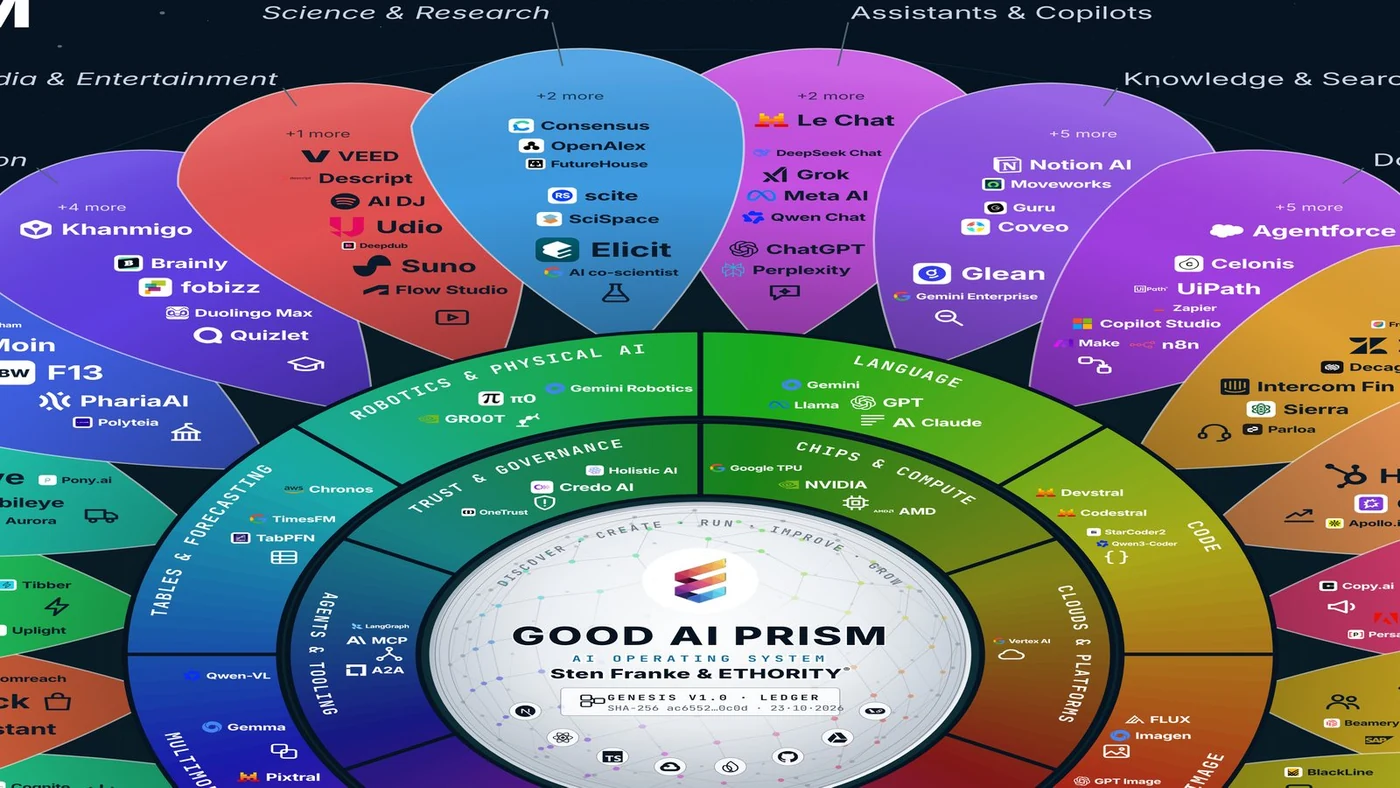
Start from a map, not a sales pitch: the Good AI Prism connects business needs, data types and technology layers, with every fact sourced and dated.
- 961
- AI offerings in the October 2026 study · 485 profiles in the online catalogueGood AI Prism, Oct 2026
- 24
- topic areas on one wheelGood AI Prism v3.11, Oct 2026
- 107
- customer-service AI offerings reviewed in depthGood AI Prism, Oct 2026
- 2009
- first German Social Media Prisma, 21 SepETHORITY archive, Sep 2009
961 offerings mapped in October 2026.
Each sits on a wheel of 24 topic areas, data types and technology layers. The market study examines 961 AI offerings. The separate online catalogue contains 485 profiles; the counts describe different populations.
Good AI Prism, Oct 2026
Customer service is mapped deepest.
107 customer-service offerings were reviewed in depth.
Good AI Prism, Oct 2026
The Prism line began with the Social Media Prisma.
The German Social Media Prisma first appeared on 21 September 2009.
ETHORITY archive, Sep 2009
Prism products
Good AI Prism Edition 2026/27
Free
Business needs, data types and technology layers in one connected market view: 961 AI offerings across 24 topic areas, 8 data types and 6 technology layers in the October 2026 research.
Free market exploration
See what this package includes →Curated Segments
Free
Focus your research on the business function, industry or technology that matters to your decision.
Free market exploration
See what this package includes →Basic Registry
Free
Each product identity connected with its documented facts, sources, read dates and correction history.
Free market exploration
See what this package includes →Public Navigator
Free
Build a shortlist you can inspect, compare and carry into the next research question or a Decision Brief.
Free market exploration
See what this package includes →Prism poster
Free
One dated market map for a workshop, briefing or publication; commercial use by licence on request.
Scope and delivery by agreement
See what this package includes →Premium Sector Editions
Fee configured to agreed scope
A sector decision with a defined research scope, a readable report and the right licence. Scoped on request.
Scope and delivery by agreement
See what this package includes →Six profiles from six areas
Every registry card shows the provider's logo, its area and up to six sourced facts with evidence marks and read dates. Six areas, six examples.

Intercom Fin
Intercom · Product
An AI agent that answers customer requests and is billed per outcome; Intercom states Fin works with “no seats required”.
- Published price
- How it is billed
- Where data is stored
- Does it train AI on your data?
Agicap
Agicap · Product
According to Agicap: “Agicap AI immediately helps explain the variance between actuals and forecasts.”
- How it is billed
- Where data is stored
- Does it train AI on your data?
- Certificates and audit reports
Dust
Dust · Platform
Dust lets company teams build shared AI agents over connected knowledge sources and tools, choosing among 20+ models per task, with stake-level approvals before agents take actions like sending email.
- Published price
- How it is billed
- Where data is stored
- Does it train AI on your data?
Snyk DeepCode AI
Snyk · Product
According to Snyk: “Snyk's DeepCode AI code analyzer was designed to find, autofix, and prioritize vulnerabilities”
- Published price
- How it is billed
- Where data is stored
- Does it train AI on your data?
Studies built on the Prism
Global edition · EN
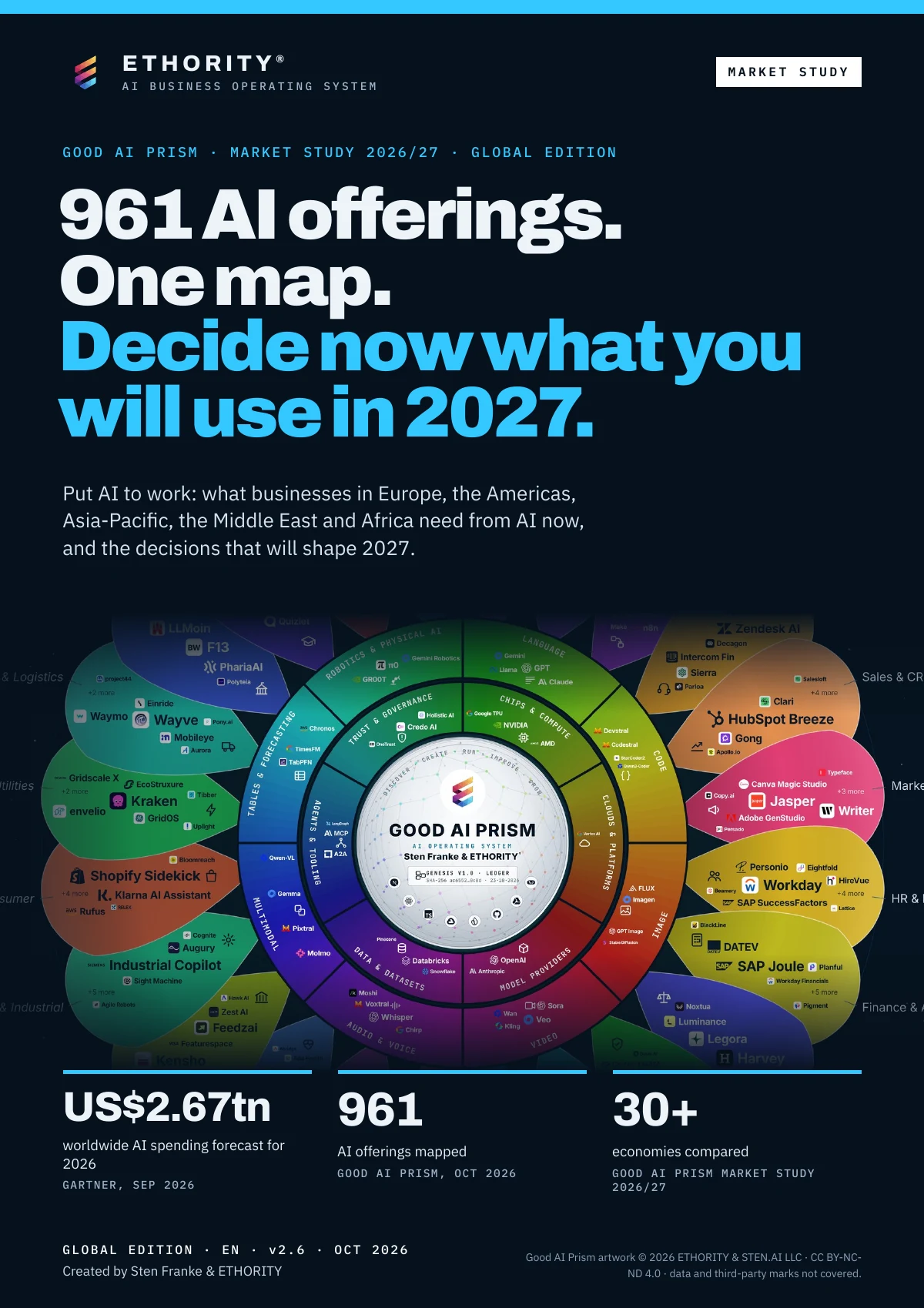
961 AI offerings. One map. Decide now what you will use in 2027.
The Good AI Prism helps you find useful AI and compare the evidence behind your options. For organisations already using AI, the question is moving from whether to use AI to which AI, how safely and whether it pays. This Global edition brings together 961 AI offerings across 24 topic areas, 8 data types and 6 technology layers, with sources, dates and limits to guide your next decision.
Version 2.6 · 90 pages
Open the study →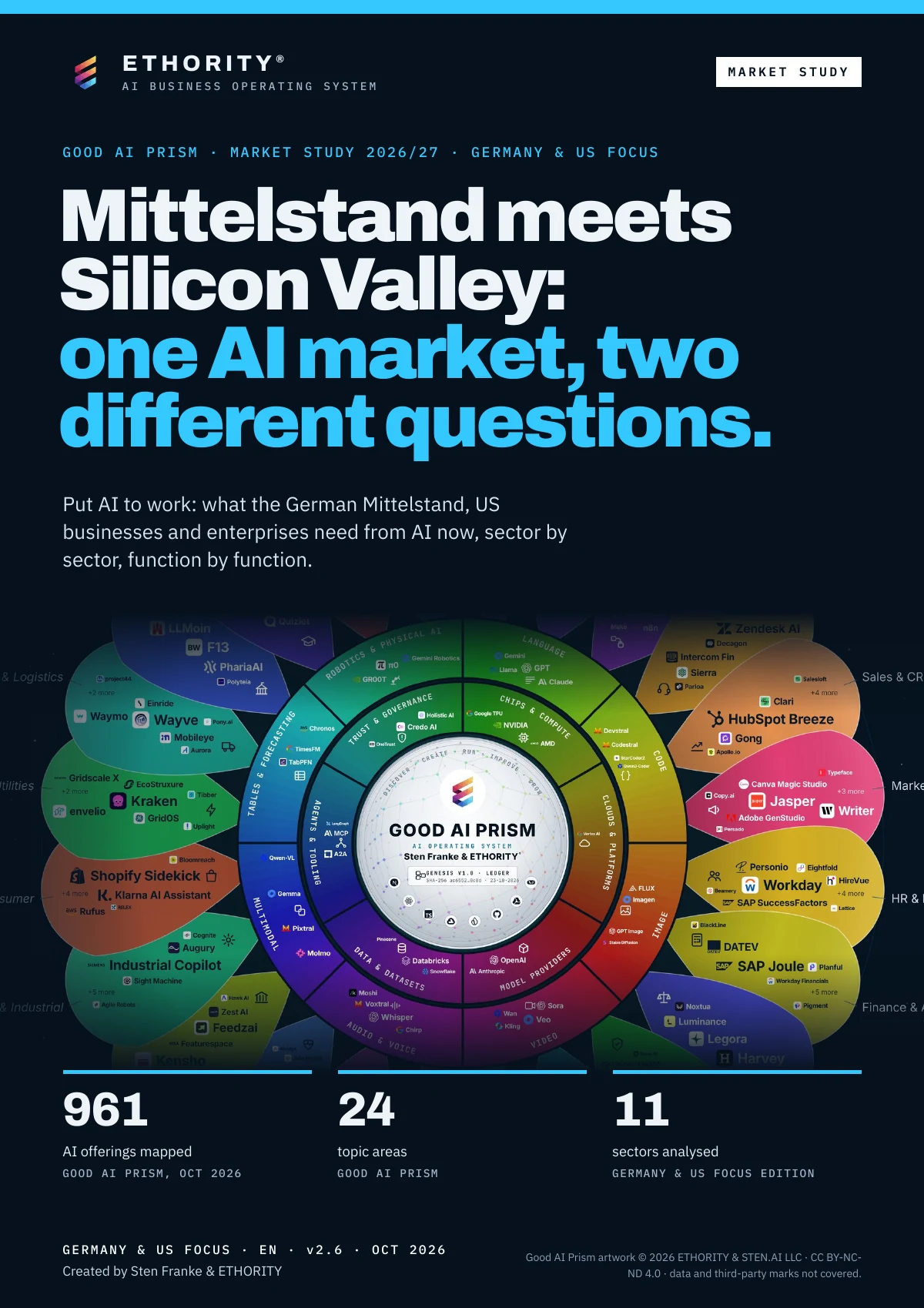
Germany & United States Focus · EN
Germany's mid-sized companies meet Silicon Valley: one AI market, two different questions.
The Mittelstand needs know-how; US firms need cost control. What German and US businesses need from AI now, sector by sector, function by function.
Version 2.6 · 72 pages
Open the study →
961 AI offerings. Start with the job, not the tool.
A method for going from one business need to a shortlist of AI offerings you can defend.
See the map on one page →Test your numbers first
The map is the first tool; the Stack Builder turns it into six technology layers. All tools sit in the ETHORITY AI calculator suite.
Good AI Prism map
The market study examines 961 AI offerings. The separate online catalogue contains 485 profiles; the counts describe different populations.
Stack Builder
Area, data type and constraints in; six technology layers with matching registry offerings and models out.
Pilot version · Scenario calculator
Open the calculator →Compare three offerings
Puts two to four offerings side by side in the same units, each fact with its source and the date it was checked.
Sten Franke leads every project.

Sten Franke
Founder & CEO
Sten Franke designs and builds AI systems, from model testing and cloud setup to the interfaces people use. He connects business decisions, software architecture and practical implementation.
AI architecture · Model testing · Cloud engineering · UX
His work spans programming, LLM evaluation, Google Cloud and AWS environments, and web applications built with Next.js and React. He connects business requirements, software architecture and practical implementation. Creator of the Good AI Prism, he brings market intelligence into AI decisions. Earlier, he created the Social Media Prisma, led a BVDW Social Media working group and contributed to its Social Media Kompass. His entrepreneurial work includes ethority, Gridpatrol and mediatime, following a practical foundation in electronics and industrial robotics.
sten@ethority.aiQuestions buyers ask
Is the Prism free?
Yes. The map, the curated segments, the basic registry profiles and the public Navigator are free to use.
Can we use the poster in a presentation?
Yes, for workshops, blogs, social media and press. Commercial use is by licence on request; the licence covers the artwork, not the underlying data or third-party marks.
How does an offering get onto the map?
Inclusion follows published, source-documented criteria. ETHORITY sets editorial order by stated evidence criteria.
How current is it?
Each fact carries the date it was read. The study is updated regularly; the current research dates from October 2026.
Who made the Prism?
Good AI Prism by Sten Franke & ETHORITY®, the successor to the first German Social Media Prisma of 2009.
Next step
Open the map, download the poster, or turn a shortlist into an AI Decision Brief for three.
ETHORITY · LONG READ
Why a market map beats a vendor list
Buyers face hundreds of AI offerings that rename, merge and reprice every few weeks. The Good AI Prism turns that market into one readable picture, and every point on it carries a source and a date.
Every buyer of AI meets the same problem early. The market is too large to read and changes too fast to remember. A search returns vendor pages written to sell. An analyst list covers the twenty biggest names. A colleague recommends the tool they happen to use. None of these shows the whole field, and none of them says when its facts were true.
The Good AI Prism by Sten Franke & ETHORITY® was built to show the whole field. In October 2026 it maps 961 AI offerings on one wheel with three rings: the business needs AI serves, the data types it works on and the technology layers it is built from. Twenty-four topic areas, from customer service to finance, HR, legal and software development, each carry their own colour. A buyer can start at the need, not at the vendor.
A map with sources
A map is only useful if its points are real. Every profile in the basic registry of profiles connects a product identity to its documented facts: pricing unit, data location, training on customer data, integrations and certificates. Each fact carries an evidence mark that says whether it is provider-documented, provider-stated, ETHORITY analysis or a third-party source, and the date it was read. When a provider changes a term, the correction history shows it.
That discipline matters because the market moves. During research for the global market study, ETHORITY found 34 product renames within a few weeks. A fact without a date would already be a guess.
Depth where buyers decide
The map is wide, and in places it is deep. Customer service is the deepest area today: 107 offerings were reviewed in detail, because that is where many organisations place their first large AI bet. The Customer Service topic area shows those profiles side by side. Finance, knowledge search, document work and software development follow.
From map to decision
The free products form a path. The Edition 2026/27 gives the overview. Curated segments narrow it to one function, industry or technology. The public Navigator builds a shortlist you can inspect and carry forward. From there, a buyer can compare up to three offerings and request an AI Decision Brief, or move to buyer intelligence research subscriptions for recurring research. The method is set out in the buyer's guide to 961 offerings: start with the job, not the tool.
A lineage of maps
Mapping technology markets is not new at ETHORITY. The German Social Media Prisma first appeared on 21 September 2009 and was updated for over a decade as social platforms multiplied. The Good AI Prism applies the same idea to AI: one picture that a leadership team can read in a minute and a researcher can trust in detail.
Using the artwork
The poster and wheel may be used in workshops, blogs, social media and press coverage with the credit line. Commercial use is by licence on request, through research and licensing. The licence covers the artwork; data, code and third-party marks keep their own terms.
Editorial independence, stated positively
Inclusion follows published, source-documented criteria. ETHORITY sets editorial order by stated evidence criteria, and provider-supplied content is labelled as such. That is what lets the same map serve buyers, providers and researchers. It also explains the design choices: a fact a provider has not published is left off the card rather than filled with an estimate, and the profile page lists it as a question to ask. Buyers see what is known, when it was known and what is still to be asked. That is a more useful starting point than any ranking.
How teams use the map in practice
Three patterns recur. A leadership team uses the wheel in a workshop to see where AI is already offered for its own functions and where the market is thin; the one-day Readiness & Maturity Check uses it that way. A buyer in one function filters to a segment, opens five or six profiles and builds a shortlist in the Navigator. A researcher or journalist uses the dated facts as a citable source, with the edition and read date attached.
All three benefit from the same rule: the map shows what is documented and when. The sector and function briefs extend it. The HR brief of the study and the finance brief of the study read the map for one function and add the regulatory dates that apply there. Each brief carries the same edition line as the study, so a figure quoted from a brief can be traced back to the dated research it came from.
The next updates deepen the areas buyers ask about most, following the same order: customer service first, then knowledge and search, document workflows, software development and finance.
Sources and further reading
YOUR NEXT STEP
Discuss your question with Sten Franke.
Bring your business question or the figures you already know. ETHORITY investigates within the agreed scope; together with Sten Franke you agree the next piece of work.