 ETHORITY®

In this article
Terms used in this article
Three rings. One AI market.
Good AI Prism v3.12 · full wheel, English edition · Good AI Prism artwork © 2026 ETHORITY & STEN.AI LLC · CC BY-NC-ND 4.0 · data and third-party marks not covered.
Source study · v2.1 · page 7 · Figure published: 25 Oct 2026
Read figure text, sources and rights
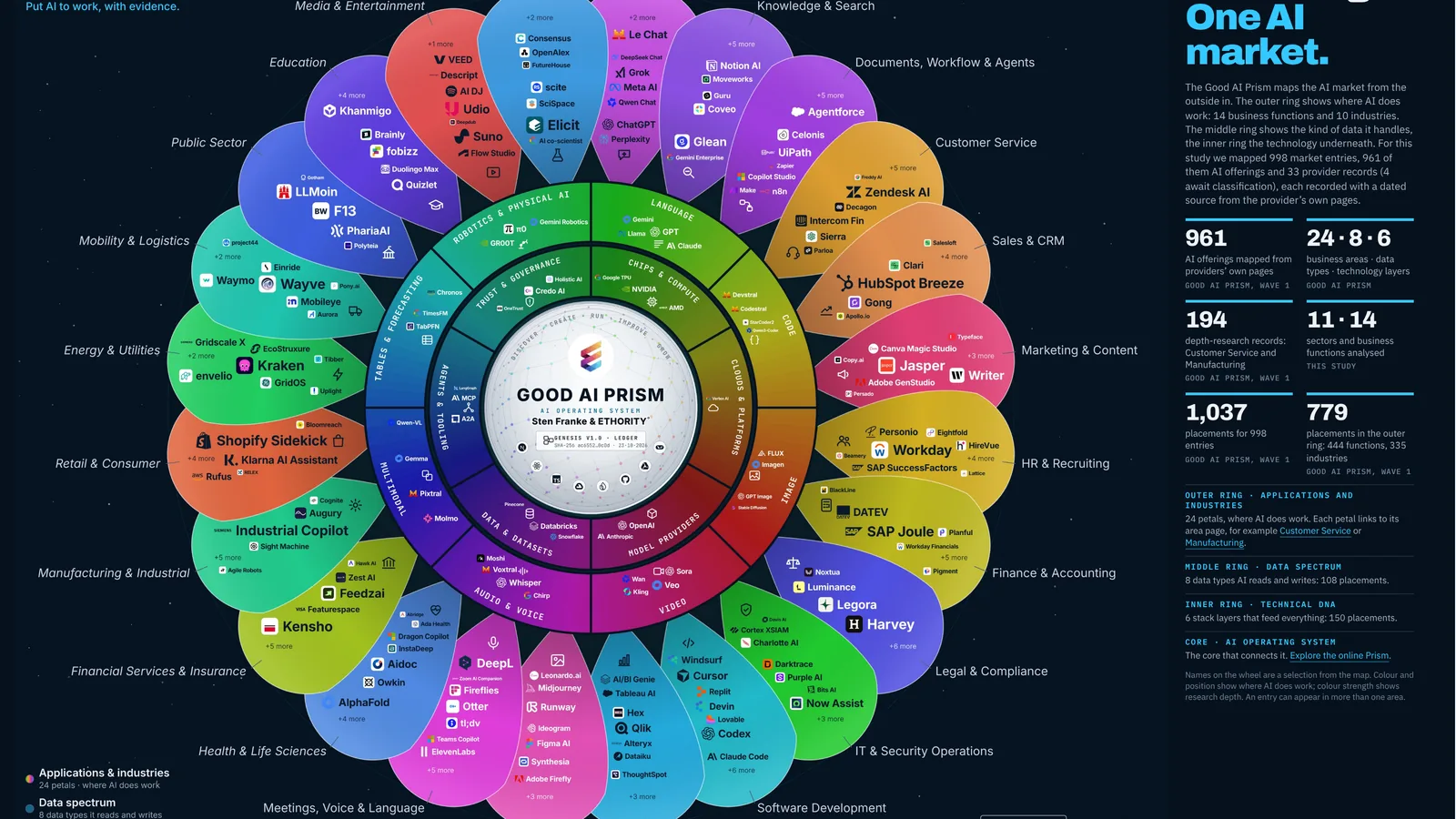
FOLD-OUT · PRISM V3.12 Three rings. One AI market. The Good AI Prism maps the AI market from the outside in. The outer ring shows where AI does work: 14 business functions and 10 industries. The middle ring shows the kind of data it handles, the inner ring the technology underneath. For this study we mapped 998 market entries, 961 of them AI offerings and 33 provider records (4 await classification), each recorded with a dated source from the provider’s own pages. 961 AI offerings mapped from providers’ own pages GOOD AI PRISM, WAVE 1 24 · 8 · 6 business areas · data types · technology layers GOOD AI PRISM 194 depth-research records: Customer Service and Manufacturing GOOD AI PRISM, WAVE 1 11 · 14 sectors and business functions analysed THIS STUDY 1,037 placements for 998 entries GOOD AI PRISM, WAVE 1 779 placements in the outer ring: 444 functions, 335 industries GOOD AI PRISM, WAVE 1 OUTER RING · APPLICATIONS AND INDUSTRIES 24 petals, where AI does work. Each petal links to its area page, for example Customer Service or Manufacturing. MIDDLE RING · DATA SPECTRUM 8 data types AI reads and writes: 108 placements. INNER RING · TECHNICAL DNA 6 stack layers that feed everything: 150 placements. CORE · AI OPERATING SYSTEM The core that connects it. Explore the online Prism. Names on the wheel are a selection from the map. Colour and position show where AI does work; colour strength shows research depth. An entry can appear in more than one area. Good AI Prism v3.12 · full wheel, English edition · Good AI Prism artwork © 2026 ETHORITY & STEN.AI LLC · CC BY-NC-ND 4.0 · data and third-party marks not covered. 7 · ethority.ai
ETHORITY figure. Rights in cited data and third-party marks remain with their owners. The Prism artwork licence applies where stated on the figure.
A list of 100 tools no longer helps anyone choose; a map of where AI does work, what data it handles and what technology it rests on does.
These figures describe the study’s research inventory, including entries outside this website’s 485-record candidate catalogue. They are not a count of verified products or website admissions.
Why we replaced the list
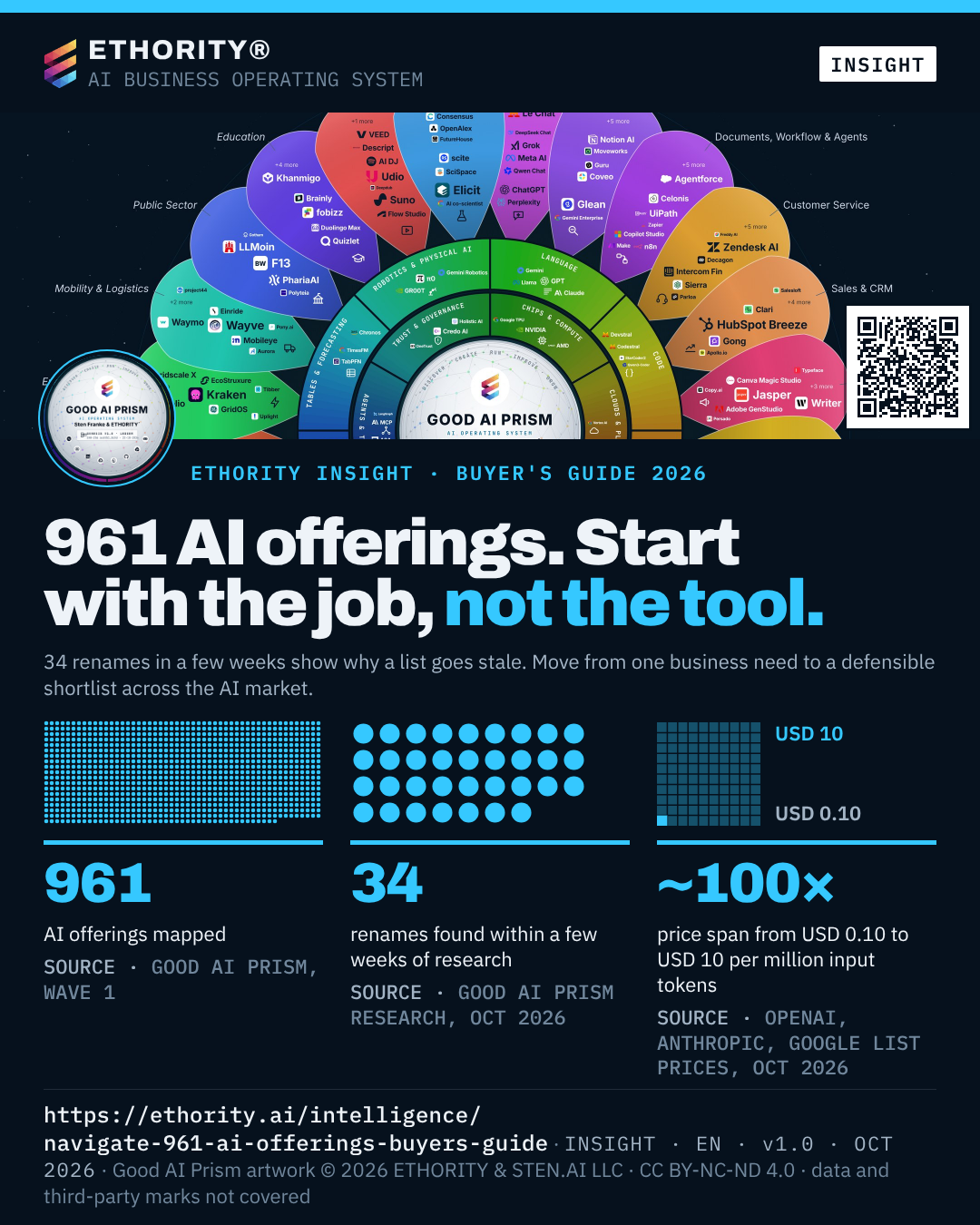
In 2024 we published a guide to more than 100 AI tools, sorted into categories such as natural language processing, computer vision, machine-learning frameworks and chatbots. Many of the names in it were developer libraries; several have since been renamed, merged or retired. The market has also grown too large for a list. For the Good AI Prism Global Market Study 2026/27 we mapped 998 market entries, 961 of them AI offerings, each recorded with a dated source from the provider's own pages.
The market also changes faster than any list. Within a few weeks of research we found 34 renames and 26 ownership changes, for example Acrolinx becoming Markup AI and LivePerson moving to SoundHound AI. So this edition is a method, not a catalogue: how to move from a business need to a defensible shortlist.
The map: three rings
The Good AI Prism maps the AI market from the outside in.
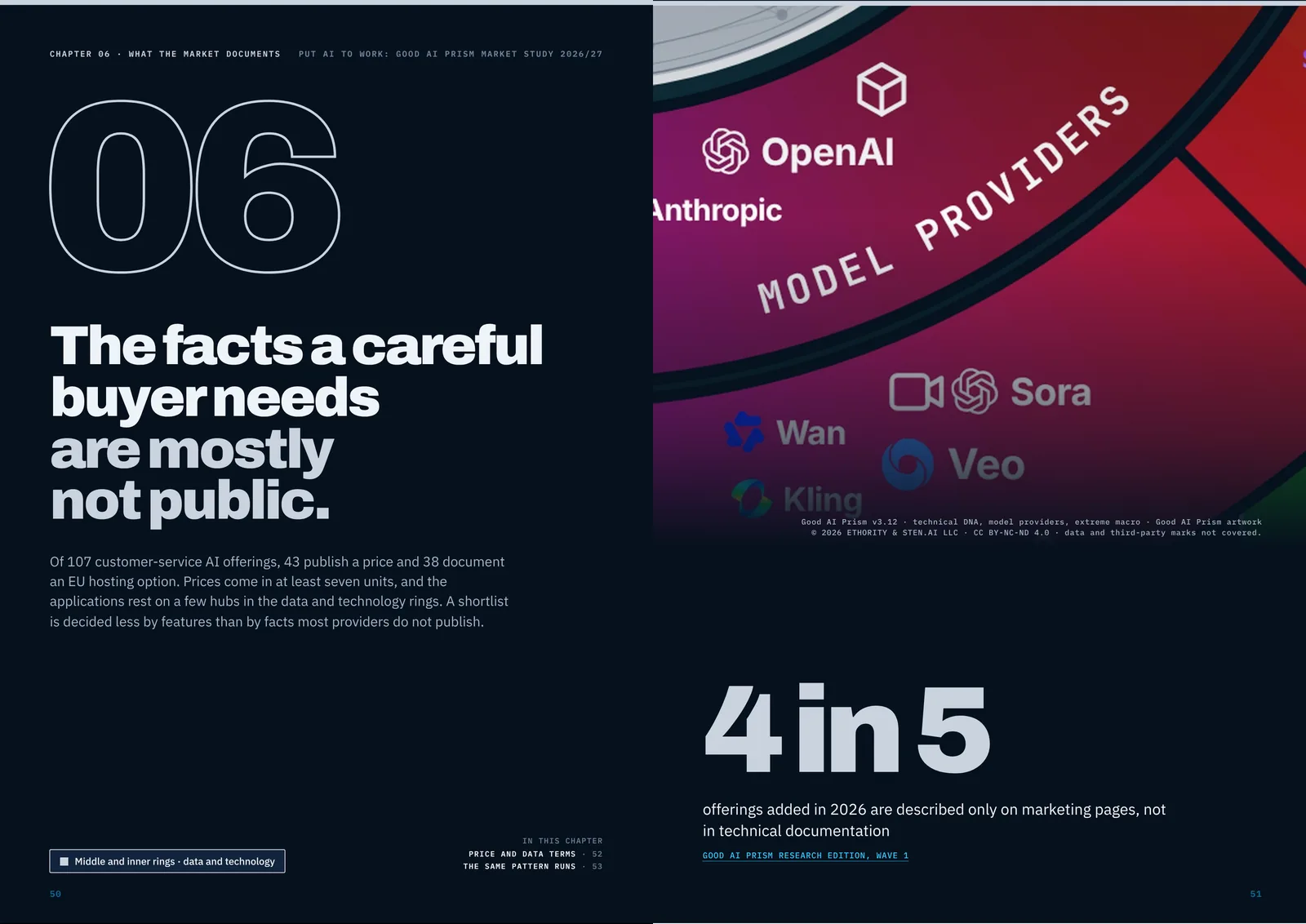
4 in 5 — offerings added in 2026 are described only on marketing pages, not in technical documentation
GOOD AI PRISM RESEARCH EDITION, WAVE 1
Source study · v2.1 · page 50-51 · Figure published: 25 Oct 2026
Read figure text, sources and rights
CHAPTER 06 · WHAT THE MARKET DOCUMENTS PUT AI TO WORK: GOOD AI PRISM MARKET STUDY 2026/27 06 The facts a careful buyer needs are mostly not public. Of 107 customer-service AI offerings, 43 publish a price and 38 document an EU hosting option. Prices come in at least seven units, and the applications rest on a few hubs in the data and technology rings. A shortlist is decided less by features than by facts most providers do not publish. Middle and inner rings · data and technology IN THIS CHAPTER PRICE AND DATA TERMS · 52 THE SAME PATTERN RUNS · 53 50 Good AI Prism v3.12 · technical DNA, model providers, extreme macro · Good AI Prism artwork © 2026 ETHORITY & STEN.AI LLC · CC BY-NC-ND 4.0 · data and third-party marks not covered. 4 in 5 offerings added in 2026 are described only on marketing pages, not in technical documentation GOOD AI PRISM RESEARCH EDITION, WAVE 1 51
ETHORITY figure. Rights in cited data and third-party marks remain with their owners. The Prism artwork licence applies where stated on the figure.
Outer ring: 24 business areas, where AI does work.
- 14 functions: Customer Service; Assistants & Copilots; Knowledge & Search; Documents, Workflow & Agents; Sales & CRM; Marketing & Content; HR & Recruiting; Finance & Accounting; Legal & Compliance; IT & Security Operations; Software Development; Data & Analytics; Design, Image & Video; Meetings, Voice & Language.
- 10 industries: Health & Life Sciences; Financial Services & Insurance; Manufacturing & Industrial; Retail & Consumer; Energy & Utilities; Mobility & Logistics; Public Sector; Education; Media & Entertainment; Science & Research.
Middle ring: 8 data types, the kind of data an offering handles: language, voice, audio, image, video, tables, code and multimodal.
Inner ring: 6 technology layers, the technology underneath: models, chips and compute, clouds, data, agents and trust.
An offering can sit in more than one area; the 998 entries hold 1,037 placements on the map.
Step 1: Start with the job, not the tool
Pick one process in one business area and measure it before you look at suppliers: volume, cost per case, quality and cycle time. Measured gains are real but task-specific. In customer support, a generative AI assistant raised issues resolved per hour by 14% on average and 34% for less experienced agents (NBER). In software work, measured effects range from 19% slower (METR) to 21% faster (Google RCT). A supplier's productivity figure is not your baseline.
Step 2: Name the data type
The middle ring narrows the field quickly. A voice agent, a document workflow and a coding assistant handle different data, carry different risks and need different checks. Voice and meeting tools, for example, raise consent questions: 65% of US workers who met with an AI notetaker said consent was inconsistent or missing (survey via KRDO).
Step 3: Understand the layers underneath
Most business buyers purchase applications, but each application rests on layers that change independently.
- Models. The frontier now has three closed flagships: OpenAI GPT-6 Astra, Anthropic Claude Fable 5.1 and Google Gemini 4 Argon. Open-weight options include Mistral Large 4, previewed in October 2026 with European deployment and on-premises options. Prices span roughly 100 times, from USD 0.10 to USD 10 per million input tokens, and 81% of large enterprises already use three or more model families (a16z). Models also retire: OpenAI shuts down its GPT-4o and GPT-4.1 snapshots on 14 January 2027.
- Chips and compute. Capacity stays tight. ASML expects its planned 2027–28 supply "will not fully meet customer demand", and big-tech capital spending is set to rise a further 75% in 2026 (IEA). At the same time, inference prices per unit keep falling steeply (Epoch AI).
- Clouds and data. Hosting region, subprocessors and data use decide whether an offering is usable for a European buyer at all.
- Agents. Spending on AI agents and assistants is forecast to grow from USD 29.2bn in 2026 to USD 65.5bn in 2027 (Gartner), yet Gartner also expects more than 40% of agentic AI projects to be cancelled by the end of 2027.
- Trust. Documentation, certifications and their scope, oversight and incident handling.
Source-documented relations between offerings show applications resting on a few hubs: Zendesk, Salesforce and the Model Context Protocol on the application side; OpenAI, Anthropic, Amazon Bedrock and Hugging Face underneath. A single model or platform change can move many products at once, so ask every supplier which model and cloud they depend on.
Source context: MCP · authorization specification · 2026-07-28 ↗
Step 4: Ask for the deciding facts in writing
A useful shortlist needs product- and plan-specific facts. Ask where storage, inference and backups take place, which sub-processors are involved, and which deployment locations you can select. An address in Europe or Switzerland does not establish EU hosting. Training only after opt-in, exclusion by default and an opt-out requirement are different policies. Inspect the dated evidence on each profile, retain qualifications, and ask the provider which contractual terms apply to your account. The study’s research records can overlap and are not a verified count of distinct products. Compare the facts for your own shortlist instead of using an earlier edition’s combined coverage ratio.
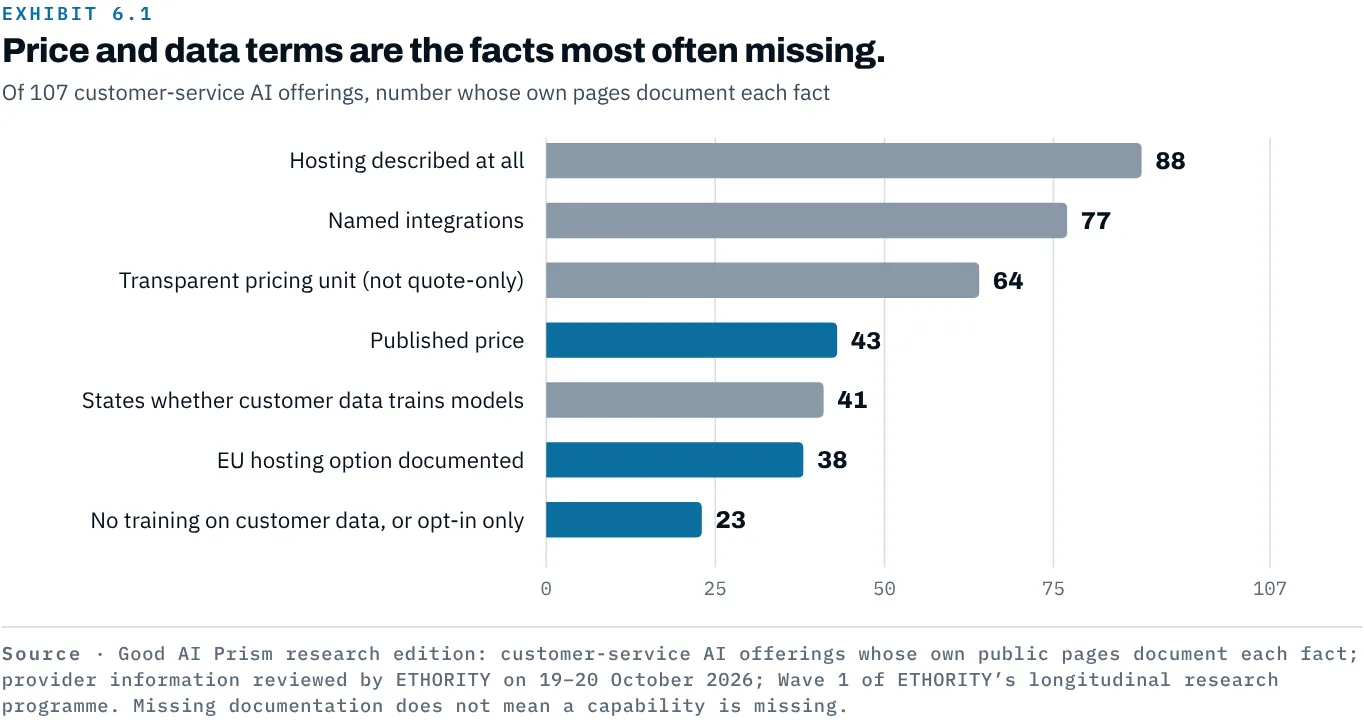
Price and data terms are the facts most often missing.
Good AI Prism research edition: customer-service AI offerings whose own public pages document each fact; provider information reviewed by ETHORITY on 19–20 October 2026; Wave 1 of ETHORITY’s longitudinal research programme. Missing documentation does not mean a capability is missing.
Source study · v2.1 · page 52 · Figure published: 25 Oct 2026
Read figure text, sources and rights
EXHIBIT 6.1 Price and data terms are the facts most often missing. Of 107 customer-service AI offerings, number whose own pages document each fact 0 25 50 75 107 Hosting described at all 88 Named integrations 77 Transparent pricing unit (not quote-only) 64 Published price 43 States whether customer data trains models 41 EU hosting option documented 38 No training on customer data, or opt-in only 23 Source · Good AI Prism research edition: customer-service AI offerings whose own public pages document each fact; provider information reviewed by ETHORITY on 19–20 October 2026; Wave 1 of ETHORITY’s longitudinal research programme. Missing documentation does not mean a capability is missing. 0 25 50 75 107 Hosting described at all 88 Named integrations 77 Transparent pricing unit (not quote-only) 64 Published price 43 States whether customer data trains models 41 EU hosting option documented 38 No training on customer data, or opt-in only 23
ETHORITY figure. Rights in cited data and third-party marks remain with their owners. The Prism artwork licence applies where stated on the figure.
Two further patterns run across the market. Four in five offerings we added in 2026 are described only on marketing pages, not in technical documentation. And prices come in at least seven units: per resolution, per seat, per conversation, per minute, credits, plan tier and quote only.
Step 5: Compare on cost per accepted outcome
Because prices come in different units, convert every option to one measure: total monthly cost (usage or licence, amortised integration, monitoring and training, human review, handling of failed cases) divided by the outcomes your business accepts. In a customer-support scenario with 10,000 cases a month, €11,000 of total cost and a 40% acceptance rate give €2.75 per accepted outcome, which you can set against today's cost per resolved case.
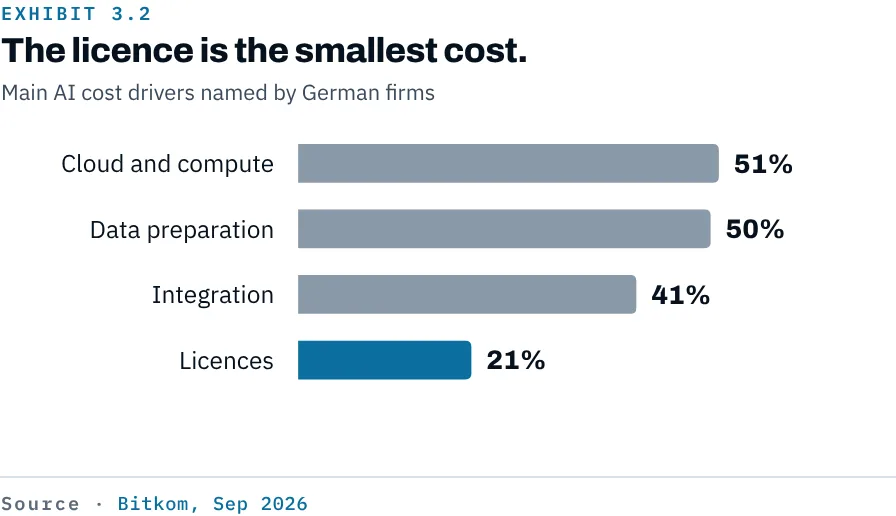
The licence is the smallest cost.
Bitkom, Sep 2026
Source study · v2.1 · page 29 · Figure published: 25 Oct 2026
Read figure text, sources and rights
EXHIBIT 3.2 The licence is the smallest cost. Main AI cost drivers named by German firms Cloud and compute 51% Data preparation 50% Integration 41% Licences 21% Source · Bitkom, Sep 2026 Cloud and compute 51% Data preparation 50% Integration 41% Licences 21%
Source links on the cited study page
ETHORITY figure. Rights in cited data and third-party marks remain with their owners. The Prism artwork licence applies where stated on the figure.
Step 6: Check the rules for your intended use
Whether an offering is high-risk depends on what you use it for. In the EU, Article 50 transparency duties apply since 2 August 2026; high-risk duties for Annex III uses such as recruitment, credit and education apply from 2 December 2027 under Regulation (EU) 2026/1744. Colorado and California duties on automated decisions apply from 1 January 2027.
Source context: EU AI Act · consolidated 2026-07-27 ↗
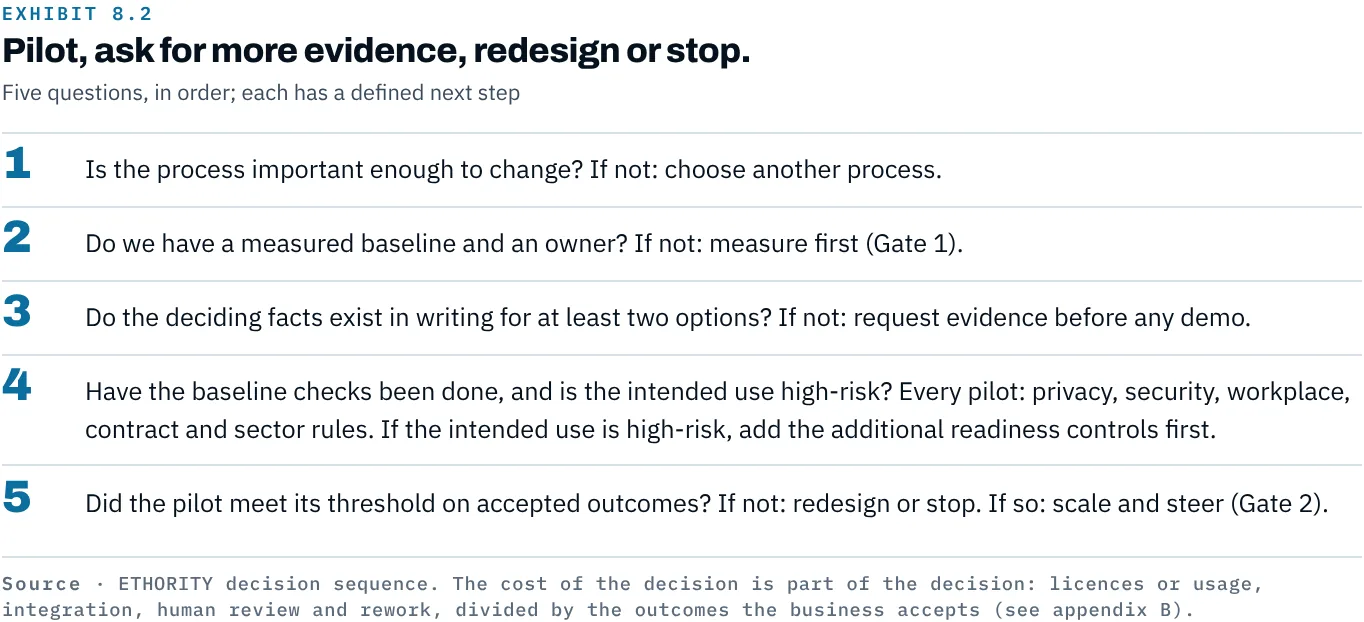
Pilot, ask for more evidence, redesign or stop.
ETHORITY decision sequence. The cost of the decision is part of the decision: licences or usage, integration, human review and rework, divided by the outcomes the business accepts (see appendix B).
Source study · v2.1 · page 66 · Figure published: 25 Oct 2026
Read figure text, sources and rights
EXHIBIT 8.2 Pilot, ask for more evidence, redesign or stop. Five questions, in order; each has a defined next step Is the process important enough to change? If not: choose another process. Do we have a measured baseline and an owner? If not: measure first (Gate 1). Do the deciding facts exist in writing for at least two options? If not: request evidence before any demo. Have the baseline checks been done, and is the intended use high-risk? Every pilot: privacy, security, workplace, contract and sector rules. If the intended use is high-risk, add the additional readiness controls first. Did the pilot meet its threshold on accepted outcomes? If not: redesign or stop. If so: scale and steer (Gate 2). Source · ETHORITY decision sequence. The cost of the decision is part of the decision: licences or usage, integration, human review and rework, divided by the outcomes the business accepts (see appendix B).
ETHORITY figure. Rights in cited data and third-party marks remain with their owners. The Prism artwork licence applies where stated on the figure.
Use the map as an entrance, not a verdict
The Prism helps identify where to look. It does not decide that an offering fits your organisation, and placement in an area is not an independent verification result. An application may appear in several areas because it supports several kinds of work. That is useful context, provided repeated placements are not counted as separate products.
Keep the research inventory, the website candidate catalogue and the evidence depth separate. The research figures above describe their stated edition. The website exposes its own admitted candidate records and qualifications. An identified offering, a substantive profile and a decision-ready research record are different levels of usefulness. The interface should help you inspect the difference rather than convert presence on a map into an assurance.
This is why the buyer's first question matters. “Find an AI tool” is too broad. “Find options for preparing support replies in German using our approved policy, with people sending the final answer” creates a tractable search. It names the task, language, source and authority boundary before a product enters the conversation.
Walk one question through the whole journey
Start in the Customer Service area and select an offering. Read the panel for its purpose and the material source qualifications. Then open the profile for the facts that matter to your intended use. If data region or training use is not established for the relevant plan, keep that as a provider question. Do not infer an answer from the supplier's headquarters.
Add two contrasting options to Compare. The point is not to assemble the largest shortlist. It is to see meaningful differences in the same fields: billing basis, relevant data conditions, scope and the work the product actually supports. A quote-only price can remain a useful option, but it cannot be represented as zero cost. A documented regional option remains conditional until its applicability is confirmed.
Inspect the sourced connections where they affect dependency. An application using a model platform may inherit some technical constraints while retaining its own contract and data processing. The relationship is evidence about a connection, not permission to transfer every claim from the platform to the application. If the source does not establish the downstream condition, ask the supplier.
Prepare a comparison that survives a supplier conversation
Use a short written brief for every candidate. Include the intended task, expected volume, languages, data sensitivity, acceptable output and actions that remain human. Ask each provider the same deciding questions. Otherwise one supplier can look stronger simply because it answered a different interpretation of the request.
Keep an explicit distinction between included functionality, optional configuration and separately scoped integration. A product can have a relevant feature without providing the complete workflow you need. Identify who will maintain the source documents, who handles exceptions and which existing systems must change. Those responsibilities affect both feasibility and cost.
Record the answer date and the service arrangement. When a sales conversation resolves a question, ask for the applicable documentation or contractual wording where the decision requires it. Do not silently replace a conflicting published source with a favourable informal answer. Preserve enough context for another buyer or reviewer to understand the conclusion.
Check the economics before reducing the shortlist to one
Use a range for uncertain inputs. If the acceptance rate is unknown, show how the result changes rather than substituting an optimistic value. If the use case releases time, describe how the organisation intends to use it. A capacity scenario is different from a realised cash saving. The economics tools can help make those assumptions visible.
Then choose the next evidence step. It may be a written price, a deployment confirmation, a small evaluation or a decision to use an existing tool. A good shortlist is not a promise to purchase. It is a manageable set of options with clear reasons for inclusion and concrete conditions for proceeding.
Keep a shortlist small enough to challenge
For every retained candidate, write one reason to consider it and one fact that could rule it out. This prevents a familiar brand from staying on the list without a relevant advantage. It also prevents a less familiar offering from being rejected merely because its documentation uses different language.
Ask another person to reconstruct the comparison from the sources. Can they find the price period, the deployment condition and the unresolved question? If not, improve the record before adding more products. A shortlist with four understandable options is more useful than a longer table whose cells conceal incompatible assumptions.
When the comparison changes, preserve the reason. A new contract condition, a corrected identity or a better-defined task may explain the update. The original selection was not necessarily careless; it relied on a different state of knowledge. Keeping that history makes the process reusable without presenting yesterday's answer as today's certainty.
Turn the research into an accountable next action
For a focused comparison of up to three offerings, inspect the AI Decision Brief. If the business question and implementation assumptions are still unclear, the AI Business Blueprint may be a better starting point. A deeper investment case is separately scoped through the Enterprise AI Opportunity Case.
Carry the selected products, language and unresolved questions into the enquiry. Check the draft before sending it yourself. A prepared message is not a submitted order, and a provider question is not a negative verdict. The map has done its job when it helps you move from an unbounded market to a useful decision with the right evidence and a responsible owner.
What to decide now
- Choose one process, place it on the map (business area, data type, layer) and measure its baseline before any demo.
- Send every shortlisted supplier the same written questions: hosting region, training use, billing unit, model and cloud dependencies, exit terms.
- Compare options on cost per accepted outcome at your own volume, with a stop condition agreed in advance.
The Good AI Prism, the full taxonomy and the October 2026 research findings are available at ethority.ai/ai-prism-study, where providers and readers can also submit corrections.
Sources
- ETHORITY, Good AI Prism Global Market Study 2026/27 (research edition 20 Oct 2026): https://ethority.ai/ai-prism-study
- NBER Working Paper 31161: https://www.nber.org/papers/w31161
- METR study, via Simon Willison: https://simonwillison.net/2025/Jul/12/ai-open-source-productivity/
- Google RCT on developer productivity: https://arxiv.org/html/2410.12944v2
- KRDO / Stacker, AI notetaker survey (Jul 2026): https://krdo.com/stacker-business-economy/2026/07/16/ai-notetakers-have-sat-in-on-1-in-3-us-workers-meetings-but-only-a-third-say-they-were-asked-first/
- OpenAI, GPT-6 Astra: https://openai.com/index/gpt-6-astra/
- Anthropic, models overview: https://platform.claude.com/docs/en/about-claude/models/overview
- Google Cloud, Gemini 4 Argon: https://cloud.google.com/blog/products/ai-machine-learning/gemini-4-argon-available-on-google-cloud
- Mistral AI, Mistral Large 4: https://mistral.ai/news/mistral-large-4/
- OpenAI, GPT-6.1 Sol and Luna pricing: https://openai.com/index/introducing-gpt-6-1-sol/
- a16z, enterprise AI survey (Jan 2026): https://a16z.com/leaders-gainers-and-unexpected-winners-in-the-enterprise-ai-arms-race/
- OpenAI, deprecations: https://developers.openai.com/api/docs/deprecations
- ASML, Q3 2026 results (6-K): https://www.sec.gov/Archives/edgar/data/0000937966/000162828026065813/pressreleasefinancialresul.htm
- IEA, data-centre electricity 2025: https://www.iea.org/news/data-centre-electricity-use-surged-in-2025-even-with-tightening-bottlenecks-driving-a-scramble-for-solutions
- Epoch AI, inference price trends: https://epoch.ai/data-insights/ai-inference-price-trends
- Gartner, worldwide AI spending forecast (16 Sep 2026): https://gartner.com/en/newsroom/press-releases/2026-09-16-gartner-forecasts-worldwide-ai-spending-to-grow-49-point-5-percent-in-2026
- Gartner, agentic AI project cancellations: https://www.gartner.com/en/newsroom/press-releases/2025-06-25-gartner-predicts-over-40-percent-of-agentic-ai-projects-will-be-canceled-by-end-of-2027
- Regulation (EU) 2026/1744: https://eur-lex.europa.eu/eli/reg/2026/1744/oj/eng
- Colorado SB 26-189: https://leg.colorado.gov/bills/sb26-189
- California Privacy Protection Agency, ADMT regulations: https://privacy.ca.gov/2025/09/california-finalizes-regulations-to-strengthen-consumers-privacy/
Updated edition of the article first published on ethority.net in 2024; the original remains archived.