 ETHORITY®

AI Business Blueprint
One objective, one 90-day AI roadmap.
Turn your business goal into a practical 90‑day AI plan.
€495 net · one-time
Scope and delivery date are confirmed in writing before work starts.

What you receive
An eleven-section plan for one objective, with the decision on page one, two to four options and a 30/60/90-day roadmap.
Your objective, an accountable owner on your side and any figures you already have. ETHORITY maps today’s workflow with your team and gathers the rest.
The ETHORITY Promise
The ETHORITY Promise
We make the value clear. We take responsibility for our delivery. We make results transparent.
- A specific expected outcome, with its basis and assumptions.
- Defined deliverables, price, timing and acceptance criteria.
- Supporting evidence, accountable ownership and measurement where included.
You receive a clear recommendation, an agreed delivery commitment and transparent results. We explain the value you can expect, the basis for that assessment and what ETHORITY takes responsibility for.
- Expected value
- You receive a plan for one objective, set out so your management can decide on it in five minutes.
- Your deliverable
- Eleven sections with the decision on page one, two to four options and a roadmap for 30, 60 and 90 days.
- Responsibility
- ETHORITY maps the current workflow, assesses the options and recommends one path, within the scope and by the date confirmed in writing before work starts.
- Evidence
- Every baseline figure carries one of four ETHORITY evidence labels; any figure still missing is named, with its effect on the decision.
- Fixed price
- €495 plus VAT, one-time
- Delivery
- scope and delivery date confirmed in writing before work starts
The value receipt runs through the whole assignment: the expected value before you order, then the agreed commitment, and the proof on delivery.
Scenario figures are assumed; your own figures are established in your assignment.Scope, responsibilities and evidence
- 11
- sections, with the decision on page oneOffer terms →
- 4
- ETHORITY evidence labels; every baseline figure carries oneOffer terms →
- 90
- days of roadmap, in steps of 30, 60 and 90Offer terms →
Your decision at a glance
- You receive
- An eleven-section plan for one objective, with the decision on page one, two to four options and a 30/60/90-day roadmap.
- Price
- €495 net · one-time
- Delivery
- Scope and delivery date are confirmed in writing before work starts.
- What we need from you to get started
- Your objective, an accountable owner on your side and any figures you already have. ETHORITY maps today’s workflow with your team and gathers the rest.
- Next step
- Request a Blueprint with a short description of your objective.
Tell us the problem.
What ETHORITY delivers
- The workflow map and opportunity map
- Two to four options with their economics
- The human-and-AI operating model
- An eleven-section plan with a 30/60/90-day roadmap
What we need from you to get started
- Your objective, an accountable owner on your side and any figures you already have. ETHORITY maps today’s workflow with your team and gathers the rest.
Your objective, an accountable owner on your side and any figures you already have. ETHORITY maps today’s workflow with your team and gathers the rest.
Don’t know something yet? Say so. ETHORITY clarifies it with you as part of the work.
Your decision
- Which option to pursue
- Which next steps to commission
Work starts after confirmed payment and receipt of the start inputs; within the agreed scope, ETHORITY gathers everything else.
- A decision on page one that your CEO reads in five minutes.
- Every figure carries one of four ETHORITY evidence labels, from known to still required.
- Two to four options and a 30/60/90-day roadmap to start.
What you receive
- Executive decision on one page: the problem, three opportunities, three open questions, three priority actions.
- Objective and baseline, each figure marked as known, customer-provided, publicly observed or still required.
- Work and process map: repetitive, knowledge-heavy, judgement-heavy and control-sensitive work.
- AI opportunity map: target work, intervention pattern, value mechanism, dependency and main open question.
- Human-and-AI operating model: what AI may do, what people keep, where approval and escalation sit.
- Technology directions compared by pattern, with fit, limits and what to validate.
- Data and integration requirements.
- Economic frame: what would have to be true for the initiative to pay off.
- Material risks, with what is known and what evidence is still needed.
- Two to four decision options and one recommended path.
- 30/60/90-day roadmap.
Who it is for
A managing director, operations lead or customer-service lead with one important objective: faster customer response, less manual administration, better use of internal knowledge. You want a plan to forward to the CEO, CFO, CIO and the team that will do the work, before anyone buys a tool from the 961 offerings in the Prism.
The question it answers
Where could AI change this part of our work, what would it take to find out, and what do we do in the next 90 days?
How it works
- 1
Request Tell us your objective and name an accountable owner; share figures if you have them. ETHORITY maps today’s workflow with your team.
- 2
Confirm Sten Franke confirms inputs, scope and delivery date with you before the work starts.
- 3
Build ETHORITY maps the work, the opportunities and the patterns, and builds the economic frame from your figures.
- 4
Deliver You receive the Blueprint with the one-page decision on top, ready to forward.
Packages and price
AI Business Blueprint
€495 net · one-time
One bounded initiative, eleven sections, baseline marked by evidence status, two to four options and a 30/60/90-day roadmap.
Request scope and delivery
See what this package includes →Terms
One-time, net. Scope and delivery date are confirmed in writing before work starts.
Boundary
A decision-ready planning document for one objective. Product choice, legal review and implementation follow as separate, named next steps.
Who is accountable for the result

Sten Franke
Founder & CEO
Sten Franke designs and builds AI systems, from model testing and cloud setup to the interfaces people use. He connects business decisions, software architecture and practical implementation.
AI architecture · Model testing · Cloud engineering · UX
His work spans programming, LLM evaluation, Google Cloud and AWS environments, and web applications built with Next.js and React. He connects business requirements, software architecture and practical implementation. Creator of the Good AI Prism, he brings market intelligence into AI decisions. Earlier, he created the Social Media Prisma, led a BVDW Social Media working group and contributed to its Social Media Kompass. His entrepreneurial work includes ethority, Gridpatrol and mediatime, following a practical foundation in electronics and industrial robotics.
sten@ethority.aiSten Franke frames the assignment, interprets the findings and signs off on the final recommendations.
Real offerings we compare against
Agent and automation platforms are often the first technology direction a Blueprint weighs. Three profiles show the facts behind that comparison: Beam AI agents, Relevance AI agent builder and Nanonets document automation.
Beam AI
Beam AI · Platform
Beam AI runs enterprise AI agents on graph-based workflows that mix fixed steps with LLM nodes, pausing at consent nodes for human approval and drawing on 1,500+ prebuilt connectors.
- How it is billed
- Where data is stored
- Does it train AI on your data?
- Certificates and audit reports
Relevance AI
Relevance AI · Platform
According to Relevance AI: “Subject-matter experts can use Relevance to design powerful AI agents without relying on developer resources.”
- Published price
- How it is billed
- Where data is stored
- Does it train AI on your data?
Nanonets
Nanonets · Product
Nanonets extracts fields and tables from invoices, forms and scans via configurable workflows billed per block run, routing rule-violating files to reviewers before export to ERPs, databases or sheets.
- Published price
- How it is billed
- Where data is stored
- Certificates and audit reports
Read before you decide
Read AI-first as an operating model before you define the objective.
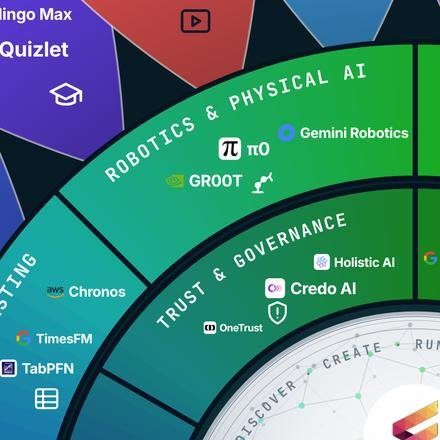
AI-first means changing how you work, not counting tools.
What has to change across the organisation: strategy, work, decision rights, knowledge, evidence and leadership.
See the map on one page →
AI does not scale by itself. Redesign the work.
Start with one objective, choose the simplest approach for each task and measure the cost of every result you accept.
See the map on one page →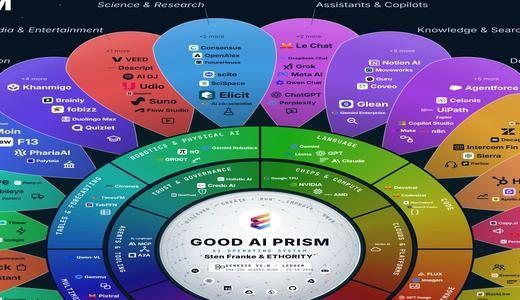
961 AI offerings. Start with the job, not the tool.
A method for going from one business need to a shortlist of AI offerings you can defend.
See the map on one page →Want a preview?
Our examples and calculators show how we assess value and assumptions. Using them is optional. For your assignment, ETHORITY does the preparation and the assessment.
Below, Capacity Conversion shows what AI-drafted quotes are worth to a sales team; the AI Journey Planner drafts the 30/60/90-day path the Blueprint finishes. All tools sit in the ETHORITY AI calculator suite.
AI Journey Planner
A plan from the first idea to scaling up, with milestones, owners, checkpoints and the EU AI Act dates in that period.
Pilot version · Scenario calculator
Open the calculator →AI Opportunity Map calculator
Ranks up to six candidate AI uses across the 24 topic areas of the Good AI Prism by the hours at stake, how ready you are and who is affected.
Pilot version · Scenario calculator
Open the calculator →Capacity Conversion calculator
Shows how much of the time AI saves becomes money, including the 36-second checking test as a Scenario.
Pilot version · Scenario calculator
Open the calculator →Questions buyers ask
Do we need complete data to start?
Start with what you have. Where the baseline is missing, the Blueprint names what to measure first.
Does it recommend a specific product?
It compares technology patterns. Product choice comes later, for example through an AI Decision Brief.
How long is it?
Long enough to answer eleven questions, with the decision on the first page so a CEO can read it in five minutes.
What if the answer is not AI?
Then the Blueprint says so. A process improvement or a measurement exercise can be the right next step.
Who works on it?
Sten Franke leads the analysis and signs the Blueprint; your accountable owner supplies the objective, today's workflow and the figures you have.
ETHORITY · LONG READ
Many AI plans start with a tool. Better ones start with the work.
A tool-first plan answers what a product can do. An objective-first plan answers what the business needs, and whether AI is the right way to get there.
A tool-first plan answers what a product can do. An objective-first plan answers what the business needs, and whether AI is the right way to get there.
Most AI plans begin in the wrong place. Someone sees a capable product, imagines where it could help and writes a proposal around it. The proposal is about the tool. Leadership then has to work backwards to the business case, and usually cannot.
The AI Business Blueprint begins with one business objective and the work behind it. What does the team do today? Which parts are repetitive, which need knowledge, which need judgement and which carry control risk? Only then does it ask where AI could change the work, through which pattern, and what that change depends on.
The baseline is honest by construction. Every figure is marked as known, provided by you, publicly observed or still required. So the economics show what is known and what is still open. Where the baseline is missing, the Blueprint says what to measure first, because a plan built on measured volumes holds at the first review. The insight on why saved hours are not AI value explains why that matters.
Technology is compared by pattern rather than by brand: assistant, retrieval, agent, workflow automation or an extension of a platform the company already owns. Each pattern gets its fit, its limits and what would have to be validated. The Good AI Prism market study supplies the market context, so the patterns describe what can be bought today.
The operating model is the section leaders read twice. It says what AI may do on its own, what people keep, and where approval and escalation sit. That is where an AI plan becomes an organisational plan.
The Blueprint ends with two to four options, one recommended path and a 30/60/90-day roadmap. The next step may be a bounded pilot, a process change or a measurement exercise. Your team should know what to do, who needs to take part and which evidence will support the next decision.
Sources and further reading
Scenario
A worked example
- The goalOne business goal. Where does AI help, and where not?
- Today’s workA map of today’s work and where AI could change it.
- The sequenceWhat to do now, next, and what can wait.
- What you receiveTwo to four options, each with its conditions.
- Your next stepA personal recommendation from Sten Franke for what to do next.
From the deliverable
AI Business Blueprint
An eleven-section plan for one objective, with the decision on page one, two to four options and a 30/60/90-day roadmap.
Explore the evidence and full sample pages
Read the example as text
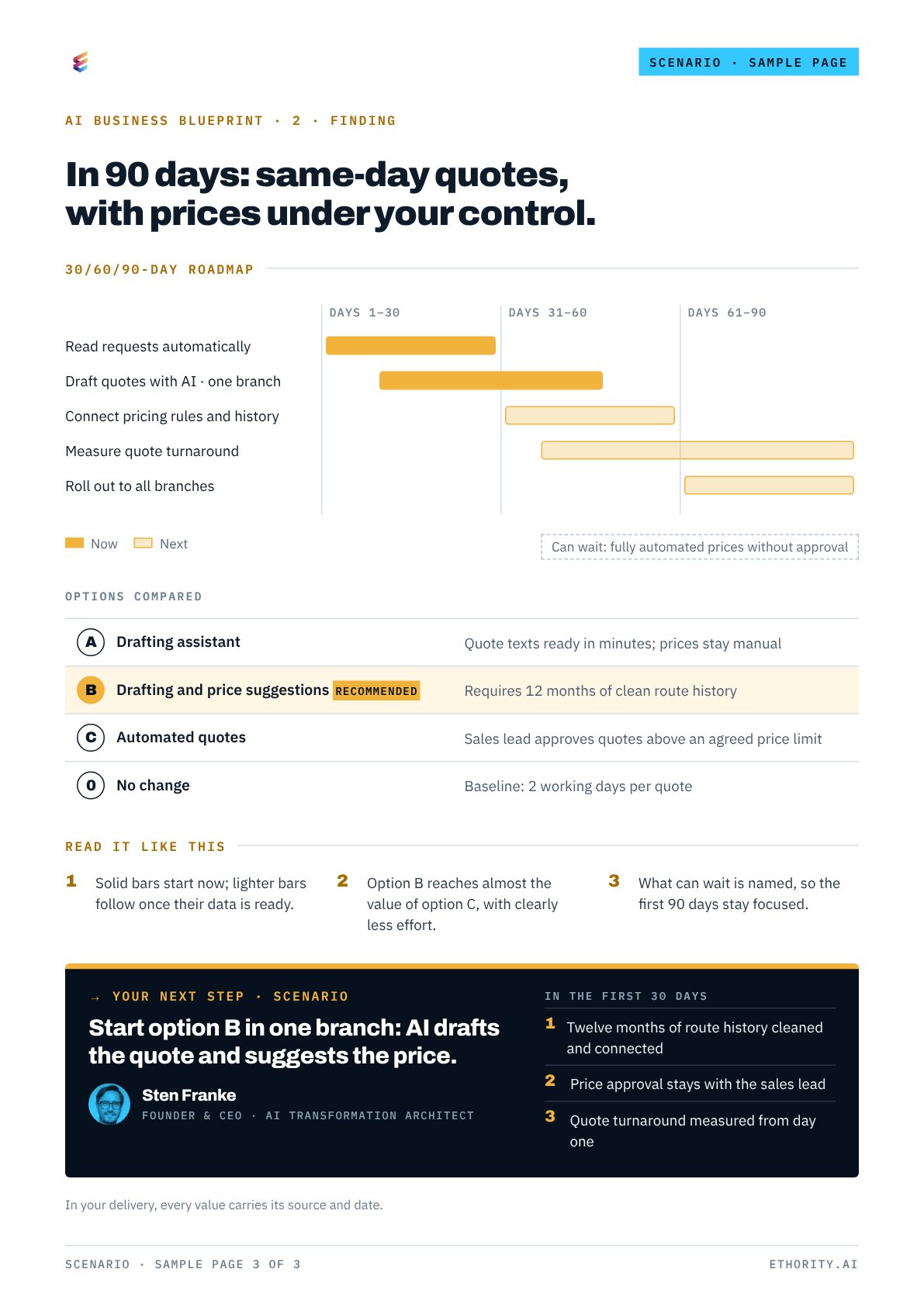
AI Business Blueprint, decision page (Scenario): In 90 days: same-day quotes, with prices under your control. Options: A Drafting assistant: Quote texts ready in minutes; prices stay manual; B Drafting and price suggestions: Requires 12 months of clean route history (Recommended); C Automated quotes: Sales lead approves quotes above an agreed price limit; 0 No change: Baseline: 2 working days per quote. 30/60/90-day roadmap: Read requests automatically; Draft quotes with AI · one branch; Connect pricing rules and history; Measure quote turnaround; Roll out to all branches. Start option B in one branch: AI drafts the quote and suggests the price.
1 / 5 · The goal
One business goal. Where does AI help, and where not?
Scenario
Read exhibit data
Scenario inputs and conditional examples; not a delivered client result or released recommendation.
AI Business Blueprint · Business goal · Scenario
Prepare customer quotes faster, with price approval kept by the sales lead.
- Who asks: Logistics company
- Today: 2 working days per quote
- Goal: Same day
See 3 sample pages · Scenario
What the deliverable looks like
Scenario: the sample shows structure, detail and questions; it is not a client result.
- A one-page decision: the problem, three opportunities, three unknowns, three actions
- A map of today’s work and where AI could change it
- What AI may do, what people decide, and when it would pay off
- Two to four options and a 30/60/90-day roadmap
Page 1 / 3
Read sample data
AI Business Blueprint · Sample page 1 of 3 · Scenario
Turn one business goal into an AI plan for the next 90 days.
Scenario: a logistics company wants AI to prepare customer quotes faster.
Prepared by Sten Franke · ETHORITY · Delivery date agreed with you before the work starts
AI Business Blueprint
€495 net · one-time