 ETHORITY®
In this article
Terms used in this article
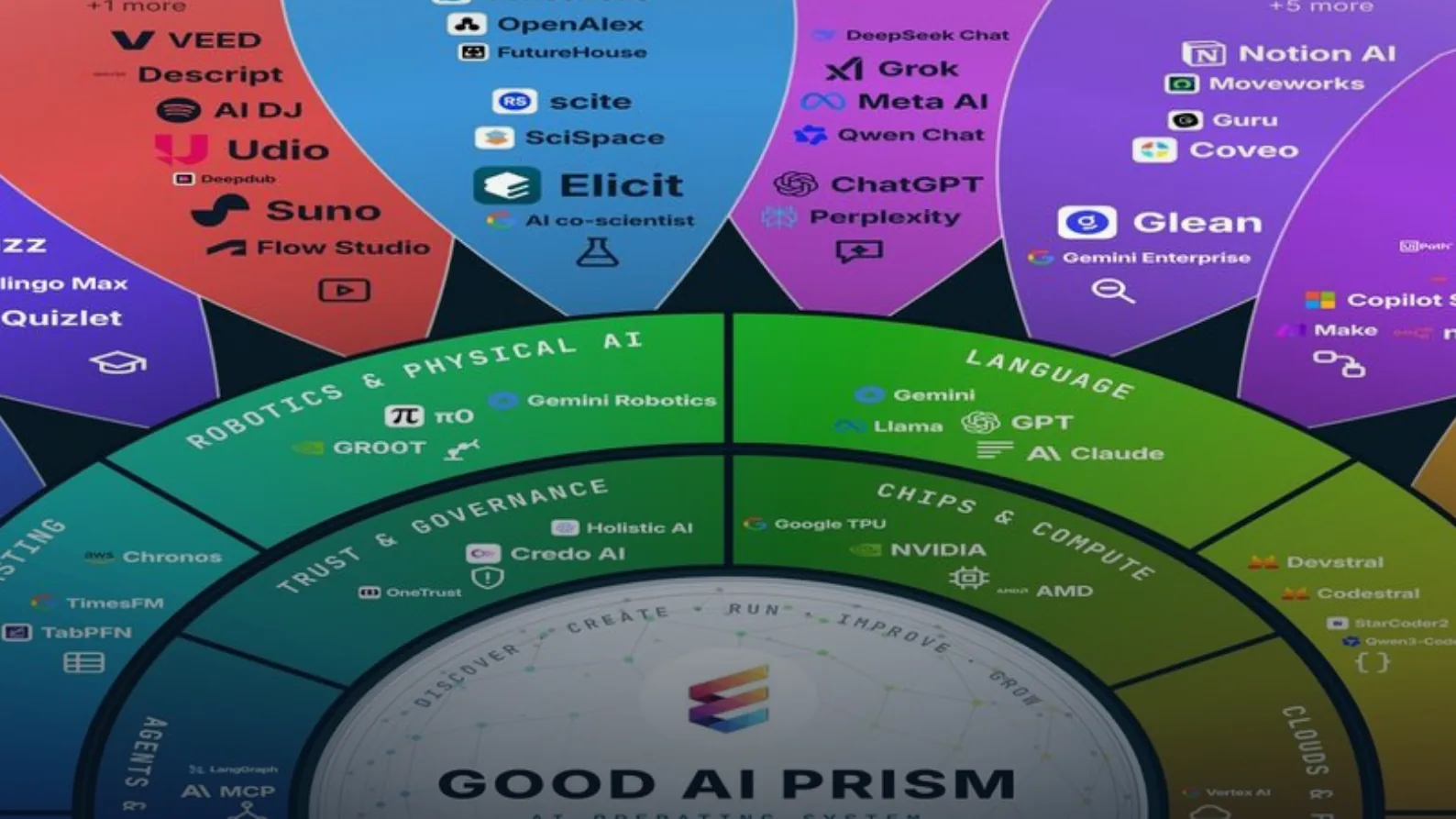
Good AI Prism v3.12 · full spectrum, wide strip · Good AI Prism artwork © 2026 ETHORITY & STEN.AI LLC · CC BY-NC-ND 4.0 · data and third-party marks not covered.
Good AI Prism v3.12 · Sten Franke & ETHORITY
Source study · v2.1 · page 25 · Figure published: 25 Oct 2026
Read figure text, sources and rights
Good AI Prism v3.12 · full spectrum, wide strip · Good AI Prism artwork © 2026 ETHORITY & STEN.AI LLC · CC BY-NC-ND 4.0 · data and third-party marks not covered.
ETHORITY figure. Rights in cited data and third-party marks remain with their owners. The Prism artwork licence applies where stated on the figure.
An AI-first organization is not a company with a lot of AI software.
It is not a company where everybody has a chatbot license.
It is not a company that added “AI” to the digital-transformation roadmap.
If AI changes the cost of cognition, software creation, analysis, coordination and execution, then the organization itself has to change.
The difficult part is not adoption.
It is operating-model redesign.
1. Strategy has to become executable
Traditional strategy often ends in slides, initiatives and annual budgets.
An AI-first organization needs strategy that can be translated into Missions:
BUSINESS OBJECTIVE → MISSION → CAPABILITY REQUIREMENT → HUMAN / AI ROLE → PROJECT → OUTCOME → LEARNING.
That creates a bridge between what leadership wants and what teams and agents actually do.
Without it, AI becomes a collection of local experiments.
2. Work has to be decomposed differently
AI works best when organizations can distinguish:
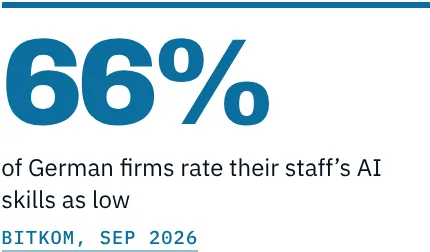
66% — of German firms rate their staff’s AI skills as low
BITKOM, SEP 2026
Source study · v2.1 · page 67 · Figure published: 25 Oct 2026
Read figure text, sources and rights
66% of German firms rate their staff’s AI skills as low BITKOM, SEP 2026
Source links on the cited study page
ETHORITY figure. Rights in cited data and third-party marks remain with their owners. The Prism artwork licence applies where stated on the figure.
TASK WORKFLOW DECISION KNOWLEDGE HUMAN JUDGMENT AI CAPABILITY TOOL AUTHORITY OUTCOME.
A job title is too coarse.
“Customer Service” can contain search, summarization, policy interpretation, empathy, negotiation, fraud judgment, refund approval, documentation and escalation. Different parts deserve different forms of automation and human authority.
This is why the right unit of transformation is often the workflow and decision—not the employee.
3. Authority has to become explicit
In conventional software, permissioning is already important.
Agentic AI makes it central.
The organization needs to know not only what an AI system can access, but what it is allowed to do.
FOUNDER MODE may own constitutional strategy, capital allocation and exceptional approval. TEAM MODE combines accountable humans and AI in normal operations. AUTONOMOUS MODE permits bounded execution within explicit authority. RISK EVENT MODE prioritizes containment, evidence preservation, continuity and recovery.
The rule is simple:
4. Knowledge has to become an organizational asset
Most companies have documents.
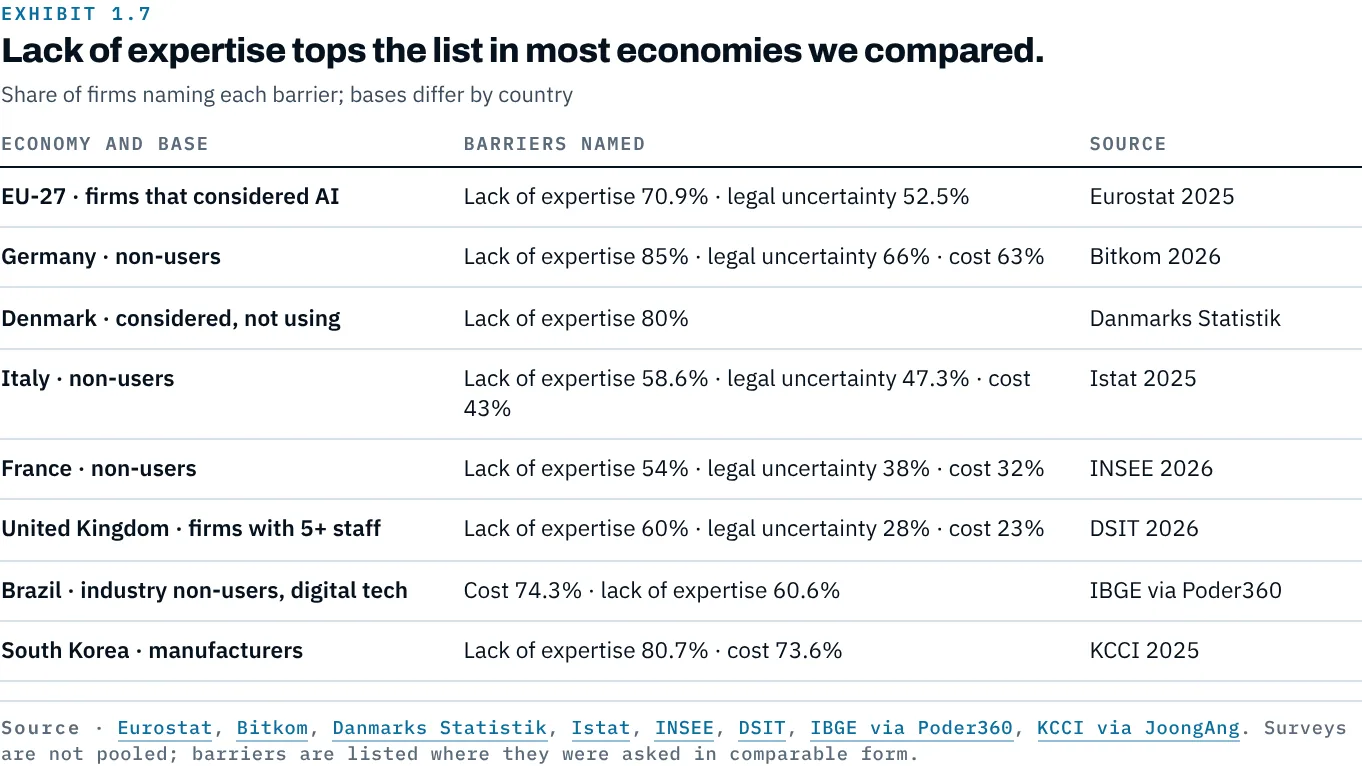
Lack of expertise tops the list in most economies we compared.
Eurostat, Bitkom, Danmarks Statistik, Istat, INSEE, DSIT, IBGE via Poder360, KCCI via JoongAng. Surveys are not pooled; barriers are listed where they were asked in comparable form.
Source study · v2.1 · page 15 · Figure published: 25 Oct 2026
Read figure text, sources and rights
EXHIBIT 1.7 Lack of expertise tops the list in most economies we compared. Share of firms naming each barrier; bases differ by country ECONOMY AND BASE BARRIERS NAMED SOURCE EU-27 · firms that considered AI Lack of expertise 70.9% · legal uncertainty 52.5% Eurostat 2025 Germany · non-users Lack of expertise 85% · legal uncertainty 66% · cost 63% Bitkom 2026 Denmark · considered, not using Lack of expertise 80% Danmarks Statistik Italy · non-users Lack of expertise 58.6% · legal uncertainty 47.3% · cost 43% Istat 2025 France · non-users Lack of expertise 54% · legal uncertainty 38% · cost 32% INSEE 2026 United Kingdom · firms with 5+ staff Lack of expertise 60% · legal uncertainty 28% · cost 23% DSIT 2026 Brazil · industry non-users, digital tech Cost 74.3% · lack of expertise 60.6% IBGE via Poder360 South Korea · manufacturers Lack of expertise 80.7% · cost 73.6% KCCI 2025 Source · Eurostat, Bitkom, Danmarks Statistik, Istat, INSEE, DSIT, IBGE via Poder360, KCCI via JoongAng. Surveys are not pooled; barriers are listed where they were asked in comparable form.
Source links on the cited study page
- ec.europa.eu ↗
- bitkom-research.de ↗
- www.dst.dk ↗
- www.istat.it ↗
- www.insee.fr ↗
- gov.uk ↗
- www.poder360.com.br ↗
- www.koreajoongangdaily.com ↗
ETHORITY figure. Rights in cited data and third-party marks remain with their owners. The Prism artwork licence applies where stated on the figure.
Fewer have governed knowledge.
An AI-first organization needs to distinguish:
source master working copy approved knowledge retrieval corpus training corpus evaluation corpus public content.
A publicly accessible PDF is not automatically legal training data. A news article can be a useful signal without becoming durable truth. A vendor page may be authoritative for a product feature and weak evidence for independent suitability.
The organization needs a knowledge substrate that machines and humans can both use responsibly.
5. Software delivery has to become continuous organizational learning
AI-assisted software development changes more than coding speed.
DataStax’s 2025 tech-leader paper captures part of the shift: adaptive AI systems continuously ingest feedback, generate new data and require knowledge layers optimized for AI consumption. It also argues that faster AI-assisted development pushes organizations toward shorter planning and delivery cycles.
The implication is bigger than CI/CD.
The organization itself needs a delivery loop:
That combines Design Thinking, scientific experimentation, Lean/Kaizen and software delivery without forcing teams to run four separate religions.
6. Evidence has to move closer to decisions
AI makes fluent claims cheap.
That makes evidence more valuable.
An AI-first organization should be able to distinguish:
What do we know? What is source-declared? What is observed? What is verified? What is unknown? What is conflicted? What changed?
This matters internally as much as externally.
The model says a task completed. Did the system state actually change?
A team says an AI pilot saved 20% of time. Did cost, throughput or revenue change?
A vendor says data is private. Under which product tier, terms and effective date?
Evidence is how an AI-first organization protects itself from its own enthusiasm.
7. Economics has to become continuous
AI changes both cost and capability quickly.

Spending rises by half; an EBIT effect stays rare.
MCKINSEY, AUG 2026 · MCKINSEY, AUG 2026 · MCKINSEY, AUG 2026 · MICROSOFT, SEP 2026
Source study · v2.1 · page 10 · Figure published: 25 Oct 2026
Read figure text, sources and rights
~90% of organisations in a global survey report regular AI use in at least one function MCKINSEY, AUG 2026 44% report scaling it across the enterprise MCKINSEY, AUG 2026 37% attribute some EBIT effect to AI MCKINSEY, AUG 2026 18.8% of working-age people worldwide use generative AI MICROSOFT, SEP 2026
Source links on the cited study page
ETHORITY figure. Rights in cited data and third-party marks remain with their owners. The Prism artwork licence applies where stated on the figure.
An annual business case is not enough.
Organizations need to track:
VALUE IDENTIFIED → MODELED → UNDER EXECUTION → OBSERVED → ATTRIBUTED → SUSTAINED.
And they need to understand full cost: model/API, infrastructure, integration, evaluation, monitoring, security, human review, maintenance, migration and organizational change.
That lets leadership stop weak projects and fund strong ones faster.
8. Governance has to become part of operations
AI governance should not be a side department that receives every project after the architecture is already fixed.
ISO/IEC 42001 is relevant because it frames AI governance as a management system with continual improvement. UNESCO’s readiness work is useful because it is explicitly multi-dimensional: legal/regulatory, social/cultural, economic, scientific/educational and technical/infrastructural.
Source context: ISO/IEC 42001:2023 ↗
An AI-first organization cannot be mature in only one of those dimensions.
9. Recovery has to include organizational reconstitution
AI-first also means resilience-first.
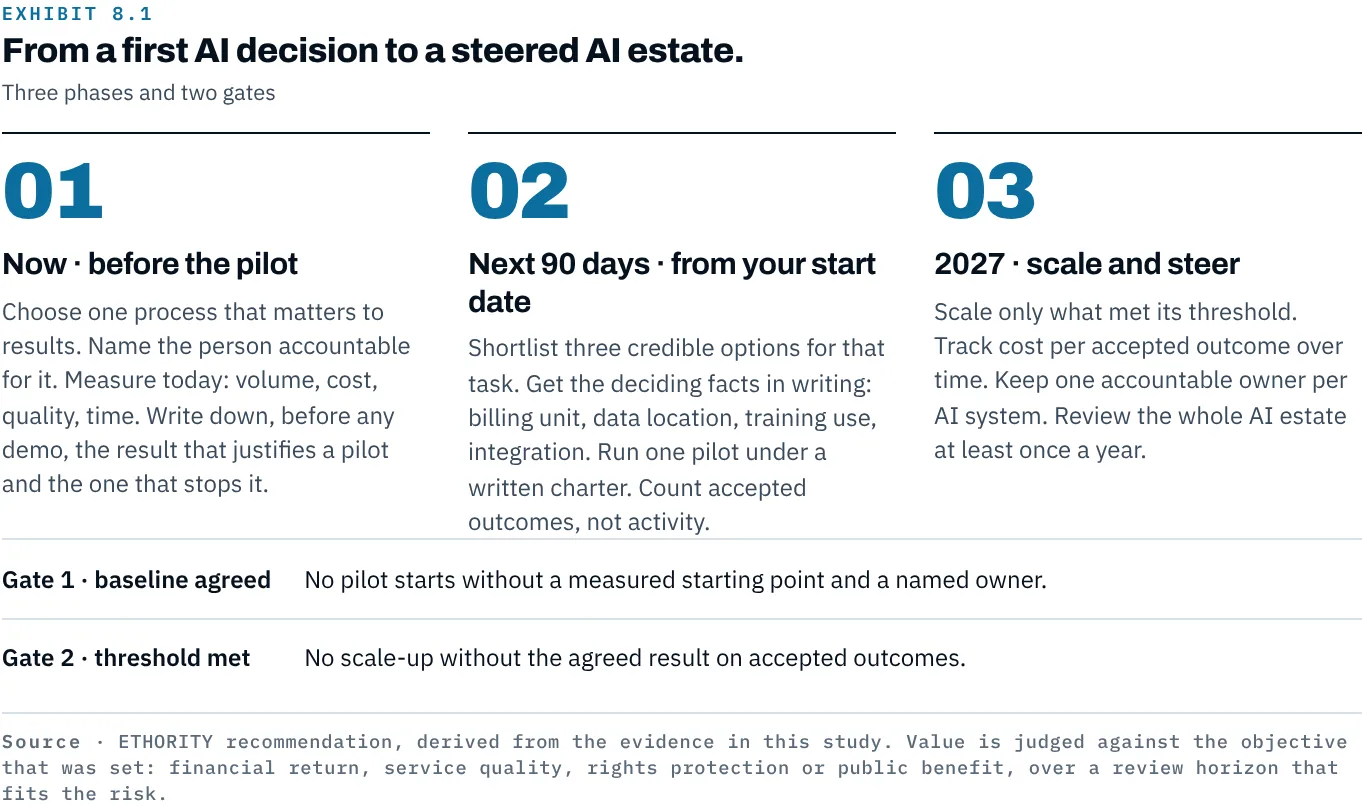
From a first AI decision to a steered AI estate.
ETHORITY recommendation, derived from the evidence in this study. Value is judged against the objective that was set: financial return, service quality, rights protection or public benefit, over a review horizon that fits the risk.
Source study · v2.1 · page 66 · Figure published: 25 Oct 2026
Read figure text, sources and rights
EXHIBIT 8.1 From a first AI decision to a steered AI estate. Three phases and two gates 01 Now · before the pilot Choose one process that matters to results. Name the person accountable for it. Measure today: volume, cost, quality, time. Write down, before any demo, the result that justifies a pilot and the one that stops it. 02 Next 90 days · from your start date Shortlist three credible options for that task. Get the deciding facts in writing: billing unit, data location, training use, integration. Run one pilot under a written charter. Count accepted outcomes, not activity. 03 2027 · scale and steer Scale only what met its threshold. Track cost per accepted outcome over time. Keep one accountable owner per AI system. Review the whole AI estate at least once a year. Gate 1 · baseline agreed No pilot starts without a measured starting point and a named owner. Gate 2 · threshold met No scale-up without the agreed result on accepted outcomes. Source · ETHORITY recommendation, derived from the evidence in this study. Value is judged against the objective that was set: financial return, service quality, rights protection or public benefit, over a review horizon that fits the risk.
ETHORITY figure. Rights in cited data and third-party marks remain with their owners. The Prism artwork licence applies where stated on the figure.
The goal is not for AI to “reinvent” the organization.
Identity, communications, domains, source code, infrastructure, critical data, payments, entitlements, customer communication and approved fallback paths should eventually be recoverable under explicit emergency authority.
That is a more serious definition of autonomy than a bot that writes emails overnight.
10. Leadership has to change too
The founder or executive team cannot delegate AI understanding entirely to IT.
AI changes capital allocation, organization design, customer experience, software production, risk, talent and business models.
Leadership therefore needs an operating view of:
The goal is not executive micromanagement.
It is the ability to steer the system.
Turn the operating model into a sequence people can follow
An AI-first organisation needs a sequence from intent to learning. ETHORITY describes that sequence as Discover, Create, Run, Improve and Grow. Discover identifies the business question and relevant options. Create designs the work and its conditions. Run puts an agreed process into operation. Improve examines actual results. Grow extends what has proved useful within a new, explicitly considered boundary. The sequence is a way to organise work, not a claim that every supporting software capability is publicly available.
The important connection is between stages. A discovery exercise should leave the next team with a clear question and evidence, rather than a list of interesting tools. A design should specify who accepts the result. An operating process should produce observations that can change the original decision. Growth should preserve what was learned about conditions and failure modes, not copy only the successful presentation.
This also makes progress easier to explain. A department can be advanced in discovery and still have no authorised autonomous execution. That is a meaningful position, not a contradiction to be hidden behind a maturity label. Explain which work is supported today, which is being demonstrated and which requires further implementation.
Redesign one handover before restructuring the company
Consider a hypothetical sales-to-delivery handover. Sales promises a customer an agreed scope, delivery needs the requirements and finance needs the commercial terms. An assistant can help assemble the packet, identify missing information and draft a clarification. If the source records disagree, the assistant should expose the difference. It should not invent a compromise scope and pass it off as an agreement.
Before building, map the current handover. Identify the original records, the responsible people and the point at which a promise becomes binding. Decide which fields may be prepared automatically and which require approval. This often reveals ordinary process problems: duplicate customer records, inconsistent definitions or an absent owner. Fixing those may create more value than improving a prompt.
Test the redesigned handover with a small set of representative cases. Measure completeness, correction effort, delay and whether the receiving team can act without asking the same questions again. Keep a manual route for unusual engagements. The objective is a reliable transition between people and systems, not the largest possible number of autonomous steps.
Give knowledge an owner and a usable lifetime
An organisation's knowledge is more than a collection of documents. A useful answer depends on knowing which document applies, which version is current and who can resolve a contradiction. A well-indexed archive of superseded terms can still produce a commercially incorrect answer if the system cannot distinguish their period and scope.
Assign ownership at the level where corrections can happen. A policy owner maintains the policy; a product owner maintains the current product conditions; the workflow owner determines which source is required for the task. Preserve those distinctions rather than appointing an AI team as the universal authority for every business fact. The technical team can maintain retrieval and access while the business retains responsibility for meaning.
Define expiry and change triggers sensibly. Some facts become unreliable quickly; others remain useful for years. A new review date should describe an actual review, not simply a fresh page visit. When an answer relies on an old source, keep its context visible. Where the decision depends on current terms, ask for confirmation before acting.
Make the employee experience part of the design
People need to understand what the system contributes and what remains their responsibility. A new interface that merely adds another review queue can increase workload even when its model is capable. Involve the receiving team in defining an acceptable output, the explanation they need and the situations they want escalated.
Training should use the actual workflow. Show an ordinary good result, a plausible error and an incomplete case. Let staff practise correcting the record and declining a suggestion. Make it clear who is available when the system behaves unexpectedly. Asking people to supervise technology without time or authority creates a formal control with little practical effect.
Consider how performance measures influence behaviour. If staff are rewarded only for speed, they may skip review or avoid reporting difficult cases. If every exception is treated as individual failure, useful evidence will disappear. A learning organisation needs measures that recognise quality, escalation and correction alongside throughput. These are operating choices to test locally, not universal predictions about employee behaviour.
Scale by preserving the conditions of success
Before extending a pilot, list what made it work: a particular data source, a narrow task, trained reviewers, a stable integration or a limited permission. Then examine whether those conditions exist in the next department. Similar job titles do not establish similar data, consequences or contractual terms. Expansion is a new decision informed by earlier evidence.
Budget for maintenance and exit. Someone must handle changes, support users and restore the ordinary process if a component fails. Preserve the records and permissions needed to move to another provider. The organisation becomes more capable when its learning survives a tool change; it becomes more dependent when knowledge remains trapped in an unexportable conversation history.
Use the portfolio as a set of connected starting points
The Good AI Prism supports discovery of relevant offerings and source-backed differences. The Workspace demonstration illustrates how related context can remain connected; inspect its stated demonstration boundary. Professional services address a defined question rather than imply that the whole operating model can be purchased as one activated product.
For a concrete business question, inspect the AI Business Blueprint. For a larger investment decision, the Enterprise AI Opportunity Case is scoped by proposal. Start with the handover or decision that most needs improvement, the person accountable for it and the evidence that would justify a change. An AI-first organisation is built through those decisions, not declared through a new label.
The AI-first organization is a learning system
The most important shift may be cultural.
AI lowers the cost of producing answers.
It does not lower the cost of being wrong in important situations.
The organizations that win will be the ones that can experiment quickly, preserve human authority where it matters, demand evidence, measure economic outcomes, learn from failure and continuously update their operating model.
AI-first is not a technology stack.
It is an organizational capability to repeatedly turn AI into outcomes.