AI ESTATE · DEMONSTRATION — IN VALIDATION
Northstar is a fictional organisation. Inspect how public market facts can inform a separate internal operating record. The demonstration does not connect to customer systems.
Choose one of four fictional contexts, then select a relationship in the map. The diagram connects purpose, people, systems and evidence; the sourced market profiles remain separate below.
Connect service, sales and retention into one accountable customer operation.
Four fictional applications connect work, people, AI components and sources. Select a node to inspect its role.
Start with the intended outcome and the work that needs to change. Establish the actual baseline with the responsible team.
Scenario: a fictional operating record
Market evidence does not establish Northstar’s deployment, permissions, data location or outcome. Those belong to the organisation’s own record and approvals.
Demonstration · early access on request
Choose a business or research question →
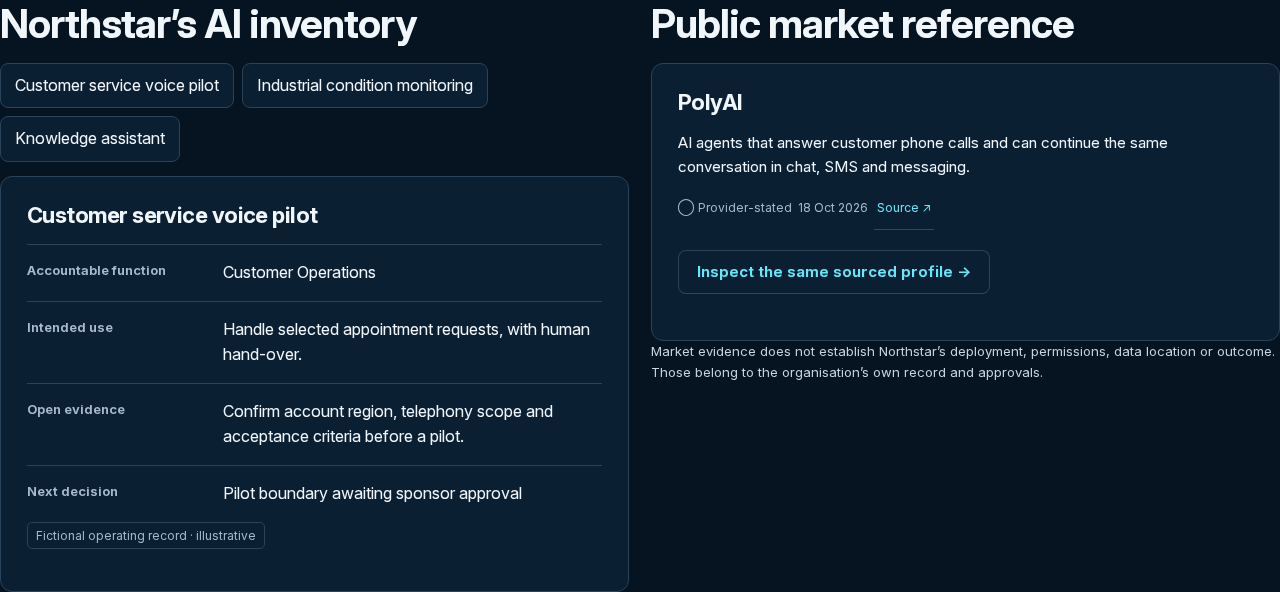
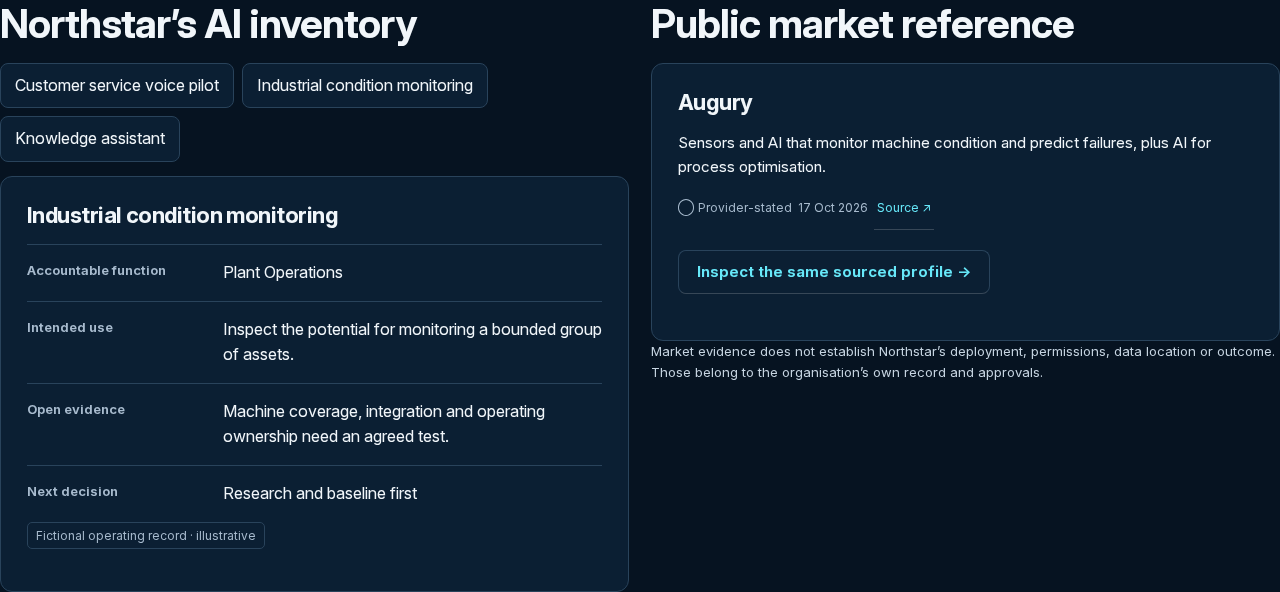
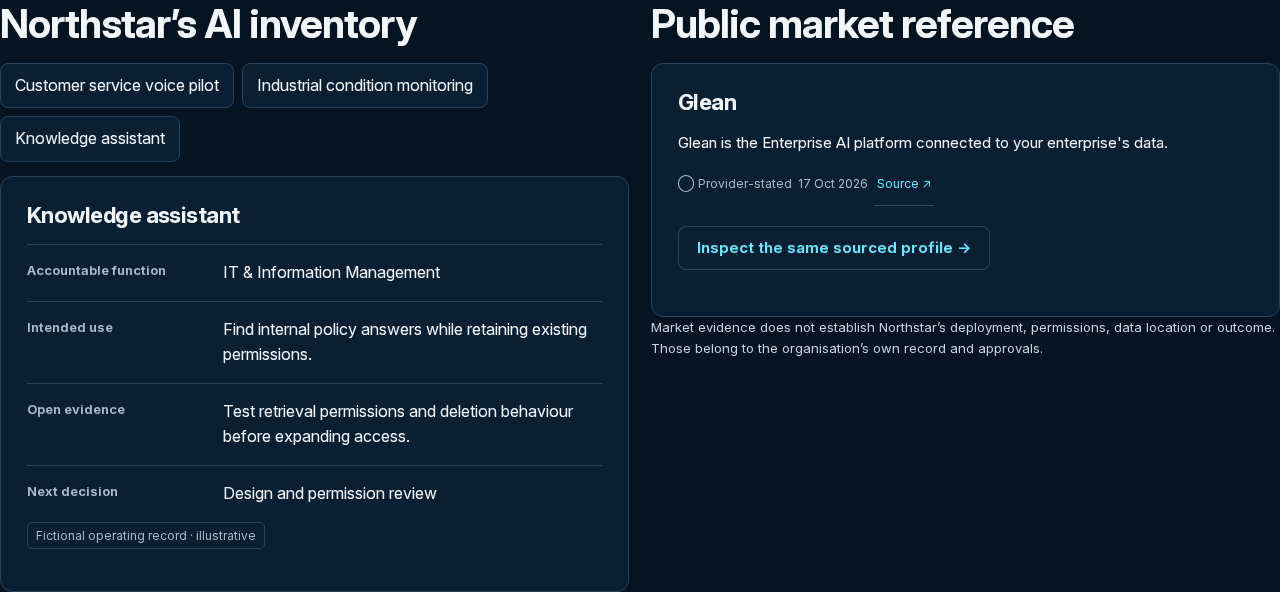
Northstar is a fictional organisation used to explain the Workspace’s intended working model. Its service team is considering a voice pilot; its plant team is exploring condition monitoring; its IT function is examining a knowledge assistant. These are different questions with different data, owners and acceptance conditions. Selecting an example changes the operating record shown above, without connecting to customer systems.
A useful starting record names the work and its intended beneficiary. For the voice example, that could be a permitted class of appointment requests with human hand-over. For condition monitoring, it is a bounded asset group and the decision the plant team needs to make. The knowledge example begins with retrieval permissions and the answers that authorised people may receive.
Each example links to the same public market profile used by the Prism and Compare. That profile describes an offering within its recorded source scope. Northstar’s separate record describes intended use, the responsible function and the evidence needed before a test. A provider’s published data statement cannot establish Northstar’s account region, configured permissions or actual result.
Use that distinction when developing a shortlist. A market fact can identify a question worth asking, while a contract, configuration test or organisational approval answers a different question. Preserve the link between the two records and the date of the source. When a vendor’s terms change, an owner can then identify which organisational decision needs another review.
For each intended use, the team identifies the process owner, data authority, reviewer and person who accepts the outcome. Those roles are operational questions, not badges attached to a vendor. The review should establish permitted data, actions, escalation and the conditions under which a person must intervene. An AI capability does not grant permission to execute a workflow.
The voice example asks for account region, telephony scope and acceptance criteria. The plant example needs machine coverage, integration and operating ownership. The knowledge example asks whether retrieval follows existing permissions and what deletion means in the actual deployment. The demonstration keeps those questions explicit instead of asserting that an scenario system has passed them.
Before a customer uses an organisational Workspace, the engagement must establish tenant and organisation boundaries, access, data handling, retention, export, deletion, support and acceptance. The AI Estate product pages describe proposed tier scope separately from this demonstration. Commercial approval of a price does not establish that the public example provisions a customer account or holds an organisation’s private records.
A pilot needs a baseline and a clear rule for acceptable output. Measure human checking and rework alongside the automated task. Keep the software price separate from integration, operating ownership, training and other full-cost items. Released time only becomes useful capacity when someone can name the destination work and accept the resulting output.
An accepted pilot is a reason to examine the next boundary. It does not establish suitability for every team or workflow. Preserve the chosen options, assumptions, sources, operating constraints and the responsible next review. When evidence changes, the team can decide whether to expand, redesign, collect more evidence or stop. Continuing learning should make the next decision more informed.
This continuity is the connection to the Living AI Universe and the AI Business Operating System direction. The public market, an organisational inventory and a project decision can refer to one another while retaining separate evidence and responsibility. The current example lets you inspect that idea using fictional systems. Its next step is a scoped conversation about what your own organisation needs.
AI Estate connects inventory, ownership, evidence and operating decisions. A customer engagement must establish the tenant boundary, access, data handling, deployment, support and acceptance conditions.
 ETHORITY®