 ETHORITY®
ETHORITY · AI ESTATE · INVENTORY, OWNERS, EVIDENCE
By 2 Dec 2027, know the AI systems you run.
Keep an AI inventory that stays true: systems, purpose, owners and evidence connected, from today's audit to tomorrow's software.
- 100,000+
- records in the ETHORITY AI Registry and AI UniverseETHORITY AI Registry, Oct 2026
- 6,700
- dated market changes trackedETHORITY AI Universe, Oct 2026
- 2 Dec 2027
- Annex III high-risk obligations of the AI Act applyReg. (EU) 2026/1744 · White & Case, Aug 2026 · whitecase.com ↗
- US$2.67tn
- AI spending in 2026Gartner, Sep 2026
An inventory is the first thing an auditor asks for.
Annex III duties apply from 2 December 2027; every obligation starts from knowing which systems you run.
White & Case, Aug 2026
Vendor facts arrive pre-researched.
Every item in an AI estate can be matched to the registry instead of researched from scratch.
ETHORITY AI Registry, Oct 2026
AI spending grows faster than oversight.
Global AI spending reaches US$2.67tn in 2026, and much of it arrives inside existing software.
Gartner, Sep 2026
AI Estate products
AI Estate Workspace
€5,990 / year · net
AI systems, purpose, accountable owners and evidence in one inventory design. Shown today as a preview; early access on request.
Demonstration · early access on request
See what this package includes →AI Estate Business
€12,000 / year · net
The AI inventory connected to business functions, decision owners and recurring governance. Preview; early access on request.
Demonstration · early access on request
See what this package includes →AI Estate Enterprise
€18,000–€50,000+ / year · net
Shared vendors, dependencies and responsibilities across business units and countries. Preview; scoped with enterprise clients.
Demonstration · early access on request
See what this package includes →TrustOps / Evidence Watch
Fee configured to agreed scope
Source changes connected to a defined review scope and the people responsible for follow-up. Configured per engagement.
Configured engagement
See what this package includes →What an estate holds
Automation platforms, CRM agents and enterprise search are the items that grow fastest in an AI estate. Three registry profiles show the facts each item carries.
Workato Genies
Workato · Agent
According to Workato: “Workato Genies go beyond traditional AI agents – they can be customized with unique KPIs”
- Published price
- How it is billed
- Where data is stored
- Does it train AI on your data?

Agentforce
Salesforce · Platform
Salesforce’s platform to build and run AI agents inside Salesforce, priced by consumption, by conversation or per user.
- Published price
- How it is billed
- Does it train AI on your data?
- Certificates and audit reports
Slack Enterprise Search
Salesforce (Slack) · Product
Slack Enterprise Search (Enterprise+ plan) lets members query connected apps such as Google Drive, SharePoint and GitHub from Slack's search bar, retrieving permission-aware results and AI answers in real time.
- Published price
- How it is billed
- Where data is stored
- Does it train AI on your data?
Read about the estate
Global edition · EN
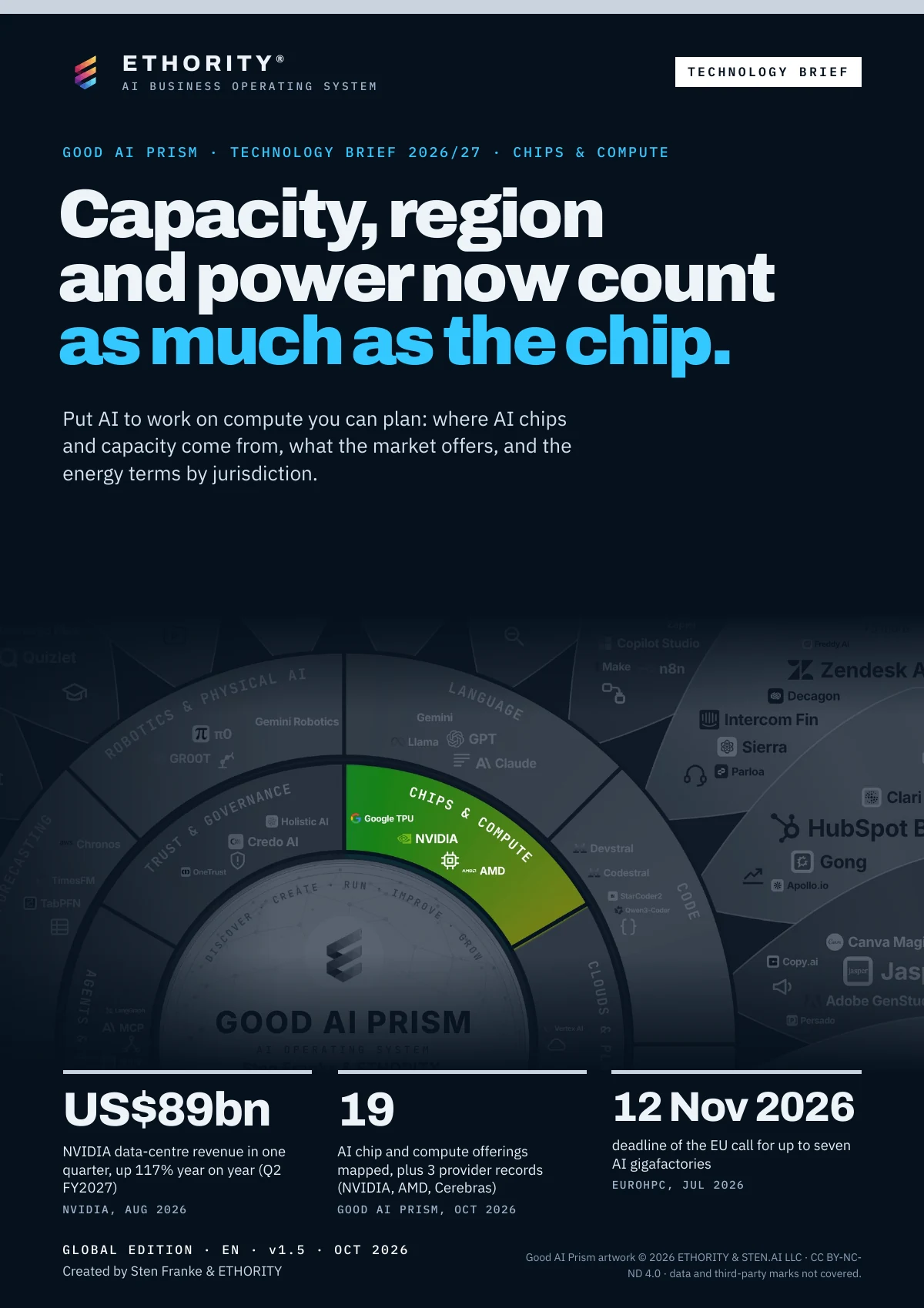
Compute that fits the work you run.
Capacity, region and energy terms count as much as chip performance. Where AI chips and capacity come from, what the market offers and the energy terms by jurisdiction.
Version 1.5 · 40 pages
Open the study →
AI does not scale by itself. Redesign the work.
Start with one objective, choose the simplest approach for each task and measure the cost of every result you accept.
See the map on one page →
Access to a tool does not give an AI agent the right to act.
How to define what each AI agent may do: by action, limit, time and consequence, rather than by the tools it can reach.
See the map on one page →Test your numbers first
Total Cost of AI Ownership prices an estate item by item; the Model Cost Estimator adds model prices. All tools sit in the ETHORITY AI calculator suite.
Total Cost of AI Ownership calculator
All six cost blocks over 36 months, compared with today's cost per accepted result, and the month the investment pays back.
Pilot version · Scenario calculator
Open the calculator →Model Cost Estimator
Estimates the monthly cost of your workload on 17 AI models, with announced price changes and end-of-service dates.
Pilot version · Scenario calculator
Open the calculator →Compare three offerings
Puts two to four offerings side by side in the same units, each fact with its source and the date it was checked.
Sten Franke leads every project.

Sten Franke
Founder & CEO
Sten Franke designs and builds AI systems, from model testing and cloud setup to the interfaces people use. He connects business decisions, software architecture and practical implementation.
AI architecture · Model testing · Cloud engineering · UX
His work spans programming, LLM evaluation, Google Cloud and AWS environments, and web applications built with Next.js and React. He connects business requirements, software architecture and practical implementation. Creator of the Good AI Prism, he brings market intelligence into AI decisions. Earlier, he created the Social Media Prisma, led a BVDW Social Media working group and contributed to its Social Media Kompass. His entrepreneurial work includes ethority, Gridpatrol and mediatime, following a practical foundation in electronics and industrial robotics.
sten@ethority.aiQuestions buyers ask
Can we buy the Workspace today?
The Workspace is shown as a preview, and early access is on request. Today the estate is built through the AI Estate Audit & Mapping.
What is TrustOps / Evidence Watch?
A configured engagement that connects source changes to a defined review scope and the people responsible for follow-up.
Who owns the inventory?
The client. It is built in the ETHORITY registry schema so it can be maintained by the client or through the retainer.
How does this relate to governance?
The estate is what governance governs. The AI Governance Setup takes the inventory as its starting point.
How long does an audit take?
Four to eight weeks, by package: Focus, Group or Group+, each with published net prices.
Next step
Start with an AI Estate Audit and Mapping and ask for early access to the Workspace in the same call.
ETHORITY · LONG READ
From a one-off audit to an estate that stays current
An AI inventory is accurate on the day it is finished. The AI Estate class is about what happens next: keeping systems, owners and evidence connected as the estate changes.
Every AI governance conversation eventually reaches the same question: what do we actually run? The answer is rarely in one place. Licences sit with IT, usage fees with business units, agent features inside CRM and office software, and pilots in project folders. With global AI spending at US$2.67tn in 2026 according to Gartner, much of it arriving inside software companies already own, the gap between what is used and what is known keeps widening.
Today: the audit
The AI Estate class starts with a service that is available now. The AI Estate Audit & Mapping builds the inventory in four to eight weeks: every tool, agent, pilot and licence, including shadow AI, mapped with owners, costs, usage, vendor facts and risk. It ends with a portfolio decision for each item, and at least 95% of known spend must be mapped before it is accepted. The inventory uses the same data model as the Good AI Prism registry, so each item carries vendor facts with source and date.
Next: keeping it current
An inventory is accurate on the day it is finished. Then a vendor changes its data terms, a model announces its retirement, a business unit adds a new agent. The AI Estate products are designed for that second phase.
TrustOps / Evidence Watch is the first step and runs as a configured engagement. It connects source changes, such as a vendor's new terms or a model's retirement date, to a defined review scope and to the people who must act on them. The ETHORITY AI Universe already tracks thousands of dated changes, so the watch starts from history rather than from a blank page. For many clients, the AI Governance Retainer delivers the same rhythm as a service.
The software layer
The AI Estate Workspace, Business and Enterprise editions bring the inventory into software: AI systems, purpose, accountable owners and evidence in one place, connected to business functions and decision owners, and, at enterprise scale, to shared vendors and dependencies across units and countries. They are shown today as previews. Early access is available on request, and activation for a client follows once tenant isolation, roles, security and support are in place for that client. Honest previews are more useful than a promise.
Why it matters now
The AI Act gives the estate a deadline. Annex III high-risk duties apply from 2 December 2027, as set by the Omnibus regulation of July 2026. Every obligation, from classification to evidence to human oversight, starts from knowing which systems exist and who owns them. Agents raise the stakes further: the insight on agent authority and its limits shows how quickly an agent's reach can exceed what anyone approved.
How the class fits
The AI Estate class sits between the services and the platform. The audit creates the inventory. Governance decides how it is controlled. The retainer or Evidence Watch keeps it current. The Workspace, as it is activated, makes it a living system the client operates itself. At every step the inventory belongs to the client, in a schema it can take anywhere.
For most organisations the right first step is still the audit. It answers the question every other step depends on, and it does so with a decision attached.
Three signs an estate needs attention
Most organisations recognise the need through one of three signals. Finance cannot reconcile AI spend across budgets, or finds two teams paying for overlapping tools. A works council, auditor or customer asks for a list of AI systems and their owners, and the answer takes weeks. Or an agent turns out to reach data nobody intended it to reach, and nobody can say who approved it.
Each of those signals points to the same missing piece: an inventory with owners and evidence. The audit supplies it, the AI Act Readiness Sprint classifies it where the question is regulatory, and the compute and infrastructure brief helps when the open question is where AI workloads run and what they cost. The Workspace, once activated for a client, keeps the answer ready the next time someone asks.
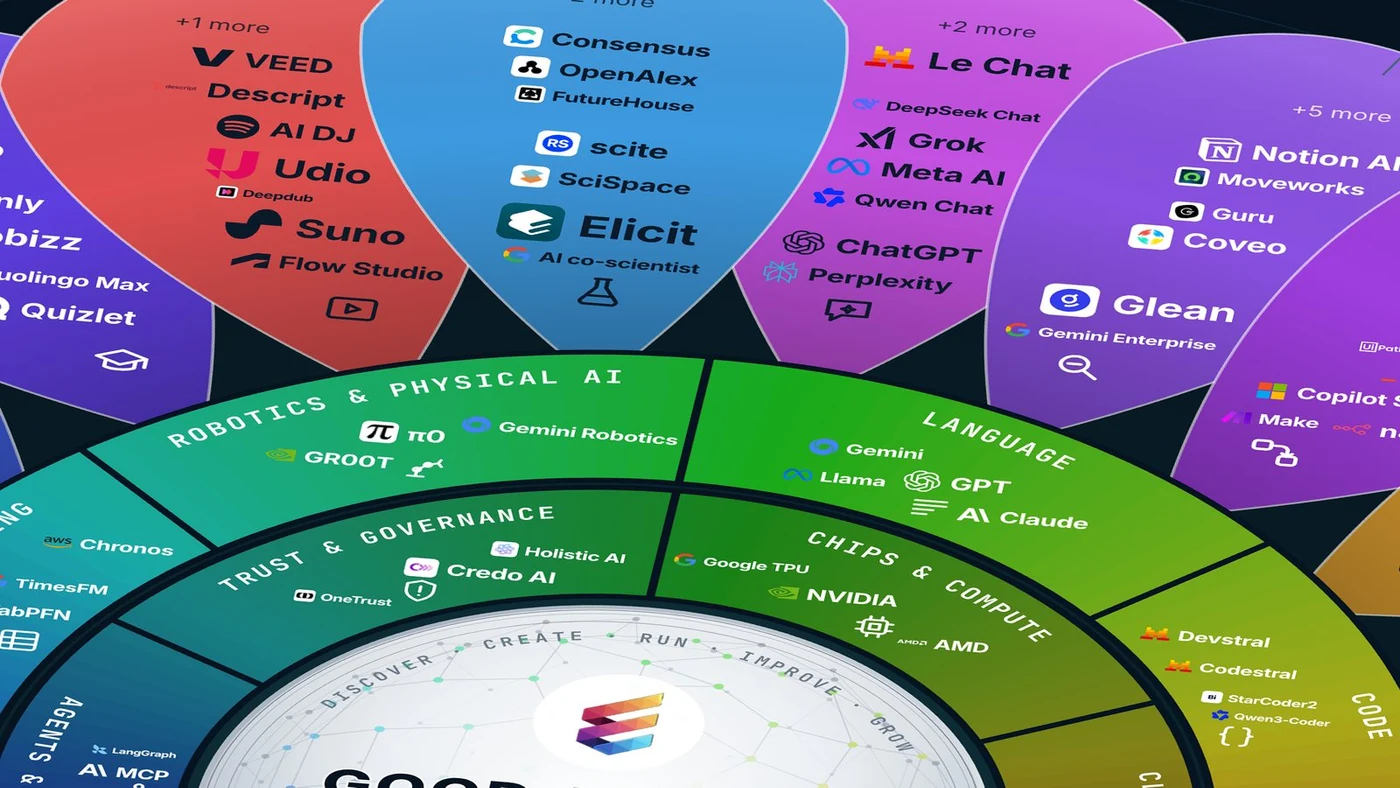
The estate is also where the market map and the company meet. The same profiles that buyers browse in the assistants and copilots area and the documents and workflow agents area appear as items in a client's estate, with the client's own owners, costs and decisions attached. When the public profile changes, the estate item can be flagged for review.
Sources and further reading
YOUR NEXT STEP
Discuss your question with Sten Franke.
Bring your business question or the figures you already know. ETHORITY investigates within the agreed scope; together with Sten Franke you agree the next piece of work.