 ETHORITY®
GOOD AI PRISM · TOPIC AREA · ASSISTANTS & COPILOTS
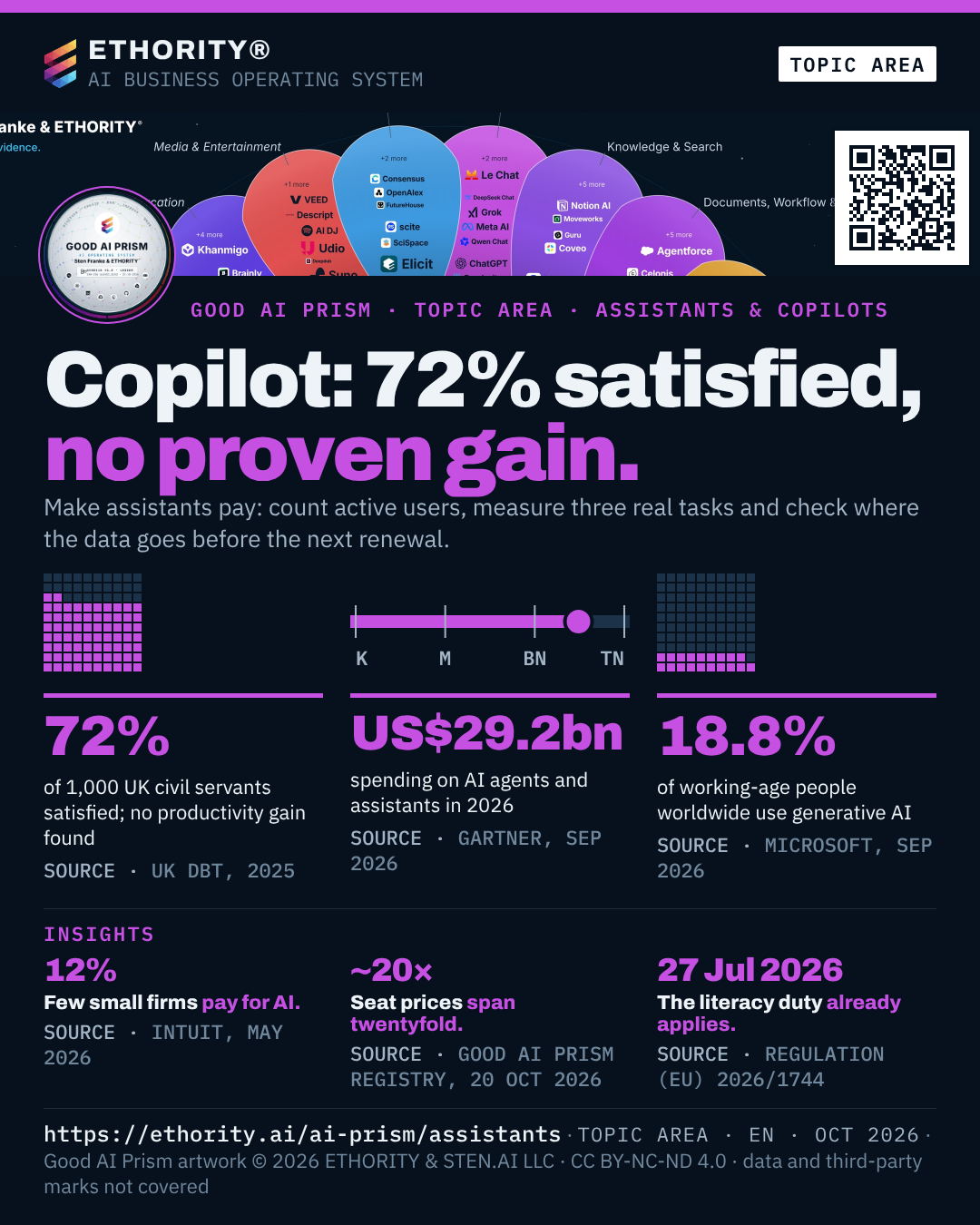
Copilot: 72% satisfied, no proven gain.
Make assistants pay: count active users, measure three real tasks and check where the data goes before the next renewal.
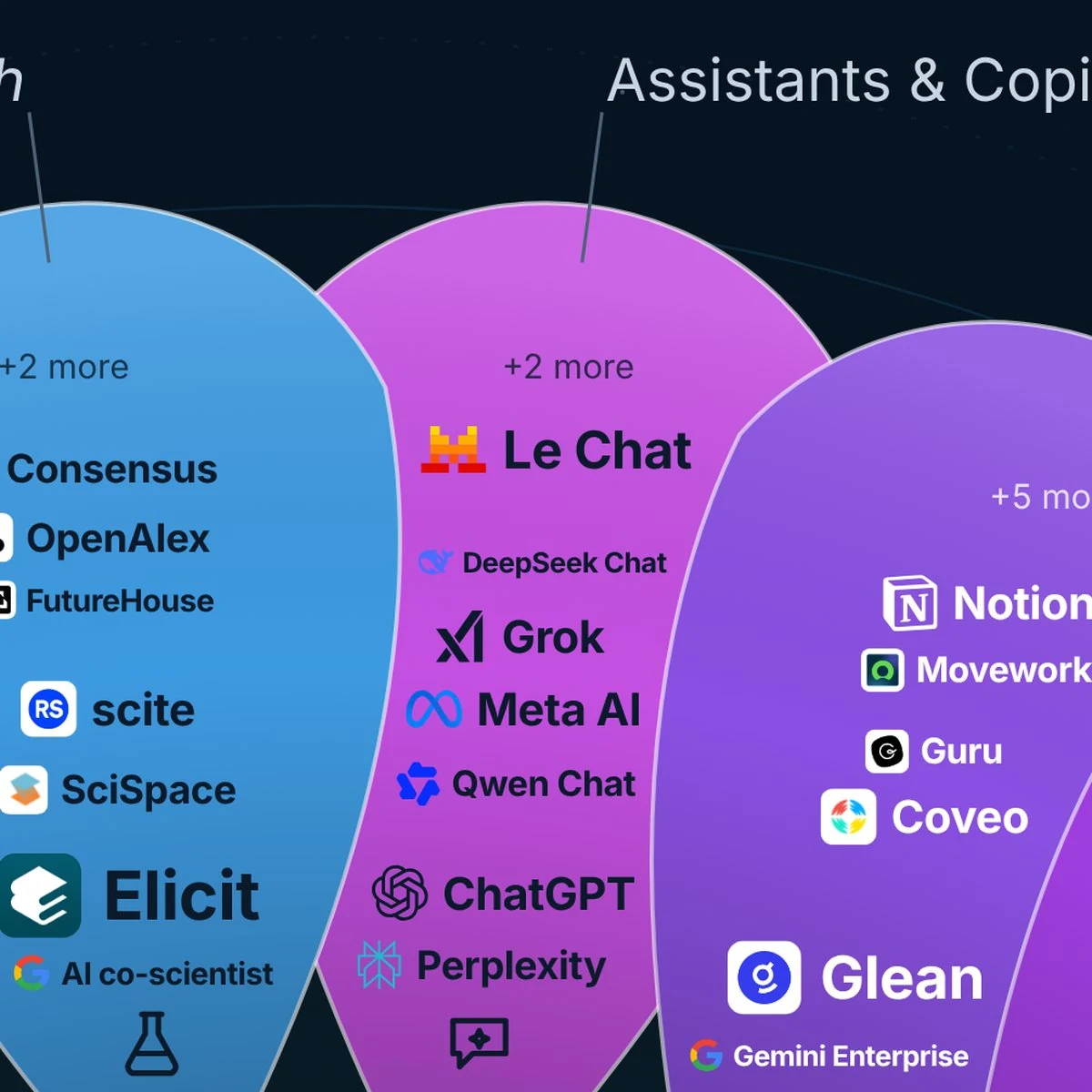
- 29
- AI offerings placed in Assistants & CopilotsGood AI Prism, Oct 2026
- 72%
- of 1,000 UK civil servants satisfied; no productivity gain foundUK DBT, 2025 · techrepublic.com ↗
- US$29.2bn
- spending on AI agents and assistants in 2026Gartner, Sep 2026 · gartner.com ↗
- 18.8%
- of working-age people worldwide use generative AIMicrosoft, Sep 2026 · blogs.microsoft.com ↗
Few small firms pay for AI.
Only 12% of small businesses on Intuit's platform pay for dedicated AI tools, but 86% of payers renew.
Intuit, May 2026
Seat prices span twentyfold.
Profiled workplace assistants list €5.40 to €109 per user a month.
Good AI Prism Registry, 20 Oct 2026
The literacy duty already applies.
The revised AI-literacy duty of the EU AI Act is in force; copilot rollouts need training.
Regulation (EU) 2026/1744
How to use this page
Three tools and one offer turn this page into a decision.
- Open the Assistants & Copilots map: 29 offerings on one petal of the Good AI Prism, with logos and provider facts.
- Compare up to three offerings: decision facts side by side, each with its source and date.
- Run the Task economics calculator: turn saved hours into capacity you can attribute, before a pilot is approved.
- Offer: AI Literacy & Adoption: role-based training on the assistants your people use, with a usage policy and an evidence file for the literacy duty.
Seven workplace assistants, fact by fact
Price, hosting, training terms and integrations, each with source and date.
meinGPT
SelectCode (MeinGPT) · Platform
MeinGPT is a Hetzner-hosted German AI platform for Mittelstand firms offering multi-model chat and assistants, plus an 'Outpost' that connects on-premise systems through an outbound-only connection.
- Published price
- How it is billed
- Where data is stored
- Does it train AI on your data?
nele.ai
nele.ai · Platform
nele.ai is a browser and desktop AI workspace for German SMEs billed through a company-wide monthly credit pool instead of per-user licences, with uploaded knowledge bases and optional pseudonymisation.
- Published price
- How it is billed
- Where data is stored
- Does it train AI on your data?
Lumo for Business
Proton · Product
Proton's Lumo for Business is a team AI chat assistant running open-source models (Qwen, GLM, Apertus) on Proton-controlled European servers, with no server-side chat logs and zero-access-encrypted history.
- Published price
- How it is billed
- Where data is stored
- Does it train AI on your data?
Mindverse Studio
Mindverse · Platform
Mindverse Studio is a Berlin-built, credit-metered browser AI workspace hosted in Germany, combining EU-endpoint OpenAI/Anthropic/Google models and German-hosted open models with knowledge bases and 500+ Composio integrations.
- Published price
- How it is billed
- Where data is stored
- Does it train AI on your data?
Logicc
Logicc · Platform
Logicc is a browser-based multi-model AI workspace (OpenAI, Anthropic, Google, Mistral) for regulated industries, storing chats and files on Hetzner servers in Germany and offering § 203 StGB agreements.
- Published price
- How it is billed
- Where data is stored
- Does it train AI on your data?
innoGPT
innoGPT · Platform
innoGPT is a German multi-model AI workspace offering 50+ models (GPT, Claude, Gemini, Mistral) with automatic 'Smart Select' routing, AWS Frankfurt hosting and SharePoint/Drive knowledge search.
- Published price
- How it is billed
- Where data is stored
- Does it train AI on your data?
Nextcloud Assistant
Nextcloud · Product
Nextcloud AI assistant that runs on-premises, so data stays local and is not leaked to third parties through training of new AI models.
- Published price
- How it is billed
- Where data is stored
- Does it train AI on your data?
Compare baseline: three billing models
Three European assistants, three ways to pay: credit pool, seat plus usage, and seat.
| Offering | Price | Billing | Data location | Source |
|---|---|---|---|---|
| nele.ai | From €10 /mo | Credit pool · no seats | Germany | nele.ai pricing and security |
| meinGPT | €5.40–18 /user/mo | Per user/mo + usage | Mainly Germany · EU | meinGPT pricing and hosting |
| innoGPT | €25–109 /user/mo | Per user per month | EU (AWS Frankfurt) | innoGPT pricing and hosting |
Registry facts as stated on each provider's own pages, read 20 Oct 2026. Add your own volumes in Compare before deciding.
What the market shows
Three signals define this area. Spending on AI agents and assistants grows from US$16.5bn in 2025 to US$65.5bn in 2027 (Gartner). Satisfaction runs ahead of proof, as the UK trial showed. And billing moves from seats to credits and usage: nele.ai bills from a credit pool. Cost per active user is the number to manage.
Rules and dates
The dates that land on every desk with an assistant.
- 2 Feb 2025
Prohibited practices and the AI literacy duty apply.
Reg. (EU) 2024/1689
- 27 Jul 2026
The Digital Omnibus applies; the revised AI-literacy duty is in force.
Reg. (EU) 2026/1744
- 2 Aug 2026
Art. 50: people must be told when they interact with an AI system.
Reg. (EU) 2026/1744
- 30 Nov 2026
Anthropic retires the claude-sonnet-4-5-20250929 model snapshot.
Anthropic model deprecations
- 14 Jan 2027
OpenAI shuts down its GPT-4o and GPT-4.1 snapshots; tools built on them change.
OpenAI deprecations
Read the evidence
The Global Market Study 2026/27 frames the area; the AI Models brief covers the layer underneath.
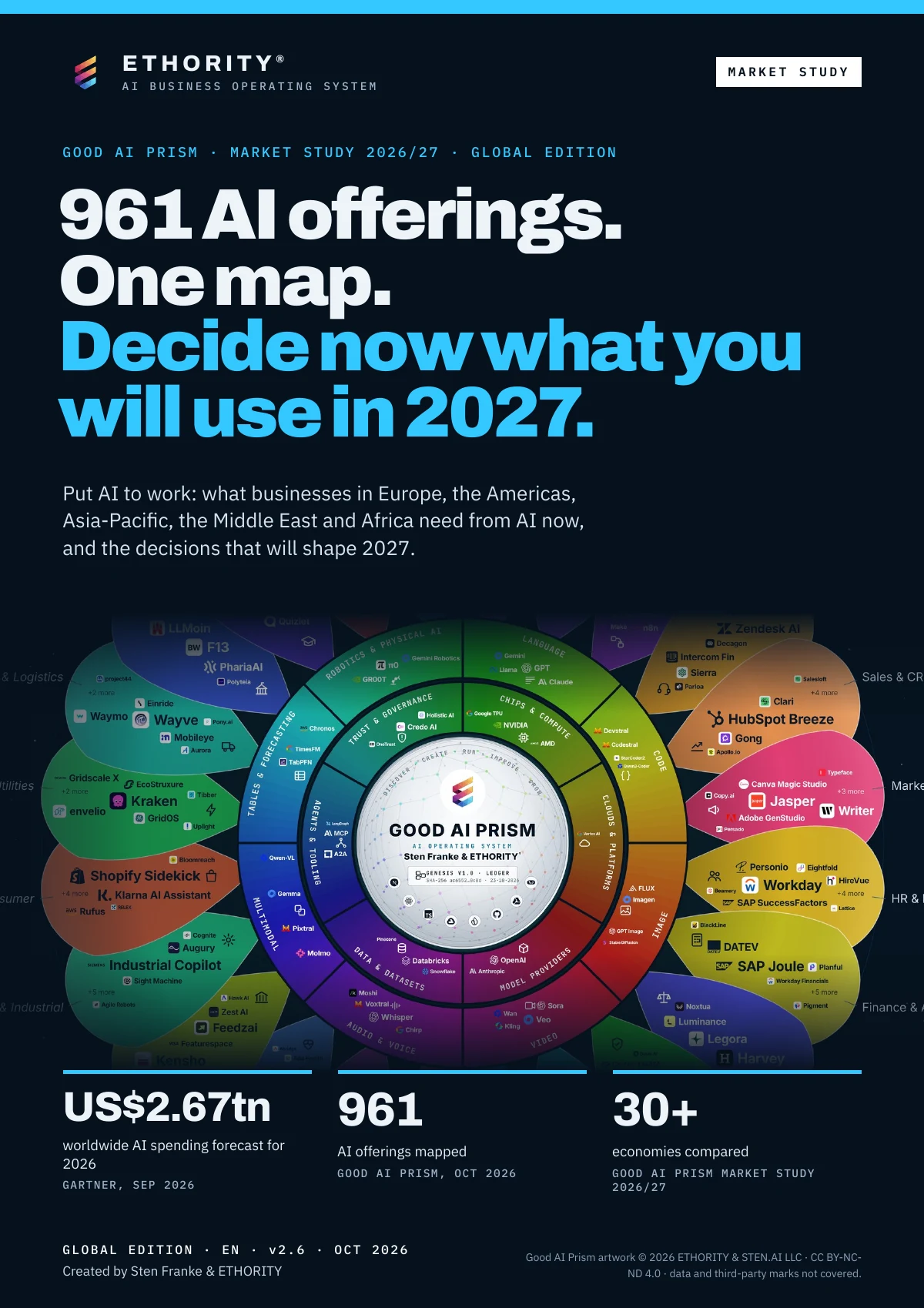
Global edition · EN
961 AI offerings. One map. Decide now what you will use in 2027.
The Good AI Prism helps you find useful AI and compare the evidence behind your options. For organisations already using AI, the question is moving from whether to use AI to which AI, how safely and whether it pays. This Global edition brings together 961 AI offerings across 24 topic areas, 8 data types and 6 technology layers, with sources, dates and limits to guide your next decision.
Version 2.6 · 90 pages
Open the study →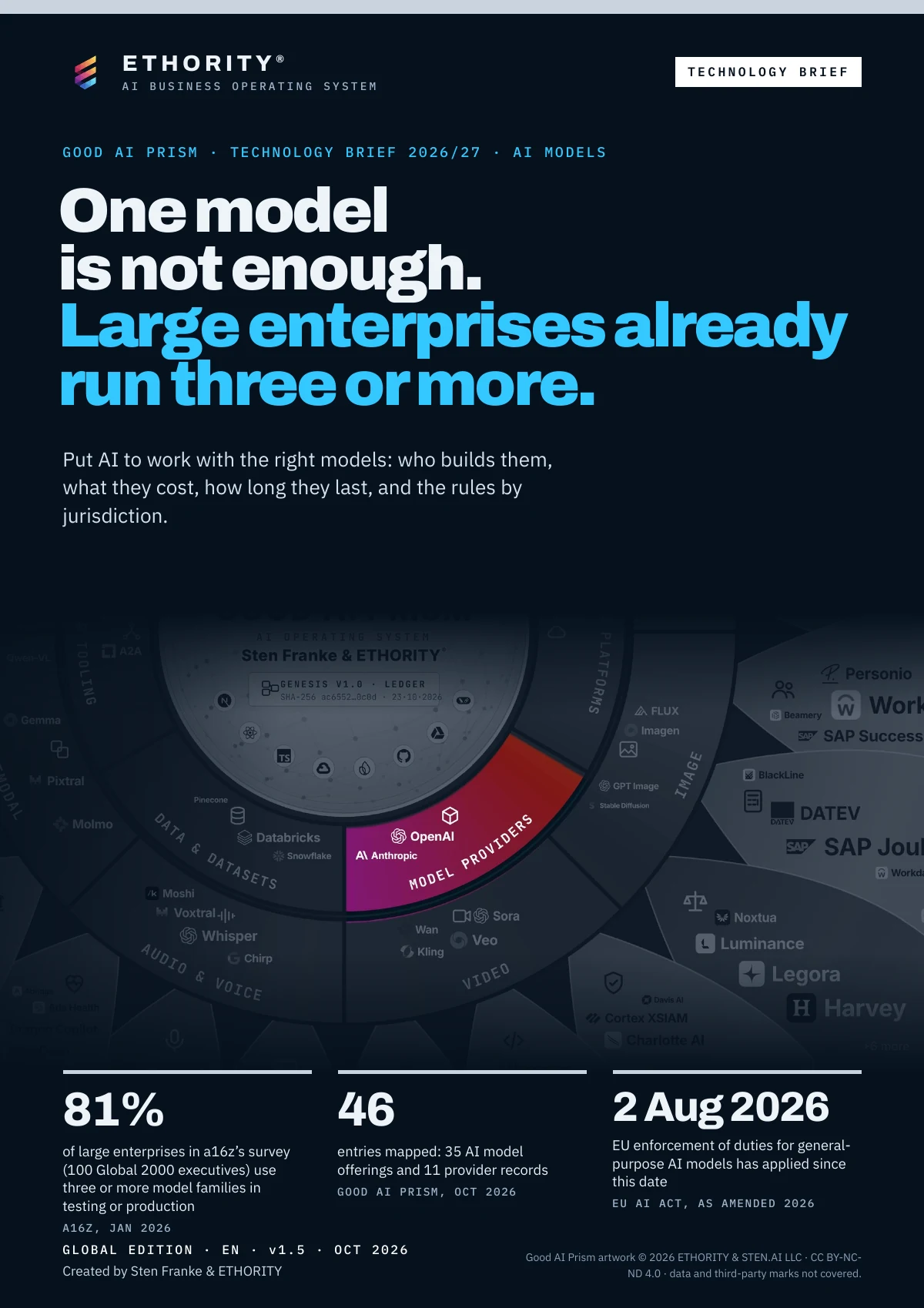
Global edition · EN
One model is not enough. Large enterprises already run three or more.
81% of large enterprises use three or more model families. Who builds AI models, what they cost, how long they last, and the rules by jurisdiction.
Version 1.5 · 38 pages
Open the study →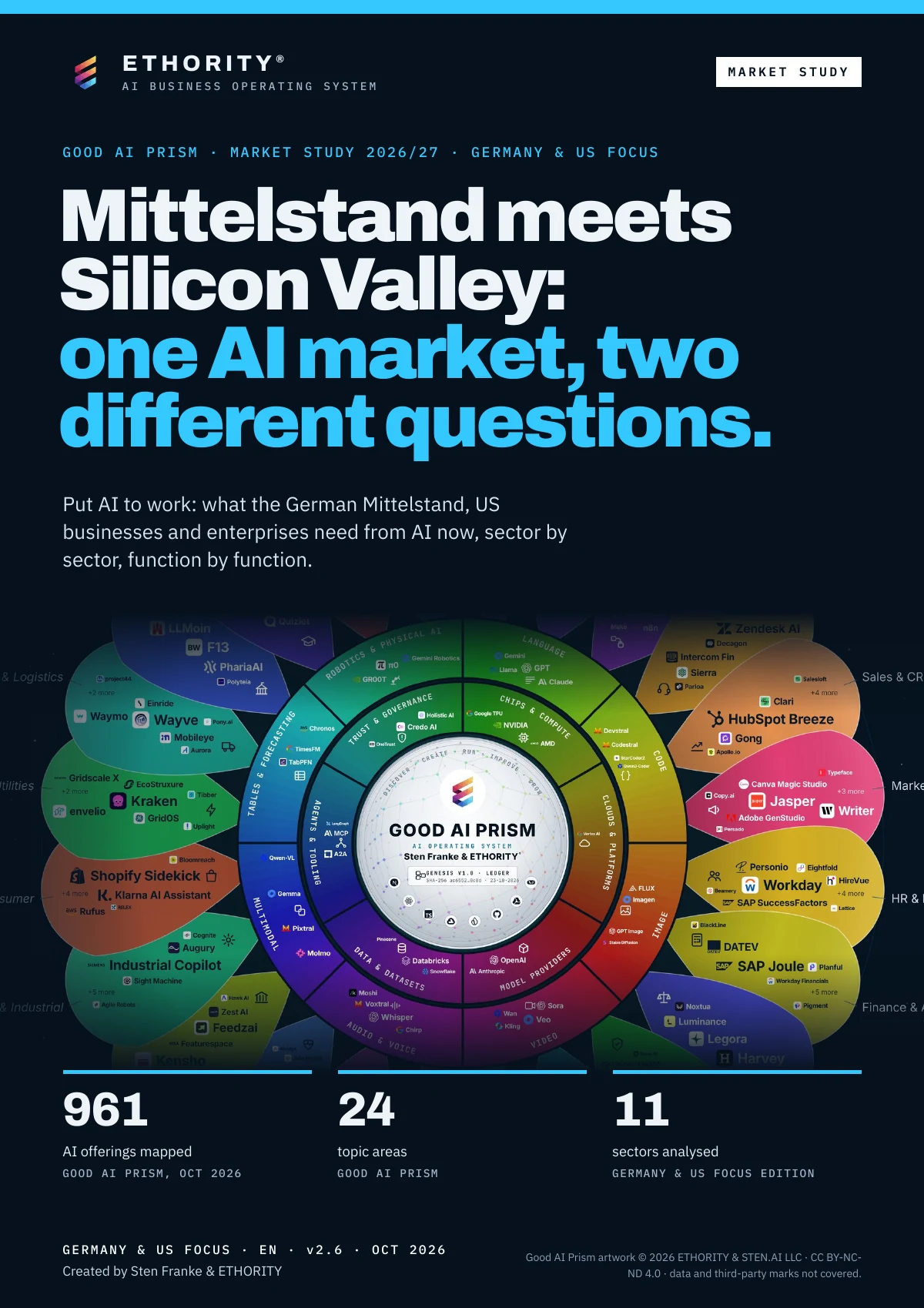
Germany & United States Focus · EN
Germany's mid-sized companies meet Silicon Valley: one AI market, two different questions.
The Mittelstand needs know-how; US firms need cost control. What German and US businesses need from AI now, sector by sector, function by function.
Version 2.6 · 72 pages
Open the study →The whole AI market on one sheet.
The full Good AI Prism as an A3 poster: every topic area, data type and technology layer on one page.
See the map on one page →Related insights
Our long read on assistant value, plus why saved hours are not AI value.
Saved hours are not AI value.
Separate a better task, freed-up time and a business result, so you can show the value AI really delivers.
See the map on one page →
AI-first means changing how you work, not counting tools.
What has to change across the organisation: strategy, work, decision rights, knowledge, evidence and leadership.
See the map on one page →
Trusting AI and going all-in are one job.
Why speed and responsible AI are no longer competing choices. An essay by Sten Franke.
See the map on one page →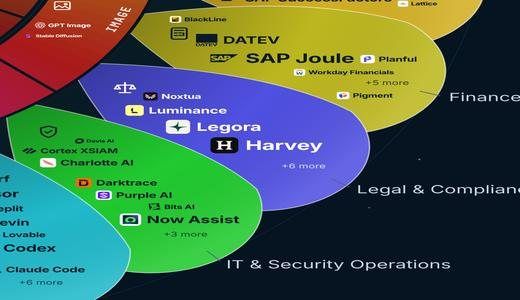
Preparing for the EU AI Act is the start; control happens in daily operation.
How to connect each EU AI Act duty to your systems, controls, evidence, monitoring and regular reassessment.
See the map on one page →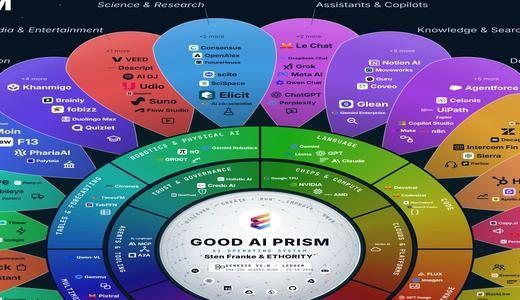
961 AI offerings. Start with the job, not the tool.
A method for going from one business need to a shortlist of AI offerings you can defend.
See the map on one page →Implement it with ETHORITY
AI Literacy & Adoption
€2,400 one-time · net
Builds AI literacy and everyday adoption in your teams, in step with the AI-literacy duty of the EU AI Act.
Scope and delivery by agreement
See what this package includes →AI Act Readiness Sprint
€6,900 one-time · net
Sets out which EU AI Act duties apply to your AI uses and what to have in place before each application date.
Date and place by agreement
See what this package includes →AI Estate Audit & Mapping
€25,000 one-time · net
Maps the AI systems, suppliers and dependencies in use across your organisation, so ownership and risk can be assigned.
Date and place by agreement
See what this package includes →Buyer questions
Do copilots raise productivity?
Not by default. The UK trial found 72% satisfaction and no evidence of productivity gains; some tasks got slower. Measure your own tasks, as Saved hours are not AI value explains.
How do we judge whether licences pay?
Track active use, hours saved on measured tasks and cost per active user, the three outcomes the Global Market Study recommends for this area.
Are there assistants that keep data in Europe?
Yes. All seven profiled workplace assistants state a European or own-server location; Logicc states German storage and EU models.
Do we have to train staff?
Yes. The revised AI-literacy duty applies since 27 Jul 2026 under Regulation (EU) 2026/1744.
Which model runs under our assistant?
Ask the provider and record it. Models retire, as the GPT-4o and GPT-4.1 snapshots do on 14 Jan 2027; the AI Models brief tracks the dates.
The evidence at a glance
ETHORITY · LONG READ
Agent and assistant spend hits US$29.2bn. Prove value per user.
Assistant licences spread faster than the evidence that they pay. A UK government trial found 72% satisfaction and no productivity proof. The Good AI Prism shows what to compare: active use, seat price, hosting and the model underneath.
The assistant is the most visible AI purchase most organisations make. It arrives as a licence for every desk, inside the office suite or as a stand-alone chat workspace. Spending shows how fast it is spreading. Gartner's September 2026 forecast puts spending on AI agents and assistants at US$29.2bn in 2026, up from US$16.5bn in 2025, and at US$65.5bn in 2027.
Use is spreading in the wider population too. Microsoft's diffusion report of September 2026 estimates from telemetry that 18.8% of working-age people worldwide use generative AI. The question for a business is no longer whether staff will use assistants. It is whether the licences it pays for produce value it can show.
A trial that pleased users and proved little
One widely reported public test of an office copilot came from the UK government. The Department for Business and Trade gave 1,000 Microsoft 365 Copilot licences to staff from October to December 2024 and evaluated the result. As TechRepublic reported from the department's evaluation, 72% of users were satisfied or very satisfied, and 80% found it useful in daily work. The trial found no evidence of productivity gains.
72% satisfied. No productivity proof. The UK Department for Business and Trade Copilot trial, 1,000 licences, Oct–Dec 2024.
The detail is instructive. Some tasks got slower: scheduling took about 35 minutes longer with Copilot, and generating images added about 30 minutes per job. Nearly a third of staff said presentations and code reviews needed more checking when Copilot was involved. Satisfaction and productivity are different measurements. A licence that people like is not yet a licence that pays.
The Global Market Study 2026/27 names the business problem for this area plainly: licences bought, value unproven. It recommends three things: an inventory of licences, an adoption and literacy programme with usage targets, and three outcome measures — active use, hours saved and cost per active user.
Small firms pay late, then stay
The buying pattern differs by size. In the Global Market Study's US evidence, 77% of small businesses on Intuit's platform use AI regularly, but only 12% pay for dedicated AI tools. Of those who pay, 86% renew (Intuit AI Impact Report, May 2026). Among solopreneurs, 86% try an AI tool before paying a person, and about 65% find checking AI output a drag (FreshBooks and Wakefield, Sep 2026).
Read together, the numbers describe a market where trying is cheap, paying is a considered step, and checking output is the hidden cost. That hidden cost is exactly what the UK trial picked up in its verification finding.
What the Prism shows about assistant offerings
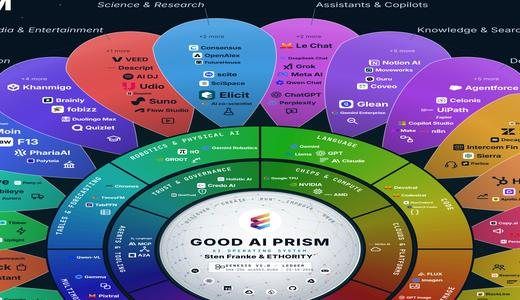
The Good AI Prism places 29 AI offerings in Assistants & Copilots, more than in most functional areas. Seven workplace assistants with document and team features carry full registry cards, profiled within the Knowledge & Search cohort and read from provider pages on 20 Oct 2026.
Exhibit: seven profiled workplace assistants
| Assistant | Price stated | Data location stated | Training on your data |
|---|---|---|---|
| meinGPT | €5.40–18 per user a month | Mainly Germany, EU | Not used |
| nele.ai | From €10 a month, credit pool | Germany | Third-party models addressed |
| Lumo for Business | US$11.99–19.99 per user a month | Europe | Opt-in only |
| Mindverse Studio | €15.20–59 per user a month | Germany | Not used |
| Logicc | €23.92–89.90 per user a month | German storage, EU models | Not used |
| innoGPT | €25–109 per user a month | EU (AWS Frankfurt) | Not used |
| Nextcloud Assistant | €183.75–204.75 per user a year | Customer's own server | Not used |
Source: Good AI Prism Registry, provider pages read 20 Oct 2026.
Two things stand out. First, per-seat prices differ by a factor of about twenty, from €5.40 to €109 a month. The cheapest plan is rarely the relevant comparison; what matters is cost per active user at your adoption rate. A €20 seat used daily is cheaper than a €6 seat nobody opens.
Second, every one of the seven states a European or own-server location. nele.ai states Germany and bills from a shared credit pool instead of seats. Logicc states German storage and EU models. For organisations that hold back on US-hosted assistants for data reasons, this part of the market offers documented alternatives.
Billing moves to usage
The billing model is moving as well. nele.ai already bills from a credit pool rather than per seat, and the Global Market Study cites Gartner, via Deloitte, expecting at least 40% of SaaS spend to be usage-, agent- or outcome-based by 2030. For assistants, that turns a fixed licence line into a variable cost that grows with use. Budget owners who know their active users and their heaviest tasks can negotiate on that basis. Those who only know their seat count cannot.
Scenario. 500 seats at €25 a month cost €12,500 a month. With 200 active users in a month, each active user costs €62.50; with 400, €31.25. The seat price did not change. The adoption rate did.
The model under the assistant matters
Assistants are interfaces on top of models, and the model layer moves quickly. The AI Models technology brief records that 81% of large enterprises already use three or more model families (a16z, Jan 2026), and that prices per million input tokens span about a hundredfold, from US$0.10 to US$10. It also records that OpenAI retires its GPT-4o and GPT-4.1 snapshots on 14 Jan 2027. An assistant that routes to several models, or switches its default, can change answers and cost without a new contract.
~20× spread in per-seat prices across seven profiled workplace assistants, from €5.40 to €109 a month (Good AI Prism Registry, 20 Oct 2026).
The literacy duty is already in force
Assistants reach every employee, so the AI-literacy duty of the EU AI Act lands here first. Under Regulation (EU) 2026/1744, a revised literacy duty applies since 27 Jul 2026: providers and deployers must take measures so that staff using AI understand it. Article 50 transparency duties apply since 2 Aug 2026. A copilot rollout without training is no longer only a missed opportunity. It is an open duty.
Literacy also speaks to what the UK trial found. Users who know when to check, and when not to use the assistant at all, avoid the slower tasks the trial found. ETHORITY's evidence synthesis Saved hours are not AI value adds the economic side: hours saved become value only when the released capacity changes an outcome you can attribute.
What to do Monday
- Count active users, not licences. Pull 30 days of usage for every assistant you pay for. Calculate cost per active user and flag seats unused for a month.
- Pick three tasks and measure them. Choose tasks where the UK trial found gains and losses, such as drafting, summarising and scheduling. Time them with and without the assistant.
- Check where the data goes. For each assistant, record stated hosting, training terms and the model it uses. The registry cards show the provider statements with sources.
- Train before you scale. Run a literacy session that covers when to check output and when not to use the tool. The AI Literacy & Adoption offer is built for this duty.
- Set a renewal gate. Before the next renewal, decide which active-use rate and which measured task gains justify it.
The Good AI Prism keeps the assistant registry current, with every price, hosting statement and training term sourced and dated.
Sources and further reading
- Gartner: Worldwide AI spending to grow 49.5% in 2026 ↗ · 16 Sep 2026
- Microsoft: The continued state of global AI diffusion in 2026 ↗ · 21 Sep 2026
- TechRepublic: UK Department for Business and Trade Microsoft 365 Copilot trial ↗ · 8 Sep 2025
- UK Department for Business and Trade: Microsoft 365 Copilot evaluation (PDF) ↗ · Aug 2025
- Intuit: AI Impact Report (via Good AI Prism Global Market Study) ↗ · May 2026
- a16z: enterprise AI survey (via Good AI Prism AI Models brief) ↗ · Jan 2026
- Regulation (EU) 2026/1744 (Digital Omnibus on AI, amending the AI Act) ↗ · in force 27 Jul 2026
- Good AI Prism Global Market Study 2026/27 (ETHORITY) → · 22 Oct 2026
- Good AI Prism Registry cards, provider pages read 20 Oct 2026 (ETHORITY) → · 20 Oct 2026
- OpenAI: API deprecations (GPT-4o and GPT-4.1 snapshots) ↗ · read 25 Oct 2026
Put the thinking to work
AI Readiness & Maturity Check →
Leadership can agree where to start, who owns each action and which next project is justified. This is not a technical system audit or vendor selection.
A written comparison of up to three AI offerings · €195 net →
Start with one question and up to three offerings. Request a sourced comparison, provider questions and a cost sketch using your assumptions.
YOUR NEXT STEP
Discuss your question with Sten Franke.
Bring your business question or the figures you already know. ETHORITY investigates within the agreed scope; together with Sten Franke you agree the next piece of work.