 ETHORITY®
GOOD AI PRISM · TOPIC AREA · DOCUMENTS, WORKFLOW & AGENTS
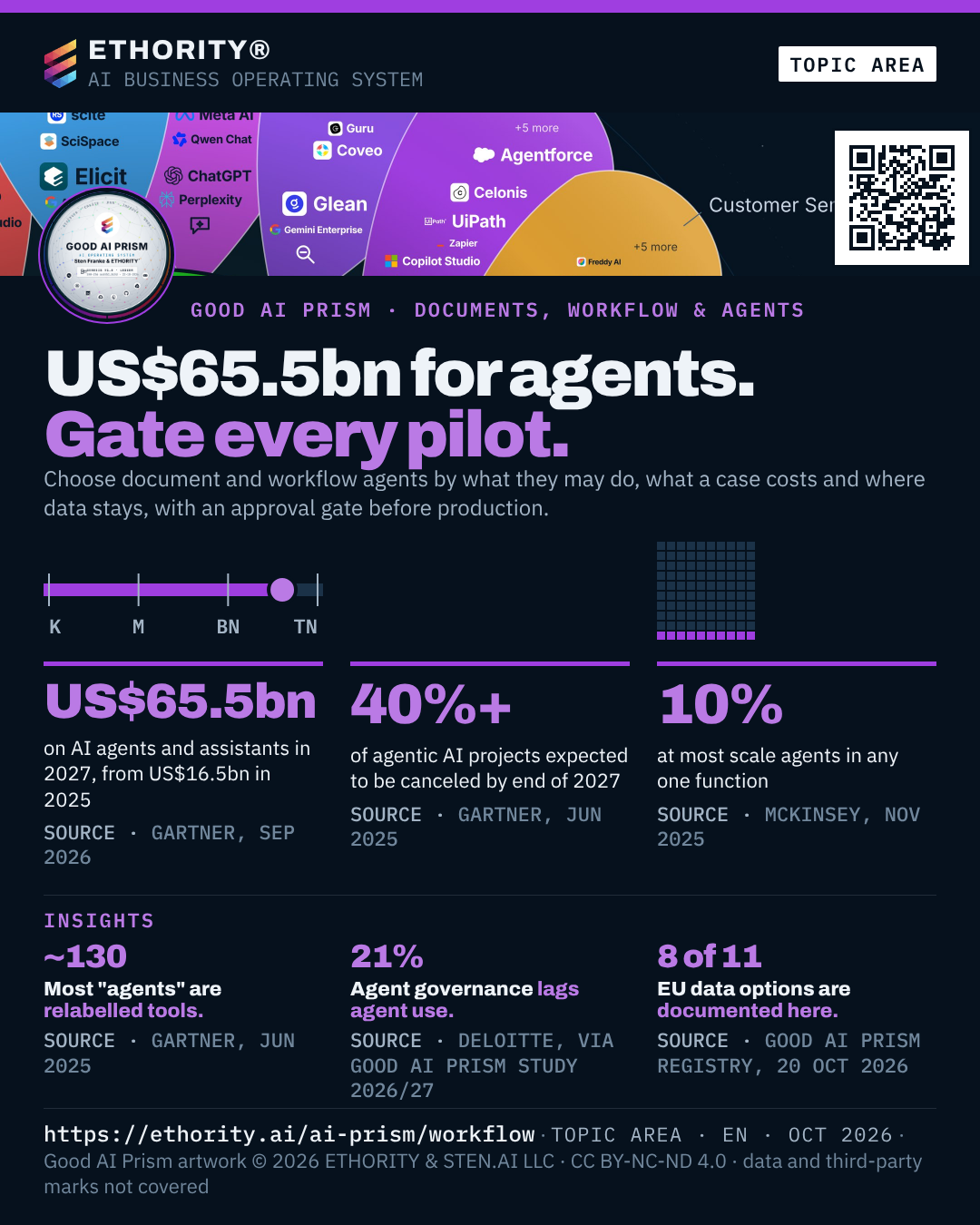
US$65.5bn for agents. Gate every pilot.
Choose document and workflow agents by what they may do, what a case costs and where data stays, with an approval gate before production.
- 24
- AI offerings placed in Documents, Workflow & Agents, plus 1 provider record (ABBYY)Good AI Prism, Oct 2026
- US$65.5bn
- on AI agents and assistants in 2027, from US$16.5bn in 2025Gartner, Sep 2026 · gartner.com ↗
- 40%+
- of agentic AI projects expected to be canceled by end of 2027Gartner, Jun 2025 · gartner.com ↗
- 10%
- at most scale agents in any one functionMcKinsey, Nov 2025 · mckinsey.com ↗
Most "agents" are relabelled tools.
Gartner estimates only about 130 of the thousands of vendors marketing agentic AI are real.
Gartner, Jun 2025
Agent governance lags agent use.
Only one organisation in five reports mature governance for its AI agents.
Deloitte, via Good AI Prism Study 2026/27
EU data options are documented here.
Eight of eleven profiled workflow offerings name an EU region, EU default or EU option.
Good AI Prism Registry, 20 Oct 2026
How to use this page
Three tools and one offer turn this page into a decision.
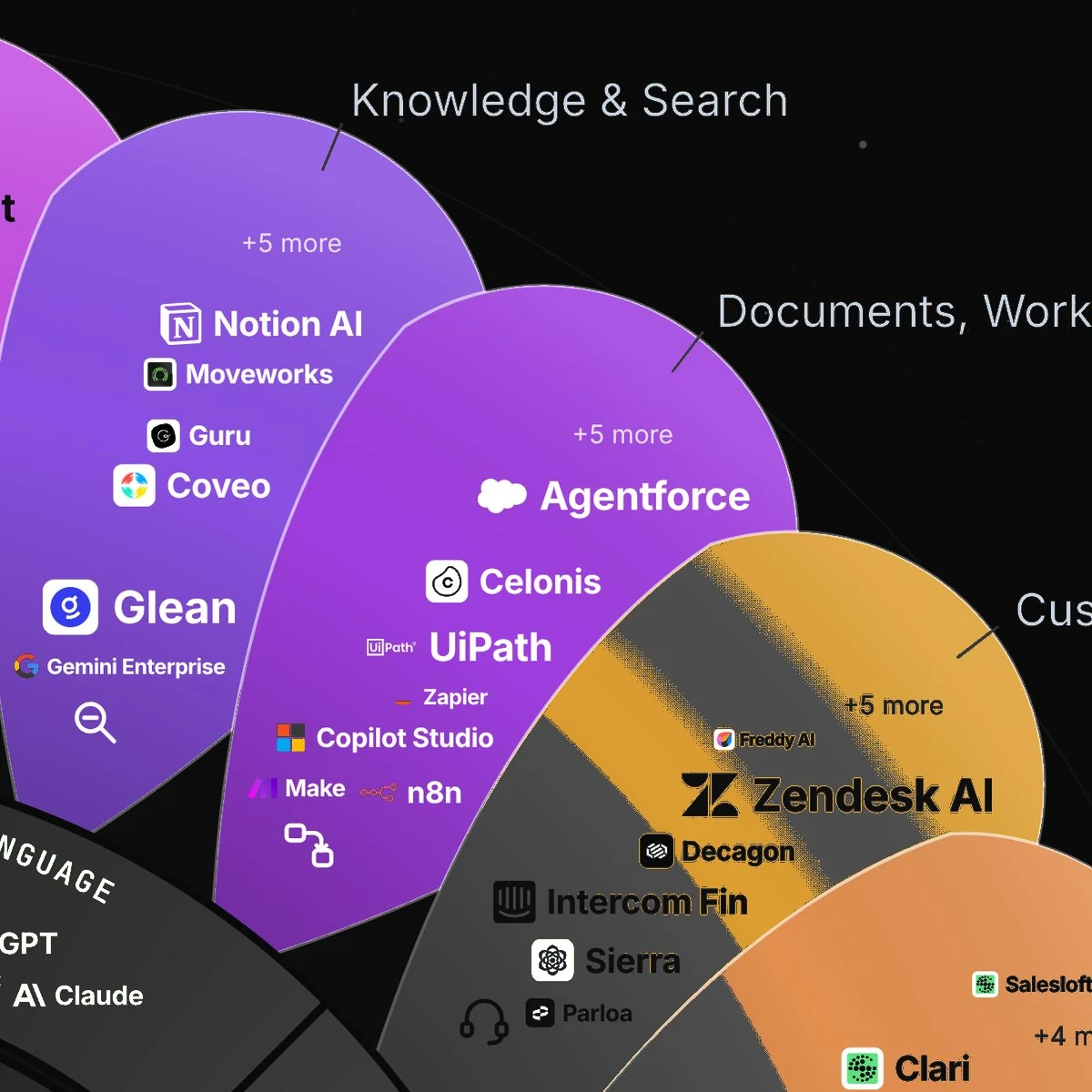
- Open the Documents & Workflow map: 24 AI offerings and 1 provider record on one petal of the Good AI Prism, with logos and provider facts.
- Compare up to three offerings: decision facts side by side, each with its source and date.
- Run the Task economics calculator: turn saved hours into capacity you can attribute, before a pilot is approved.
- Offer: AI Trust Pilot: one agent run under real conditions for six weeks, with owners, a stop rule and a decision package at the end.
Eleven workflow and agent offerings, fact by fact
Billing unit, price, training terms, data location, integrations and certifications, each with source and date.
Dify
LangGenius (Dify) · Platform
Dify is a source-available platform for visually building LLM chat apps, agents and workflows with knowledge bases, Marketplace model and tool plugins, human-input pause nodes, run cloud-hosted or self-hosted.
- Published price
- How it is billed
- Where data is stored
- Does it train AI on your data?
Rossum
Rossum · Product
Rossum captures data from invoices, purchase orders and bills of lading using its in-house transactional LLM Aurora, holding fields below confidence thresholds for human validation before export to SAP or Coupa.
- Published price
- How it is billed
- Where data is stored
- Certificates and audit reports
Instabase AI Hub
Instabase · Platform
According to Instabase: “Instabase can classify files, discern intent, and even split multi-document packets into individual files.”
- Where data is stored
- Does it train AI on your data?
- Certificates and audit reports
- Connects with
Beam AI
Beam AI · Platform
Beam AI runs enterprise AI agents on graph-based workflows that mix fixed steps with LLM nodes, pausing at consent nodes for human approval and drawing on 1,500+ prebuilt connectors.
- How it is billed
- Where data is stored
- Does it train AI on your data?
- Certificates and audit reports
Workato Genies
Workato · Agent
According to Workato: “Workato Genies go beyond traditional AI agents – they can be customized with unique KPIs”
- Published price
- How it is billed
- Where data is stored
- Does it train AI on your data?
Appian Agent Studio
Appian · Platform
Agent Studio lets Appian designers configure AI agents that follow prompt instructions and call tools, MCP servers and Appian process models to route cases, update records and start workflows.
- How it is billed
- Where data is stored
- Does it train AI on your data?
- Certificates and audit reports
Doxis AI.dp
Doxis (formerly Klippa) · Product
According to Doxis (formerly Klippa): “Doxis’ solution leverages AI to analyze the pixel-level structure of documents in the metadata to detect fraud.”
- How it is billed
- Where data is stored
- Certificates and audit reports
- Connects with
Relevance AI
Relevance AI · Platform
According to Relevance AI: “Subject-matter experts can use Relevance to design powerful AI agents without relying on developer resources.”
- Published price
- How it is billed
- Where data is stored
- Does it train AI on your data?
Lindy
Lindy · Agent
Lindy is a credit-billed AI teammate set up in plain sentences that works across 1,500+ connected apps from Slack, email, iMessage and phone, holding outbound actions for approval.
- Published price
- How it is billed
- Does it train AI on your data?
- Certificates and audit reports
Nanonets
Nanonets · Product
Nanonets extracts fields and tables from invoices, forms and scans via configurable workflows billed per block run, routing rule-violating files to reviewers before export to ERPs, databases or sheets.
- Published price
- How it is billed
- Where data is stored
- Certificates and audit reports
Dust
Dust · Platform
Dust lets company teams build shared AI agents over connected knowledge sources and tools, choosing among 20+ models per task, with stake-level approvals before agents take actions like sending email.
- Published price
- How it is billed
- Where data is stored
- Does it train AI on your data?
Compare baseline: three billing units
Per action, per seat plus credits, per user and app: three units that scale very differently.
| Offering | Billing unit | Data location | Training | Source |
|---|---|---|---|---|
| Workato Genies | Per Genie action | EU in-region option | Not used for training | Workato Genies pricing and trust |
| Dust | Per seat/mo + credits | EU or US | Not used for training | Dust pricing and security |
| Appian Agent Studio | Per user/app/month | EU AWS regions | Not used for training | Appian Agent Studio documentation |
Registry facts as stated on each provider's own pages, read 20 Oct 2026. Add your own volumes in Compare before deciding.
Rules and dates
The dates that apply once an agent writes, decides or routes cases.
- 2 Aug 2026
Art. 50: people must be told when they interact with an AI system.
Reg. (EU) 2026/1744
- 1 Jan 2027
Colorado and California duties on automated decisions apply for covered uses.
State law, CO and CA
- 2 Dec 2027
Annex III high-risk duties apply, incl. employment, credit, education and justice.
Reg. (EU) 2026/1744
- 2 Aug 2028
High-risk duties apply to AI in regulated products.
Reg. (EU) 2026/1744
Read the evidence
The Global Market Study 2026/27 names "agent washing" and stalled pilots as the problems of this area.
Global edition · EN
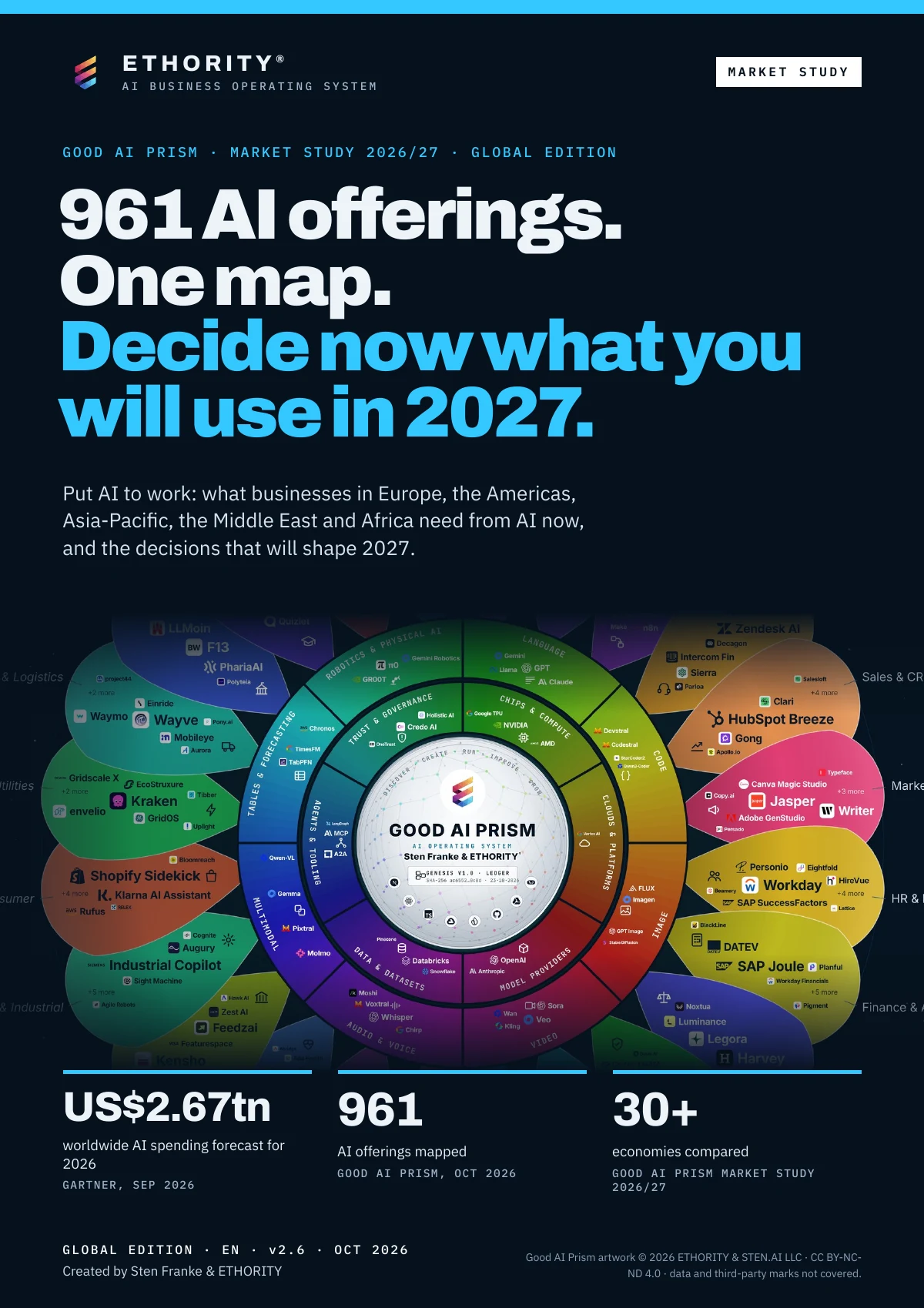
961 AI offerings. One map. Decide now what you will use in 2027.
The Good AI Prism helps you find useful AI and compare the evidence behind your options. For organisations already using AI, the question is moving from whether to use AI to which AI, how safely and whether it pays. This Global edition brings together 961 AI offerings across 24 topic areas, 8 data types and 6 technology layers, with sources, dates and limits to guide your next decision.
Version 2.6 · 90 pages
Open the study →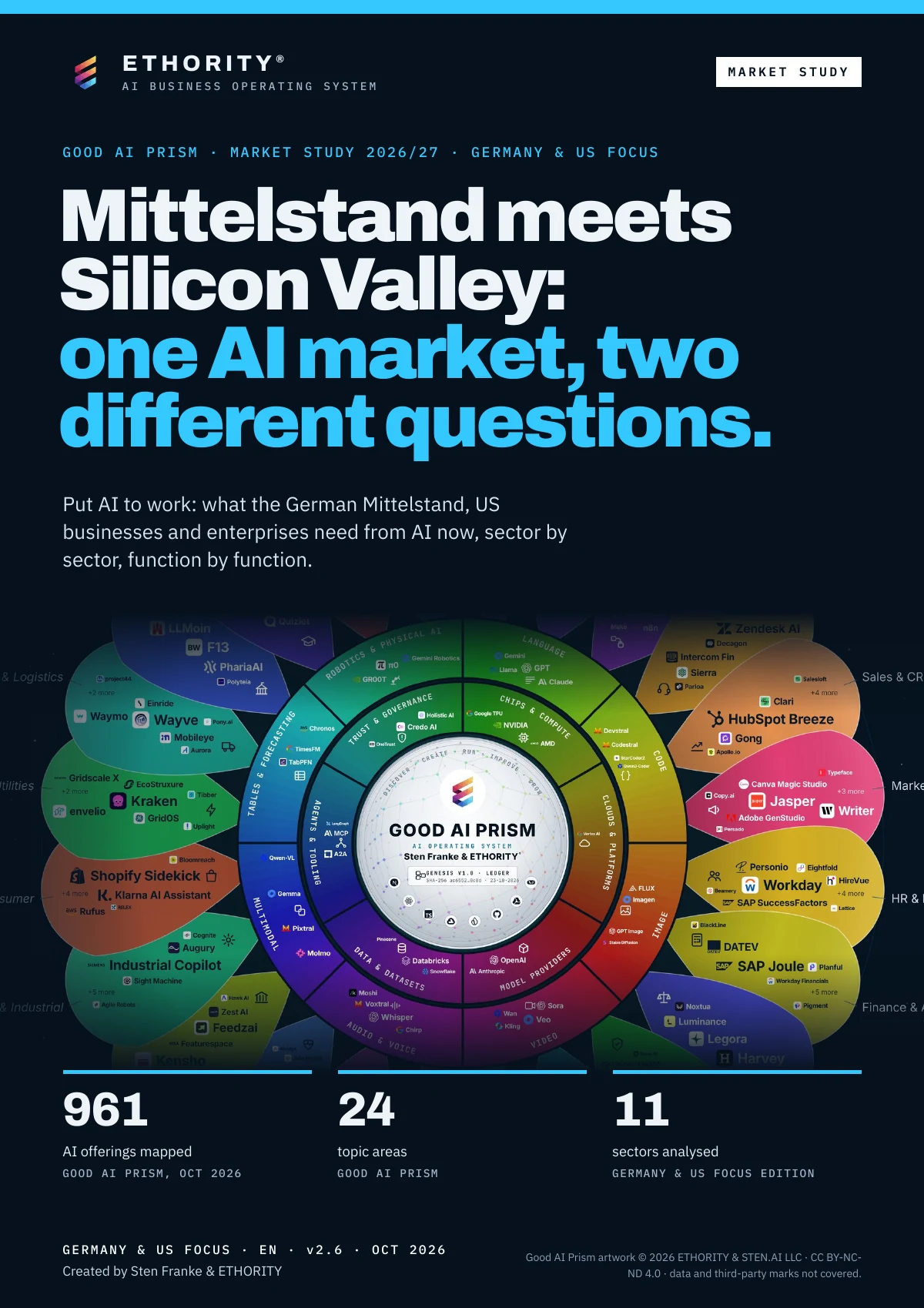
Germany & United States Focus · EN
Germany's mid-sized companies meet Silicon Valley: one AI market, two different questions.
The Mittelstand needs know-how; US firms need cost control. What German and US businesses need from AI now, sector by sector, function by function.
Version 2.6 · 72 pages
Open the study →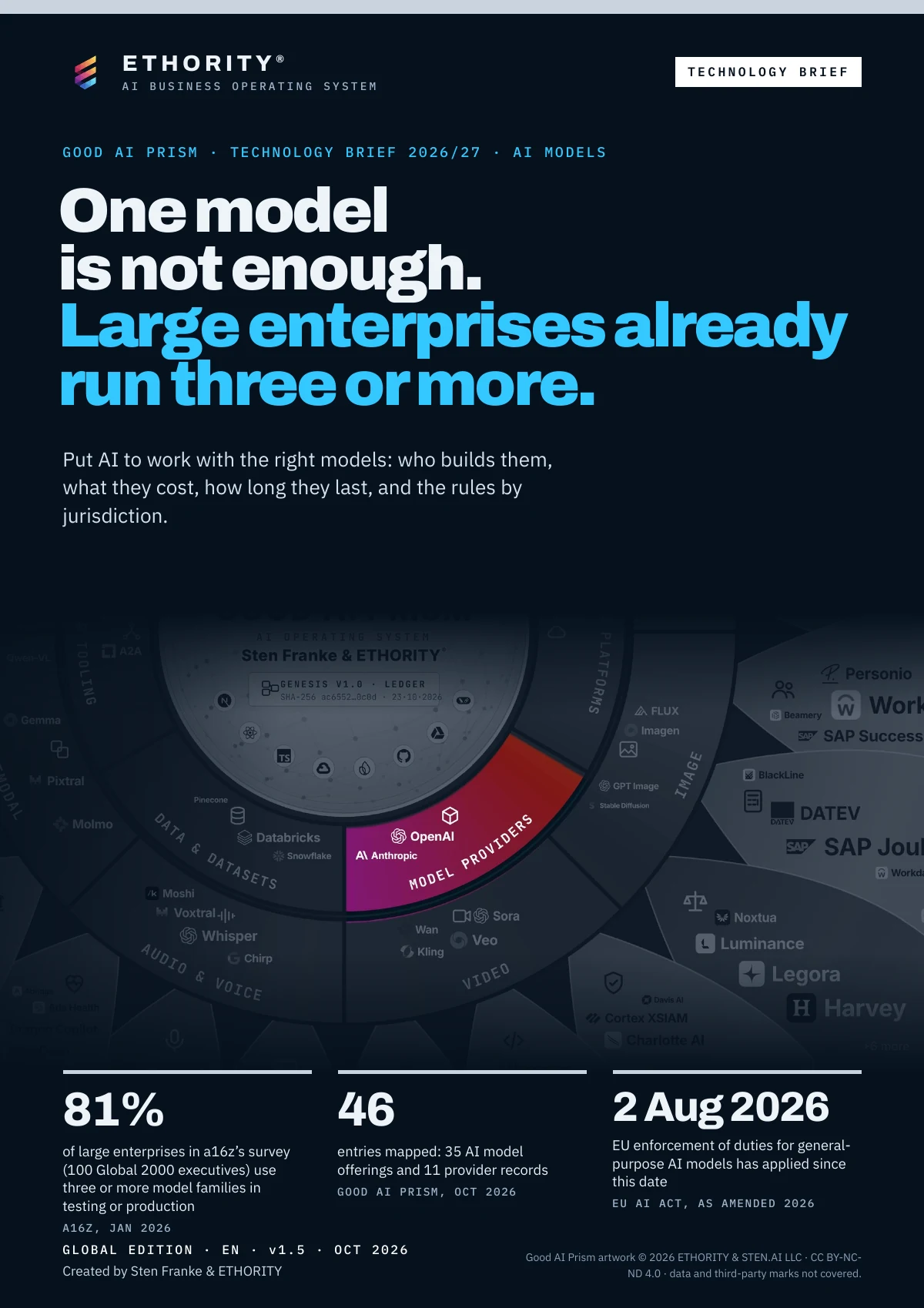
Global edition · EN
One model is not enough. Large enterprises already run three or more.
81% of large enterprises use three or more model families. Who builds AI models, what they cost, how long they last, and the rules by jurisdiction.
Version 1.5 · 38 pages
Open the study →Related insights
Our long read on gating agents, plus why tool access is not authority.
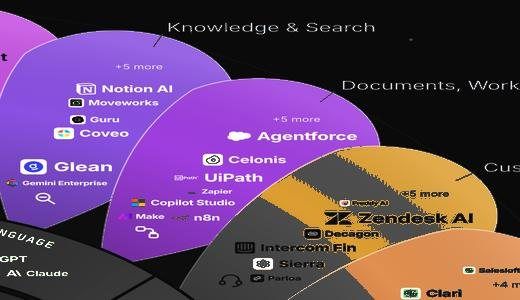
Access to a tool does not give an AI agent the right to act.
How to define what each AI agent may do: by action, limit, time and consequence, rather than by the tools it can reach.
See the map on one page →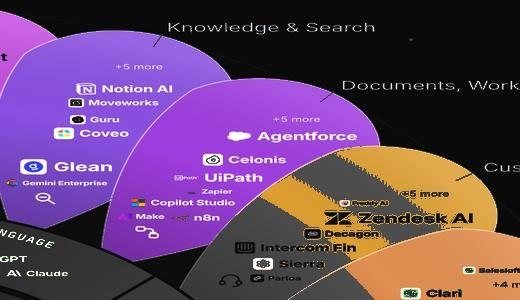
A marketplace listing does not make an AI agent trustworthy.
When you buy AI agents, keep identity, offer, payment, evidence and trust apart, and grant rights only after purchase.
See the map on one page →
AI does not scale by itself. Redesign the work.
Start with one objective, choose the simplest approach for each task and measure the cost of every result you accept.
See the map on one page →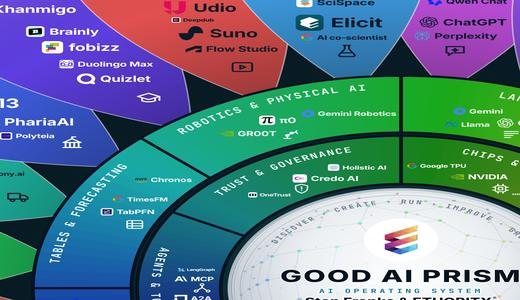
A list of AI agents does not control them.
What controls AI agents in daily operation: clear rights, a record of how well each fact is supported, checks matched to the risk, data limits and alerts when something changes.
See the map on one page →
AI rules move from documents into daily operation.
Why AI agents, tools and constant change move AI governance – the rules and responsibilities for AI – into the systems that run your AI every day.
See the map on one page →Implement it with ETHORITY
Enterprise AI Opportunity Case
Priced after scoping
Compares real options, including doing nothing, models the economics and the assumptions that can break them, and recommends: start, change, test first or stop.
Scope and delivery by agreement
See what this package includes →AI Trust Pilot
€25,000 net · one-time
Runs one agreed AI use case under real conditions in one department, with owners, evidence, review and stop conditions set before it starts.
Request scope and delivery
See what this package includes →AI Governance Setup
€19,500 one-time · net
Sets named owners, bounded authority, current evidence and a defined response to change for the AI you run.
Scope and delivery by agreement
See what this package includes →Buyer questions
How do we tell a real agent from a relabelled chatbot?
Ask what it may do on its own, under which limits, and who answers for the result. Tool access is not authority sets out the four limits: action, value, time and consequence.
Why do so many agent projects get canceled?
Gartner names escalating costs, unclear business value and inadequate risk controls. A business case with a stop/go gate and a cost per accepted case addresses all three.
How are workflow and agent offerings billed?
In at least eight units across 11 profiled cards: per workspace, seat, action, run, document or annual volume. Workato Genies, for example, bills per Genie action.
Can our documents stay in the EU?
Often, but check the plan. Eight of 11 profiled offerings name an EU option; Doxis AI.dp states Amsterdam as its default.
Should we buy agents from a marketplace?
Only with identity, evidence and authority checked separately. A marketplace listing is not trust explains the five checks.
The evidence at a glance
ETHORITY · LONG READ
Gartner: 40% of agent projects face cancellation. Scope authority first.
Agent spending is set to quadruple to US$65.5bn by 2027, while Gartner expects over 40% of agentic projects to be canceled. The Good AI Prism shows what separates the survivors: authority, cost per case and data terms.
Agents are where AI budgets are heading. Gartner's September 2026 spending forecast puts spending on AI agents and assistants at US$16.5bn in 2025, US$29.2bn in 2026 and US$65.5bn in 2027. That is roughly four times as much in two years. Gartner now reports agents and assistants as their own market, separate from AI software.
The same analyst house expects many of these projects to fail. In its June 2025 forecast, Gartner predicted that over 40% of agentic AI projects will be canceled by the end of 2027, citing escalating costs, unclear business value or inadequate risk controls. Both forecasts can be true at once. Money is flowing in faster than organisations learn to run agents.
Many pilots, little scale
Survey data shows how early the market still is. In the McKinsey State of AI 2025, 23% of respondents said their organisation was scaling agentic AI somewhere, and a further 39% were experimenting. In any given business function, no more than 10% reported scaling agents. The August 2026 edition shows the gap widening by size: 40% of large organisations scale agents, against 22% of smaller ones.
10%. No business function had more than one in ten organisations scaling AI agents in McKinsey's 2025 survey.
Governance lags further. The Global Market Study 2026/27 records that only 21% of organisations have mature agent governance (Deloitte), and that 26% of large US firms see their AI costs in real time (KPMG AI Pulse, Q2 2026). Agents that act on documents, tickets and systems without a named owner and a cost line are exactly the projects Gartner expects to be cut.
"Agent washing" makes choosing harder
Gartner also estimated that only about 130 of the thousands of vendors marketing agentic AI offer real agentic capability. The rest relabel chatbots, assistants or robotic process automation. The study calls this "agent washing" and lists it as the main business problem in this area, next to pilots that never ship.
For a buyer, the label "agent" says little. What matters is what the system may do on its own, under which limits, and who answers for the result. ETHORITY's insight Tool access is not authority makes the point directly: scope each agent by action, limit, time and consequence, not by the tools it can reach. Bought agents need the same discipline. A marketplace listing is not trust separates identity, offer, payment, evidence and authority, and grants authority only after purchase.
~130 of the thousands of vendors marketing agentic AI offer real agentic capability, by Gartner's estimate (Jun 2025).
What the Prism shows about workflow and agent offerings
The Good AI Prism places 24 AI offerings and one provider record (ABBYY) in Documents, Workflow & Agents. They range from intelligent document processing to agent builders and enterprise automation platforms. Eleven carry a full registry card with sourced decision facts, read from provider pages on 20 Oct 2026.
Exhibit: eleven profiled workflow and agent offerings
| Decision fact | What the 11 cards show |
|---|---|
| Billing unit | At least eight different units, from per workspace and per seat to per action, per run and per document |
| Training on your data | 7 state customer data is not used for training; 3 leave it to be asked; 1 offers opt-out on certain plans |
| EU data location | 8 name an EU region, EU default or EU option |
| Published price | 7 publish a list price, from free tiers to US$18,000 a year |
| Agent standards | 3 name the Model Context Protocol (MCP) |
Source: Good AI Prism Registry, provider pages read 20 Oct 2026.
Billing is the first trap. Workato Genies bill per Genie action. Nanonets bills per run, without seats. Rossum bills annually by volume, from US$18,000 a year. Dust charges €24–120 per seat a month plus credits. Agents that act many times per case make volume the main cost driver. A pilot priced per seat can turn into a production bill priced per action.
Data location is better documented here than in most areas. Eight of the eleven name an EU option, including Doxis AI.dp with an Amsterdam default and Appian Agent Studio in EU AWS regions. Training terms are less complete: three providers state nothing clear on training, so the question goes into the contract.
Interoperability is becoming a buying criterion. Three profiled offerings name the Model Context Protocol, among them Workato Genies. Verified relations in the Prism show many applications resting on a few hubs, MCP among them. One protocol or platform change can move many agents at once.
Scenario. A team of 25 on Dust pays €600 a month at €24 per seat, or €3,000 at €120, before credits. A per-action plan such as Workato Genies grows with cases, not people. Price the pilot at production volume and divide by accepted cases.
Rules arrive while agents spread
Agents that write, decide or route cases touch the EU AI Act. Under Regulation (EU) 2026/1744, Article 50 transparency duties apply since 2 Aug 2026. High-risk duties for Annex III uses, such as recruitment, credit and education decisions, apply from 2 Dec 2027. An agent that pre-screens applicants or loan files is judged by its use, not by its label. In the United States, Colorado and California duties on automated decisions apply from 1 Jan 2027 for covered uses.
The scaling question is organisational as much as technical. ETHORITY's insight AI does not scale by itself draws on a McKinsey survey of 696 companies (Jun 2026) linking operating practice to AI scale: start with one objective, pick the simplest mode per task and measure the cost of an accepted result. Not every workflow needs an agent. Many need a well-designed document pipeline with a human decision at the end.
Measure the right outcome
The study names three outcomes for this area: cycle time, straight-through rate and cases in production. They are harder to fake than demo metrics. A document workflow that processes most invoices without touch, at a known cost per case, is a result. An agent that "can" process invoices is not.
Put a business case with a stop/go gate in front of every agent pilot. Define what the agent may do alone, at what value limit, and when a human signs. Record the model and the platform underneath. Then compare offerings on cost per accepted case at your own volume.
What to do Monday
- List every agent and automation already running. Include tools bought by departments. For each, record owner, actions it can take, systems it touches and monthly cost.
- Write the authority for one agent. Actions allowed, value limits, time window, escalation rule and who signs the consequence. If nobody can sign, the agent is not ready for production.
- Price the pilot as production. Convert per-seat, per-action and per-run pricing into cost per accepted case at expected volume.
- Ask three questions in writing. Where is our data processed? Is it used for training? Which models and protocols does the agent depend on?
- Set the gate before the pilot. Agree the cycle time, straight-through rate and cost per case that decide go or stop. The AI Trust Pilot offer runs one use case this way, with stop conditions agreed before it starts.
The registry cards for this area are kept current in the Good AI Prism, with every decision fact sourced and dated, so a shortlist can start from evidence rather than from an "agent" label.
Sources and further reading
- Gartner: Worldwide AI spending to grow 49.5% in 2026 ↗ · 16 Sep 2026
- Gartner: Over 40% of agentic AI projects will be canceled by end of 2027 ↗ · 25 Jun 2025
- McKinsey: The state of AI in 2025 (1,993 respondents, 105 countries) ↗ · 5 Nov 2025
- McKinsey: The state of AI, August 2026 edition (1,719 respondents, 97 countries) ↗ · 25 Aug 2026
- Deloitte: AI agents scaling faster (agent governance maturity) ↗ · 2026
- KPMG: AI Pulse Survey Q2 2026 ↗ · 2026
- Regulation (EU) 2026/1744 (Digital Omnibus on AI, amending the AI Act) ↗ · in force 27 Jul 2026
- Good AI Prism Global Market Study 2026/27 (ETHORITY) → · 22 Oct 2026
- Good AI Prism Registry cards, provider pages read 20 Oct 2026 (ETHORITY) → · 20 Oct 2026
Put the thinking to work
AI Opportunity Case →
A defensible proceed, test, redesign, defer or stop decision. The fee is independent of which outcome the evidence supports.
A written comparison of up to three AI offerings · €195 net →
Start with one question and up to three offerings. Request a sourced comparison, provider questions and a cost sketch using your assumptions.
YOUR NEXT STEP
Discuss your question with Sten Franke.
Bring your business question or the figures you already know. ETHORITY investigates within the agreed scope; together with Sten Franke you agree the next piece of work.