 ETHORITY®
In this article
Terms used in this article
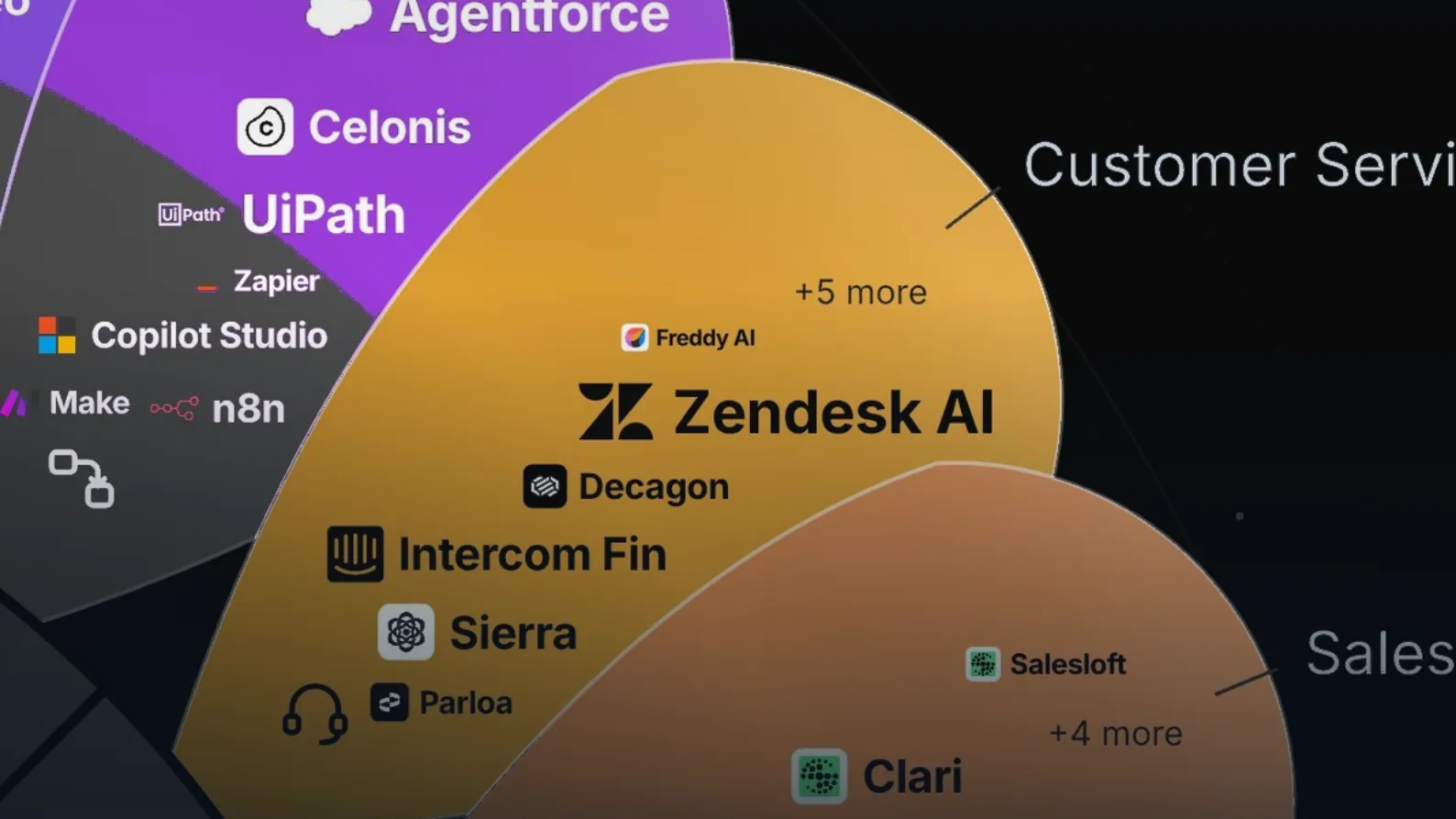
Good AI Prism v3.12 · Customer Service petal, colour-keyed · Good AI Prism artwork © 2026 ETHORITY & STEN.AI LLC · CC BY-NC-ND 4.0 · data and third-party marks not covered.
Good AI Prism v3.12 · Sten Franke & ETHORITY
Source study · v2.1 · page 45 · Figure published: 25 Oct 2026
Read figure text, sources and rights
Good AI Prism v3.12 · Customer Service petal, colour-keyed · Good AI Prism artwork © 2026 ETHORITY & STEN.AI LLC · CC BY-NC-ND 4.0 · data and third-party marks not covered.
ETHORITY figure. Rights in cited data and third-party marks remain with their owners. The Prism artwork licence applies where stated on the figure.
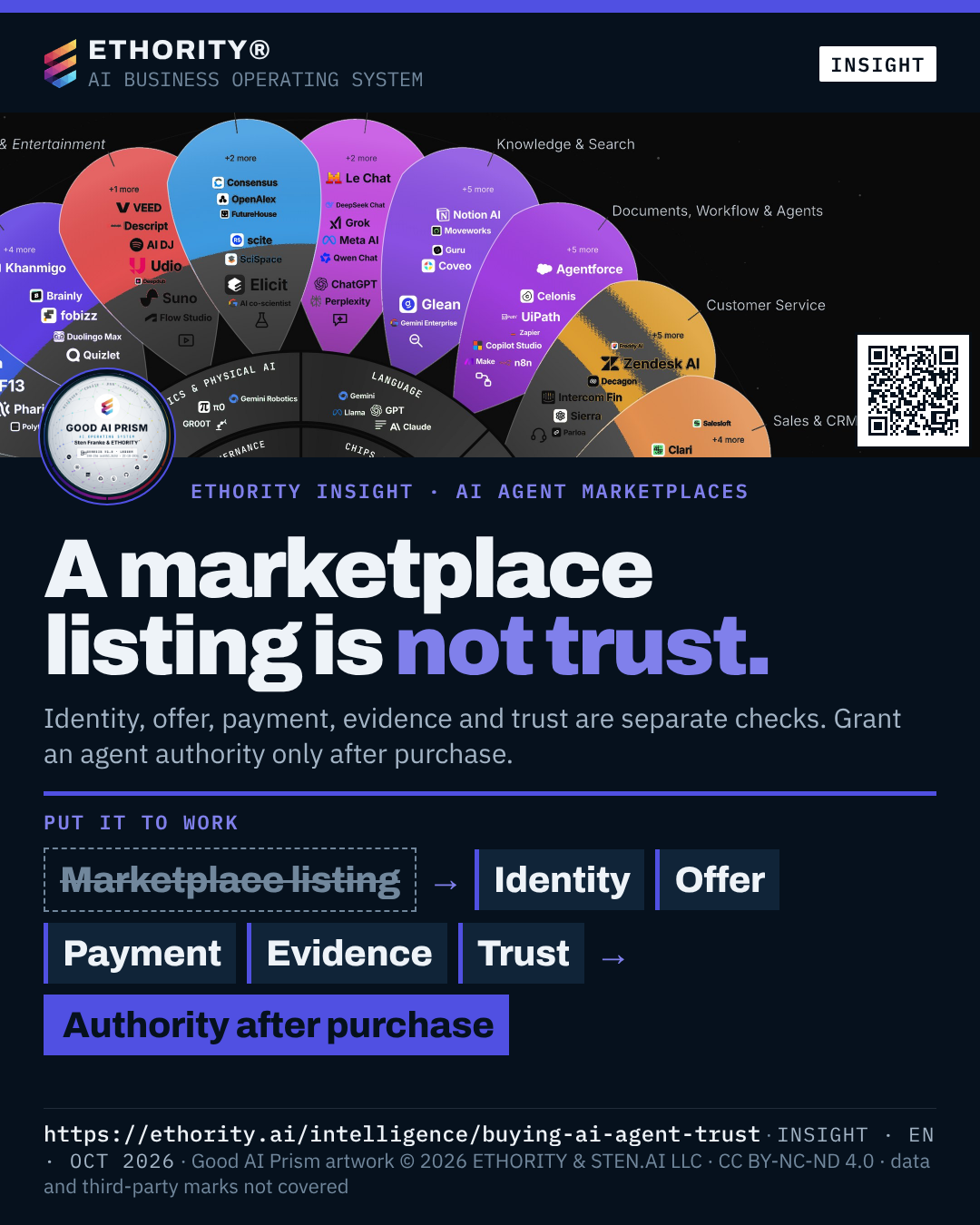
The AI agent marketplace is coming fast.
Agents are becoming products. Providers are packaging specialist capabilities. Platforms are making agents easier to discover, connect and deploy. Protocols such as A2A and MCP are reducing the integration friction around multi-agent systems and tool access.
Source context: MCP · authorization specification · 2026-07-28 ↗ · Agent2Agent · v1.0 specification ↗
That is good for the market.
It also creates a dangerous shortcut:
If an agent is listed, purchasable or popular, buyers may assume it has already been vetted.
Marketplace presence is not trust.
First separate the objects
A serious AI marketplace needs to distinguish several things that consumer app stores often blur together:
ENTITY Who or what is this agent/system/provider?
OFFER What exactly is being sold or made available, under which terms?
ORDER What did the customer agree to purchase or request?
TRANSACTION What payment/settlement event occurred?
ENTITLEMENT What access or usage rights were created?
EVIDENCE What supports material claims about the agent?
ASSURANCE / VERIFICATION What, if anything, has been independently assessed?
TRUST What conclusion is justified for this specific context?
These are not the same object.
Payment should never create trust truth.
A commercial offer is not a system identity
Imagine an agent called “Procurement Analyst Pro.”
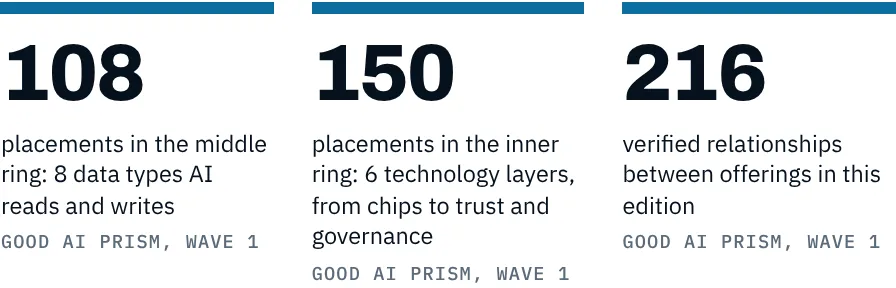
The same pattern runs across the market.
GOOD AI PRISM, WAVE 1 · GOOD AI PRISM, WAVE 1 · GOOD AI PRISM, WAVE 1
Source study · v2.1 · page 53 · Figure published: 25 Oct 2026
Read figure text, sources and rights
108 placements in the middle ring: 8 data types AI reads and writes GOOD AI PRISM, WAVE 1 150 placements in the inner ring: 6 technology layers, from chips to trust and governance GOOD AI PRISM, WAVE 1 216 verified relationships between offerings in this edition GOOD AI PRISM, WAVE 1
ETHORITY figure. Rights in cited data and third-party marks remain with their owners. The Prism artwork licence applies where stated on the figure.
The canonical entity might identify the provider, agent identity, version lineage and technical capabilities.
A commercial offer might separately define:
- price;
- subscription or usage model;
- territory;
- service level;
- included tools/connectors;
- license terms;
- data handling;
- support;
- capacity;
- availability;
- entitlement conditions.
The offer can change without changing the underlying entity.
The entity can change version without automatically changing a signed commercial order.
Keeping those objects separate is essential for traceability.
Discovery should start with the Mission
Most marketplaces start with products.
For AI, that is often backwards.
A business buyer does not wake up wanting “Agent X.”
They want to reduce customer-service cost, automate an administrative workflow, improve sales intelligence, analyze research, monitor risk or build a new AI-enabled service.
A better journey begins:
MISSION / NEED → CAPABILITY REQUIREMENT → CANDIDATE ENTITIES → COMPARE → INSPECT EVIDENCE → COMMERCIAL OFFER → REQUEST / BUY / CONNECT → PROJECT → OPERATE / MONITOR.
That changes the marketplace from a catalog into a decision environment.
Comparison needs more than features
An AI-agent comparison should not look only at:
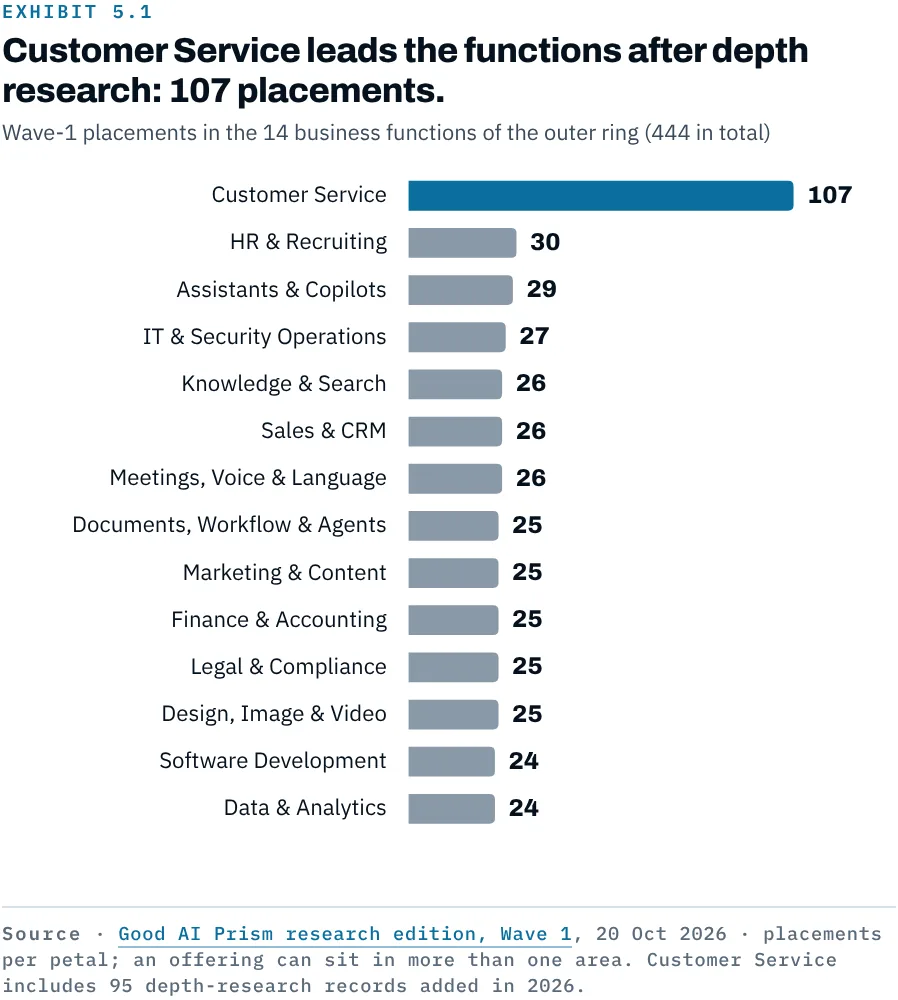
Customer Service leads the functions after depth research: 107 placements.
Good AI Prism research edition, Wave 1, 20 Oct 2026 · placements per petal; an offering can sit in more than one area. Customer Service includes 95 depth-research records added in 2026.
Source study · v2.1 · page 46 · Figure published: 25 Oct 2026
Read figure text, sources and rights
EXHIBIT 5.1 Customer Service leads the functions after depth research: 107 placements. Wave-1 placements in the 14 business functions of the outer ring (444 in total) Customer Service 107 HR & Recruiting 30 Assistants & Copilots 29 IT & Security Operations 27 Knowledge & Search 26 Sales & CRM 26 Meetings, Voice & Language 26 Documents, Workflow & Agents 25 Marketing & Content 25 Finance & Accounting 25 Legal & Compliance 25 Design, Image & Video 25 Software Development 24 Data & Analytics 24 Source · Good AI Prism research edition, Wave 1, 20 Oct 2026 · placements per petal; an offering can sit in more than one area. Customer Service includes 95 depth-research records added in 2026. Customer Service 107 HR & Recruiting 30 Assistants & Copilots 29 IT & Security Operations 27 Knowledge & Search 26 Sales & CRM 26 Meetings, Voice & Language 26 Documents, Workflow & Agents 25 Marketing & Content 25 Finance & Accounting 25 Legal & Compliance 25 Design, Image & Video 25 Software Development 24 Data & Analytics 24
Source links on the cited study page
ETHORITY figure. Rights in cited data and third-party marks remain with their owners. The Prism artwork licence applies where stated on the figure.
features price reviews popularity.
Decision-relevant dimensions may include:
CAPABILITY What tasks can it actually perform?
CONTEXT Which data, systems and workflows can it work with?
EVIDENCE What documentation, evaluations, security assurance, system cards or independent sources exist?
DATA What does it read, retain or use for training?
SECURITY How are identity, secrets, tools and tenant boundaries handled?
INTEROPERABILITY Which protocols, APIs and tool ecosystems does it support?
ECONOMICS What is the fully loaded cost, not merely the sticker price?
CHANGE How are new versions, model/provider changes and incidents communicated?
EXIT Can the customer migrate away without rebuilding the whole operating system?
The result should not be “Agent A is 87% trustworthy.”
It should help the buyer understand tradeoffs and unknowns.
Trust cannot be bought
A marketplace can sell an agent.
It can sell an assurance service.
It can sell implementation support.
It can sell monitoring.
But a commercial relationship must not silently generate a favorable trust conclusion.
That is why ETHORITY’s architecture keeps commercial truth and trust/evidence truth separate.
A provider can declare information about its offer. That declaration is a source claim until appropriately supported.
A customer can purchase an agent. Payment proves a transaction, not suitability.
ETHORITY can evaluate evidence. Verification, where offered, remains a separate process and authority.
The agent still needs authority after purchase
Buying a capable agent does not mean the organization should deploy it with maximum permissions.
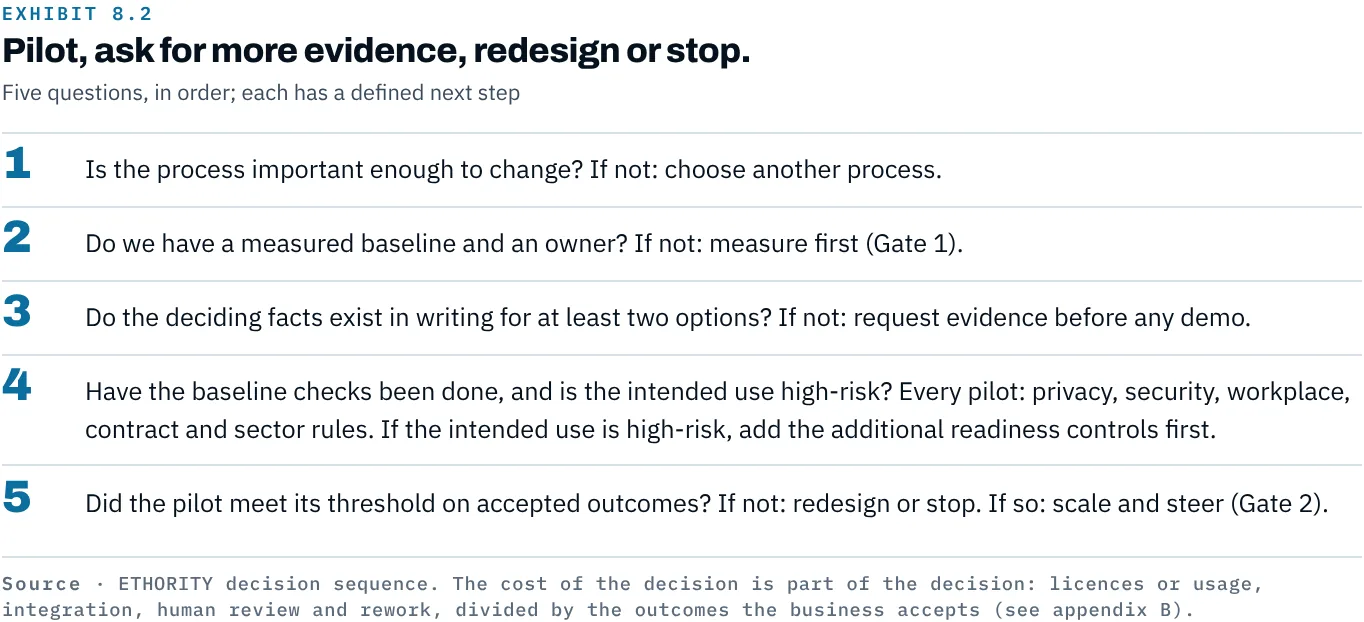
Pilot, ask for more evidence, redesign or stop.
ETHORITY decision sequence. The cost of the decision is part of the decision: licences or usage, integration, human review and rework, divided by the outcomes the business accepts (see appendix B).
Source study · v2.1 · page 66 · Figure published: 25 Oct 2026
Read figure text, sources and rights
EXHIBIT 8.2 Pilot, ask for more evidence, redesign or stop. Five questions, in order; each has a defined next step Is the process important enough to change? If not: choose another process. Do we have a measured baseline and an owner? If not: measure first (Gate 1). Do the deciding facts exist in writing for at least two options? If not: request evidence before any demo. Have the baseline checks been done, and is the intended use high-risk? Every pilot: privacy, security, workplace, contract and sector rules. If the intended use is high-risk, add the additional readiness controls first. Did the pilot meet its threshold on accepted outcomes? If not: redesign or stop. If so: scale and steer (Gate 2). Source · ETHORITY decision sequence. The cost of the decision is part of the decision: licences or usage, integration, human review and rework, divided by the outcomes the business accepts (see appendix B).
ETHORITY figure. Rights in cited data and third-party marks remain with their owners. The Prism artwork licence applies where stated on the figure.
After purchase, the organization still has to decide:
Which Mission does it support? Which data can it access? Which tools can it call? Which actions can it prepare? Which actions can it execute? Which limits apply? Which actions require human approval? What happens if authority expires or is revoked?
Marketplace procurement is therefore the beginning of governance—not the end.
Synthetic marketplace demos are useful if they are honest
Before a generalized multi-party marketplace is live, a product team can still demonstrate the customer journey using clearly labelled synthetic commercial data.
For example, Northstar—a synthetic organization—might have a Mission to reduce customer-service cost.
ETHORITY could show:
Mission requirement → candidate agent/system approaches → comparison → evidence gaps → synthetic offer terms → add candidate to Project → request provider information.
The synthetic parts must be unmistakably marked.
Do not fabricate a real vendor’s price, SLA, endorsement or availability.
That lets us test the marketplace experience without pretending the transaction economy is already operational.
Separate the purchasing decision from the permission decision
Buying a subscription establishes a commercial relationship. It does not by itself authorise the product to read every document or act for every employee. Treat procurement and deployment as connected decisions with different owners. Procurement establishes the agreed product, terms and supplier. The workflow owner determines what it may do in the business. Security, privacy and legal specialists contribute within their respective responsibilities.
Begin the supplier brief with the task rather than the phrase “AI agent.” Describe the input, the required output, the recipient and the actions that remain human. A product that prepares a reliable draft may be a better fit than one offering more autonomy. A deterministic rule or an existing application feature may be enough. The brief should permit those answers instead of requiring a new agent before the problem has been examined.
Keep the system identity distinct from the commercial package. A supplier can sell several products, and a product can be delivered through different platforms or contracts. A company name is not sufficient to establish hosting, retention or a certification's scope. Stable product identity makes the comparison useful; the selected service arrangement makes it applicable.
Write a supplier question that can be answered
“Is your agent trustworthy?” invites a broad assurance. “Does our selected plan permit customer records to be processed only in the specified region, and which terms establish that?” invites a scoped answer. Ask the questions that determine whether the proposed workflow can proceed. Keep a separate list of interesting features that do not affect the immediate decision.
For a service workflow, useful questions include how customer data is used, the applicable retention and deletion process, the authentication model, the boundaries of human review and the full billing basis. Ask whether an answer applies by default or requires configuration or an additional agreement. A capability available somewhere in the product family is not necessarily included in the offer you are evaluating.
Preserve material contradictions. If a product page and a contract appear to describe different conditions, show both and request clarification. The buyer should be able to carry that question from a public profile into a comparison and then into an enquiry. A clean interface should make the question easier to act on, not remove it to make the supplier look simpler.
Use a small, difficult evaluation set
Build cases from the work that actually matters. Include a routine request, an ambiguous request, missing information, conflicting sources, an unauthorised action and a request outside the intended purpose. Define what a good response looks like for each. Sometimes the correct result is an escalation or a refusal to act. Do not force every case into a success definition that rewards fluent completion.
For a hypothetical returns assistant, a difficult case might contain a valid purchase but inconsistent delivery records. The assistant should locate the discrepancy and prepare a review rather than infer a refund entitlement. A separate test checks whether it can be induced to follow an instruction inside a supplier document. Another checks whether a repeated request creates a duplicate transaction. These tests investigate different properties and should remain separately visible.
Record the configuration, model version, data sources and reviewer effort. A vendor-run demonstration and a buyer-run test can both be informative, but they are not equivalent evidence. Keep the conditions attached to the result. A test with synthetic data can explore behaviour without proving the quality of every production integration.
Make price comparable without disguising uncertainty
Specify the expected workload and calculate the cost of accepted work. Include subscriptions, usage, implementation, supporting systems, human review and exception handling. Where a provider charges per resolution, inspect the contractual definition of a resolution. Where it charges per seat, identify which staff and administrators require a licence. Keep annual commitments distinct from month-to-month prices.
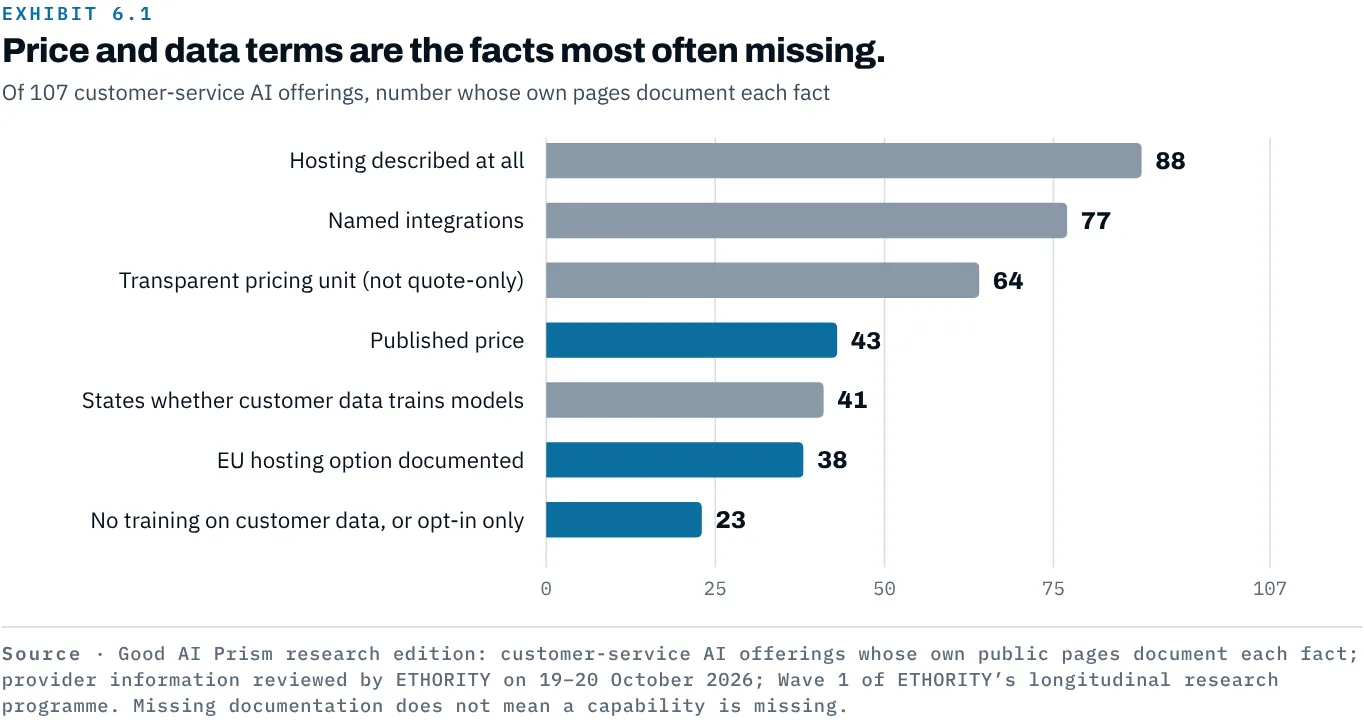
Price and data terms are the facts most often missing.
Good AI Prism research edition: customer-service AI offerings whose own public pages document each fact; provider information reviewed by ETHORITY on 19–20 October 2026; Wave 1 of ETHORITY’s longitudinal research programme. Missing documentation does not mean a capability is missing.
Source study · v2.1 · page 52 · Figure published: 25 Oct 2026
Read figure text, sources and rights
EXHIBIT 6.1 Price and data terms are the facts most often missing. Of 107 customer-service AI offerings, number whose own pages document each fact 0 25 50 75 107 Hosting described at all 88 Named integrations 77 Transparent pricing unit (not quote-only) 64 Published price 43 States whether customer data trains models 41 EU hosting option documented 38 No training on customer data, or opt-in only 23 Source · Good AI Prism research edition: customer-service AI offerings whose own public pages document each fact; provider information reviewed by ETHORITY on 19–20 October 2026; Wave 1 of ETHORITY’s longitudinal research programme. Missing documentation does not mean a capability is missing. 0 25 50 75 107 Hosting described at all 88 Named integrations 77 Transparent pricing unit (not quote-only) 64 Published price 43 States whether customer data trains models 41 EU hosting option documented 38 No training on customer data, or opt-in only 23
ETHORITY figure. Rights in cited data and third-party marks remain with their owners. The Prism artwork licence applies where stated on the figure.
Consider low, expected and high workload scenarios. An attractive pilot price may depend on allowances that will not apply at scale. Conversely, a higher fixed fee may be economical for a stable large workload. The purpose is not to select the cheapest displayed number; it is to compare the same work under explicit conditions. Use the economics tools to test assumptions rather than promise savings.
Also ask about exit costs. Can the organisation export its source documents, decision records and configuration? Who handles outstanding actions when access ends? Avoid treating portability as a vague future concern. It affects how much of the organisation's learning remains usable if the provider changes or the project stops.
Keep paid services separate from editorial evidence
A provider may pay for profile management, research services or another commercial deliverable. That does not buy editorial inclusion, favourable assessment, independent verification or rank. The same distinction protects buyers: a professional service can help structure a decision without converting its subject into a universally trusted product. Inspect the deliverable and the evidence standard rather than inferring assurance from payment.
The Good AI Prism is a discovery and comparison route. Public profiles show sourced facts and material questions; they are not deployment approvals. A fictional Workspace demonstration illustrates connected records and workflows. It should be understood within its stated demonstration scope, not as proof of a live customer installation or a successfully fulfilled order.
Inspect the handover that follows the purchase
Before signing, ask the future operating owner to walk through the first week of use. Which accounts are created, which source documents are connected and which actions remain disabled? Identify the first acceptable result and the person who will confirm it. This exposes gaps between a supplier's commercial deliverable and the organisation's own implementation responsibilities.
Then walk through the first failure. A missing source, an incorrect answer or an unavailable connector should have a practical route to support. Establish who receives the case and what evidence they need. Do not assume that a support subscription includes responsibility for your internal permissions or business decisions. The purchase is better prepared when both parties can explain the boundary without relying on general assurances.
Choose an accountable next step
If the immediate need is a focused comparison, inspect the AI Decision Brief. If a chosen system needs an organised evidence record, inspect the AI Trust Record. A controlled use-case test belongs in a separately agreed AI Trust Pilot. Keep those purposes distinct instead of treating every enquiry as the start of a large transformation programme.
An enquiry should include the business question, selected products, relevant assumptions and the fact that would change the decision. Preparing an email is not sending it, and a scoping request is not a paid order. The useful purchasing outcome is a supported choice with clear conditions, a responsible owner and a reason to revisit it when the underlying facts change.
The marketplace becomes more valuable when it keeps learning
The long-term opportunity is not another app store.
It is a living decision network.
A Marketplace candidate can connect to:
Then the marketplace can answer a much better question than:
“What agents exist?”
It can help answer:
That is where an AI marketplace becomes infrastructure for the AI economy.