 ETHORITY®
GOOD AI PRISM · TOPIC AREA · MEDIA & ENTERTAINMENT
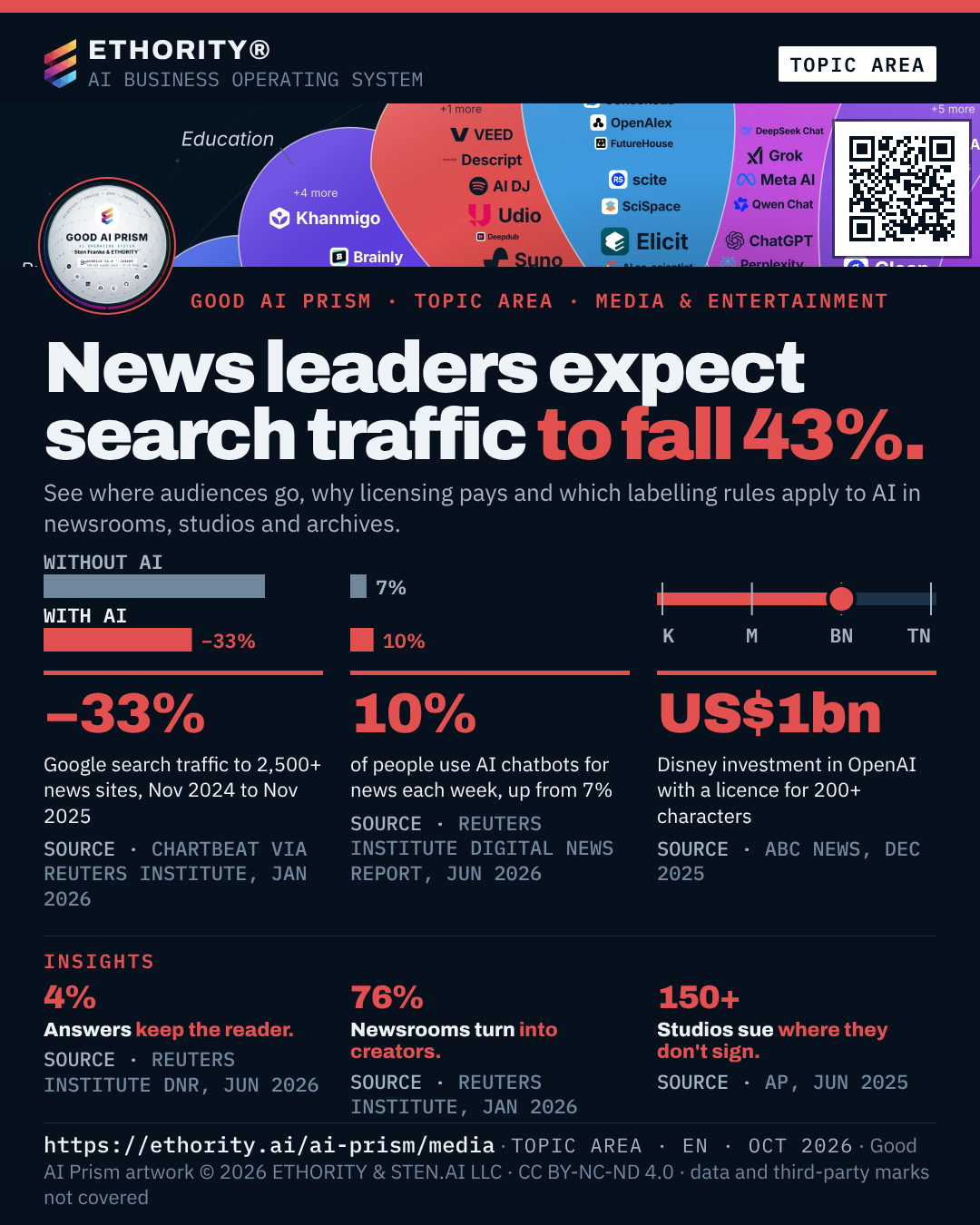
News leaders expect search traffic to fall 43%.
See where audiences go, why licensing pays and which labelling rules apply to AI in newsrooms, studios and archives.
- −43%
- search referrals media leaders expect over the next three yearsReuters Institute, Jan 2026 · politics.ox.ac.uk ↗
- −33%
- Google search traffic to 2,500+ news sites, Nov 2024 to Nov 2025Chartbeat via Reuters Institute, Jan 2026 · reutersinstitute.politics.ox.ac.uk ↗
- 10%
- of people use AI chatbots for news each week, up from 7%Reuters Institute Digital News Report, Jun 2026 · the-decoder.com ↗
- US$1bn
- Disney investment in OpenAI with a licence for 200+ charactersABC News, Dec 2025 · abcnews.com ↗
Answers keep the reader.
Only 4% of chatbot news users often click through to the source, against 19% for search (Digital News Report summary).
Reuters Institute DNR, Jun 2026
Newsrooms turn into creators.
76% of media leaders will push staff to act more like creators in 2026; half plan creator partnerships.
Reuters Institute, Jan 2026
Studios sue where they don't sign.
Disney and Universal cite 150+ works against Midjourney while Disney licenses characters to OpenAI (AP report on the lawsuit).
AP, Jun 2025
How to use this page
Three tools and one offer turn this page into a decision.
- Open the Media & Entertainment map: the area's offerings on one petal of the Good AI Prism, with logos and provider facts.
- Compare up to three offerings: decision facts side by side, each with its source and date.
- Run the Task economics calculator: turn saved hours into capacity you can attribute, before a pilot is approved.
- Offer: AI Decision Brief: up to three media AI offerings compared fact by fact, with training data, licence and labelling terms.
Models and data that power media AI
Multimodal models and the open datasets behind many generators, with licence facts on each card.

Common Crawl
Common Crawl · Dataset
Open repository of web crawl data that anyone can access and analyse; widely used to train language models.

LAION-5B
LAION · Dataset
Open dataset of 5.85 billion image-text pairs for training image models.
The study behind this hub
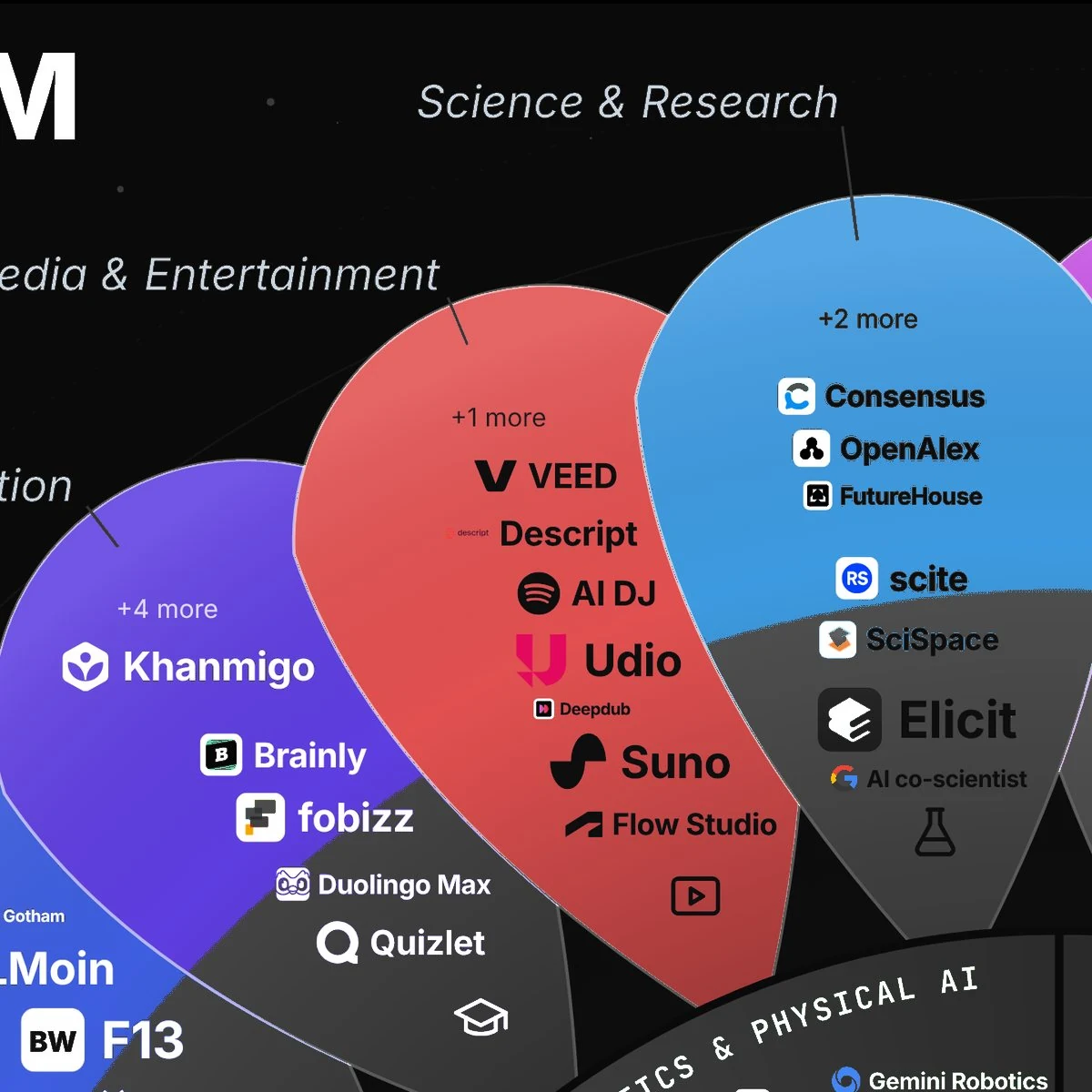
The global market study compares media with ten other sectors; the A3 companion shows the full map.
Global edition · EN
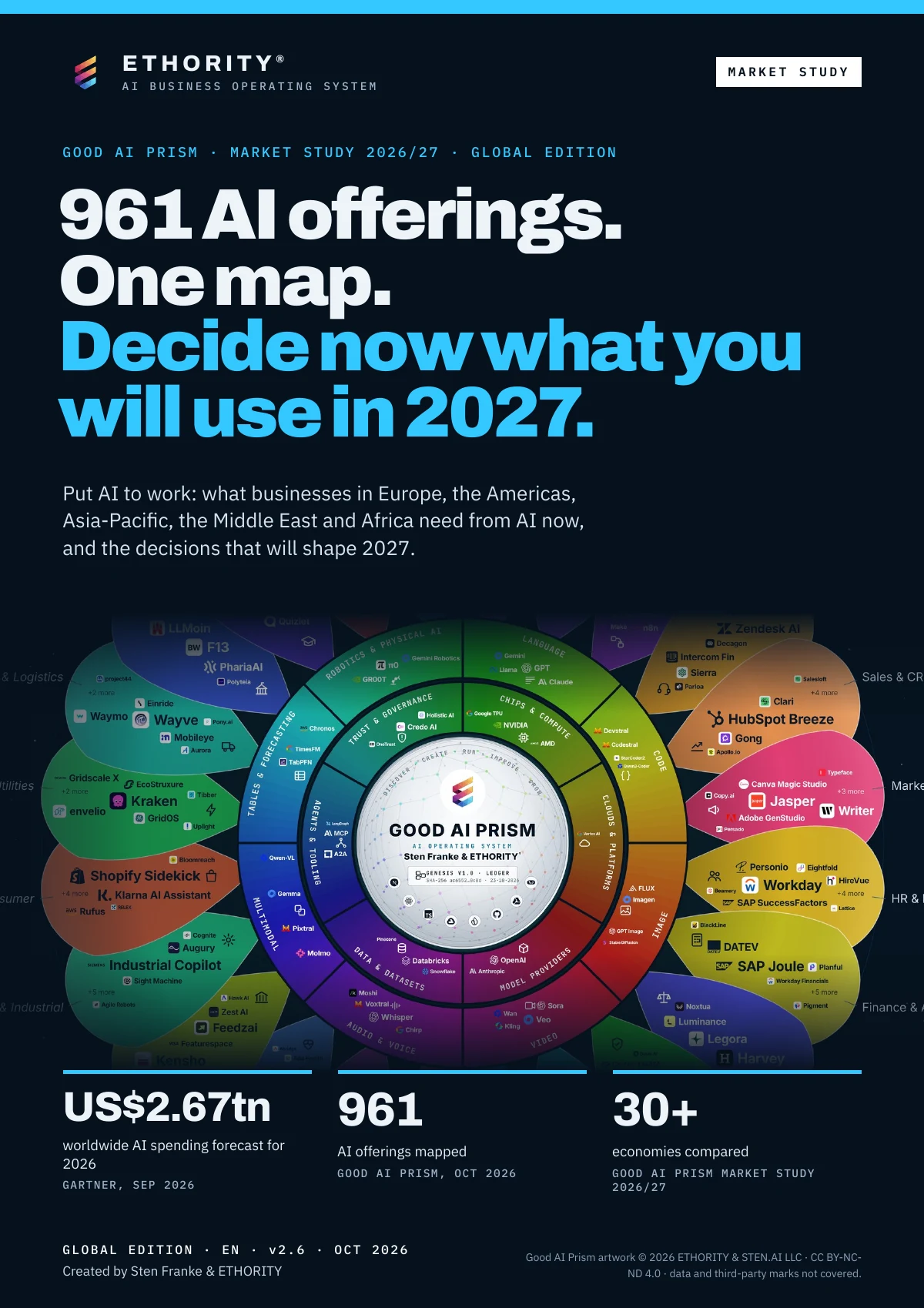
961 AI offerings. One map. Decide now what you will use in 2027.
The Good AI Prism helps you find useful AI and compare the evidence behind your options. For organisations already using AI, the question is moving from whether to use AI to which AI, how safely and whether it pays. This Global edition brings together 961 AI offerings across 24 topic areas, 8 data types and 6 technology layers, with sources, dates and limits to guide your next decision.
Version 2.6 · 90 pages
Open the study →The whole AI market on one sheet.
The full Good AI Prism as an A3 poster: every topic area, data type and technology layer on one page.
See the map on one page →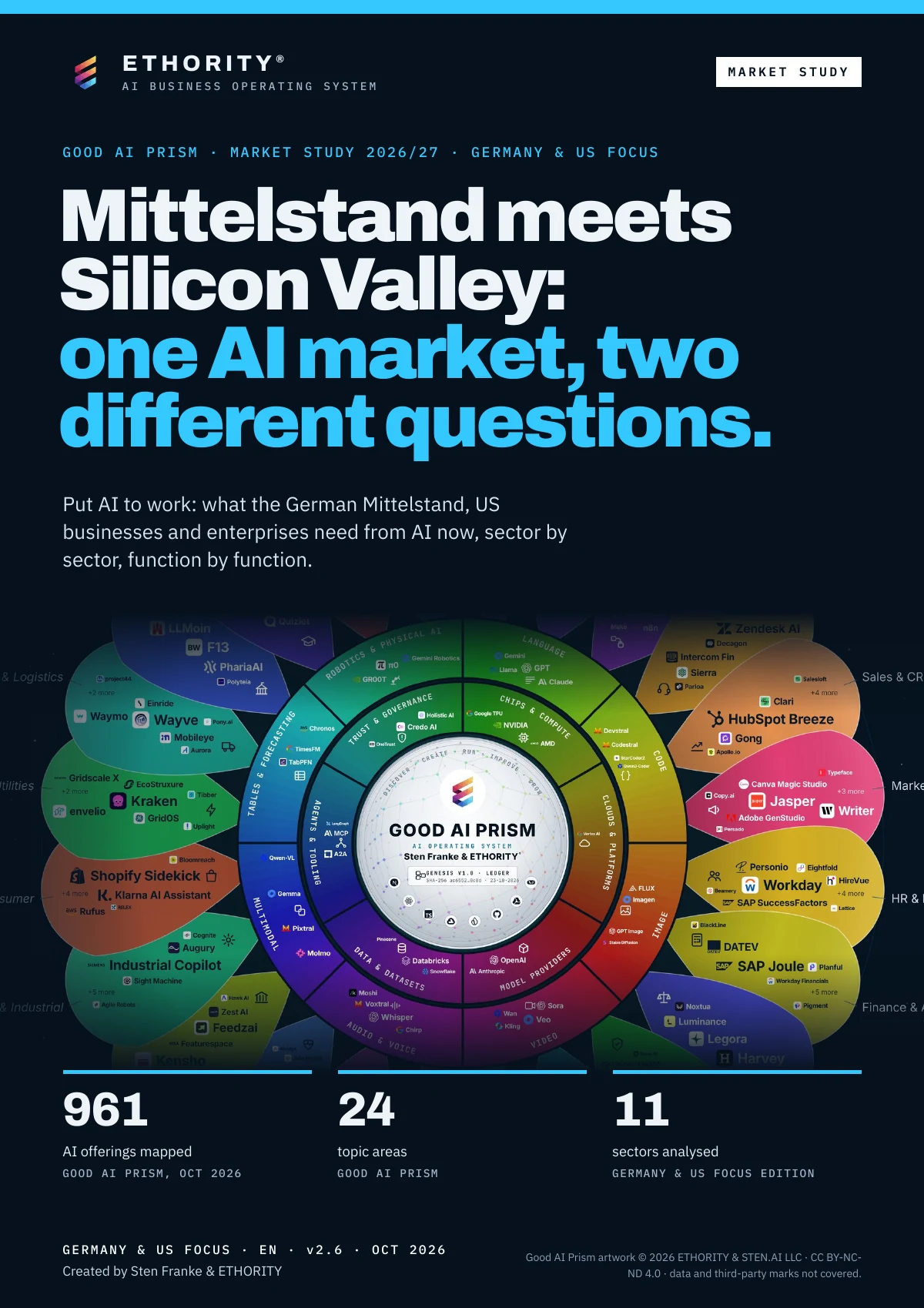
Germany & United States Focus · EN
Germany's mid-sized companies meet Silicon Valley: one AI market, two different questions.
The Mittelstand needs know-how; US firms need cost control. What German and US businesses need from AI now, sector by sector, function by function.
Version 2.6 · 72 pages
Open the study →Read next
Three related analyses from ETHORITY; the long read for this area follows further down the page.
AI spending is forecast to rise by half. 37% of surveyed organisations see an effect on profit.
Sourced figures for 2025–26 on AI spending, adoption, models, energy and value, for your 2027 planning.
See the map on one page →
Synthetic media now needs a label almost everywhere.
What has changed for AI-generated faces and voices since Microsoft's VASA-1 model in 2024, and the labelling rules in the EU, China, Korea and India.
See the map on one page →
Check every vendor claim before you rely on it.
Tie every vendor claim to the exact product, version, contract and use before you rely on it.
See the map on one page →Where ETHORITY can start
From one AI use case in the newsroom to a full inventory of generative tools and their rights terms.
AI Opportunity Case
Priced after scoping
One use case assessed against evidence, cost and rules, ending in a decision: pilot, redesign, expand or stop.
Scope and delivery by agreement
See what this package includes →AI Estate Audit
€25,000 one-time · net
An inventory of every AI use, including tools staff bring themselves, with a scale, fix or stop view per use.
Date and place by agreement
See what this package includes →AI Act Readiness Sprint
€6,900 one-time · net
Each use mapped to the EU AI Act and the dates that apply to it, with the duties you carry as provider or deployer.
Date and place by agreement
See what this package includes →AI Governance Setup
€19,500 one-time · net
Owners, controls, registers and review routines that keep AI decisions accountable every day.
Scope and delivery by agreement
See what this package includes →Licensed Premium Sector Editions
Fee configured to agreed scope
The Good AI Prism for one sector under licence, with the area map and sourced profiles for your teams.
Scope and delivery by agreement
See what this package includes →Rules and dates
The labelling dates that apply to publishers and studios.
- 1 Sep 2025
China's labelling measures apply to AI-generated text, images, audio and video.
CAC and partner agencies
- 22 Jan 2026
South Korea's AI Basic Act applies, including notice for AI-generated content.
AI Basic Act
- 2 Aug 2026
EU Art. 50: published deepfakes and AI text on public-interest matters must be disclosed.
Reg. (EU) 2024/1689
- 2 Dec 2026
Machine-readable marking for generative systems already on the EU market.
Reg. (EU) 2026/1744
Questions media buyers ask
Do we have to label AI-generated articles in the EU?
AI text published to inform the public on matters of public interest must be disclosed under Art. 50, unless it has gone through human review and a person holds editorial responsibility. Deepfakes must always be disclosed. See our synthetic media rules analysis.
Is it safe to use image generators for commercial work?
It depends on the tool's licence, training-data statement and indemnity. The law is unsettled: Getty lost most of its UK case against Stability AI, while Disney and Universal are suing Midjourney in the US.
How do we stay visible when readers get answers from AI?
Measure AI referrals separately from search, and make sure your reporting is attributable. Only 4% of chatbot news users often click through to the source (Reuters Institute news report).
Should we license our archive to AI companies?
Decide deliberately which content you license and which you protect. Up to one in five media leaders expect substantial AI platform revenue in 2026; Disney combined a $1bn investment with a character licence.
What should we measure in an AI pilot?
Cost per content unit and licensing revenue, as the Good AI Prism Global Market Study proposes for media, plus error and correction rates on AI-assisted output.
The evidence at a glance
ETHORITY · LONG READ
Google traffic to news fell 33%. Licences are the new front.
Search referrals are shrinking, readers take answers from chatbots, and studios license characters while suing image generators. What media and entertainment companies should measure, contract and label now.
The search referral is shrinking
For twenty years, news publishers lived on a simple bargain: search engines sent readers, publishers sold their attention. AI answers are breaking it. Google search traffic to more than 2,500 news sites fell 33% between November 2024 and November 2025, and Google Discover fell 21%, according to Chartbeat data in the Reuters Institute trends report. Media leaders expect search referrals to fall by another 43% over the next three years.
−33% Google search traffic to 2,500+ news sites, Nov 2024 to Nov 2025 (Chartbeat via Reuters Institute)
The survey behind that expectation covers 280 media leaders in 51 countries, the Reuters Institute release says. Two thirds of them report that AI efficiencies have not yet saved any jobs. Up to one in five expect substantial revenue from AI platforms in 2026. The industry is betting on AI and bracing for it at the same time.
That double position shapes buying. A newsroom that licenses its archive to an AI platform on Monday may be negotiating with the same company's answer engine about attribution on Tuesday. Before a single tool is chosen, three questions need an owner: which content is used to train or ground AI systems, on what terms, and how the brand appears when an AI answer quotes it. The tools themselves come second. A transcription service, a versioning assistant or a dubbing engine is easy to pilot; the rights position behind it is not. Media buyers who settle the rights first move faster later, because every pilot then starts from known terms.
Audiences are moving to answers
The other side of the bargain is the reader. In the Reuters Institute Digital News Report 2026, 10% of people across 45 markets use AI chatbots for news each week, up from 7% a year earlier, The Decoder summarises. Among 18- to 24-year-olds it is 17%. Only 1% call a chatbot their main source, but the habit is forming in the youngest group first.
The problem for publishers is what happens after the answer. Only 4% of chatbot news users always or often click through to the original source, against 19% for search engines and 17% for social media. A chatbot answer can carry a publisher's reporting without carrying its reader.
| Route to news | Users who always or often click through to the source |
|---|---|
| Search engines | 19% |
| Social media | 17% |
| AI chatbots | 4% |
Source: Reuters Institute Digital News Report 2026, 27 markets; as summarised by The Decoder, 19 Jun 2026.
Trust lags use. 20% of people trust news from AI chatbots, compared with 37% who trust most news. Among chatbot users the figure is higher, which is exactly why accuracy and attribution in AI answers matter to the brands being summarised.
Licensing becomes the business model
If traffic falls, the value of an archive, a character library or a newsroom's daily output shifts to licensing. The largest signal so far came from entertainment. On 11 December 2025 Disney announced a $1 billion investment in OpenAI and a licence for more than 200 animated characters, with costumes and props, for Sora and ChatGPT, ABC News reported.
US$1bn Disney's investment in OpenAI, with a character licence for Sora (Dec 2025)
The same studio litigates where it has no deal. In June 2025 Disney and Universal sued the image generator Midjourney in a California federal court, alleging that it trained on their characters and reproduces them. The complaint cites more than 150 works and seeks up to $150,000 per infringed work; it describes Midjourney as having 21 million subscribers and $300 million in revenue the year before.
Courts have not given a single answer. In the UK, the High Court ruled on 4 November 2025 in Getty Images v Stability AI. Getty had dropped its primary copyright claims during trial; the secondary infringement claim was dismissed, and Getty won only on some trademark points that the judge called extremely limited in scope, as Cleary Gottlieb summarises. For media buyers the lesson is practical. The law will take years to settle. Contracts, licences and provenance records decide your exposure now.
Video, creators and the new front page
Publishers are also changing what they make. 76% of leaders in the Reuters Institute survey will push staff to act more like creators in 2026, and half plan to partner with creators to distribute content. Planned extra investment is strongest on YouTube, ahead of TikTok and Instagram.
AI is part of that shift: transcription, versioning, translation, clipping and synthetic voice make one story available in more formats and languages at lower cost. The Good AI Prism places these tools across several petals: Media & Entertainment for newsroom and studio workflows, Design, Image & Video for generation and editing, and Meetings, Voice & Language for transcription, dubbing and translation. In the Good AI Prism Global Market Study, the media row names two outcomes to measure: cost per content unit and licensing revenue.
Labels are now law
Synthetic media needs a label almost everywhere. Under Article 50 of the EU AI Act, applying since 2 August 2026, deployers who publish deepfakes must disclose that the content was artificially generated or manipulated. AI-generated text published to inform the public on matters of public interest must also be disclosed, unless it has gone through human review and a person holds editorial responsibility. Generative systems already on the market have until 2 December 2026 to mark output in a machine-readable format, under the Digital Omnibus on AI.
China's labelling measures have applied since 1 September 2025, with explicit labels and metadata on text, images, audio and video. South Korea's AI Basic Act has applied since 22 January 2026. Our synthetic media rules analysis compares the regimes in detail.
The exception for human editorial control matters for newsrooms. It rewards exactly what good journalism already does: a named editor who checks and answers for what is published.
In practice
Best practice: a named editor on every AI-assisted piece. The AI Act exempts AI-generated text on matters of public interest from the disclosure duty when it has passed human review and a person holds editorial responsibility. The routine that earns the exemption is the one good newsrooms already run: a named editor reviews, approves and answers for each AI-assisted piece, and the CMS records who it was.
Scenario: an archive licence offer. An AI platform offers a regional publisher a fee for its archive. Before signing, the publisher settles three points: which content is in and which stays out, whether answers attribute and link to the source, and what happens to the licence if the platform's answer engine cuts search referrals further. Its own click-through data is the baseline for that negotiation.
What to do Monday
- Measure the AI referral. Track traffic from AI assistants and answer engines separately from search, and set a baseline before you change anything.
- Audit every generative tool. List each tool that produces text, image, video or voice, with its licence terms, training-data statement and how it marks output for 2 December 2026.
- Write rights into contracts. Require indemnities, provenance records and consent for any cloned voice or likeness, including staff and presenters.
- Price your archive. Decide which content you license to AI platforms, on what terms, and which you protect; record what is already being used.
- Keep an editor accountable. Put a named editor on every AI-assisted publication. It is good journalism and, in the EU, the condition for the text exception.
Sources and further reading
- Reuters Institute (via University of Oxford DPIR), News publishers expect search traffic to fall by more than 40% ↗ · 13 Jan 2026
- Reuters Institute, Journalism, Media and Technology Trends and Predictions 2026 (280 leaders, 51 countries) ↗ · 13 Jan 2026
- The Decoder, Reuters Institute Digital News Report 2026: more people get news from AI chatbots ↗ · 19 Jun 2026
- ABC News, Disney to invest $1 billion in OpenAI and license characters for Sora ↗ · 11 Dec 2025
- AP via KRDO, Disney and Universal sue Midjourney ↗ · 11 Jun 2025
- Cleary Gottlieb, UK High Court ruling in Getty Images v Stability AI ↗ · 4 Nov 2025
- Regulation (EU) 2024/1689 (AI Act), Art. 50 ↗ · 12 Jul 2024
- Regulation (EU) 2026/1744 (Digital Omnibus on AI) ↗ · 27 Jul 2026
- Loeb & Loeb, China's AI labelling measures take effect 1 September 2025 ↗ · Mar 2025
- ETHORITY, Put AI to Work: The Good AI Prism Global Market Study 2026/27 → · 22 Oct 2026
Put the thinking to work
AI Readiness & Maturity Check →
Leadership can agree where to start, who owns each action and which next project is justified. This is not a technical system audit or vendor selection.
A written comparison of up to three AI offerings · €195 net →
Start with one question and up to three offerings. Request a sourced comparison, provider questions and a cost sketch using your assumptions.
YOUR NEXT STEP
Discuss your question with Sten Franke.
Bring your business question or the figures you already know. ETHORITY investigates within the agreed scope; together with Sten Franke you agree the next piece of work.