 ETHORITY®
GOOD AI PRISM · TOPIC AREA · DESIGN, IMAGE & VIDEO
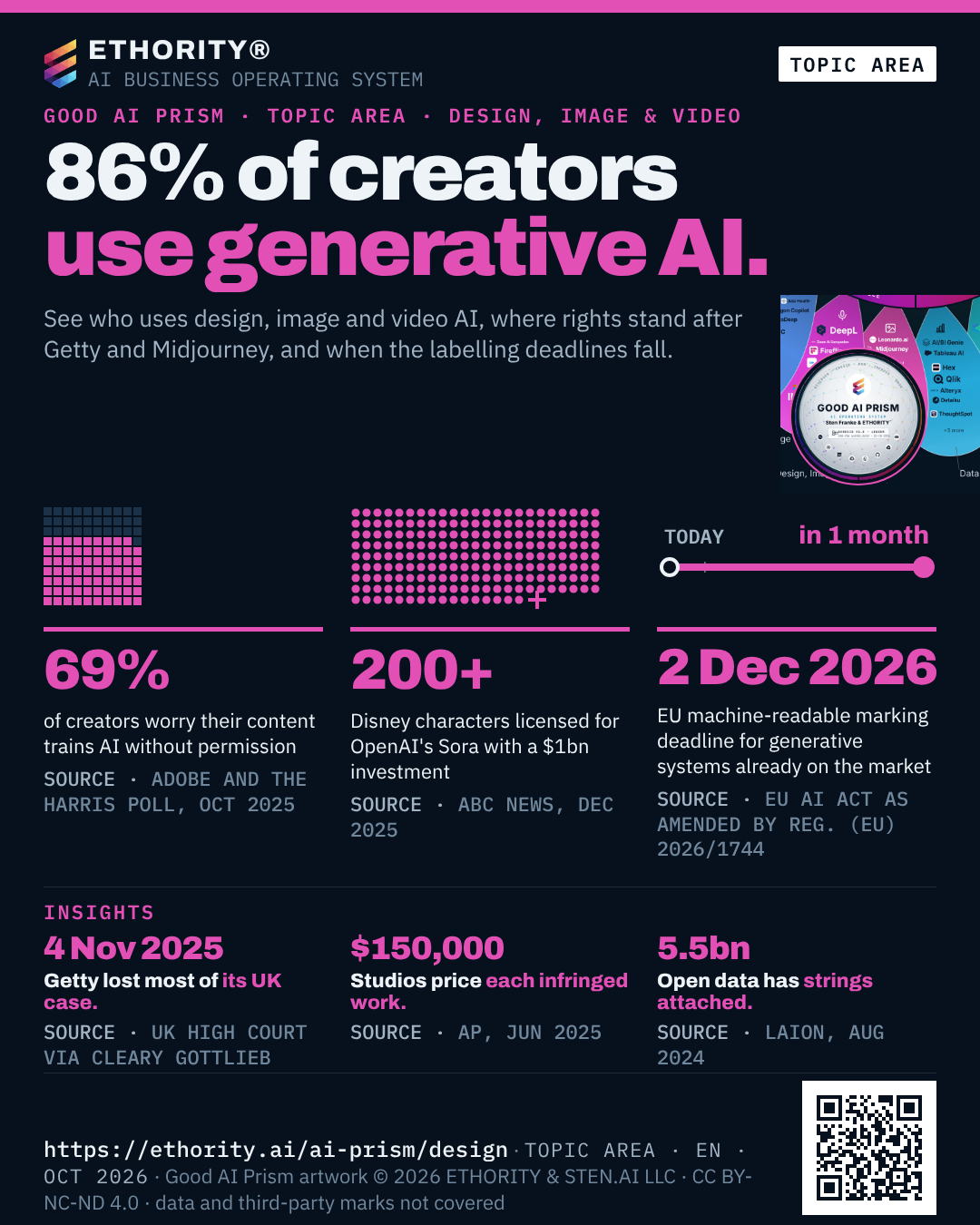
86% of creators use generative AI.
See who uses design, image and video AI, where rights stand after Getty and Midjourney, and when the labelling deadlines fall.
- 86%
- of creators actively use creative generative AI (vendor survey, 16,000+ creators)Adobe and The Harris Poll, Oct 2025 · news.adobe.com ↗
- 69%
- of creators worry their content trains AI without permissionAdobe and The Harris Poll, Oct 2025 · news.adobe.com ↗
- 200+
- Disney characters licensed for OpenAI's Sora with a $1bn investmentABC News, Dec 2025 · abcnews.com ↗
- 2 Dec 2026
- EU machine-readable marking deadline for generative systems already on the marketEU AI Act as amended by Reg. (EU) 2026/1744 · eur-lex.europa.eu ↗
Getty lost most of its UK case.
The secondary infringement claim against Stability AI was dismissed; trademark findings were narrow (Cleary Gottlieb case note).
UK High Court via Cleary Gottlieb
Studios price each infringed work.
Disney and Universal seek up to $150,000 per work against Midjourney, citing 150+ works (AP report on the lawsuit).
AP, Jun 2025
Open data has strings attached.
Re-LAION-5B holds about 5.5 billion image-text pairs; its publisher advises against production use (LAION-5B registry card).
LAION, Aug 2024
How to use this page
Three tools and one offer turn this page into a decision.
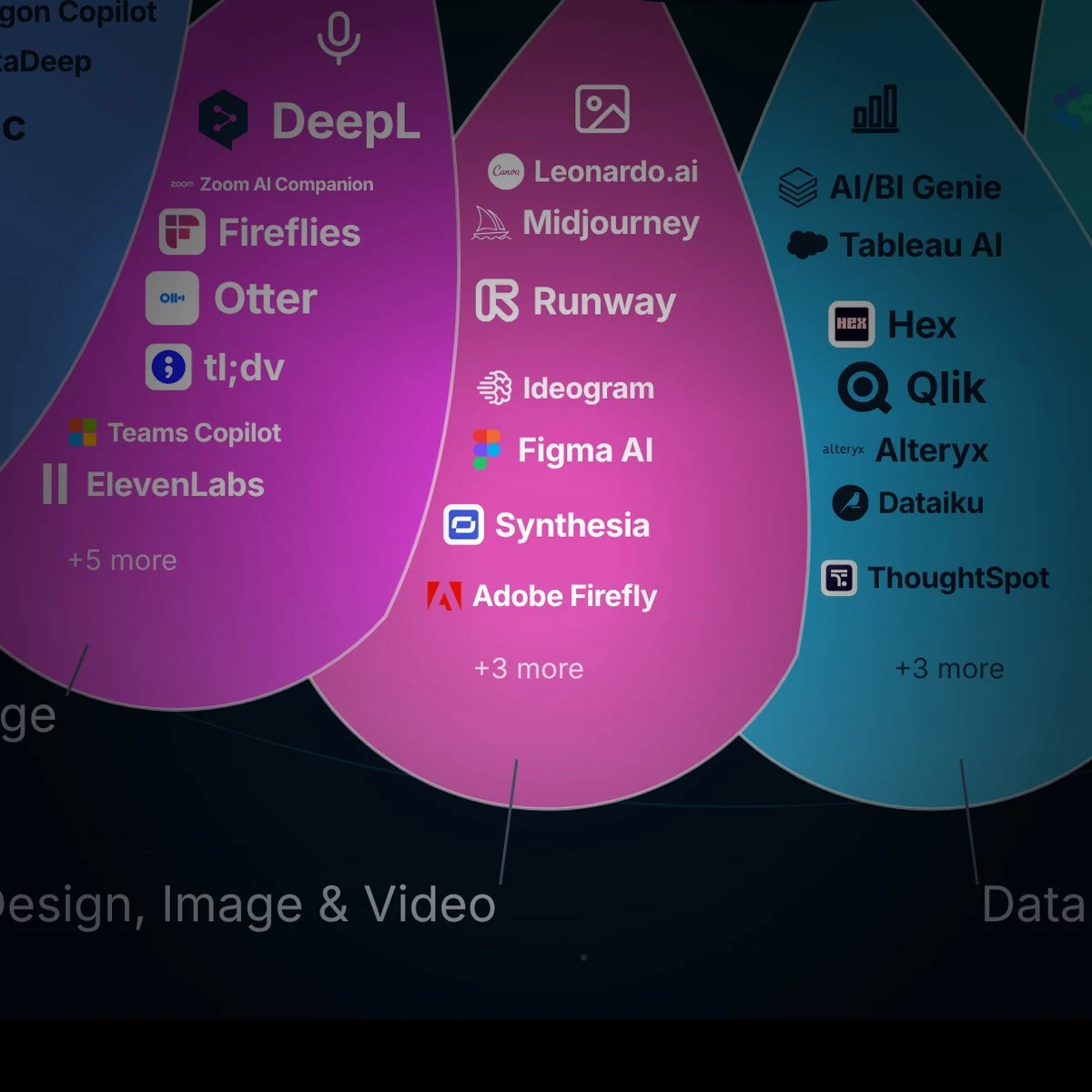
- Open the Design, Image & Video map: the area's offerings on one petal of the Good AI Prism, with logos and provider facts.
- Compare up to three offerings: decision facts side by side, each with its source and date.
- Run the Task economics calculator: turn saved hours into capacity you can attribute, before a pilot is approved.
- Offer: AI Trust Record: one clear answer about one generative tool before your brand depends on it: purpose, rights, evidence, known limits and a review path.
Models and datasets behind image and video AI
Multimodal models and the image datasets many generators trace back to, with licence facts on each card.

LAION-5B
LAION · Dataset
Open dataset of 5.85 billion image-text pairs for training image models.

Common Crawl
Common Crawl · Dataset
Open repository of web crawl data that anyone can access and analyse; widely used to train language models.
The study behind this hub
The global market study and the A3 companion with the full map.
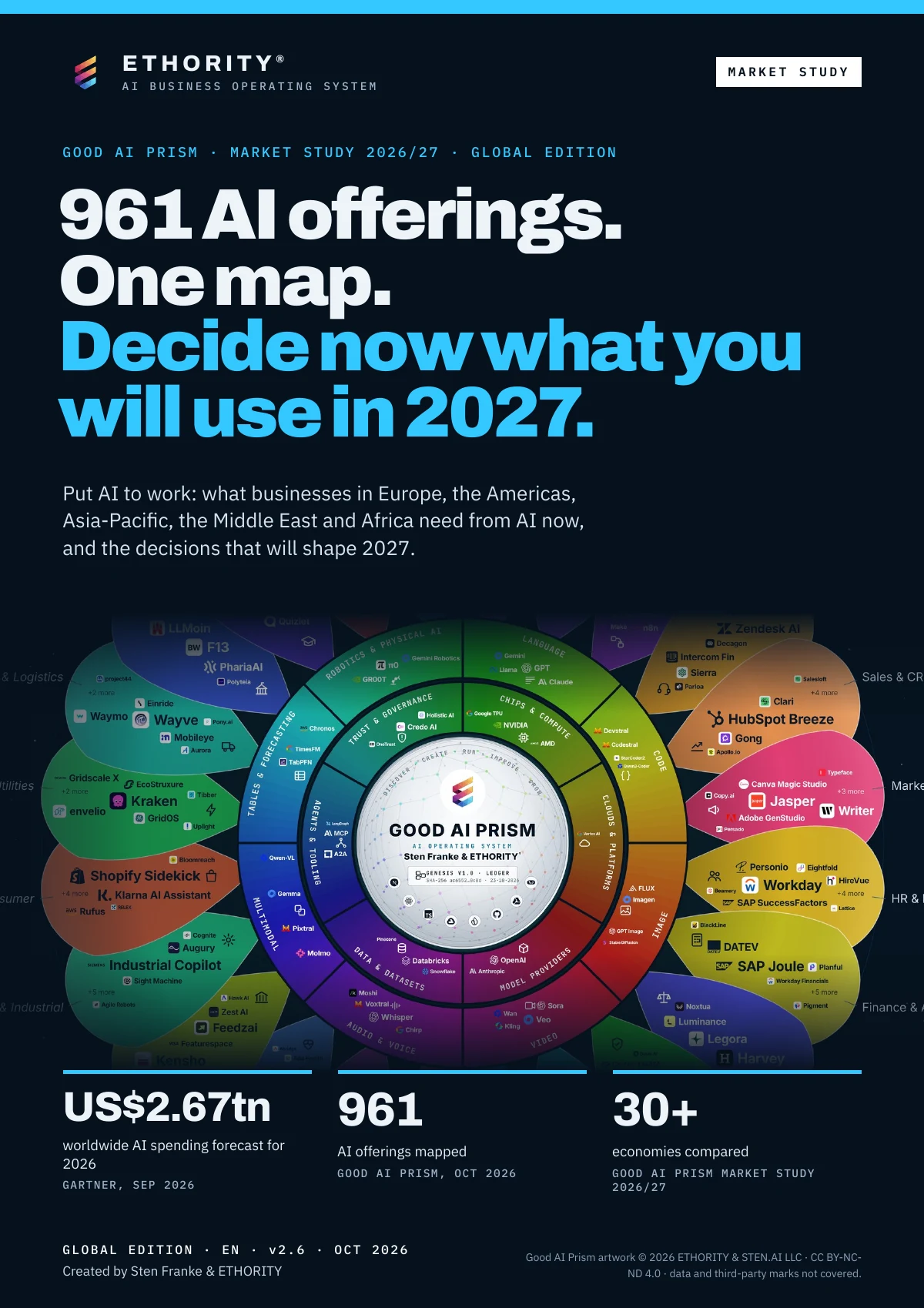
Global edition · EN
961 AI offerings. One map. Decide now what you will use in 2027.
The Good AI Prism helps you find useful AI and compare the evidence behind your options. For organisations already using AI, the question is moving from whether to use AI to which AI, how safely and whether it pays. This Global edition brings together 961 AI offerings across 24 topic areas, 8 data types and 6 technology layers, with sources, dates and limits to guide your next decision.
Version 2.6 · 90 pages
Open the study →The whole AI market on one sheet.
The full Good AI Prism as an A3 poster: every topic area, data type and technology layer on one page.
See the map on one page →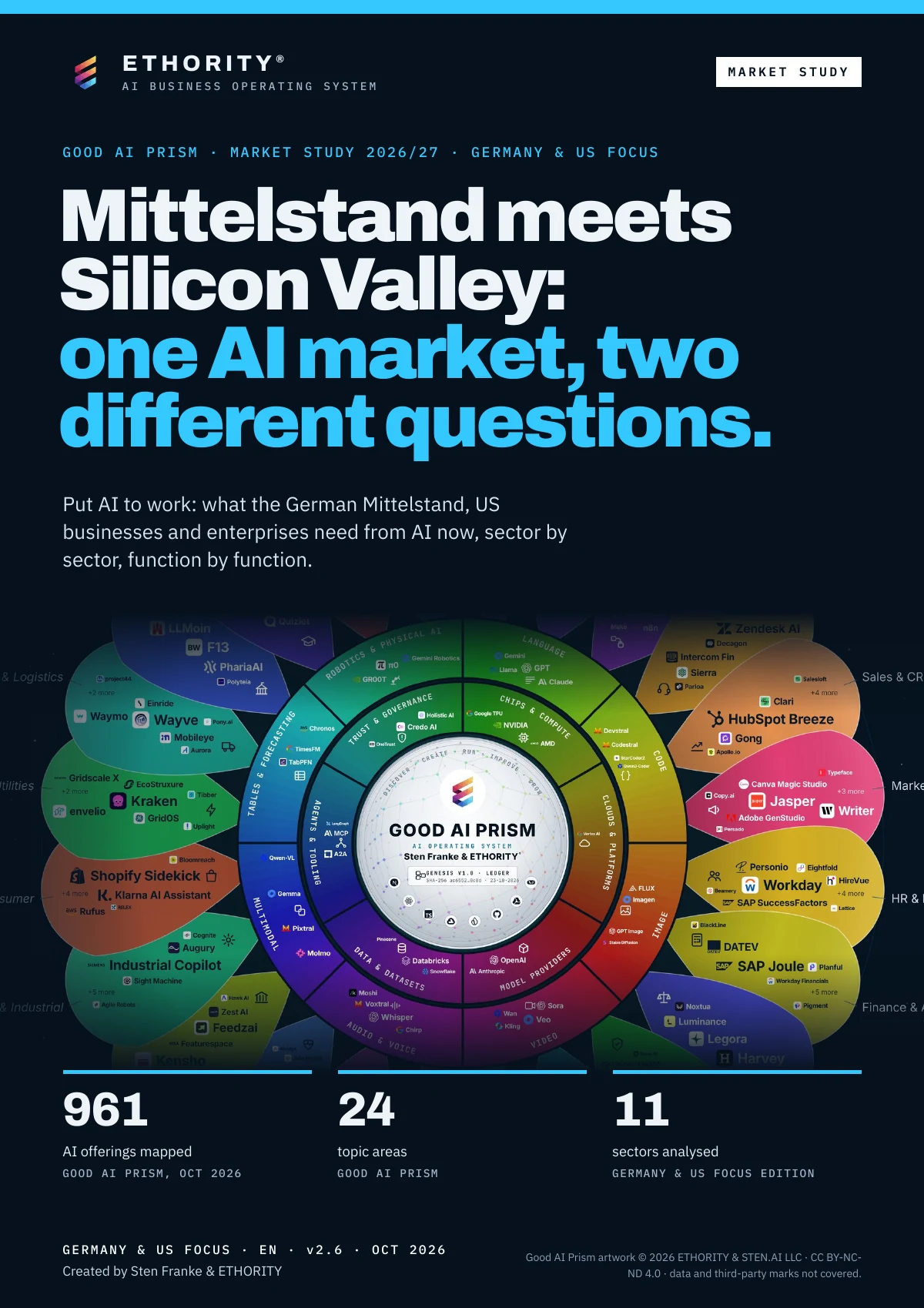
Germany & United States Focus · EN
Germany's mid-sized companies meet Silicon Valley: one AI market, two different questions.
The Mittelstand needs know-how; US firms need cost control. What German and US businesses need from AI now, sector by sector, function by function.
Version 2.6 · 72 pages
Open the study →Read next
Three related analyses from ETHORITY; the long read for this area follows further down the page.
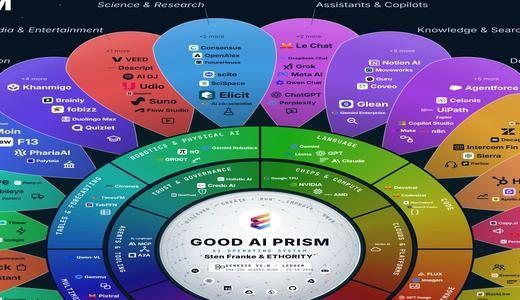
961 AI offerings. Start with the job, not the tool.
A method for going from one business need to a shortlist of AI offerings you can defend.
See the map on one page →
Synthetic media now needs a label almost everywhere.
What has changed for AI-generated faces and voices since Microsoft's VASA-1 model in 2024, and the labelling rules in the EU, China, Korea and India.
See the map on one page →
Check every vendor claim before you rely on it.
Tie every vendor claim to the exact product, version, contract and use before you rely on it.
See the map on one page →Where ETHORITY can start
From an inventory of generative tools and their rights terms to governance for synthetic media.
AI Estate Audit
€25,000 one-time · net
An inventory of every AI use, including tools staff bring themselves, with a scale, fix or stop view per use.
Date and place by agreement
See what this package includes →AI Opportunity Case
Priced after scoping
One use case assessed against evidence, cost and rules, ending in a decision: pilot, redesign, expand or stop.
Scope and delivery by agreement
See what this package includes →AI Act Readiness Sprint
€6,900 one-time · net
Each use mapped to the EU AI Act and the dates that apply to it, with the duties you carry as provider or deployer.
Date and place by agreement
See what this package includes →AI Governance Setup
€19,500 one-time · net
Owners, controls, registers and review routines that keep AI decisions accountable every day.
Scope and delivery by agreement
See what this package includes →Licensed Premium Sector Editions
Fee configured to agreed scope
The Good AI Prism for one sector under licence, with the area map and sourced profiles for your teams.
Scope and delivery by agreement
See what this package includes →Rules and dates
The labelling dates for synthetic images and video.
- 1 Sep 2025
China's labelling measures apply to AI-generated images, audio and video.
CAC and partner agencies
- 22 Jan 2026
South Korea's AI Basic Act applies.
AI Basic Act
- 20 Feb 2026
India's labelling rules apply, with a three-hour takedown duty.
MeitY, amended IT Rules
- 2 Aug 2026
EU Art. 50: published deepfakes must be disclosed; synthetic output must be marked.
Reg. (EU) 2024/1689
- 2 Dec 2026
Marking deadline for systems already on the market; ban on generating non-consensual intimate imagery.
Reg. (EU) 2026/1744
Questions creative buyers ask
Can we use AI-generated images in campaigns?
Yes, with the right tool and terms. Check the licence, the training-data statement and the indemnity, and label deepfakes in the EU under Art. 50. The AI Estate Audit lists every tool with its terms.
What did the Getty v Stability AI ruling decide?
On 4 Nov 2025 the UK High Court dismissed Getty's secondary copyright claim and found only narrow trademark infringement. Getty had dropped its primary claims during trial. It is not a general licence to train.
How do we meet the EU marking duty?
Make sure each generator marks output in a machine-readable way and that the mark survives export and editing. Systems already on the market must comply by 2 Dec 2026 (Digital Omnibus regulation).
Do we need consent for synthetic presenters?
Yes. Keep written consent from anyone whose face or voice is cloned, staff included, and agree verification rules with security. Our synthetic media analysis covers the rules by country.
What should we measure?
Cost per asset and rights incidents, the two outcomes the global market study proposes for Design, Image & Video.
The evidence at a glance
ETHORITY · LONG READ
Image AI goes licensed. EU marking due 2 Dec 2026.
Most creators already use generative tools. The courts have not settled the rights, studios license where they once sued, and the EU wants synthetic output marked by 2 Dec 2026. What design and brand teams should change now.
Generative design is the default now
Generative AI is no longer a side experiment in creative work. 86% of creators actively use creative generative AI, according to the Adobe Creators' Toolkit report, a survey of more than 16,000 creators in the US, UK, France, Germany, South Korea, Japan, India and Australia, run with The Harris Poll in September 2025. It is a vendor survey, and Adobe sells these tools, but the direction matches what every agency and in-house studio reports.
The same survey carries the warning. 69% of creators worry that their content could be used to train AI without their permission. The people who use generative tools most are also the people whose work trained them.
86% of creators use creative generative AI; 69% worry about training without permission (Adobe and Harris Poll, Oct 2025)
For a business buyer, the question has moved. It is not whether designers will use image and video generators, but under which licence, with which training data behind them, and with what label on the output.
The courts have not settled the rights
Two cases frame the legal uncertainty. In the UK, the High Court ruled on 4 November 2025 in Getty Images v Stability AI. Getty had dropped its primary copyright claims during the trial; the secondary infringement claim was dismissed, and Getty won only on some trademark points that the judge described as extremely limited in scope, as Cleary Gottlieb's case note records. The model maker largely won, but on a narrowed case.
In the US, Disney and Universal sued Midjourney in June 2025 in a California federal court. They allege that Midjourney trained on their characters and reproduces them on request, cite more than 150 works and seek up to $150,000 per infringed work. The complaint describes Midjourney as having 21 million subscribers and $300 million in revenue the year before.
| Case or deal | Date | What it signals |
|---|---|---|
| Disney and Universal v Midjourney (US) | 11 Jun 2025 | Studios litigate unlicensed character output |
| Getty Images v Stability AI (UK High Court) | 4 Nov 2025 | Secondary infringement claim dismissed; narrow trademark findings |
| Disney investment and licence with OpenAI | 11 Dec 2025 | Licensed characters move into video generation |
Sources: AP, Cleary Gottlieb, ABC News; dates as reported.
Licensing is the new route
Where courts are slow, contracts move fast. On 11 December 2025 Disney announced a $1 billion investment in OpenAI and a licence for more than 200 animated characters, with costumes and props, for Sora and ChatGPT, ABC News reported. The same company suing one image generator licenses its characters to another video generator. The message to the market is clear: licensed generation is acceptable, unlicensed generation is a legal risk.
For brands this changes the buying checklist. A design tool is only as safe as the rights behind its training data and the indemnity behind its output. Some providers train on licensed or owned libraries and offer indemnities; others train on web-scale data and offer none. Both kinds appear in the Good AI Prism, and the difference is a decision fact, not a footnote.
The data behind the pictures
Many image models trace back to a small number of open datasets. The Good AI Prism Registry records them with their licences. The LAION-5B registry card lists 5.85 billion image-text pairs from 2022 and the cleaned Re-LAION-5B release of August 2024 with about 5.5 billion pairs under Apache 2.0; the publisher does not recommend it for production products. ImageNet's 1.28 million training images are licensed for non-commercial research and education only. Common Crawl's dataset card shows the web source under much of it, at more than 300 billion pages.
That is why the question "what was this model trained on?" belongs in every design-tool tender. A licence on the tool does not clean the data underneath it.
Labels are required almost everywhere
Synthetic images and video now need a label in most major markets. Under Article 50 of the EU AI Act, applying since 2 August 2026, deployers who publish deepfakes must disclose that the content was artificially generated or manipulated, and providers must mark synthetic output in a machine-readable format. Generative systems already on the market before 2 August 2026 have until 2 December 2026, under the Digital Omnibus on AI. From the same date, the Omnibus prohibits AI systems that generate non-consensual intimate imagery of identifiable people or child sexual abuse material.
2 Dec 2026 machine-readable marking deadline in the EU for generative systems already on the market
Other markets moved earlier. China's labelling measures have applied since 1 September 2025, with explicit labels and metadata on images, audio and video. South Korea's AI Basic Act has applied since 22 January 2026. India's amended IT Rules have applied since 20 February 2026, with prominent labels, permanent metadata and a three-hour takedown duty. The ETHORITY analysis of synthetic faces and voices compares the regimes.
The practical consequence is a production question, not a legal footnote. Marking has to survive export, compression and re-editing, so it belongs in the pipeline, not at publication.
Generation moves onto the desk
The hardware shift makes governance harder. Work that needed a data-centre GPU in 2024 now runs close to everyday machines. Apple's M5 chip offers more than four times the peak GPU compute for AI of its predecessor, and Counterpoint expected AI-capable PCs to exceed half of global PC shipments in 2026, as the ETHORITY synthetic media analysis records. When image and video models run locally, the central licence register no longer sees every tool. A designer can install an open model on a laptop in minutes. That is good for speed and privacy, and it means the inventory has to include local models, plug-ins and browser tools, not only the subscriptions that procurement signed.
Synthetic media is also a risk channel
The same building blocks lower the cost of impersonation. Cyber incidents remain the top business risk in the Allianz Risk Barometer 2026 at 42%, and AI has climbed to second place at 32%. Fake video calls and cloned faces of executives are already a fraud pattern. Design and brand teams that produce synthetic presenters should agree consent and verification rules with the security team.
In practice
Use case: licensed characters. In December 2025 Disney licensed more than 200 animated characters to OpenAI for Sora and ChatGPT, while it litigates against Midjourney over unlicensed output. For a brand team the lesson is contractual: character, likeness and brand work goes only to tools whose licence and indemnity cover it, in writing.
Scenario: a campaign before the marking date. An in-house studio plans a December campaign with an image generator bought in 2025. Before 2 December 2026 it exports a test file through its usual compression and editing chain and checks that the machine-readable mark survives. If it does not, the campaign moves to a tool that passes, and the result goes into the tool register.
What to do Monday
- List every generative tool. Record each image, video and design tool in use, with its licence, training-data statement and indemnity.
- Check marking for 2 December 2026. Confirm how each tool marks output in a machine-readable way, and whether the mark survives export and editing.
- Require documented consent. For any synthetic presenter, cloned face or likeness, keep written consent from the person depicted, including staff.
- Prefer licensed generation. For brand and character work, choose tools trained on licensed or owned data, with an indemnity in the contract.
- Measure cost and rights. Track cost per asset and rights incidents, the two outcomes the Good AI Prism Global Market Study proposes for this area.
The Media & Entertainment topic area follows the same rights questions into newsrooms and archives.
Sources and further reading
- Adobe, Creators' Toolkit Report (Adobe and The Harris Poll, 16,000+ creators, 8 countries; vendor survey) ↗ · 28 Oct 2025
- Cleary Gottlieb, UK High Court ruling in Getty Images v Stability AI ↗ · 4 Nov 2025
- AP via KRDO, Disney and Universal sue Midjourney ↗ · 11 Jun 2025
- ABC News, Disney to invest $1 billion in OpenAI and license characters for Sora ↗ · 11 Dec 2025
- Regulation (EU) 2024/1689 (AI Act), Art. 50 ↗ · 12 Jul 2024
- Regulation (EU) 2026/1744 (Digital Omnibus on AI) ↗ · 27 Jul 2026
- Loeb & Loeb, China's AI labelling measures ↗ · Mar 2025
- Hogan Lovells, India introduces mandatory labelling for AI content ↗ · Feb 2026
- ITA, South Korea AI Basic Act ↗ · 2026
- Allianz Risk Barometer 2026 ↗ · Jan 2026
- LAION, Re-LAION-5B release ↗ · 30 Aug 2024
- Apple, M5 announcement ↗ · Oct 2025
- Counterpoint, AI PCs to surpass half of global shipments in 2026 ↗ · 2025
- ETHORITY, Synthetic Faces and Voices in 2026 → · 22 Oct 2026
- ETHORITY, Put AI to Work: The Good AI Prism Global Market Study 2026/27 → · 22 Oct 2026
Put the thinking to work
AI Opportunity Case →
A defensible proceed, test, redesign, defer or stop decision. The fee is independent of which outcome the evidence supports.
A written comparison of up to three AI offerings · €195 net →
Start with one question and up to three offerings. Request a sourced comparison, provider questions and a cost sketch using your assumptions.
YOUR NEXT STEP
Discuss your question with Sten Franke.
Bring your business question or the figures you already know. ETHORITY investigates within the agreed scope; together with Sten Franke you agree the next piece of work.