 ETHORITY®
In this article
Terms used in this article
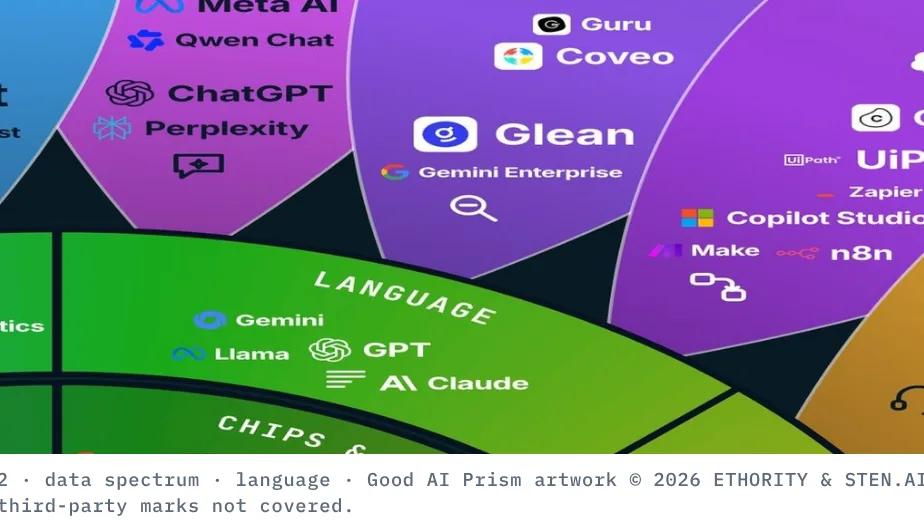
Good AI Prism v3.12 · data spectrum · language · Good AI Prism artwork © 2026 ETHORITY & STEN.AI LLC · CC BY-NC-ND 4.0 · data and third-party marks not covered.
Good AI Prism v3.12 · Sten Franke & ETHORITY
Source study · v2.1 · page 37 · Figure published: 25 Oct 2026
Read figure text, sources and rights
Good AI Prism v3.12 · data spectrum · language · Good AI Prism artwork © 2026 ETHORITY & STEN.AI LLC · CC BY-NC-ND 4.0 · data and third-party marks not covered.
ETHORITY figure. Rights in cited data and third-party marks remain with their owners. The Prism artwork licence applies where stated on the figure.
In 2024 a research demo showed a lifelike talking face made from one photo and a voice clip; in 2026 the question is no longer whether this is possible, but how synthetic media is labelled, governed and used well.
By Sten Franke, Founder & CEO · AI Transformation Architect, ETHORITY
Where we started: VASA-1
In April 2024 we wrote about Microsoft Research's VASA-1. From a single portrait and an audio clip, it generated a talking face with synchronised lips, natural head movement and expressions. The researchers reported 512×512 video frames at 45 frames per second in offline batch mode and up to 40 frames per second in online streaming with 170 milliseconds of starting latency, on a desktop PC with a single NVIDIA RTX 4090 GPU.
The team handled the release with care. Their project page states that they have "no plans to release an online demo, API, product, additional implementation details" until they are confident the technology will be used responsibly. They noted it "could still potentially be misused for impersonating humans" and that generated videos "still contain identifiable artifacts."
Our questions then were: how do we tell AI-created content from authentic recordings, what happens to identity and privacy, and how does such a tool fit into an information space already under pressure? Two and a half years later, regulators have given concrete answers to the first question, and businesses have learned a lot about the second and third.
What has changed in the technology
Real-time synthesis is no longer a research exception. The capability that needed a high-end GPU in 2024 now sits close to everyday hardware: Apple's M5 chip offers over four times the peak GPU compute for AI of its predecessor, and Qualcomm's Snapdragon X2 Elite Extreme carries an 80 TOPS neural processor. Counterpoint expected AI-capable PCs to exceed half of global shipments in 2026.
Legitimate uses have grown alongside. Voice agents are now a standard part of customer service; the Good AI Prism maps them in the Customer Service and the Meetings, Voice & Language areas. Synthetic presenters are used in training and accessibility. The same building blocks also lower the cost of impersonation, which is why cyber incidents remain the top business risk in the Allianz Risk Barometer 2026 (42%), with AI climbing to second place (32%).
The rules in 2026: labelling is the common denominator
Most AI regimes differ in scope, but almost all now require synthetic content to be identifiable.
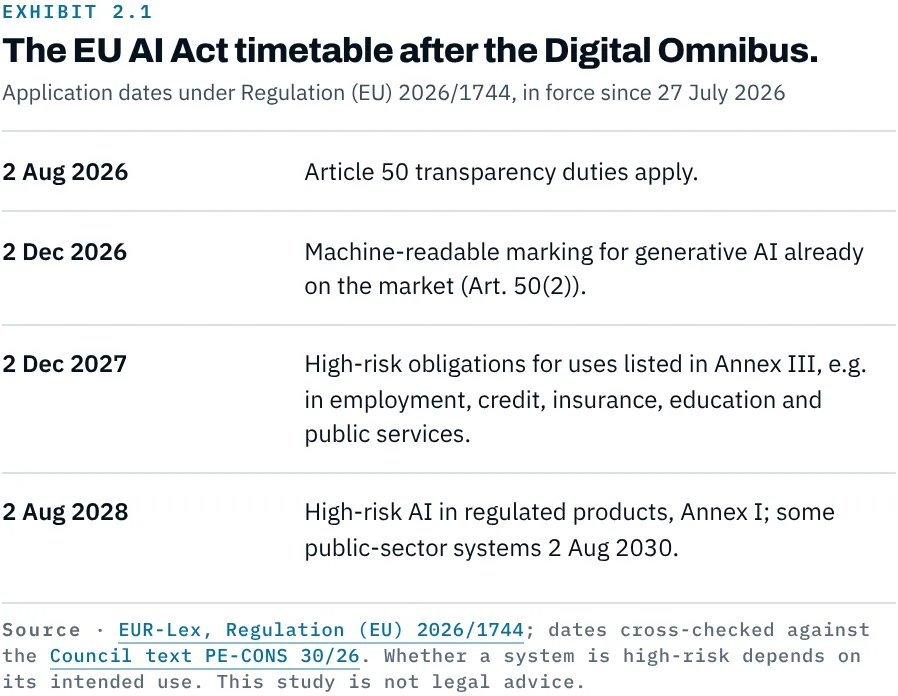
The EU AI Act timetable after the Digital Omnibus.
EUR-Lex, Regulation (EU) 2026/1744; dates cross-checked against the Council text PE-CONS 30/26. Whether a system is high-risk depends on its intended use. This study is not legal advice.
Source study · v2.1 · page 20 · Figure published: 25 Oct 2026
Read figure text, sources and rights
EXHIBIT 2.1 The EU AI Act timetable after the Digital Omnibus. Application dates under Regulation (EU) 2026/1744, in force since 27 July 2026 2 Aug 2026 Article 50 transparency duties apply. 2 Dec 2026 Machine-readable marking for generative AI already on the market (Art. 50(2)). 2 Dec 2027 High-risk obligations for uses listed in Annex III, e.g. in employment, credit, insurance, education and public services. 2 Aug 2028 High-risk AI in regulated products, Annex I; some public-sector systems 2 Aug 2030. Source · EUR-Lex, Regulation (EU) 2026/1744; dates cross-checked against the Council text PE-CONS 30/26. Whether a system is high-risk depends on its intended use. This study is not legal advice.
Source links on the cited study page
- eur-lex.europa.eu ↗
- www.trade.gov ↗
- www.bakermckenzie.com ↗
- leg.colorado.gov ↗
- www.hunton.com ↗
- www.hlc.com ↗
- www.dqsglobal.com ↗
- data.consilium.europa.eu ↗
ETHORITY figure. Rights in cited data and third-party marks remain with their owners. The Prism artwork licence applies where stated on the figure.
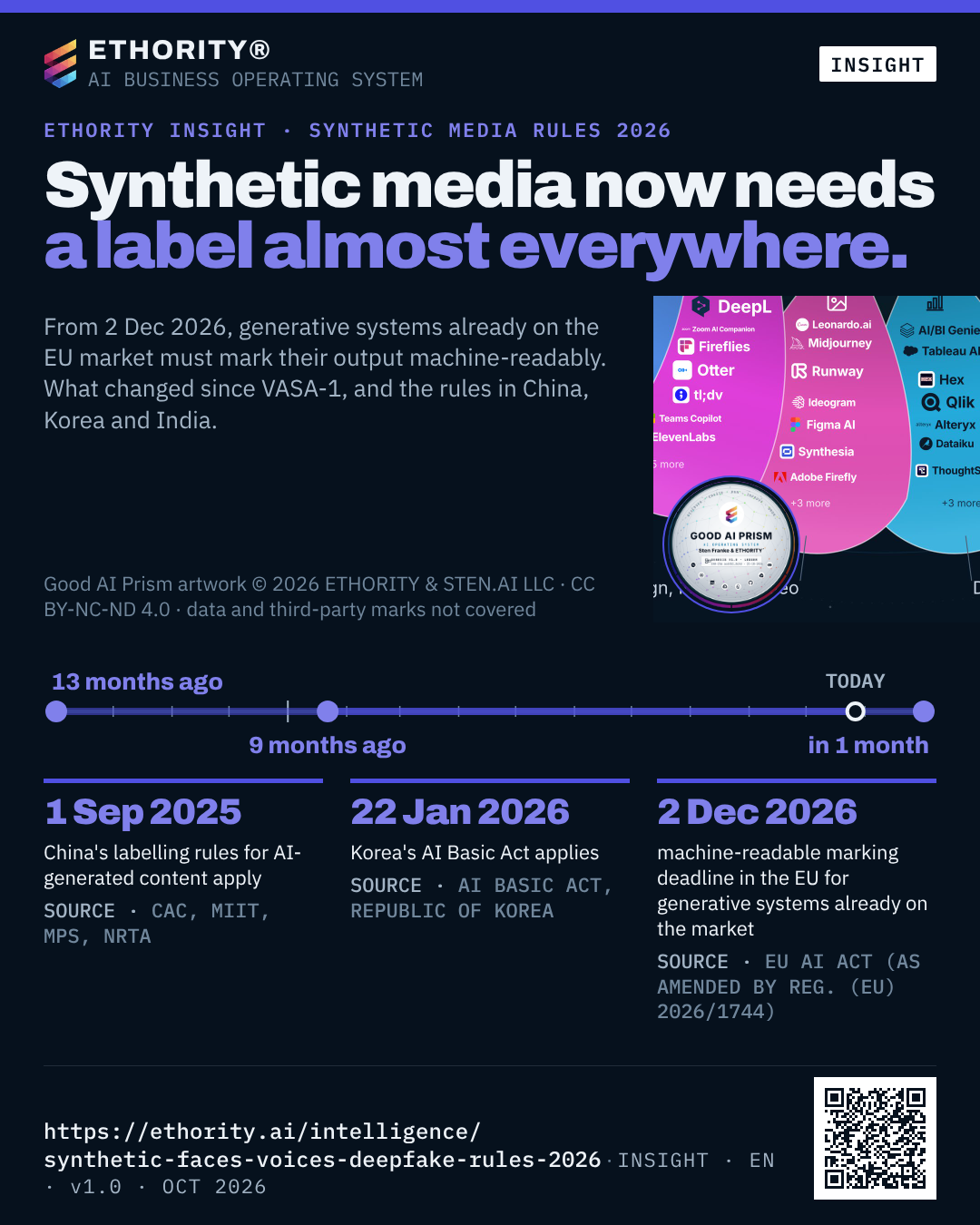
European Union. The AI Act's Article 50 transparency duties apply from 2 August 2026, as confirmed by the Digital Omnibus (Regulation (EU) 2026/1744). Providers of systems that generate synthetic audio, image, video or text must mark outputs in a machine-readable format; systems already on the market before 2 August 2026 have until 2 December 2026. Deployers who publish deepfakes must disclose that the content has been artificially generated or manipulated. From 2 December 2026, the Omnibus also adds a prohibition on AI systems that generate non-consensual intimate imagery of identifiable people or child sexual abuse material.
Source context: EU AI Act · consolidated 2026-07-27 ↗
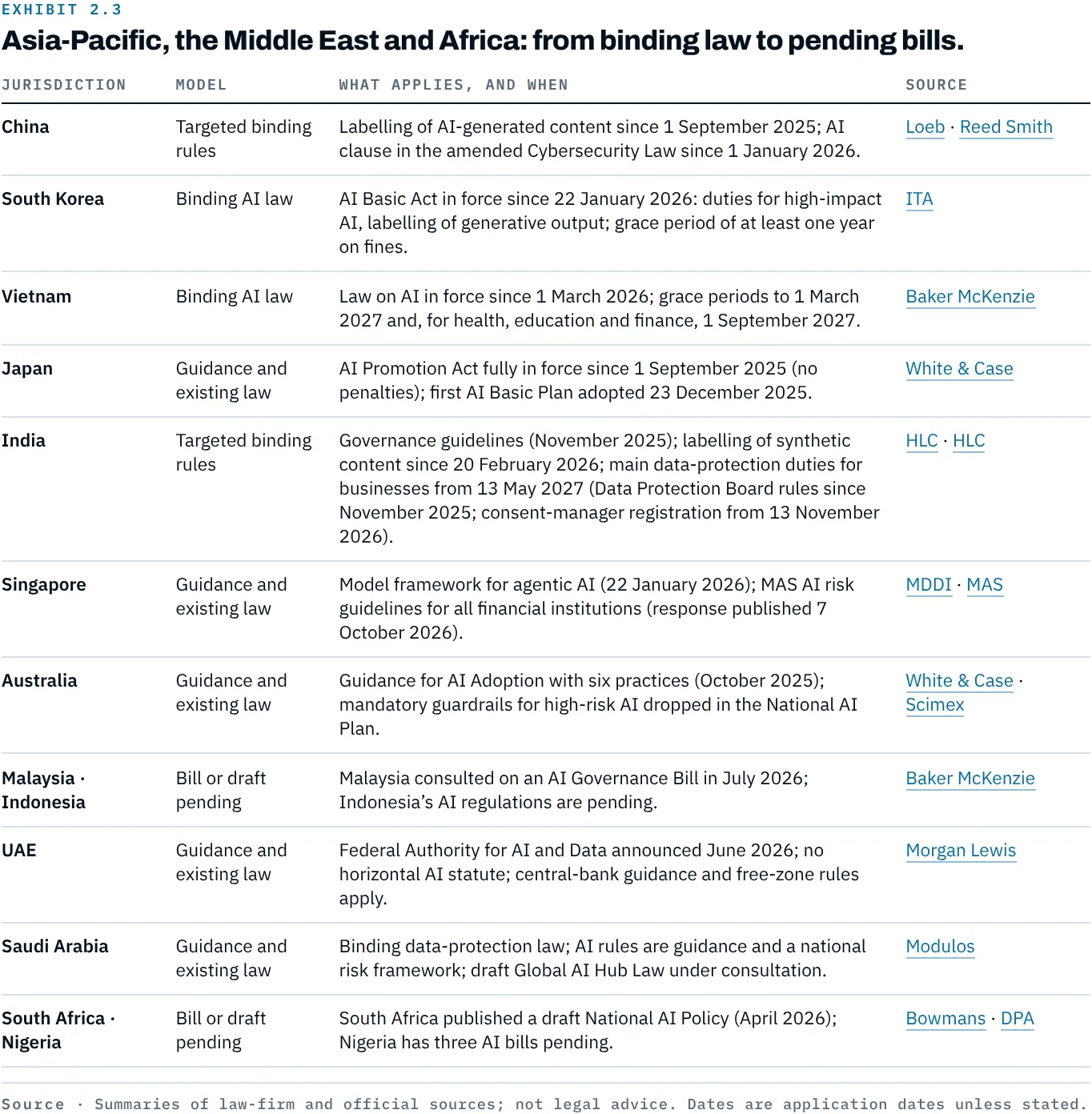
Asia-Pacific, the Middle East and Africa: from binding law to pending bills.
Summaries of law-firm and official sources; not legal advice. Dates are application dates unless stated.
Source study · v2.1 · page 22 · Figure published: 25 Oct 2026
Read figure text, sources and rights
EXHIBIT 2.3 Asia-Pacific, the Middle East and Africa: from binding law to pending bills. JURISDICTION MODEL WHAT APPLIES, AND WHEN SOURCE China Targeted binding rules Labelling of AI-generated content since 1 September 2025; AI clause in the amended Cybersecurity Law since 1 January 2026. Loeb · Reed Smith South Korea Binding AI law AI Basic Act in force since 22 January 2026: duties for high-impact AI, labelling of generative output; grace period of at least one year on fines. ITA Vietnam Binding AI law Law on AI in force since 1 March 2026; grace periods to 1 March 2027 and, for health, education and finance, 1 September 2027. Baker McKenzie Japan Guidance and existing law AI Promotion Act fully in force since 1 September 2025 (no penalties); first AI Basic Plan adopted 23 December 2025. White & Case India Targeted binding rules Governance guidelines (November 2025); labelling of synthetic content since 20 February 2026; main data-protection duties for businesses from 13 May 2027 (Data Protection Board rules since November 2025; consent-manager registration from 13 November 2026). HLC · HLC Singapore Guidance and existing law Model framework for agentic AI (22 January 2026); MAS AI risk guidelines for all financial institutions (response published 7 October 2026). MDDI · MAS Australia Guidance and existing law Guidance for AI Adoption with six practices (October 2025); mandatory guardrails for high-risk AI dropped in the National AI Plan. White & Case · Scimex Malaysia · Indonesia Bill or draft pending Malaysia consulted on an AI Governance Bill in July 2026; Indonesia’s AI regulations are pending. Baker McKenzie UAE Guidance and existing law Federal Authority for AI and Data announced June 2026; no horizontal AI statute; central-bank guidance and free-zone rules apply. Morgan Lewis Saudi Arabia Guidance and existing law Binding data-protection law; AI rules are guidance and a national risk framework; draft Global AI Hub Law under consultation. Modulos South Africa · Nigeria Bill or draft pending South Africa published a draft National AI Policy (April 2026); Nigeria has three AI bills pending. Bowmans · DPA Source · Summaries of law-firm and official sources; not legal advice. Dates are application dates unless stated.
Source links on the cited study page
- www.loeb.com ↗
- www.reedsmith.com ↗
- www.trade.gov ↗
- www.bakermckenzie.com ↗
- www.whitecase.com ↗
- www.hlc.com ↗
- www.hlc.com ↗
- www.mddi.gov.sg ↗
- www.mas.gov.sg ↗
- www.whitecase.com ↗
- www.scimex.org ↗
- www.bakermckenzie.com ↗
- www.morganlewis.com ↗
- www.modulos.ai ↗
- bowmanslaw.com ↗
- digitalpolicyalert.org ↗
ETHORITY figure. Rights in cited data and third-party marks remain with their owners. The Prism artwork licence applies where stated on the figure.
China. Measures for labelling AI-generated synthetic content have applied since 1 September 2025. They require explicit labels on text, images, audio, video and virtual scenes, plus implicit labels in file metadata, and oblige app stores to check labelling when reviewing apps.
South Korea. The AI Basic Act has applied since 22 January 2026. Providers must tell users in advance that AI is in use and may need to disclose that images, video or audio are AI-generated where they are hard to distinguish from reality. A grace period of at least one year applies to fines.
India. Amended IT Rules have applied since 20 February 2026. Permitted synthetic content must be prominently labelled and carry permanent metadata or provenance markers that platforms may not remove; takedown orders must be acted on within three hours.
What this means for businesses
For most organisations, synthetic media is now a governance topic with three sides:
- As a creator. If you produce AI-generated video, voice or images for marketing, training or service, you need labelling and marking that work across the EU, China, Korea and India. Build them into the production workflow rather than adding them at publication.
- As a buyer. Ask suppliers of generative tools how outputs are marked, which metadata survives export, and whether voice or face cloning requires documented consent from the person depicted.
- As a target. Voice and video impersonation of executives is a fraud vector. Payment approvals, password resets and supplier bank-detail changes should never rely on a voice or video call alone.
Consent deserves special attention in meetings. In a US survey, 33% of workers had met with an AI notetaker, and 65% of them said consent was inconsistent or missing.
A long view
Twenty years ago, at my company Gridpatrol, we monitored the web for brands and once intercepted a compromising image of a retail manager before it spread. Then the problem was static images and text. Today it is real-time video and cloned voices. What has stayed the same is the principle: detect early, label honestly, and keep a human accountable for what is published.
Rules alone will not make synthetic media trustworthy. Clear labels, documented consent and verification steps inside business processes will. The opportunity for 2027 is to use synthetic voices and faces where they genuinely help, in accessibility, training and service, while making their origin visible.
Begin with the purpose and the person represented
A synthetic presenter can make training easier to update or support access in another language. That does not remove the need to decide whose likeness is used, what the person agreed to and how audiences will understand the result. Start with the communication purpose and the rights involved, not the most impressive demonstration available.
Separate a fictional character, a licensed performer, an employee replica and a depiction of a public figure. These are different situations. Consent to record one interview should not be assumed to include indefinite voice cloning, new scripts or distribution in every market. The production brief should identify the intended uses, languages, channels, duration and the process for withdrawal or correction where applicable.
Also consider who appears to be speaking. A generated spokesperson reading an approved script is different from an interactive system improvising an answer in that person's voice. The latter can create statements the represented person never reviewed. Define whether the system may answer freely, only retrieve approved material or hand off to a human. The visual realism should not conceal the actual operating boundary.
Treat provenance as a production chain
Origin information can be lost during ordinary work. A video may pass through editing, compression, translation, captioning, a publishing platform and a distributor. Check the final delivered asset, not only the generation tool's export settings. If the company relies on a visible disclosure, test that it remains visible on mobile and in the places where the material is embedded.
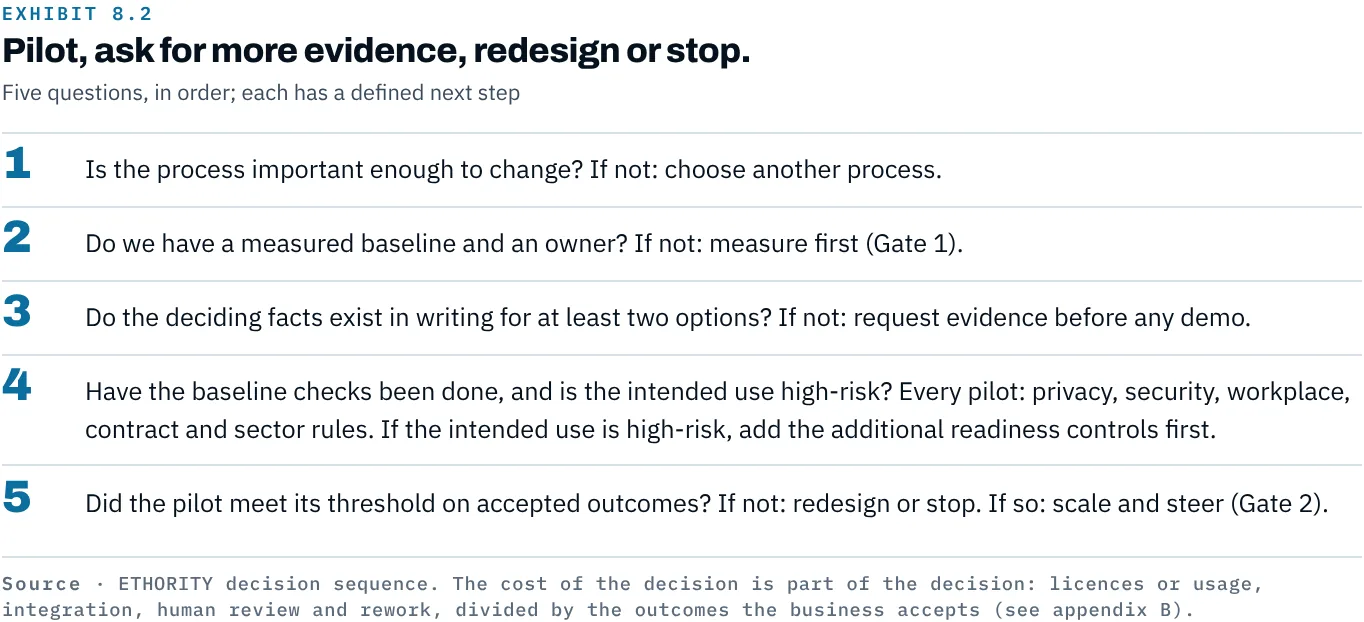
Pilot, ask for more evidence, redesign or stop.
ETHORITY decision sequence. The cost of the decision is part of the decision: licences or usage, integration, human review and rework, divided by the outcomes the business accepts (see appendix B).
Source study · v2.1 · page 66 · Figure published: 25 Oct 2026
Read figure text, sources and rights
EXHIBIT 8.2 Pilot, ask for more evidence, redesign or stop. Five questions, in order; each has a defined next step Is the process important enough to change? If not: choose another process. Do we have a measured baseline and an owner? If not: measure first (Gate 1). Do the deciding facts exist in writing for at least two options? If not: request evidence before any demo. Have the baseline checks been done, and is the intended use high-risk? Every pilot: privacy, security, workplace, contract and sector rules. If the intended use is high-risk, add the additional readiness controls first. Did the pilot meet its threshold on accepted outcomes? If not: redesign or stop. If so: scale and steer (Gate 2). Source · ETHORITY decision sequence. The cost of the decision is part of the decision: licences or usage, integration, human review and rework, divided by the outcomes the business accepts (see appendix B).
ETHORITY figure. Rights in cited data and third-party marks remain with their owners. The Prism artwork licence applies where stated on the figure.
A content-provenance mechanism can help preserve assertions about creation and editing. It does not, by itself, establish that the depicted event happened or that every assertion in the media is true. Equally, the absence of a particular provenance signal is not conclusive proof of deception. Use technical markers as one contribution to a broader editorial and rights process. The C2PA specification describes the mechanism and its scope.
Keep a production record linking the approved script, relevant permissions, source material and final asset. Limit access to sensitive recordings. If a presenter leaves the organisation, the business should be able to find the assets and agreements affected. The aim is an actionable rights and publication record, not a large collection of personal data without a clear purpose.
A hypothetical training project from script to release
Suppose a company wants a multilingual induction video with a synthetic presenter. First, the subject owner approves the factual script. The rights owner confirms the use of voice and likeness. A qualified language reviewer checks meaning in each edition, including instructions that affect safety or employment. The production team then creates the media and applies the agreed disclosures.
The acceptance test should inspect the complete viewer experience. Are captions accurate? Is the spoken instruction consistent with the written policy? Can a viewer distinguish the presenter from a live person? Is there a contact route for questions? Does the mobile crop obscure the disclosure? A technically realistic face is a poor success measure if the audience cannot understand the instruction.
When a policy changes, identify which language editions and derived clips need updating. Do not leave an old spoken instruction live because the text page has already been corrected. Preserve the earlier asset as an archive where necessary, but route ordinary viewers to the current edition. Version management is part of the service the media provides.
Design fraud resistance around the transaction
An organisation should not rely on recognition of a voice or face as the sole authorisation for a consequential action. A convincing call can create urgency while bypassing ordinary checks. The more robust question is whether the requested payment, account change or disclosure follows the established authority process.
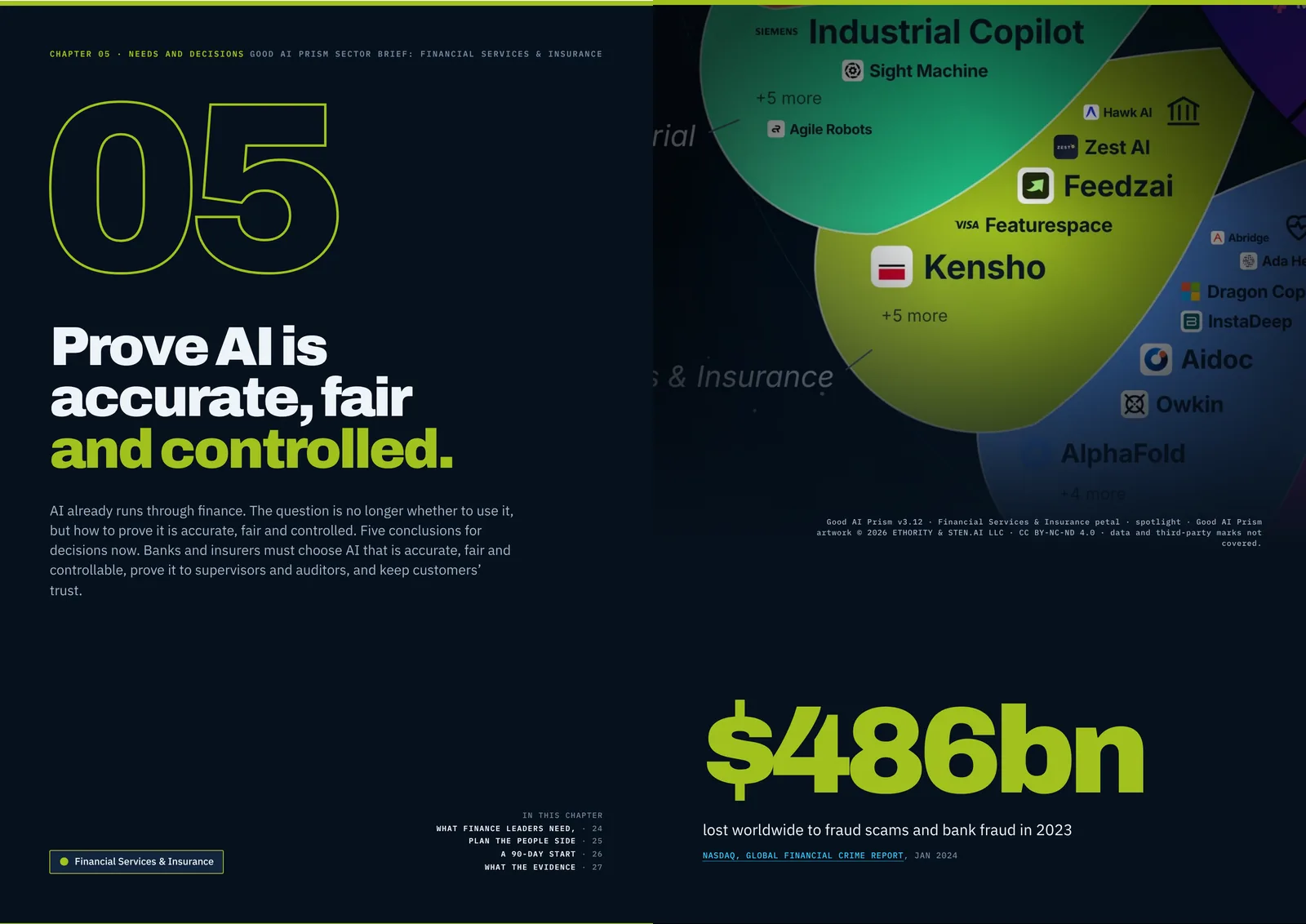
$486bn — lost worldwide to fraud scams and bank fraud in 2023
NASDAQ, GLOBAL FINANCIAL CRIME REPORT, JAN 2024
Source study · v1.2 · page 22-23 · Figure published: 25 Oct 2026
Read figure text, sources and rights
CHAPTER 05 · NEEDS AND DECISIONS GOOD AI PRISM SECTOR BRIEF: FINANCIAL SERVICES & INSURANCE 05 Prove AI is accurate, fair and controlled. AI already runs through finance. The question is no longer whether to use it, but how to prove it is accurate, fair and controlled. Five conclusions for decisions now. Banks and insurers must choose AI that is accurate, fair and controllable, prove it to supervisors and auditors, and keep customers’ trust. Financial Services & Insurance IN THIS CHAPTER WHAT FINANCE LEADERS NEED, · 24 PLAN THE PEOPLE SIDE · 25 A 90-DAY START · 26 WHAT THE EVIDENCE · 27 22 Good AI Prism v3.12 · Financial Services & Insurance petal · spotlight · Good AI Prism artwork © 2026 ETHORITY & STEN.AI LLC · CC BY-NC-ND 4.0 · data and third-party marks not covered. $486bn lost worldwide to fraud scams and bank fraud in 2023 NASDAQ, GLOBAL FINANCIAL CRIME REPORT, JAN 2024 23
Source links on the cited study page
ETHORITY figure. Rights in cited data and third-party marks remain with their owners. The Prism artwork licence applies where stated on the figure.
For example, a hypothetical supplier bank-detail change can be checked through a previously established independent channel and an authorised approval workflow. Do not use contact details supplied only in the suspicious request as the independent check. Staff should know how to pause the transaction and whom to contact without being punished for slowing an unusual demand.
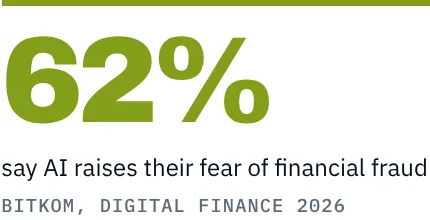
62% — say AI raises their fear of financial fraud
BITKOM, DIGITAL FINANCE 2026
Source study · v1.2 · page 11 · Figure published: 25 Oct 2026
Read figure text, sources and rights
62% say AI raises their fear of financial fraud BITKOM, DIGITAL FINANCE 2026
Source links on the cited study page
ETHORITY figure. Rights in cited data and third-party marks remain with their owners. The Prism artwork licence applies where stated on the figure.
Practise with safe scenarios. Test whether staff can locate the genuine contact route, recognise a change to a familiar procedure and record the attempted request. Avoid creating harmful impersonation material or circulating employee replicas merely to make an exercise dramatic. The objective is to test the process, not humiliate individuals or prove that a detector can identify every deepfake.
Evaluate suppliers on rights, controls and usable output
Compare more than visual quality. Ask how the provider handles source recordings, training use, retention, deletion, access and permission to create a likeness. Establish whether the relevant controls apply to the selected plan. A public example showing a famous person does not establish that your intended use is authorised.
Measure the cost of accepted content. Include script preparation, language review, rights work, rendering, corrections and updates. A low generation price can be misleading if each revision requires extensive checking. Conversely, a synthetic version may be useful for frequent updates even where the first production costs more. Use a scenario based on the actual publishing cycle rather than an invented universal saving.
Keep accessibility and alternatives in the evaluation. Some audiences may prefer text, captions or a clearly fictional voice. A realistic presenter is a design choice, not a prerequisite for useful communication. The right format follows the purpose, the audience and the consequences of misunderstanding.
Check the last mile of a media correction
A correction should reach the places where people still encounter the material. List the original page, embedded players, derivative clips and language editions. Identify which can be replaced and which require a separate notice. Keeping that list during production is easier than reconstructing it after an error.
Test one corrected asset through the ordinary publishing path. Confirm the caption, spoken message and disclosure on the delivered version. Retain the previous asset as required for the organisation's records, but do not let an archive link silently become the default viewer route. A good correction explains the changed content where that matters to the audience.
This is also a useful purchasing question. Ask whether the service can identify derived editions and export the information needed for a provider change. Generating a convincing face is one capability; maintaining a responsible communication asset over its useful life is a larger service requirement.
Connect the media decision to a bounded next step
Use the Good AI Prism to explore relevant voice, language and media offerings, then inspect their profiles and source-backed limitations. The AI Decision Brief can support a focused comparison. A wider workflow and investment question can be discussed through the Enterprise AI Opportunity Case.
Bring the intended audience, represented person, distribution channels and the decision you need to make. Keep legal interpretation and rights clearance with the appropriate specialists. An enquiry starts a discussion about scope; it does not grant likeness rights, publish an asset or activate a synthetic spokesperson. The commercial opportunity lies in useful communication whose origin, ownership and conditions remain understandable.
What to decide now
- Inventory every tool that generates images, video or voice and confirm how it meets EU machine-readable marking by 2 December 2026.
- Require documented consent for any cloned voice or likeness, including employees and presenters.
- Add a second, non-voice verification step to payment approvals and supplier bank-detail changes.
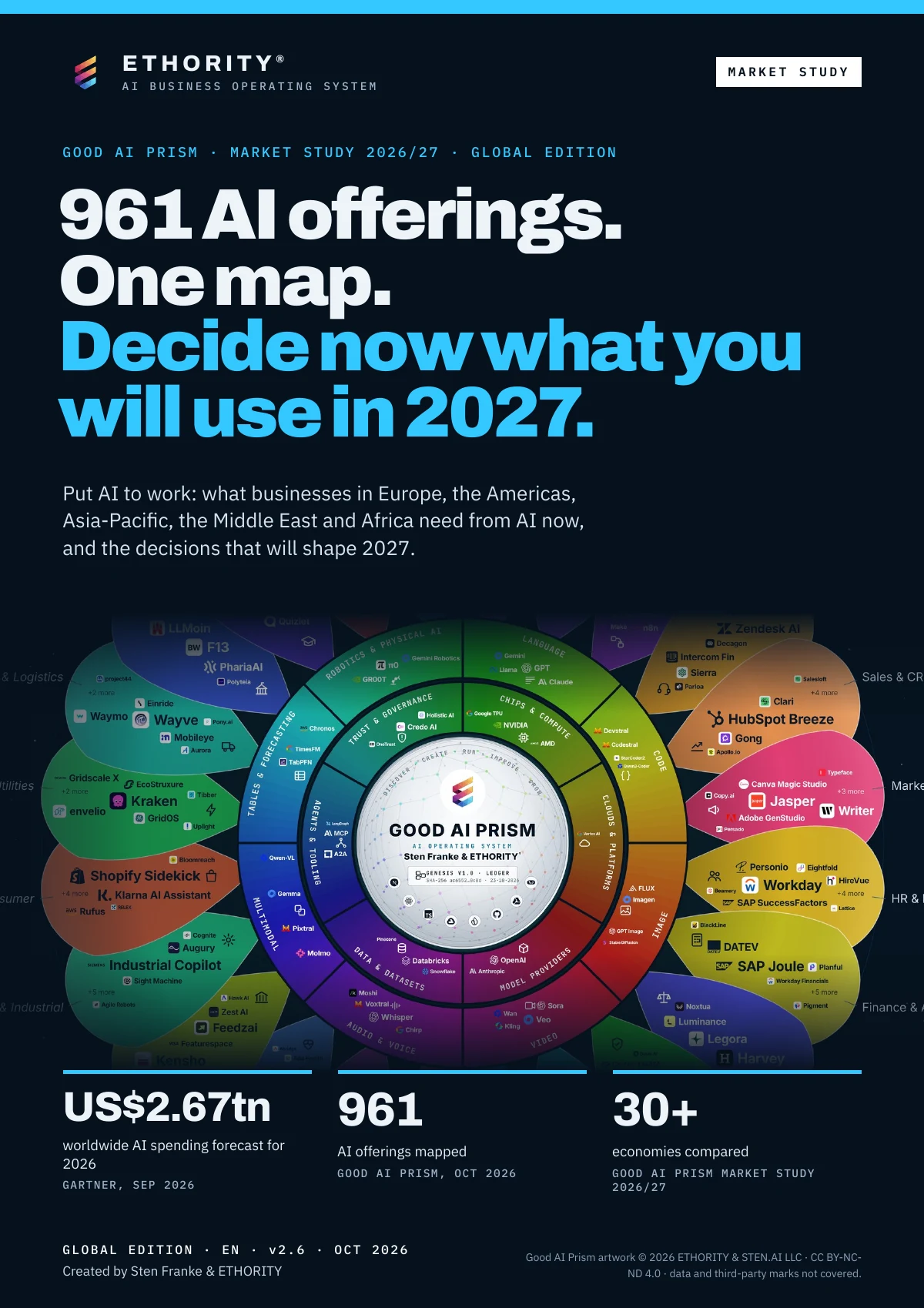
Labelling rules for more than 30 economies are compared in the Good AI Prism Global Market Study 2026/27 at ethority.ai/ai-prism-study.
Sources
- Microsoft Research, VASA-1 project page: https://www.microsoft.com/en-us/research/project/vasa-1/
- VASA-1 project site (release and responsible-AI statement): https://vasavatar.github.io/VASA-1/
- Apple, M5 announcement (Oct 2025): https://www.apple.com/newsroom/2025/10/apple-unleashes-m5-the-next-big-leap-in-ai-performance-for-apple-silicon
- Futurum, Snapdragon X2 Elite (Oct 2025): https://futurumgroup.com/insights/snapdragon-x2-elite-pushes-ai-pc-performance-to-new-heights
- Counterpoint, AI PCs in 2026: https://counterpointresearch.com/ko/reports/ai-advanced-pcs-to-surpass-half-of-global-shipments-in-2026
- Allianz Risk Barometer 2026: https://commercial.allianz.com/news-and-insights/news/allianz-risk-barometer-2026.html
- Regulation (EU) 2026/1744: https://eur-lex.europa.eu/eli/reg/2026/1744/oj/eng
- Regulation (EU) 2024/1689 (AI Act): https://eur-lex.europa.eu/eli/reg/2024/1689/oj
- Lewis Silkin, Digital Omnibus on AI (Jul 2026): https://www.lewissilkin.com/en/insights/2026/07/27/the-digital-omnibus-on-ai-enters-into-force-today-102nedo
- nicfab, Digital Omnibus on AI in the Official Journal: https://www.nicfab.eu/en/posts/digital-omnibus-ai-official-journal/
- Loeb & Loeb, China AI labelling measures: https://www.loeb.com/en/insights/publications/2025/03/chinas-ai-labeling-measures-and-mandatory-national-standards-take-effect-september-1
- ITA, South Korea AI Basic Act: https://www.trade.gov/market-intelligence/south-korea-ai-basic-act
- Hogan Lovells, India synthetic-content labelling (Feb 2026): https://www.hlc.com/en/publications/india-introduces-mandatory-labelling-for-ai-and-3hour-takedown-for-illegal-content
- KRDO / Stacker, AI notetaker survey (Jul 2026): https://krdo.com/stacker-business-economy/2026/07/16/ai-notetakers-have-sat-in-on-1-in-3-us-workers-meetings-but-only-a-third-say-they-were-asked-first/
- ETHORITY, Good AI Prism Global Market Study 2026/27: https://ethority.ai/ai-prism-study
This article is not legal advice.
Updated edition of the article first published on ethority.net in 2024; the original remains archived.