 ETHORITY®
GOOD AI PRISM · TOPIC AREA · MEETINGS, VOICE & LANGUAGE
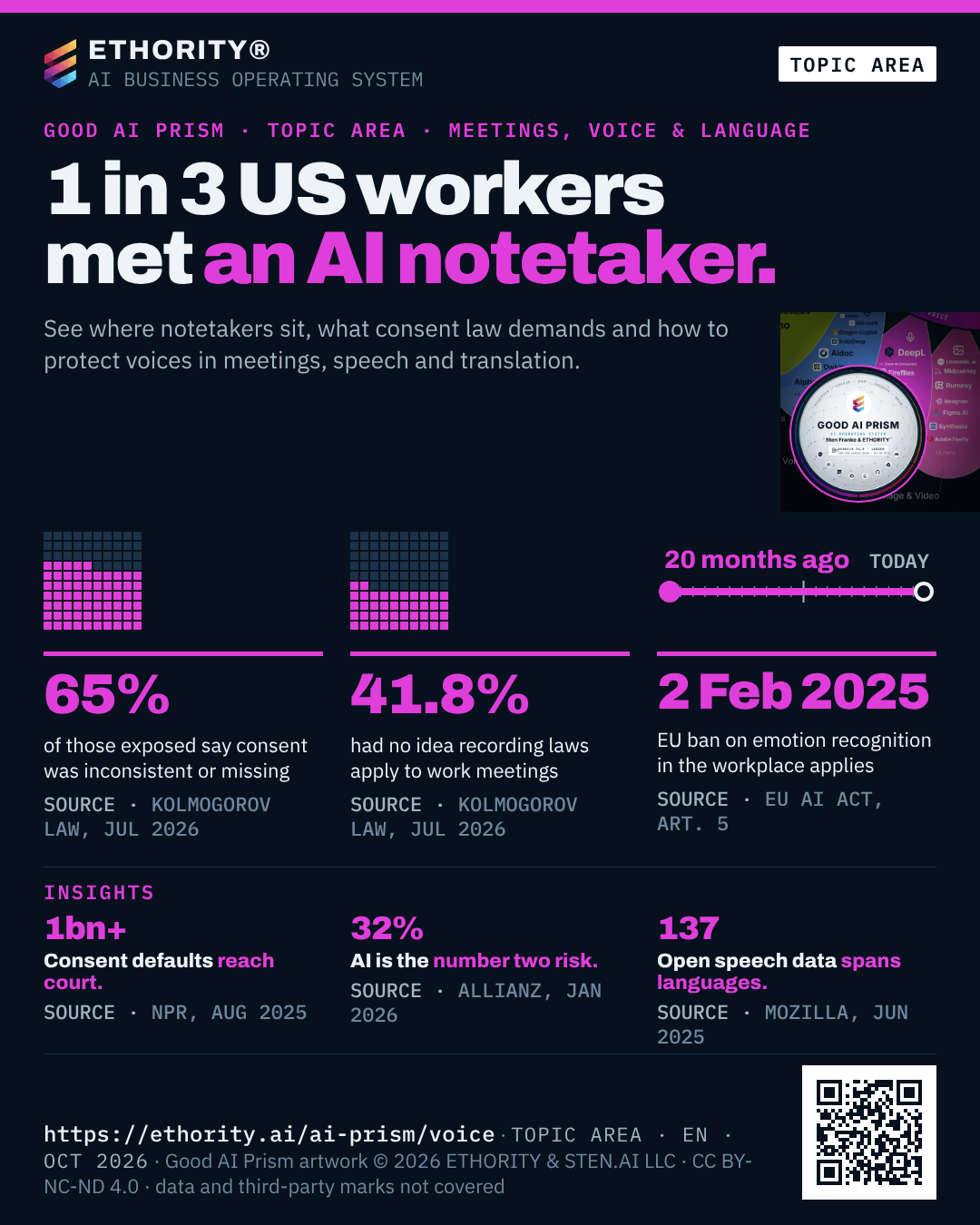
1 in 3 US workers met an AI notetaker.
See where notetakers sit, what consent law demands and how to protect voices in meetings, speech and translation.
- 1 in 3
- US workers have had an AI notetaker in their work meetingsKolmogorov Law, Jul 2026 · krdo.com ↗
- 65%
- of those exposed say consent was inconsistent or missingKolmogorov Law, Jul 2026 · krdo.com ↗
- 41.8%
- had no idea recording laws apply to work meetingsKolmogorov Law, Jul 2026 · krdo.com ↗
- 2 Feb 2025
- EU ban on emotion recognition in the workplace appliesEU AI Act, Art. 5 · eur-lex.europa.eu ↗
Consent defaults reach court.
A class action alleges Otter's notetaker joins without consent; Otter, with 1bn+ meetings processed, denies it (NPR on the Otter lawsuit).
NPR, Aug 2025
AI is the number two risk.
AI ranks second among business risks, behind cyber incidents at 42%, as cloned voices lower the cost of fraud (Allianz Risk Barometer 2026).
Allianz, Jan 2026
Open speech data spans languages.
Mozilla Common Voice holds 33,815 hours of speech in 137 languages under CC0 (Common Voice registry card).
Mozilla, Jun 2025
How to use this page
Three tools and one offer turn this page into a decision.
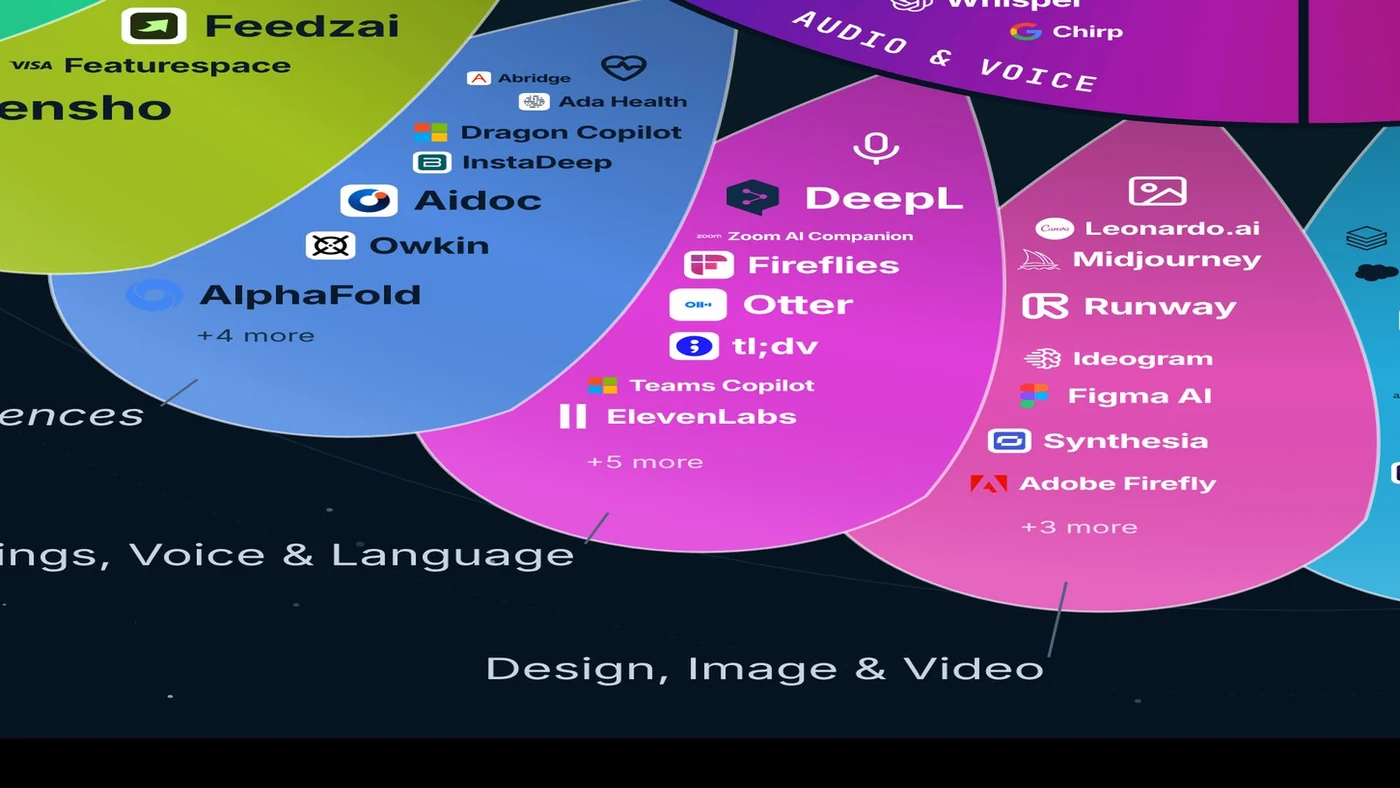
- Open the Meetings, Voice & Language map: the area's offerings on one petal of the Good AI Prism, with logos and provider facts.
- Compare up to three offerings: decision facts side by side, each with its source and date.
- Run the Task economics calculator: turn saved hours into capacity you can attribute, before a pilot is approved.
- Offer: AI Governance Setup: owners, consent settings, registers and review routines for every meeting bot, so the rules work in daily use.
The study behind this hub
The global market study and the A3 companion with the full map.
Global edition · EN
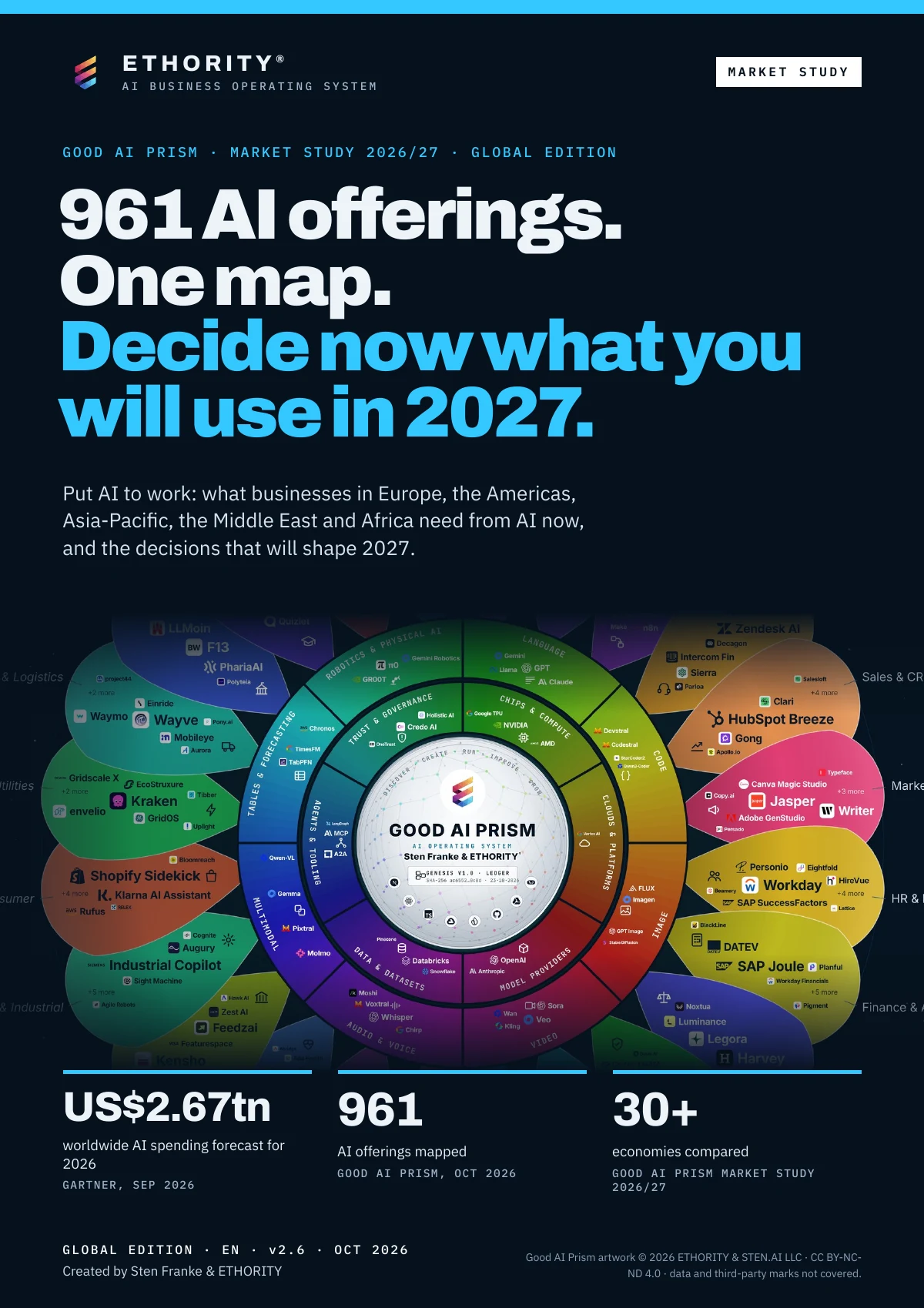
961 AI offerings. One map. Decide now what you will use in 2027.
The Good AI Prism helps you find useful AI and compare the evidence behind your options. For organisations already using AI, the question is moving from whether to use AI to which AI, how safely and whether it pays. This Global edition brings together 961 AI offerings across 24 topic areas, 8 data types and 6 technology layers, with sources, dates and limits to guide your next decision.
Version 2.6 · 90 pages
Open the study →The whole AI market on one sheet.
The full Good AI Prism as an A3 poster: every topic area, data type and technology layer on one page.
See the map on one page →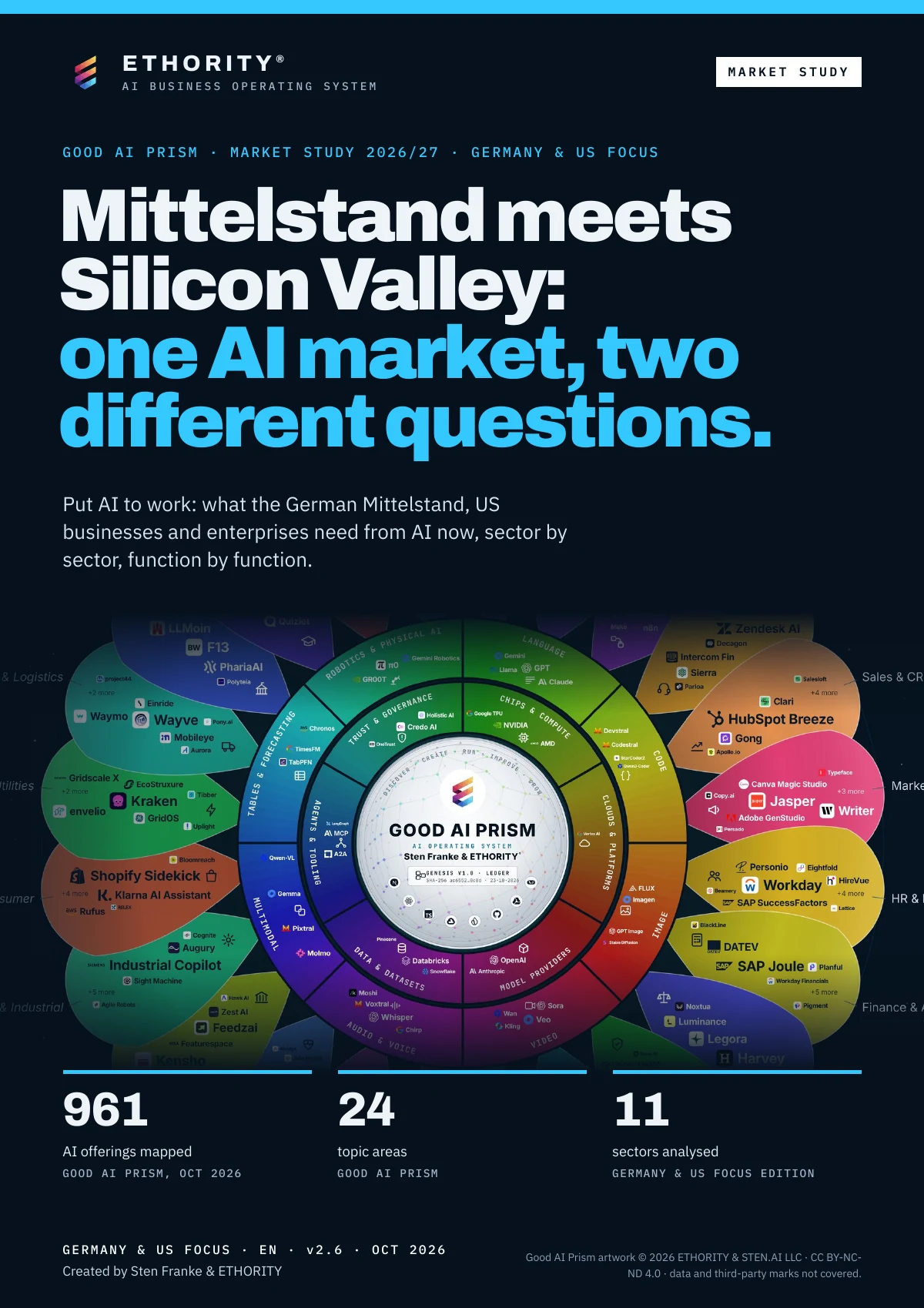
Germany & United States Focus · EN
Germany's mid-sized companies meet Silicon Valley: one AI market, two different questions.
The Mittelstand needs know-how; US firms need cost control. What German and US businesses need from AI now, sector by sector, function by function.
Version 2.6 · 72 pages
Open the study →Read next
Three related analyses from ETHORITY; the long read for this area follows further down the page.
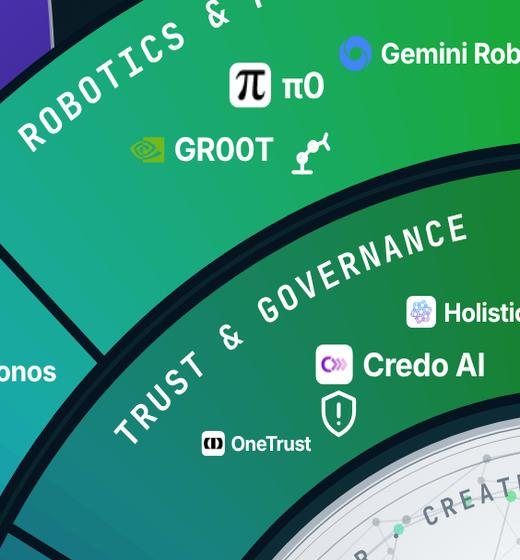
Check every vendor claim before you rely on it.
Tie every vendor claim to the exact product, version, contract and use before you rely on it.
See the map on one page →
Synthetic media now needs a label almost everywhere.
What has changed for AI-generated faces and voices since Microsoft's VASA-1 model in 2024, and the labelling rules in the EU, China, Korea and India.
See the map on one page →
AI rules move from documents into daily operation.
Why AI agents, tools and constant change move AI governance – the rules and responsibilities for AI – into the systems that run your AI every day.
See the map on one page →Where ETHORITY can start
From finding every meeting bot to consent rules and governance that work in daily use.
AI Estate Audit
€25,000 one-time · net
An inventory of every AI use, including tools staff bring themselves, with a scale, fix or stop view per use.
Date and place by agreement
See what this package includes →AI Act Readiness Sprint
€6,900 one-time · net
Each use mapped to the EU AI Act and the dates that apply to it, with the duties you carry as provider or deployer.
Date and place by agreement
See what this package includes →AI Governance Setup
€19,500 one-time · net
Owners, controls, registers and review routines that keep AI decisions accountable every day.
Scope and delivery by agreement
See what this package includes →AI Literacy & Adoption
€2,400 one-time · net
Role-based AI literacy for the people who use, review and own AI outputs, documented for Article 4.
Scope and delivery by agreement
See what this package includes →AI Opportunity Case
Priced after scoping
One use case assessed against evidence, cost and rules, ending in a decision: pilot, redesign, expand or stop.
Scope and delivery by agreement
See what this package includes →Rules and dates
The dates that apply to meeting, voice and language AI.
- 2 Feb 2025
EU ban on emotion recognition at work and in education applies.
Reg. (EU) 2024/1689, Art. 5
- 15 Aug 2025
Class action against Otter.ai over notetaker consent reported; Otter denies the claims.
NPR
- 2 Aug 2026
EU Art. 50: people must be told when they interact with an AI system.
Reg. (EU) 2024/1689
- 2 Dec 2026
Machine-readable marking for synthetic audio from systems already on the market (Digital Omnibus).
Reg. (EU) 2026/1744
Questions buyers of meeting AI ask
May we record and transcribe meetings with AI in Germany?
Only with consent. Recording the privately spoken word without it is an offence under section 201 of the Criminal Code. Configure tools to announce themselves and ask every participant.
Do we need the works council?
Usually yes. A tool that can monitor behaviour or performance triggers co-determination under section 87 of the Works Constitution Act; settle storage, access and deletion in a works agreement.
Can we use sentiment or engagement scores from meetings?
Be careful. Emotion recognition in the workplace is banned in the EU since 2 Feb 2025, with narrow medical and safety exceptions. The AI Act Readiness Sprint reviews each feature.
Are transcripts used to train the provider's AI?
Ask each provider and get it in the contract. The Otter class action alleges training on recordings without clear notice; Otter denies it. The AI Estate Audit records each tool's data terms.
What should we measure?
Meeting time saved and consent compliance, the two outcomes the Good AI Prism Global Market Study proposes for this area.
The evidence at a glance
ETHORITY · LONG READ
65% of workers with AI notetakers weren't always asked.
AI notetakers now sit in one in three US workers' meetings, often without consent. European law sets a higher bar, emotion scoring is banned at work, and cloned voices are a fraud channel. What to configure, agree and measure now.
The notetaker joined before anyone asked
AI notetakers spread through meetings faster than the rules about them. One in three US workers, 33.4%, say an AI notetaker or transcription bot has been in their work meetings, according to a survey published by Stacker in July 2026. Another 22.4% cannot say whether they have been recorded. The survey was commissioned by a law firm, Kolmogorov Law, and run through Pollfish among 500 employed US adults; it is small and has an interest in the topic. Its direction is still hard to ignore.
Among the workers who had met a notetaker, only 34.7% say they were always asked first. 36.5% were asked only sometimes, 25.1% were never asked and 3.6% found out afterwards. That adds up to 65.3% for whom consent was inconsistent or missing. 18.8% of all workers have discovered a recording they did not know about.
65% of US workers who met an AI notetaker say consent was inconsistent or missing (Kolmogorov Law, Jul 2026)
| Consent before an AI notetaker joined | Share of exposed US workers |
|---|---|
| Always asked | 34.7% |
| Asked only sometimes | 36.5% |
| Never asked | 25.1% |
| Learned afterwards | 3.6% |
Source: Kolmogorov Law survey via Pollfish, 167 exposed respondents, fielded 8 Jul 2026, published by Stacker 16 Jul 2026.
Most people do not know the law applies
Awareness lags use. 41.8% of US workers had no idea that recording laws apply to work meetings, and only 35% knew that some states require the consent of every participant. 64.4% did not know that pasting confidential data into a personal chatbot can be illegal. Shadow AI in meetings is not a fringe problem; it is the default.
41.8% of US workers did not know that recording laws apply to work meetings (Kolmogorov Law via Stacker, Jul 2026)
The first test case is in court. In August 2025 a plaintiff filed a class action against Otter.ai in the federal court for the Northern District of California, NPR reported. The suit alleges that Otter's notetaker can join meetings without the consent of participants and that recordings are used to train its AI without clear notice. Otter denies the allegations and the case is open. The company says about 25 million people use its tools and that it has processed more than one billion meetings since 2016. Scale like that turns a consent default into a legal question.
In Europe the bar is higher
European law starts from a stricter place. In Germany, recording the privately spoken word without consent is a criminal offence under section 201 of the Criminal Code. A meeting bot that records by default is therefore not a convenience setting but a legal risk. Where a tool can monitor employees' behaviour or performance, the works council has a right of co-determination under section 87 of the Works Constitution Act, so introducing a notetaker across a company usually needs a works agreement.
The EU AI Act adds two layers. Since 2 February 2025, emotion recognition in the workplace is prohibited under Article 5, with narrow medical and safety exceptions. Meeting analytics that score mood, engagement or sentiment from faces or voices need careful review against that ban. Since 2 August 2026, under Article 50 of the AI Act, people must be told when they interact with an AI system, and providers of systems that generate synthetic audio must mark it in a machine-readable way. Systems already on the market have until 2 December 2026, under the Digital Omnibus on AI.
What a consent-first setup looks like
Consent is mostly a configuration question, and most tools can be set up properly. A consent-first setup has five parts. The bot announces itself by name when it joins, in the meeting and in the invitation. Every participant can decline, and the host can remove the bot without technical help. Recording, transcript and summary are stored in a region and system the organisation controls, with a fixed retention period. The provider's right to use recordings or transcripts for training is switched off or excluded by contract. And external participants, such as customers, candidates or patients, get the same notice as colleagues, because they are the people most likely to object and least likely to know the tool.
None of this slows a meeting down. It does change the buying process: the questions above belong in the tender, not in a later policy. A tool that cannot meet them should not join a meeting with customers or job candidates. Teams that settle these points once, at company level, avoid a hundred individual decisions by people who simply clicked "add to calendar".
Voice is now an attack surface
The same speech technology that writes the minutes can clone a voice. Cyber incidents remain the top business risk in the Allianz Risk Barometer 2026 at 42%, and AI has climbed to second place at 32%. Voice impersonation of executives is a fraud vector for payment approvals, password resets and supplier bank changes. The ETHORITY analysis of synthetic faces and voices sets out the rule: a voice or video call alone should never approve a payment.
Language is where the value is
None of this argues against the category. Transcription, summaries, translation and dubbing are among the most useful AI jobs in daily work. They make meetings searchable, include people who missed them and open content to other languages. The Good AI Prism maps them in Meetings, Voice & Language, next to Customer Service for voice agents and Media & Entertainment for dubbing and versioning.
Language coverage depends on data. Mozilla Common Voice on its card holds 33,815 hours of speech in 137 languages under CC0, including low-resource languages, in its 22.0 release of June 2025. European models such as Aleph Alpha's Pharia-1-LLM cover English, German, French, Spanish, Italian, Portuguese and Dutch, but only under a research licence. For a multinational, the practical question is which languages a tool handles well enough to put in the minutes.
The Good AI Prism Global Market Study names the two outcomes to measure in this area: meeting time saved and consent compliance. The second is the one most pilots forget.
In practice
Use case: a lawsuit as a buying checklist. The August 2025 class action against Otter.ai alleges two things: a bot that joins without every participant's consent, and recordings used for training without clear notice. Otter denies the claims. Both allegations map onto settings a buyer controls: announcement and opt-out in the meeting, and a contractual exclusion of training.
Scenario: an interview with an external candidate. A recruiter in Germany adds a notetaker to a video interview. In a consent-first setup the invitation names the bot, the candidate can decline without penalty, the transcript stays in the company's EU tenant for a fixed period, and no mood or engagement score is produced. Without those settings the interview touches section 201 of the Criminal Code and the EU ban on emotion recognition at work.
What to do Monday
- Find every bot. List the notetakers, transcription and translation tools in use, including those individuals add to calendars, and where recordings and transcripts are stored.
- Turn consent on by default. Configure tools to announce themselves and ask every participant, and give people a simple way to decline.
- Agree it with the works council. In Germany, a company-wide notetaker normally needs a works agreement; settle storage, access and deletion there.
- Switch off emotion scoring. Review meeting analytics against the EU ban on emotion recognition at work, in force since 2 February 2025.
- Separate voice from approval. Add a second, non-voice check to payment approvals, password resets and bank-detail changes.
Sources and further reading
- Stacker via KRDO, AI notetakers have sat in on 1 in 3 US workers' meetings (Kolmogorov Law survey via Pollfish, 500 US workers) ↗ · 16 Jul 2026
- NPR, Class-action suit claims Otter AI secretly records private work conversations ↗ · 15 Aug 2025
- Regulation (EU) 2024/1689 (AI Act), Art. 5(1)(f) and Art. 50 ↗ · 12 Jul 2024
- Regulation (EU) 2026/1744 (Digital Omnibus on AI) ↗ · 27 Jul 2026
- German Criminal Code, section 201 (confidentiality of the spoken word) ↗ · current version
- Works Constitution Act, section 87 (co-determination) ↗ · current version
- Allianz Risk Barometer 2026 ↗ · Jan 2026
- Mozilla, Common Voice 22.0 release ↗ · 25 Jun 2025
- ETHORITY, Synthetic Faces and Voices in 2026 → · 22 Oct 2026
- ETHORITY, Put AI to Work: The Good AI Prism Global Market Study 2026/27 → · 22 Oct 2026
Put the thinking to work
AI Opportunity Case →
A defensible proceed, test, redesign, defer or stop decision. The fee is independent of which outcome the evidence supports.
A written comparison of up to three AI offerings · €195 net →
Start with one question and up to three offerings. Request a sourced comparison, provider questions and a cost sketch using your assumptions.
YOUR NEXT STEP
Discuss your question with Sten Franke.
Bring your business question or the figures you already know. ETHORITY investigates within the agreed scope; together with Sten Franke you agree the next piece of work.