 ETHORITY®

ETHORITY · ADVISORY SERVICE · FROM €6,900 NET · 2–3 WEEKS
Know in 2–3 weeks what the EU AI Act requires of you.
From 2 December 2027, the EU AI Act sets strict duties for listed high-risk uses, for example certain AI in hiring, credit scoring or education. The sprint lists the AI systems within the agreed scope, classifies the risk of each with written reasoning, names the missing evidence and gives your board a costed plan. ETHORITY calls this the AI Act Readiness Sprint.

- 2 Dec 2027
- duties for listed high-risk uses apply (AI Act Annex III: for example certain AI in hiring, credit scoring and education)Reg. (EU) 2026/1744 · White & Case, Aug 2026 · whitecase.com ↗
- €6,900
- Mittelstand package, up to 15 AI uses, 2 weeksETHORITY price list, 16 Oct 2026
- €19,500
- Enterprise package, up to 40 systems, 3 weeksETHORITY price list, 16 Oct 2026
- 2 Aug 2026
- Article 50 transparency duties applyReg. (EU) 2026/1744 · White & Case, Aug 2026 · whitecase.com ↗
An EU amending law moved the high-risk deadline to December 2027.
The Digital Omnibus on AI, Regulation (EU) 2026/1744, entered into force on 27 July 2026. AI that is a safety component of a regulated product (Annex I) follows on 2 August 2028.
White & Case, Aug 2026
Transparency duties under Article 50 already apply.
Only the high-risk duties were postponed. The duties to label AI content and to disclose AI use apply already.
White & Case, Aug 2026
Up to 40 systems classified in the Enterprise package.
Each additional system is quoted at €450 after the scoping call.
ETHORITY price list, 16 Oct 2026
Who it is for
Companies that use AI in HR, customer service, finance, credit, insurance, education or critical infrastructure. Boards, auditors or works councils that ask for an AI Act position. Companies planning their 2027 budget and needing a number for compliance work, often after a one-day Readiness Check.
The sprint also records AI that nobody approved (shadow AI), as far as the staff survey and the licence list reveal it.
The question it answers
Which of our AI systems fall under which AI Act duty, what evidence is missing, and what will it cost to close the gap by December 2027?
What you receive
Select a result to see it in a scenario.
Scenario: an insurer with 22 AI systems in scope (Enterprise package).
- 1
AI register you keep: system, owner, purpose, vendor, data, users and your role as provider or deployer.
AI register
Read as text
AI Act Readiness Sprint · AI register · Scenario
Scenario: an insurer with 22 AI systems in scope (Enterprise package).
System | Owner | Purpose | Data | Your role
Claims triage | Head of Claims | Sort incoming claims | Claims, photos | Deployer
Life-insurance pricing model | Chief Actuary | Price life policies | Health and age data | Provider
Customer chatbot | Head of Service | Answer policy questions | Customer messages | Deployer
CV screening | Head of HR | Pre-select applicants | CVs | Deployer
Writing assistant | IT | Draft texts | Internal documents | Deployer
+17 more systems · 3 found through the staff survey
- 2
Risk classification per system (prohibited, high-risk under Annex III, Article 50 transparency, minimal) with written reasoning; borderline cases marked for legal review.
Risk classification
Read as text
AI Act Readiness Sprint · Risk classification · 22 systems · Scenario
Scenario: an insurer with 22 AI systems in scope (Enterprise package).
- Prohibited: 0
- High-risk · Annex III: 3
- Transparency · Article 50: 6
- Minimal: 13
High-risk systems:
- Life-insurance pricing model · Annex III 5(c)
- CV screening · Annex III 4(a)
- Claims fraud scoring · borderline, to legal review
2 borderline cases go to your lawyers with our reasoning
- 3
Gap analysis: obligations, existing evidence and missing evidence, including Article 4 literacy and Article 50 labelling.
Gap analysis
Read as text
AI Act Readiness Sprint · Gap analysis · Scenario
Scenario: an insurer with 22 AI systems in scope (Enterprise package).
- Article 4 · AI literacy: Training for 40 of 900 users (Partly)
- Article 50 · chatbot disclosure: Notice in the chat window (In place)
- Annex III · human oversight (CV screening): No documented oversight (Missing)
- Annex III · provider documentation (pricing model): Technical documentation incomplete (Partly)
- Article 26 · logs kept by deployer: Logs kept for 30 days (Partly)
- Vendor documentation: 4 of 9 vendors answered (Partly)
- 4
Roadmap and budget to December 2027: actions, owners, effort and cost ranges.
Roadmap and budget
Read as text
AI Act Readiness Sprint · Roadmap and budget to 2 Dec 2027 · Scenario
Scenario: an insurer with 22 AI systems in scope (Enterprise package).
- Literacy for all 900 users: Q1 2027, HR, €30–45k
- Human oversight for CV screening: Q1–Q2 2027, Head of HR, €15–25k
- Technical documentation, pricing model: Q1–Q3 2027, Chief Actuary, €60–90k
- Log retention and monitoring: Q2 2027, IT, €20–35k
- Vendor contracts updated: Q2–Q3 2027, Procurement, €10–15k
Total cost range: €135–210k
Annex III duties apply from 2 Dec 2027 (Reg. (EU) 2026/1744)
- 55
Vendor question letters for the documentation your providers must supply, with vendor facts checked against the Good AI Prism registry.
- 66
Board briefing and a summary signed by Sten Franke.
1 / 4 · AI register
Every system with owner, purpose, vendor, data, users and your role.
Scenario: an insurer with 22 AI systems in scope (Enterprise package).
Read as text
AI Act Readiness Sprint · AI register · Scenario
Scenario: an insurer with 22 AI systems in scope (Enterprise package).
System | Owner | Purpose | Data | Your role
Claims triage | Head of Claims | Sort incoming claims | Claims, photos | Deployer
Life-insurance pricing model | Chief Actuary | Price life policies | Health and age data | Provider
Customer chatbot | Head of Service | Answer policy questions | Customer messages | Deployer
CV screening | Head of HR | Pre-select applicants | CVs | Deployer
Writing assistant | IT | Draft texts | Internal documents | Deployer
+17 more systems · 3 found through the staff survey
How it works
- Week 0
30-minute scoping call: package, sponsor, contacts and the document request (licence list, AI-related contracts, policies, organisation chart).
- Week 1 · Find
Kick-off, staff survey, 45-minute interviews with IT, HR, legal and business units, licence and contract review, and a check of every vendor in ETHORITY's directory. Result: a first register of the AI systems within the agreed scope.
- Week 2 · Classify
Role per system, risk classification with reasoning, evidence map, vendor letters sent with your approval, 60-minute review with the sponsor.
- Week 3 · Decide
Gap analysis per obligation, roadmap and budget to 2 Dec 2027, quality review by Sten Franke, board briefing and handover. The package for mid-sized companies fits this into two weeks.
Packages and price
Mittelstand
€6,900 one-time · net
Up to 15 AI uses, 2 weeks, 4 interviews, staff survey, vendor letter template, 45-minute board briefing.
Date and place by agreement
See what this package includes →Request this package →Enterprise
€19,500 one-time · net
Up to 40 AI systems, 3 weeks, up to 10 interviews, survey by business unit, letters per vendor, 60-minute briefing plus two-page summary.
Date and place by agreement
See what this package includes →Request this package →Terms
Net prices. Above 40 systems: fixed quote after the scoping call, at €450 per additional system as a guide. Work starts after confirmed payment and complete agreed inputs. Travel within Germany included. Your time: about six hours in total, spread over sponsor, IT, HR, legal and two or three business units.
What the sprint covers
A technical and organisational assessment of the AI systems within the agreed scope. Borderline cases go to your lawyers with our reasoning attached; conformity assessment (the formal check some high-risk systems need) and model testing are scoped with specialists where needed.
Who is accountable for the result

Sten Franke
Founder & CEO
Sten Franke designs and builds AI systems, from model testing and cloud setup to the interfaces people use. He connects business decisions, software architecture and practical implementation.
AI architecture · Model testing · Cloud engineering · UX
His work spans programming, LLM evaluation, Google Cloud and AWS environments, and web applications built with Next.js and React. He connects business requirements, software architecture and practical implementation. Creator of the Good AI Prism, he brings market intelligence into AI decisions. Earlier, he created the Social Media Prisma, led a BVDW Social Media working group and contributed to its Social Media Kompass. His entrepreneurial work includes ethority, Gridpatrol and mediatime, following a practical foundation in electronics and industrial robotics.
sten@ethority.aiRead before you decide
Read what AI Act readiness requires before the scoping call.
Preparing for the EU AI Act is the start; control happens in daily operation.
How to connect each EU AI Act duty to your systems, controls, evidence, monitoring and regular reassessment.
See the map on one page →
Ten AI ethics issues now have legal dates.
The ten AI ethics issues of 2024 now each have a legal date, a measurable control or published evidence.
See the map on one page →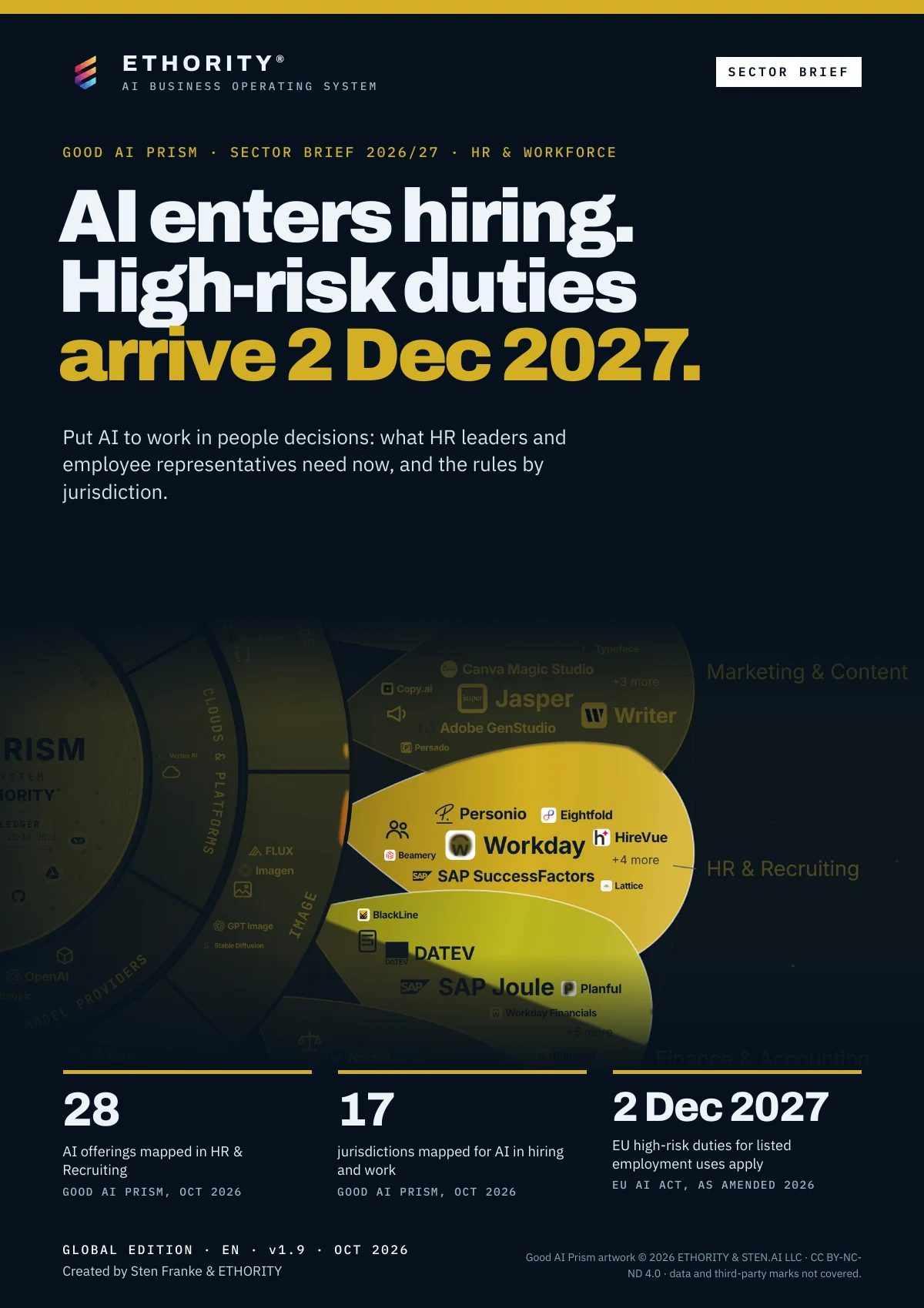
Global edition · EN
AI enters hiring. High-risk duties arrive 2 Dec 2027.
Half the mapped HR offerings serve hiring. What HR leaders and employee representatives need now, and the rules in 17 jurisdictions.
Version 1.9 · 40 pages
Open the study →Test your numbers first
Try the EU AI Act self-check first: in five minutes, seven questions give an indicative risk class for one system. The sprint does this for every system within the agreed scope. All seven calculators are on the ETHORITY calculators page.
EU AI Act Navigator
Seven questions give an indicative risk class, your duties, the dates and the missing evidence, ready to take to your lawyer.
Pilot version · Scenario calculator
Open the calculator →Good AI Prism map
The market study examines 961 AI offerings. The separate online catalogue contains 485 profiles; the counts describe different populations.
Compare three offerings
Puts two to four offerings side by side in the same units, each fact with its source and the date it was checked.
Questions buyers ask
How do you work with our lawyers?
The sprint delivers the technical and organisational assessment. Borderline cases are marked for legal review, and we work alongside your counsel.
We only use standard software. Does the AI Act concern us?
Often yes: AI features inside CRM, ERP, HR and office software count. The sprint finds them through the licence review and the staff survey.
What if we have more than 40 systems?
We give a fixed quote after the scoping call, guided by €450 per additional system.
What do we own afterwards?
The AI register, the classification, the roadmap and all working files. The register is yours and can be maintained through the AI Governance Retainer.
Has the EU's amending law (the Omnibus) changed the deadline?
Yes. Annex III high-risk obligations now apply from 2 December 2027; Article 50 transparency duties have applied since 2 August 2026.
Next step
Request the 30-minute scoping call. Where no AI rules and responsibilities exist yet, the AI Governance Setup is the next step; it reuses the register from the sprint.
ETHORITY · LONG READ
The AI Act deadline moved. The work did not get smaller.
The Omnibus gives companies until 2 December 2027 for Annex III high-risk duties. That is one budget cycle, and the first step is still the same: know what you run.
On 24 July 2026 the Digital Omnibus on AI was published in the Official Journal, and it entered into force three days later. Its headline change is a date. Annex III high-risk obligations, the ones that cover AI in employment, credit, education and essential services, now apply from 2 December 2027, according to White & Case's Omnibus summary. AI that is a safety component of a regulated product follows on 2 August 2028.
It is tempting to read that as breathing room. It is better read as a budget question. Most companies plan 2027 spending in the last quarter of 2026, and a company that cannot list its AI systems cannot put a number on compliance. The transparency duties under Article 50 were not deferred at all: they have applied since 2 August 2026.
The AI Act Readiness Sprint starts with the inventory, because everything else depends on it. Licence lists are not enough. AI now arrives inside existing software, through updates nobody tendered for, and through tools teams buy themselves. The sprint combines interviews, a contract review and a staff survey, then checks every vendor against the dated facts in the Good AI Prism registry. The result is a register your company keeps and the Governance Retainer keeps current.
Classification comes next, with reasoning written down for each system: prohibited, high-risk, transparency duty or minimal. The reasoning matters more than the label. An auditor or works council can follow it, and when a vendor changes its product, your team can see which conclusion needs to be revisited.
The gap analysis and roadmap turn obligations into work: who documents what, which vendor must supply which evidence, what training is still missing, and what it costs. The roadmap ends on the date that now matters, 2 December 2027.
The sprint is a technical and organisational assessment; where a case is borderline, it goes to your counsel with the reasoning attached. What it gives a board is a defensible position and a number, which is what the operational side of AI Act readiness has been missing.
Sources and further reading
YOUR NEXT STEP
Discuss your question with Sten Franke.
Bring your business question or the figures you already know. ETHORITY investigates within the agreed scope; together with Sten Franke you agree the next piece of work.