 ETHORITY®
GOOD AI PRISM · TOPIC AREA · KNOWLEDGE & SEARCH
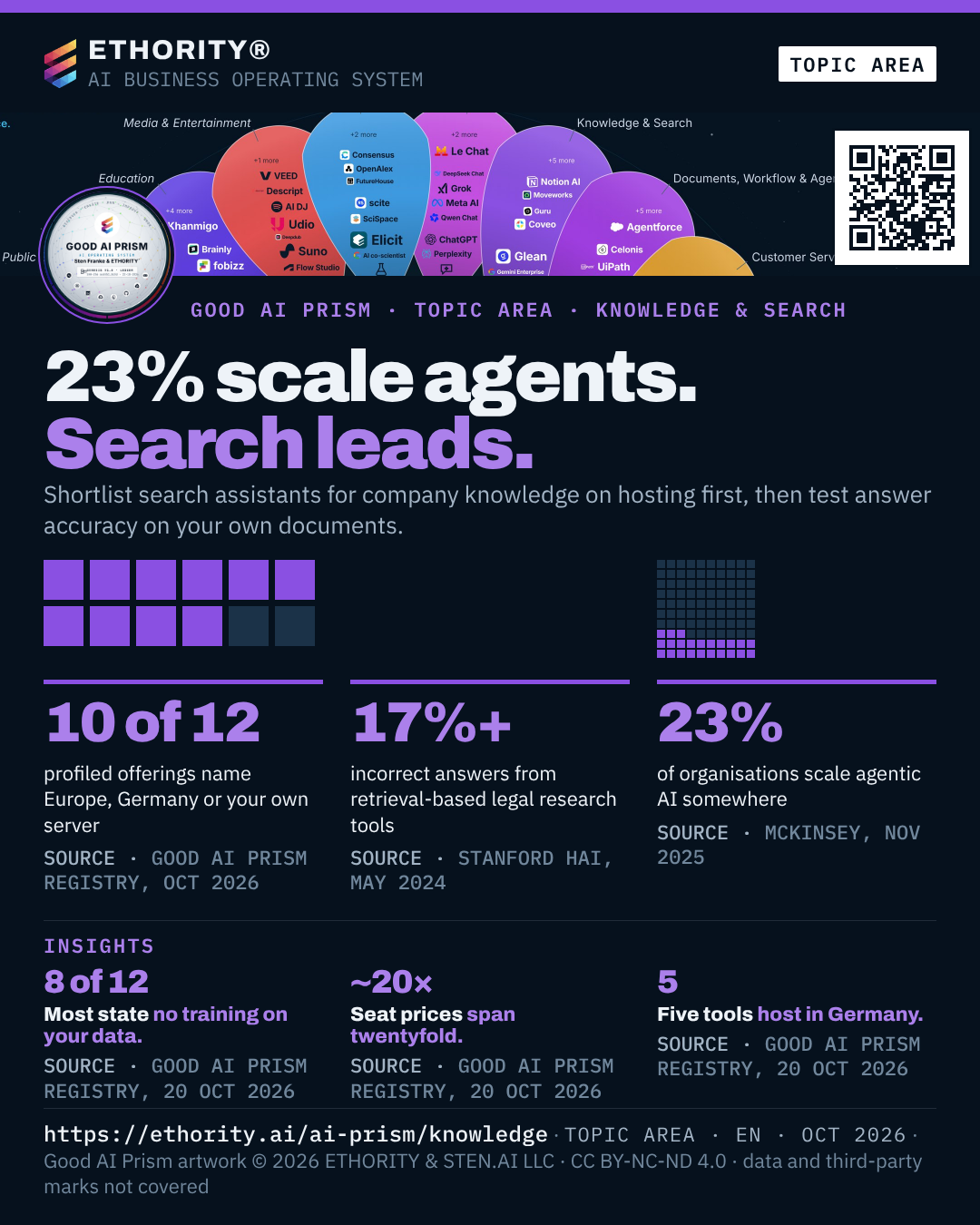
23% scale agents. Search leads.
Shortlist search assistants for company knowledge on hosting first, then test answer accuracy on your own documents.
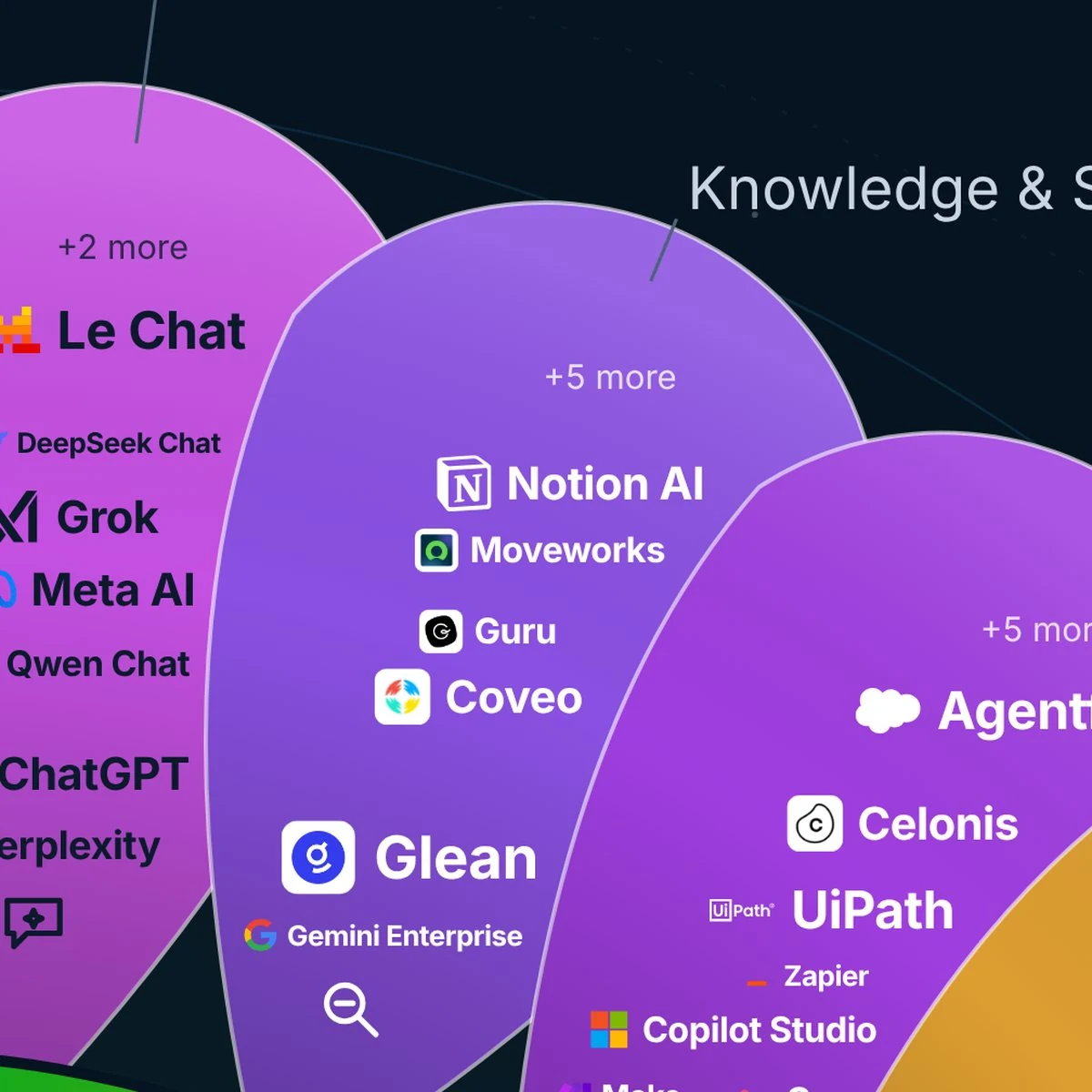
- 26
- AI offerings placed in Knowledge & SearchGood AI Prism, Oct 2026
- 10 of 12
- profiled offerings name Europe, Germany or your own serverGood AI Prism Registry, Oct 2026
- 17%+
- incorrect answers from retrieval-based legal research toolsStanford HAI, May 2024 · hai.stanford.edu ↗
- 23%
- of organisations scale agentic AI somewhereMcKinsey, Nov 2025 · mckinsey.com ↗
Most state no training on your data.
Eight profiled offerings state customer data is not used to train models; two address only third-party models.
Good AI Prism Registry, 20 Oct 2026
Seat prices span twentyfold.
Per-user prices run from €5.40 to €109 a month across the profiled offerings.
Good AI Prism Registry, 20 Oct 2026
Five tools host in Germany.
Five of the twelve profiled cards state hosting or storage in Germany.
Good AI Prism Registry, 20 Oct 2026
How to use this page
Three tools and one offer turn this page into a decision.
- Open the Knowledge & Search map: 26 offerings on one petal of the Good AI Prism, with logos and provider facts.
- Compare up to three offerings: decision facts side by side, each with its source and date.
- Run the Task economics calculator: turn saved hours into capacity you can attribute, before a pilot is approved.
- Offer: AI Decision Brief: up to three search offerings compared fact by fact, with sources, dates and the questions to ask before signing.
Twelve search and knowledge offerings, fact by fact
Hosting, training terms, price basis, integrations and security evidence, each with source and date.
Onyx
Onyx · Product
Onyx is an open-source enterprise search and AI assistant indexing 40+ connected apps, self-hostable on bare metal or air-gapped and usable with any LLM including self-hosted vLLM models.
- Published price
- How it is billed
- Where data is stored
- Does it train AI on your data?
Dropbox Dash
Dropbox · Product
According to Dropbox: “Dash searches across apps like OneDrive, Notion, and Gmail—finding files, images, or videos fast with AI-powered universal search.”
- Published price
- How it is billed
- Where data is stored
- Does it train AI on your data?
Elastic Workplace Search
Elastic · Product
Elastic workplace search across all your tools, which teams combine with generative AI to build their own Slackbots, website portals and mobile employee experiences.
- Published price
- How it is billed
- Where data is stored
- Does it train AI on your data?
Slack Enterprise Search
Salesforce (Slack) · Product
Slack Enterprise Search (Enterprise+ plan) lets members query connected apps such as Google Drive, SharePoint and GitHub from Slack's search bar, retrieving permission-aware results and AI answers in real time.
- Published price
- How it is billed
- Where data is stored
- Does it train AI on your data?
Slite Agent
Slite · Agent
According to Slite: “Scale AI across your company with Slite agent that delivers trusted answers, drafts documentation and proposes updates for your team to approve.”
- Published price
- How it is billed
- Where data is stored
- Does it train AI on your data?
Lumo for Business
Proton · Product
Proton's Lumo for Business is a team AI chat assistant running open-source models (Qwen, GLM, Apertus) on Proton-controlled European servers, with no server-side chat logs and zero-access-encrypted history.
- Published price
- How it is billed
- Where data is stored
- Does it train AI on your data?
nele.ai
nele.ai · Platform
nele.ai is a browser and desktop AI workspace for German SMEs billed through a company-wide monthly credit pool instead of per-user licences, with uploaded knowledge bases and optional pseudonymisation.
- Published price
- How it is billed
- Where data is stored
- Does it train AI on your data?
innoGPT
innoGPT · Platform
innoGPT is a German multi-model AI workspace offering 50+ models (GPT, Claude, Gemini, Mistral) with automatic 'Smart Select' routing, AWS Frankfurt hosting and SharePoint/Drive knowledge search.
- Published price
- How it is billed
- Where data is stored
- Does it train AI on your data?
Logicc
Logicc · Platform
Logicc is a browser-based multi-model AI workspace (OpenAI, Anthropic, Google, Mistral) for regulated industries, storing chats and files on Hetzner servers in Germany and offering § 203 StGB agreements.
- Published price
- How it is billed
- Where data is stored
- Does it train AI on your data?
meinGPT
SelectCode (MeinGPT) · Platform
MeinGPT is a Hetzner-hosted German AI platform for Mittelstand firms offering multi-model chat and assistants, plus an 'Outpost' that connects on-premise systems through an outbound-only connection.
- Published price
- How it is billed
- Where data is stored
- Does it train AI on your data?
Mindverse Studio
Mindverse · Platform
Mindverse Studio is a Berlin-built, credit-metered browser AI workspace hosted in Germany, combining EU-endpoint OpenAI/Anthropic/Google models and German-hosted open models with knowledge bases and 500+ Composio integrations.
- Published price
- How it is billed
- Where data is stored
- Does it train AI on your data?
Nextcloud Assistant
Nextcloud · Product
Nextcloud AI assistant that runs on-premises, so data stays local and is not leaked to third parties through training of new AI models.
- Published price
- How it is billed
- Where data is stored
- Does it train AI on your data?
Compare baseline: three European options
Three assistants with European data locations, from SaaS to your own server.
| Offering | Price | Data location | Training | Source |
|---|---|---|---|---|
| Logicc | €23.92–89.90 /user/mo | DE storage · EU models | Not used for training | Logicc pricing and hosting |
| meinGPT | €5.40–18 /user/mo | Mainly Germany · EU | Not used for training | meinGPT pricing and hosting |
| Nextcloud Assistant | €183.75–204.75 /user/yr | Your own server | Not used for training | Nextcloud Assistant pricing |
Registry facts as stated on each provider's own pages, read 20 Oct 2026. Add your own volumes in Compare before deciding.
What the market shows
Three signals define this area. Agents are used most in IT and knowledge management (McKinsey). Hosting is the best documented decision fact: ten of twelve profiled offerings state Europe, Germany or the customer's own server. And grounded answers still need testing, as the Stanford legal benchmark showed.
Rules and dates
Two duties already apply to every search assistant.
- 2 Feb 2025
Prohibited practices and the AI literacy duty apply.
Reg. (EU) 2024/1689
- 27 Jul 2026
The Digital Omnibus applies; the revised AI-literacy duty is in force.
Reg. (EU) 2026/1744
- 2 Aug 2026
Art. 50: people must be told when they interact with an AI system.
Reg. (EU) 2026/1744
- 2 Dec 2027
Annex III high-risk duties apply, incl. employment, credit, education and justice.
Reg. (EU) 2026/1744
Read the evidence
The Global Market Study 2026/27 names the problem of this area: staff do not trust internal AI answers.
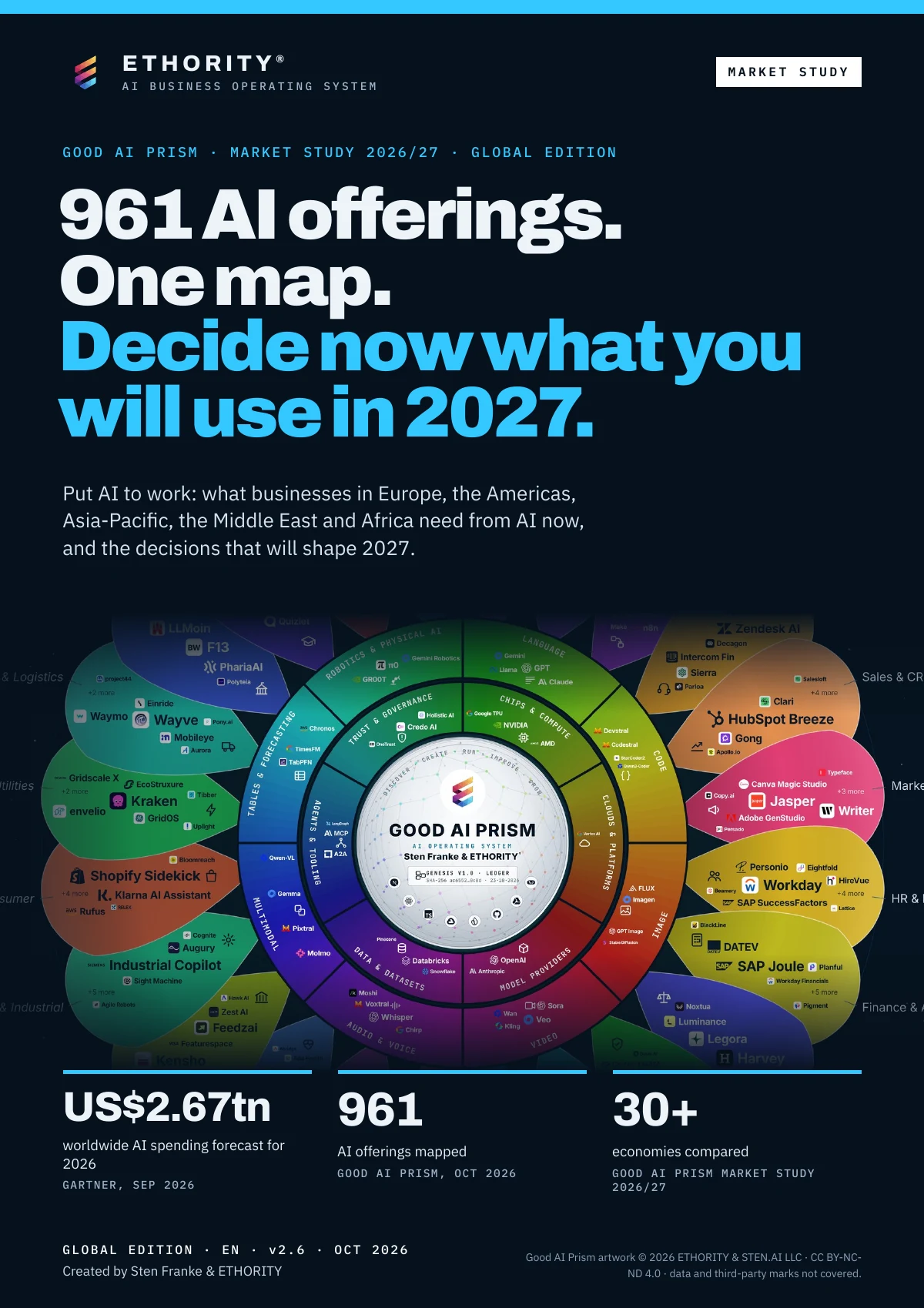
Global edition · EN
961 AI offerings. One map. Decide now what you will use in 2027.
The Good AI Prism helps you find useful AI and compare the evidence behind your options. For organisations already using AI, the question is moving from whether to use AI to which AI, how safely and whether it pays. This Global edition brings together 961 AI offerings across 24 topic areas, 8 data types and 6 technology layers, with sources, dates and limits to guide your next decision.
Version 2.6 · 90 pages
Open the study →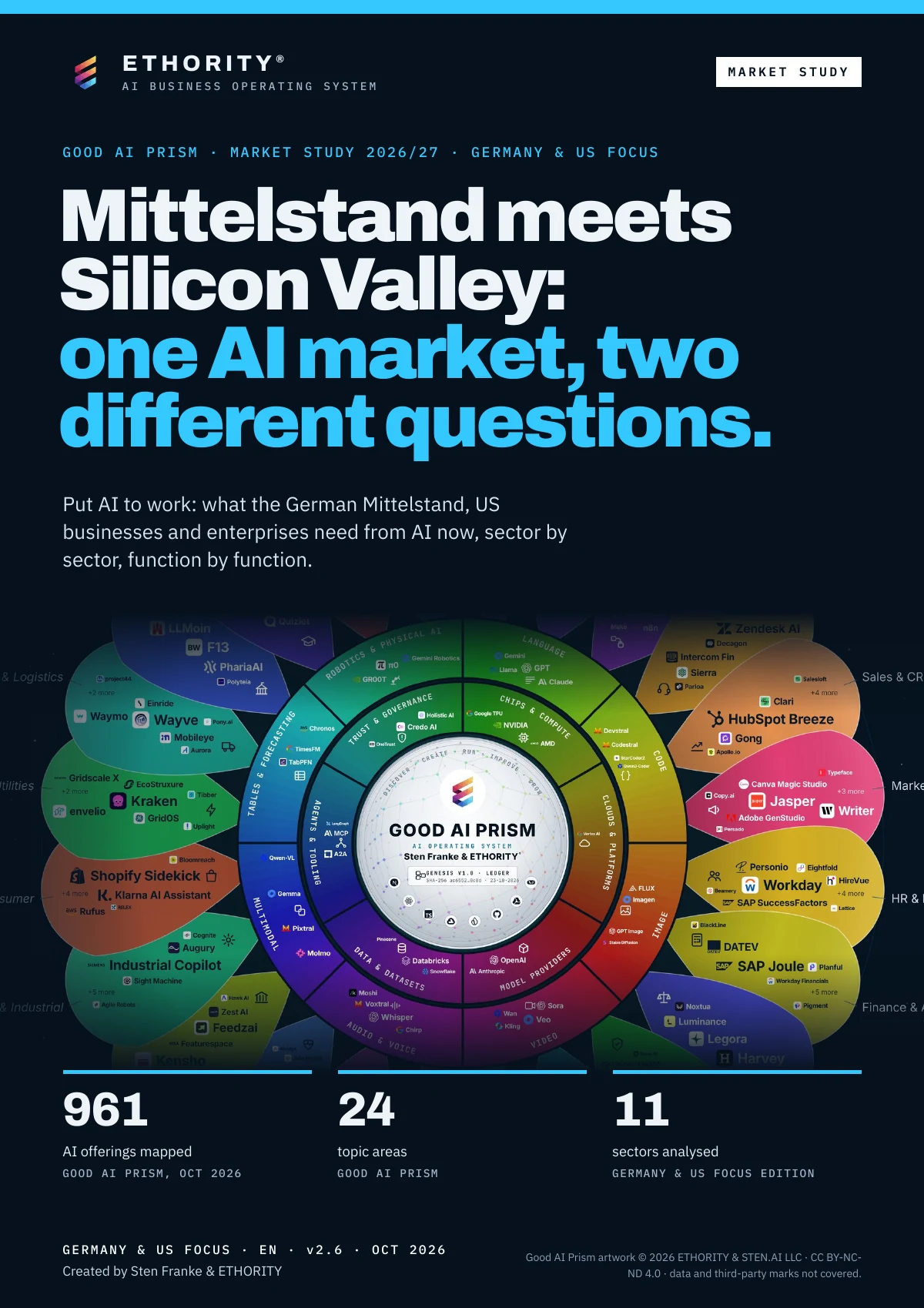
Germany & United States Focus · EN
Germany's mid-sized companies meet Silicon Valley: one AI market, two different questions.
The Mittelstand needs know-how; US firms need cost control. What German and US businesses need from AI now, sector by sector, function by function.
Version 2.6 · 72 pages
Open the study →The whole AI market on one sheet.
The full Good AI Prism as an A3 poster: every topic area, data type and technology layer on one page.
See the map on one page →Related insights
Our long read on hosting and accuracy, plus how to test a vendor claim.
961 AI offerings. Start with the job, not the tool.
A method for going from one business need to a shortlist of AI offerings you can defend.
See the map on one page →
Check every vendor claim before you rely on it.
Tie every vendor claim to the exact product, version, contract and use before you rely on it.
See the map on one page →
Trusting AI and going all-in are one job.
Why speed and responsible AI are no longer competing choices. An essay by Sten Franke.
See the map on one page →
Govern the outcome, not only the risk.
Connect your AI rules to the business result, the full cost and the value you observe, and let them say stop.
See the map on one page →Implement it with ETHORITY
AI Decision Brief
€195 net · one-time
Puts the facts that decide between two or three AI offerings side by side, each sourced and dated, with the questions to ask each provider.
Request scope and delivery
See what this package includes →AI Trust Record
€4,500 net · one-time
One clear answer about one AI system before you depend on it: purpose, responsibility, evidence, known limits and an agreed review path.
Request scope and delivery
See what this package includes →AI Readiness & Maturity Check
€3,500 one-time · net
Shows where your organisation stands on AI readiness and maturity, and which steps come first.
Date and place by agreement
See what this package includes →Buyer questions
Where is our indexed data hosted?
It varies by tool and plan. Ten of 12 profiled offerings state Europe, Germany or your own server; one states US only. Nextcloud Assistant runs on your own server.
Does retrieval stop the assistant from making things up?
It reduces errors but does not remove them. Retrieval-based legal tools were wrong in 17% or more of queries in the Stanford benchmark. Test on your own documents.
How do we test answer accuracy before buying?
Use 50 real questions with known answers and sources, run them through two or three tools on the same documents, and count correct answers, correct sources and confident errors.
Is our data used to train the models?
Eight of 12 profiled cards say no. Two address only third-party models, as the Slite Agent registry card shows; put the question in your contract.
What does the EU AI Act require for search assistants?
Mostly the AI-literacy duty, in force since 27 Jul 2026, and Article 50 transparency since 2 Aug 2026. A vendor claim is not evidence shows how to check provider statements.
The evidence at a glance
ETHORITY · LONG READ
Knowledge agents lead adoption. Hosting and accuracy decide.
Organisations use AI agents most in IT and knowledge management, yet staff do not trust internal AI answers. The Good AI Prism profiles twelve search offerings: where they host, how they train, what a seat costs.
Knowledge work is where AI agents went first. In the McKinsey State of AI 2025, respondents reported using agents most often in IT and in knowledge management, with deep research named as a typical use case. The August 2026 edition confirms the pattern: organisations scale agents most often in IT, knowledge management and software engineering.
The shift is real, and so is the problem it brings. The Global Market Study 2026/27 names the business problem in this area in six words: staff do not trust internal AI answers. An assistant that searches every drive, wiki and ticket is only useful when people believe what it says, and when the company knows where the indexed data goes.
Grounded answers still go wrong
Retrieval was supposed to fix hallucination. Ground the model in your own documents, and it will quote rather than invent. The evidence says it helps, but not enough to skip checking. Stanford researchers tested legal research tools built on retrieval-augmented generation with over 200 open-ended queries. In their May 2024 benchmark, two systems produced incorrect information more than 17% of the time, and a third more than 34% of the time.
17% or more. Retrieval-based legal research tools gave incorrect answers in at least one query in six (Stanford, May 2024).
Legal research is a demanding test, but internal knowledge is messy too: outdated policies, duplicate versions, contradictory wikis. A search assistant that finds the wrong version and summarises it fluently is worse than no answer. That is why the study recommends comparing search and retrieval tools on two things before anything else: where they host the data, and how accurate their answers are on your own content.
Adoption is broad, scale is narrow
The same McKinsey survey that puts knowledge management at the front of agent use also shows how early the market is. 23% of respondents said their organisation was scaling agentic AI somewhere; 39% were experimenting; and in no single function did more than 10% report scaling agents. Knowledge search leads a race that has barely started.
That leaves time to choose well. It also means most organisations will run several overlapping tools for a while: a search feature in the collaboration suite, a chat assistant with document upload, perhaps an open-source search stack. Each indexes data differently and bills differently.
What the Prism shows about search and knowledge offerings
The Good AI Prism places 26 AI offerings in Knowledge & Search, from enterprise search platforms to workplace assistants with document connectors. Twelve carry a full registry card with sourced decision facts, read from provider pages on 20 Oct 2026. Every one of the twelve publishes a hosting statement and a price or price basis.
Exhibit: twelve profiled knowledge and search offerings
| Decision fact | What the 12 cards show |
|---|---|
| Data location | 10 name Europe, Germany or the customer's own server; 1 states US only; 1 sets region by plan |
| Hosting in Germany | 5 state German hosting or storage |
| Training on your data | 8 state customer data is not used to train models; 2 opt-in only; 2 address only third-party models |
| Price basis | Mostly per user per month, from €5.40 to €109; one credit pool; one usage-based; one on request |
| Security evidence | All 12 name a certification, attestation, audit or management standard, with very different scope |
Source: Good AI Prism Registry, provider pages read 20 Oct 2026.
Hosting is the strongest documented fact in this area, and the most varied. Nextcloud Assistant runs on the customer's own server. Slite Agent states hosting in Belgium on Google Cloud. Dropbox Dash states US-only data. For a European buyer indexing contracts, HR files or customer correspondence, that one line decides whether a tool can be considered at all.
Training terms need a second look. Two providers address only the third-party models they call, not their own handling of your data. That is not a refusal, but it is not an answer either. Put the question in writing.
Prices and certificates
Prices span roughly twentyfold per seat. meinGPT lists €5.40–18 per user a month; innoGPT €25–109; Nextcloud bills per user per year with a minimum of 100 users; Elastic bills by usage from US$99 a month. Comparing them means modelling your real number of active users and documents, not list prices.
Certifications look uniform and are not. One card names an ISO 27001 certificate with TÜV as the issuer; another an "ISO 27001-aligned" management system; another relies on its host's certificates. The registry keeps the exact wording and the evidence class, because "ISO 27001" in a sales deck can mean any of the three.
10 of 12 profiled knowledge offerings name Europe, Germany or the customer's own server as their data location (Good AI Prism Registry, 20 Oct 2026).
Accuracy is a measurement, not a feature
Answer accuracy is not a fact a provider can publish for you. It depends on your documents. That is the main reason to run a structured test before buying. Take 50 real questions your staff ask, with known correct answers and sources. Run them through two or three shortlisted tools with the same document set. Count correct answers, correct sources and confident wrong answers separately.
The outcomes the study recommends for this area are answer accuracy and time to information. Both can be measured in a short pilot. Neither appears on a vendor's feature list. ETHORITY's insight A vendor claim is not evidence explains how to turn a provider statement into something you can check.
Best practice. Score every shortlisted tool on the same 50 questions and count three things separately: correct answers, correct sources and confident wrong answers. A tool with fewer answers and no confident errors is often the safer buy.
Rules that touch search
Most knowledge tools sit outside the high-risk list of the EU AI Act, but two duties apply widely. The AI-literacy duty, revised under Regulation (EU) 2026/1744 and in force since 27 Jul 2026, requires providers and deployers to take measures so staff using AI understand it. Article 50 transparency duties apply since 2 Aug 2026. If staff are told to rely on an assistant's answers, they need to know when it can be wrong.
What to do Monday
- Map what would be indexed. List the drives, wikis, ticket systems and mailboxes a search assistant would read, and mark which hold personal, confidential or client data.
- Shortlist on hosting first. Remove every tool whose stated data location does not fit your obligations. The registry cards show the stated location and its source.
- Build a 50-question test set. Use real questions with known answers. Score correct answers, correct sources and confident errors.
- Price your real users. Model active users and document volume, not licence lists. Include connectors and admin time.
- Write the training question into the contract. Where a provider addresses only third-party models, ask how it handles your data itself.
For a written side-by-side of two or three search offerings, the AI Decision Brief offer sets out the deciding facts with sources, and the buyer's guide to 961 offerings explains the method behind it.
Sources and further reading
- McKinsey: The state of AI in 2025 (1,993 respondents, 105 countries) ↗ · 5 Nov 2025
- McKinsey: The state of AI, August 2026 edition (1,719 respondents, 97 countries) ↗ · 25 Aug 2026
- Stanford HAI: AI on Trial: Legal models hallucinate in 1 out of 6 (or more) benchmarking queries ↗ · 23 May 2024, updated 30 May 2024
- Regulation (EU) 2026/1744 (Digital Omnibus on AI, amending the AI Act) ↗ · in force 27 Jul 2026
- Good AI Prism Global Market Study 2026/27 (ETHORITY) → · 22 Oct 2026
- Good AI Prism Registry cards, provider pages read 20 Oct 2026 (ETHORITY) → · 20 Oct 2026
Put the thinking to work
AI Opportunity Case →
A defensible proceed, test, redesign, defer or stop decision. The fee is independent of which outcome the evidence supports.
A written comparison of up to three AI offerings · €195 net →
Start with one question and up to three offerings. Request a sourced comparison, provider questions and a cost sketch using your assumptions.
YOUR NEXT STEP
Discuss your question with Sten Franke.
Bring your business question or the figures you already know. ETHORITY investigates within the agreed scope; together with Sten Franke you agree the next piece of work.