 ETHORITY®
In this article
Terms used in this article
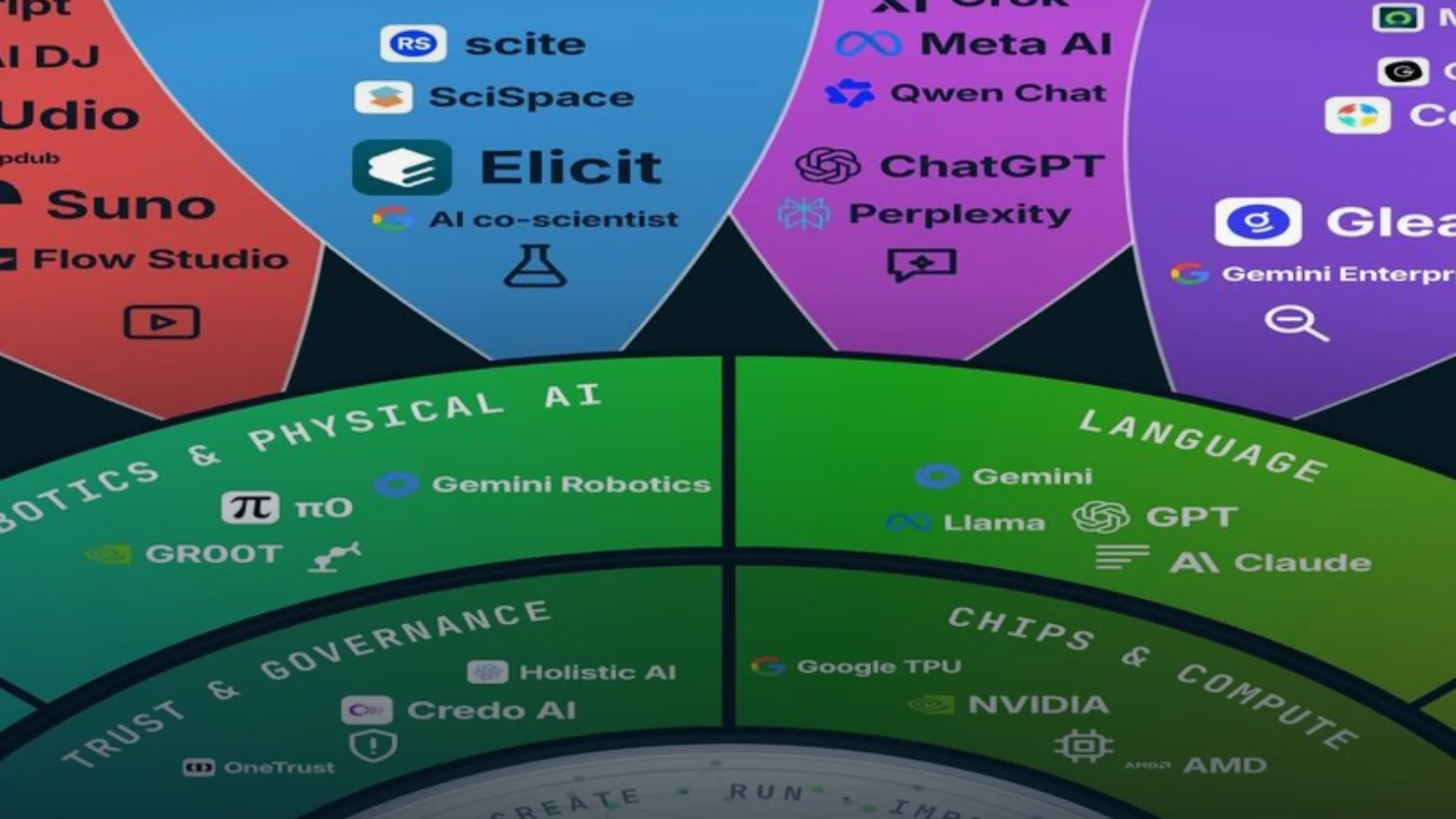
Good AI Prism v3.12 · full spectrum, close-up · Good AI Prism artwork © 2026 ETHORITY & STEN.AI LLC · CC BY-NC-ND 4.0 · data and third-party marks not covered.
Good AI Prism v3.12 · Sten Franke & ETHORITY
Source study · v2.1 · page 63 · Figure published: 25 Oct 2026
Read figure text, sources and rights
Good AI Prism v3.12 · full spectrum, close-up · Good AI Prism artwork © 2026 ETHORITY & STEN.AI LLC · CC BY-NC-ND 4.0 · data and third-party marks not covered.
ETHORITY figure. Rights in cited data and third-party marks remain with their owners. The Prism artwork licence applies where stated on the figure.
Ask ten people to define AI governance and you will hear some version of risk, policy, compliance, transparency, accountability and control.
All of those matter.
But one question is usually missing:
What business outcome are we protecting?
That omission is more serious than it sounds.
If governance cannot explain the outcome an AI system is intended to create, it becomes hard to judge how much autonomy is justified, which risks are material, what evidence is necessary, what the controls are worth, or whether the system should exist at all.
Risk without outcome becomes abstract
Consider two customer-service AI systems.
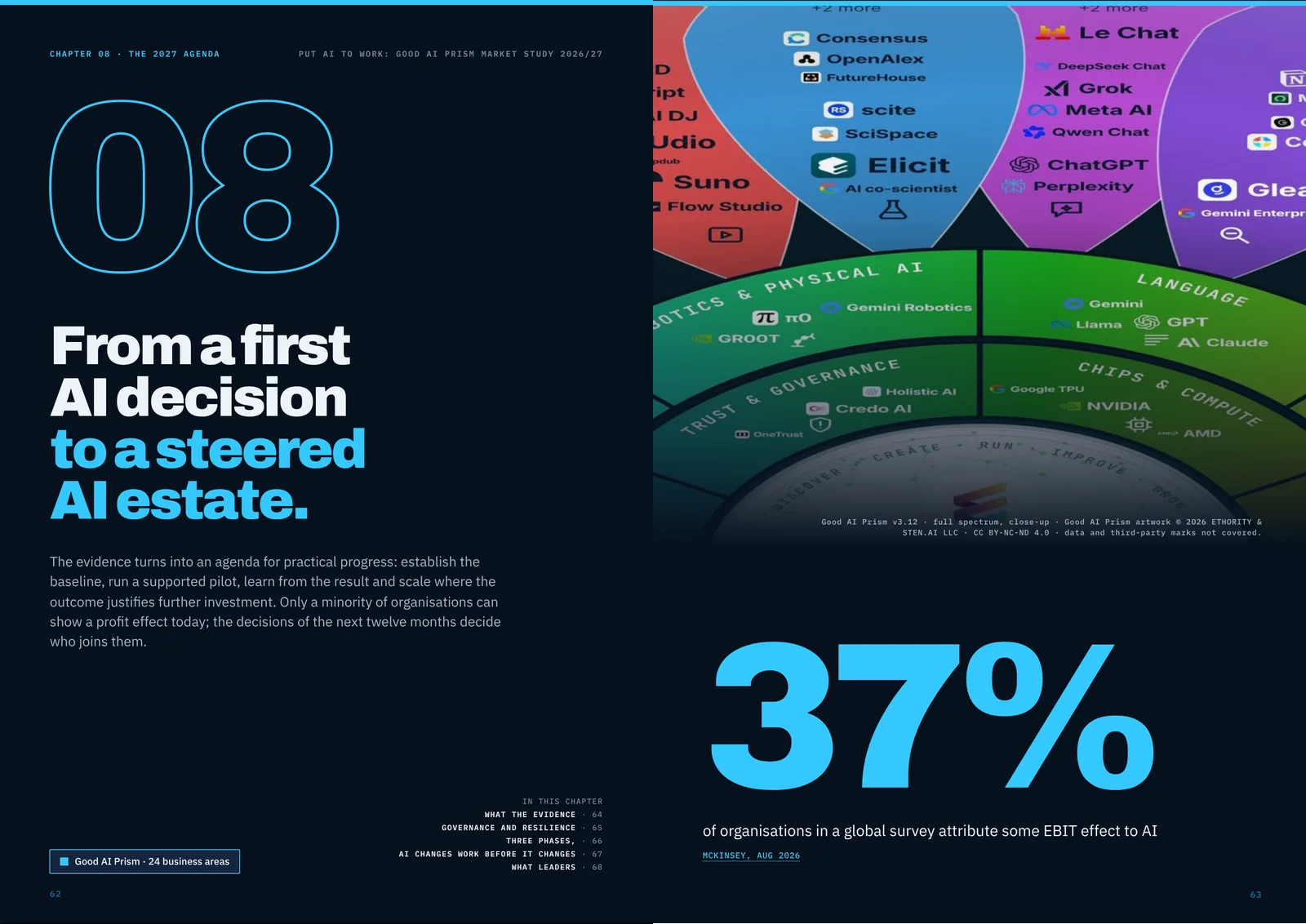
37% — of organisations in a global survey attribute some EBIT effect to AI
MCKINSEY, AUG 2026
Source study · v2.1 · page 62-63 · Figure published: 25 Oct 2026
Read figure text, sources and rights
CHAPTER 08 · THE 2027 AGENDA PUT AI TO WORK: GOOD AI PRISM MARKET STUDY 2026/27 08 From a first AI decision to a steered AI estate. The evidence turns into an agenda for practical progress: establish the baseline, run a supported pilot, learn from the result and scale where the outcome justifies further investment. Only a minority of organisations can show a profit effect today; the decisions of the next twelve months decide who joins them. Good AI Prism · 24 business areas IN THIS CHAPTER WHAT THE EVIDENCE · 64 GOVERNANCE AND RESILIENCE · 65 THREE PHASES, · 66 AI CHANGES WORK BEFORE IT CHANGES · 67 WHAT LEADERS · 68 62 Good AI Prism v3.12 · full spectrum, close-up · Good AI Prism artwork © 2026 ETHORITY & STEN.AI LLC · CC BY-NC-ND 4.0 · data and third-party marks not covered. 37% of organisations in a global survey attribute some EBIT effect to AI MCKINSEY, AUG 2026 63
Source links on the cited study page
ETHORITY figure. Rights in cited data and third-party marks remain with their owners. The Prism artwork licence applies where stated on the figure.
System A drafts responses for human agents. System B can issue refunds, modify customer records and send messages without review.
They may use the same foundation model. They may process similar data. But they are not economically or operationally equivalent.
System A might be intended to reduce handling time while preserving service quality. System B might be intended to resolve a larger percentage of cases without human intervention.
Governance should therefore start one step earlier than risk classification:
What Mission is the organization trying to accomplish?
The business case is part of governance
An AI project is often approved using a productivity story:

Spending rises by half; an EBIT effect stays rare.
MCKINSEY, AUG 2026 · MCKINSEY, AUG 2026 · MCKINSEY, AUG 2026 · MICROSOFT, SEP 2026
Source study · v2.1 · page 10 · Figure published: 25 Oct 2026
Read figure text, sources and rights
~90% of organisations in a global survey report regular AI use in at least one function MCKINSEY, AUG 2026 44% report scaling it across the enterprise MCKINSEY, AUG 2026 37% attribute some EBIT effect to AI MCKINSEY, AUG 2026 18.8% of working-age people worldwide use generative AI MICROSOFT, SEP 2026
Source links on the cited study page
ETHORITY figure. Rights in cited data and third-party marks remain with their owners. The Prism artwork licence applies where stated on the figure.
“Employees will save 20% of their time.”
That is not yet economic value.
If 1,000 hours are theoretically released but staffing, throughput, revenue, cost or service quality do not change, the organization has not necessarily realized a financial benefit.
ETHORITY therefore separates economic states:
VALUE IDENTIFIED → VALUE MODELED → VALUE UNDER EXECUTION → VALUE OBSERVED → VALUE ATTRIBUTED → VALUE SUSTAINED.
This matters to governance because each step changes what can responsibly be claimed.
A modeled €500,000 annual opportunity is not €500,000 of realized savings. An observed productivity change is not automatically attributable to the AI system. A one-month improvement is not sustained value.
Cost belongs on the same page
AI economics is also more than token price.
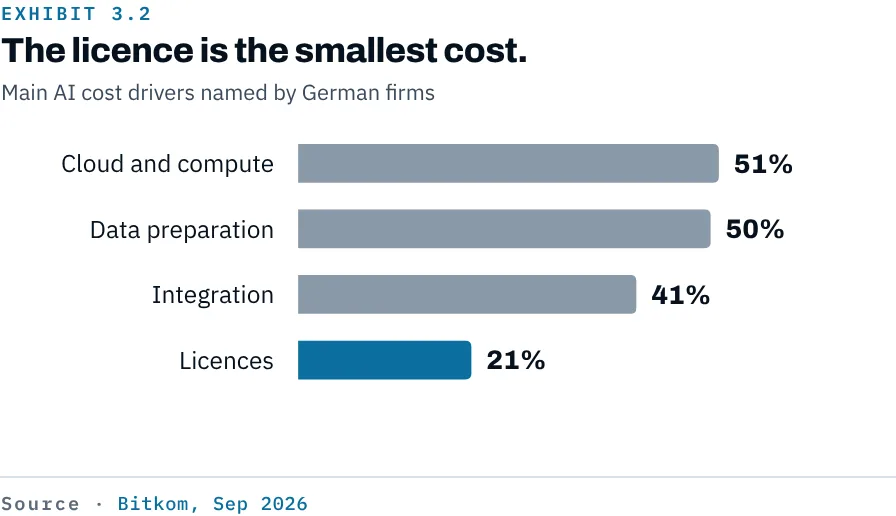
The licence is the smallest cost.
Bitkom, Sep 2026
Source study · v2.1 · page 29 · Figure published: 25 Oct 2026
Read figure text, sources and rights
EXHIBIT 3.2 The licence is the smallest cost. Main AI cost drivers named by German firms Cloud and compute 51% Data preparation 50% Integration 41% Licences 21% Source · Bitkom, Sep 2026 Cloud and compute 51% Data preparation 50% Integration 41% Licences 21%
Source links on the cited study page
ETHORITY figure. Rights in cited data and third-party marks remain with their owners. The Prism artwork licence applies where stated on the figure.
A provocative 2025 analysis of open-source LLM deployment makes a useful point even though its numerical estimates should be independently validated: “free” models can shift cost into engineering, infrastructure, evaluation, monitoring, maintenance, security and operational complexity.
That is exactly the kind of cost architecture governance should see.
The decision is not:
API model = expensive Open source = free.
It is:
What is the fully loaded cost of delivering this capability at the required quality, latency, privacy, resilience and assurance level?
The answer may include:
- model/API or inference cost;
- data and retrieval infrastructure;
- integration engineering;
- evaluation and red teaming;
- security and privacy controls;
- observability and logs;
- human review;
- model/provider migration;
- compliance and audit work;
- incident handling;
- business-process redesign;
- ongoing improvement.
Governance that ignores those costs can accidentally protect economically irrational architecture.
The control has an economic purpose too
Controls are often discussed as pure overhead.
But the right control can increase economic value.
A human approval gate may make a high-consequence agent deployable. A tenant-isolation control may make an enterprise sale possible. Evidence traceability may shorten procurement or audit cycles. A rollback mechanism may reduce expected loss from model change. A clear authority boundary may allow more low-risk tasks to be automated safely.
The goal is not “maximum control.”
It is enough control to support the Mission at an acceptable level of consequence and uncertainty.
Governance can say “AI is not the answer”
A mature AI governance system should be allowed to conclude:
MEASURE FIRST. USE A RULE-BASED WORKFLOW. FIX THE PROCESS. IMPROVE THE DATA. KEEP THE DECISION HUMAN. DO NOT AUTOMATE THIS YET.
That is not governance blocking innovation.
It is governance preventing AI theater.
For some administrative tasks, a deterministic workflow may be cheaper and more reliable than an agent. For a poorly understood service problem, a baseline may be more valuable than another pilot. For a high-impact decision with weak evidence, the correct answer may be a decision hold.
A better governance equation
A useful executive model is:
The order matters.
If the business outcome is unclear, stop. If the baseline is unknown, model a range or require measurement. If authority is insufficient, do not execute. If evidence is weak, do not inflate confidence. If cost exceeds plausible value, redesign or stop. If protected human, safety, privacy or legal boundaries are triggered, economics cannot override them.
Write the outcome so somebody can accept it
“Improve productivity” is an ambition, not an acceptance rule. A more useful statement names the process, the people affected, the quality condition and the observation period. For example: reduce the time needed to prepare a complete supplier review while preserving the required evidence and approval. This leaves room for different technical approaches. It also makes a solution without generative AI a legitimate option.
Define the baseline with the people doing the work. Include the difficult cases, interruptions and corrections rather than timing only the cleanest task. Ask what makes an output acceptable to its recipient. A faster draft has little value if the next team must reconstruct its sources. When a process crosses departments, agree whose time is counted so that one team's apparent saving is not another team's hidden workload.
A worked capacity calculation with explicit assumptions
Consider a hypothetical team handling 4,000 cases a month. Suppose an assisted process releases six minutes on 60% of cases after human review. The potential released capacity is 4,000 × 60% × six minutes, or 240 hours a month. These are scenario inputs, not observed ETHORITY results. The remaining cases and any additional exception work still need to be included in the operating plan.
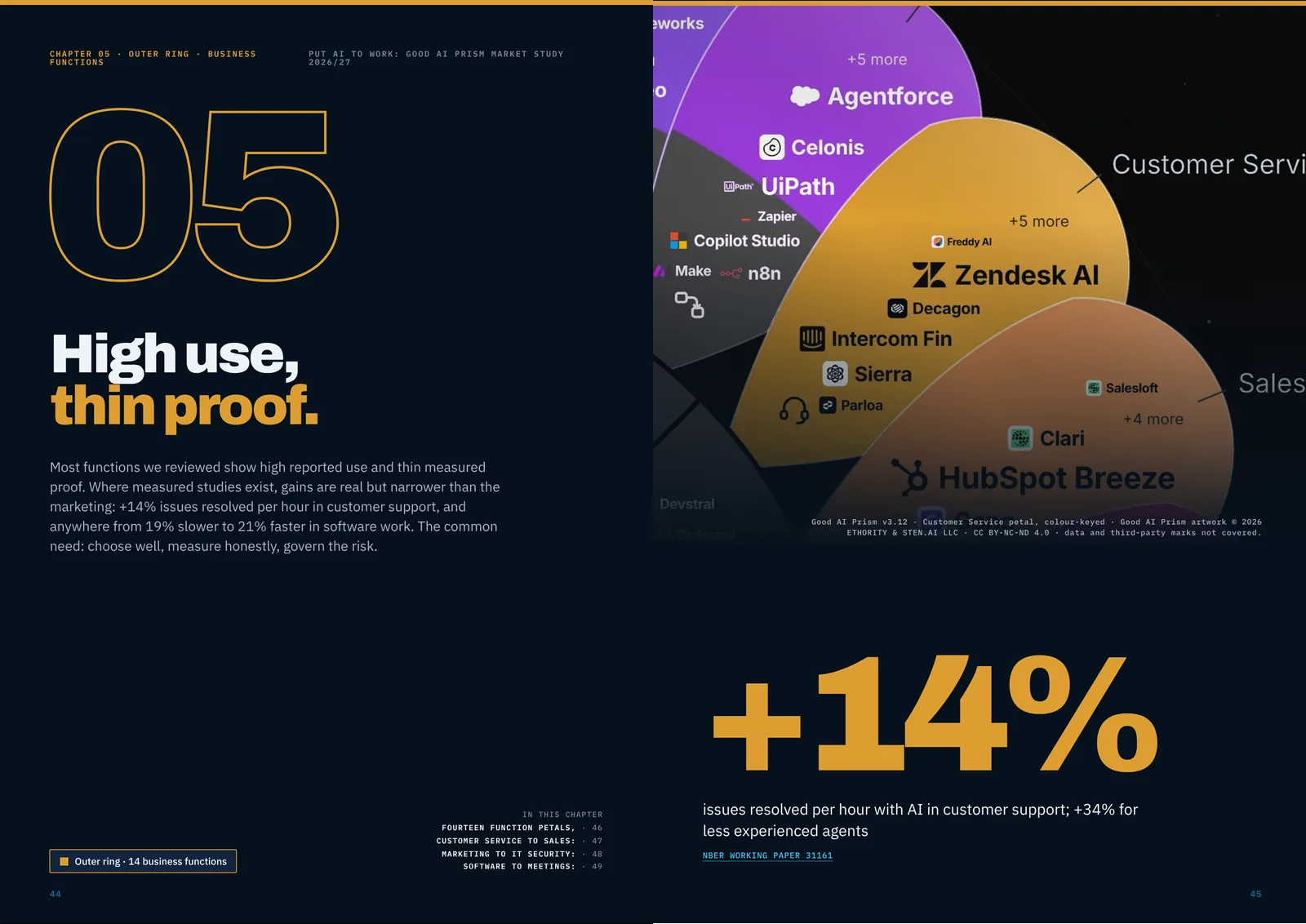
+14% — issues resolved per hour with AI in customer support; +34% for less experienced agents
NBER WORKING PAPER 31161
Source study · v2.1 · page 44-45 · Figure published: 25 Oct 2026
Read figure text, sources and rights
CHAPTER 05 · OUTER RING · BUSINESS FUNCTIONS PUT AI TO WORK: GOOD AI PRISM MARKET STUDY 2026/27 05 High use, thin proof. Most functions we reviewed show high reported use and thin measured proof. Where measured studies exist, gains are real but narrower than the marketing: +14% issues resolved per hour in customer support, and anywhere from 19% slower to 21% faster in software work. The common need: choose well, measure honestly, govern the risk. Outer ring · 14 business functions IN THIS CHAPTER FOURTEEN FUNCTION PETALS, · 46 CUSTOMER SERVICE TO SALES: · 47 MARKETING TO IT SECURITY: · 48 SOFTWARE TO MEETINGS: · 49 44 Good AI Prism v3.12 · Customer Service petal, colour-keyed · Good AI Prism artwork © 2026 ETHORITY & STEN.AI LLC · CC BY-NC-ND 4.0 · data and third-party marks not covered. +14% issues resolved per hour with AI in customer support; +34% for less experienced agents NBER WORKING PAPER 31161 45
Source links on the cited study page
ETHORITY figure. Rights in cited data and third-party marks remain with their owners. The Prism artwork licence applies where stated on the figure.
If the team values time at €35 an hour, multiplying gives €8,400 of capacity value. That number is not automatically a cash saving. The organisation would need a credible way to use the capacity or avoid an expense. It must also deduct the costs of licences, usage, integration, support, review and change management before discussing net value. If review time was already subtracted from the six-minute input, do not subtract it again.
Now test the sensitive assumption. If only 30% of cases qualify, the released capacity falls to 120 hours. If the six-minute gain disappears on difficult cases, the average should reflect that distribution. A simple sensitivity table can be more useful than a complicated model because it shows which operational fact must be measured next. The calculator is a way to explore those assumptions, not turn them into a forecast.
Choose controls that protect the actual outcome
For the same service process, a source check protects answer quality, a permission check protects the customer record and an escalation path protects exceptional cases. Explain each control in relation to the consequence it addresses. That makes it possible to discuss its cost and test its behaviour without treating control reduction as the default route to higher returns.
Some limits are not economic trade-offs. An attractive scenario does not create permission to disclose confidential information or disregard an applicable legal duty. Keep those boundaries explicit. Within the permitted space, the team can compare different operating designs: human preparation with AI assistance, a model-generated draft with review or a narrowly bounded action. Each can have a different cost and acceptance rate.
Avoid counting every prevented error as a financial saving. The value of a control may be maintaining an acceptable service, protecting affected people or enabling a task that would otherwise remain prohibited. Those benefits matter even when a defensible monetary amount is unavailable. Describe the mechanism and the evidence rather than filling the gap with an invented probability of catastrophe.
Make a pilot capable of changing the decision
A useful pilot tests the uncertain assumption that matters most. If the decision depends on whether staff accept the output, measure acceptance in the real workflow. If it depends on the integration cost, inspect the necessary systems and permissions. A polished demonstration of a model's general capability does not resolve either question.
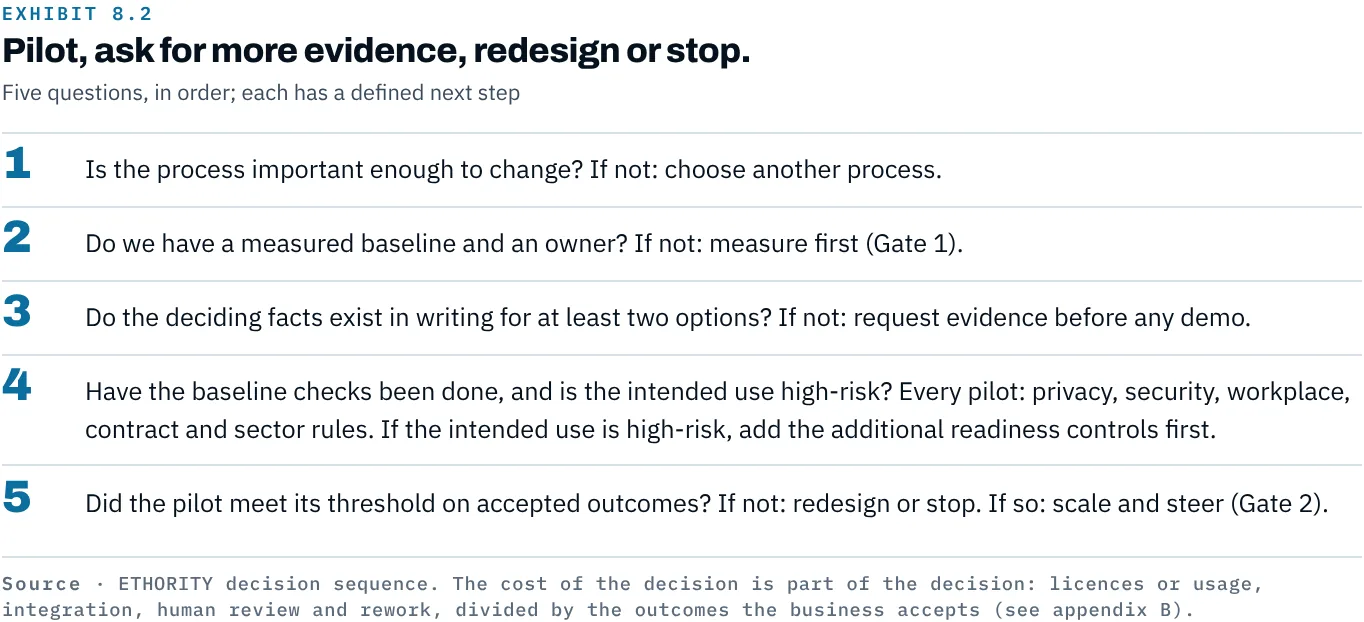
Pilot, ask for more evidence, redesign or stop.
ETHORITY decision sequence. The cost of the decision is part of the decision: licences or usage, integration, human review and rework, divided by the outcomes the business accepts (see appendix B).
Source study · v2.1 · page 66 · Figure published: 25 Oct 2026
Read figure text, sources and rights
EXHIBIT 8.2 Pilot, ask for more evidence, redesign or stop. Five questions, in order; each has a defined next step Is the process important enough to change? If not: choose another process. Do we have a measured baseline and an owner? If not: measure first (Gate 1). Do the deciding facts exist in writing for at least two options? If not: request evidence before any demo. Have the baseline checks been done, and is the intended use high-risk? Every pilot: privacy, security, workplace, contract and sector rules. If the intended use is high-risk, add the additional readiness controls first. Did the pilot meet its threshold on accepted outcomes? If not: redesign or stop. If so: scale and steer (Gate 2). Source · ETHORITY decision sequence. The cost of the decision is part of the decision: licences or usage, integration, human review and rework, divided by the outcomes the business accepts (see appendix B).
ETHORITY figure. Rights in cited data and third-party marks remain with their owners. The Prism artwork licence applies where stated on the figure.
Agree the comparison period and account for differences in demand, staffing and case mix. Report what was observed and what remains uncertain. An improvement that coincides with a new training programme or a changed policy should not be attributed entirely to AI without a suitable design. Small samples can still inform an operating choice, provided the conclusion stays within their limits.
Use clear outcomes at the end: proceed within the tested boundary, revise the process, gather a specific missing fact or stop. “Continue exploring AI” is too vague to justify another investment. Preserve the rationale so that a later sponsor can understand why the team chose a bounded step rather than a larger rollout.
Use an acceptance meeting to connect finance and operations
Before committing to expansion, bring the workflow owner, the recipient of the output and the person responsible for the financial assumptions together. Review one ordinary case and one rejected case. Ask where time was released, what work appeared elsewhere and whether the accepted result met the same quality rule as the baseline. This prevents a financial model from drifting away from the work it is meant to describe.
Check the accounting of one-time and recurring costs. An integration expense spread over a year is an assumption about useful life, not a monthly invoice. A subscription paid annually is a cash commitment even when the scenario displays a monthly equivalent. Keep both views understandable so that a purchasing decision does not rely on a misleadingly smooth cost line.
Finish with a decision and its conditions: continue at the tested volume, change the design, obtain a specific fact or stop. Name the person responsible for the next observation. If the organisation cannot yet explain how capacity becomes business value, retain the capacity result and leave the financial conclusion open. That is a more useful outcome than forcing every successful task test into a positive ROI claim.
Connect the evidence to the appropriate commercial step
The Enterprise AI Opportunity Case is relevant when the question concerns a business case, assumptions and implementation conditions. Its scope is agreed by proposal. An AI Business Blueprint offers a smaller defined starting point for structuring a business question. Inspect the actual deliverables rather than assuming that either includes an operational software deployment.
When the uncertainty concerns one supplier comparison, begin with the AI Decision Brief instead. Where an actual use case needs a controlled test, discuss the AI Trust Pilot. These are different pieces of work; a more expensive engagement is not automatically a better fit. The right next step is the smallest one that can resolve the decision-relevant uncertainty.
Bring the baseline, the intended recipient of the output and the assumption you most need to test. An enquiry prepares a discussion about that work. It does not place a paid order or guarantee an outcome. The aim is a defensible decision about what to do next, including the possibility that a simpler process change provides greater value than adding AI.
Governance should help capital allocation
Ultimately, AI governance is also a portfolio discipline.
Executives do not need another list of 73 AI ideas. They need to know:
Which opportunities are material? Which are measurable? Which have the necessary data? Which require AI rather than simpler automation? Which carry disproportionate risk? Which can be piloted cheaply? Which deserve additional capital? Which should stop?
That is where governance becomes strategic.
The question is no longer only:
Can we use this AI responsibly?
It becomes:
Is this the right AI decision for the business—and can we prove that as we operate it?