 ETHORITY®
GOOD AI PRISM · TOPIC AREA · DATA & ANALYTICS
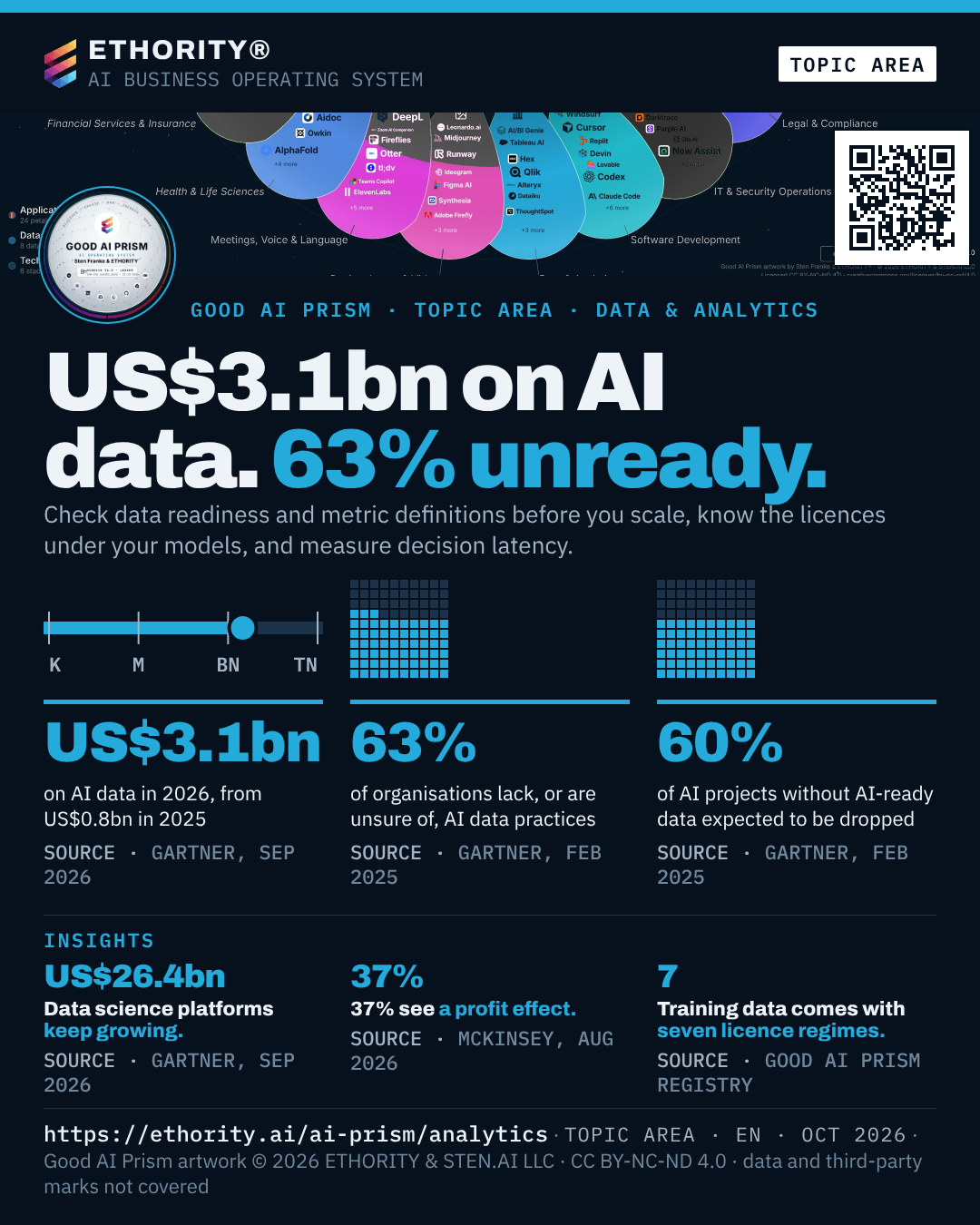
US$3.1bn on AI data. 63% unready.
Check data readiness and metric definitions before you scale, know the licences under your models, and measure decision latency.
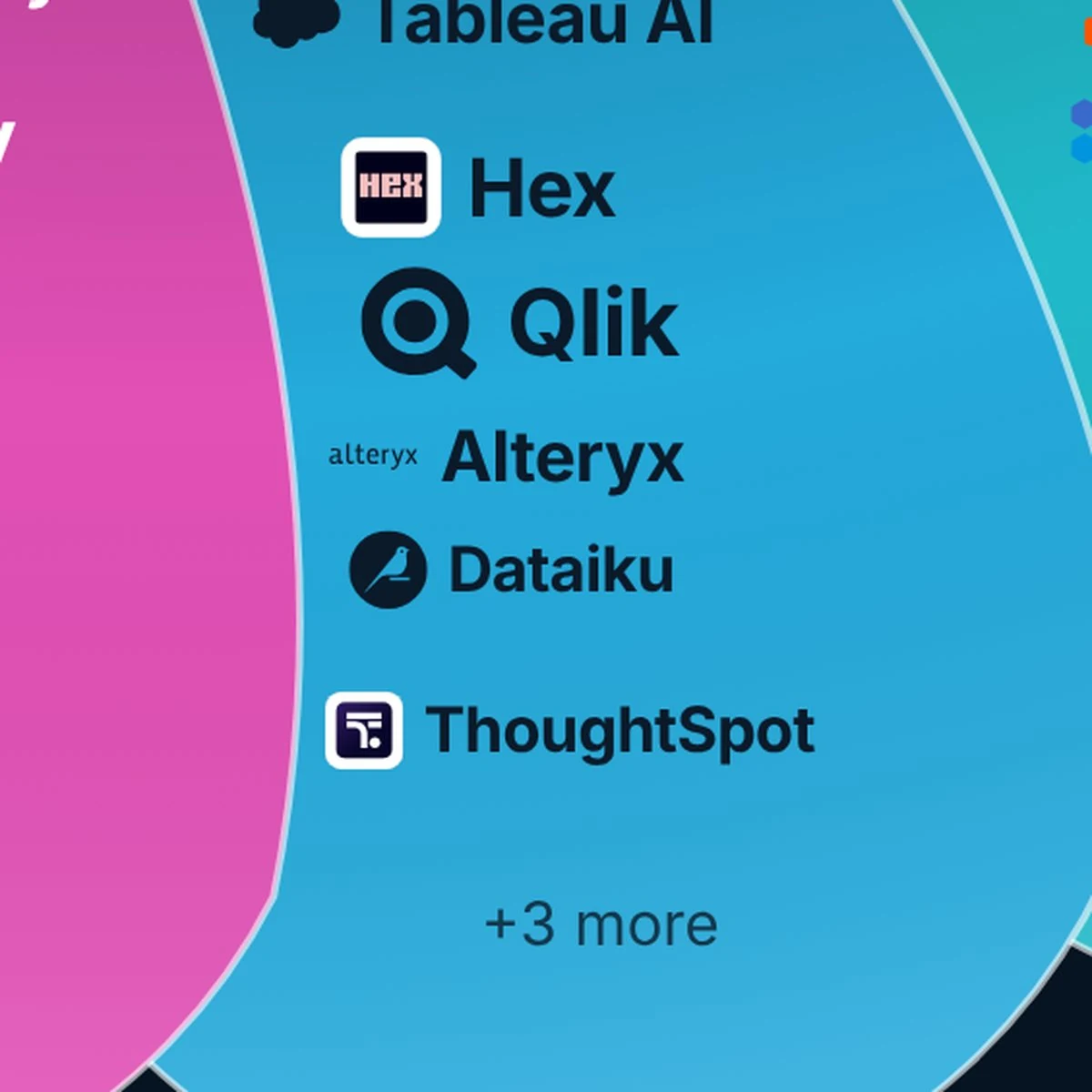
- 22
- AI offerings mapped in Data & Analytics, plus 1 provider record (Qlik)Good AI Prism, Oct 2026
- US$3.1bn
- on AI data in 2026, from US$0.8bn in 2025Gartner, Sep 2026 · gartner.com ↗
- 63%
- of organisations lack, or are unsure of, AI data practicesGartner, Feb 2025 · gartner.com ↗
- 60%
- of AI projects without AI-ready data expected to be droppedGartner, Feb 2025 · gartner.com ↗
Data science platforms keep growing.
Spending on AI platforms for data science and machine learning rises to US$26.4bn in 2026 and US$35.6bn in 2027.
Gartner, Sep 2026
37% see a profit effect.
Only 37% of surveyed organisations attribute any EBIT effect to AI.
McKinsey, Aug 2026
Training data comes with seven licence regimes.
The 12 profiled datasets range from public-domain dedication to research-only use.
Good AI Prism Registry
How to use this page
Three tools and one offer turn this page into a decision.
- Open the Data & Analytics map: 22 AI offerings and 1 provider record on one petal of the Good AI Prism, with logos and provider facts.
- Compare up to three offerings: decision facts side by side, each with its source and date.
- Run the Task economics calculator: turn saved hours into capacity you can attribute, before a pilot is approved.
- Offer: AI Readiness & Maturity Check: one workshop day: a maturity score on seven pillars, including data, and the five most valuable AI uses.
The data layer, fact by fact
Twelve widely used training datasets: licence, size, languages and last update, each with its source.

Common Crawl
Common Crawl · Dataset
Open repository of web crawl data that anyone can access and analyse; widely used to train language models.

FineWeb
Hugging Face · Dataset
Open dataset of more than 18.5 trillion tokens of cleaned, deduplicated English web text from Common Crawl, for language-model pretraining research.

LAION-5B
LAION · Dataset
Open dataset of 5.85 billion image-text pairs for training image models.
Compare baseline: three dataset licences
Open with attribution, public domain and share-alike: three licences with different consequences for a model you ship.
| Offering | Licence | Size | Languages | Source |
|---|---|---|---|---|
| FineWeb | ODC-By 1.0 | 15T tokens | English | FineWeb dataset card |
| Mozilla Common Voice | CC0 | 33,815 h | 137 | Common Voice dataset page |
| Wikipedia (wikimedia/wikipedia) | CC BY-SA 3.0 | 10M–100M rows | 300+ | Wikipedia dataset card |
Registry facts as stated on each provider's own pages, read 25 Oct 2026. Add your own volumes in Compare before deciding.
What the market shows
Three signals define this area in 2026. Spending on AI data nearly quadruples, from US$0.8bn to US$3.1bn (Gartner). Most organisations are unsure their data practices fit AI. And returns stay thin: 37% of surveyed organisations attribute any EBIT effect to AI (McKinsey). The AI growth facts 2026 collect the wider numbers for planning 2027.
Rules and dates
The dates that reach analytics teams through the models they use.
- 2 Aug 2025
Obligations for general-purpose AI models apply.
Reg. (EU) 2024/1689
- 2 Aug 2026
Art. 50: people must be told when they interact with an AI system.
Reg. (EU) 2026/1744
- 2 Dec 2026
Machine-readable marking for generative systems already on the EU market.
Reg. (EU) 2026/1744
- 2 Dec 2027
Annex III high-risk duties apply, incl. employment, credit, education and justice.
Reg. (EU) 2026/1744
Read the evidence
Global edition · EN
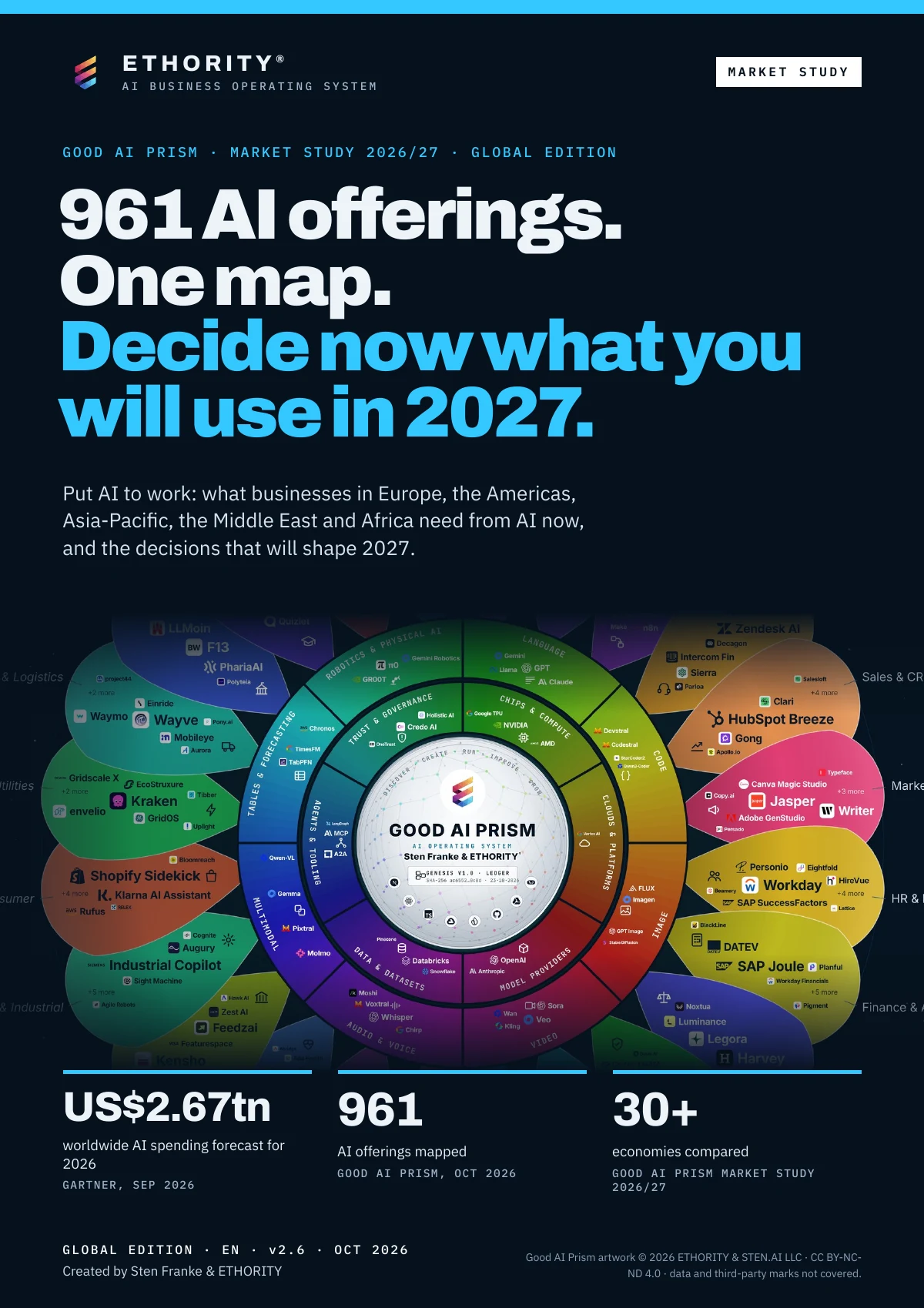
961 AI offerings. One map. Decide now what you will use in 2027.
The Good AI Prism helps you find useful AI and compare the evidence behind your options. For organisations already using AI, the question is moving from whether to use AI to which AI, how safely and whether it pays. This Global edition brings together 961 AI offerings across 24 topic areas, 8 data types and 6 technology layers, with sources, dates and limits to guide your next decision.
Version 2.6 · 90 pages
Open the study →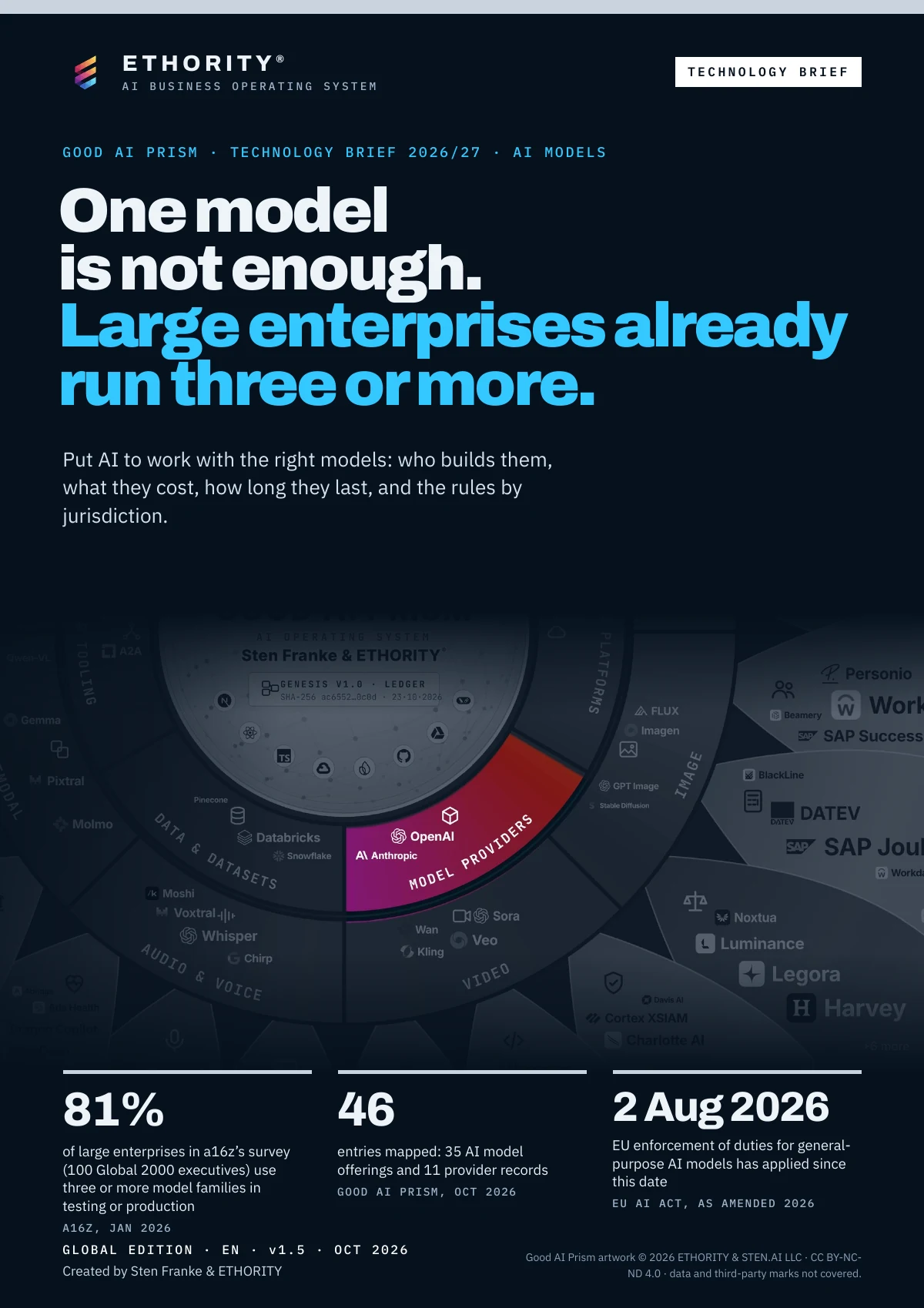
Global edition · EN
One model is not enough. Large enterprises already run three or more.
81% of large enterprises use three or more model families. Who builds AI models, what they cost, how long they last, and the rules by jurisdiction.
Version 1.5 · 38 pages
Open the study →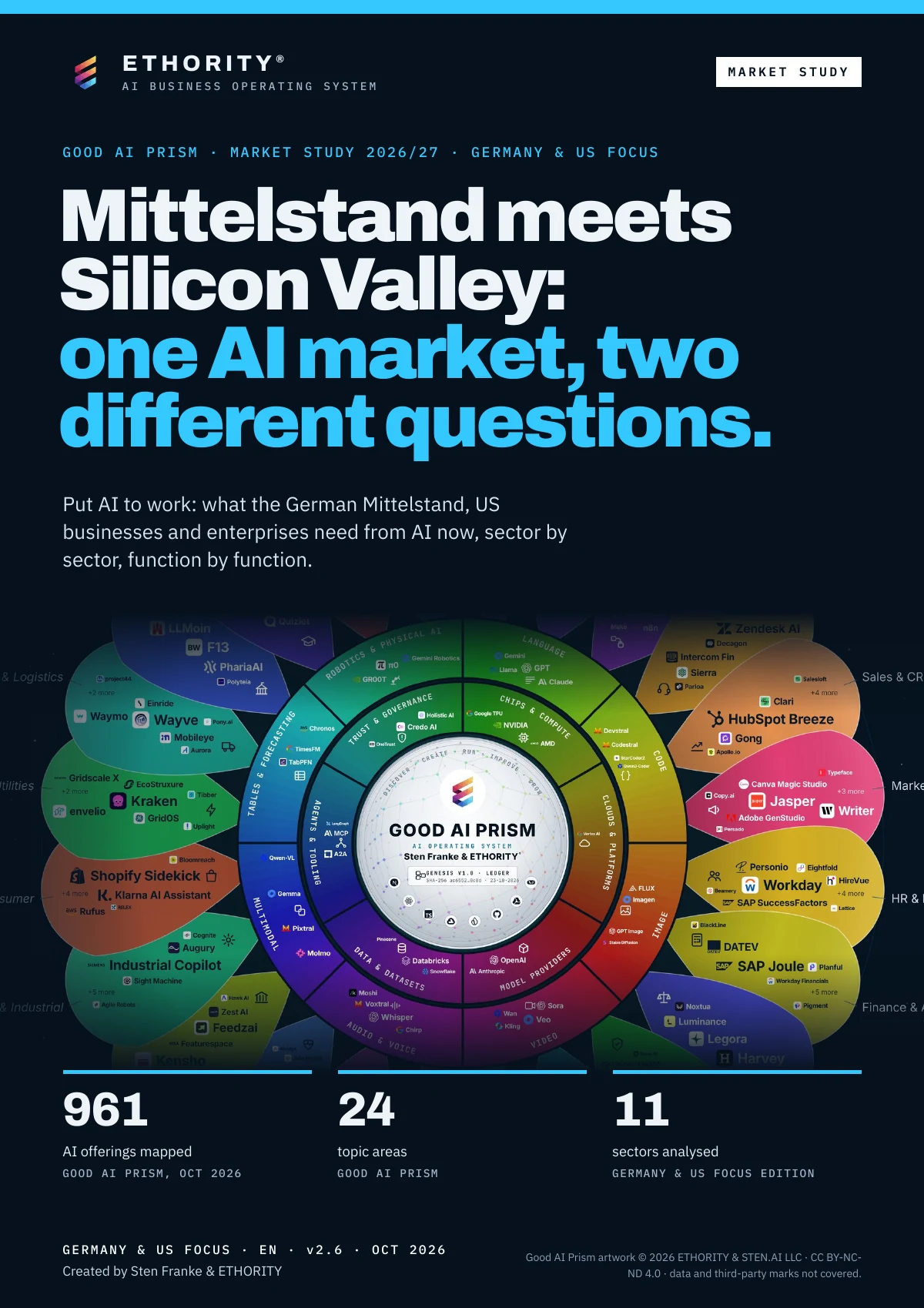
Germany & United States Focus · EN
Germany's mid-sized companies meet Silicon Valley: one AI market, two different questions.
The Mittelstand needs know-how; US firms need cost control. What German and US businesses need from AI now, sector by sector, function by function.
Version 2.6 · 72 pages
Open the study →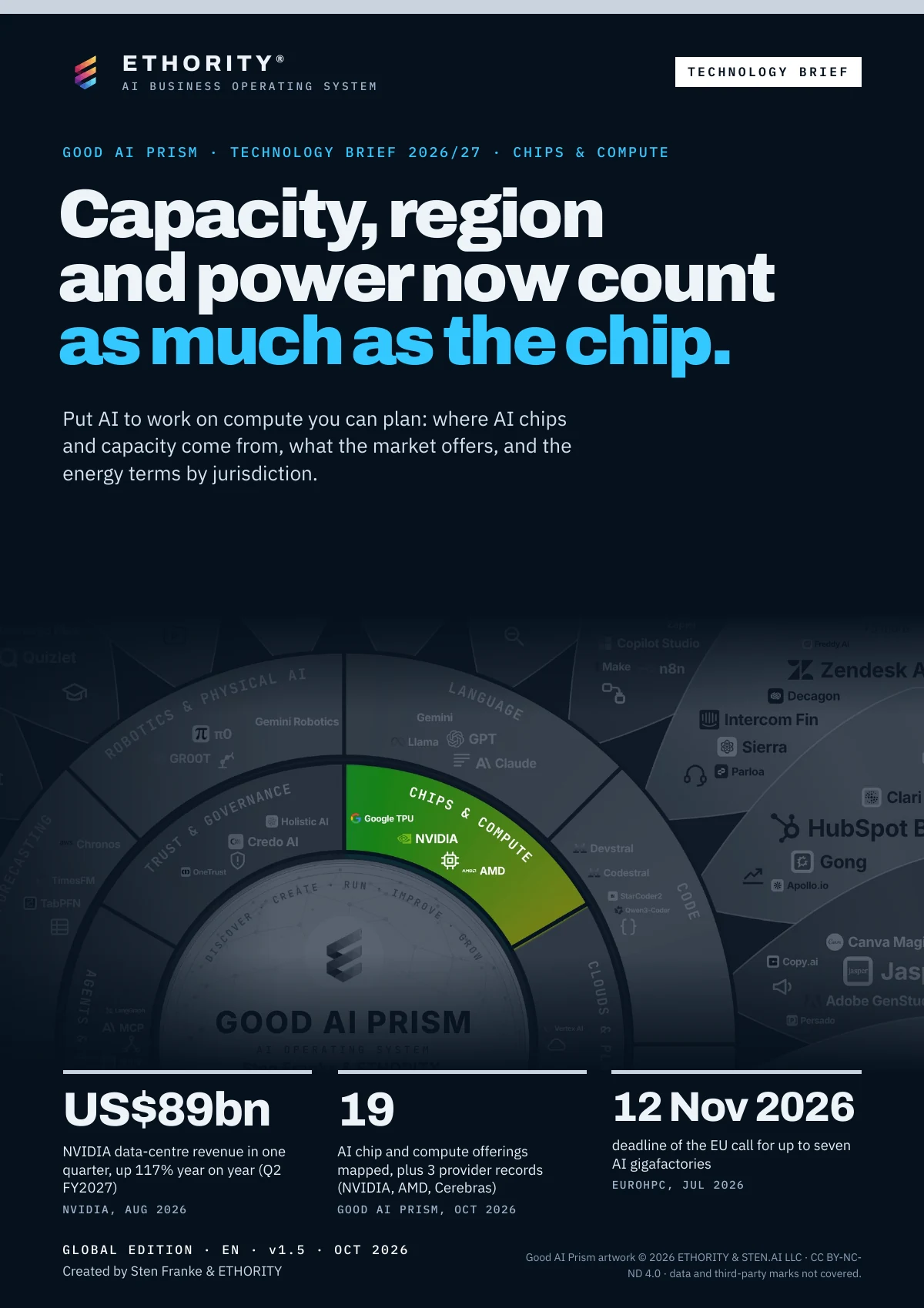
Global edition · EN
Compute that fits the work you run.
Capacity, region and energy terms count as much as chip performance. Where AI chips and capacity come from, what the market offers and the energy terms by jurisdiction.
Version 1.5 · 40 pages
Open the study →Related insights
Saved hours are not AI value.
Separate a better task, freed-up time and a business result, so you can show the value AI really delivers.
See the map on one page →
AI spending is forecast to rise by half. 37% of surveyed organisations see an effect on profit.
Sourced figures for 2025–26 on AI spending, adoption, models, energy and value, for your 2027 planning.
See the map on one page →
Govern the outcome, not only the risk.
Connect your AI rules to the business result, the full cost and the value you observe, and let them say stop.
See the map on one page →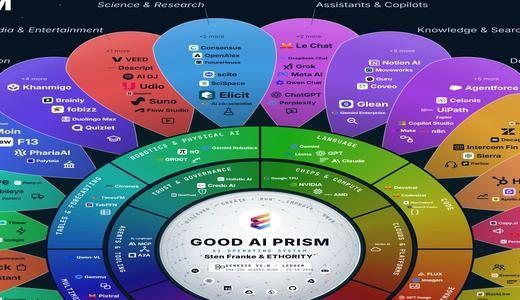
961 AI offerings. Start with the job, not the tool.
A method for going from one business need to a shortlist of AI offerings you can defend.
See the map on one page →Implement it with ETHORITY
AI Readiness & Maturity Check
€3,500 one-time · net
Shows where your organisation stands on AI readiness and maturity, and which steps come first.
Date and place by agreement
See what this package includes →Enterprise AI Opportunity Case
Priced after scoping
Compares real options, including doing nothing, models the economics and the assumptions that can break them, and recommends: start, change, test first or stop.
Scope and delivery by agreement
See what this package includes →AI Decision Brief
€195 net · one-time
Puts the facts that decide between two or three AI offerings side by side, each sourced and dated, with the questions to ask each provider.
Request scope and delivery
See what this package includes →Buyer questions
What makes data AI-ready?
Current, documented, permissioned data with one agreed definition per metric. Gartner found 63% of organisations lack or are unsure of such practices (Gartner, Feb 2025).
Why do AI projects fail on data?
Definitions, access rules and lineage were built for reporting, not for systems that act on data. Gartner expects 60% of projects without AI-ready data to be abandoned through 2026.
Which outcomes should analytics AI improve?
Decision latency and forecast error, the two measures the Global Market Study recommends for this area.
Do training-data licences matter to us?
Yes, if you build or fine-tune models. The ImageNet registry card records research-only use; The Stack v2 records licences per file.
How do we show value beyond saved time?
Separate task improvement, released capacity and business outcome, as Saved hours are not AI value sets out.
The evidence at a glance
ETHORITY · LONG READ
Gartner: without AI-ready data, 60% of AI projects get dropped.
Spending on AI data nearly quadruples in 2026, yet 63% of organisations are unsure their data practices fit AI. What data leaders should check first: definitions, readiness, training-data licences and two outcome measures.
Money is moving to the data layer of AI. Gartner's September 2026 spending forecast puts spending on AI data at US$3.1bn in 2026, up from US$0.8bn in 2025, and at US$6.5bn in 2027. Spending on AI platforms for data science and machine learning grows from US$19.4bn in 2025 to US$26.4bn in 2026 and US$35.6bn in 2027. Data teams are being asked to feed AI, not just to report on the business.
Most organisations are not ready for that job. That is the finding a data leader should start from.
Most data is not AI-ready
Gartner put the gap in two numbers in its February 2025 release on AI-ready data. 63% of organisations either do not have, or are unsure whether they have, the right data management practices for AI. And Gartner predicts that through 2026, organisations will abandon 60% of AI projects that are not supported by AI-ready data.
60%. The share of AI projects without AI-ready data that Gartner expects organisations to abandon through 2026.
"AI-ready" is not the same as "clean". A data warehouse built for monthly reporting can be accurate and still unfit for an AI system that needs current, well-described, permissioned data at the moment of a decision. Definitions that live in the heads of analysts, metrics that differ between departments, and access rules that were never written down all break when a model or an agent starts asking questions.
The Global Market Study 2026/27 names the business problem of this area as data readiness and trust in numbers. What helps, it says, is a data-readiness check and a semantic layer before scaling: one agreed definition per business metric, documented where both people and machines can read it.
Wide use, thin returns
The return question sits on top of the readiness question. Use of AI is broad: in official EU statistics, 20% of enterprises with ten or more staff used AI in 2025 (Eurostat, as reported in ETHORITY's AI growth facts). But in McKinsey's August 2026 survey, only 37% of organisations attribute any EBIT effect to AI.
Analytics is where that gap becomes visible, because data teams are usually the ones asked to measure it. An AI forecasting feature that lowers forecast error but is never used in a planning decision has produced a better number, not a better result. The ETHORITY evidence synthesis Saved hours are not AI value separates three levels that are often merged: task improvement, released capacity and a business outcome. Only the third pays.
37% of surveyed organisations attribute any EBIT effect to AI (McKinsey, Aug 2026).
The data under the models
Data & Analytics buyers face a second data question: what the models they use were trained on. The Good AI Prism keeps registry cards for twelve widely used public datasets, read from their cards and licences, and they show how varied the terms are.
Exhibit: licence terms on twelve profiled datasets
| Dataset | Licence stated | Size stated |
|---|---|---|
| Common Crawl | Own terms of use | 300bn+ pages |
| FineWeb | ODC-By 1.0 | 15tn tokens |
| Dolma | ODC-BY | 2.3tn tokens |
| The Stack v2 | Per-file licences | 67.5 TB, 900bn tokens |
| LAION-5B (Re-LAION-5B) | Apache 2.0 | 5.5bn image-text pairs |
| ImageNet (ILSVRC 2012) | Research only | 1.28m images |
| Wikipedia | CC BY-SA 3.0 | 10m–100m rows, 300+ languages |
| Mozilla Common Voice | CC0 | 33,815 hours, 137 languages |
Source: Good AI Prism Registry, dataset cards; selection of 8 of 12.
Across the twelve cards, at least seven different licence regimes appear, from public-domain dedication to research-only use. The ImageNet registry card records "research only". The The Stack v2 card records licences per file, which means compliance depends on which files a model actually used. For an analytics team building its own models or fine-tuning one, these terms decide what may go into production.
What the Prism shows about analytics offerings
The Good AI Prism places 22 AI offerings and one provider record (Qlik) in Data & Analytics, from AI features in business-intelligence platforms to forecasting, data preparation and natural-language query tools. Each is mapped from the provider's own pages, and the decision facts a buyer should collect are the same as in the Knowledge & Search topic area: pricing unit, hosting, training terms, integrations and certifications, each with source and date.
Three questions from the profiled cohorts transfer directly to analytics tools. Where is the data processed, especially when a natural-language query sends table contents to a hosted model? Is customer data used to train the provider's models? And which billing unit applies: seats, queries, compute or credits? In the twelve Software Development cards, for example, at least five billing units appear. Analytics tools that charge per query or per compute unit make volume the main cost driver.
Measure decisions, not dashboards
The study recommends two outcome measures for this area: decision latency and forecast error. Both tie analytics to a business result. Decision latency asks how long it takes from a question to an action. Forecast error asks whether the numbers that drive planning got better. A new dashboard, a new model or a new chat interface on top of the warehouse is only progress if one of the two moves.
Use case. A demand forecast. A retailer adds an AI forecasting feature to its planning tool. The team records today's forecast error per product group and the days between a forecast and a purchasing decision. After three months it compares both, and it checks how often planners actually used the AI forecast. If error fell but planners overrode the forecast, the next investment is in trust and process, not in a better model. If both measures improved, the case for scale is documented.
Usage-based pricing raises the stakes. The Global Market Study cites Gartner, via Deloitte, expecting at least 40% of SaaS spend to be usage-, agent- or outcome-based by 2030. Natural-language analytics invites more questions. More questions mean more compute. Without a cost per decision supported, a successful rollout can look like a budget problem.
What to do Monday
- Pick the five metrics your executives use most. Check whether each has one written definition, one owner and one source. Where it does not, fix that before connecting any AI tool.
- Run an AI-readiness check on one data domain. Test currency, documentation, access rules and lineage for the data a planned AI use case will read.
- Record the training-data terms of the models you use. Note licence and restrictions, especially where you fine-tune or build your own.
- Ask analytics suppliers three questions in writing. Where is query data processed? Is it used for training? Which billing unit applies at your volume?
- Set two outcome measures before the pilot. Baseline decision latency and forecast error for one planning process, and decide in advance what improvement justifies scale. The AI Readiness & Maturity Check starts exactly there.
The Good AI Prism keeps every registry fact sourced and dated, so that a data strategy can start from documented terms rather than from a vendor demo.
Sources and further reading
- Gartner: Worldwide AI spending to grow 49.5% in 2026 ↗ · 16 Sep 2026
- Gartner: Lack of AI-ready data puts AI projects at risk ↗ · 26 Feb 2025
- Eurostat: use of artificial intelligence in enterprises, 2025 ↗ · 11 Dec 2025
- McKinsey: The state of AI, August 2026 edition (1,719 respondents, 97 countries) ↗ · 25 Aug 2026
- Good AI Prism Global Market Study 2026/27 (ETHORITY) → · 22 Oct 2026
- Good AI Prism Registry cards, provider pages read 20 Oct 2026 (ETHORITY) → · 20 Oct 2026
Put the thinking to work
AI Opportunity Case →
A defensible proceed, test, redesign, defer or stop decision. The fee is independent of which outcome the evidence supports.
A written comparison of up to three AI offerings · €195 net →
Start with one question and up to three offerings. Request a sourced comparison, provider questions and a cost sketch using your assumptions.
YOUR NEXT STEP
Discuss your question with Sten Franke.
Bring your business question or the figures you already know. ETHORITY investigates within the agreed scope; together with Sten Franke you agree the next piece of work.