 ETHORITY®
GOOD AI PRISM · TOPIC AREA · LEGAL & COMPLIANCE
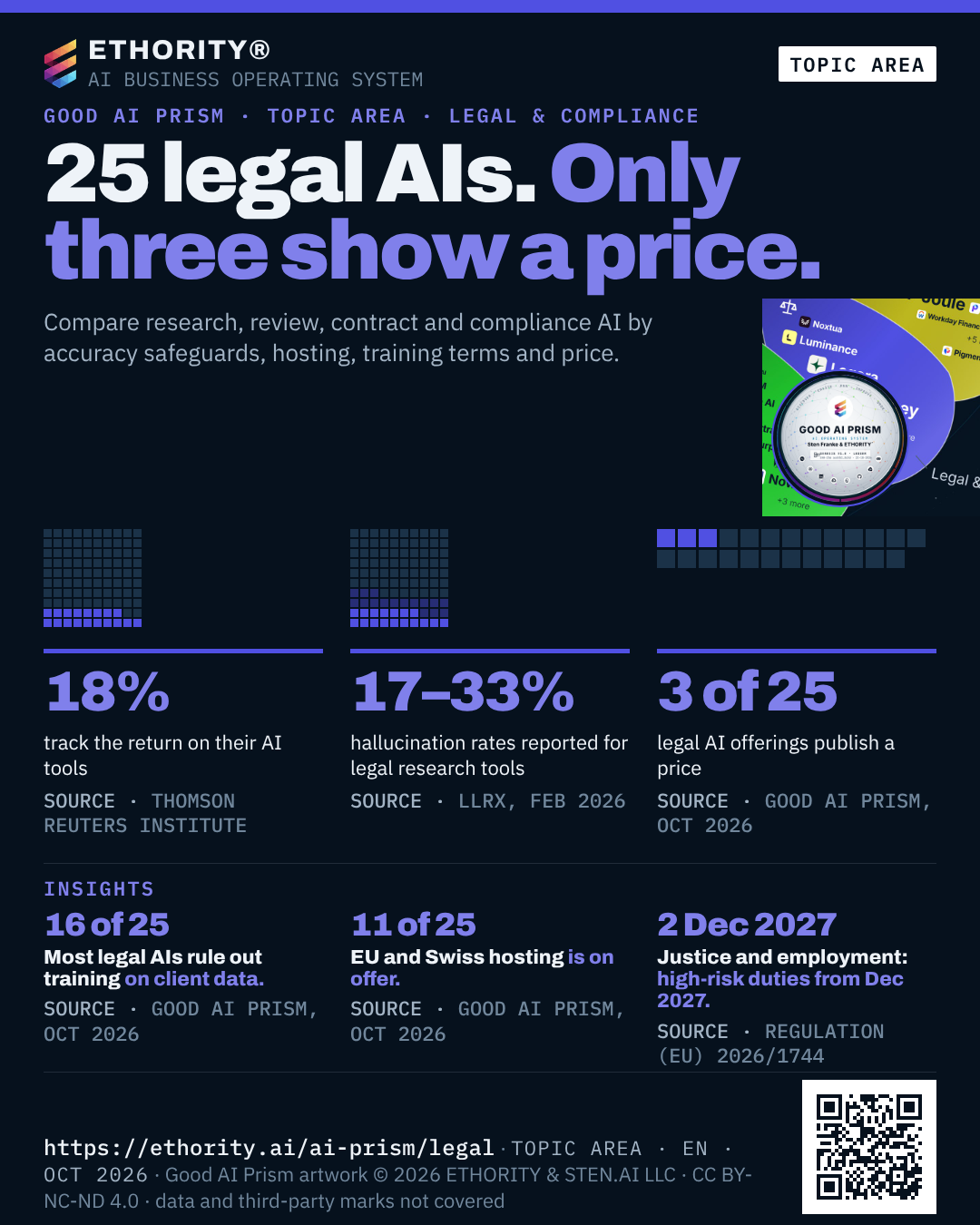
25 legal AIs. Only three show a price.
Compare research, review, contract and compliance AI by accuracy safeguards, hosting, training terms and price.
- 40%
- of professional-services firms use GenAI, up from 22%Thomson Reuters Institute · marketscale.com ↗
- 18%
- track the return on their AI toolsThomson Reuters Institute · marketscale.com ↗
- 17–33%
- hallucination rates reported for legal research toolsLLRX, Feb 2026 · llrx.com ↗
- 3 of 25
- legal AI offerings publish a priceGood AI Prism, Oct 2026
Most legal AIs rule out training on client data.
16 of 25 document that customer data is not used for training or only with opt-in.
Good AI Prism, Oct 2026
EU and Swiss hosting is on offer.
11 of 25 document an EU hosting option; Harvey also offers Switzerland.
Good AI Prism, Oct 2026
Justice and employment: high-risk duties from Dec 2027.
Annex III duties, including administration of justice and employment, apply from 2 Dec 2027.
Regulation (EU) 2026/1744
How to use this page
Three tools and one offer turn this page into a decision.
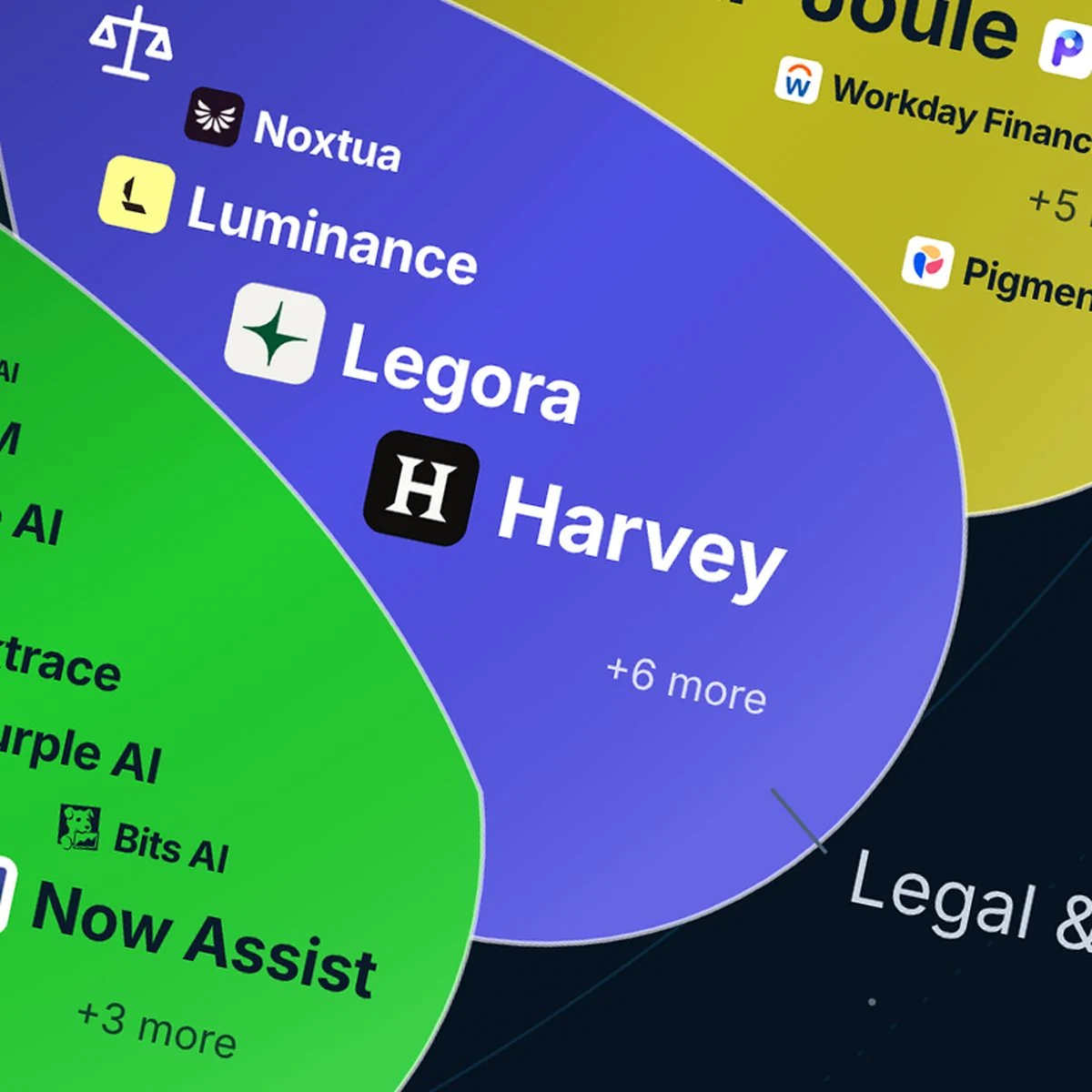
- Open the Legal & Compliance map: 25 offerings on one petal of the Good AI Prism, with logos and provider facts.
- Compare up to three offerings: decision facts side by side, each with its source and date.
- Run the Task economics calculator: turn saved hours into capacity you can attribute, before a pilot is approved.
- Offer: AI Governance Setup: roles, decision rights, an approval workflow and a maintained AI register, mapped to the AI Act dates.
Compare baseline: three ways to hold client data
EU and Swiss hosting with a training opt-out, four regions with no training, and a per-user practice tool.
| Offering | Billing | Data location | Training | Source |
|---|---|---|---|---|
| Legartis | Per user | EU · CH | On · opt-out | Legartis pricing and security |
| Harvey | Quote only | EU · CH · US · AU | Not used | Harvey security and hosting |
| Clio Work | Per user | EU · US · CA · AU | Not used | Clio Work security page |
Registry facts as stated on each provider's own pages, read 22 Oct 2026. Add your own volumes in Compare before deciding.
Rules and dates
The compliance calendar is now fixed.
- 2 Feb 2025
Prohibited practices and the AI literacy duty apply.
Reg. (EU) 2024/1689
- 2 Aug 2025
Obligations for general-purpose AI models apply.
Reg. (EU) 2024/1689
- 2 Aug 2026
Art. 50: people must be told when they interact with an AI system.
Reg. (EU) 2026/1744
- 2 Dec 2026
Machine-readable marking for generative systems already on the EU market.
Reg. (EU) 2026/1744
- 2 Dec 2027
Annex III high-risk duties apply, incl. employment, credit, education and justice.
Reg. (EU) 2026/1744
- 2 Aug 2028
High-risk duties apply to AI in regulated products.
Reg. (EU) 2026/1744
The study
The Global Market Study 2026/27 reads Legal & Compliance as a function and legal services as a sector.
Global edition · EN
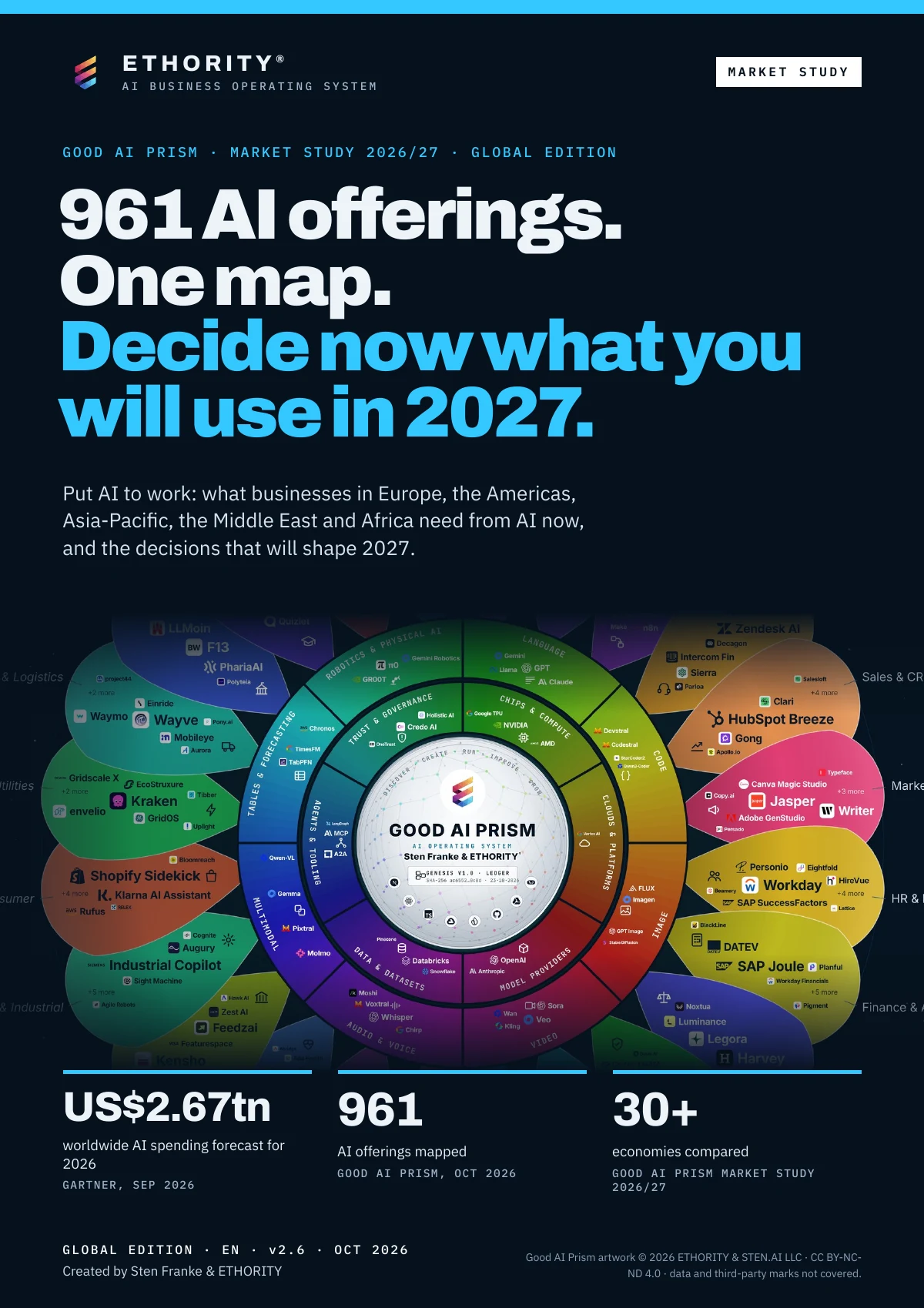
961 AI offerings. One map. Decide now what you will use in 2027.
The Good AI Prism helps you find useful AI and compare the evidence behind your options. For organisations already using AI, the question is moving from whether to use AI to which AI, how safely and whether it pays. This Global edition brings together 961 AI offerings across 24 topic areas, 8 data types and 6 technology layers, with sources, dates and limits to guide your next decision.
Version 2.6 · 90 pages
Open the study →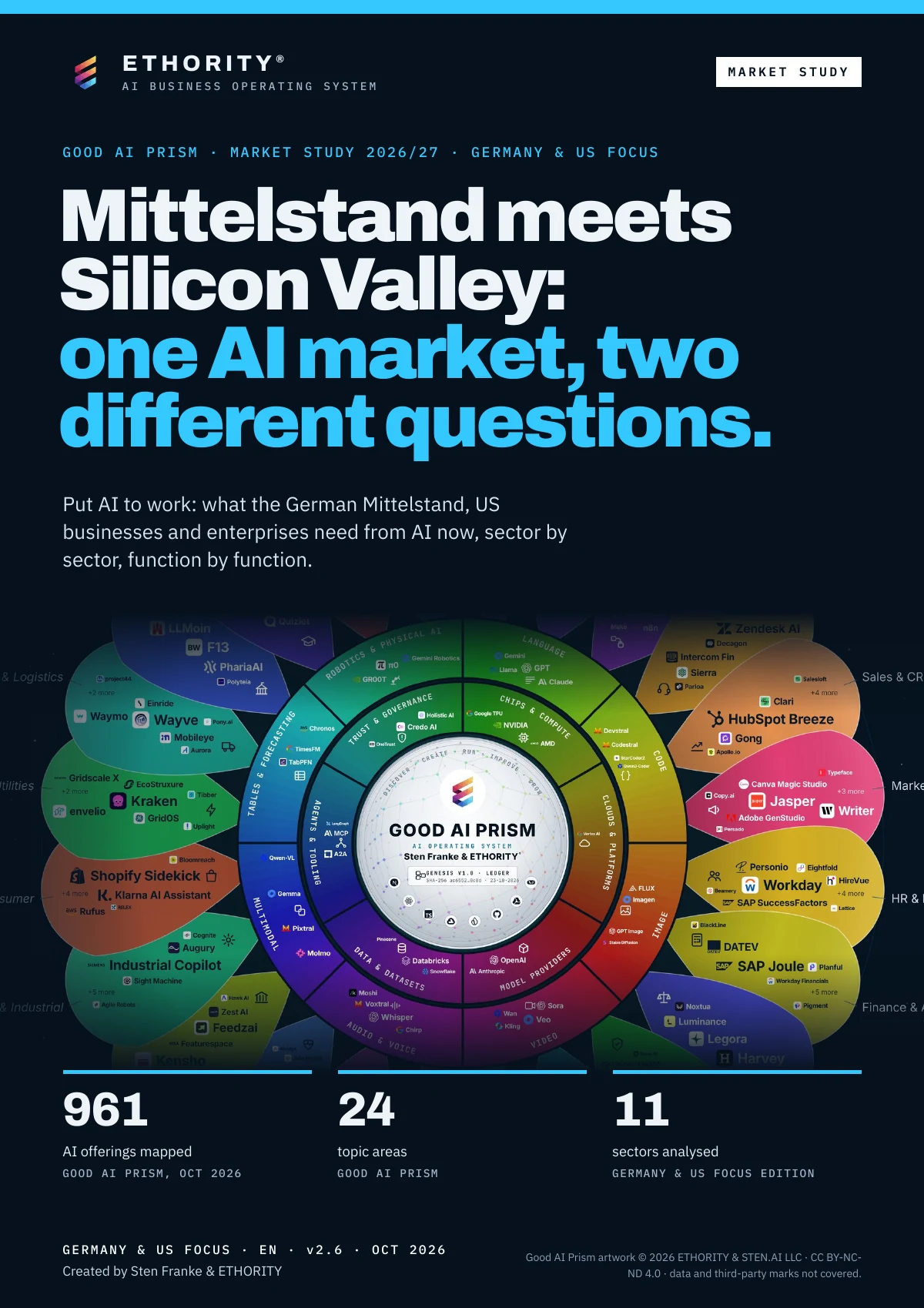
Germany & United States Focus · EN
Germany's mid-sized companies meet Silicon Valley: one AI market, two different questions.
The Mittelstand needs know-how; US firms need cost control. What German and US businesses need from AI now, sector by sector, function by function.
Version 2.6 · 72 pages
Open the study →Read on
Our long read on legal AI, plus ten AI ethics issues with legal dates and AI Act readiness versus control.
Ten AI ethics issues now have legal dates.
The ten AI ethics issues of 2024 now each have a legal date, a measurable control or published evidence.
See the map on one page →
Preparing for the EU AI Act is the start; control happens in daily operation.
How to connect each EU AI Act duty to your systems, controls, evidence, monitoring and regular reassessment.
See the map on one page →
AI rules move from documents into daily operation.
Why AI agents, tools and constant change move AI governance – the rules and responsibilities for AI – into the systems that run your AI every day.
See the map on one page →
A list of AI agents does not control them.
What controls AI agents in daily operation: clear rights, a record of how well each fact is supported, checks matched to the risk, data limits and alerts when something changes.
See the map on one page →
Govern the outcome, not only the risk.
Connect your AI rules to the business result, the full cost and the value you observe, and let them say stop.
See the map on one page →Implement it with ETHORITY
From policy to governance that holds when someone asks.
AI Act Readiness Sprint
€6,900 one-time · net
Inventory, classification and an obligation-by-date plan for every AI system in scope.
Date and place by agreement
See what this package includes →AI Governance Setup
€19,500 one-time · net
Named owners, bounded authority, current evidence and a defined response to change, connected to daily decisions.
Scope and delivery by agreement
See what this package includes →AI Governance Retainer
€2,500 / month · net
Ongoing review of inventory, provider terms and deadlines, with a six-month minimum term.
Scope and delivery by agreement
See what this package includes →AI Trust Record
€4,500 net · one-time
A documented record for one legal AI system: owner, data, provider terms, review rule and evidence.
Request scope and delivery
See what this package includes →Buyer questions
How accurate are legal AI research tools?
Studies summarised by LLRX in Feb 2026 report hallucination rates of 17–33% for legal research tools. Require citations for every statement of law and a named reviewer for anything that reaches a client or court.
Will our client documents train the provider's model?
Check the plan and the default. In our review, 16 of 25 legal offerings document no training on customer data or opt-in only; Legartis offers an opt-out on Team and Enterprise plans.
Can we keep data in the EU or Switzerland?
Often yes. 11 of 25 document an EU hosting option. Harvey offers EU, Switzerland, US or Australia; Noxtua runs on European clouds; Bryter keeps EU customer data in Frankfurt.
What do legal AI tools cost?
Few say. Libra lists from €900 per user per year, Legartis €2,500 per user per year for Professional, Otto Schmidt Answers €79 per user per month. The large platforms quote.
Which AI Act dates should compliance teams plan for next?
2 Dec 2026 for machine-readable marking of synthetic content from existing generative systems, and 2 Dec 2027 for Annex III high-risk duties, including employment and the administration of justice.
The evidence at a glance
ETHORITY · LONG READ
Legal AI use nearly doubles to 40%. Only 18% track returns.
Generative AI use in legal and professional services rose from 22% to 40% in a year. Accuracy and returns lag. We read the prices, hosting and training terms of 25 legal AI offerings.
Legal work has crossed the adoption line faster than its measurement. The Thomson Reuters Institute's 2026 AI in Professional Services Report, drawn from more than 1,500 respondents in 27 countries across law, tax, accounting and risk, found that 40% of organisations now use generative AI, up from 22% a year earlier. Fifteen per cent have adopted some form of agentic AI. Only 18% say they track the return on their AI tools.
For a profession that bills by evidence, that last number is the uncomfortable one. Clients ask whether AI makes legal work cheaper, faster or better. Most firms and legal departments cannot yet answer with data.
ETHORITY reviewed 25 legal and compliance AI offerings for the Good AI Prism in October 2026, reading each provider's pricing, security and legal pages. Here is what the market puts on the record, and what buyers should demand before relying on it.
The market: research, review, contracts, compliance
The Legal & Compliance area map covers four jobs. Legal research and drafting assistants: Harvey, Legora, CoCounsel, Lexis+ with Protégé, Libra by Wolters Kluwer, Otto Schmidt Answers, Noxtua and DeepJudge. Document review and e-discovery: Relativity aiR for Review and Everlaw. Contract review and lifecycle management: Juro, Legartis, LegalOn, Spellbook, Robin AI, Definely, Luminance, Ironclad, Icertis Vera, Sirion and LEGALFLY. Regulatory compliance and workflow: Norm Ai, Corlytics, Bryter and Clio Work.
German-language legal content has its own cluster. Libra builds on Wolters Kluwer content, Otto Schmidt Answers on the publisher's own commentary, and Noxtua runs on European clouds. For German law, the licensed content behind a tool matters as much as the model.
3 of 25 legal AI offerings publish a price. Libra, Legartis and Otto Schmidt Answers do; the other 22 quote on request.
Prices: per user, per year, mostly private
The three published prices share a unit: per user. Libra lists its Starter plan at €900 per user per year, with Professional at €2,000 and Team at €2,400, and charges partner content separately. Legartis lists Professional at €2,500 per user per year. Otto Schmidt Answers costs €79 per user per month at list price. The large research and contract platforms quote.
Per-user pricing is easy to budget and hard to judge, because the value depends on how much work moves. A practice group that runs every first-draft contract review through a tool gets a different return from one that uses it twice a month. Measure review time and verified-citation rate per matter type before and after, which is exactly what the Global Market Study recommends for this function.
Scenario. For a team of ten lawyers, list prices run from €9,000 a year (Libra Starter at €900 per user) to €9,480 (Otto Schmidt Answers at €79 per user a month) and €25,000 (Legartis Professional at €2,500). The price gap matters less than the review time per matter and the verified-citation rate each tool reaches on your own files.
Accuracy: the number that decides liability
The risk in legal AI is not that a tool fails to answer. It is that it answers confidently and wrongly. Studies summarised by LLRX report hallucination rates of 17% to 33% in legal research tools. Those are tools built for lawyers, with retrieval over legal sources, not general chatbots.
The response is procedural, not technical. Require source citations for every statement of law. Classify the evidence behind each citation. Keep a person who signs for every output that reaches a client or a court. And measure the verified-citation rate per tool and per matter type, so that trust follows evidence rather than demos.
17–33% hallucination rates reported for legal research tools built for lawyers (studies summarised by LLRX, Feb 2026).
Where client data goes, and what it trains
Client confidentiality makes hosting and training terms decisive, and legal providers document them more often than most. Eleven of 25 document an EU hosting option. Harvey lets customers keep data in the EU or Switzerland, the US or Australia. Noxtua runs its own AI infrastructure on European clouds including IONOS and Deutsche Telekom. Bryter keeps EU and EEA customer data on servers in Frankfurt. Libra states that user data is stored in Germany.
On training, 16 of 25 document that customer data is not used to train models, or only with opt-in. One, Legartis, offers an opt-out from model training on its Team and Enterprise plans, which makes the default worth checking on smaller plans. For a law firm, a training clause is a professional-secrecy question, not a feature comparison.
Agents arrive in the contract workflow
The 15% of organisations already using agentic AI are a signal of where contract tools are heading. Several providers in the map now market agents that redline against a playbook, route a contract for approval or answer a business user's question about a clause without a lawyer in the loop. That changes the governance question from "is the answer right?" to "who authorised the action?"
A sensible boundary has three lines. Agents may propose redlines, but a named lawyer accepts them. Agents may answer from an approved playbook, but questions outside it go to a person. Agents may route and file, but they do not sign, send to the counterparty or change a template without approval. Written down, those three lines are short enough to fit into a policy and concrete enough to test in a pilot.
The compliance calendar is now fixed
For compliance teams, 2026 turned AI principles into dates. Under the AI Act, as amended by Regulation (EU) 2026/1744, the calendar reads as follows. Prohibited practices and the AI literacy duty have applied since 2 Feb 2025. General-purpose model obligations since 2 Aug 2025. Article 50 transparency duties since 2 Aug 2026. Machine-readable marking for generative systems already on the market, and a new prohibition on non-consensual intimate imagery, from 2 Dec 2026. High-risk duties for Annex III uses, including employment, credit, education and the administration of justice, from 2 Dec 2027. High-risk duties for AI in regulated products from 2 Aug 2028.
Boards have noticed. In the Allianz Risk Barometer 2026, 32% of respondents named AI as a top business risk, now in second place. Our article on why AI Act readiness is not operational control explains how to connect each obligation to a system, a control and a piece of evidence.
What good governance looks like in a legal team
Legal and compliance teams usually own AI governance for the whole organisation, and they use AI themselves. Both roles benefit from the same artefacts: an inventory of AI systems with owners and intended uses, a register of provider terms, a review rule for outputs that leave the building, and a record of who was trained on what. The difference between a policy and governance is whether these artefacts are current when someone asks.
What to do Monday
- Set the accuracy rule. No AI output reaches a client or a court without verified citations and a named reviewer.
- Measure two numbers. Verified-citation rate and review time per matter type, before and after the tool.
- Read the training clause as a secrecy clause. Default setting, plan level and opt-out route, in writing.
- Put the AI Act dates in the compliance calendar. Next stops: 2 Dec 2026 for marking, 2 Dec 2027 for Annex III.
- Start the inventory. List every AI system, its owner and its intended use; it is the first artefact every regulator asks for.
The HR & Recruiting topic area covers the employment uses that carry high-risk duties from Dec 2027.
Sources and further reading
- ETHORITY, Good AI Prism research on 25 legal and compliance offerings (provider pages read 22 Oct 2026) → · 22 Oct 2026
- ETHORITY, Good AI Prism Global Market Study 2026/27 → · 22 Oct 2026
- Thomson Reuters Institute, 2026 AI in Professional Services Report ↗ · 2026
- MarketScale, Only 18% track AI ROI as agentic AI rolls into professional services (report summary) ↗ · 5 Sep 2026
- LLRX, What the science says about hallucinations in legal research ↗ · Feb 2026
- Regulation (EU) 2026/1744 (Digital Omnibus on AI) ↗ · in force 27 Jul 2026
- Lewis Silkin, The Digital Omnibus on AI enters into force ↗ · 27 Jul 2026
- Allianz Risk Barometer 2026 ↗ · Jan 2026
- Libra, pricing ↗ · read 22 Oct 2026
- Legartis, pricing ↗ · read 22 Oct 2026
- Otto Schmidt, Otto Schmidt Answers ↗ · read 22 Oct 2026
- Harvey, security ↗ · read 22 Oct 2026
- Noxtua, FAQ ↗ · read 22 Oct 2026
- Bryter, security and privacy ↗ · read 22 Oct 2026
Put the thinking to work
AI Governance Setup →
A repeatable governance process people can operate and review. Framework mapping is not an ISO certificate or legal opinion.
A written comparison of up to three AI offerings · €195 net →
Start with one question and up to three offerings. Request a sourced comparison, provider questions and a cost sketch using your assumptions.
YOUR NEXT STEP
Discuss your question with Sten Franke.
Bring your business question or the figures you already know. ETHORITY investigates within the agreed scope; together with Sten Franke you agree the next piece of work.