 ETHORITY®
GOOD AI PRISM · TOPIC AREA · HR & RECRUITING
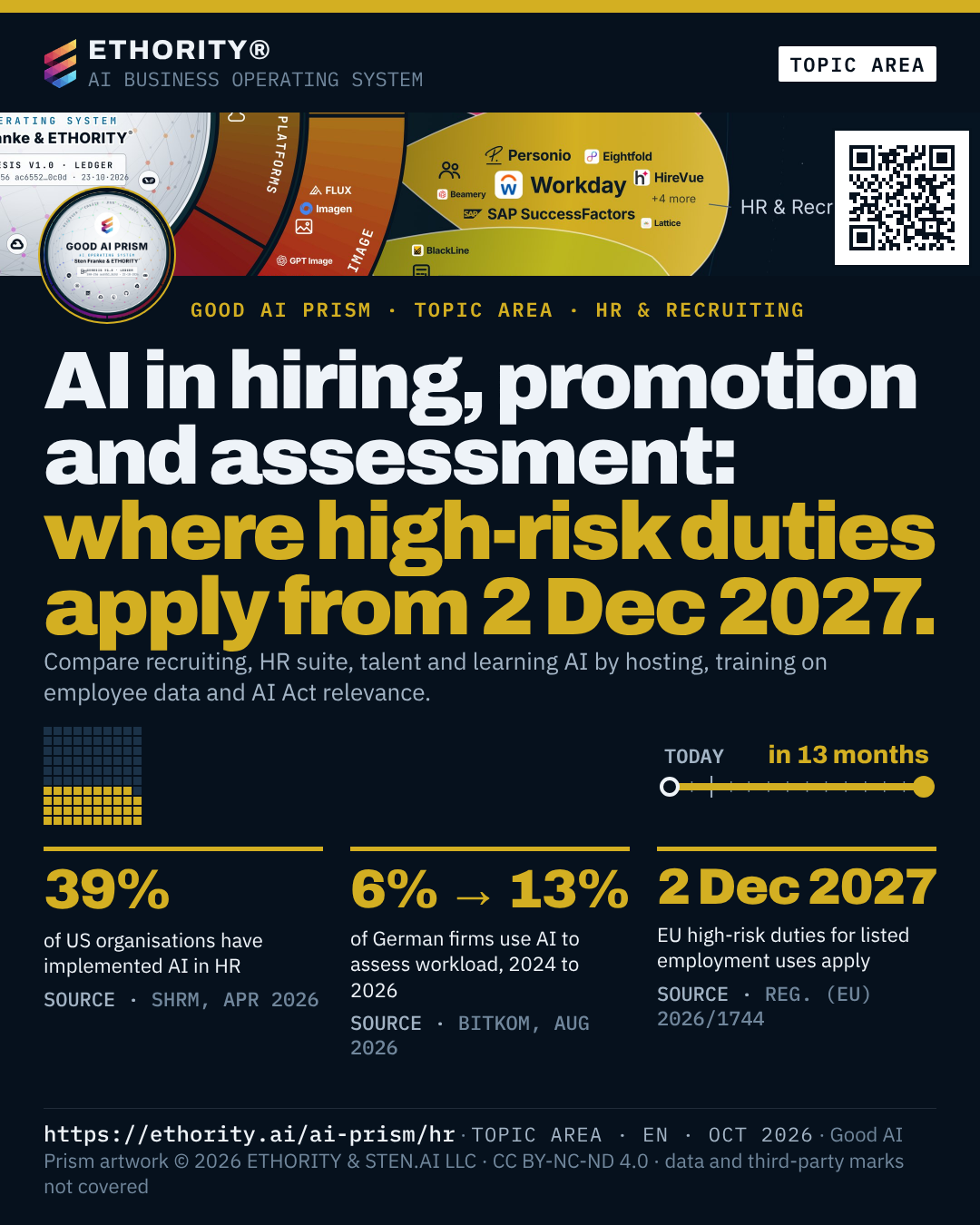
AI in hiring, promotion and assessment: where high-risk duties apply from 2 Dec 2027.
Compare recruiting, HR suite, talent and learning AI by hosting, training on employee data and AI Act relevance.
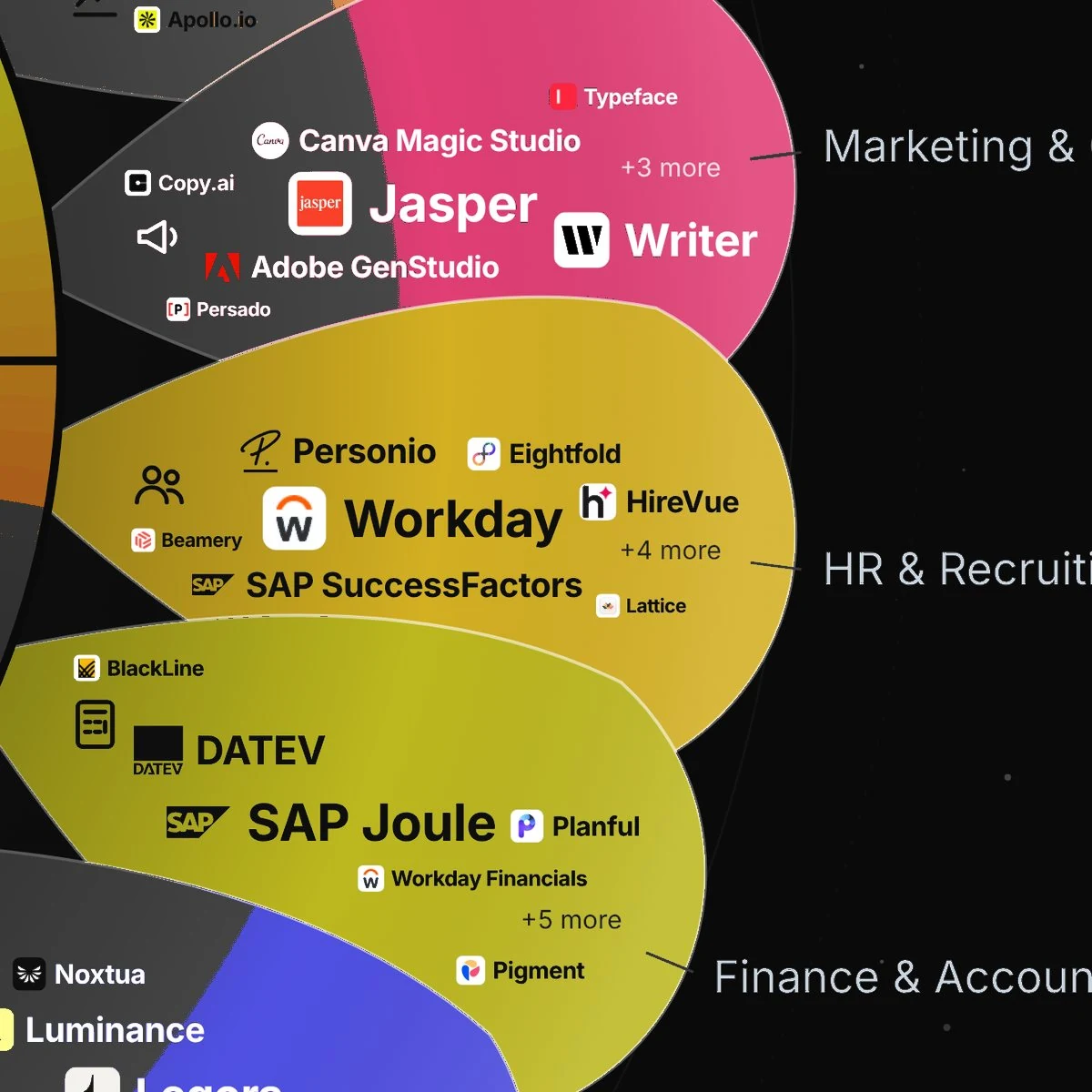
- 28
- AI offerings mapped in HR & Recruiting, plus 2 provider records (Workday, Rippling)Good AI Prism HR brief
- 39%
- of US organisations have implemented AI in HRSHRM, Apr 2026 · shrm.org ↗
- 6% → 13%
- of German firms use AI to assess workload, 2024 to 2026Bitkom, Aug 2026 · bitkom.org ↗
- 2 Dec 2027
- EU high-risk duties for employment AI applyReg. (EU) 2026/1744 · eur-lex.europa.eu ↗
Structured AI interviews can lift hiring.
In a field experiment with about 70,000 applicants, AI-led interviews raised job starts by 18%.
Erasmus University, Oct 2025
HR is left out of AI strategy.
More than half of organisations do not involve HR in their AI strategy or vision.
SHRM, Apr 2026
EU hosting is common in HR AI.
19 of the 30 mapped HR entries document an EU hosting option; training defaults still differ.
Good AI Prism, Oct 2026
How to use this page
Three tools and one offer turn this page into a decision.
- Open the HR & Recruiting map: 28 AI offerings and 2 provider records on one petal of the Good AI Prism, with logos and provider facts.
- Compare up to three offerings: decision facts side by side, each with its source and date.
- Run the Task economics calculator: turn saved hours into capacity you can attribute, before a pilot is approved.
- Offer: AI Act Readiness Sprint: every HR AI use classified under the AI Act, with gaps, evidence and a costed plan before 2 Dec 2027.
Compare baseline: three training defaults
Not used, on with opt-out, and used: the same question answered three ways by providers that hold employee data.
| Offering | Data location | Training | Certifications | Source |
|---|---|---|---|---|
| Teamtailor Co-pilot | EU · CH · US | Not used | SOC 2 · ISO 27001 +2 | Teamtailor security and privacy |
| Workday | EU option | On · opt-out | SOC 2 · ISO 27001 +3 | Workday AI data contributions |
| Winston | Germany | Used | SOC 2 · ISO 27001 | SmartRecruiters Winston terms |
Registry facts as stated on each provider's own pages, read 22 Oct 2026. Add your own volumes in Compare before deciding.
Rules and dates
The dates HR teams plan against.
- 2 Feb 2025
Prohibited practices and the AI literacy duty apply.
Reg. (EU) 2024/1689
- 2 Aug 2026
Art. 50: people must be told when they interact with an AI system.
Reg. (EU) 2026/1744
- 1 Jan 2027
Colorado and California duties on automated decisions apply for covered uses.
State law, CO and CA
- 2 Dec 2027
Annex III high-risk duties apply, incl. employment, credit, education and justice.
Reg. (EU) 2026/1744
The brief
The HR & Workforce brief maps 30 entries and 17 jurisdictions for AI in hiring and work.
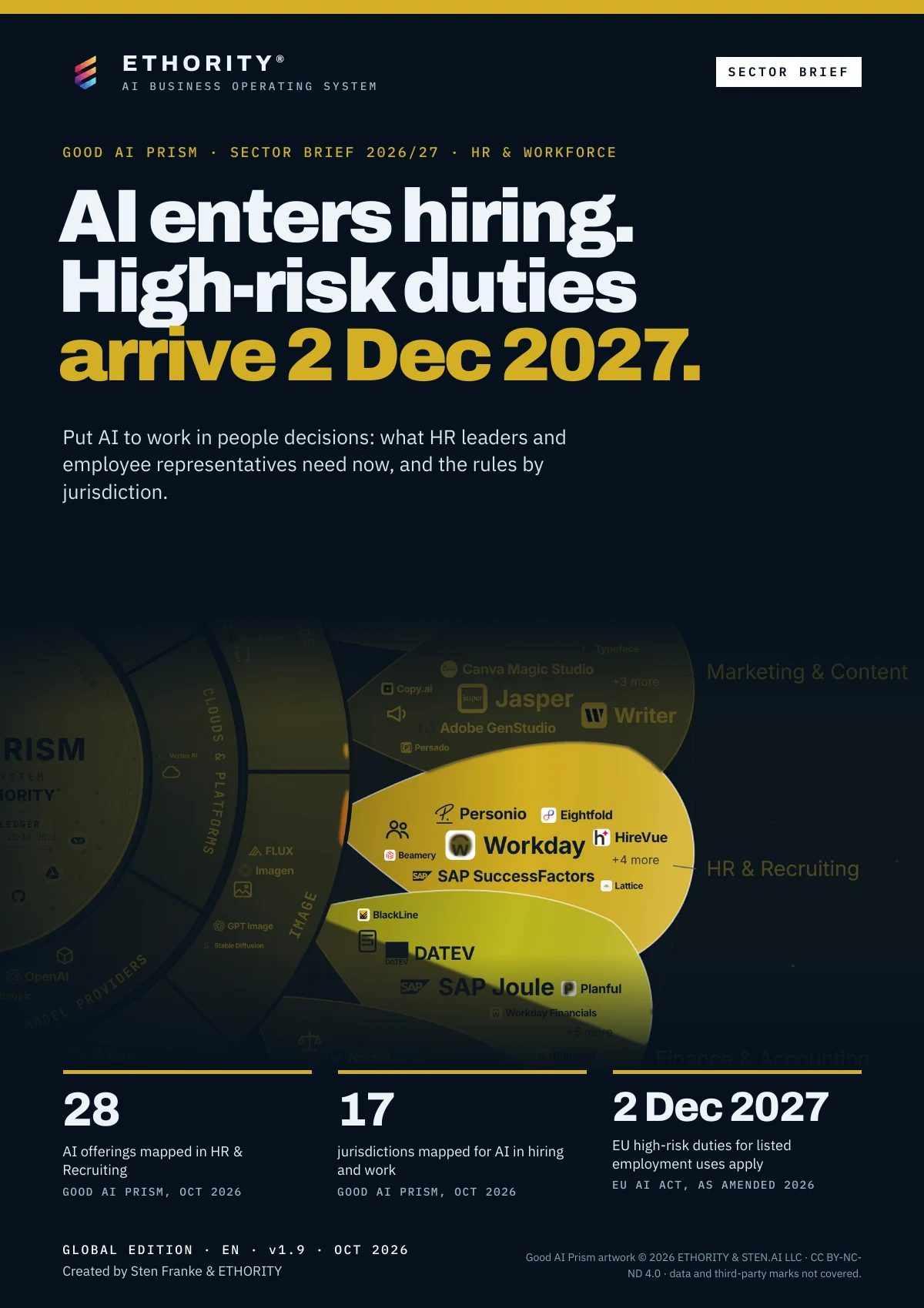
Global edition · EN
AI enters hiring. High-risk duties arrive 2 Dec 2027.
Half the mapped HR offerings serve hiring. What HR leaders and employee representatives need now, and the rules in 17 jurisdictions.
Version 1.9 · 40 pages
Open the study →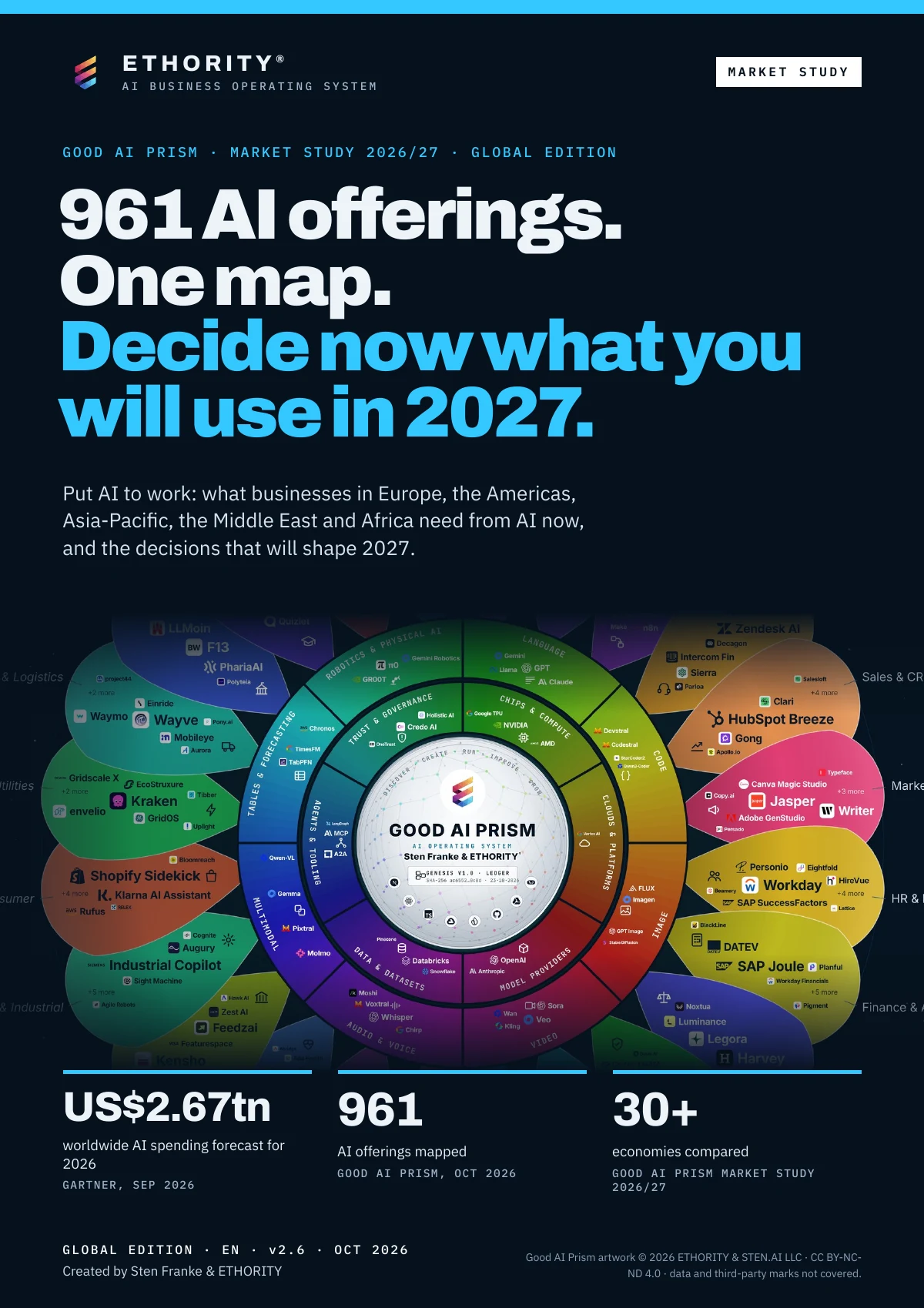
Global edition · EN
961 AI offerings. One map. Decide now what you will use in 2027.
The Good AI Prism helps you find useful AI and compare the evidence behind your options. For organisations already using AI, the question is moving from whether to use AI to which AI, how safely and whether it pays. This Global edition brings together 961 AI offerings across 24 topic areas, 8 data types and 6 technology layers, with sources, dates and limits to guide your next decision.
Version 2.6 · 90 pages
Open the study →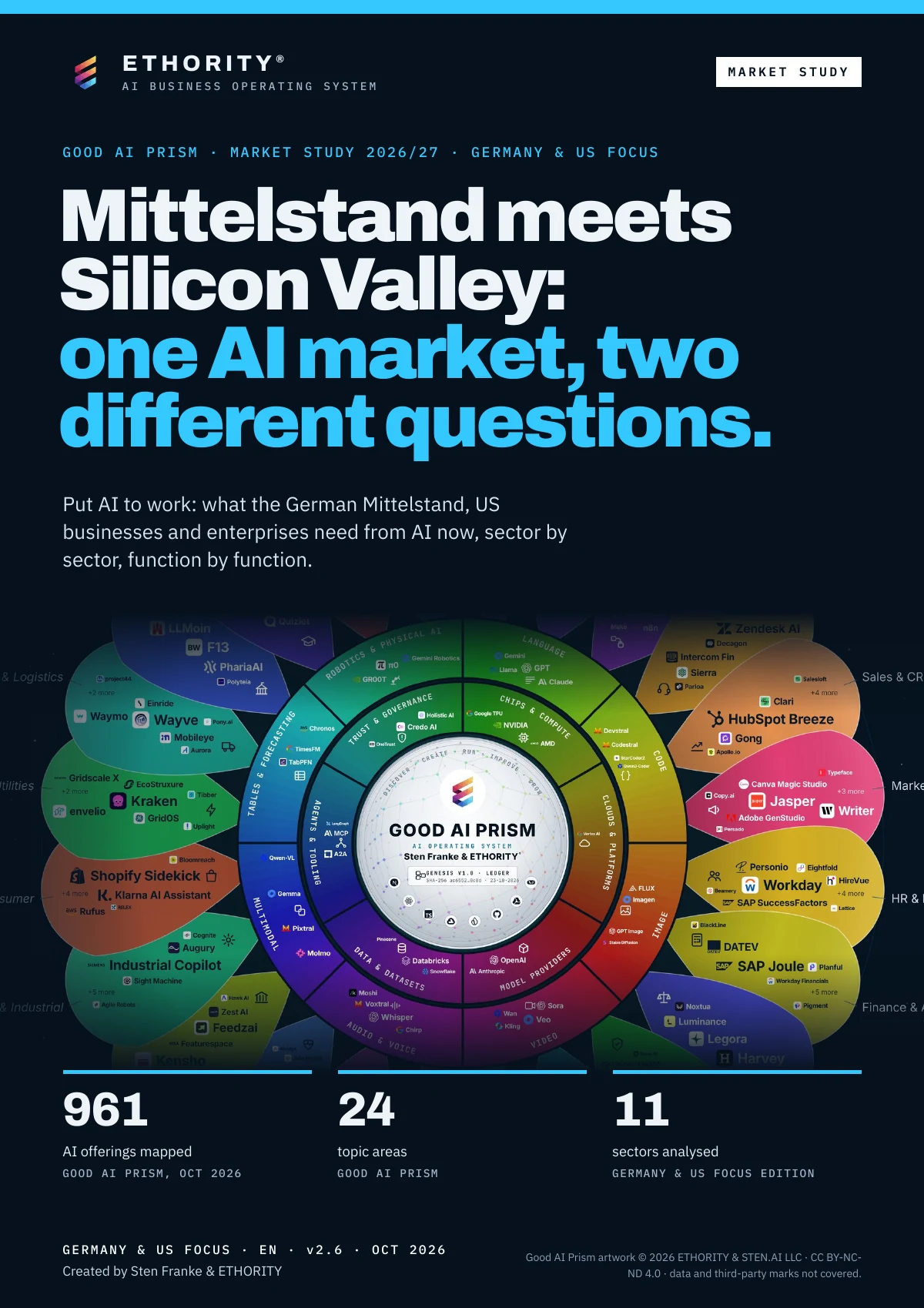
Germany & United States Focus · EN
Germany's mid-sized companies meet Silicon Valley: one AI market, two different questions.
The Mittelstand needs know-how; US firms need cost control. What German and US businesses need from AI now, sector by sector, function by function.
Version 2.6 · 72 pages
Open the study →Read on
Our long read on AI in assessment, plus ten AI ethics issues with legal dates.
Ten AI ethics issues now have legal dates.
The ten AI ethics issues of 2024 now each have a legal date, a measurable control or published evidence.
See the map on one page →
Preparing for the EU AI Act is the start; control happens in daily operation.
How to connect each EU AI Act duty to your systems, controls, evidence, monitoring and regular reassessment.
See the map on one page →
AI-first means changing how you work, not counting tools.
What has to change across the organisation: strategy, work, decision rights, knowledge, evidence and leadership.
See the map on one page →
Saved hours are not AI value.
Separate a better task, freed-up time and a business result, so you can show the value AI really delivers.
See the map on one page →Implement it with ETHORITY
Ready for 2 Dec 2027, with the works council on board.
AI Act Readiness Sprint
€6,900 one-time · net
Inventory and classification of every HR AI feature against Annex III, with owners and a plan to 2 Dec 2027.
Date and place by agreement
See what this package includes →AI Governance Setup
€19,500 one-time · net
Named owners, bounded authority and evidence for high-risk HR uses, connected to daily decisions.
Scope and delivery by agreement
See what this package includes →AI Literacy & Adoption
€2,400 one-time · net
Role-based AI literacy for HR, recruiters and managers, documented for the AI Act's Article 4.
Scope and delivery by agreement
See what this package includes →Buyer questions
Which HR AI uses carry high-risk duties under the EU AI Act?
Recruitment and selection, and decisions on promotion, termination, task allocation and performance evaluation are listed in Annex III. Duties apply from 2 Dec 2027 under Regulation (EU) 2026/1744.
Does AI in hiring work?
It can. A field experiment with about 70,000 applicants found AI-led interviews raised job starts by 18%. Research has also shown bias in model-based CV ranking, so audit before and after go-live.
Will candidate or employee data train the provider's model?
Ask in writing. In our review, 18 of the 30 HR entries document no training or opt-in only; Workday enables data contributions by default with an opt-out, and SmartRecruiters reserves use of anonymised data for Winston.
Where is HR data hosted?
19 of the 30 entries document an EU hosting option. Personio keeps assistant data in Frankfurt; Teamtailor offers Ireland or Oregon; Ashby stores data in the United States.
When should the works council be involved?
At the shortlist. Tools that can monitor performance or behaviour are subject to co-determination in Germany, and assessment tools are the fastest-growing HR use (Bitkom, Aug 2026).
The evidence at a glance
ETHORITY · LONG READ
AI starts assessing work. HR has until 2 Dec 2027.
Workload scoring by AI doubled in German firms in two years. EU high-risk duties for hiring and assessment arrive on 2 Dec 2027. Here is what the 30 mapped HR entries publish, and what to do first.
AI in HR is moving from writing job ads to judging people's work. In Germany the share of companies using AI to assess employee workload more than doubled in two years, from 6% in 2024 to 13% in 2026, and 12% already use it to assess performance, according to Bitkom's August 2026 survey of 602 firms. In the United States, 39% of organisations have implemented AI in HR, with recruiting the leading use at 27% (SHRM, April 2026).
Each step brings AI closer to decisions for which the EU sets high-risk duties. Recruitment, selection, promotion, task allocation and performance evaluation are listed in Annex III of the AI Act. Under Regulation (EU) 2026/1744, the duties for those uses apply from 2 Dec 2027. That gives HR leaders 13 months from today to know which tools they run, what they decide and who answers for them.
A market built around hiring
The HR & Workforce brief places 28 AI offerings and two provider records (Workday, Rippling) in HR & Recruiting; 15 of the 28 offerings serve recruiting and hiring. They range from job-ad writers and sourcing agents to interview note-takers and autonomous screening agents: Ashby AI, Greenhouse AI, HireVue, iCIMS Copilot, Metaview, Paradox, Phenom, Retorio, SeekOut, softgarden, Teamtailor Co-pilot, Textio, Winston from SmartRecruiters and Workable's recruiting agents. The other half are HR suites with built-in AI, such as Workday, SAP SuccessFactors, Oracle HCM, Personio, Rippling and Cegid, plus talent intelligence, learning, performance and an employee service agent.
The concentration in recruiting makes sense. Application volumes are high, the work is repetitive, and the business case is easy to state. It is also where the evidence is strongest in both directions.
+18% job starts when AI led structured interviews, in a field experiment with about 70,000 applicants (Erasmus University, Oct 2025).
What the evidence shows
On the upside, a field experiment with about 70,000 applicants found that AI-led job interviews raised job starts by 18%, with higher offer rates and better 30-day retention. On the downside, peer-reviewed research has shown name-based bias in model-based CV ranking, and enforcement of disclosure rules has been weak. New York's Local Law 144 requires bias audits of automated hiring tools, yet the State Comptroller's audit found two complaints in two years and far more potential non-compliance than the city's own review.
Both findings point the same way. AI can improve hiring when the process is structured, validated and audited before and after go-live. It cannot be bought as a black box and trusted because the vendor says it is fair.
2 Dec 2027 is the date from which EU high-risk duties apply to AI used in recruitment, selection, promotion and performance evaluation.
What providers publish about your people's data
ETHORITY's Good AI Prism research read the pricing, security and legal pages of all 30 entries in October 2026. HR is better documented than most areas on hosting: 19 of 30 document an EU hosting option. Personio states that assistant data is stored in Frankfurt and never leaves the EU. Teamtailor lets customers choose between Ireland and Oregon. Ashby states that data is stored in the United States, with EU transfers under the Data Privacy Framework or standard clauses.
Training terms matter more here than anywhere, because the data describes candidates and employees. Eighteen of 30 document that customer data is not used for training, or only with opt-in. Two state otherwise. Workday says it automatically enables data contributions for AI features in purchased products, with an opt-out. SmartRecruiters reserves the right to use anonymised or pseudonymised data to develop and train AI features for Winston. Neither is unlawful in itself. Both are decisions an employer should take consciously, with the works council where one exists.
Prices are rare
Prices are rare. Six of 30 publish one, mostly the newer recruiting tools: Job Studio charges per active job, Ashby and SeekOut publish monthly plans, 360Learning lists a per-user price. The large suites quote.
The governance gap inside HR
SHRM's survey adds an uncomfortable detail: 52% of organisations do not involve HR in their AI strategy, and only 16% of HR functions use ROI as a success measure. HR is asked to deploy tools that touch every employee, while the strategy is set elsewhere and the value is rarely measured.
In Germany the gap is legal as well as organisational. Under the Works Constitution Act, technical systems that can monitor performance or behaviour require co-determination, and employers must inform the works council about planned AI use. A tool that scores workload is exactly such a system. The practical answer is to bring the works council in at the shortlist, not after the contract.
Use case. An interview note-taker decides nothing on its own, but its summaries feed a hiring decision. Treat it as part of that process: record which interviews it covers, who reads the summaries and who decides, and show the works council before go-live.
The quieter half: service, learning and literacy
Not every HR use carries high-risk duties. The most common uses in the Bitkom survey are supportive: individual training at 16% of firms, up from 12% in 2024, work references and onboarding at 14% each, and answers to internal HR questions at 13%. These uses carry lighter duties and often faster returns, because they take routine work off HR teams without deciding anything about a person.
They still carry one duty that already applies. Since 2 Feb 2025, Article 4 of the AI Act requires employers that deploy AI systems to ensure a sufficient level of AI literacy among the staff who use them. HR usually owns that programme for the whole organisation. The practical form is simple: a record of who uses which system, what training they received, and when. It also tends to surface the tools nobody had listed.
What high-risk duties will ask of you
For high-risk uses, deployers must use systems according to the provider's instructions, assign human oversight to competent people, monitor operation, keep logs, and inform workers and their representatives before use. Providers must supply documentation, accuracy information and the basis for conformity. None of this is new to a well-run HR function. What is new is that it must be shown, per system, with evidence.
That makes the inventory the first deliverable. Many HR teams cannot list every AI feature switched on in their suite, let alone the tools recruiters bought on a card. The Bitkom data on rising assessment use suggests the list is longer than most leaders think.
What to do Monday
- List every AI feature in HR. Include suite features switched on by default and tools bought by individual recruiters.
- Classify each by intended use. Recruiting, promotion, allocation and evaluation are Annex III uses; mark them for 2 Dec 2027.
- Check training defaults. Ask each provider in writing whether candidate or employee data trains its models, and how to switch it off.
- Bring in the works council now. Share the inventory and agree how assessment tools will be introduced and reviewed.
- Set one measured outcome. Time to hire, quality of hire or retention at 90 days, with a baseline before go-live.
The Legal & Compliance topic area covers the wider AI Act calendar, and the HR & Recruiting area map holds all 30 profiles.
Sources and further reading
- ETHORITY, Good AI Prism Sector Brief: HR & Workforce, Global edition → · 22 Oct 2026
- ETHORITY, Good AI Prism research on 30 HR offerings (provider pages read 22 Oct 2026) → · 22 Oct 2026
- SHRM, State of AI in HR 2026: five critical insights for CHROs ↗ · 3 Apr 2026
- Bitkom, one in seven companies writes work references with AI (n=602) ↗ · 18 Aug 2026
- Erasmus University (ERIM), AI automation of job interviews: a natural field experiment ↗ · 28 Oct 2025
- Regulation (EU) 2026/1744 (Digital Omnibus on AI) ↗ · in force 27 Jul 2026
- Office of the New York State Comptroller, enforcement of Local Law 144 ↗ · 2 Dec 2025
- Regulation (EU) 2024/1689 (AI Act), Article 4 ↗ · 13 Jun 2024; Art. 4 applies since 2 Feb 2025
- Workday, AI data contributions ↗ · read 22 Oct 2026
- Personio, Personio Assistant ↗ · read 22 Oct 2026
- Ashby, AI notetaker security FAQ ↗ · read 22 Oct 2026
- Teamtailor, Co-pilot privacy and security ↗ · read 22 Oct 2026
- SmartRecruiters, Artificial Intelligence Addendum ↗ · read 22 Oct 2026
Put the thinking to work
AI Governance Setup →
A repeatable governance process people can operate and review. Framework mapping is not an ISO certificate or legal opinion.
A written comparison of up to three AI offerings · €195 net →
Start with one question and up to three offerings. Request a sourced comparison, provider questions and a cost sketch using your assumptions.
YOUR NEXT STEP
Discuss your question with Sten Franke.
Bring your business question or the figures you already know. ETHORITY investigates within the agreed scope; together with Sten Franke you agree the next piece of work.