 ETHORITY®
GOOD AI PRISM · TOPIC AREA · EDUCATION
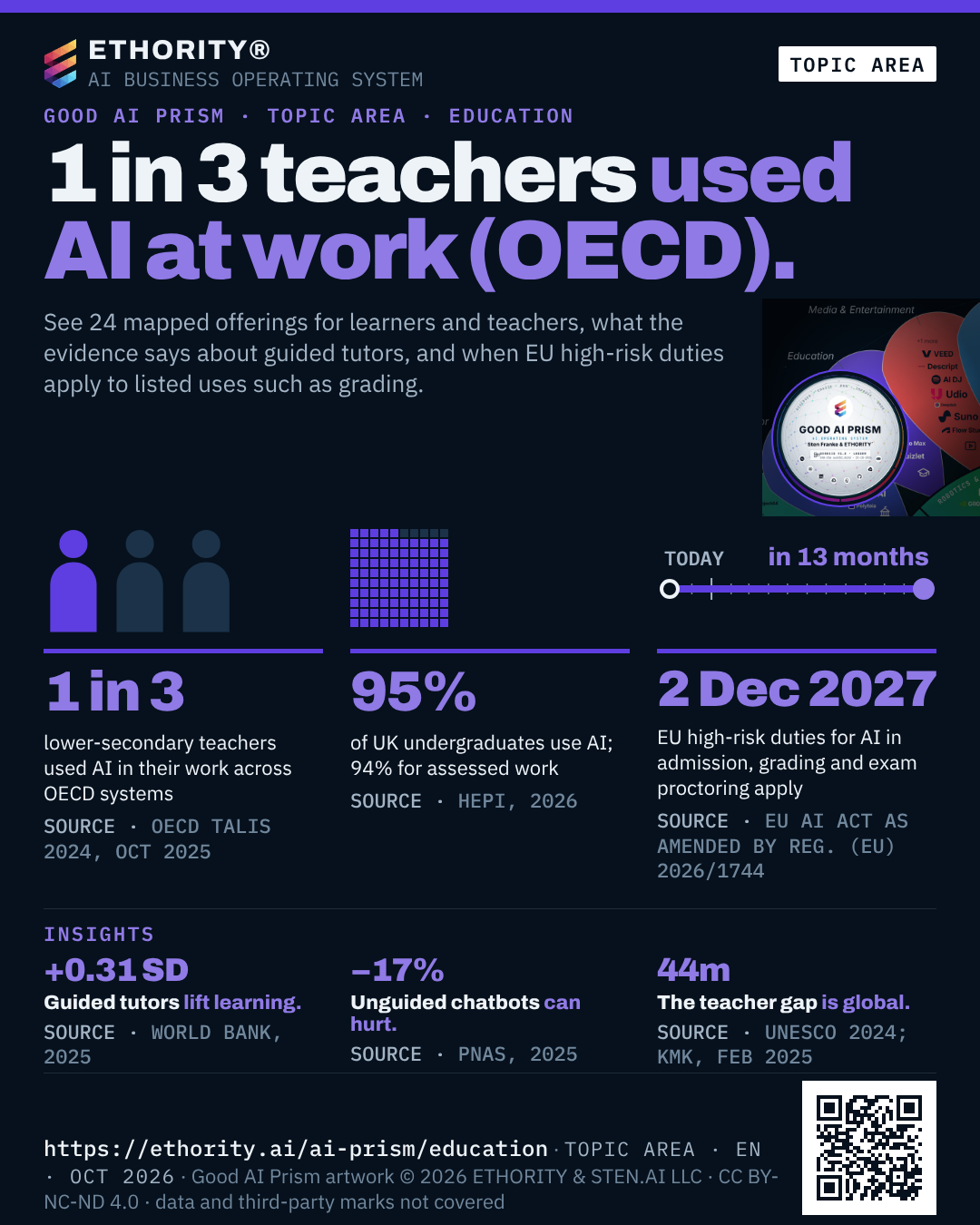
1 in 3 teachers used AI at work (OECD).
See 24 mapped offerings for learners and teachers, what the evidence says about guided tutors, and when EU high-risk duties apply to listed uses such as grading.
- 1 in 3
- lower-secondary teachers used AI in their work across OECD systemsOECD TALIS 2024, Oct 2025 · oecd.org ↗
- 24
- AI offerings mapped in EducationGood AI Prism, Oct 2026
- 95%
- of UK undergraduates use AI; 94% for assessed workHEPI, 2026 · hepi.ac.uk ↗
- 2 Dec 2027
- EU high-risk duties for AI in admission, grading and exam proctoring applyEU AI Act as amended by Reg. (EU) 2026/1744 · eur-lex.europa.eu ↗
Guided tutors lift learning.
Six weeks of guided GPT-4 tutoring in Nigeria added about 1.5–2 years of schooling (World Bank working paper).
World Bank, 2025
Unguided chatbots can hurt.
Students with plain GPT-4 access scored 17% worse on a later exam (PNAS study by Bastani).
PNAS, 2025
The teacher gap is global.
The world needs 44 million more teachers by 2030; Germany projects a gap of about 49,000 to 2035.
UNESCO 2024; KMK, Feb 2025
How to use this page
Three tools and one offer turn this page into a decision.
- Open the Education map: 24 offerings on one petal of the Good AI Prism, with logos and provider facts.
- Compare up to three offerings: decision facts side by side, each with its source and date.
- Run the Task economics calculator: turn saved hours into capacity you can attribute, before a pilot is approved.
- Offer: AI Literacy & Adoption: role-based AI literacy for teachers, trainers and support staff, documented for Article 4.
The Education brief and the study
The sector brief in English and German, and the global market study it builds on.
Global edition · EN
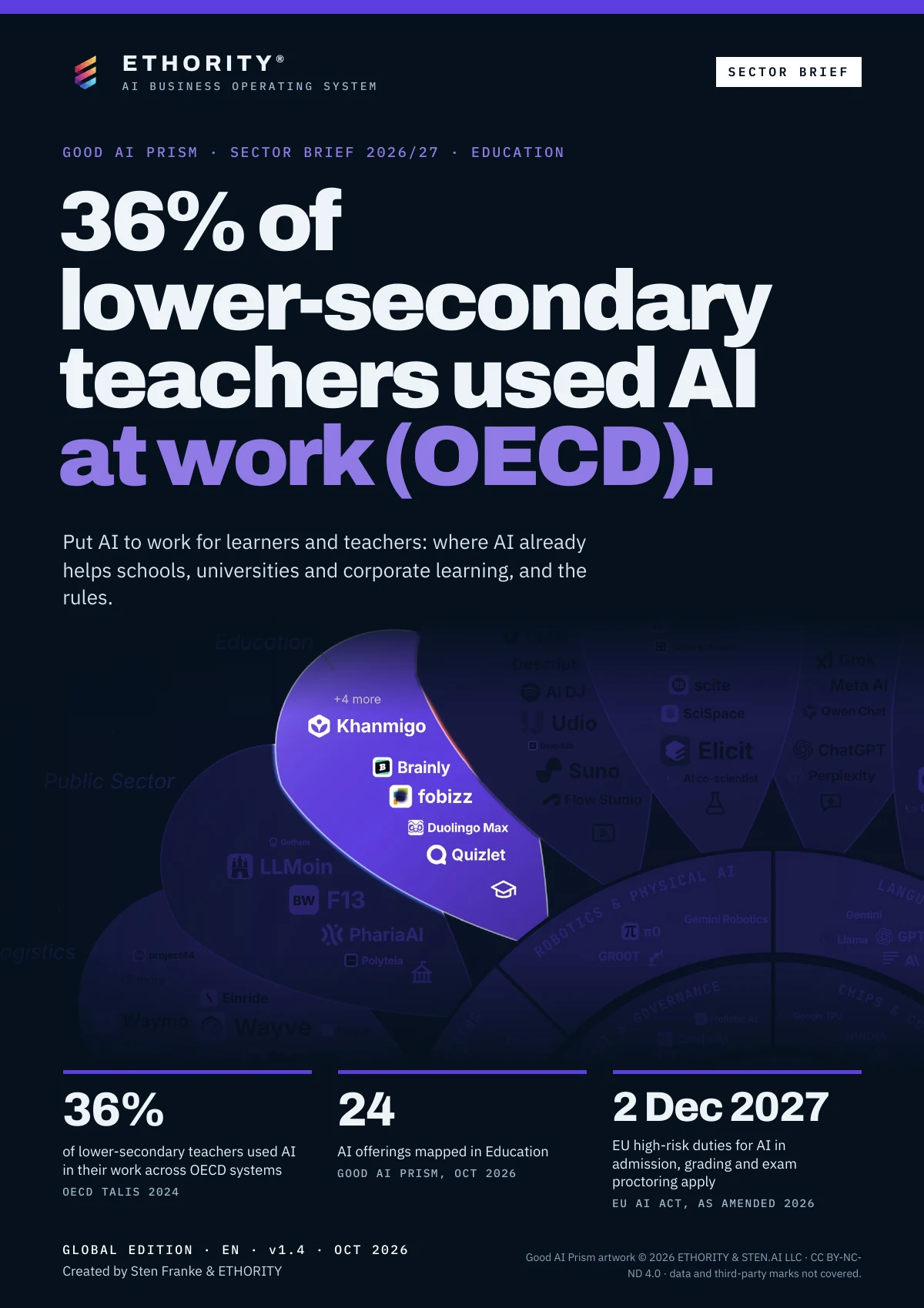
36% of lower-secondary teachers used AI at work (OECD).
From 2 Dec 2027 high-risk duties apply to certain AI in admission, grading and proctoring. Where AI already helps schools, universities and corporate learning.
Version 1.4 · 40 pages
Open the study →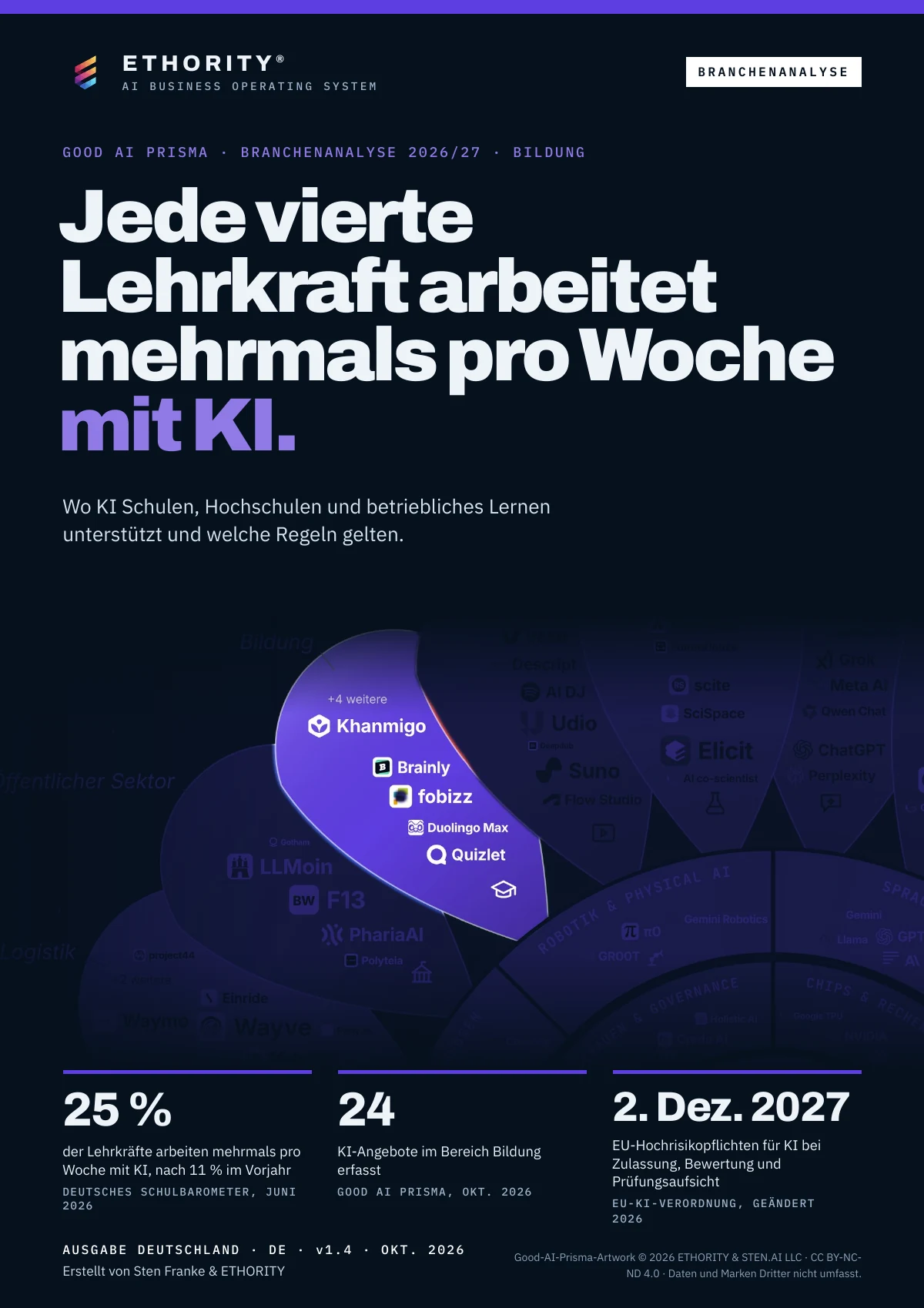
Germany · DE
Jede vierte Lehrkraft arbeitet mehrmals pro Woche mit KI.
Der Anteil hat sich binnen eines Jahres mehr als verdoppelt, von 11 % auf 25 %. Wo KI Schulen, Hochschulen und betriebliches Lernen unterstützt und welche Regeln gelten.
Version 1.4 · 38 pages
Open the study →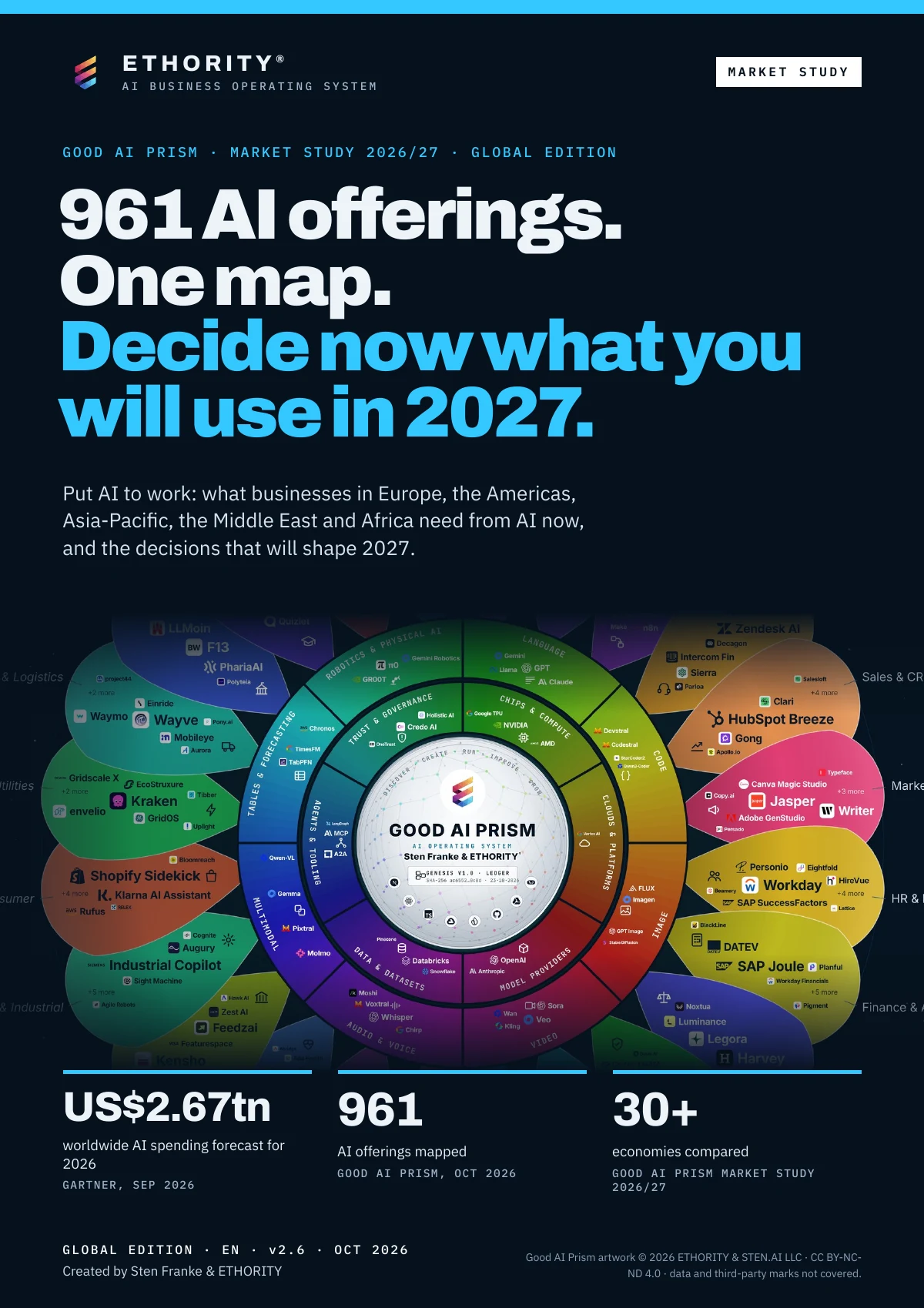
Global edition · EN
961 AI offerings. One map. Decide now what you will use in 2027.
The Good AI Prism helps you find useful AI and compare the evidence behind your options. For organisations already using AI, the question is moving from whether to use AI to which AI, how safely and whether it pays. This Global edition brings together 961 AI offerings across 24 topic areas, 8 data types and 6 technology layers, with sources, dates and limits to guide your next decision.
Version 2.6 · 90 pages
Open the study →Read next
Three related analyses from ETHORITY; the long read for this area follows further down the page.
Check every vendor claim before you rely on it.
Tie every vendor claim to the exact product, version, contract and use before you rely on it.
See the map on one page →
Ten AI ethics issues now have legal dates.
The ten AI ethics issues of 2024 now each have a legal date, a measurable control or published evidence.
See the map on one page →
AI does not scale by itself. Redesign the work.
Start with one objective, choose the simplest approach for each task and measure the cost of every result you accept.
See the map on one page →Where ETHORITY can start
Five ways in, from teacher AI literacy to a check of every tool already in use.
AI Literacy & Adoption
€2,400 one-time · net
Role-based AI literacy for the people who use, review and own AI outputs, documented for Article 4.
Scope and delivery by agreement
See what this package includes →AI Estate Audit
€25,000 one-time · net
An inventory of every AI use, including tools staff bring themselves, with a scale, fix or stop view per use.
Date and place by agreement
See what this package includes →AI Act Readiness Sprint
€6,900 one-time · net
Each use mapped to the EU AI Act and the dates that apply to it, with the duties you carry as provider or deployer.
Date and place by agreement
See what this package includes →AI Opportunity Case
Priced after scoping
One use case assessed against evidence, cost and rules, ending in a decision: pilot, redesign, expand or stop.
Scope and delivery by agreement
See what this package includes →Licensed Premium Sector Editions
Fee configured to agreed scope
The Good AI Prism for one sector under licence, with the area map and sourced profiles for your teams.
Scope and delivery by agreement
See what this package includes →Rules and dates
The dates schools, universities and academies plan against.
- 2 Feb 2025
Emotion recognition banned in education institutions; AI literacy measures expected.
Reg. (EU) 2024/1689
- 2 Aug 2026
Learners must be told when they interact with an AI system (Art. 50).
Reg. (EU) 2026/1744
- 1 Sep 2026
DigitalPakt 2.0 starts with €5bn from the federal government and the Länder.
BMBFSFJ
- 2 Dec 2026
Machine-readable marking of AI output for generative systems already on the market.
Reg. (EU) 2026/1744
- 2 Dec 2027
Annex III high-risk duties for admission, grading, steering learning and proctoring.
Reg. (EU) 2026/1744
Questions education buyers ask
Is a lesson-planning assistant high-risk?
No. Preparation is minimal risk. From 2 Dec 2027, high-risk duties under Annex III point 3 apply when a tool admits, grades, steers learning or proctors exams. The AI Act Readiness Sprint maps each use.
Which AI tutors actually improve learning?
Tutors with pedagogical guardrails. Guided tutoring raised learning in Nigeria and more than doubled gains in a Harvard course; plain chatbot access lowered later exam results by 17%.
What should we ask about pupils' data?
Where it is stored, whether it trains the provider's models, and how parents are informed. AIS.chat for all Länder is EU-hosted with no training on pupils' data.
Where should we start with teachers?
With training. Three in four non-users cite a lack of skills and 52% of German teachers want training. Our AI Literacy & Adoption programme documents it for Article 4.
How do we measure success?
Learning gains, teacher time, equity and wellbeing, measured before and after a pilot. Saved time counts when it demonstrably goes into learning. The Education sector brief lists seven pilot questions.
The evidence at a glance
ETHORITY · LONG READ
Guided AI tutors lift learning. AI grading: high-risk duties from Dec 2027.
One in three teachers already uses AI and most students do. Guided tutors raise learning, plain chatbots can lower it, and from 2 Dec 2027 EU high-risk duties apply to AI grading. What schools and academies should choose now.
Students moved first. Teachers are catching up fast.
Around one in three lower-secondary teachers used AI in their work across OECD systems in 2024, the TALIS survey found. The spread is wide: about three in four teachers in Singapore and the United Arab Emirates, 14% in France. Most use it to learn about or summarise a topic (68% of AI users) and to generate lesson plans or activities (64%). Only a quarter use it on student participation or performance data.
Germany moved within a year. The share of teachers who use AI for work several times a month or more rose from under a third to 52%, the German School Barometer reports. Students are further ahead still: 84% of German 12- to 19-year-olds have used ChatGPT and 74% use AI for homework. In the UK, 95% of undergraduates use AI and 94% use it for assessed work, according to HEPI. In the US, 54% of teens have used chatbots for schoolwork.
52% of German teachers use AI for work several times a month or more (Schulbarometer 2026)
The question for schools, universities and company academies is no longer whether AI is in the classroom. It arrived on students' phones. The question is whether it improves learning.
Design decides the effect
The evidence is now clear on one point. AI designed for teaching raises learning; unguided use can weaken it.
| Study | Setting | Result |
|---|---|---|
| World Bank, 2025 | Six weeks of guided GPT-4 tutoring, Nigeria | +0.31 standard deviations, about 1.5–2 years of schooling |
| Kestin et al., 2025 | AI tutor in a Harvard physics course | Learning gains more than doubled |
| Bastani et al., PNAS 2025 | Plain GPT-4 access, Turkish high schools | 17% worse on a later exam |
Sources: as listed; effect sizes as reported by the authors.
The guided-tutoring study in Nigeria and the Harvard physics trial used tools with pedagogical guardrails: they ask, prompt and check rather than hand out answers. The PNAS study from Turkey gave students plain chatbot access; they practised faster and learned less. The OECD reaches the same conclusion in its Digital Education Outlook 2026: tools built for teaching work better than general chatbots.
For a buyer this is the most useful filter in the market. Ask what the tool does when a learner asks for the answer.
A profession under pressure
The world needs 44 million more teachers by 2030, UNESCO estimates. A quarter of teachers in OECD systems work in schools where shortages limit teaching. In Germany the education ministers project a gap of about 49,000 teachers to 2035, concentrated in lower secondary and vocational schools.
Skills are the barrier, not interest. Three in four teachers who do not use AI cite a lack of knowledge, and 52% of German teachers say they need training. Teachers are also cautious: two thirds expect negative effects on critical thinking, while 59% see benefits for individual support. Training is where the time returned by AI should go first.
That makes the people side part of every pilot, not an afterthought. A workforce annex names the teachers, trainers and support staff a pilot touches, measures preparation, marking and administration time before anything changes, and sets a training plan with an owner. It brings in staff councils, school leadership, parents and learner representatives early. It names the teacher or trainer accountable for every grade and learning decision, and it says how learners and parents can challenge an AI-supported result. Finally it decides where returned time goes: individual support, feedback or professional learning. Saved time is not realised value until it demonstrably goes into learning.
What the market offers
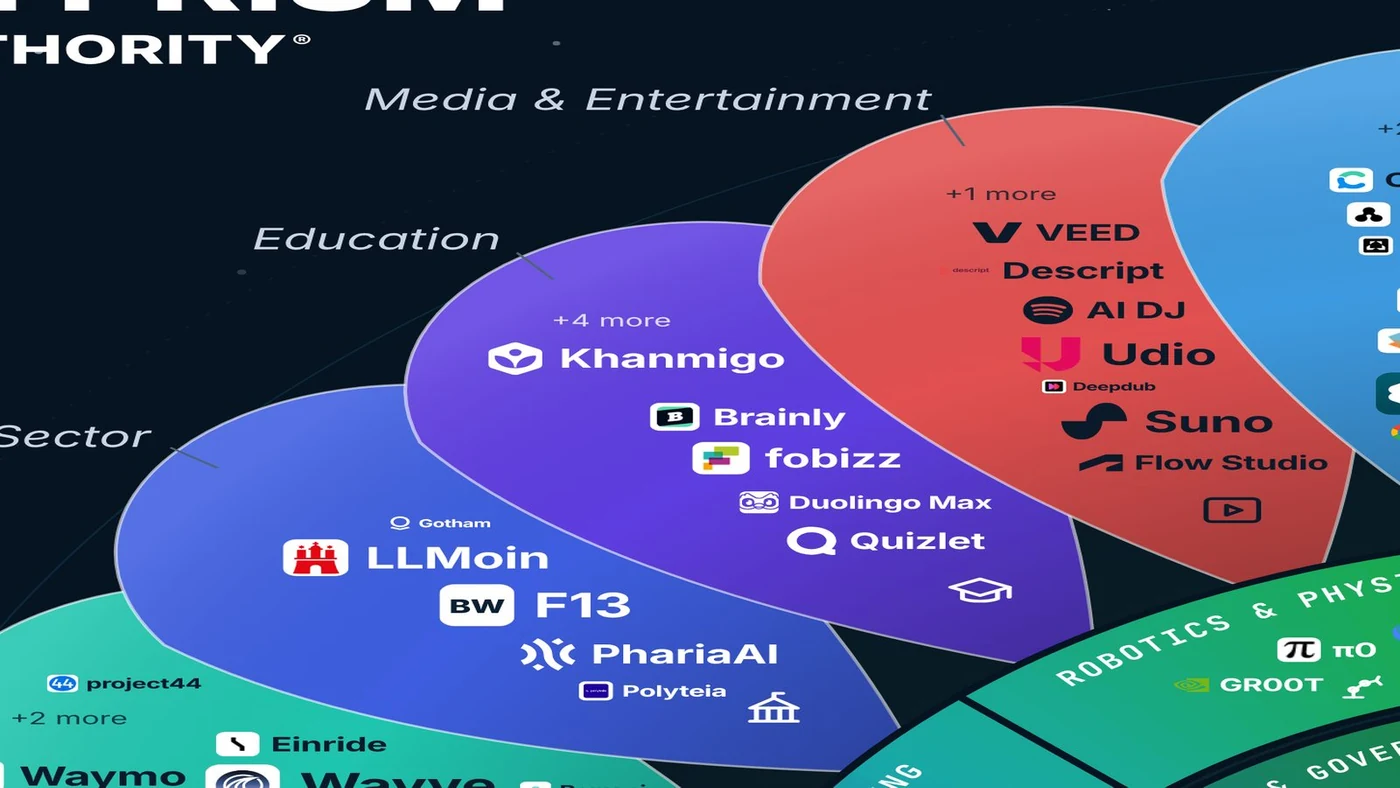
The Good AI Prism maps 24 offerings in Education, each with a dated source from the provider's own pages. Seven serve corporate learning and course creation, among them 360Learning, Area9 Rhapsode, Docebo Harmony and Sana Learn from Workday. Six help teachers prepare lessons: Brisk Teaching, Eduaide, fobizz, MagicSchool, TeacherMatic and to-teach. Six tutor students directly, including AIS.chat, Khanmigo from Khan Academy, simpleclub and Skye from Third Space Learning. Three are course, language and study tools such as Duolingo Max and NotebookLM, and two support assessment: Gradescope and Kahoot!. 12 of the 24 offerings come from providers headquartered in Europe, five of them in Germany. Ownership matters too: Workday owns Sana, Turnitin owns Gradescope, and Jisc owns TeacherMatic, so a school buying a small tool may be contracting with a much larger group. The order is alphabetical, not a ranking. The full map sits in the Education sector brief.
Germany shows the shared route. AIS.chat, formerly telli, is one AI chatbot for schools run by FWU for all 16 Länder, hosted in the EU, with pupils' data not used for training, as the FWU announcement sets out. DigitalPakt 2.0 adds €5 billion from the federal government and the Länder from 1 September 2026, with AI focused on teacher training.
Grading: high-risk duties from Dec 2027
Europe's AI Act, as amended by the Digital Omnibus on AI, already bans emotion recognition in education institutions since 2 February 2025. Since 2 August 2026, learners must be told when they interact with an AI system. By 2 December 2026, generative systems already on the market must mark their output in a machine-readable way. From 2 December 2027, AI used for admission, evaluating learning outcomes, steering the learning process, deciding the level of education or proctoring exams carries high-risk duties under Annex III.
2 Dec 2027 EU high-risk duties for AI in admission, grading and exam proctoring apply
The AI Act classifies uses, not products. A lesson-planning assistant is minimal risk; the same vendor's feature that grades essays falls under the high-risk duties. Elsewhere the rules come from ministries and regulators. England's exam regulator asked exam boards in March 2026 to strengthen detection of AI misuse, and 65% of UK students say assessment has already changed because of AI.
In practice
Use case: one chatbot for all Länder. AIS.chat, formerly telli, is one AI chatbot for schools, run by FWU for all 16 Länder, hosted in the EU, with pupils' data not used for training. A single shared contract settles hosting, training and exit for every school that joins.
Scenario: an essay-feedback tool. A secondary school pilots a tool that comments on essays before they are handed in. As long as it gives hints and teachers set every grade, the school records it as learning support. Once its score enters the report card, it evaluates learning outcomes and carries high-risk duties from 2 December 2027. The school decides and documents which side of that line the pilot sits on before the first essay is uploaded.
What to do Monday
- List every tool in use. Include those teachers and students bring themselves, and note where pupils' data is stored and whether it is used for training.
- Separate support from grading. Lesson preparation and tutoring stay low-risk; admission, grading, steering learning and proctoring need high-risk controls by December 2027.
- Prefer tools built for learning. Ask for evidence of learning gains for your age group and for the guardrails that stop the tool from handing out answers.
- Train teachers first. Document AI literacy measures, funded through programmes such as DigitalPakt 2.0, and keep a teacher accountable for every grade.
- Redesign assessment. Adapt assignments and exams to a world where AI is always available, and measure learning gains, teacher time and equity before scaling.
The Public Sector topic area applies the same AI Act calendar to administrations, and the global market study sets education against ten other sectors.
Sources and further reading
- OECD, Results from TALIS 2024 (about 280,000 teachers, 55 systems) ↗ · Oct 2025
- Robert Bosch Stiftung, Deutsches Schulbarometer 2026 (forsa, n = 1,547) ↗ · 23 Jun 2026
- mpfs, JIM-Studie 2025 ↗ · Nov 2025
- HEPI and Kortext, Student Generative AI Survey 2026 ↗ · 2026
- Pew Research Center, How teens use and view AI ↗ · 24 Feb 2026
- UNESCO and Teacher Task Force, Global Report on Teachers ↗ · 2024
- KMK teacher demand projection, via News4teachers ↗ · Feb 2025
- De Simone et al., World Bank Policy Research Working Paper 11125 ↗ · 2025
- Kestin et al., AI tutoring RCT, Scientific Reports 15:17458 ↗ · 2025
- Bastani et al., Generative AI without guardrails can harm learning, PNAS 122(26) ↗ · 2025
- OECD, Digital Education Outlook 2026 ↗ · Jan 2026
- Regulation (EU) 2024/1689 (AI Act), Art. 4, 5, 50, Annex III point 3 ↗ · 12 Jul 2024
- Regulation (EU) 2026/1744 (Digital Omnibus on AI) ↗ · 27 Jul 2026
- BMBFSFJ, DigitalPakt 2.0 starts on 1 September ↗ · 19 Aug 2026
- FWU, telli becomes AIS.chat ↗ · May 2026
- Ofqual, letter to exam board chief executives ↗ · 2 Mar 2026
- ETHORITY, Good AI Prism Sector Brief: Education, Global edition 1.4 → · 27 Oct 2026
Put the thinking to work
AI Readiness & Maturity Check →
Leadership can agree where to start, who owns each action and which next project is justified. This is not a technical system audit or vendor selection.
A written comparison of up to three AI offerings · €195 net →
Start with one question and up to three offerings. Request a sourced comparison, provider questions and a cost sketch using your assumptions.
YOUR NEXT STEP
Discuss your question with Sten Franke.
Bring your business question or the figures you already know. ETHORITY investigates within the agreed scope; together with Sten Franke you agree the next piece of work.