 ETHORITY®
GOOD AI PRISM · TOPIC AREA · PUBLIC SECTOR
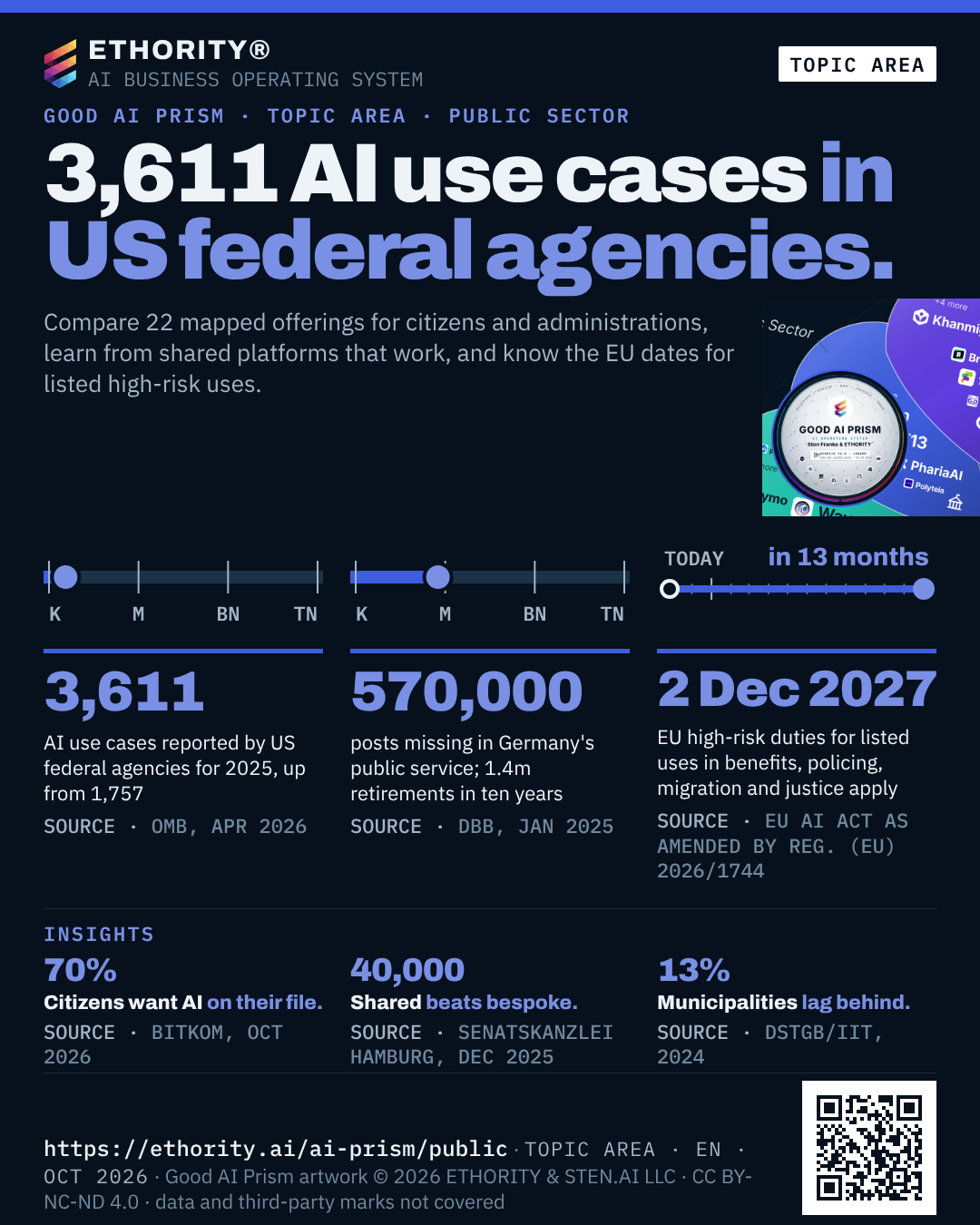
3,611 AI use cases in US federal agencies.
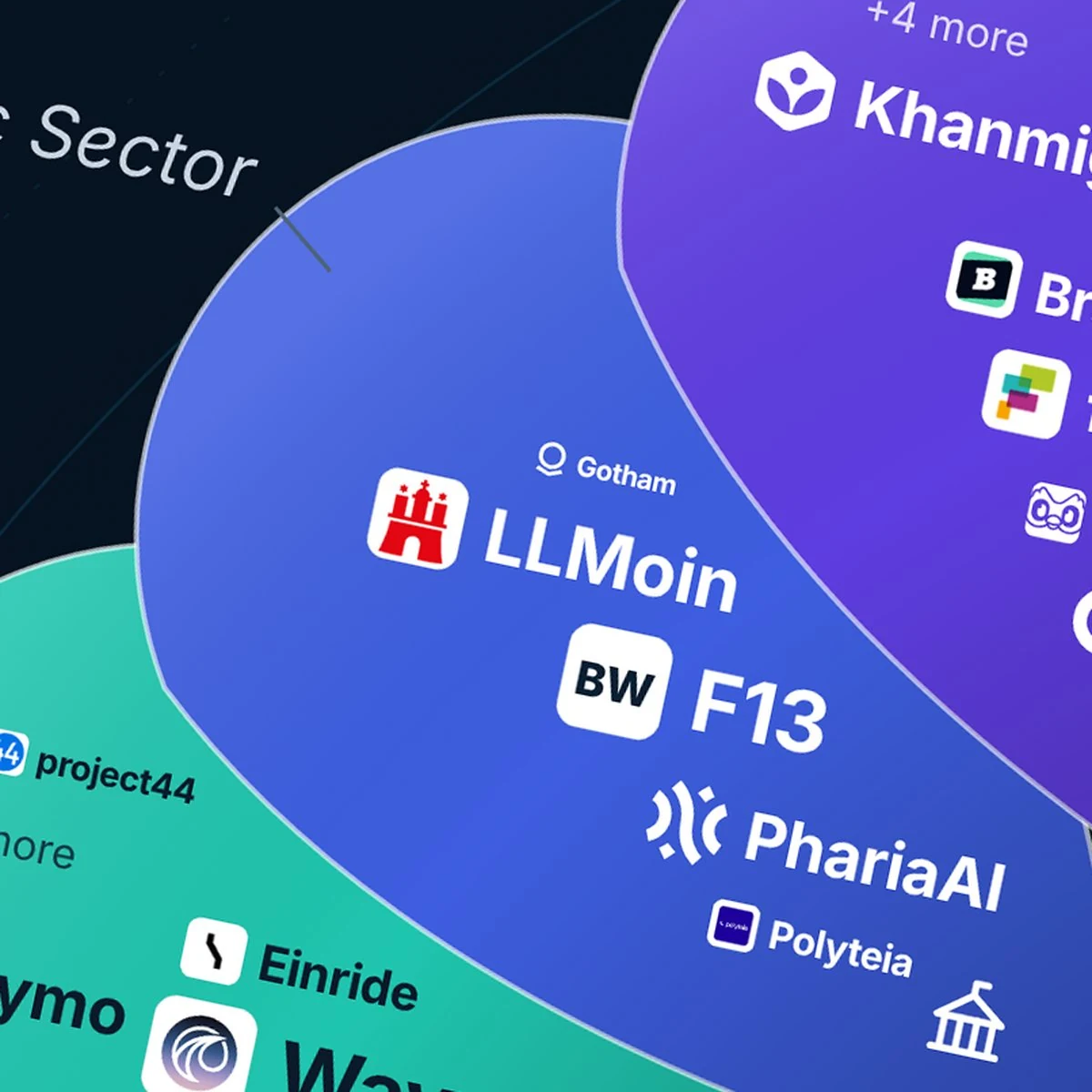
Compare 22 mapped offerings for citizens and administrations, learn from shared platforms that work, and know the EU dates for listed high-risk uses.
- 3,611
- AI use cases reported by US federal agencies for 2025, up from 1,757OMB, Apr 2026 · github.com ↗
- 22
- AI offerings mapped in the Public SectorGood AI Prism, Oct 2026
- 570,000
- posts missing in Germany's public service; 1.4m retirements in ten yearsdbb, Jan 2025 · presseportal.de ↗
- 2 Dec 2027
- EU high-risk duties for AI in benefits, policing, migration and justice applyEU AI Act as amended by Reg. (EU) 2026/1744 · eur-lex.europa.eu ↗
Citizens want AI on their file.
Seven in ten Germans want AI used when their application is processed; only 12% want it to decide alone (Bitkom survey on AI).
Bitkom, Oct 2026
Shared beats bespoke.
Hamburg's assistant LLMoin reaches 40,000 staff and four more states adopt it, a model for sovereign platforms (Senatskanzlei Hamburg release).
Senatskanzlei Hamburg, Dec 2025
Municipalities lag behind.
13% of German municipalities used AI or automated systems in 2024, up from 8%, while 43% report an acute staff need.
DStGB/iit, 2024
How to use this page
Three tools and one offer turn this page into a decision.
- Open the Public Sector map: 22 offerings on one petal of the Good AI Prism, with logos and provider facts.
- Compare up to three offerings: decision facts side by side, each with its source and date.
- Run the Task economics calculator: turn saved hours into capacity you can attribute, before a pilot is approved.
- Offer: AI Act Readiness Sprint: each use mapped to the AI Act dates, with the impact assessment planned before 2 Dec 2027.
The Public Sector brief and the study
The sector brief in English and German, and the global market study it builds on.
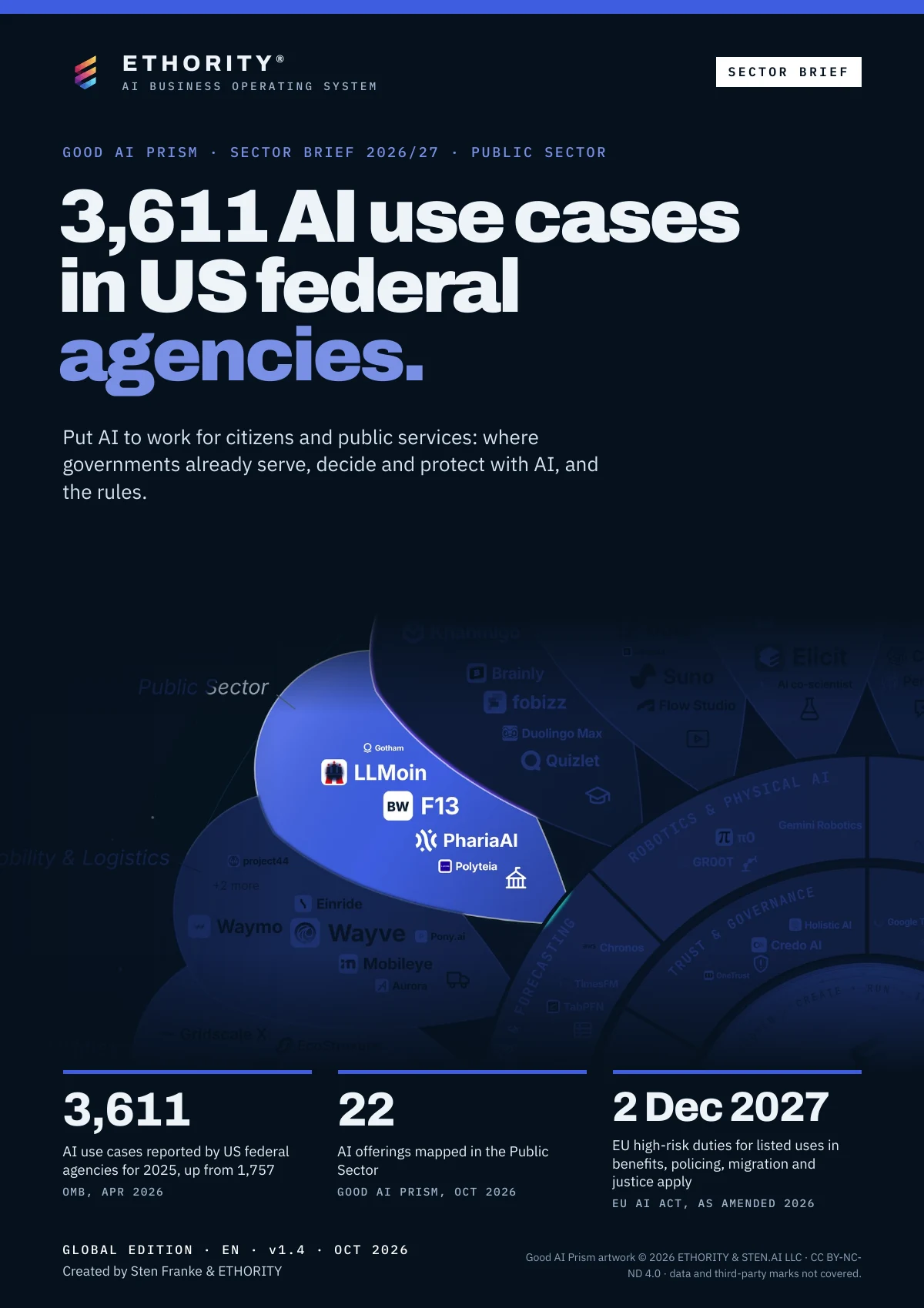
Global edition · EN
3,611 AI use cases in US federal agencies.
US federal AI use cases more than doubled in a year. Where governments already serve, decide and protect with AI, and the rules that apply.
Version 1.4 · 40 pages
Open the study →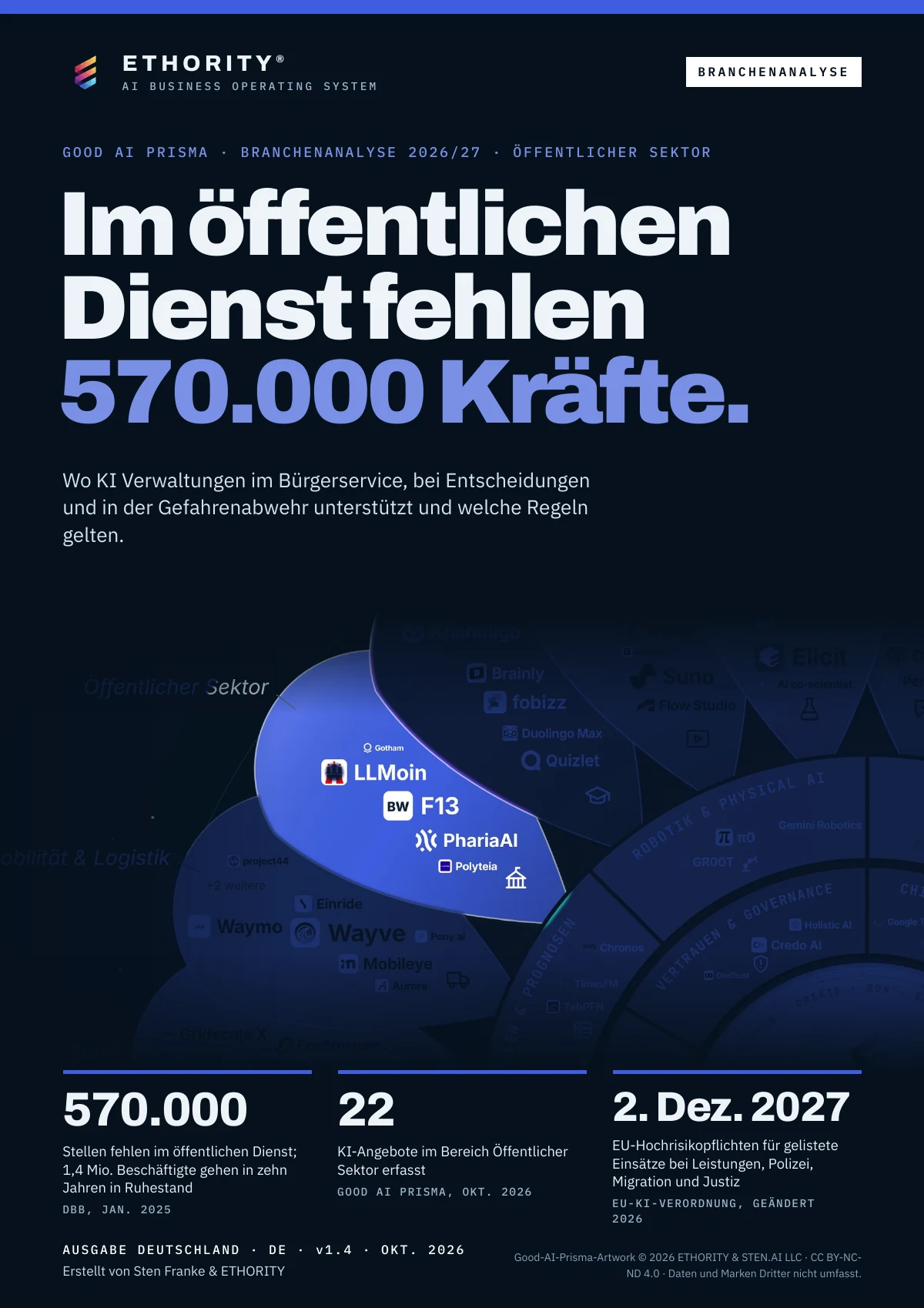
Germany · DE
Im öffentlichen Dienst fehlen 570.000 Kräfte.
1,4 Mio. Beschäftigte gehen in zehn Jahren in Ruhestand. Wo KI Verwaltungen im Bürgerservice, bei Entscheidungen und in der Gefahrenabwehr unterstützt und welche Regeln gelten.
Version 1.4 · 38 pages
Open the study →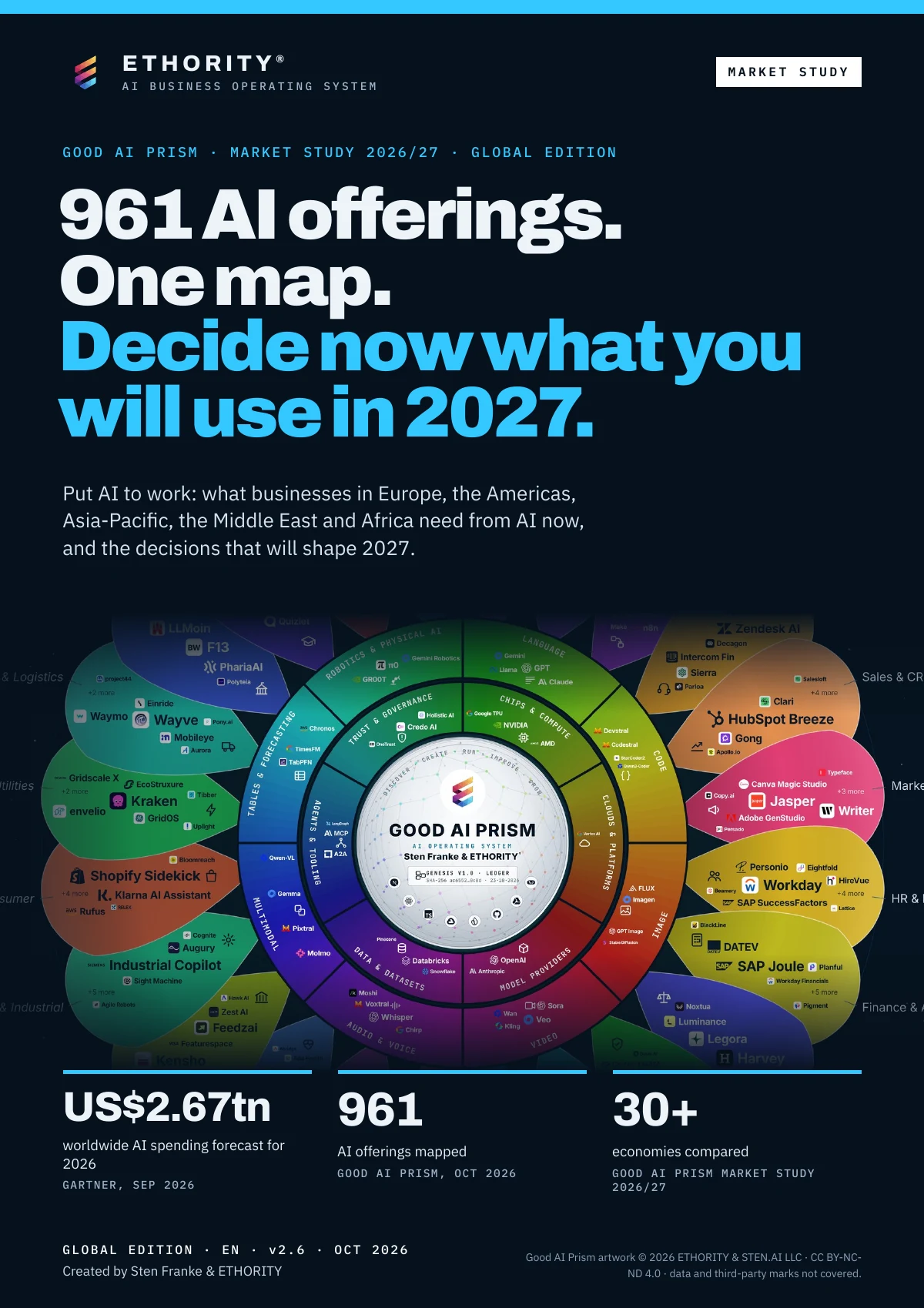
Global edition · EN
961 AI offerings. One map. Decide now what you will use in 2027.
The Good AI Prism helps you find useful AI and compare the evidence behind your options. For organisations already using AI, the question is moving from whether to use AI to which AI, how safely and whether it pays. This Global edition brings together 961 AI offerings across 24 topic areas, 8 data types and 6 technology layers, with sources, dates and limits to guide your next decision.
Version 2.6 · 90 pages
Open the study →Read next
Three related analyses from ETHORITY; the long read for this area follows further down the page.
A list of AI agents does not control them.
What controls AI agents in daily operation: clear rights, a record of how well each fact is supported, checks matched to the risk, data limits and alerts when something changes.
See the map on one page →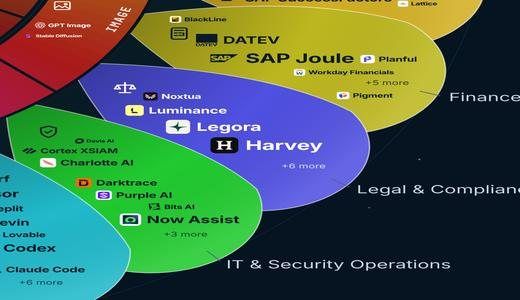
Preparing for the EU AI Act is the start; control happens in daily operation.
How to connect each EU AI Act duty to your systems, controls, evidence, monitoring and regular reassessment.
See the map on one page →
AI rules move from documents into daily operation.
Why AI agents, tools and constant change move AI governance – the rules and responsibilities for AI – into the systems that run your AI every day.
See the map on one page →Where ETHORITY can start
Five ways in, from an inventory of AI already in use to governance that holds after the pilot.
AI Estate Audit
€25,000 one-time · net
An inventory of every AI use, including tools staff bring themselves, with a scale, fix or stop view per use.
Date and place by agreement
See what this package includes →AI Act Readiness Sprint
€6,900 one-time · net
Each use mapped to the EU AI Act and the dates that apply to it, with the duties you carry as provider or deployer.
Date and place by agreement
See what this package includes →AI Opportunity Case
Priced after scoping
One use case assessed against evidence, cost and rules, ending in a decision: pilot, redesign, expand or stop.
Scope and delivery by agreement
See what this package includes →AI Literacy & Adoption
€2,400 one-time · net
Role-based AI literacy for the people who use, review and own AI outputs, documented for Article 4.
Scope and delivery by agreement
See what this package includes →AI Governance Setup
€19,500 one-time · net
Owners, controls, registers and review routines that keep AI decisions accountable every day.
Scope and delivery by agreement
See what this package includes →Rules and dates
The dates public administrations plan against.
- 2 Feb 2025
EU prohibitions apply, including social scoring; AI literacy measures expected.
Reg. (EU) 2024/1689
- 27 Mar 2025
German federal guideline on AI sets human oversight, disclosure and registration.
BMDS
- 2 Aug 2026
Transparency: people must be told when they interact with an AI system (Art. 50).
Reg. (EU) 2026/1744
- 2 Dec 2027
Annex III high-risk duties for benefits, policing, migration and justice; fundamental-rights impact assessment for public deployers.
Reg. (EU) 2026/1744
- 2 Aug 2030
High-risk AI already used by public authorities must fully comply.
Reg. (EU) 2024/1689 as amended
Questions public buyers ask
Is our citizen chatbot high-risk under the AI Act?
Usually not, if it answers questions and must disclose that it is AI (Art. 50, since 2 Aug 2026). From 2 Dec 2027, high-risk duties under Annex III apply when it decides access to benefits or services. The AI Act Readiness Sprint maps each use.
May AI issue an administrative decision on its own in Germany?
Only with a legal basis: under section 35a of the Administrative Procedure Act a fully automated act needs one and leaves no room for discretion. The federal guideline also requires human oversight.
Should we buy our own assistant or join a shared platform?
Check shared platforms first. Hamburg's LLMoin rollout reaches 40,000 staff and four more states; F13 is open source; a federal platform is being built. Write hosting and exit terms into any contract.
What do we need before 2 Dec 2027?
An inventory of every AI use, a classification of uses in benefits, policing, migration and justice, a fundamental-rights impact assessment for those, and a named accountable official for each. The Public Sector sector brief lists seven questions.
How do we prove that AI helped citizens?
Measure processing time, backlog, appeals and satisfaction before and after the pilot. Saved hours count only when they demonstrably flow into faster, better service.
The evidence at a glance
ETHORITY · LONG READ
Government AI doubles to 3,611 uses. Rules land Dec 2027.
US federal agencies reported twice as many AI uses in a year. Germany is short 570,000 public servants. Europe's high-risk duties apply from 2 Dec 2027. What public leaders can buy, share and decide now.
The count doubled in a year
US federal agencies reported 3,611 AI use cases for 2025, up from 1,757 a year earlier, according to the OMB federal use-case inventory. 858 of them use generative AI and 117 agentic AI. 445 are classed as high-impact, the category that triggers risk practices for agencies. Government AI is no longer a lab exercise. It is a portfolio, and portfolios need owners.
The topic mix tells you where the work is. Science leads with 21.0% of use cases, followed by administrative functions and IT. Service delivery, the part citizens actually see, is still small.
| Topic area | Share of 3,611 US federal AI use cases, 2025 |
|---|---|
| Science | 21.0% |
| Administrative functions | 11.9% |
| IT | 10.9% |
| Law enforcement | 7.9% |
| Health and medical | 7.5% |
| Service delivery | 4.2% |
Source: OMB inventory raw data, status 13 Apr 2026; ETHORITY tally; 16.7% without topic.
The UK moves in the same direction from a lower base. The National Audit Office found in March 2024 that 37% of 87 central government bodies had deployed AI, and 70% were piloting or planning it. Analysing about 500 public consultations a year takes UK government roughly 75,000 working days, which is why a consultation tool became one of the first AI projects with a clear time account.
Germany's driver is people, not technology
Germany's public service employs about 5.5 million people, 12% of everyone in work, according to Destatis. The civil servants' federation dbb counts 570,000 missing posts today and 1.4 million retirements within ten years. 43% of municipalities report an acute need for staff, 61% of large cities.
570,000 posts missing in Germany's public service (dbb, Jan 2025)
That is the frame for every AI decision in German administration. AI is a capacity strategy first. Every hour it returns has to land in case work, citizen contact or the backlog, or it is not value at all.
Citizens are ahead of their administrations. In Bitkom's October 2026 survey, 74% of Germans say authorities take too long and 70% want AI used when their application is processed, up from 63% a year earlier. Only 12% want AI to decide alone. That is the public mandate in one line: AI prepares, a person decides.
The people side breaks first when agendas move fast: half-adopted tools, skills that lag the system, staff who were not involved and decisions no one owns. A pilot charter therefore needs a workforce annex. It names the case-work and service roles the pilot touches, measures today's processing times, backlogs and error rates before anything changes, plans training for operating, reviewing and challenging the system, and names the official accountable for every decision that affects a citizen. It also says where returned time goes: complex cases, citizen contact, backlog or training, and who decides that. Without it, saved minutes evaporate into the next queue.
Municipal adoption trails. 13% of German municipalities used AI or automated systems in 2024, up from 8% a year earlier, the DStGB/iit Zukunftsradar shows.
Build once, share widely
The strongest German pattern is shared, sovereign platforms rather than a hundred separate chatbots. Hamburg's assistant LLMoin reaches 40,000 staff, and four more states adopt it. Baden-Württemberg's F13 is open source. In May 2026 the federal government commissioned a sovereign AI platform from Deutsche Telekom and SAP as part of the Deutschland-Stack.
For a state ministry or a district office, the buying question changes. It is no longer "which assistant?" but "which shared platform do we join, where is the model hosted, and how do we leave?". Hosting, model choice and exit terms decide long-term control more than any feature list.
Seven AI offerings for citizens, four for police and rescue
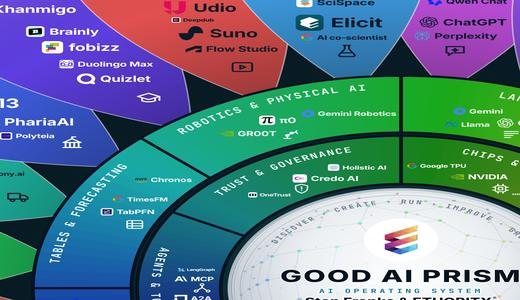
The Good AI Prism maps 22 offerings in the Public Sector area, each with a dated source from the provider's own pages. Seven serve citizens through chat, phone and participation, among them Citibot, CivicPlus Agent, convaise Studio, fonio and Go Vocal. Five are administrative assistants and sovereign platforms: Assistent.iQ from Bundesdruckerei, F13, Fabasoft eGov-Suite, LLMoin and PhariaAI from Aleph Alpha. Four support police and emergency services, including tools from Axon, Mark43 and Motorola Solutions. Four are data and decision platforms such as Palantir Gotham and Tyler AI, and two handle documents and procurement. 10 of the 22 offerings come from providers headquartered in Europe, seven of them in Germany, and 12 from providers headquartered in North America. The order is alphabetical, not a ranking. The full map sits in the Public Sector sector brief.
The market moves while you buy. Axon acquired Prepared in October 2025. Cohere and Aleph Alpha agreed to merge in September 2026. A procurement file written in spring can describe a different company by autumn, so tender documents need change-of-control and exit clauses as standard.
The rules have dates
Europe's AI Act, as amended by the Digital Omnibus on AI in force since 27 July 2026, sets the calendar. Prohibitions, including social scoring, apply since 2 February 2025. Since 2 August 2026, people must be told when they deal with an AI system. From 2 December 2027, AI that decides eligibility for public benefits, supports law enforcement, migration, asylum and border control, or the administration of justice carries high-risk duties under Annex III, and public deployers run a fundamental-rights impact assessment under Article 27. High-risk systems already in use by public authorities must fully comply by 2 August 2030.
2 Dec 2027 EU high-risk duties for AI in benefits, policing, migration and justice apply
Germany adds its own building blocks: the federal guideline on AI with human oversight, disclosure and registration; the MaKI marketplace and register; and section 35a of the Administrative Procedure Act, under which a fully automated administrative act needs a legal basis and leaves no room for discretion. The UK made algorithmic transparency records mandatory across departments. Australia's policy since 15 December 2025 requires a use-case register, an accountable owner and an impact assessment.
The AI Act classifies uses, not products. The same assistant is minimal risk when it writes a letter and falls under the high-risk duties when it decides a benefit claim. That is why the inventory comes before the tender.
In practice
Use case: one assistant, many administrations. Hamburg's assistant LLMoin reaches 40,000 staff, and four more states adopt it. One shared platform settles hosting, model choice and exit once, instead of in a hundred separate tenders, and every new administration starts with a tested setup.
Scenario: from letter to decision. A district office uses an assistant to write letters to citizens, a minimal-risk use. When the same assistant is asked to pre-sort benefit claims by eligibility, it becomes a high-risk use under Annex III from 2 December 2027, with registration, human oversight and a fundamental-rights impact assessment. Because the inventory records uses rather than tools, the change is visible before it happens.
What to do Monday
- Inventory every use. List each AI use, including tools staff bring themselves, and record it in a register such as MaKI or the UK standard.
- Separate assistance from decisions. Mark every use that touches benefits, policing, migration or justice, and plan the impact assessment for December 2027 now.
- Join before you buy. Check shared platforms such as LLMoin, F13 and the federal platform before a new tender; write hosting, model choice and exit into every contract.
- Measure what citizens feel. Record processing time, backlog, appeals and satisfaction before a pilot, and scale only on the measured change.
- Bring people in early. The staff council, data protection and the named official accountable for each decision belong in the pilot charter from day one.
The Good AI Prism Global Market Study puts the public sector next to ten other sectors; the Education topic area shows the same rule dates applied to schools.
Sources and further reading
- OMB, 2025 Federal Agency AI Use Case Inventory (raw data, status 13 Apr 2026) ↗ · 13 Apr 2026
- Nextgov, Agencies report over 3,000 AI use cases for 2025 ↗ · Apr 2026
- National Audit Office, Use of AI in government ↗ · 15 Mar 2024
- DSIT, Humphrey tool reviews consultation responses ↗ · 14 May 2025
- dbb beamtenbund und tarifunion, staff gap in the public service ↗ · 24 Jan 2025
- Destatis, Public service staff ↗ · 22 Jun 2026
- Bitkom, survey on AI in public administration (n = 1,004) ↗ · 6 Oct 2026
- DStGB and iit, Zukunftsradar Digitale Kommune 2024 ↗ · 2024
- Senatskanzlei Hamburg, LLMoin ↗ · 15 Dec 2025
- Deutsche Telekom, sovereign AI platform for the federal government ↗ · 21 May 2026
- Regulation (EU) 2024/1689 (AI Act) ↗ · 12 Jul 2024
- Regulation (EU) 2026/1744 (Digital Omnibus on AI) ↗ · 27 Jul 2026
- BMDS, Guideline on AI in the federal administration ↗ · 27 Mar 2025
- IT-Planungsrat, MaKI marketplace and register ↗ · 2025
- GDS, ATRS mandatory across government ↗ · 8 May 2025
- DTA Australia, AI policy update ↗ · Dec 2025
- SiliconANGLE, Cohere and Aleph Alpha agree to merge ↗ · 16 Sep 2026
- ETHORITY, Good AI Prism Sector Brief: Public Sector, Global edition 1.4 → · 27 Oct 2026
Put the thinking to work
AI Governance Setup →
A repeatable governance process people can operate and review. Framework mapping is not an ISO certificate or legal opinion.
A written comparison of up to three AI offerings · €195 net →
Start with one question and up to three offerings. Request a sourced comparison, provider questions and a cost sketch using your assumptions.
YOUR NEXT STEP
Discuss your question with Sten Franke.
Bring your business question or the figures you already know. ETHORITY investigates within the agreed scope; together with Sten Franke you agree the next piece of work.