 ETHORITY®
GOOD AI PRISM · TOPIC AREA · RETAIL & CONSUMER
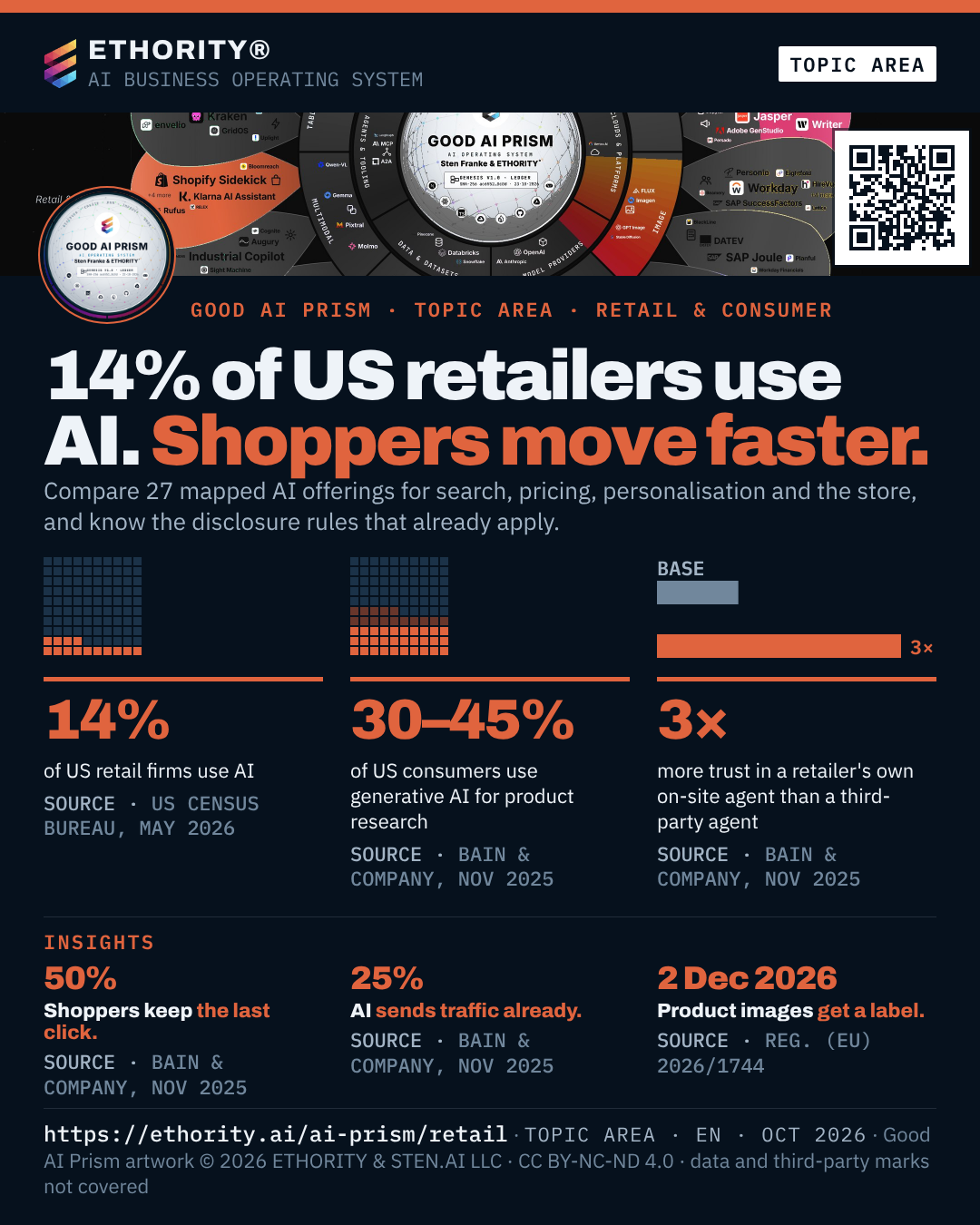
14% of US retailers use AI. Shoppers move faster.
Compare 27 mapped AI offerings for search, pricing, personalisation and the store, and know the disclosure rules that already apply.
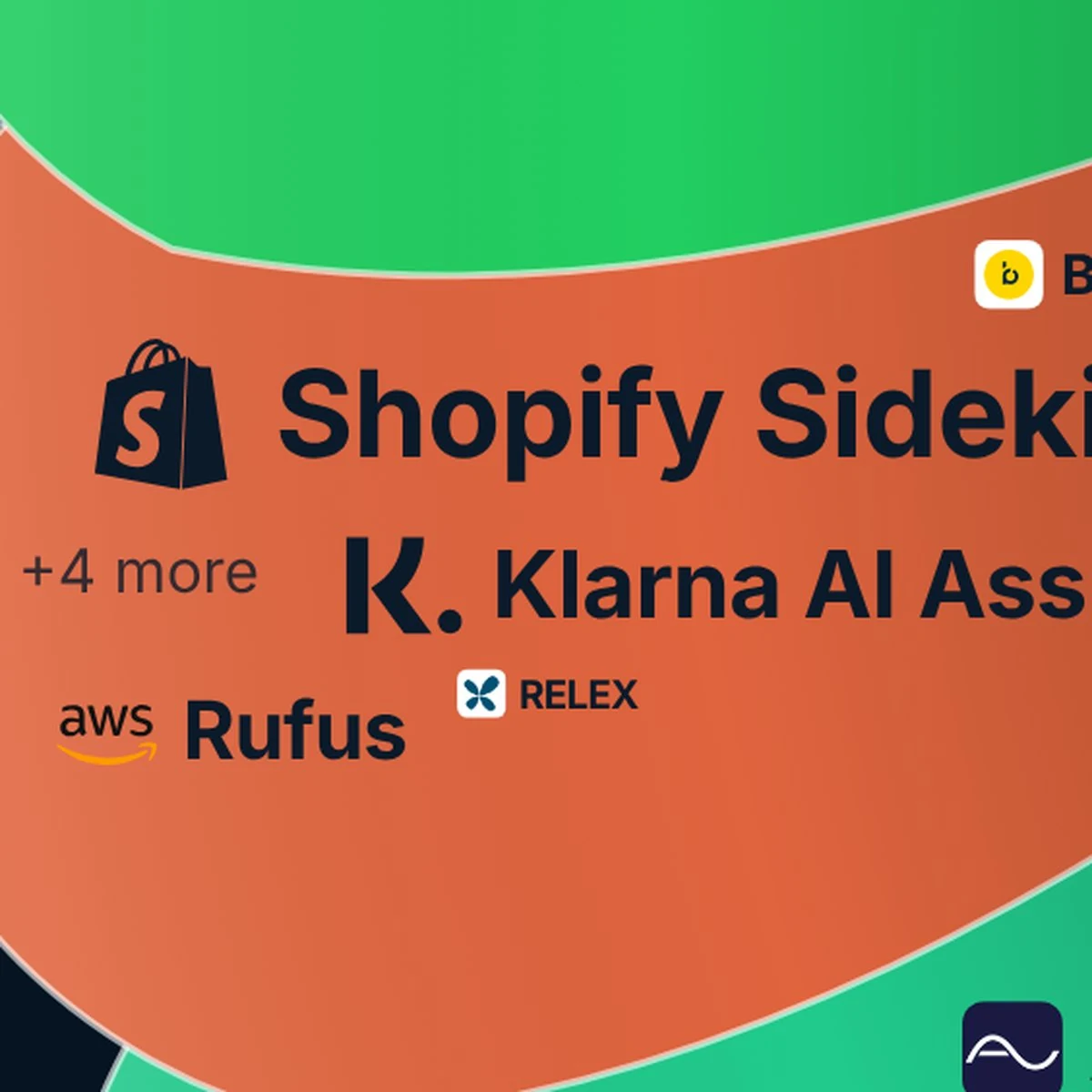
- 27
- AI offerings mapped in Retail & Consumer, plus 2 provider records (Bloomreach, Blue Yonder)Good AI Prism, Oct 2026
- 14%
- of US retail firms use AIUS Census Bureau, May 2026 · census.gov ↗
- 30–45%
- of US consumers use generative AI for product researchBain & Company, Nov 2025 · bain.com ↗
- 3×
- more trust in a retailer's own on-site agent than a third-party agentBain & Company, Nov 2025 · bain.com ↗
Shoppers keep the last click.
Half of consumers are not comfortable letting AI complete a purchase on its own.
Bain & Company, Nov 2025
AI sends traffic already.
AI accounts for up to 25% of referral traffic for some retailers, though under 1% of total traffic.
Bain & Company, Nov 2025
Product images get a label.
Generative systems already on the market must mark synthetic outputs, including product images, machine-readably from this date.
Reg. (EU) 2026/1744
How to use this page
Three tools and one offer turn this page into a decision.
- Open the Retail & Consumer map: the area's offerings on one petal of the Good AI Prism, with logos and provider facts.
- Compare up to three offerings: decision facts side by side, each with its source and date.
- Run the Task economics calculator: turn saved hours into capacity you can attribute, before a pilot is approved.
- Offer: AI Decision Brief: up to three retail AI offerings compared fact by fact, with hosting, training and billing terms and the questions to ask.
The brief and the studies
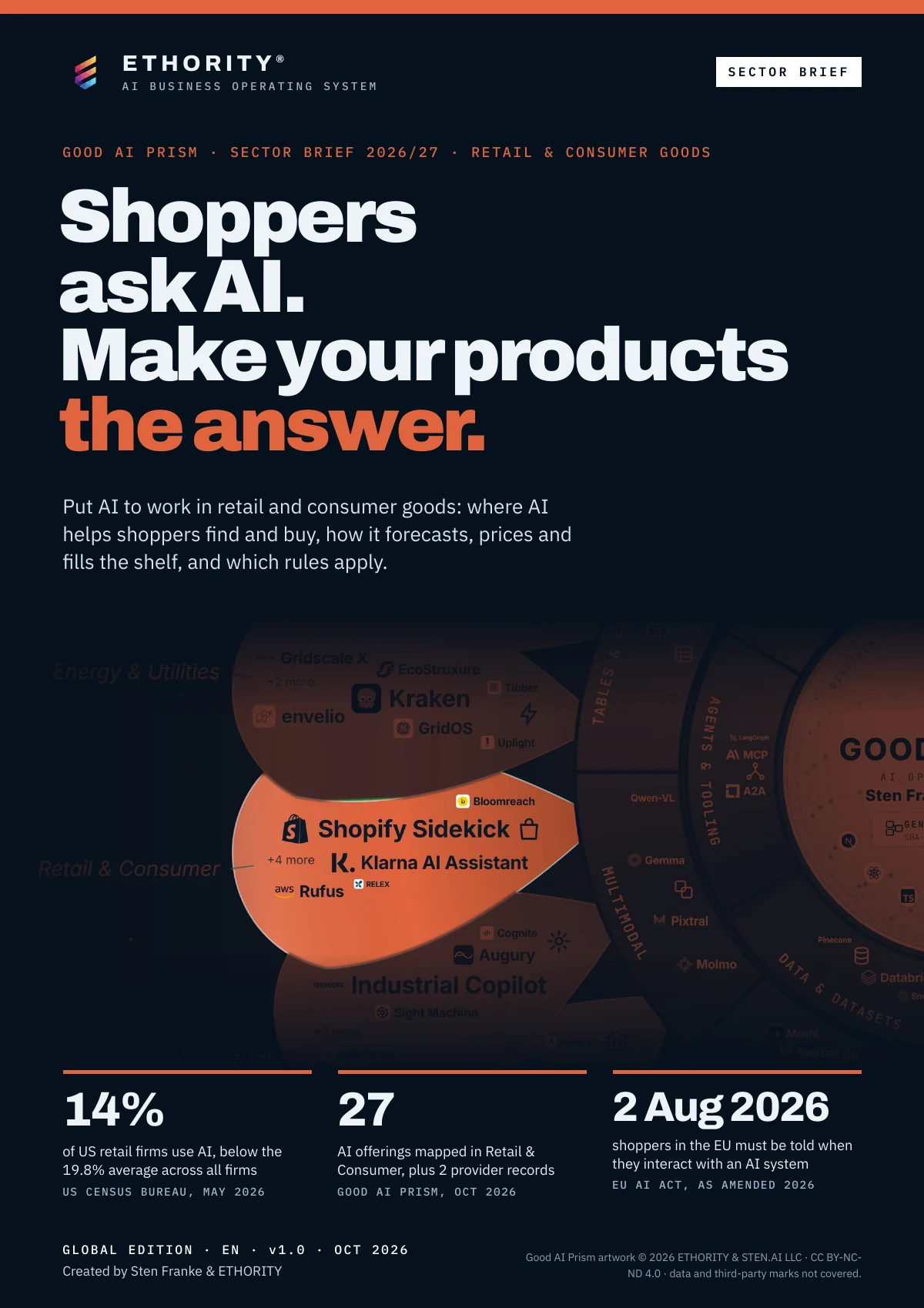
New: the Retail & Consumer Goods sector brief, first edition of 27 Oct 2026. The Global and DE-US Focus studies set retail against ten other sectors, with the buyer worksheet and sector evidence.
Global edition · EN
Shoppers ask AI. Make your products the answer.
The assistant advises, trust decides. Where AI helps shoppers find and buy, how it forecasts, prices and fills the shelf, and which rules apply.
Version 1.0 · 40 pages
Open the study →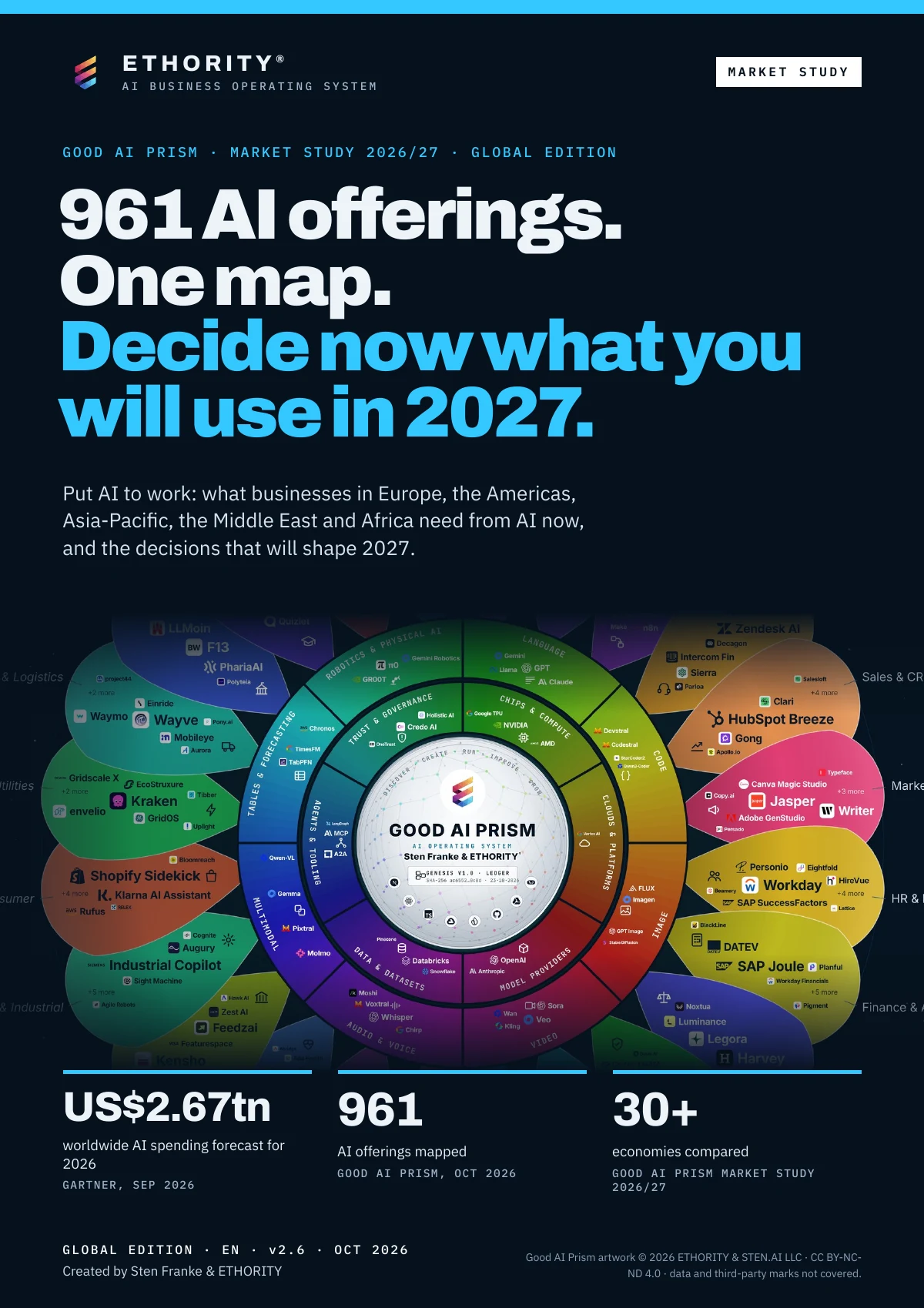
Global edition · EN
961 AI offerings. One map. Decide now what you will use in 2027.
The Good AI Prism helps you find useful AI and compare the evidence behind your options. For organisations already using AI, the question is moving from whether to use AI to which AI, how safely and whether it pays. This Global edition brings together 961 AI offerings across 24 topic areas, 8 data types and 6 technology layers, with sources, dates and limits to guide your next decision.
Version 2.6 · 90 pages
Open the study →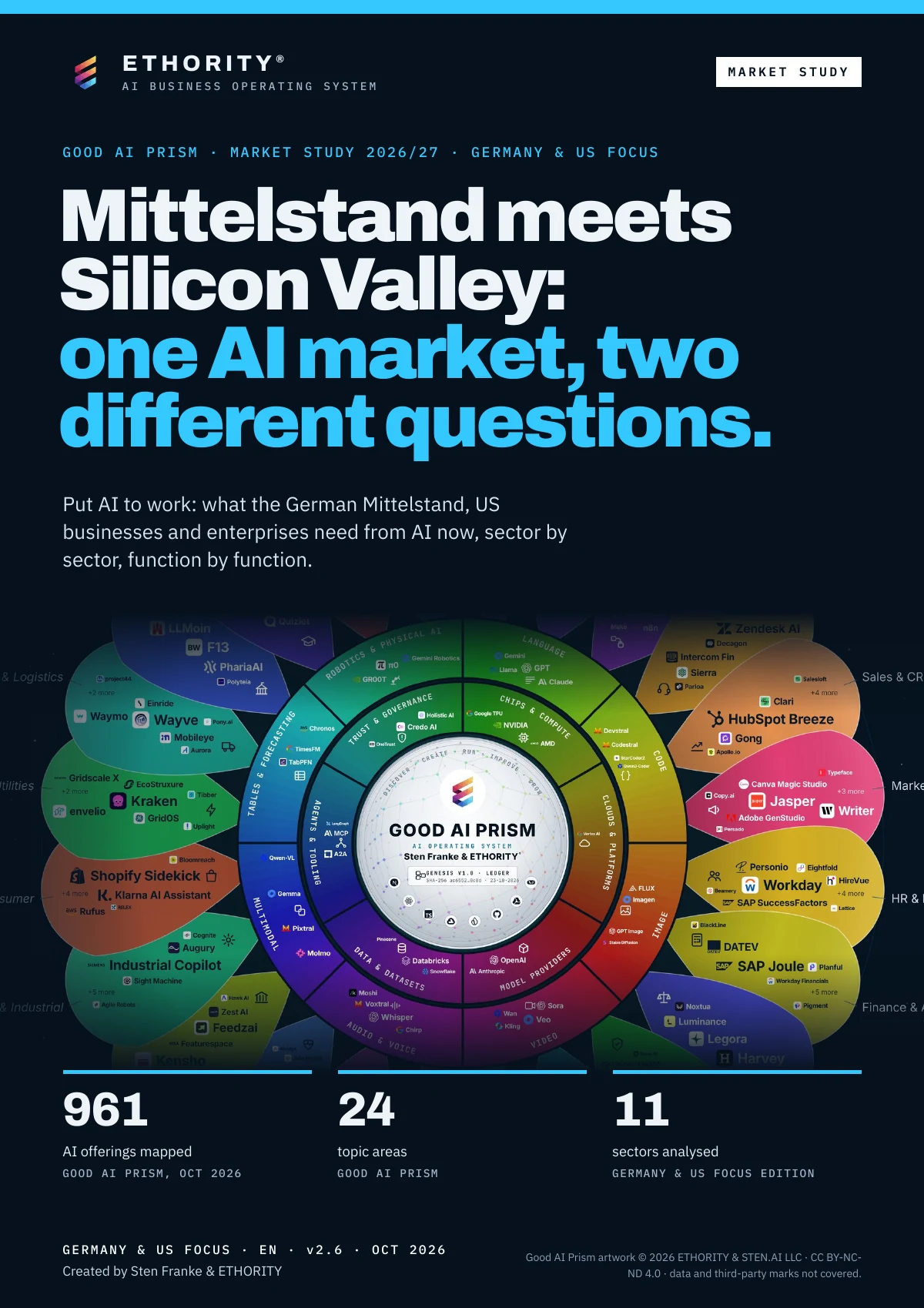
Germany & United States Focus · EN
Germany's mid-sized companies meet Silicon Valley: one AI market, two different questions.
The Mittelstand needs know-how; US firms need cost control. What German and US businesses need from AI now, sector by sector, function by function.
Version 2.6 · 72 pages
Open the study →The whole AI market on one sheet.
The full Good AI Prism as an A3 poster: every topic area, data type and technology layer on one page.
See the map on one page →Read on
Three related analyses from ETHORITY; the long read for this area follows further down the page.
Shoppers move to AI faster than retailers.
Why consumer trust and measured results now matter as much as algorithms in pricing and personalisation.
See the map on one page →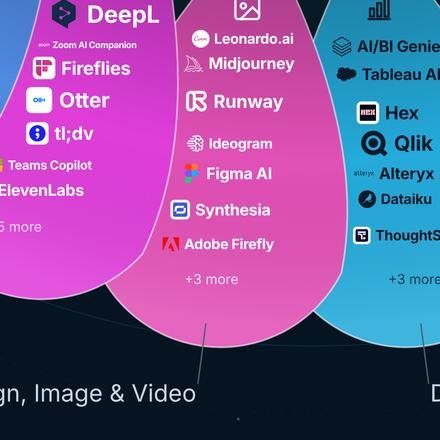
Synthetic media now needs a label almost everywhere.
What has changed for AI-generated faces and voices since Microsoft's VASA-1 model in 2024, and the labelling rules in the EU, China, Korea and India.
See the map on one page →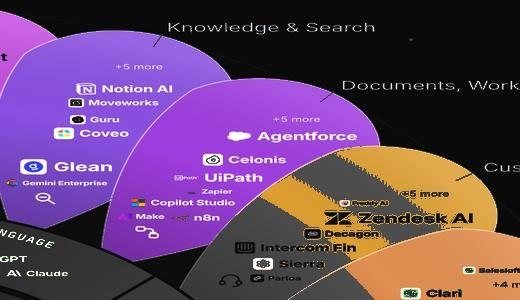
A marketplace listing does not make an AI agent trustworthy.
When you buy AI agents, keep identity, offer, payment, evidence and trust apart, and grant rights only after purchase.
See the map on one page →Rules and dates
Shoppers must be told when they talk to an AI system since 2 Aug 2026 (Art. 50). Synthetic outputs need machine-readable marking from 2 Dec 2026. Credit at checkout for natural persons carries high-risk duties from 2 Dec 2027, under the amended AI Act timetable.
Where a retail project can begin
AI Opportunity Case
Priced after scoping
One use, such as pricing or an on-site assistant, tested against a control group, margin and complaint rate, ending in a clear decision.
Scope and delivery by agreement
See what this package includes →AI Act Readiness Sprint
€6,900 one-time · net
Every customer-facing AI system mapped to its duties: Art. 50 now, machine-readable marking from 2 Dec 2026, checkout credit from 2 Dec 2027.
Date and place by agreement
See what this package includes →AI Governance Setup
€19,500 one-time · net
Permissions for AI agents that change prices or complete payments: limits, approvals and logs.
Scope and delivery by agreement
See what this package includes →AI Estate Audit
€25,000 one-time · net
An inventory of AI from search and service to replenishment, with providers, data and owners.
Date and place by agreement
See what this package includes →Questions buyers ask
Do we have to label our shopping assistant?
Yes. Since 2 Aug 2026 the EU AI Act (Art. 50) requires that people are told when they interact with an AI system.
Is personalised pricing high-risk under the AI Act?
Pricing is not listed in Annex III. Credit assessment of natural persons at checkout is, from 2 Dec 2027, and personalised prices are a consumer-protection topic in several markets.
How do we measure AI pricing honestly?
Against a control group of stores, products or customers, tracking conversion, margin, markdowns, returns and complaints together. The retail pricing article sets out the method.
Should we serve third-party shopping agents?
Decide channel by channel. Consumers trust a retailer's own agent three times more than a third-party agent; own the channels where trust and data matter most.
Which offerings does the Good AI Prism map?
29 entries: shopping assistants, product search, price optimisation, demand forecasting, product content, personalisation and in-store vision.
The evidence at a glance
ETHORITY · LONG READ
Shoppers adopt AI faster than retailers. Trust decides who wins.
US shoppers research with AI while most retailers still test it. Where traffic moves, what the 29 mapped entries do, which rules apply and how to measure pricing and personalisation.
Retail has a speed problem, and it runs the wrong way. Inside the firm, AI adoption is modest: about 14% of US retail firms use AI, below the national average of 19.8% and far below the information sector at 39.7% (US Census Bureau, May 2026). About 17% expect to use it within six months. Outside the firm, customers have already moved. Between 30% and 45% of US consumers use generative AI for product research and comparison, according to Bain & Company's November 2025 study. Shoppers are adopting AI faster than the stores they buy from.
14% of US retail firms use AI, against 19.8% of all firms (US Census Bureau, May 2026)
Discovery moves to the assistant
The traffic numbers are still small, and they are rising. AI accounts for up to 25% of referral traffic for some retailers, though still less than 1% of total traffic (Bain). The shift changes where a purchase starts. A customer who asks an assistant for the best running shoe under a budget may never see a category page, a banner or a sponsored listing. Retail media built for keyword search has to be rethought for natural-language questions.
Agents are the next step. Worldwide AI spending is forecast at US$2.67 trillion in 2026, and Gartner expects spending on AI agents and assistants to grow from US$29.2 billion in 2026 to US$65.5 billion in 2027. Yet half of consumers are not comfortable letting AI complete a purchase on its own (Bain). And Gartner expects more than 40% of agentic AI projects cancelled by the end of 2027. Agentic commerce is coming, but slower and more carefully than the demos suggest.
Trust is the asset retailers own
One number stands out. Consumers trust a retailer's own on-site agent three times more than a third-party agent (Bain), though Bain expects the gap could narrow. That makes trust the asset a retailer can still own. Bain advises retailers to "dig the customer moat" with exclusive products and loyalty benefits, and to keep ownership of first-party data and checkout wherever possible.
3× more trust in a retailer's own on-site agent than in a third-party agent (Bain & Company, Nov 2025)
The practical question for 2027 is which AI channels to own and which to serve. An on-site assistant, a loyalty app and checkout are owned channels. Third-party agents are channels the retailer serves on someone else's terms. Each needs a decision on product data, pricing data and customer data.
13 offerings face the shopper, 6 work on stock and stores
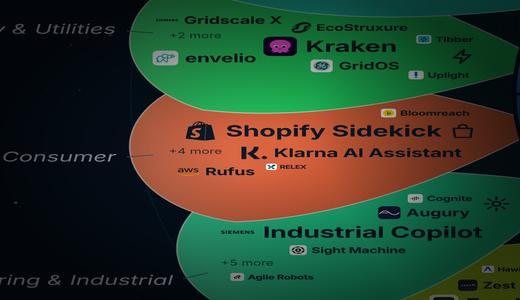
The Good AI Prism maps 27 AI offerings and two provider records (Bloomreach, Blue Yonder) in Retail & Consumer, each recorded with a dated source from the provider's own pages. They cover the whole shop. Shopping assistants and agents come from Constructor, epoq, Retresco and Zoovu, alongside the assistants retailers and platforms run themselves, such as Amazon's Rufus, Klarna's AI Assistant, Shopify Sidekick and the Zalando Assistant. Product discovery and search come from Algolia, Doofinder, FactFinder and Syte. Price optimisation from 7Learnings, Competera and Quicklizard. Demand forecasting and replenishment from Delicious Data, paretos and RELEX. Product content from Salsify and Lily AI. Personalisation from Hello Retail and Nosto. In the store, Everseen and Trax use computer vision for checkout loss and shelf recognition, and Heuritech forecasts fashion trends.
Nine of the 29 entries come from providers headquartered in Germany, including epoq, FactFinder, paretos, Delicious Data, Retresco, Shopware and Spryker, and 16 from providers headquartered in Europe. The Global Market Study sets retail against ten other sectors.
Behind the shelf: forecasting and replenishment
Not every retail AI faces the customer. Some of the most measurable uses sit behind the shelf. Demand forecasting and replenishment tools predict sales by article and store, set order quantities and plan markdowns for perishable goods. They work on data a retailer already owns: sales history, stock, promotions, weather and local events. Results show up in numbers a category manager tracks every week: forecast accuracy, stock-outs, write-offs and working capital. Product content tools sit in the same quiet zone. They enrich attributes, descriptions and metadata so that search on the own site, and the answers of external assistants, find the right article. For a retailer that wants AI-referred traffic, clean product data is the entry ticket.
Seven questions before you buy
Settle seven questions in writing before a demo. Which outcome should move: conversion, margin, forecast accuracy or cost to serve? What is today's baseline? Where is customer and product data hosted, and does the provider train on it? What is the billing unit: per seat, per resolution, per order or on quote? Which integrations does it need with the shop system, the ERP and the loyalty platform? Who can stop an agent that changes a price or completes a payment? And which result ends the pilot? A provider that answers these on paper is worth a test.
The rules: disclosure now, credit later
Retail AI mostly sits in the minimal-risk zone of the EU AI Act, with three exceptions that carry dates under the amended timetable of Regulation (EU) 2026/1744:
- Since 2 August 2026, people must be told when they interact with an AI system, such as a shopping assistant (Art. 50).
- From 2 December 2026, generative systems already on the market must mark synthetic outputs, including product images, in a machine-readable way.
- From 2 December 2027, creditworthiness assessment of natural persons, for example instalment payments at checkout, is a high-risk use under Annex III.
In the US, Colorado's bill SB 26-189 on AI and California's rules on automated decision-making bring duties from 1 January 2027. Personalised prices are also a consumer-protection topic in several markets; check the disclosure duties where you sell before launch. The article on synthetic faces and voices covers the marking rules in detail.
Measure margin, not only sales
Measured gains exist where AI supports people. In customer support, a generative AI assistant raised issues resolved per hour by 14% on average and by 34% for less experienced agents (NBER Working Paper 31161). Pricing and personalisation need the same discipline. Run AI pricing or personalisation against a holdout of stores, products or customers, so that seasonality and promotions do not inflate the result. Track conversion, gross margin, markdown rate and return rate together. Measure AI-referred traffic and its conversion separately. Watch complaint rate, price-related service contacts and opt-outs as trust signals. And agree in advance which result scales the pilot and which ends it. The retail pricing and personalisation article sets out the method step by step.
In practice
Use case: owned assistants. Amazon's Rufus, Klarna's AI Assistant, Shopify Sidekick and the Zalando Assistant are assistants that retailers and platforms run themselves, and all four sit on the Good AI Prism map. They keep product data, customer context and checkout with the operator, in the channel consumers trust three times more than a third-party agent, according to Bain.
Scenario: a pricing pilot with a holdout. A fashion retailer tests AI markdown pricing in part of its stores and keeps a matched group on the old rules. After one season it compares gross margin, markdown rate, return rate and price-related complaints between both groups. Only a margin gain without a rise in complaints scales the pilot.
What to do Monday
- Pick one use with a control group. Pricing or personalisation, measured on margin and complaint rate, not only on sales.
- Decide your channel map. Which AI channels you own, which third-party agents you serve, and on what data terms.
- Map every customer-facing AI system to its duty: Art. 50 now, machine-readable marking from 2 December 2026, checkout credit from 2 December 2027.
- Scope agent permissions tightly. Anything that changes a price or completes a payment needs a limit and a log; an AI Governance Setup defines both.
- Ask for hosting, training use and billing unit in writing before any demo.
This article describes market and regulation. It is not legal advice.
Sources and further reading
- US Census Bureau, AI use by businesses ↗ · May 2026
- Bain & Company, Agentic AI poised to disrupt retail, even with 50% of consumers cautious ↗ · 13 Nov 2025
- Gartner, worldwide AI spending forecast · 16 Sep 2026
- Gartner, over 40% of agentic AI projects will be canceled by end of 2027 · 25 Jun 2025
- Regulation (EU) 2026/1744 (Digital Omnibus on AI) ↗ · 27 Jul 2026
- Colorado SB 26-189 ↗ · 2026
- California Privacy Protection Agency, ADMT regulations finalised ↗ · Sep 2025
- NBER Working Paper 31161, Generative AI at Work ↗ · 2023
- ETHORITY, Good AI Prism Global Market Study 2026/27 and Good AI Prism research edition, Retail & Consumer area → · 22 Oct 2026
Put the thinking to work
AI Opportunity Case →
A defensible proceed, test, redesign, defer or stop decision. The fee is independent of which outcome the evidence supports.
A written comparison of up to three AI offerings · €195 net →
Start with one question and up to three offerings. Request a sourced comparison, provider questions and a cost sketch using your assumptions.
YOUR NEXT STEP
Discuss your question with Sten Franke.
Bring your business question or the figures you already know. ETHORITY investigates within the agreed scope; together with Sten Franke you agree the next piece of work.