 ETHORITY®
In this article
Terms used in this article
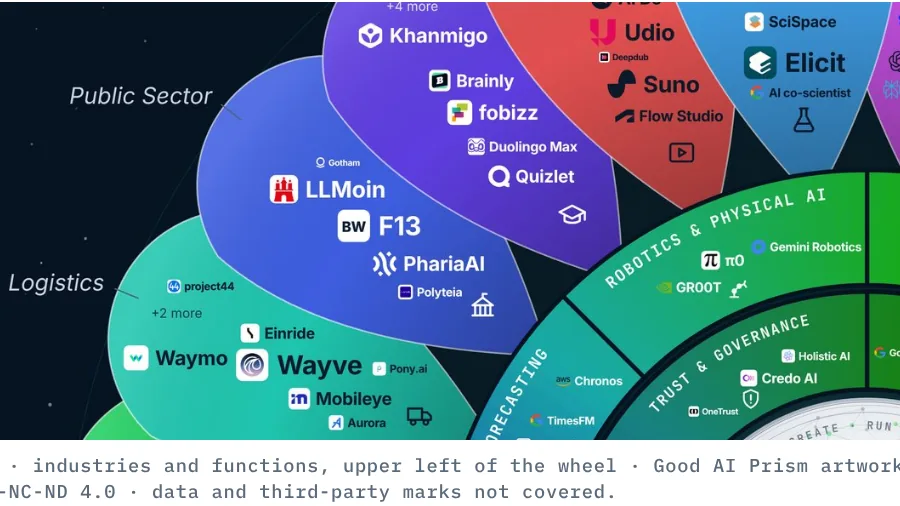
Good AI Prism v3.12 · industries and functions, upper left of the wheel · Good AI Prism artwork © 2026 ETHORITY & STEN.AI LLC · CC BY-NC-ND 4.0 · data and third-party marks not covered.
Good AI Prism v3.12 · Sten Franke & ETHORITY
Source study · v2.1 · page 4 · Figure published: 25 Oct 2026
Read figure text, sources and rights
Good AI Prism v3.12 · industries and functions, upper left of the wheel · Good AI Prism artwork © 2026 ETHORITY & STEN.AI LLC · CC BY-NC-ND 4.0 · data and third-party marks not covered.
ETHORITY figure. Rights in cited data and third-party marks remain with their owners. The Prism artwork licence applies where stated on the figure.
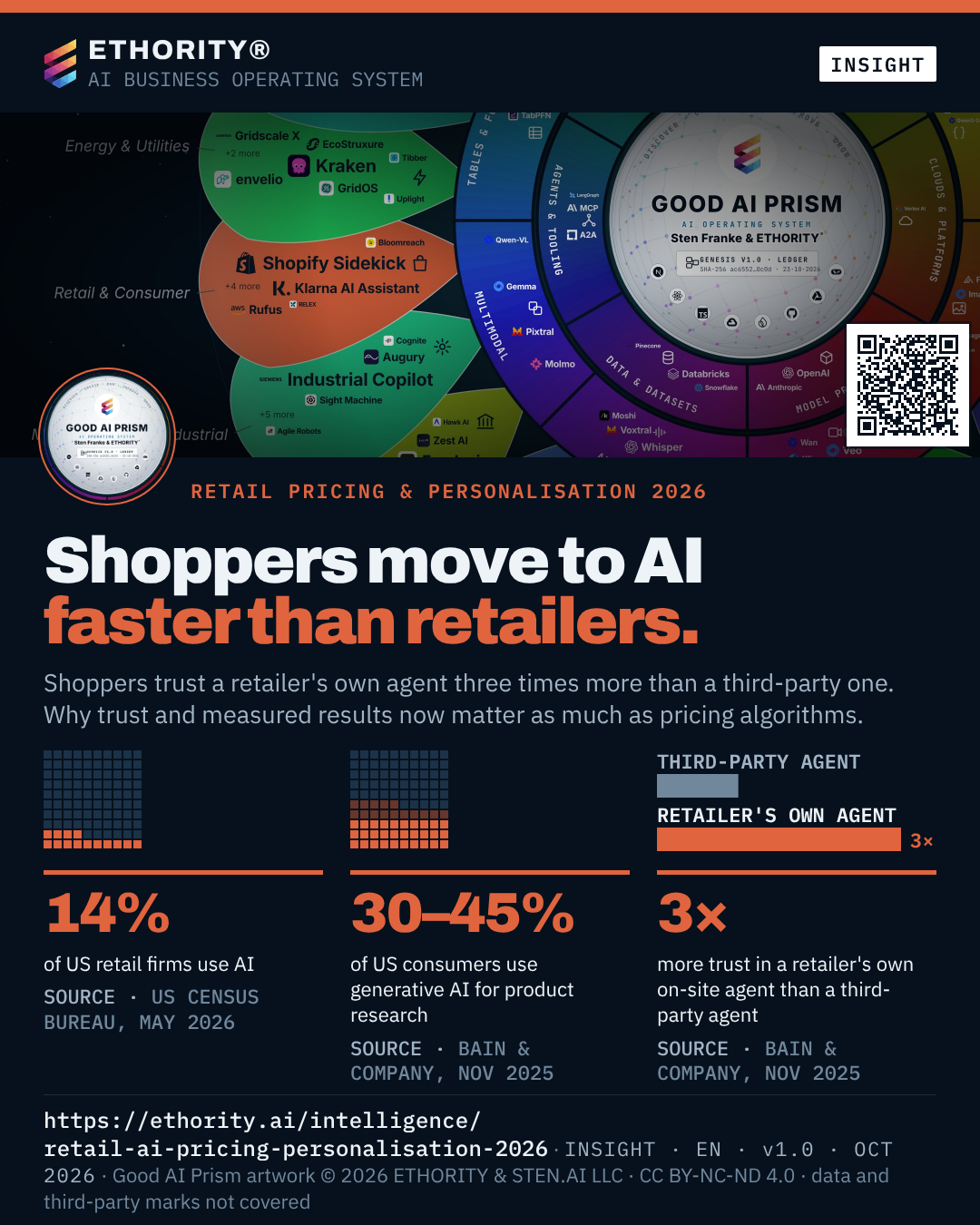
AI-driven discovery and agentic shopping are changing how customers find and buy, so retailers who price and personalise with AI now need consumer trust and measured results as much as algorithms.
What has changed since 2024
Our 2024 article described how AI adjusts prices to demand, stock and competition, and how it tailors offers to each customer. The mechanics still hold. What has changed is the setting. Customers now research products with AI assistants, AI agents are starting to buy on their behalf, and regulators have set dates for transparency. The 2024 version also leaned on a widely quoted consumer statistic and an unnamed retailer case. This edition replaces both with dated, sourced figures.
Where retail stands
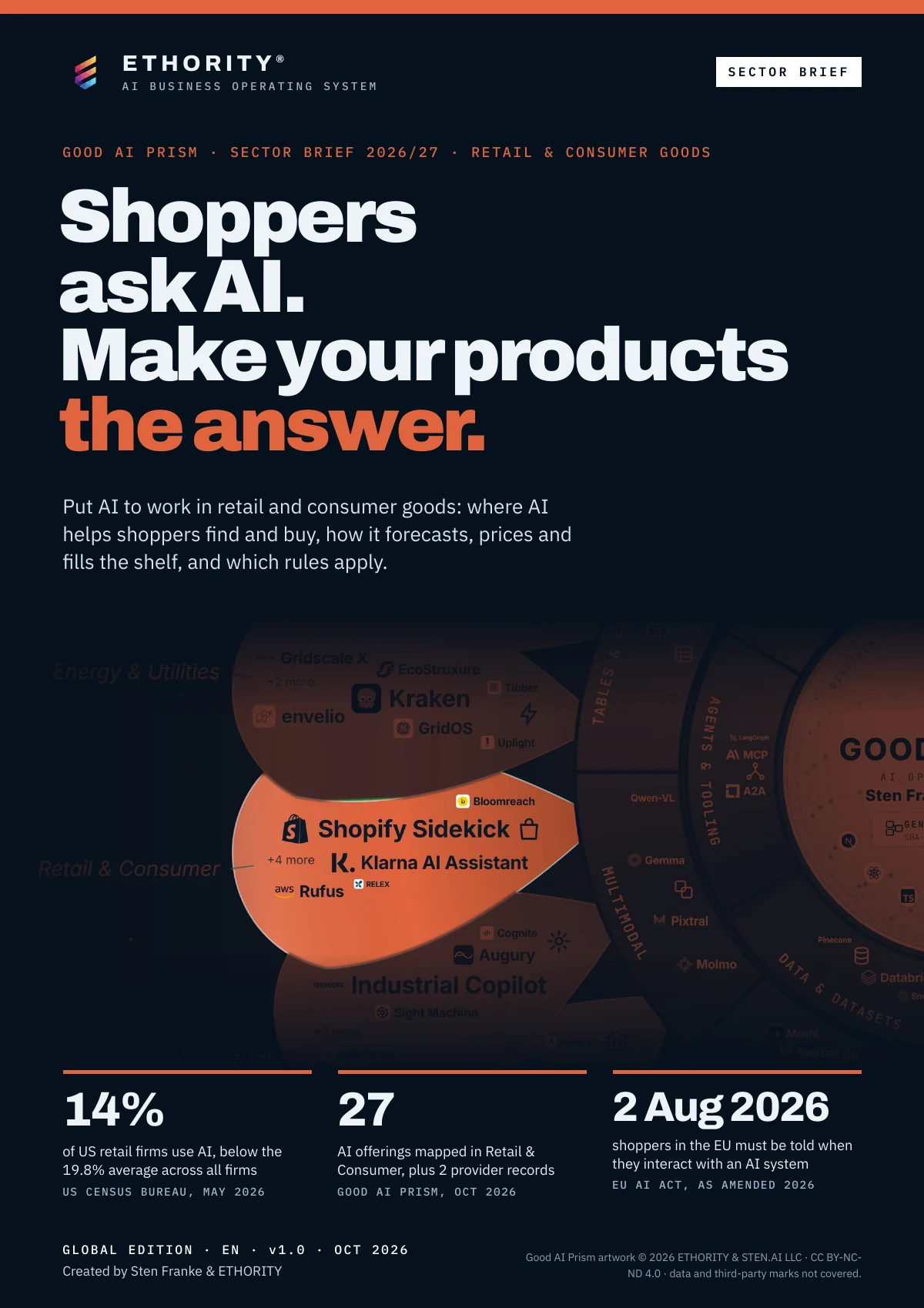
- About 14% of US retail firms use AI, and about 17% expect to within six months (US Census Bureau, May 2026). That is below the national average of 19.8% and well below information (39.7%).
- 30% to 45% of US consumers already use generative AI for product research and comparison (Bain & Company, November 2025).
- AI accounts for up to 25% of referral traffic for some retailers, but still less than 1% of total traffic (Bain).
- Half of consumers are not comfortable letting AI handle end-to-end transactions on their own (Bain).
- Consumers trust a retailer's own on-site agent three times more than a third-party agent, though Bain expects that gap could narrow.
In other words, retail AI use inside the firm is still modest, while customers are moving faster. The gap is an opportunity for retailers who build trusted, owned channels.
How AI pricing and personalisation work in 2026
The core loop is unchanged: models combine sales history, inventory, competitor prices, seasonality and local signals to forecast demand and recommend a price or an offer; feedback from results retrains the model. Three developments in the technology stack matter for retailers now:
- Language models are affordable at retail volume. Small models from OpenAI (GPT-6 Luna) and Anthropic (Claude Haiku 5.5) start at USD 0.10 per million input tokens, and flagship prices span about 100 times. Personalised product descriptions, search and service answers can be generated at scale, with the cost per interaction measurable.
- Retailers run several models. 81% of large enterprises use three or more model families (a16z). Models also retire: OpenAI shuts down its GPT-4o and GPT-4.1 snapshots on 14 January 2027, so every customer-facing workflow needs a test before a model switch.
- Agents enter commerce. Spending on AI agents and assistants is forecast to grow from USD 29.2 billion in 2026 to USD 65.5 billion in 2027 (Gartner). Gartner also expects more than 40% of agentic AI projects to be cancelled by the end of 2027. Scope agent permissions tightly, especially for anything that changes a price or completes a payment.
Trust is now a design requirement
Personalisation creates value only when customers accept it. Three practical points follow.
Own the relationship. Bain advises retailers to "dig the customer moat" with exclusive products and loyalty benefits, rethink retail media for natural-language queries, and retain ownership of first-party data and checkout wherever possible.
Explain the AI. In the EU, Article 50 of the AI Act requires since 2 August 2026 that people are told when they are interacting with an AI system, such as a shopping assistant. From 2 December 2026, generative systems already on the market must mark synthetic outputs, including product images, in a machine-readable way (Regulation (EU) 2026/1744).
Source context: EU AI Act · consolidated 2026-07-27 ↗
Know which decisions are regulated. Creditworthiness assessment of natural persons, for example for instalment payments at checkout, is an Annex III high-risk use with duties from 2 December 2027. In the US, Colorado and California rules on automated decisions with significant effects apply from 1 January 2027. Personalised prices are also a consumer-protection topic in several markets; check the disclosure duties in each market where you sell before you launch.
Choosing tools on facts
Retail AI often starts with customer service and search. For a European shortlist, ask which contractual locations apply to storage, inference, backups and sub-processors. Check whether customer data is excluded from training by default, used only after opt-in, or used unless you opt out; those are different conditions. Prices use different units, from per resolution to per seat or a scoped proposal. Get the applicable location, training conditions and billing unit in writing before comparing a deployment.
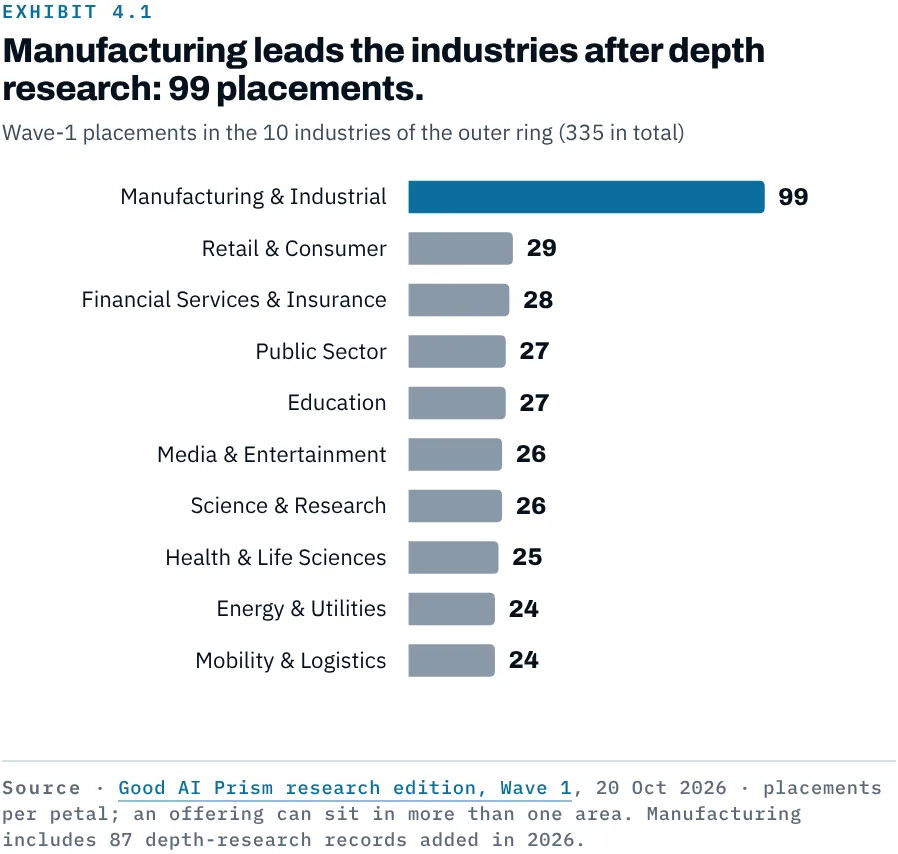
Manufacturing leads the industries after depth research: 99 placements.
Good AI Prism research edition, Wave 1, 20 Oct 2026 · placements per petal; an offering can sit in more than one area. Manufacturing includes 87 depth-research records added in 2026.
Source study · v2.1 · page 40 · Figure published: 25 Oct 2026
Read figure text, sources and rights
EXHIBIT 4.1 Manufacturing leads the industries after depth research: 99 placements. Wave-1 placements in the 10 industries of the outer ring (335 in total) Manufacturing & Industrial 99 Retail & Consumer 29 Financial Services & Insurance 28 Public Sector 27 Education 27 Media & Entertainment 26 Science & Research 26 Health & Life Sciences 25 Energy & Utilities 24 Mobility & Logistics 24 Source · Good AI Prism research edition, Wave 1, 20 Oct 2026 · placements per petal; an offering can sit in more than one area. Manufacturing includes 87 depth-research records added in 2026. Manufacturing & Industrial 99 Retail & Consumer 29 Financial Services & Insurance 28 Public Sector 27 Education 27 Media & Entertainment 26 Science & Research 26 Health & Life Sciences 25 Energy & Utilities 24 Mobility & Logistics 24
ETHORITY figure. Rights in cited data and third-party marks remain with their owners. The Prism artwork licence applies where stated on the figure.
Measured gains exist: in customer support, a generative AI assistant raised issues resolved per hour by 14% on average and 34% for less experienced agents (NBER).
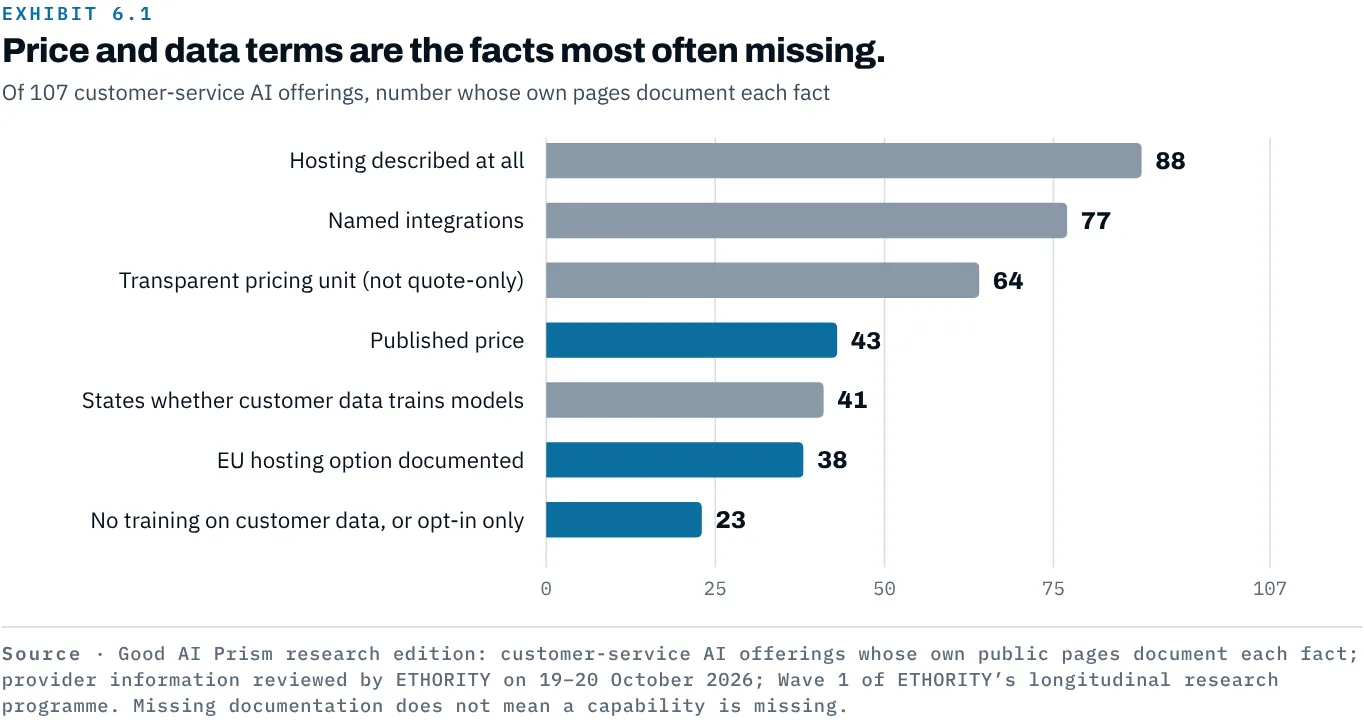
Price and data terms are the facts most often missing.
Good AI Prism research edition: customer-service AI offerings whose own public pages document each fact; provider information reviewed by ETHORITY on 19–20 October 2026; Wave 1 of ETHORITY’s longitudinal research programme. Missing documentation does not mean a capability is missing.
Source study · v2.1 · page 52 · Figure published: 25 Oct 2026
Read figure text, sources and rights
EXHIBIT 6.1 Price and data terms are the facts most often missing. Of 107 customer-service AI offerings, number whose own pages document each fact 0 25 50 75 107 Hosting described at all 88 Named integrations 77 Transparent pricing unit (not quote-only) 64 Published price 43 States whether customer data trains models 41 EU hosting option documented 38 No training on customer data, or opt-in only 23 Source · Good AI Prism research edition: customer-service AI offerings whose own public pages document each fact; provider information reviewed by ETHORITY on 19–20 October 2026; Wave 1 of ETHORITY’s longitudinal research programme. Missing documentation does not mean a capability is missing. 0 25 50 75 107 Hosting described at all 88 Named integrations 77 Transparent pricing unit (not quote-only) 64 Published price 43 States whether customer data trains models 41 EU hosting option documented 38 No training on customer data, or opt-in only 23
ETHORITY figure. Rights in cited data and third-party marks remain with their owners. The Prism artwork licence applies where stated on the figure.
How to measure pricing and personalisation
The evaluation methods from 2024 remain the right ones, with sharper rules:
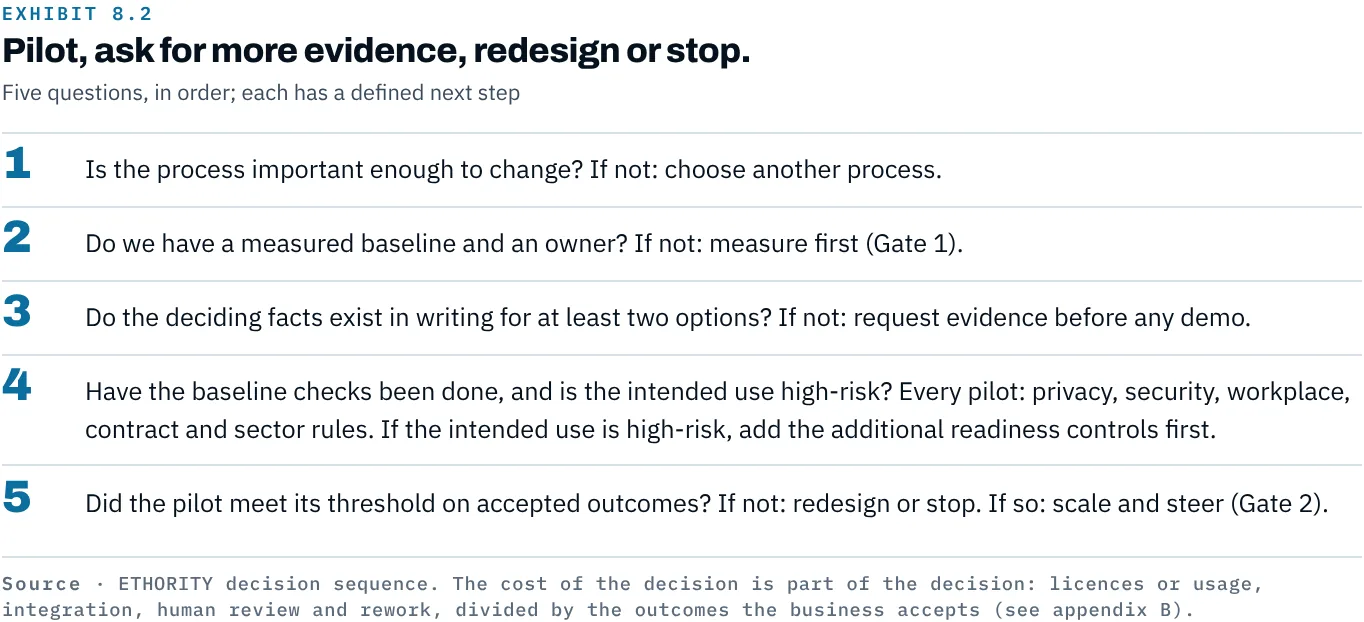
Pilot, ask for more evidence, redesign or stop.
ETHORITY decision sequence. The cost of the decision is part of the decision: licences or usage, integration, human review and rework, divided by the outcomes the business accepts (see appendix B).
Source study · v2.1 · page 66 · Figure published: 25 Oct 2026
Read figure text, sources and rights
EXHIBIT 8.2 Pilot, ask for more evidence, redesign or stop. Five questions, in order; each has a defined next step Is the process important enough to change? If not: choose another process. Do we have a measured baseline and an owner? If not: measure first (Gate 1). Do the deciding facts exist in writing for at least two options? If not: request evidence before any demo. Have the baseline checks been done, and is the intended use high-risk? Every pilot: privacy, security, workplace, contract and sector rules. If the intended use is high-risk, add the additional readiness controls first. Did the pilot meet its threshold on accepted outcomes? If not: redesign or stop. If so: scale and steer (Gate 2). Source · ETHORITY decision sequence. The cost of the decision is part of the decision: licences or usage, integration, human review and rework, divided by the outcomes the business accepts (see appendix B).
ETHORITY figure. Rights in cited data and third-party marks remain with their owners. The Prism artwork licence applies where stated on the figure.
- Use a control group. Run AI pricing or personalisation against a holdout of stores, products or customers, so that seasonality and promotions do not inflate the result.
- Measure margin, not only sales. Track conversion, gross margin, markdown rate and return rate together.
- Track AI-driven discovery. Measure AI-referred traffic and its conversion separately; it is small today but growing.
- Watch trust signals. Complaint rate, price-related service contacts and opt-outs show whether customers accept the personalisation.
- Agree a stop condition. Decide in advance which result scales the pilot and which ends it.
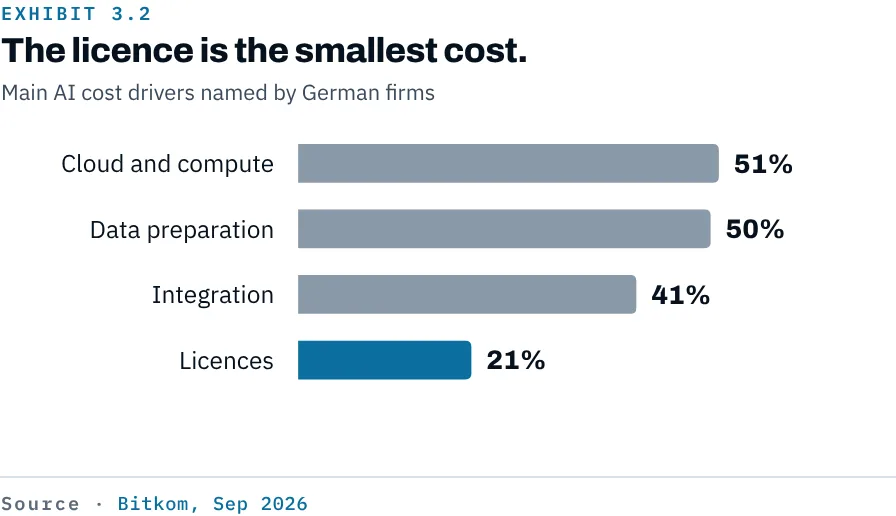
The licence is the smallest cost.
Bitkom, Sep 2026
Source study · v2.1 · page 29 · Figure published: 25 Oct 2026
Read figure text, sources and rights
EXHIBIT 3.2 The licence is the smallest cost. Main AI cost drivers named by German firms Cloud and compute 51% Data preparation 50% Integration 41% Licences 21% Source · Bitkom, Sep 2026 Cloud and compute 51% Data preparation 50% Integration 41% Licences 21%
Source links on the cited study page
ETHORITY figure. Rights in cited data and third-party marks remain with their owners. The Prism artwork licence applies where stated on the figure.
Separate three decisions that are often bundled together
Dynamic pricing changes a price in response to conditions such as demand, stock or time. Personalised pricing varies the price or discount according to information about a person or group. Personalised merchandising changes what is shown, even where the underlying prices remain the same. A retailer should specify which practice it proposes before discussing benefits, data or disclosure. Calling all three “personalisation” makes the operating and consumer questions harder to answer.
The distinction also improves the experiment. A promotion recommendation and an automatic price change have different permissions and different risks. A product-ranking change may affect customers without changing any price. Identify the action, the population exposed and the person able to stop it. The intended business result should be explicit: improved margin, less waste, better discovery or another measured outcome.
The FTC's January 2025 surveillance-pricing work examined how intermediaries can use detailed consumer information to influence prices and promotions. Its initial findings and hypothetical examples should not be treated as proof that every retailer uses those practices. They do establish a useful reason to inspect the data and inference behind a proposed personalisation service. FTC source.
A worked experiment: compare contribution, not just conversion
Imagine a hypothetical retailer considering a personalised promotion. In a baseline group, 1,000 eligible visits produce 100 purchases with €20 contribution per order, or €2,000. In a test group of the same size, 120 purchases contribute €15 each after the discount, or €1,800. Conversion has risen while contribution has fallen. These figures illustrate arithmetic, not a customer result or an expected effect.
The comparison is still incomplete. Include returns, fulfilment costs, service contacts and any change in basket composition. Keep the groups comparable and inspect whether customers moved between channels or delayed purchases to wait for a discount. A short test may miss repeat purchasing and complaints. Agree which measures are sufficient for the next decision rather than claiming the experiment answers every commercial question.
Also inspect distribution. An average can hide a group receiving consistently worse offers or a segment exposed to repeated price changes. The business needs a policy for acceptable treatment and a way to investigate complaints. A model's ability to optimise a target does not establish that the target captures the relationship the retailer wants with customers.
Set price authority outside the recommendation
The recommendation system should not define its own commercial limits. A retailer can specify permitted ranges, minimum margin conditions, excluded products and review requirements. A recommendation outside those bounds should be held rather than converted into a new rule. Keep the authority to publish prices separate from the ability to predict demand.
Test practical failure cases: stale stock, a missing competitor feed, an incorrect currency and a repeated update. Check how a human correction reaches every relevant channel. A website, an app and a store label should not quietly diverge because they receive updates on different schedules. Define the appropriate fallback when the source is unavailable.
For an agent that can complete a transaction, identify the customer's consent, spending limit and exact order. A product substitution or changed price may require renewed agreement. A successful conversation is not evidence that the order was accepted or payment completed. The authoritative transaction system must establish those states, and an uncertain response must be reconciled before retrying.
Explain the customer-facing change in ordinary language
People should understand the relevant use of AI without reading a technical architecture. Explain whether they are speaking with an assistant, how to reach a person and where material offer conditions can be found. A generic statement that the business “uses responsible AI” does not explain an unexpected price or a refused request.
Do not collect extra personal data merely because the model can use it. Ask which information is necessary for the proposed benefit and whether a less intrusive design can achieve the objective. Privacy and consumer-law obligations require assessment for the actual practice and market. This article provides questions for that assessment rather than a universal conclusion about lawful personalisation.
Test explanations in the language and channel customers actually use. The mobile notice, product page, basket and service response should tell a consistent story. Preserve an accessible way to challenge a consequential error. Complaint themes can reveal a defect that an aggregate conversion measure would miss.
A release checklist for the actual promotion
Before activating a test, ask the commercial owner to inspect the exact offer a customer will see. Check product, price, currency, eligibility, duration and the way returns affect the calculation. The model's recommended value and the published promotion are separate states. The experiment should record which one it measures.
Ask the service team to explain the offer using the same information available to the customer. If staff cannot explain why a price applies, investigate before exposing a larger audience. A useful explanation should identify the relevant rule without revealing another person's data or pretending that every model influence can be reduced to a simple story.
Next, simulate a correction. A mistaken price, an expired promotion or a customer challenge should reach the responsible role. Confirm how the website, basket, confirmation and support record are reconciled. A successful change in one interface does not establish that every customer-facing state has been updated.
Select a useful first project and a relevant offer
Retailers can begin with service answers, search or staff assistance before granting price-changing authority. Use the Retail area of the Prism to explore products, then inspect provider facts about data handling, billing and deployment. Do not infer EU processing from the provider's address or a no-training commitment from the word “enterprise.” Carry the material questions into the comparison.
An AI Decision Brief can address a focused shortlist. A proposal-based Enterprise AI Opportunity Case is more appropriate when the question concerns the business case and operating conditions. Use the calculator for explicit workload and review assumptions. The request should describe the commercial decision, the affected customer journey and the evidence needed before changing it.
The useful deliverable is a decision that connects customer treatment, operating control and economics. A higher conversion number alone is not that decision. Neither is a legal checklist detached from how prices reach the customer. The strongest project makes those connections visible before scaling.
What to decide now
- Choose one pricing or personalisation use case and run it against a control group with margin and complaint rate as outcome measures.
- Decide which AI-driven channels you want to own (on-site assistant, loyalty, checkout) and which third-party agents you will serve, and on what data terms.
- Map every customer-facing AI system to its disclosure duties: Article 50 now, machine-readable marking from 2 December 2026, credit decisions from 2 December 2027.
Source context: EU AI Act · consolidated 2026-07-27 ↗
Sector evidence for Retail & Consumer and the full buyer worksheet are in the Good AI Prism Global Market Study 2026/27 at ethority.ai/ai-prism-study.
Sources
- US Census Bureau, AI use by businesses (May 2026): https://census.gov/library/stories/2026/05/ai-use-businesses.html
- Bain & Company, Agentic AI poised to disrupt retail (13 Nov 2025): https://www.bain.com/about/media-center/press-releases/20252/agentic-ai-poised-to-disrupt-retail-even-with-50-of-consumers-cautious-of-fully-autonomous-purchasesbain--company/
- OpenAI, GPT-6.1 Sol and Luna pricing: https://openai.com/index/introducing-gpt-6-1-sol/
- Anthropic, models overview: https://platform.claude.com/docs/en/about-claude/models/overview
- a16z, enterprise AI survey (Jan 2026): https://a16z.com/leaders-gainers-and-unexpected-winners-in-the-enterprise-ai-arms-race/
- OpenAI, deprecations: https://developers.openai.com/api/docs/deprecations
- Gartner, worldwide AI spending forecast (Sep 2026): https://gartner.com/en/newsroom/press-releases/2026-09-16-gartner-forecasts-worldwide-ai-spending-to-grow-49-point-5-percent-in-2026
- Gartner, agentic AI project cancellations: https://www.gartner.com/en/newsroom/press-releases/2025-06-25-gartner-predicts-over-40-percent-of-agentic-ai-projects-will-be-canceled-by-end-of-2027
- Regulation (EU) 2026/1744: https://eur-lex.europa.eu/eli/reg/2026/1744/oj/eng
- Lewis Silkin, Digital Omnibus on AI (Jul 2026): https://www.lewissilkin.com/en/insights/2026/07/27/the-digital-omnibus-on-ai-enters-into-force-today-102nedo
- Colorado SB 26-189: https://leg.colorado.gov/bills/sb26-189
- California Privacy Protection Agency, ADMT regulations: https://privacy.ca.gov/2025/09/california-finalizes-regulations-to-strengthen-consumers-privacy/
- NBER Working Paper 31161: https://www.nber.org/papers/w31161
- ETHORITY, Good AI Prism Global Market Study 2026/27: https://ethority.ai/ai-prism-study
Updated edition of the article first published on ethority.net in 2024; the original remains archived.