 ETHORITY®
GOOD AI PRISM · TOPIC AREA · MOBILITY & LOGISTICS
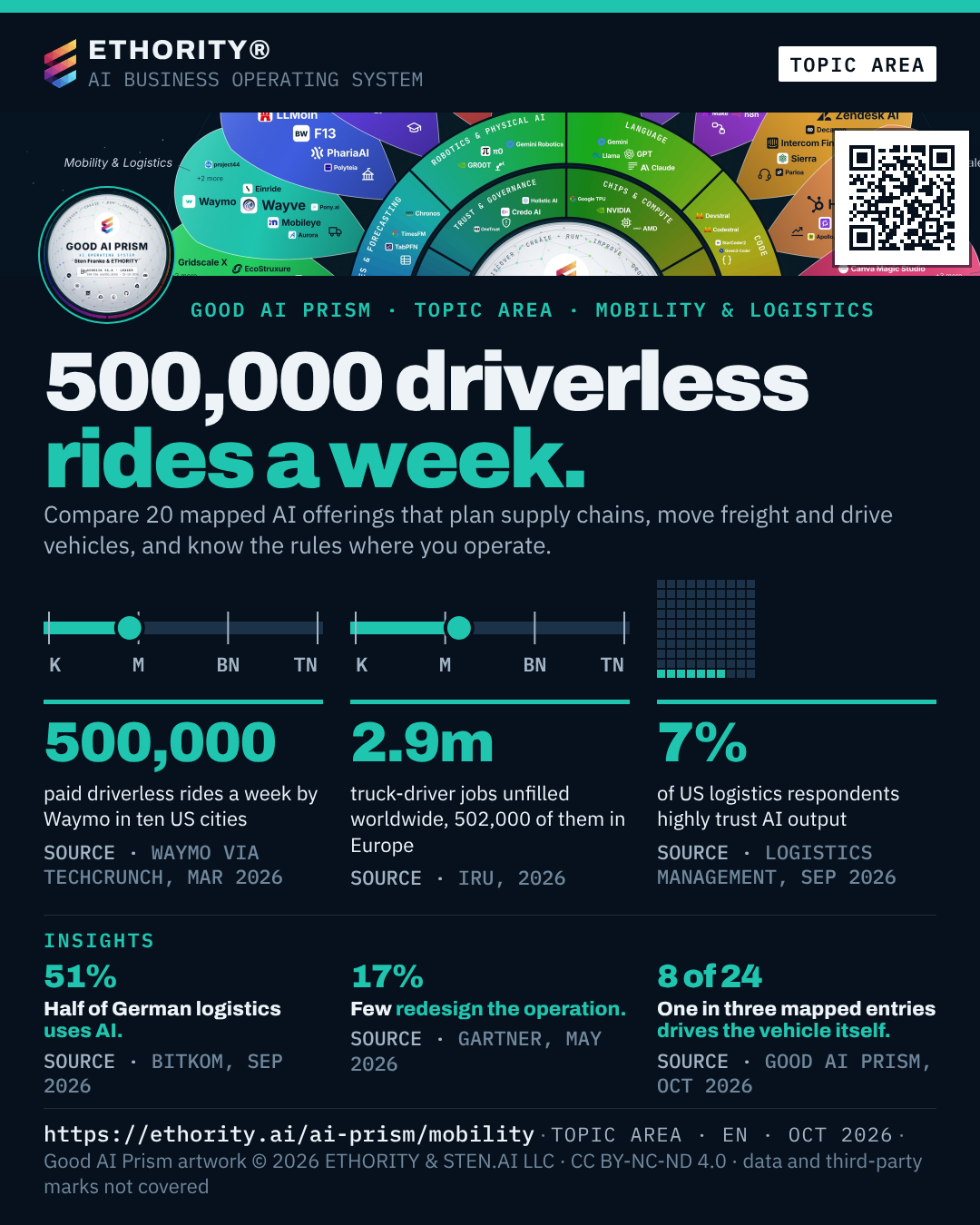
500,000 driverless rides a week.
Compare 20 mapped AI offerings that plan supply chains, move freight and drive vehicles, and know the rules where you operate.
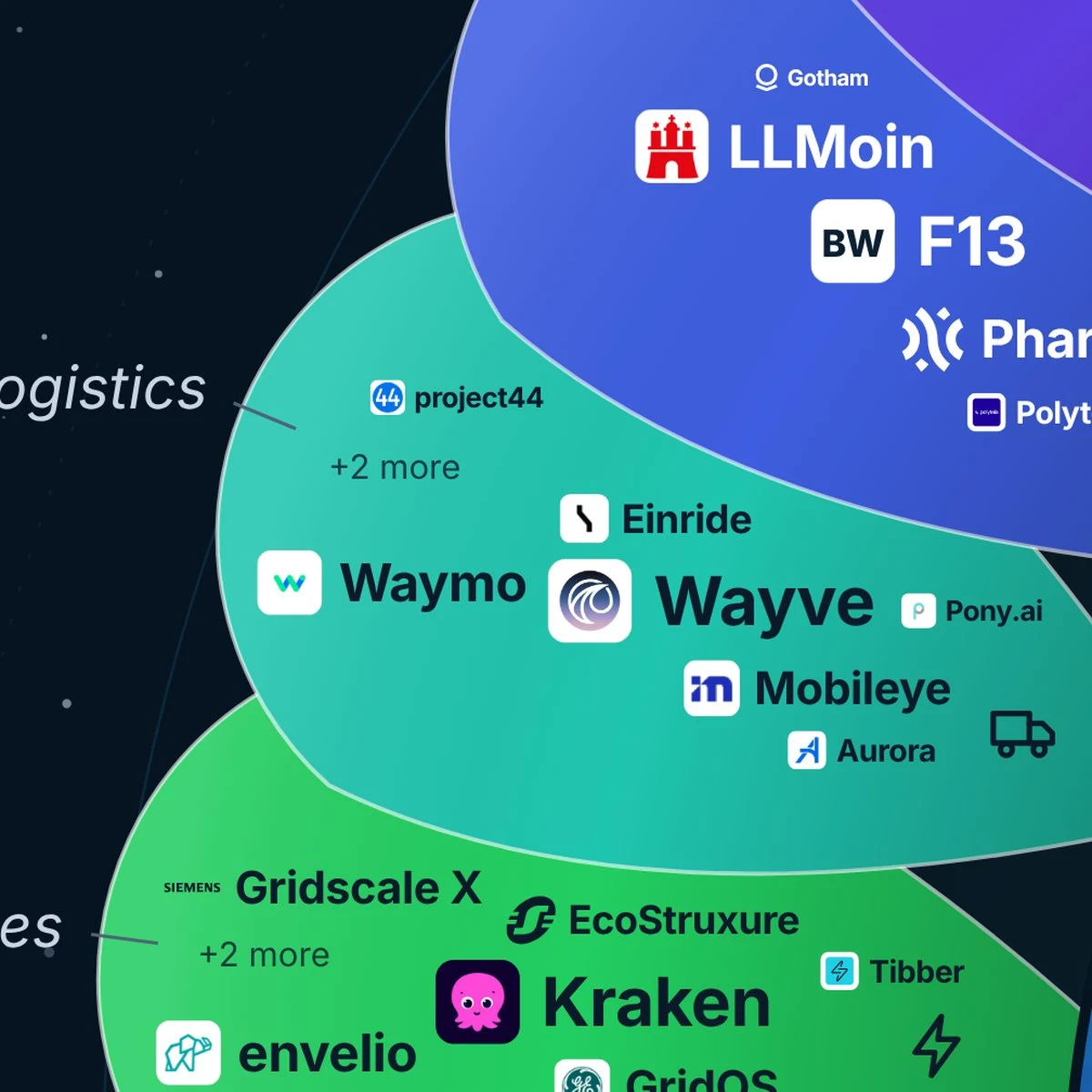
- 20
- AI offerings mapped in Mobility & Logistics, plus 1 provider record (Mobileye) and 3 unclassified records (sennder, Forto, Flexport)Good AI Prism, Oct 2026
- 500,000
- paid driverless rides a week by Waymo in ten US citiesWaymo via TechCrunch, Mar 2026 · techcrunch.com ↗
- 2.9m
- truck-driver jobs unfilled worldwide, 502,000 of them in EuropeIRU, 2026 · dcvelocity.com ↗
- 7%
- of US logistics respondents highly trust AI outputLogistics Management, Sep 2026 · supplychain247.com ↗
Half of German logistics uses AI.
51% of German logistics firms with 20+ staff use AI, up from 22% in 2022.
Bitkom, Sep 2026
Few redesign the operation.
Only 17% of supply-chain leaders use AI to redesign their operating model; 83% scale it step by step.
Gartner, May 2026
One in three mapped entries drives the vehicle itself.
Eight of the 24 mapped entries drive vehicles: robotaxis, driverless trucks, terminal tractors and driving systems.
Good AI Prism, Oct 2026
How to use this page
Three tools and one offer turn this page into a decision.
- Open the Mobility & Logistics map: 20 AI offerings, 1 provider record and 3 unclassified records on one petal of the Good AI Prism, with logos and provider facts.
- Compare up to three offerings: decision facts side by side, each with its source and date.
- Run the Task economics calculator: turn saved hours into capacity you can attribute, before a pilot is approved.
- Offer: AI Estate Audit: every AI tool and model in use, including the ones staff bring themselves, with a scale, fix or stop view per use.
The briefs
The sector brief maps the 24 entries and the rules by jurisdiction; the Robotics brief covers the machines in warehouses and yards.
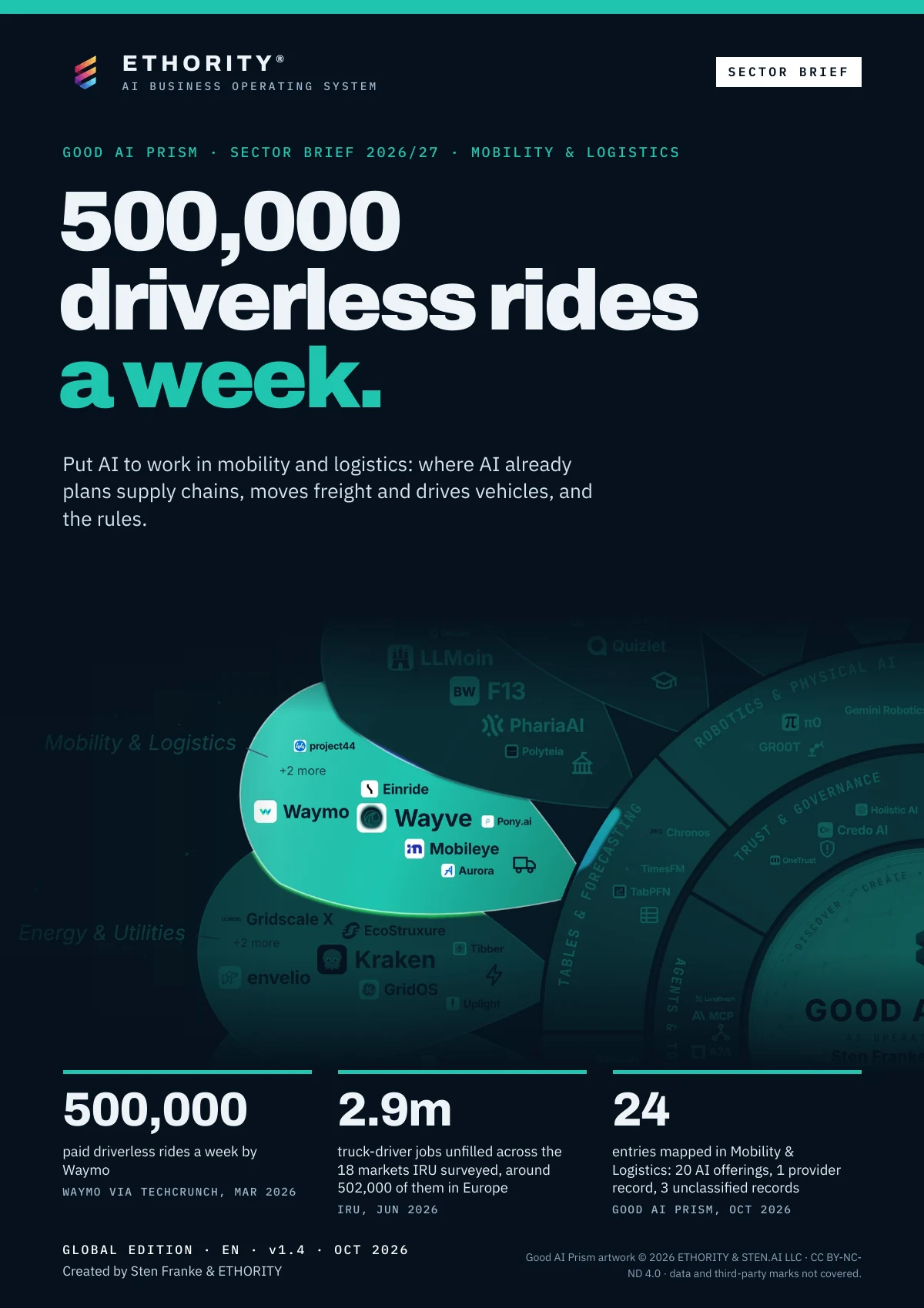
Global edition · EN
500,000 driverless rides a week.
2.9 million truck-driver jobs are unfilled in the markets IRU surveyed. Where AI already plans supply chains, moves freight and drives vehicles, and the rules.
Version 1.4 · 40 pages
Open the study →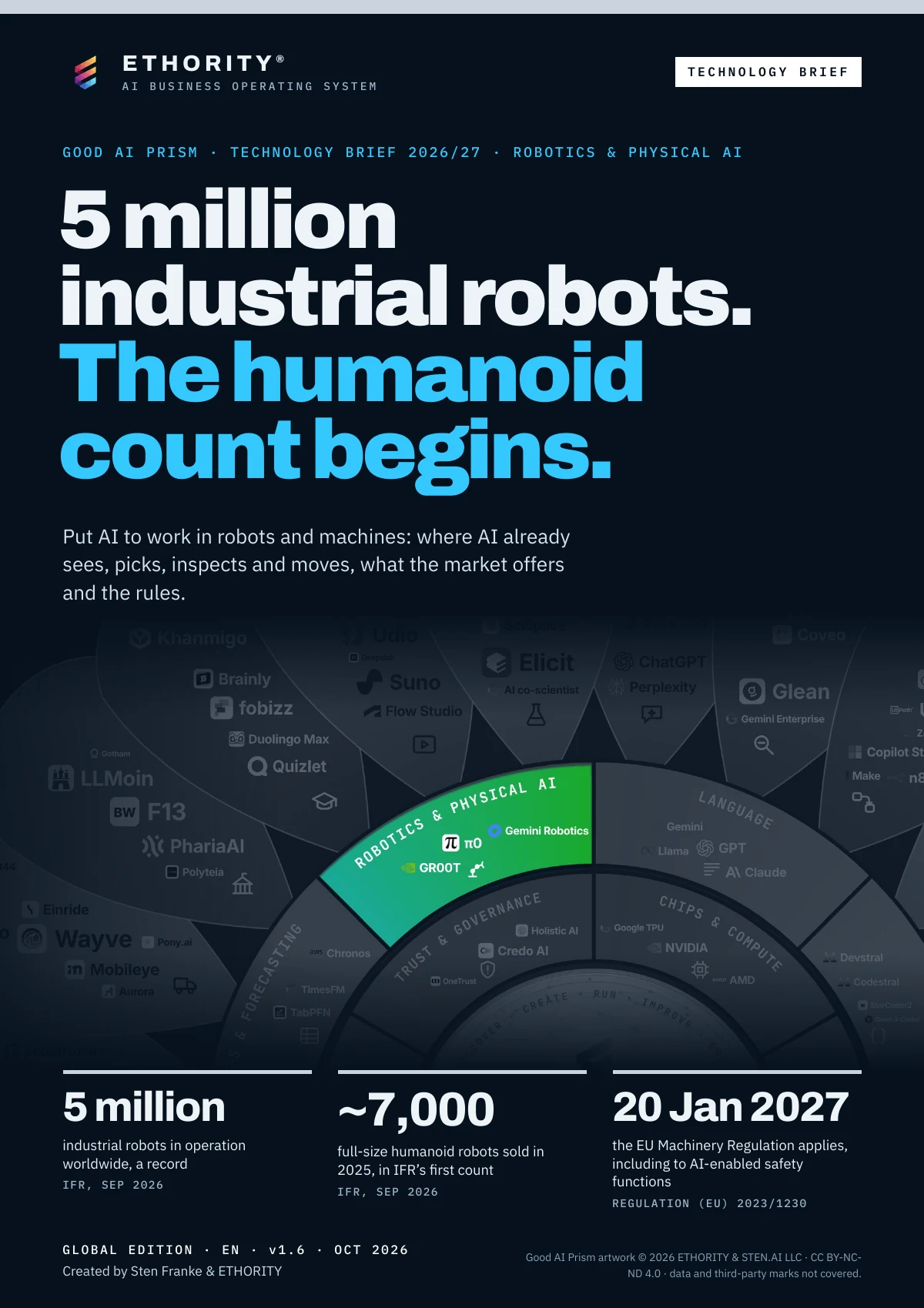
Global edition · EN
5 million industrial robots. The humanoid count begins.
Humanoids are counted for the first time: about 7,000 sold in 2025. Where AI already sees, picks, inspects and moves, what the market offers and the rules.
Version 1.6 · 40 pages
Open the study →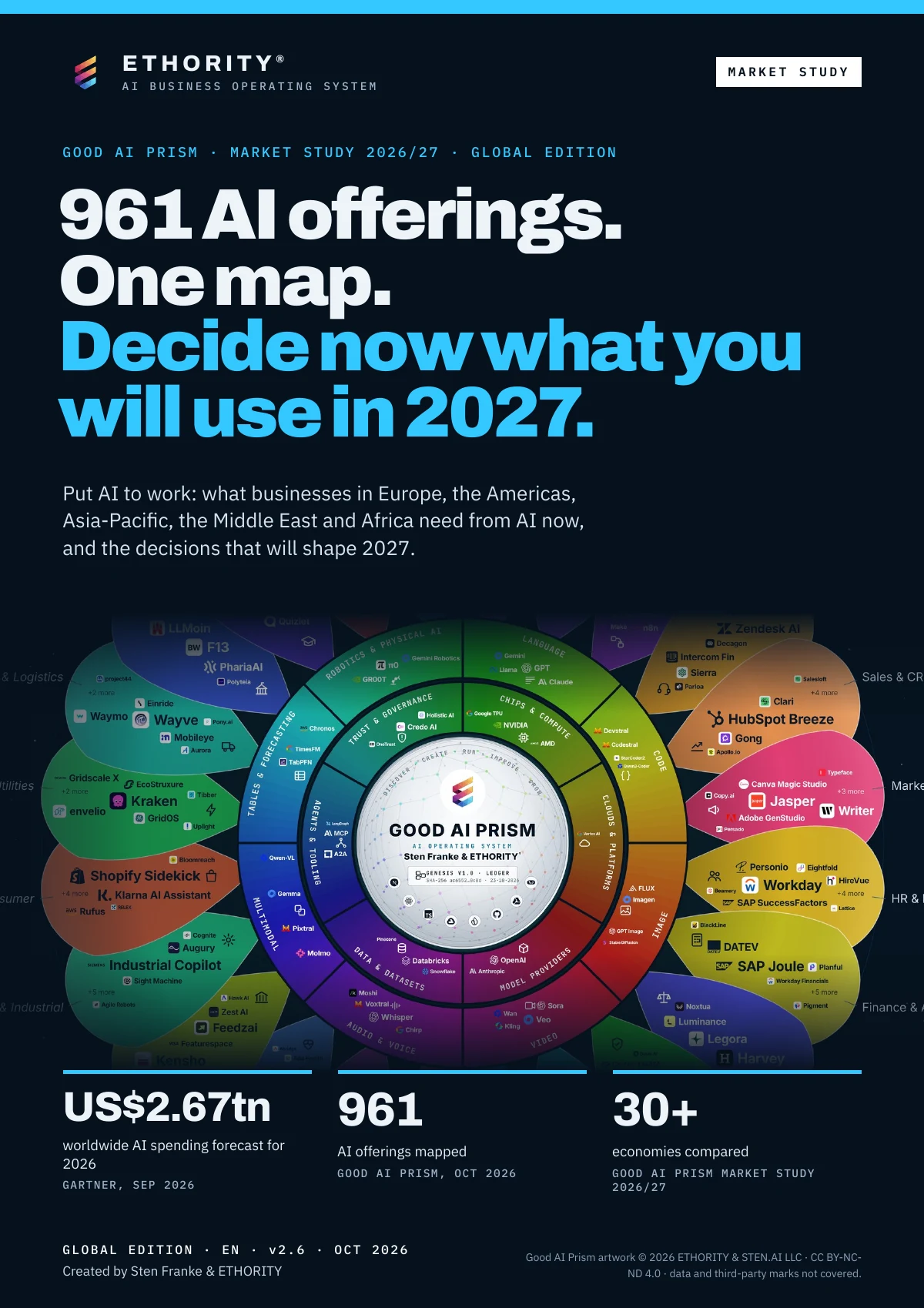
Global edition · EN
961 AI offerings. One map. Decide now what you will use in 2027.
The Good AI Prism helps you find useful AI and compare the evidence behind your options. For organisations already using AI, the question is moving from whether to use AI to which AI, how safely and whether it pays. This Global edition brings together 961 AI offerings across 24 topic areas, 8 data types and 6 technology layers, with sources, dates and limits to guide your next decision.
Version 2.6 · 90 pages
Open the study →Read on
Three related analyses from ETHORITY; the long read for this area follows further down the page.

A marketplace listing does not make an AI agent trustworthy.
When you buy AI agents, keep identity, offer, payment, evidence and trust apart, and grant rights only after purchase.
See the map on one page →
Half of German logistics firms use AI. Measure your own gains.
What has been measured in warehouses and supply chains since 2024, and how to measure it in your own operation.
See the map on one page →
Access to a tool does not give an AI agent the right to act.
How to define what each AI agent may do: by action, limit, time and consequence, rather than by the tools it can reach.
See the map on one page →Rules and dates
Authorities must accept electronic freight information from Jul 2027. AI as a safety component in road traffic carries high-risk duties from 2 Dec 2027; AI in vehicles follows type approval with duties from Aug 2028, under the amended AI Act timetable. Germany allows level-4 operation in approved areas.
Where a logistics project can begin
AI Estate Audit
€25,000 one-time · net
An inventory of AI from dispatch to driver assistance, including shadow AI, with owners and risks.
Date and place by agreement
See what this package includes →AI Opportunity Case
Priced after scoping
One use, such as routing or visibility, assessed against empty runs, on-time rate and cost, ending in a clear decision.
Scope and delivery by agreement
See what this package includes →AI Literacy & Adoption
€2,400 one-time · net
Training for dispatchers, drivers and warehouse teams, with documented literacy measures and override rights.
Scope and delivery by agreement
See what this package includes →AI Governance Setup
€19,500 one-time · net
Rules for AI agents in booking, procurement and service: permissions, approvals and logs.
Scope and delivery by agreement
See what this package includes →Questions buyers ask
Is our routing or visibility tool high-risk?
In most uses, no. Annex III point 2 covers AI as a safety component in road traffic management; vehicles follow type-approval law. Driver monitoring touches workplace and data-protection rules.
How do we deal with shadow AI?
Start with an inventory. 65% of US logistics respondents say AI is used with or without approval (Logistics Management trust study). An AI Estate Audit lists every tool, owner and data source.
Where does AI pay first?
In planning, routing and visibility, where data already flows and results are measured daily: empty runs, on-time delivery and cost per shipment.
Which offerings does the Good AI Prism map?
24: eight for autonomous driving, six for freight brokerage and forwarding, five for visibility and fleet risk, and five for supply-chain planning and routing.
When can trucks drive without drivers in Europe?
Germany allows level-4 operation in approved areas with technical supervision. The Mobility & Logistics brief tracks approvals by jurisdiction.
The evidence at a glance
ETHORITY · LONG READ
Robotaxis carry 500,000 riders a week. Logistics plans first.
Driverless service is real in parts of the US and China, while most logistics AI still plans, routes and tracks. What the market offers, where trust breaks and which rules apply.
In March 2026, Waymo gave about 500,000 paid driverless rides a week across ten US cities. A year earlier that would have read as a forecast. Now it is a service with a timetable. At the same time the road-freight industry is running out of people: the IRU counts 2.9 million unfilled truck-driver jobs worldwide, 502,000 of them in Europe. Mobility and logistics is where AI leaves the screen and enters the street, and where a staff shortage meets a technology that is finally ready to carry some of the load.
500,000 paid driverless rides a week across ten US cities (Waymo via TechCrunch, Mar 2026)
Planning first, autonomy step by step
Most AI in logistics does not drive. It plans. In Germany, 51% of logistics firms now use AI, up from 22% in 2022, and they expect more supply-chain transparency (66%), lower environmental impact (60%) and lower costs (49%) (Bitkom, September 2026). In the US, active AI use among logistics respondents rose from 16% to 43% in a year, according to a Logistics Management study.
51% of German logistics firms use AI, up from 22% in 2022 (Bitkom, Sep 2026)
Yet transformation is rare. Only 17% of supply-chain leaders use AI to redesign their operating model; 83% scale it step by step (Gartner, May 2026). That is a reasonable choice. Planning, routing and visibility produce results that are measured daily, against data that already flows. About a fifth of EU road-freight vehicle-kilometres still run empty (Eurostat), and 71% of German logistics firms name supply-chain disruption as a challenge (Bitkom).
Trust is the bottleneck
Use is rising faster than confidence. Only 7% of US logistics respondents highly trust AI output, and 65% say people in their organisation use AI with or without approval (Logistics Management). Shadow AI is not a side issue in an industry that handles customs documents, invoices and proof of delivery, where document fraud is a known risk. The first control is simple: know which AI tools are in use, by whom, on which data.
Driverless becomes a service
Autonomous driving has moved from test tracks to paid service in several markets. Beyond Waymo, Pony.ai operated 1,975 robotaxis in mid-2026 and planned more than 3,500 by year-end, with a European launch planned with Uber. Apollo Go drives in Dubai. Aurora's driverless trucks have covered about 440,000 miles in Texas and the Southwest. In a peer-reviewed, company-authored analysis over 56.7 million miles, Waymo reported 85% fewer serious-injury crashes than human drivers.
Europe moves in steps. In Hamburg, MOIA and Volkswagen have tested the ID. Buzz AD with passengers since July 2026, with safety drivers, aiming for driverless approval in 2027. FERNRIDE received the first TÜV SÜD certification of an autonomous terminal tractor under the EU Machinery Directive in July 2025. In warehouses the change is already counted: 47% of professional service robots sold in 2025 went to transport and logistics (IFR, September 2026).
For a logistics operator, the practical question is not when every truck drives itself. It is which routes, yards and terminals can run autonomous vehicles first, under which approval, and what that means for dispatch, maintenance and insurance. Hub-to-hub highway freight and closed terminals move first; mixed urban traffic comes later. The Robotics & Physical AI brief covers the machines that move goods inside the fence.
More than one in three AI offerings drives the vehicle itself
The Good AI Prism places 24 entries in Mobility & Logistics, 20 AI offerings, one provider record (Mobileye) and three unclassified records (sennder, Forto, Flexport), each with a dated source from the provider's own pages. Eight drive vehicles: Aurora, Einride, FERNRIDE, Mobileye, Oxa, Pony.ai, Waymo and Wayve. Six broker and forward freight: cargo.one, Flexport, Forto, sennder, Transporeon and Uber Freight. Five give visibility, tracking and fleet risk: Everstream Analytics, FourKites, Motive, project44 and Shippeo. Five plan supply chains and routes: Aera, Kinaxis, Locus, o9 and REMIRA. Six of the 24 entries come from providers headquartered in Germany. The Mobility & Logistics sector brief lists each group with the rule that applies.
The rules: vehicle law plus AI law
In the EU, vehicles are governed by type-approval law, which brings AI Act requirements in through delegated acts; AI in vehicles follows Annex I, with duties from August 2028. AI used as a safety component in the management and operation of road traffic carries high-risk duties under Annex III from 2 December 2027, as amended by Regulation (EU) 2026/1744. From July 2027, authorities must accept electronic freight transport information (eFTI). Planning and visibility tools are minimal-risk in most uses; driver monitoring touches workplace and data-protection rules.
Germany already allows level-4 driving in approved operating areas under its Autonomous Driving Act of 2021, with technical supervision and approval by the KBA. The UK's Automated Vehicles Act enables commercial taxi and bus pilots; Japan allows level 4 in designated areas since April 2023; Dubai licensed fully driverless ride-hailing in April 2026 and targets 25% of trips smart or driverless by 2030.
Seven questions before a pilot
Before AI moves goods or people, settle seven questions in writing. Does it control a vehicle or a traffic safety function? Then type approval and the AI Act's high-risk rules apply. Which approvals does driverless operation need where we run, and who is the technical supervisor? Which data from drivers, vehicles and customers does it use, and how is privacy protected? How do drivers and dispatchers override or correct an AI decision, and how fast? How does it integrate with our transport management system and with partners' systems, and can we exit? Do customers know when they deal with AI agents in booking and service? And which measures decide scaling: empty runs, on-time delivery, cost per shipment, safety events and CO2? Agents that book freight or negotiate rates raise one more question: what are they allowed to commit to on the company's behalf, and who signs off above that limit? A provider that answers in writing is ready for a pilot.
The workforce side
Germany misses more than 70,000 truck drivers: 30,000 to 35,000 retire each year against 15,000 to 20,000 new entrants, and about a third of drivers are over 55. Shortages reach the whole chain: German logistics firms report gaps in couriers (64%), drivers (55%), dispatchers (53%) and warehouse staff (48%). And 55% of supply-chain leaders expect agentic AI to reduce entry-level hiring (Gartner, February 2026). That makes skills and oversight part of the business case. Dispatchers and drivers need the right to override AI decisions, and the training to do it well.
In practice
Use case: driverless inside the fence. FERNRIDE received the first TÜV SÜD certification of an autonomous terminal tractor under the EU Machinery Directive in July 2025. Terminals and yards are closed areas with known routes and trained staff, which is why autonomy reaches them before it reaches mixed urban traffic.
Scenario: an agent that books freight. A forwarder lets an AI agent book spot capacity on freight platforms. The agent may commit up to a set amount per shipment and only with approved carriers; anything above goes to a dispatcher, and every booking is logged with price, carrier and reason. The limit is written before the agent goes live, not after the first unexpected invoice.
What to do Monday
- Surface shadow AI. List every AI tool and model in use, from planning to driver assistance; an AI Estate Audit makes the list complete.
- Separate the regimes. Keep planning and visibility apart from vehicle and traffic safety functions, and map each to its rule.
- Start where data already flows. Pilot one planning, routing or visibility use with a baseline of empty runs, on-time delivery and cost.
- Write the override. Define how drivers and dispatchers correct an AI decision, and the response time.
- Scale on measures: empty runs, delivery reliability, cost per shipment, safety events and CO2.
This article describes market and regulation. It is not legal advice.
Sources and further reading
- TechCrunch, Waymo's skyrocketing ridership in one chart ↗ · 27 Mar 2026
- IRU driver shortage report, via DC Velocity ↗ · 2026
- Bitkom, Logistics invests in AI but lacks know-how ↗ · Sep 2026
- Logistics Management, AI use, adoption and trust study ↗ · Sep 2026
- Gartner, AI is not driving supply-chain operating model transformation · 6 May 2026
- Gartner, 55% of supply-chain leaders expect agentic AI to reduce entry-level hiring · 25 Feb 2026
- IFR, World Robotics 2026: Service Robots ↗ · 30 Sep 2026
- Regulation (EU) 2026/1744 (Digital Omnibus on AI) ↗ · 27 Jul 2026
- ETHORITY, Good AI Prism Sector Brief: Mobility & Logistics, Global edition (Pony.ai filing, Waymo safety study, Eurostat, KBA, MOIA, IRU) → · 22 Oct 2026
Put the thinking to work
AI Opportunity Case →
A defensible proceed, test, redesign, defer or stop decision. The fee is independent of which outcome the evidence supports.
A written comparison of up to three AI offerings · €195 net →
Start with one question and up to three offerings. Request a sourced comparison, provider questions and a cost sketch using your assumptions.
YOUR NEXT STEP
Discuss your question with Sten Franke.
Bring your business question or the figures you already know. ETHORITY investigates within the agreed scope; together with Sten Franke you agree the next piece of work.