 ETHORITY®
In this article
Terms used in this article
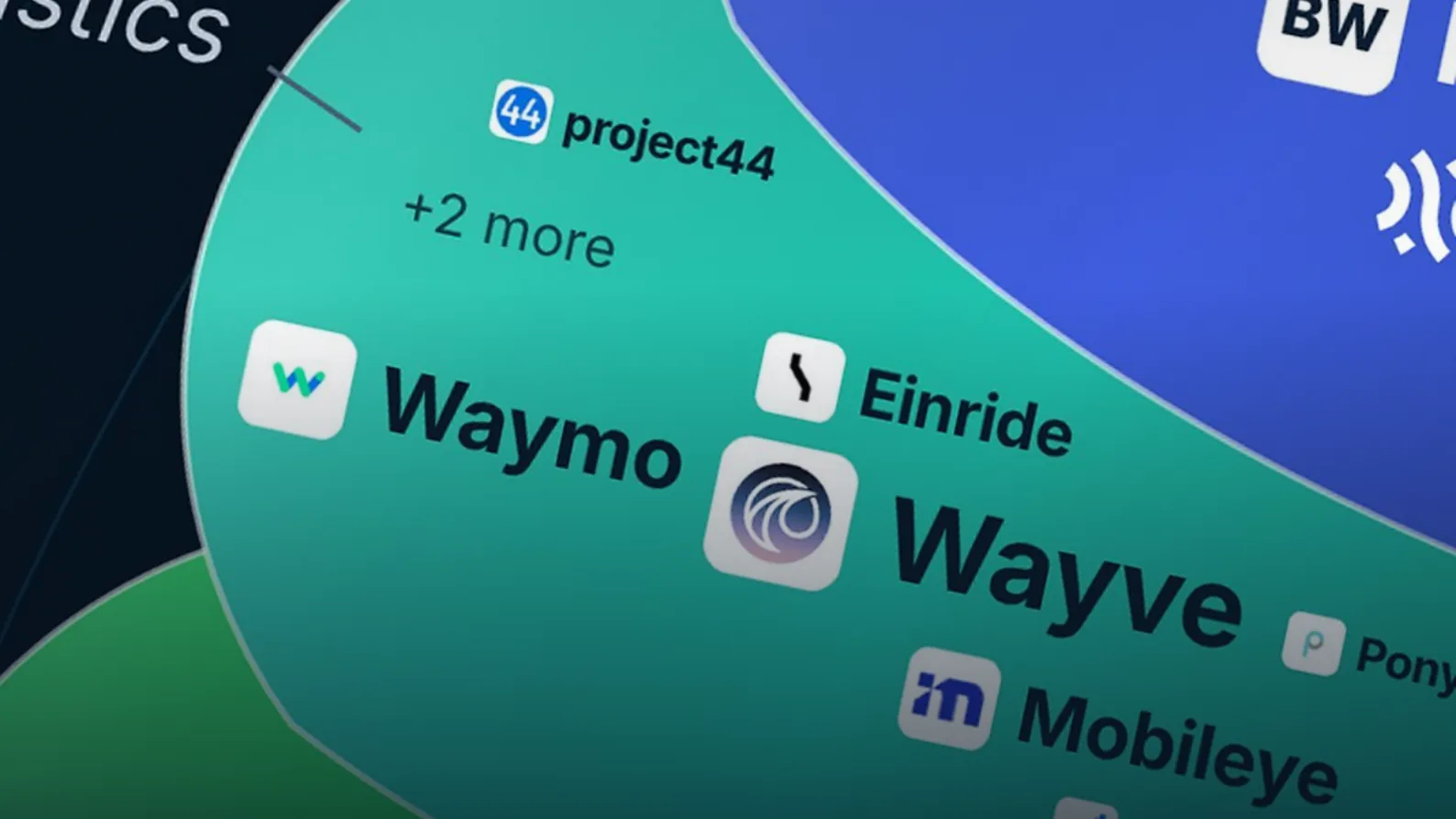
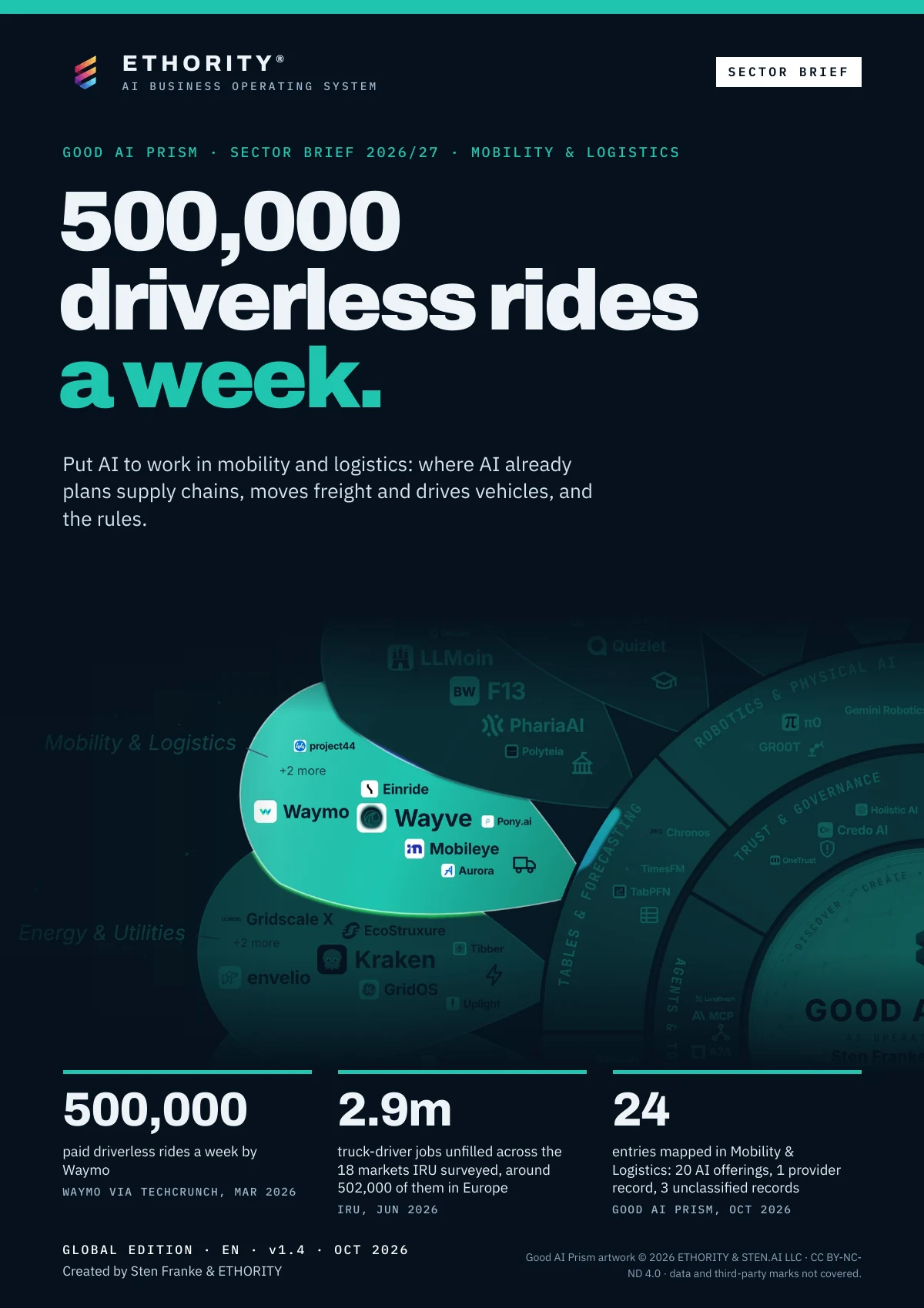
Good AI Prism v3.12 · Mobility & Logistics petal · rotated macro · Good AI Prism artwork © 2026 ETHORITY & STEN.AI LLC · CC BY-NC-ND 4.0 · data and third-party marks not covered.
Good AI Prism v3.12 · Sten Franke & ETHORITY
Source study · v1.1 · page 5 · Figure published: 25 Oct 2026
Read figure text, sources and rights
Good AI Prism v3.12 · Mobility & Logistics petal · rotated macro · Good AI Prism artwork © 2026 ETHORITY & STEN.AI LLC · CC BY-NC-ND 4.0 · data and third-party marks not covered.
ETHORITY figure. Rights in cited data and third-party marks remain with their owners. The Prism artwork licence applies where stated on the figure.
Half of German logistics firms now use AI and logistics robots lead the service-robot market; the gains that count are the ones you measure against your own baseline.
A note on the original headline
Our 2024 article looked at how AI improves inventory accuracy in retail. This edition builds on what has been measured and published since, and adds a method to measure the effect in your own operation.
Where adoption stands
Logistics has moved quickly from pilots to use:
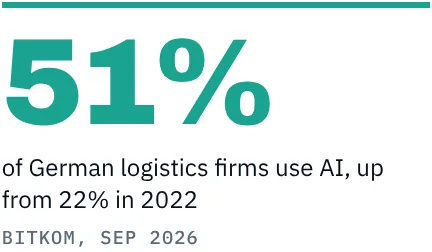
51% — of German logistics firms use AI, up from 22% in 2022
BITKOM, SEP 2026
Source study · v1.1 · page 6 · Figure published: 25 Oct 2026
Read figure text, sources and rights
51% of German logistics firms use AI, up from 22% in 2022 BITKOM, SEP 2026
Source links on the cited study page
ETHORITY figure. Rights in cited data and third-party marks remain with their owners. The Prism artwork licence applies where stated on the figure.
- 51% of German logistics firms with 20 or more staff use AI in 2026, up from 22% in 2022 (Bitkom, September 2026, n=502). Across the German economy the figure is 57%.
- In the same survey, 47% use warehouse management systems, 39% big data and analytics, 23% digital twins, 17% robotics or autonomous transport and 15% smart shelves.
- In a US logistics survey, active AI use rose from 16% to 43% in one year, yet only 7% of respondents highly trust AI output, and 65% say staff use AI with or without approval (Logistics Management, September 2026).
- About 14% of US retail firms use AI (US Census Bureau, May 2026), well below information (39.7%) and finance and insurance (33.9%).
- Only 17% of supply-chain leaders pursue a transformational redesign with AI; 83% scale it incrementally (Gartner, May 2026, n=140).
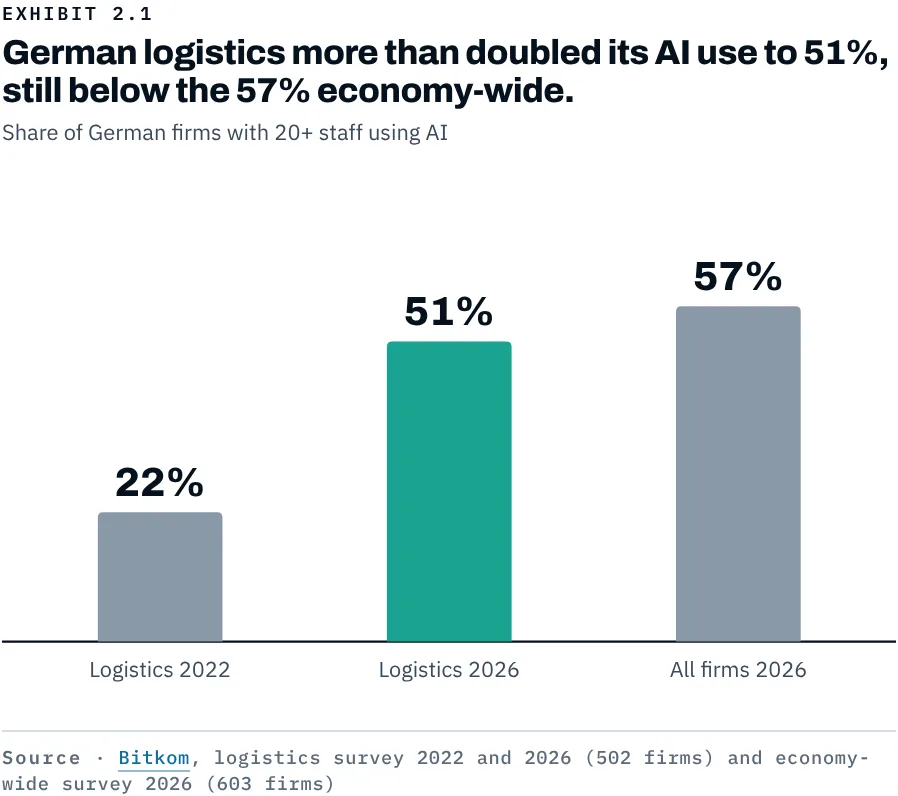
German logistics more than doubled its AI use to 51%, still below the 57% economy-wide.
Bitkom, logistics survey 2022 and 2026 (502 firms) and economy-wide survey 2026 (603 firms)
Source study · v1.1 · page 10 · Figure published: 25 Oct 2026
Read figure text, sources and rights
EXHIBIT 2.1 German logistics more than doubled its AI use to 51%, still below the 57% economy-wide. Share of German firms with 20+ staff using AI 22% Logistics 2022 51% Logistics 2026 57% All firms 2026 Source · Bitkom, logistics survey 2022 and 2026 (502 firms) and economy-wide survey 2026 (603 firms) 22% Logistics 2022 51% Logistics 2026 57% All firms 2026
Source links on the cited study page
ETHORITY figure. Rights in cited data and third-party marks remain with their owners. The Prism artwork licence applies where stated on the figure.
Read together, these figures say that use is spreading, but trust and depth of use are the next constraints.
What AI does in inventory and the supply chain
The core techniques described in 2024 remain valid: demand forecasting from sales history, seasonality and external signals; automated replenishment; dynamic safety stock; and route and warehouse optimisation. Three things have changed in the technology underneath:
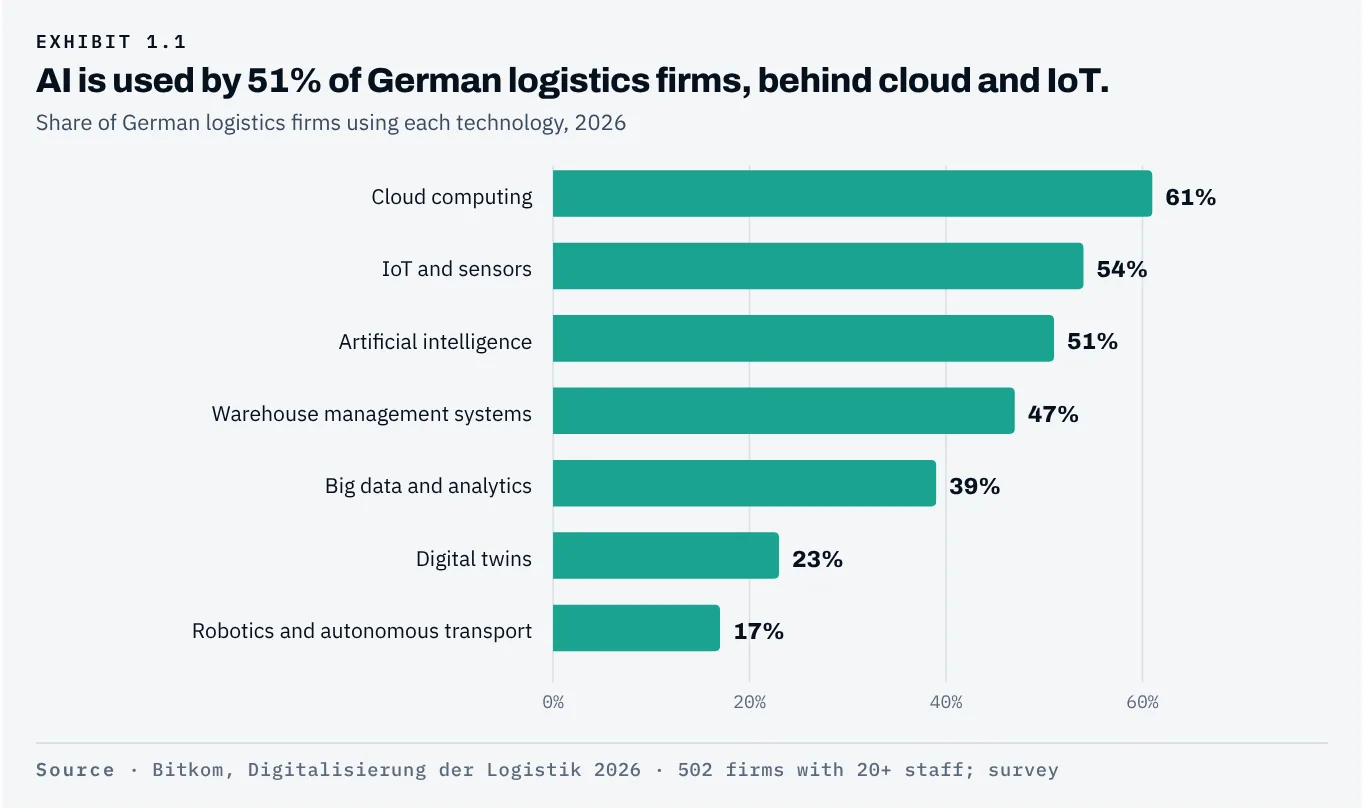
AI is used by 51% of German logistics firms, behind cloud and IoT.
Bitkom, Digitalisierung der Logistik 2026 · 502 firms with 20+ staff; survey
Source study · v1.1 · page 6 · Figure published: 25 Oct 2026
Read figure text, sources and rights
EXHIBIT 1.1 AI is used by 51% of German logistics firms, behind cloud and IoT. Share of German logistics firms using each technology, 2026 0% 20% 40% 60% Cloud computing 61% IoT and sensors 54% Artificial intelligence 51% Warehouse management systems 47% Big data and analytics 39% Digital twins 23% Robotics and autonomous transport 17% Source · Bitkom, Digitalisierung der Logistik 2026 · 502 firms with 20+ staff; survey 0% 20% 40% 60% Cloud computing 61% IoT and sensors 54% Artificial intelligence 51% Warehouse management systems 47% Big data and analytics 39% Digital twins 23% Robotics and autonomous transport 17%
Source links on the cited study page
ETHORITY figure. Rights in cited data and third-party marks remain with their owners. The Prism artwork licence applies where stated on the figure.
- Language models handle the documents. Delivery notes, customs papers, supplier emails and claims can now be read and checked by general-purpose models. Prices for small models start at USD 0.10 per million input tokens (OpenAI GPT-6 Luna, Anthropic Claude Haiku 5.5), which makes high-volume document work affordable. Document fraud is one of the risks logistics leaders name.
- Agents act across systems. Spending on AI agents and assistants is forecast to more than double to USD 65.5 billion in 2027 (Gartner). 55% of supply-chain leaders expect agentic AI to reduce entry-level hiring needs (Gartner, February 2026, n=509).
- Models change often. OpenAI retires its GPT-4o and GPT-4.1 snapshots on 14 January 2027. Any agent or document workflow needs a regression test before a model switch.
Expected benefits are clear in the German data: 66% of logistics firms expect better supply-chain transparency, 60% a lower environmental impact and 49% lower costs (Bitkom).
Physical AI: robots in the warehouse
Logistics is where robots earn their keep today.
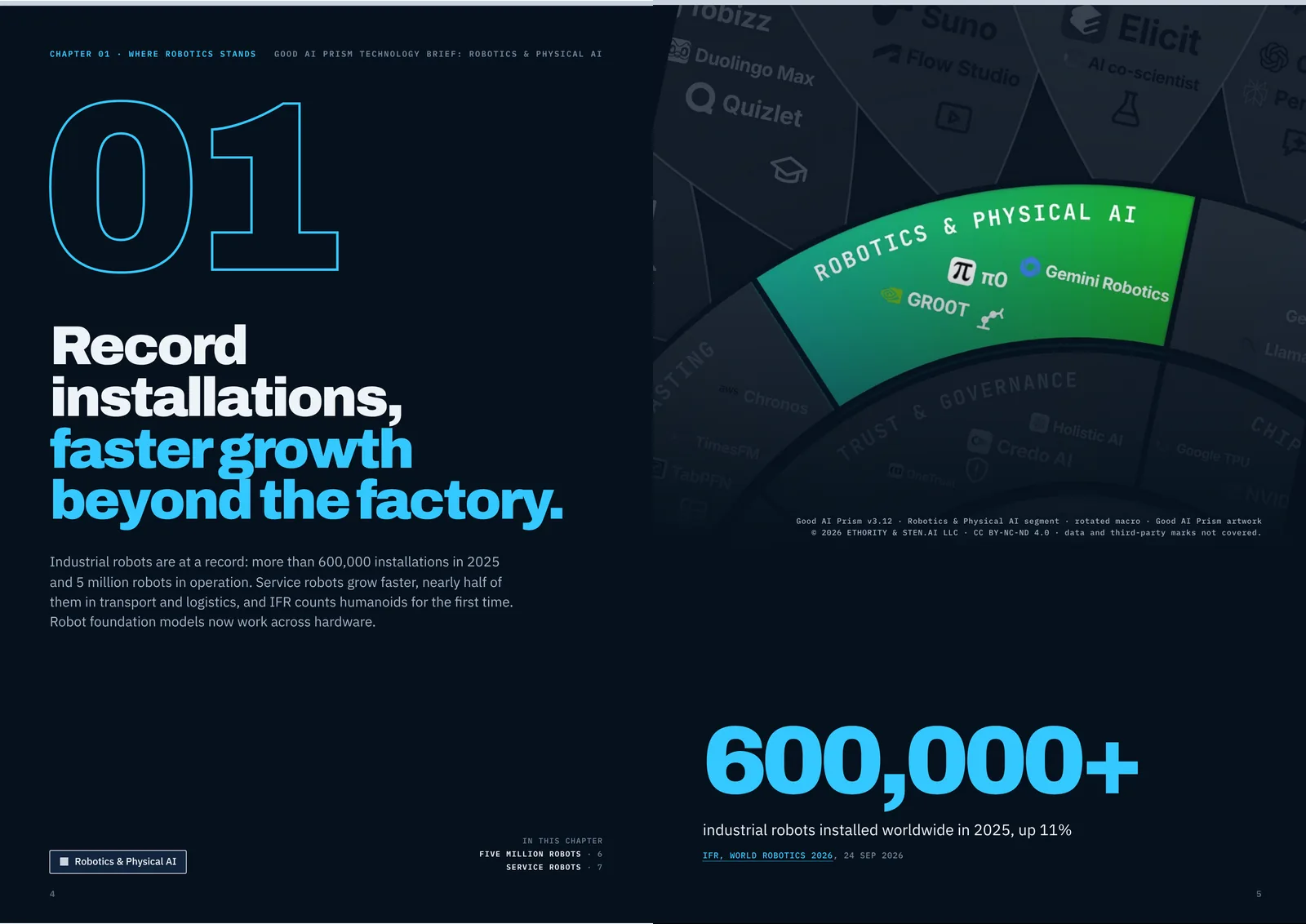
600,000+ — industrial robots installed worldwide in 2025, up 11%
IFR, WORLD ROBOTICS 2026, 24 SEP 2026
Source study · v1.2 · page 4-5 · Figure published: 25 Oct 2026
Read figure text, sources and rights
CHAPTER 01 · WHERE ROBOTICS STANDS GOOD AI PRISM TECHNOLOGY BRIEF: ROBOTICS & PHYSICAL AI 01 Record installations, faster growth beyond the factory. Industrial robots are at a record: more than 600,000 installations in 2025 and 5 million robots in operation. Service robots grow faster, nearly half of them in transport and logistics, and IFR counts humanoids for the first time. Robot foundation models now work across hardware. Robotics & Physical AI IN THIS CHAPTER FIVE MILLION ROBOTS · 6 SERVICE ROBOTS · 7 4 Good AI Prism v3.12 · Robotics & Physical AI segment · rotated macro · Good AI Prism artwork © 2026 ETHORITY & STEN.AI LLC · CC BY-NC-ND 4.0 · data and third-party marks not covered. 600,000+ industrial robots installed worldwide in 2025, up 11% IFR, WORLD ROBOTICS 2026, 24 SEP 2026 5
Source links on the cited study page
ETHORITY figure. Rights in cited data and third-party marks remain with their owners. The Prism artwork licence applies where stated on the figure.
- Almost 250,000 professional service robots were sold worldwide in 2025 (+24%). Transport and logistics accounted for 117,500 units, or 47%, the largest application (IFR, September 2026).
- Robots-as-a-service is the dominant business model in the US (IFR).
- About 7,000 full-size humanoid robots were sold globally in 2025, the first IFR count. For warehouses, humanoids are pilots; mobile robots and automated storage are where volume deployments sit.
- Industrial robot stock reached a record 5 million units; Germany has 449 robots per 10,000 manufacturing employees, against an EU-27 average of 231 (IFR).
Two rules matter for anyone buying robots for the EU. The Machinery Regulation (EU) 2023/1230 applies from 20 January 2027, including requirements for AI-enabled safety functions. Updated robot safety standards ISO 10218-1 and -2 were published in 2025.
People and constraints
AI and robotics in logistics respond to a labour gap. 87% of German logistics firms cite a shortage of skilled staff, including 48% for warehouse staff (Bitkom). Globally, about 2.9 million truck-driver jobs are unfilled (IRU). Energy matters too: every German logistics firm surveyed named energy prices as a challenge.
Where AI touches workers, rules apply. Worker management and performance monitoring are Annex III uses under the EU AI Act, with high-risk duties from 2 December 2027 (Regulation (EU) 2026/1744). Emotion recognition at work has been prohibited since February 2025.
How to measure the effect yourself
A credible number comes from your own operation, measured before and after:
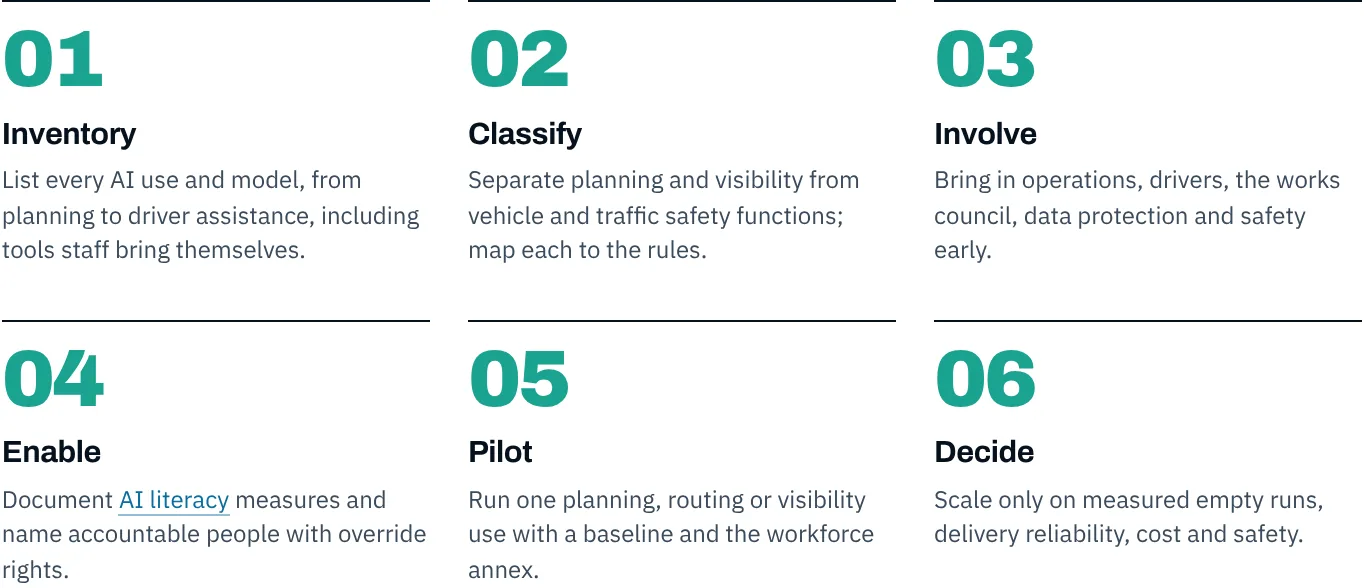
A 90-day start for logistics and mobility companies.
ETHORITY planning example. The duration is an assumption to adapt to the agreed scope.
Source study · v1.1 · page 26 · Figure published: 25 Oct 2026
Read figure text, sources and rights
01 Inventory List every AI use and model, from planning to driver assistance, including tools staff bring themselves. 02 Classify Separate planning and visibility from vehicle and traffic safety functions; map each to the rules. 03 Involve Bring in operations, drivers, the works council, data protection and safety early. 04 Enable Document AI literacy measures and name accountable people with override rights. 05 Pilot Run one planning, routing or visibility use with a baseline and the workforce annex. 06 Decide Scale only on measured empty runs, delivery reliability, cost and safety.
ETHORITY figure. Rights in cited data and third-party marks remain with their owners. The Prism artwork licence applies where stated on the figure.
- Set the baseline. Inventory accuracy (physical vs system), forecast error, stock turns, stock-out rate, on-time rate and cost per shipment, measured for at least one comparable period.
- Check data readiness first. In manufacturing, data quality is behind 51% of failed AI pilots (RSM, 2026).
- Count accepted outcomes. For document or replenishment workflows, divide total cost (usage, integration, review, rework) by the cases your team accepts, not by the cases processed.
- Agree a stop condition. Decide in advance which result scales the pilot and which ends it.
- Make shadow AI visible. With 65% reporting AI use with or without approval, an inventory of tools in use is the starting point for trust.
The Good AI Prism maps offerings in the Mobility & Logistics and Retail & Consumer areas by data type and technology layer, which helps narrow a shortlist before any demo.
Define the inventory problem before choosing the technology
Inventory accuracy, forecast quality and physical handling are different problems. A warehouse can have accurate records and still stock the wrong assortment. A good demand forecast does not prove that received goods were scanned correctly. A robot can move a container efficiently while the system records the wrong item. Identify the error and the operating decision before looking for an AI product.
Start with a representative product group or location. Record the current stock process, data sources, replenishment rule and responsibility for corrections. Include ordinary variation: promotions, returns, supplier delays, substitutions and damaged goods. The baseline should describe the actual operation rather than a clean sample that excludes its recurring difficulties.
Choose the outcome that matters. Lower stock-outs, reduced expiry, less manual checking and improved delivery reliability require different measures. A project can improve one while worsening another. State the acceptable trade-offs and any boundaries that cannot be traded away, such as worker safety or required handling controls. This gives the evaluation a purpose beyond producing a better-looking dashboard.
A worked example: forecast error is not stock availability
Consider a hypothetical item with daily demand of 80, 100 and 120 units. A forecast of 100 each day has absolute errors of 20, zero and 20, averaging about 13.3 units. That describes one forecast-error measure for three observations. It does not establish whether customers received their orders, because starting stock, lead time and replenishment also matter.
Now suppose a new model reduces that error but the supplier's lead time doubles. Availability may still deteriorate. Conversely, a modest forecast combined with a better replenishment rule may improve service. Measure the complete mechanism instead of attributing every operational change to forecast accuracy. These numbers belong to a calculation scenario, not findings about a supplier or customer.
Report the relevant distribution. Slow-moving items, new products and promotional lines can behave differently from stable high-volume stock. A strong average can hide an unacceptable result for critical items. Agree which groups need separate review and retain the reason for any exclusion. The result should help determine where the method is useful, not imply one model works equally well for every product.
Fix the data handover before automating the action
Inventory workflows depend on identities, units and timestamps. A carton, a pallet and an individual item are not interchangeable quantities. A late event is different from a missing event. A returned product may need inspection before it becomes available stock. An assistant can help identify inconsistencies, but the authoritative stock system must remain the place where accepted changes are recorded.
For document work, compare the extracted information with the source record. A delivery note can contain a valid quantity for the wrong order. A fluent summary can overlook a damaged-goods exception. Define which discrepancies can be prepared for review and which block an update. Do not allow a generated explanation to replace the original document when the decision depends on its details.
Test repeated imports and recovery after interruption. The same delivery note should not create two receipts because a request was retried. If an update may already have occurred, reconcile its state before running it again. Preserve the identifier that connects the source document, proposed change and accepted transaction. This is ordinary operational discipline made more important by flexible automated preparation.
Treat physical automation as its own safety decision
A conversational assistant and a moving machine have different consequences. A demonstration of a robot's capability does not establish the safety of your site, layout, payload or interaction with people. The machinery specification, installation assessment and applicable conformity work require qualified specialists. Do not use a generic AI evaluation as a substitute for them.
Consider the ordinary environment: blocked routes, changing storage locations, maintenance, temporary workers and emergency procedures. The operating plan should say who can stop the equipment, who restores it and how the rest of the process continues. A software update may change behaviour in a way that requires review of the physical application.
The Machinery Regulation's application date and a standard's publication date are different facts. Neither means every product described as a robot automatically satisfies the necessary requirements. Use the official regulation and the relevant technical standard with competent advice for the actual application. Keep any supplier claim scoped to the equipment and conditions it covers.
Measure cost and people together
For document assistance, count accepted records, correction minutes, unresolved discrepancies and the cost of rework. For replenishment, include service level, stock value, expiry and emergency orders. For physical handling, measure the appropriate throughput and safety conditions. A common financial model can connect these results, but it should not collapse their different meanings into one automation percentage.
Released capacity may support more volume or reduce strain without immediately lowering cash expenditure. Explain the intended use of the capacity. Include training, maintenance, integration and exception work in the cost base. A project that transfers work from a warehouse employee to an unsupported supervisor has not necessarily reduced total effort.
Where the system affects people, involve the appropriate employee representatives and specialist advisers. Explain what is measured and why. Data collected for stock movement should not silently become an employee-performance system. A change of purpose is a new decision with different questions, not a minor technical reuse.
Use an exception walk to test the full workflow
Before expanding the pilot, follow one disputed delivery from document receipt to accepted stock. Ask the operator to show the source, explain the mismatch and identify who can correct it. Check whether the assistant preserves the original quantity and unit when preparing its proposal. A plausible summary must not silently normalise a discrepancy that still needs a business decision.
Now interrupt the process after preparation but before confirmation. On resuming, can staff distinguish a draft, an attempted update and an accepted transaction? Check the authoritative stock record independently. This is particularly important where a network failure leaves the user unsure whether the operation completed. The recovery path should establish the state rather than encourage repeated submission.
Next, compare the corrected physical count with the system record. A successful software update does not prove that the goods are present or usable. If damaged goods, quarantine or inspection matter, retain those states. The business acceptance rule should reflect what can actually be promised to a customer.
Finally, ask the shift supervisor whether the process is practical during a busy period. Record the time needed to resolve the exception and the support required. A control that works only when the project team is standing beside the operator is not yet an ordinary operating capability. Use that observation to refine the handover, narrow the permitted task or obtain the missing source before extending the deployment.
Select a bounded continuation
Explore relevant offerings in the Mobility and Logistics area, then compare their actual functions, deployment conditions and billing basis. A relevant category does not establish suitability for a particular warehouse. Carry the unanswered material questions into the profile comparison and the supplier discussion.
For a defined business question, inspect the AI Business Blueprint. A deeper process and investment case belongs in the proposal-based Enterprise AI Opportunity Case. Bring a specific flow, baseline and decision owner. The useful next step should clarify whether the main opportunity is better data, a different rule, assisted work or a carefully assessed automated action.
What to decide now
- Pick one inventory or logistics process and record its baseline: accuracy, forecast error, cost per shipment.
- For any robot purchase from 2027, write Machinery Regulation conformity and ISO 10218:2025 into the specification.
- If AI monitors warehouse staff, prepare for the 2 December 2027 high-risk duties now, with works-council involvement.
Evidence and buyer tools for logistics and retail are in the Good AI Prism Global Market Study 2026/27 at ethority.ai/ai-prism-study.
Sources
- Bitkom, logistics and AI 2026 (Sep 2026): https://www.bitkom.org/Presse/Presseinformation/Die-Logistik-investiert-in-KI-doch-es-fehlt-Knowhow
- Bitkom, majority of companies use AI (Sep 2026): https://www.bitkom.org/Presse/Presseinformation/Erstmals-nutzt-die-Mehrheit-der-Unternehmen-KI
- Logistics Management, AI use and trust study (Sep 2026): https://www.supplychain247.com/article/logistics-ai-use-adoption-trust-study
- US Census Bureau, AI use by businesses (May 2026): https://census.gov/library/stories/2026/05/ai-use-businesses.html
- Gartner, AI and supply-chain operating models (May 2026): https://www.gartner.com/en/newsroom/press-releases/2026-05-06-gartner-survey-shows-ai-is-not-driving-supply-chain-operating-model-transformation
- Gartner, agentic AI and entry-level hiring (Feb 2026): https://www.gartner.com/en/newsroom/press-releases/2026-02-25-gartner-survey-shows-55-percent-of-supply-chain-leaders-expect-agentic-ai-to-reduce-entry-level-hiring-needs
- Gartner, worldwide AI spending forecast (Sep 2026): https://gartner.com/en/newsroom/press-releases/2026-09-16-gartner-forecasts-worldwide-ai-spending-to-grow-49-point-5-percent-in-2026
- OpenAI, GPT-6.1 Sol and Luna pricing: https://openai.com/index/introducing-gpt-6-1-sol/
- Anthropic, models overview: https://platform.claude.com/docs/en/about-claude/models/overview
- OpenAI, deprecations: https://developers.openai.com/api/docs/deprecations
- IFR, World Robotics 2026 Service Robots (Sep 2026): https://kyodonewsprwire.jp/release/202610017079
- IFR, five million robots (Sep 2026): https://ifr.org/ifr-press-releases/five-million-robots-now-operate-in-factories-globally
- IFR, robot density (Apr 2026): https://ifr.org/downloads/press_docs/DE-2026-APRIL-_8-IFR_PRESSMELDUNG_Roboterdichte-deutsch.pdf
- Regulation (EU) 2023/1230 (Machinery Regulation): https://eur-lex.europa.eu/eli/reg/2023/1230/oj
- ISO 10218-2:2025: https://www.iso.org/standard/73934.html
- IRU driver shortage report (via DC Velocity): https://www.dcvelocity.com/supply-chain/other-services/labor/iru-report-finds-global-truck-driver-shortage
- Regulation (EU) 2026/1744: https://eur-lex.europa.eu/eli/reg/2026/1744/oj/eng
- RSM, manufacturers using AI 2026: https://rsmus.com/insights/industries/manufacturing/manufacturers-using-ai-2026.html
- ETHORITY, Good AI Prism Global Market Study 2026/27: https://ethority.ai/ai-prism-study
Updated edition of the article first published on ethority.net in 2024; the original remains archived.