 ETHORITY®
GOOD AI PRISM · TOPIC AREA · HEALTH & LIFE SCIENCES
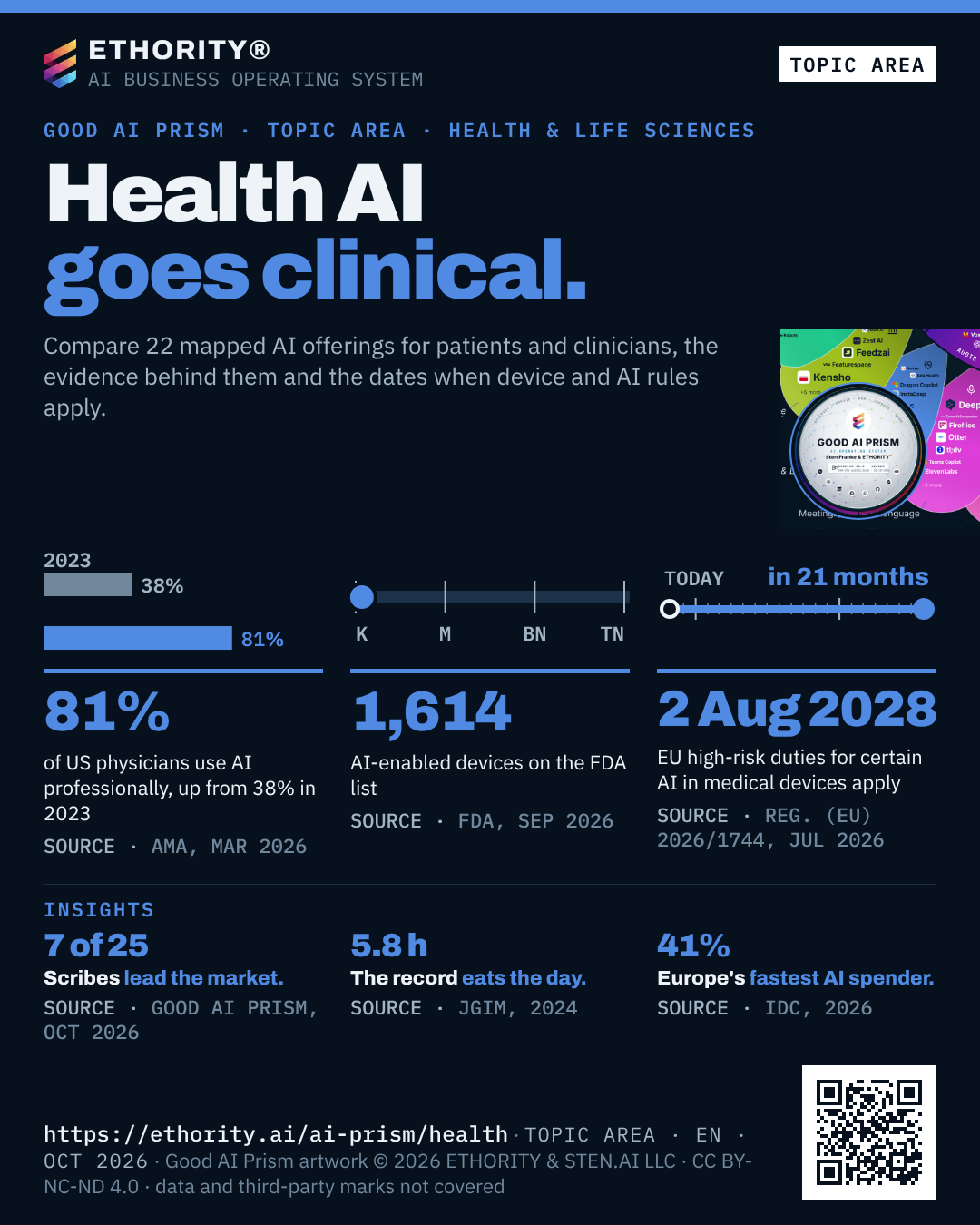
Health AI goes clinical.
Compare 22 mapped AI offerings for patients and clinicians, the evidence behind them and the dates when device and AI rules apply.
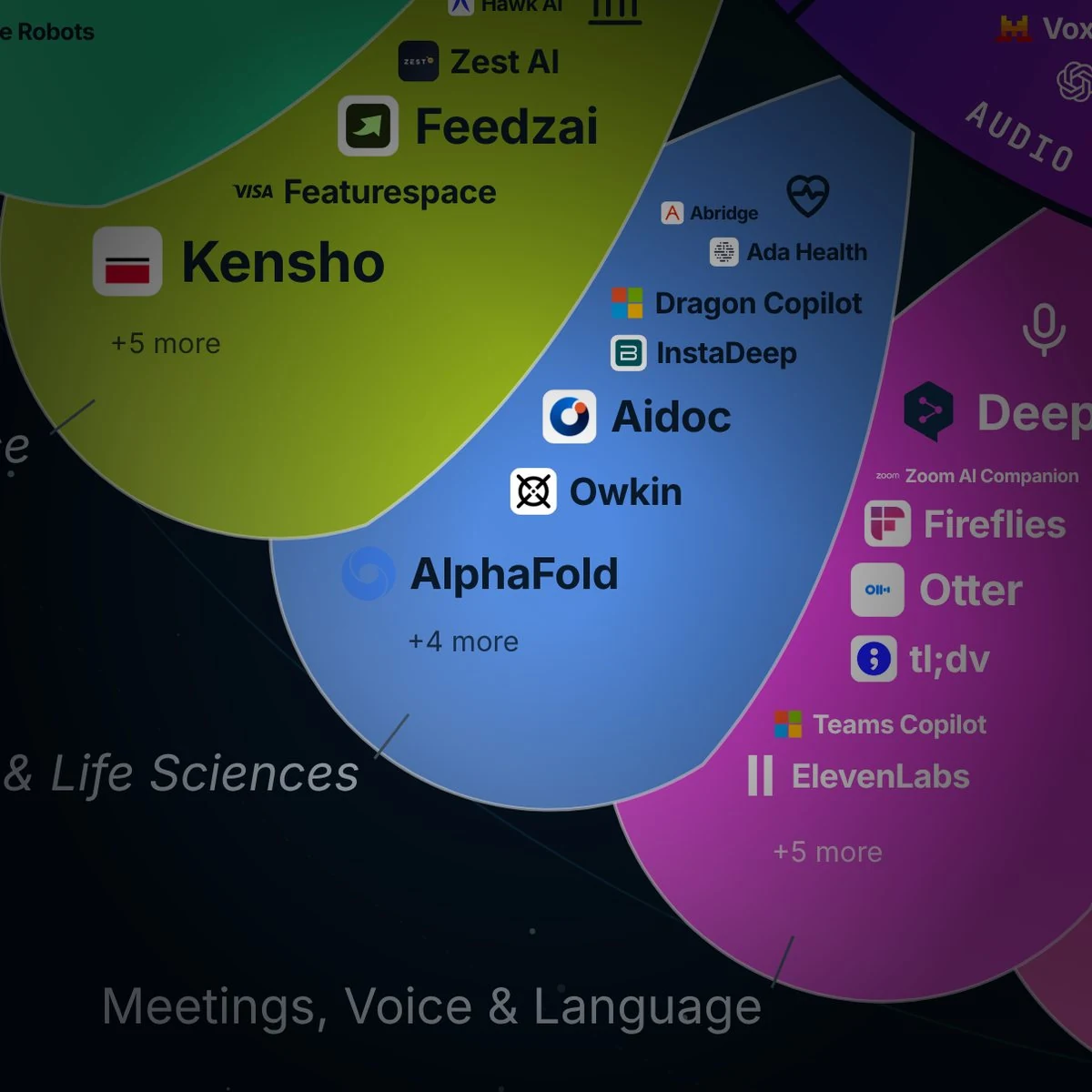
- 22
- AI offerings mapped in Health & Life Sciences, plus 3 provider records (Isomorphic Labs, Owkin, Tempus)Good AI Prism, Oct 2026
- 81%
- of US physicians use AI professionally, up from 38% in 2023AMA, Mar 2026 · ama-assn.org ↗
- 1,614
- AI-enabled devices on the FDA listFDA, Sep 2026 · fda.gov ↗
- 2 Aug 2028
- EU high-risk duties for AI in medical devices applyReg. (EU) 2026/1744, Jul 2026 · eur-lex.europa.eu ↗
Scribes lead the market.
Seven of the 25 mapped entries capture the clinical conversation and write documentation, the largest job group in the area.
Good AI Prism, Oct 2026
The record eats the day.
US physicians spend 5.8 hours in the electronic record for every 8 hours of scheduled patient time.
JGIM, 2024
Europe's fastest AI spender.
Health is the fastest-growing AI spender in Europe, growing 41% a year.
IDC, 2026
How to use this page
Three tools and one offer turn this page into a decision.
- Open the Health & Life Sciences map: 22 AI offerings and 3 provider records on one petal of the Good AI Prism, with logos and provider facts.
- Compare up to three offerings: decision facts side by side, each with its source and date.
- Run the Task economics calculator: turn saved hours into capacity you can attribute, before a pilot is approved.
- Offer: AI Trust Record: one clear answer about one clinical AI system before you depend on it: purpose, responsibility, evidence, known limits and a review path.
The brief and the studies
The sector brief maps the 25 entries by job and the rules by jurisdiction; the two theme studies follow care and drug discovery.
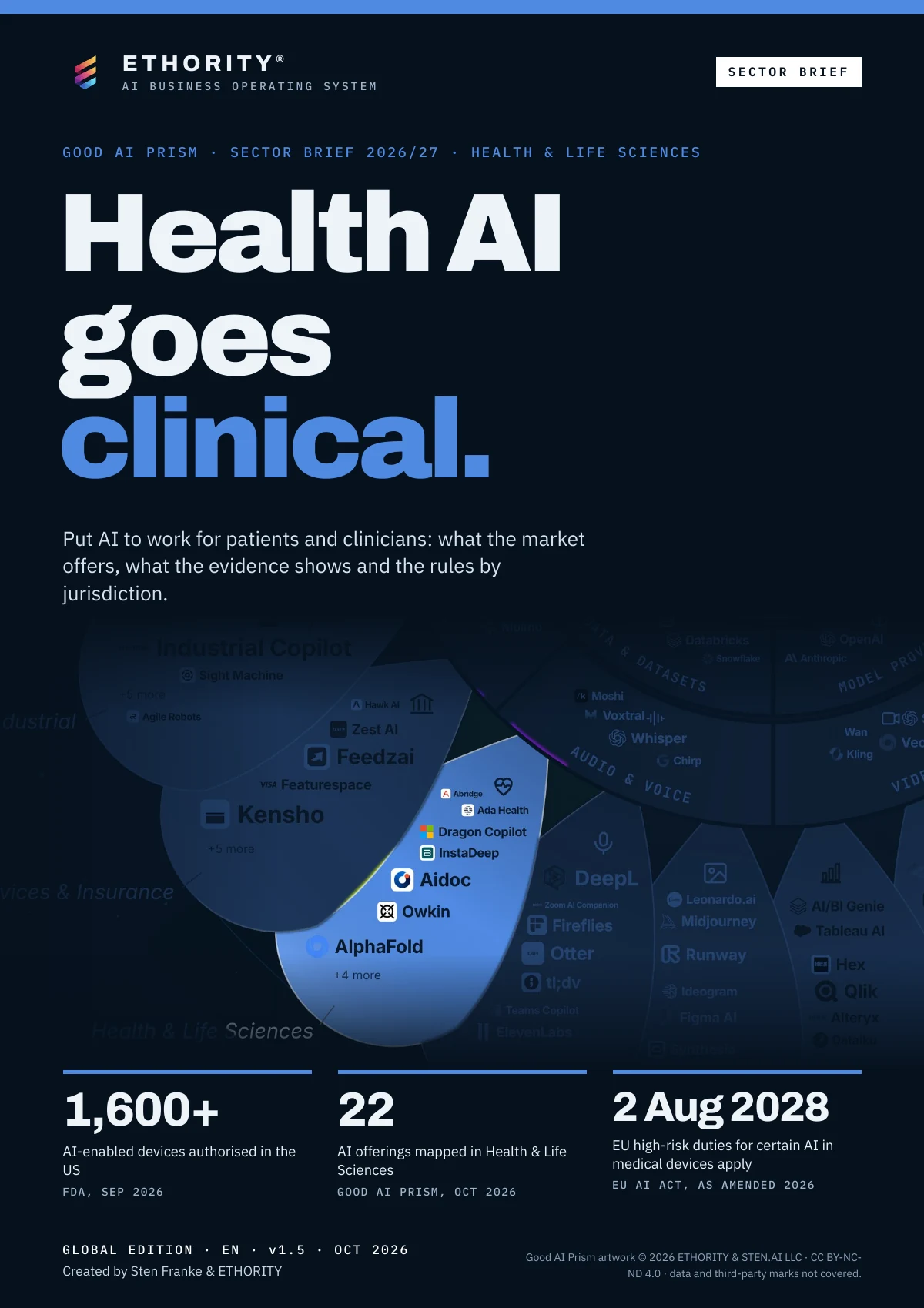
Global edition · EN
Health AI goes clinical.
More than 1,600 AI-enabled devices are authorised in the US. What the market offers patients and clinicians, what the evidence shows and the rules by jurisdiction.
Version 1.5 · 40 pages
Open the study →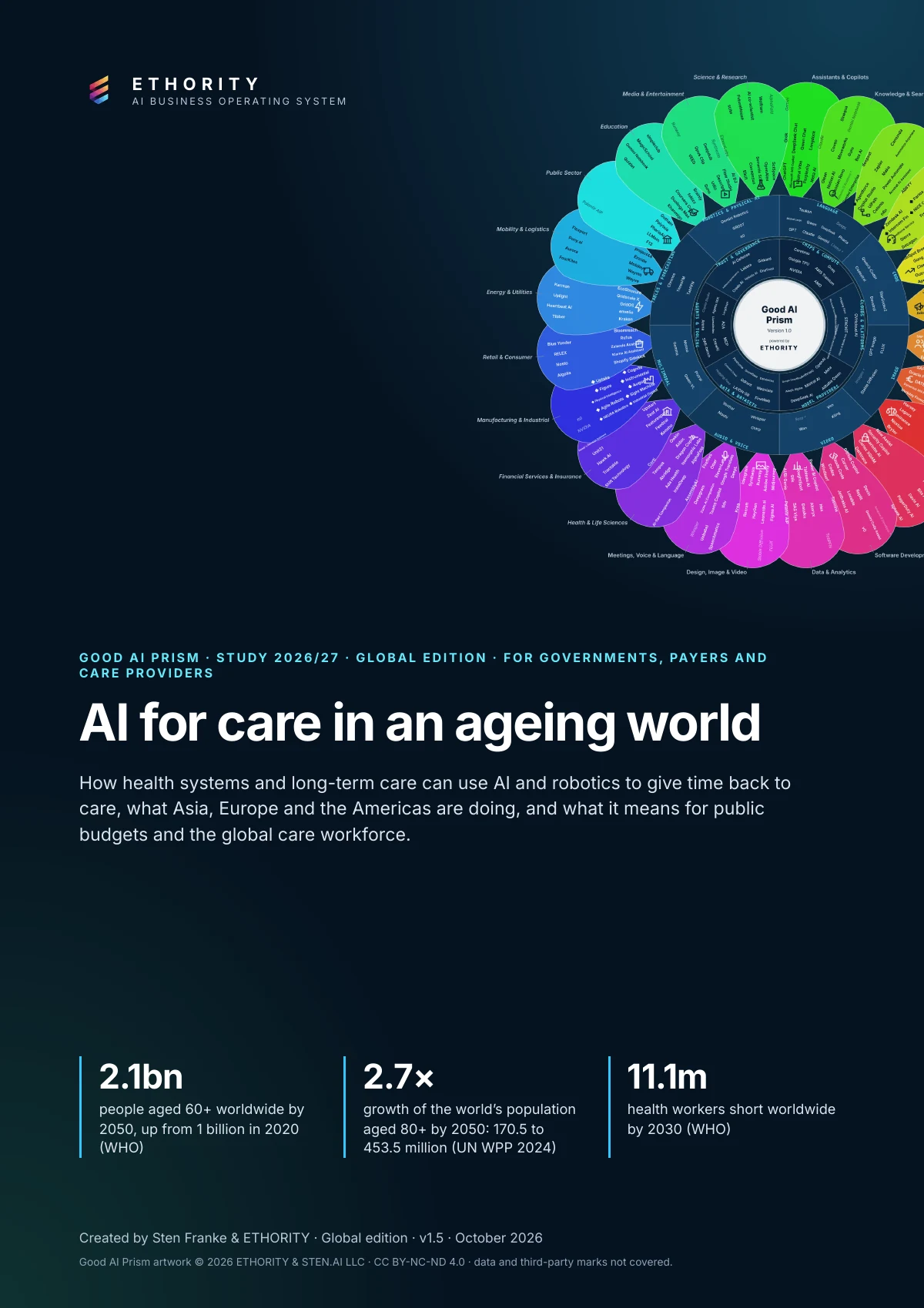
Global edition · EN
AI for care in an ageing world
The world will be short of 11.1 million health workers by 2030. How health systems and long-term care use AI and robotics to give time back to care.
Version 1.5 · 23 pages
Open the study →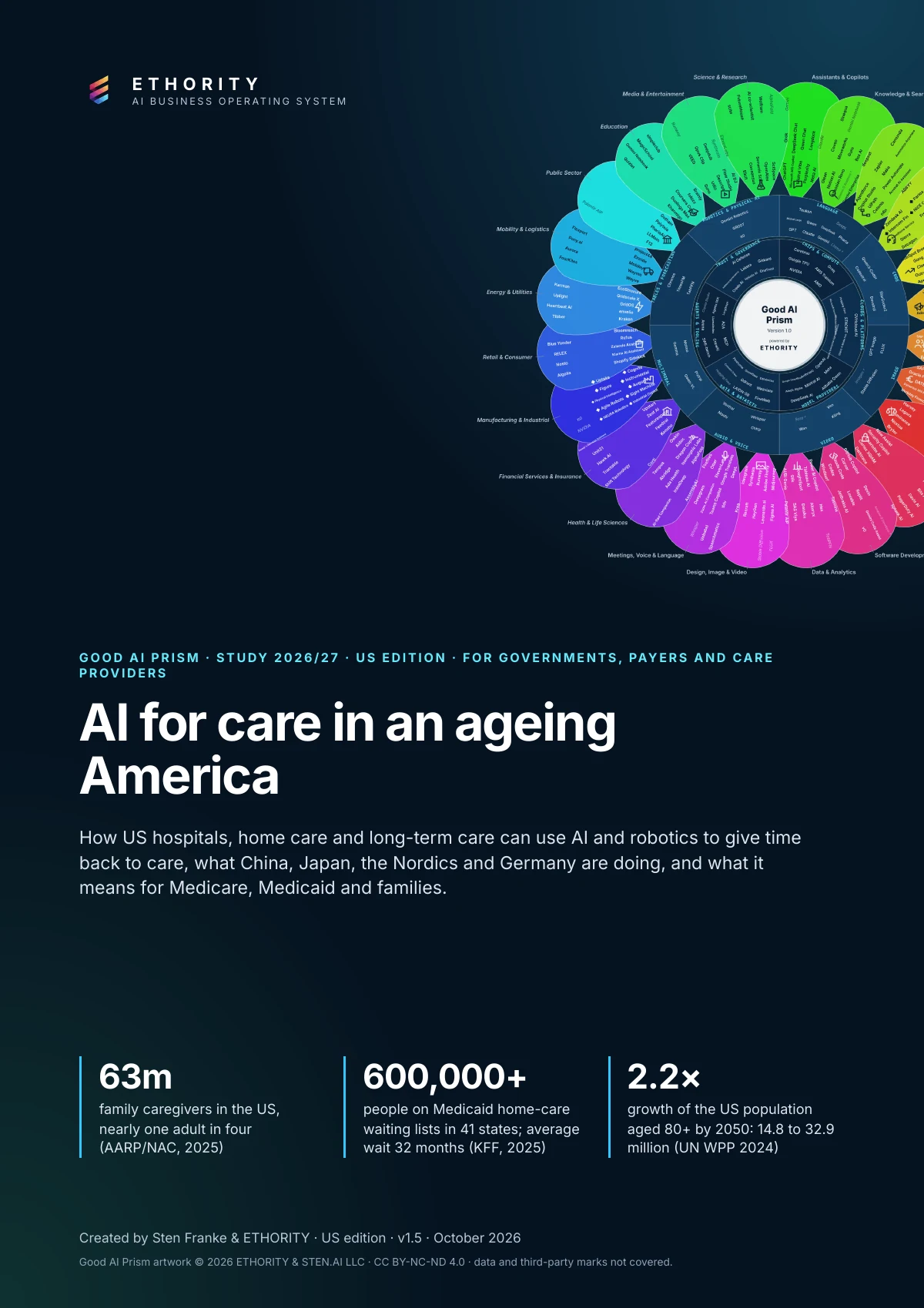
United States · EN
AI for care in an ageing America
More than 600,000 people wait for Medicaid home care. What US hospitals, home care and long-term care can do with AI, and what it means for Medicare and Medicaid.
Version 1.5 · 23 pages
Open the study →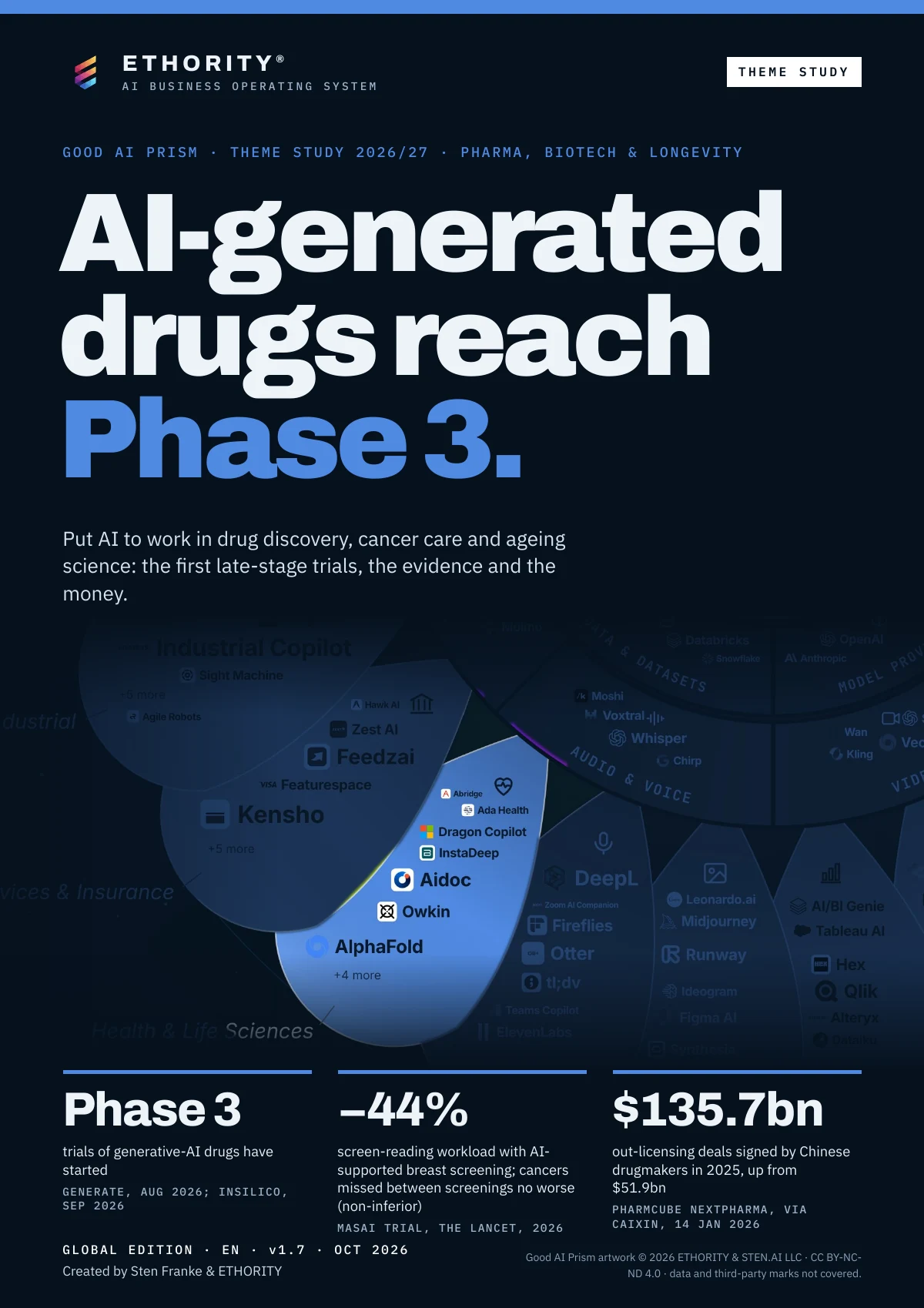
Global edition · EN
AI-generated drugs reach Phase 3.
AI-supported breast screening cut screen-reading workload by 44%. The first late-stage trials, the evidence and the money in drug discovery, cancer care and ageing science.
Version 1.7 · 40 pages
Open the study →Read on
Three related analyses from ETHORITY; the long read for this area follows further down the page.
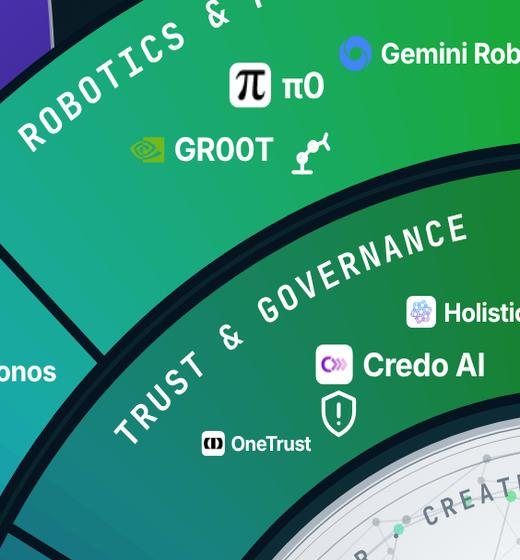
Check every vendor claim before you rely on it.
Tie every vendor claim to the exact product, version, contract and use before you rely on it.
See the map on one page →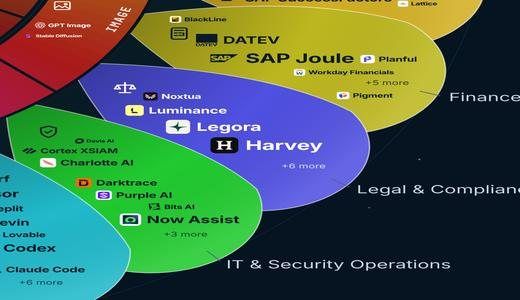
Preparing for the EU AI Act is the start; control happens in daily operation.
How to connect each EU AI Act duty to your systems, controls, evidence, monitoring and regular reassessment.
See the map on one page →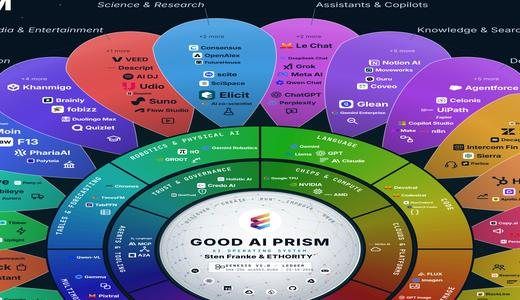
Saved hours are not AI value.
Separate a better task, freed-up time and a business result, so you can show the value AI really delivers.
See the map on one page →Rules and dates
Patients must be told when they interact with AI since 2 Aug 2026 (Art. 50). High-risk duties apply to emergency triage from 2 Dec 2027 and to AI in medical devices that need a notified body from 2 Aug 2028, as amended by the Digital Omnibus Regulation 2026/1744. The AI Act readiness article shows how to prepare.
Where a health project can begin
AI Opportunity Case
Priced after scoping
One use, such as documentation or imaging support, assessed against evidence, cost and rules, ending in a decision: pilot, redesign, expand or stop.
Scope and delivery by agreement
See what this package includes →AI Estate Audit
€25,000 one-time · net
An inventory of AI across clinical and administrative work, including tools clinicians bring themselves, with owners and risks.
Date and place by agreement
See what this package includes →AI Act Readiness Sprint
€6,900 one-time · net
Each use mapped to the AI Act, device law and health-data rules, with the controls each one needs before its date applies.
Date and place by agreement
See what this package includes →AI Literacy & Adoption
€2,400 one-time · net
Role-based training for physicians, nurses and managers, with named clinical overseers and documented literacy measures.
Scope and delivery by agreement
See what this package includes →Questions buyers ask
Is an AI scribe a medical device?
It depends on its intended purpose. A scribe that writes documentation is usually not; once it supports diagnosis, treatment or triage, device law applies and, in the EU, the AI Act's high-risk rules from 2 Aug 2028. The Health sector brief maps each job group to its rule.
What do we have to tell patients?
Since 2 Aug 2026 the EU AI Act (Art. 50) requires that people are told when they interact with an AI system. California and Texas have their own disclosure rules for generative AI in patient communication.
Which offerings does the Good AI Prism map for health?
25 entries: seven documentation tools, six imaging and diagnostic tools, six for drug discovery and biology, three for clinical trials and precision data, two for symptom assessment and one for hospital operations.
Where should a hospital start?
With an inventory of every AI use, then one documentation pilot with a measured baseline. The brief's 90-day plan sets the order: inventory, classify, involve, enable, pilot, decide.
Who is responsible for an AI output?
A named clinician. Professional rules in Germany and Brazil and several US state laws keep final responsibility with the physician.
The evidence at a glance
ETHORITY · LONG READ
81% of US physicians use AI. The EU sets the dates.
Clinical AI started with paperwork and is moving into diagnosis. Here is what the market offers, what the evidence shows and which rules apply when.
Clinical AI is no longer a lab experiment. It sits in the consultation room, in the radiology reading list and in the electronic record. In 2026, 81% of US physicians used AI in their professional work, against 38% in 2023, and the average physician now uses it for more than two tasks (AMA, March 2026). The shift is broad, fast and mostly invisible to patients. It is also about to meet a fixed rulebook.
81% of US physicians used AI in their professional work in 2026, up from 38% in 2023 (AMA, Mar 2026)
The first wave is paperwork
The most common uses are not diagnosis. They are summaries of medical research (39% of US physicians), care plans and discharge notes (30%), charting and visit notes (28%) and chart summaries (28%). Assistive diagnosis comes later, at 17% (AMA). Hospitals follow the same order: 71% of US acute-care hospitals ran predictive AI inside their electronic health record in 2024 (ONC via AHA).
The reason is time. US physicians spend 5.8 hours in the electronic record for every 8 hours of scheduled patient time (JGIM, 2024). Employed physicians in Germany spend about three hours a day on administration and documentation (Marburger Bund, 2024). In one large US programme, ambient scribes saved physicians about an hour a day at the keyboard (NEJM Catalyst via AMA).
The workforce math makes this urgent. The World Health Organization projects a shortfall of 11.1 million health workers by 2030. AI that returns time to care is not a luxury purchase; it is capacity planning.
Europe spends fast, Germany adopts slowly
Health is the fastest-growing AI spender in Europe, at 41% a year according to IDC. Adoption on the ward is uneven. In the UK, 29% of doctors used at least one AI system in the past year (GMC, February 2025). Across the WHO European Region, 32 of 50 responding states use AI-assisted diagnostics, yet only 8% have a national health-AI strategy and 86% name legal uncertainty as a barrier (WHO Europe, November 2025).
Germany shows the gap between infrastructure and use. 18% of hospital physicians use AI, up from 9% in 2022, and 15% of practice physicians (Bitkom and Hartmannbund, May 2025). About 73 million electronic patient records exist, but 3.6% are actively used by patients. The country also runs a working market for prescribable apps: 58 digital health applications were listed at the end of 2025. Our German Health brief maps these building blocks in detail.
22 AI offerings, seven of them clinical scribes
The Good AI Prism places 22 AI offerings and three provider records (Isomorphic Labs, Owkin, Tempus) in Health & Life Sciences, each recorded with a dated source from the provider's own pages. Seven capture the conversation between clinician and patient and write the documentation: Abridge, Corti, Dragon Copilot from Microsoft, Heidi, Nabla, Suki and Tandem Health. Six read images and pathology slides, among them Aidoc, Siemens Healthineers' AI-Rad Companion, Brainomix, Gleamer, Lunit and Paige. Six support drug discovery and biology, from Google DeepMind's AlphaFold and Isomorphic Labs to Insilico Medicine, Owkin, Recursion and BioNTech's InstaDeep. Three run clinical trials and precision data, two assess symptoms and one plans hospital capacity.
The split matters because the rules follow the job, not the brand. A scribe that writes a note is treated differently from a model that flags a stroke on a scan. Open the Health & Life Sciences sector brief for the full map by job and the rule that applies to each group.
The rulebook has dates
The US Food and Drug Administration lists 1,614 AI-enabled medical devices, 76% of them in radiology. In the European Union, the AI Act now sets the timetable, as amended by the Digital Omnibus Regulation (EU) 2026/1744, in force since 27 July 2026:
1,614 AI-enabled medical devices on the FDA list, 76% of them in radiology (FDA, Sep 2026)
- Since 2 August 2026, patients must be told when they interact with an AI system (Art. 50).
- From 2 December 2027, EU high-risk duties apply to emergency triage of patients and to eligibility for public health services, both listed in Annex III.
- From 2 August 2028, AI in medical devices and in-vitro diagnostics that need a notified body carries high-risk duties under Annex I, alongside MDR and IVDR.
Other jurisdictions move in parallel. 22 US states enacted health AI laws in the first half of 2026, many of them on disclosure of generative AI in patient communication. Brazil's Federal Council of Medicine requires AI committees and patient information since 10 August 2026. Germany's 2025 Medical Assembly put it in one line: AI supports decisions, final responsibility stays with the physician.
Beyond the clinic: care and drug discovery
The same pressure runs through long-term care. The world will count 2.1 billion people aged 60 and over by 2050 (WHO). Our study AI for Care in Ageing Societies shows how health systems use AI and robotics to give time back to care, with separate US and German editions.
In research, the first drugs designed with generative AI have reached Phase 3 trials (Generate, December 2025; Insilico, September 2026). In breast screening, the MASAI trial reported 44% less screen-reading workload with AI support and non-inferior interval cancer rates (The Lancet, 2026). The Pharma, Biotech and Longevity study follows the evidence and the money.
How to judge a vendor's evidence
Health buyers face a market where every provider claims accuracy and few publish what a procurement team needs. Four questions separate a credible offer from a demo. First, does the provider show clinical evidence for a population like the own patients, not only a benchmark dataset? Second, is there a predetermined plan for model changes, as the FDA now accepts for updates, and how fast can a change be rolled back? Third, where is the data hosted, does the provider train on customer data, and do GDPR, HIPAA or the European Health Data Space rules on secondary use apply? Fourth, who reviews every output before it reaches a patient or the record? Write the answers into the contract, not into meeting notes. The AI vendor claims article shows how to read provider statements against evidence.
What the evidence still lacks
Most published evidence measures accuracy, not time returned or patient outcomes. That is the gap a buyer has to close inside the own organisation. Saved minutes count only when they demonstrably go into patient contact, quality or access. A tool that is accurate in a vendor study may not fit the own patient population, and a model update can change its behaviour after go-live.
In practice
Use case: ambient scribes. In one large US programme, ambient AI scribes saved physicians about an hour a day at the keyboard (NEJM Catalyst via AMA). The gain showed up as time. Whether that time reaches patients is the measure a hospital still has to add to its own pilot.
Best practice: test against the old workflow. The MASAI breast-screening trial randomised AI-supported reading against standard double reading and reported 44% less screen-reading workload with non-inferior interval cancer rates (The Lancet, 2026). It measured workload and patient outcome together, the design a hospital pilot can copy at a smaller scale.
What to do Monday
- List every AI use, including scribes and chat tools clinicians bring themselves. An AI Estate Audit makes the list complete.
- Classify by intended purpose. Separate documentation from diagnosis and triage, and map each against device law and the AI Act dates.
- Name a clinical owner for every AI output that reaches a patient or the record.
- Pilot documentation first, with a baseline of documentation time, quality and incident reports measured before go-live.
- Decide on measured outcomes. Scale only on time returned to care, quality and patient outcomes; stop when the threshold is missed.
This article describes market and regulation. It is not medical or legal advice.
Sources and further reading
- AMA, AI usage among doctors doubles ↗ · 12 Mar 2026
- FDA, Artificial Intelligence-Enabled Medical Devices ↗ · 22 Sep 2026
- IDC, European AI spending forecast to 2030 ↗ · 2026
- Regulation (EU) 2026/1744 (Digital Omnibus on AI) ↗ · 27 Jul 2026
- WHO, Health workforce ↗ · read 25 Oct 2026
- ETHORITY, Good AI Prism Sector Brief: Health & Life Sciences, Global edition (AMA, ONC/AHA, GMC, WHO Europe, Bitkom, Marburger Bund, JGIM, NEJM Catalyst, GKV-Spitzenverband) → · 22 Oct 2026
- ETHORITY, AI for Care in Ageing Societies, Global edition; AI in Pharma, Biotech and Longevity (Generate, Insilico, MASAI/The Lancet) → · 22 Oct 2026
Put the thinking to work
AI Governance Setup →
A repeatable governance process people can operate and review. Framework mapping is not an ISO certificate or legal opinion.
A written comparison of up to three AI offerings · €195 net →
Start with one question and up to three offerings. Request a sourced comparison, provider questions and a cost sketch using your assumptions.
YOUR NEXT STEP
Discuss your question with Sten Franke.
Bring your business question or the figures you already know. ETHORITY investigates within the agreed scope; together with Sten Franke you agree the next piece of work.