 ETHORITY®
GOOD AI PRISM · TOPIC AREA · FINANCE & ACCOUNTING
Finance AI stuck at 59%. Agents rise.
Compare AP, expense, close and planning AI by hosting, training on your invoices and price, with the 2027 deadlines in view.
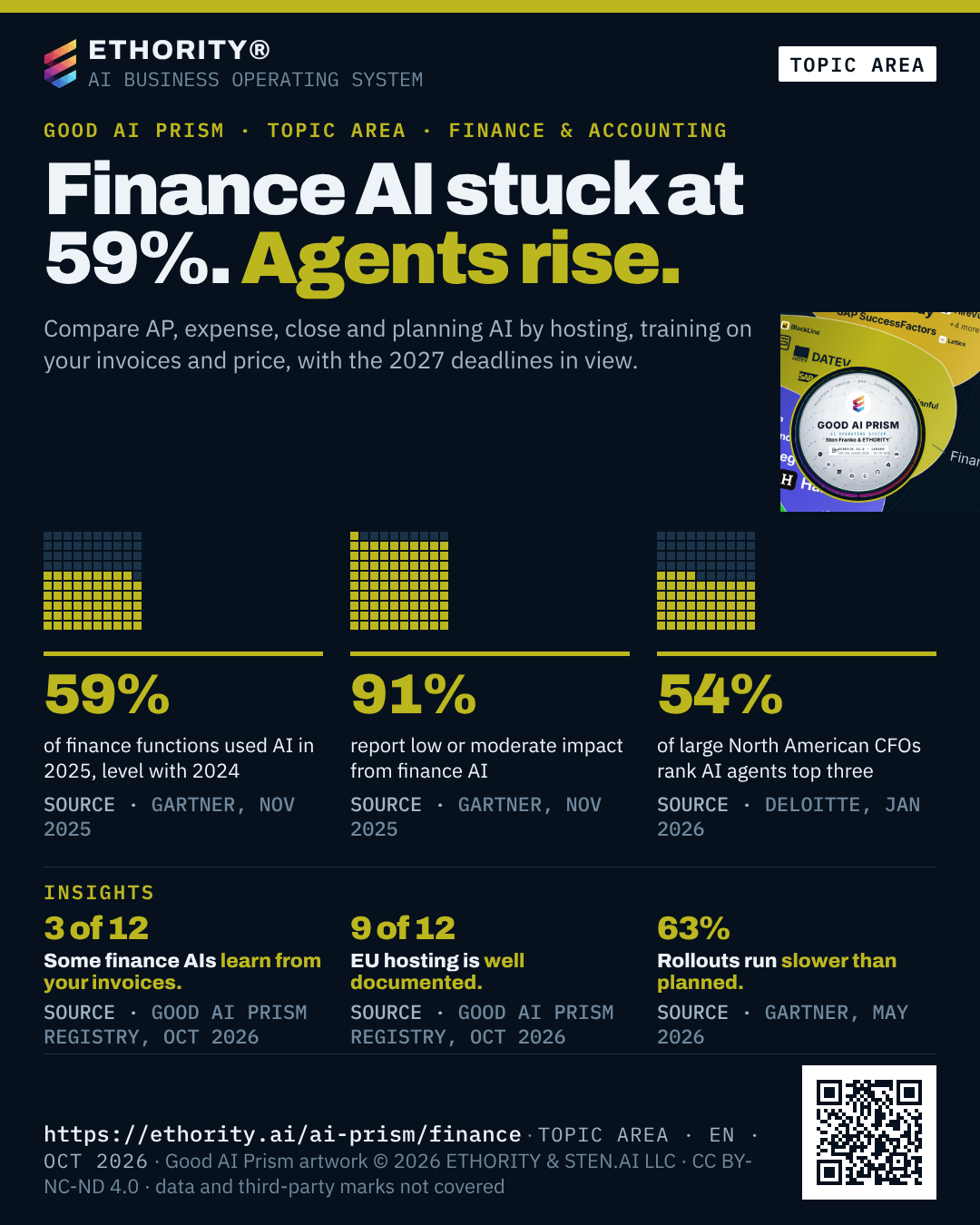
- 59%
- of finance functions used AI in 2025, level with 2024Gartner, Nov 2025 · gartner.com ↗
- 91%
- report low or moderate impact from finance AIGartner, Nov 2025 · gartner.com ↗
- 54%
- of large North American CFOs rank AI agents top threeDeloitte, Jan 2026 · deloitte.com ↗
- 24
- AI offerings mapped in Finance & Accounting, plus 1 provider record (DATEV)Good AI Prism finance brief
Some finance AIs learn from your invoices.
Vic.ai, AppZen and Basware state that customer data trains models in de-identified, aggregated or customer-specific form.
Good AI Prism Registry, Oct 2026
EU hosting is well documented.
Nine of twelve profiled offerings state an EU hosting location, from Belgium to Germany and Ireland.
Good AI Prism Registry, Oct 2026
Rollouts run slower than planned.
63% of finance organisations say AI implementation was slower than expected in 2025.
Gartner, May 2026
How to use this page
Three tools and one offer turn this page into a decision.
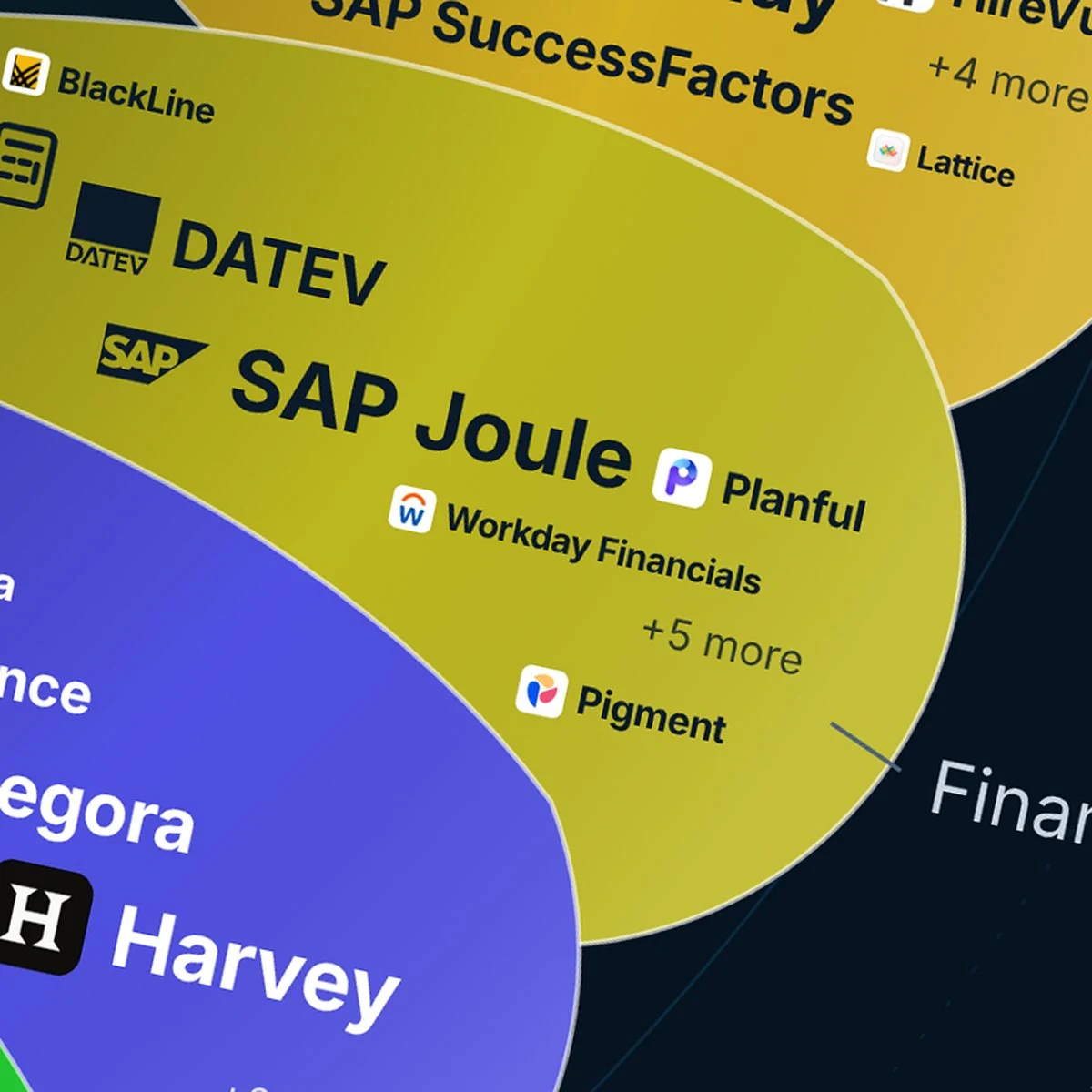
- Open the Finance & Accounting map: 24 AI offerings and 1 provider record on one petal of the Good AI Prism, with logos and provider facts.
- Compare up to three offerings: decision facts side by side, each with its source and date.
- Run the Task economics calculator: turn saved hours into capacity you can attribute, before a pilot is approved.
- Offer: AI Readiness & Maturity Check: one workshop day for the finance team: a maturity score, the five most valuable AI uses and the next decision.
12 profiles, fact by fact
AP, expenses, close, spend and planning, each with hosting, training terms, billing and integrations.
Jedox
Jedox · Product
Jedox is an Azure-hosted planning platform with an Excel-like interface that links P&L, balance-sheet and cash planning in one model, adding JedoxAI Planning Wizards for revenue and cash-flow forecasts.
- How it is billed
- Where data is stored
- Does it train AI on your data?
- Connects with
Agicap
Agicap · Product
According to Agicap: “Agicap AI immediately helps explain the variance between actuals and forecasts.”
- How it is billed
- Where data is stored
- Does it train AI on your data?
- Certificates and audit reports
Vic.ai
Vic.ai · Product
Invoice AI developed by accountants and trained on over a billion invoices that extracts, codes and approves invoices.
- How it is billed
- Where data is stored
- Does it train AI on your data?
- Certificates and audit reports
Spendesk AI Connect
Spendesk · Product
Connects Spendesk spend data to AI assistants so finance teams can search, analyse and report on spend in plain language.
- Published price
- How it is billed
- Where data is stored
- Does it train AI on your data?
FloQast
FloQast · Product
Close-management software whose Close AI agents prepare reconciliations, build and post journal entries to the ERP, and draft flux explanations, with accountant sign-off and captured audit evidence.
- How it is billed
- Certificates and audit reports
- Connects with
Payhawk AI Office of the CFO
Payhawk · Agent
According to Payhawk: “The Financial Controller AI Agent clears your month-end by chasing employees, fetching invoices and coding expenses.”
- Published price
- How it is billed
- Where data is stored
- Does it train AI on your data?
Datarails Genius AI
Datarails · Product
Generative AI layer in Datarails' Excel-connected FP&A platform that answers finance questions on consolidated actuals, builds variance and board-story narratives, and runs what-if forecasts.
- Published price
- How it is billed
- Does it train AI on your data?
- Certificates and audit reports
AppZen Expense Audit
AppZen · Product
According to AppZen: “Audit every expense report automatically with AI.”
- How it is billed
- Where data is stored
- Does it train AI on your data?
- Certificates and audit reports
Circula
Circula · Product
Expense workflow tool built for German legislation, whose AI enforces tax and policy rules in real time from receipt capture to approvals.
- Published price
- How it is billed
- Where data is stored
- Certificates and audit reports
Stampli
Stampli · Product
According to Stampli: “Billy captures and codes every line, identifies vendors, predicts approvers, flags duplicates”
- How it is billed
- Where data is stored
- Certificates and audit reports
- Connects with
Basware SmartCoding
Basware · Product
Machine-learning feature in Basware AP that proposes GL and cost-centre coding rows for non-PO invoices from the customer's historical supplier coding, offering top-five options for review.
- Where data is stored
- Does it train AI on your data?
- Certificates and audit reports
- Connects with
sevdesk
sevdesk · Product
According to sevdesk: “Für die Buchungskategorie macht sevdesk dir KI-gestützt einen Vorschlag und lernt aus denen Zuordnungen.”
- Published price
- How it is billed
- Where data is stored
- Connects with
Compare baseline: three billing logics
Per module, annual minimum and per order form, with three different answers on training.
| Offering | Billing | Data location | Training | Source |
|---|---|---|---|---|
| Payhawk AI Office of the CFO | Per module · per month | EU (BE · DE) | Not used for training | Payhawk pricing and DPA |
| Agicap | Annual · 12-month min. | Belgium (GCP) | Not used for training | Agicap security and AI |
| Vic.ai | Per order form | AWS · US, Norway | Used (de-identified) | Vic.ai trust and security |
Registry facts as stated on each provider's own pages, read 21 Oct 2026. Add your own volumes in Compare before deciding.
Rules and dates
For most finance AI, these dates matter more than the AI Act.
- 2 Aug 2026
Art. 50: people must be told when they interact with an AI system.
Reg. (EU) 2026/1744
- 1 Jan 2027
German firms above €800,000 prior-year revenue must issue e-invoices.
Wachstumschancengesetz, via IHK Stuttgart
- 2 Dec 2027
Annex III high-risk duties apply, incl. employment, credit, education and justice.
Reg. (EU) 2026/1744
- End 2027
SAP ERP 6.0 leaves mainstream maintenance.
SAP News
- 1 Jan 2028
All domestic B2B transactions in Germany follow with e-invoicing.
Wachstumschancengesetz, via IHK Stuttgart
The brief
The Finance & Accounting brief maps 25 entries, the adoption evidence and the rules.
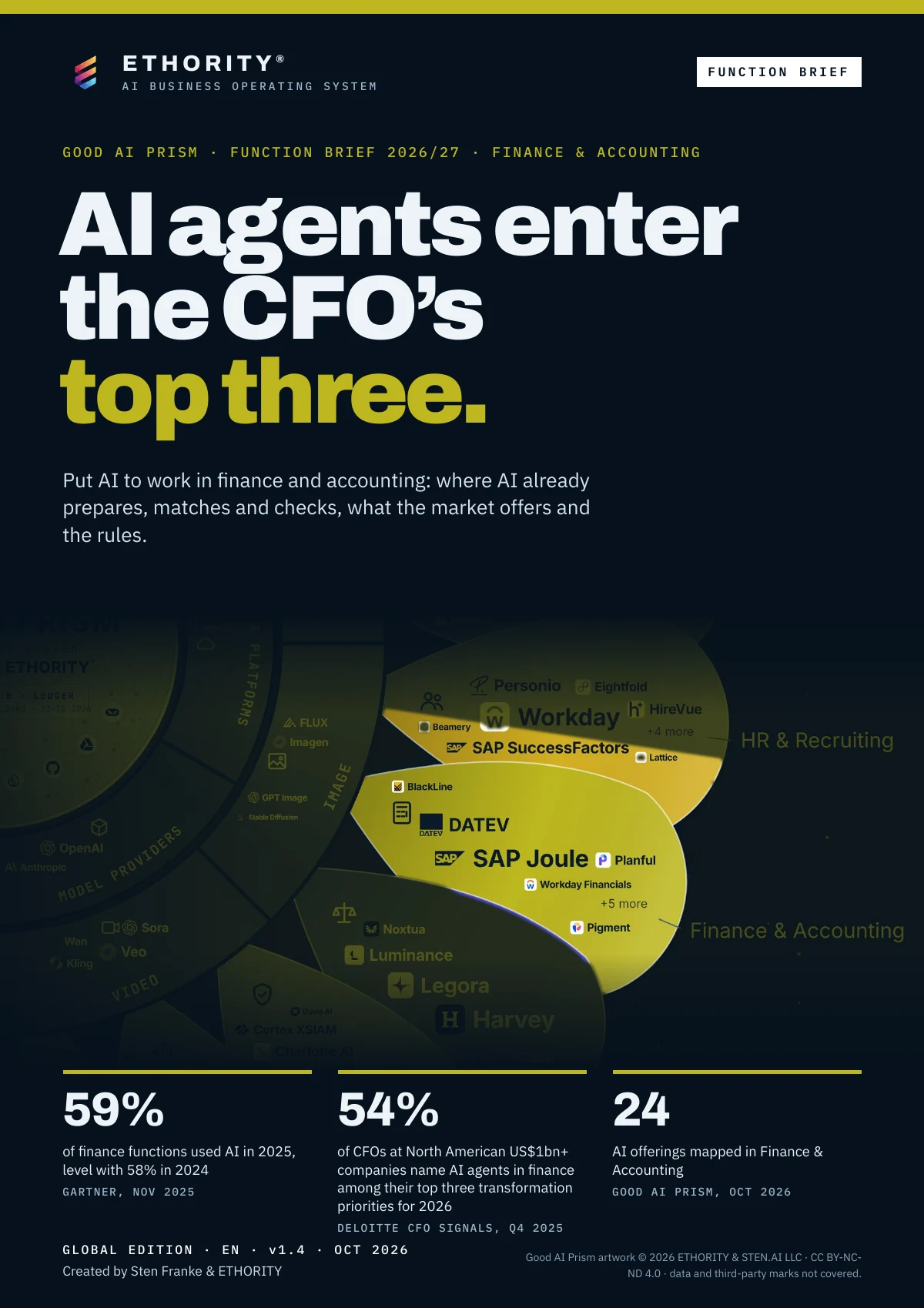
Global edition · EN
AI agents enter the CFO’s top three.
AI use in finance holds at 59% while CFOs push agents up their agenda. Where AI already prepares, matches and checks, what the market offers and the rules.
Version 1.4 · 40 pages
Open the study →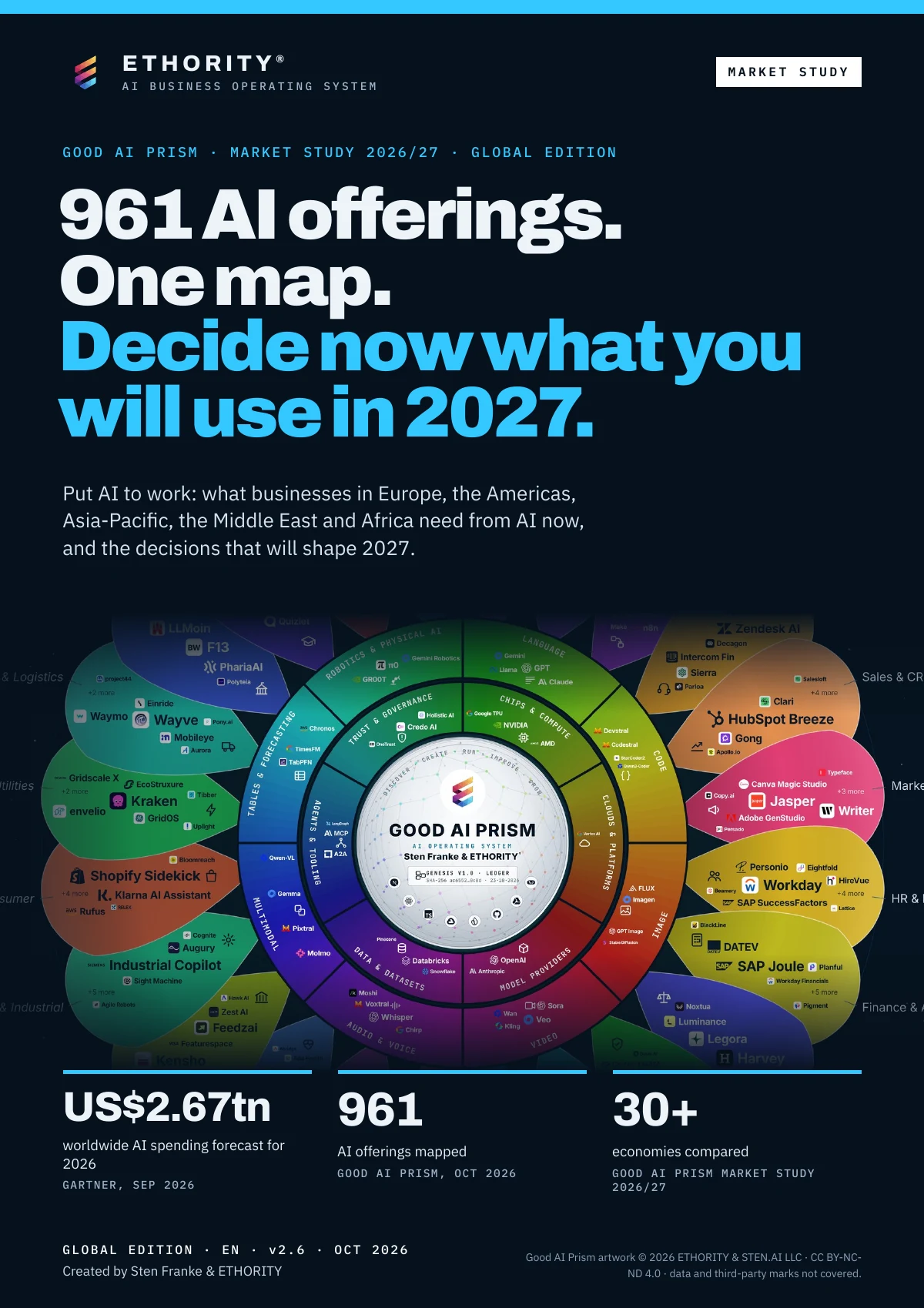
Global edition · EN
961 AI offerings. One map. Decide now what you will use in 2027.
The Good AI Prism helps you find useful AI and compare the evidence behind your options. For organisations already using AI, the question is moving from whether to use AI to which AI, how safely and whether it pays. This Global edition brings together 961 AI offerings across 24 topic areas, 8 data types and 6 technology layers, with sources, dates and limits to guide your next decision.
Version 2.6 · 90 pages
Open the study →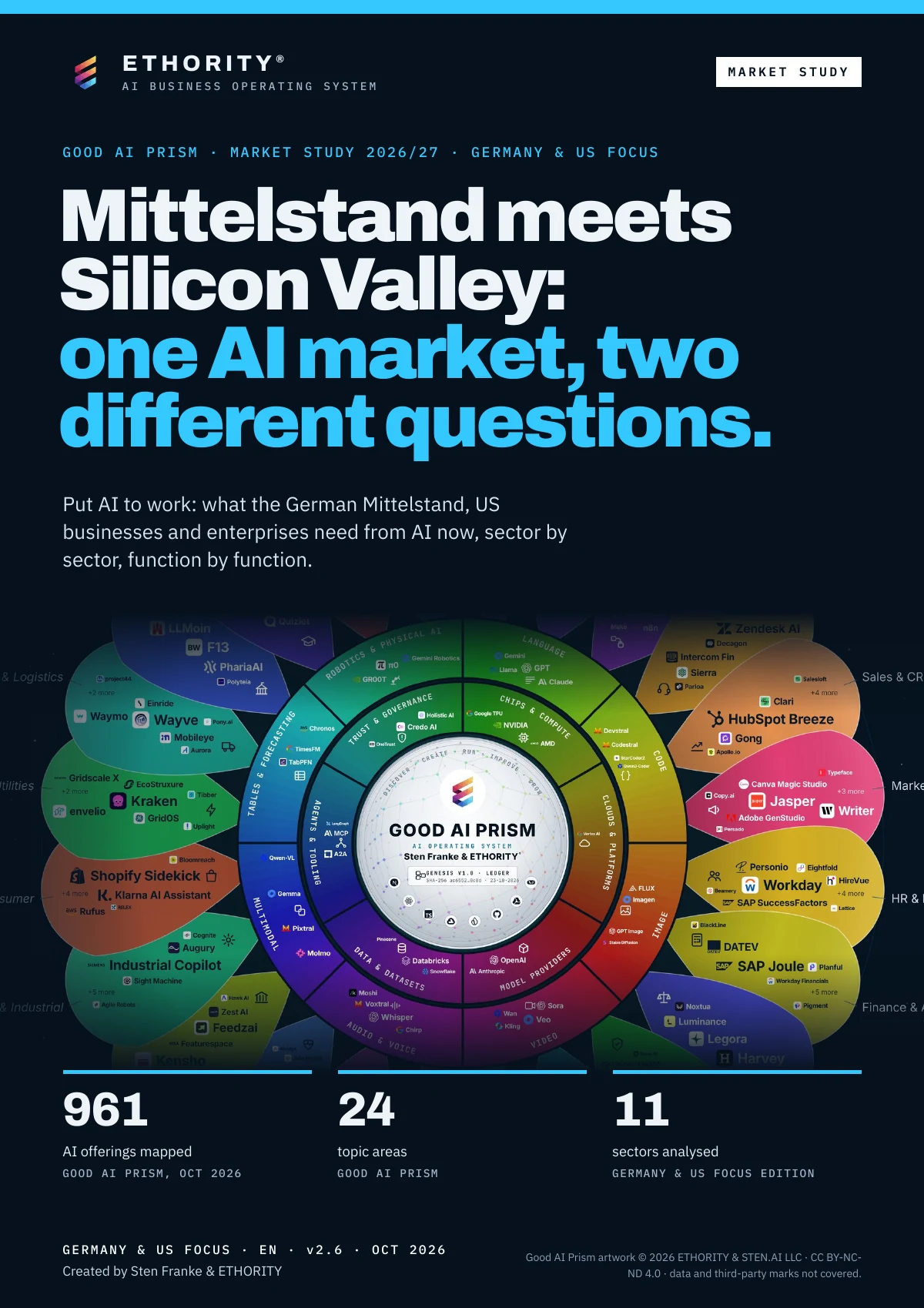
Germany & United States Focus · EN
Germany's mid-sized companies meet Silicon Valley: one AI market, two different questions.
The Mittelstand needs know-how; US firms need cost control. What German and US businesses need from AI now, sector by sector, function by function.
Version 2.6 · 72 pages
Open the study →Read on
Our long read on training terms in finance AI, plus why saved hours are not AI value.
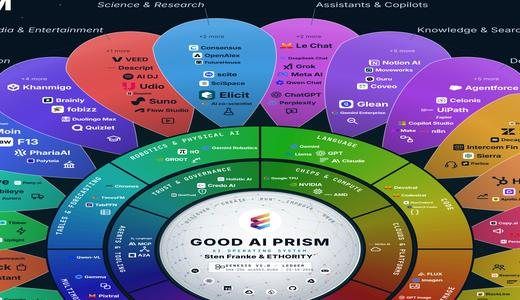
Saved hours are not AI value.
Separate a better task, freed-up time and a business result, so you can show the value AI really delivers.
See the map on one page →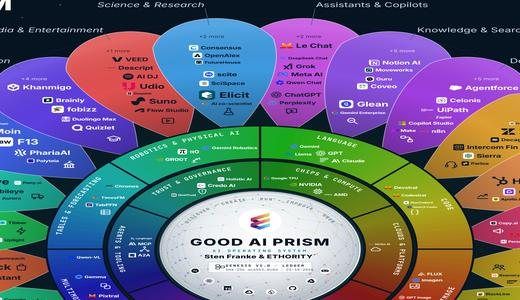
AI spending is forecast to rise by half. 37% of surveyed organisations see an effect on profit.
Sourced figures for 2025–26 on AI spending, adoption, models, energy and value, for your 2027 planning.
See the map on one page →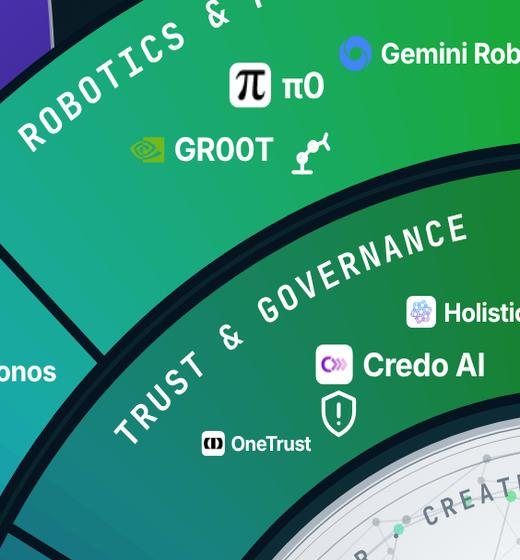
Check every vendor claim before you rely on it.
Tie every vendor claim to the exact product, version, contract and use before you rely on it.
See the map on one page →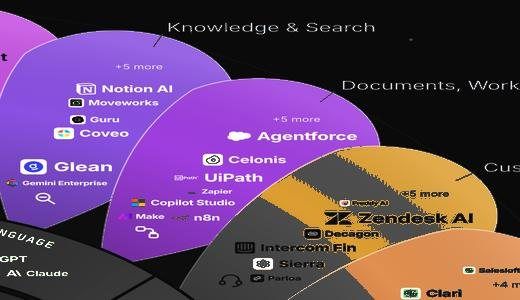
Access to a tool does not give an AI agent the right to act.
How to define what each AI agent may do: by action, limit, time and consequence, rather than by the tools it can reach.
See the map on one page →Implement it with ETHORITY
From a finance shortlist to a decision the CFO can sign.
AI Decision Brief
€195 net · one-time
Up to three finance AI offerings compared fact by fact, including the training clause and price unit.
Request scope and delivery
See what this package includes →AI Readiness & Maturity Check
€3,500 one-time · net
Where finance stands on data, process and skills before the e-invoicing and ERP deadlines of 2027.
Date and place by agreement
See what this package includes →Enterprise AI Opportunity Case
Priced after scoping
A business case for a finance agent with a PILOT, REDESIGN, EXPAND or STOP decision, built on your volumes.
Scope and delivery by agreement
See what this package includes →Buyer questions
Where does finance AI deliver first?
Gartner's top use cases among finance AI users are knowledge management (49%), AP automation (37%) and error and anomaly detection (34%) (Gartner, Nov 2025). Start with payables and close, measured against a baseline.
Will our invoices train the provider's model?
Read the training clause. Vic.ai trains global models on de-identified data, AppZen fine-tunes on aggregated data, Basware trains SmartCoding on your own invoice history; Payhawk and Agicap state no training on customer data.
Is finance AI high-risk under the EU AI Act?
Mostly not. Close, AP, planning, treasury and corporate fraud detection are not listed in Annex III; credit scoring of natural persons is. AI literacy and transparency duties still apply.
What do finance AI tools cost?
From a free MCP connector (Spendesk, 2026) and sevdesk plans from €8.90 a month to Datarails at US$35,000–80,000 a year for most mid-market teams. Compare on cost per invoice or per day saved at close.
How do the 2027 deadlines change the plan?
German e-invoicing becomes mandatory above €800,000 revenue from 1 Jan 2027, and SAP ERP 6.0 leaves mainstream maintenance at the end of 2027. Tie AI projects to those programmes.
The evidence at a glance
ETHORITY · LONG READ
Three of twelve finance AIs learn from customer data.
Finance AI use has plateaued at 59% while CFOs put agents on the agenda. Our 12 finance profiles show where the data is hosted, what it costs, and whose model your invoices train.
Finance has adopted AI and stalled. Gartner's survey of finance leaders found that 59% of finance functions used AI in 2025, level with 58% a year earlier, and 91% reported only low or moderate impact. In May 2026 Gartner added that 63% of finance organisations found implementation slower than expected. Yet the agenda keeps moving: 54% of large North American CFOs now rank AI agents among their top three transformation priorities for 2026, according to Deloitte's CFO Signals.
That combination, flat adoption, modest impact and rising ambition, puts the contract terms in focus. When an agent prepares journal entries, matches invoices or audits expenses, it works on the most sensitive operational data a company holds. What the provider does with that data is no longer a footnote.
What the 12 profiles show
The Finance & Accounting brief maps 24 AI offerings and one provider record (DATEV): four ERP suites and 21 specialist tools. Twelve of them are profiled in depth in the Finance & Accounting area map: Jedox, Agicap, Vic.ai, Spendesk AI Connect, FloQast, Payhawk, Datarails, AppZen, Circula, Stampli, Basware SmartCoding and sevdesk. Each fact on each card carries a link to the provider's own page and the date it was read.
Three findings stand out. First, hosting is well documented: 9 of the 12 state where data is hosted in the EU, from Agicap's Google Cloud region in Belgium to Circula's AWS servers in Germany and Stampli's databases in Ireland. Second, prices are not: 5 of 12 publish a price or a price range. Third, three of the twelve state that customer data trains their models in some form.
3 of 12 finance AI profiles state that customer data is used to train or fine-tune models, in de-identified, aggregated or customer-specific form.
Three ways your invoices teach a model
The three are not alike, and the difference is the point. Vic.ai states that its global models train on derived, de-identified data from all customers, while local line-coding models stay per customer. AppZen states that its models do not learn from raw data but are fine-tuned using aggregated data. Basware states that SmartCoding is trained on your historic invoice data, which produces a model specific to your own coding patterns.
A customer-specific model may be exactly what an AP team wants: it learns your cost centres and suppliers. A pooled model benefits from scale but means your supplier and spend patterns contribute, in de-identified form, to a product sold to others. Both are legitimate designs. Neither should be discovered after signing. On the other side, Payhawk's data processing agreement states that controller data, including prompts, will not be used to train foundational or general-purpose models, and Agicap states that it does not use customer data to train AI models.
What measured results look like
Independent evidence on generative AI in close and AP is still thin. Most figures in circulation are vendor-reported. Stampli is an exception worth noting for its method: it publishes that its invoice-field suggestions covered 87% of 34.3 million ERP-structured fields in April 2026, that 92% were correct, and that all require human review. It is a vendor measurement, not an audit, but it shows the shape of a useful claim: denominator, period, accuracy and the human step.
Ask every provider for a claim in that shape. A percentage without a denominator, a period and a definition of "correct" is marketing.
Pricing: from free connectors to five-figure plans
Prices span three orders of magnitude. Spendesk offers its MCP connector to AI assistants free to customers in 2026, noting that pricing may change. sevdesk lists plans from €8.90 a month for small businesses. Circula starts from €15 per licence per month. Payhawk lists modules from US$299 a month. Datarails states that most mid-market teams invest US$35,000 to US$80,000 a year. The rest price by order form, volume or package.
Compare on cost per invoice processed, per expense report audited or per day saved at close, at your own volumes. A connector priced at zero can still carry cost in the AI assistant on the other end.
Scenario. Divide every price by your own volume. A module listed from US$299 a month, at 2,000 invoices a month, costs about US$0.15 per invoice in licence fees. A plan at US$35,000 a year is about US$2,900 a month and needs a wider scope, such as planning and reporting, to compare. Add review time per item: a cheap tool that needs more checking is not cheap.
The dates that matter more than the AI Act
For most finance AI, the AI Act is not the binding deadline. Close, AP, planning, treasury and corporate fraud detection are not listed in Annex III; credit scoring of natural persons is. The dates that drive finance projects come from elsewhere. In Germany, companies with prior-year revenue above €800,000 must issue e-invoices from 1 Jan 2027, and all domestic B2B transactions follow on 1 Jan 2028. SAP ERP 6.0 leaves mainstream maintenance at the end of 2027.
Both deadlines force data and process change. Structured e-invoices make AI matching and coding far more reliable, and an ERP migration is the natural moment to decide which agents the new system will run. AI projects that ride these programmes inherit their budgets and their governance.
63% of finance organisations found AI implementation slower than expected (Gartner, May 2026).
What an agent may do in your ledger
The ERP suites shipped agentic finance during 2026, and the specialist tools followed. Agents now prepare reconciliations, propose accruals, code invoices and flag expense reports. The question for a controller is less what the agent can do than what it may do without a person.
Four rules for an agent
A workable rule set has four parts. First, a value threshold: below it the agent may post a proposal for batch approval, above it a named person approves each item. Second, a scope list: which ledgers, entities and accounts the agent may touch, and which it may only read. Third, an evidence trail: every proposal keeps its inputs, the model version and the person who accepted or changed it, so the auditor can follow it. Fourth, a stop rule: the error rate or exception volume at which the agent is paused.
None of this needs new software. It needs the same discipline finance already applies to delegated authority and to segregation of duties, written down for a new kind of colleague. Teams that do it before go-live tend to scale faster, because the auditor's questions are answered in advance.
What to do Monday
- Pick one process with a clean measure. AP cost per invoice, days to close or audit coverage of expenses. Record the baseline.
- Read the training clause first. For each shortlisted tool, find out whether your data trains a pooled, aggregated or customer-specific model, and whether you can switch it off.
- Ask for claims with denominators. Accuracy, period, volume and the human review step, in writing.
- Tie AI to the e-invoicing and ERP plan. Use the 2027 deadlines as the delivery vehicle, not a competing project.
- Keep a human sign-off. Every agent that posts, pays or approves needs a named owner and a review threshold.
For the full shortlist, compare up to three profiles side by side. The Legal & Compliance topic area covers the governance side, and the HR & Recruiting topic area the people data that often flows through payroll.
Sources and further reading
- ETHORITY, Good AI Prism Function Brief: Finance & Accounting, Global edition → · 22 Oct 2026
- ETHORITY, Good AI Prism Registry, 12 Finance & Accounting profiles (provider pages read 21 Oct 2026) → · 21 Oct 2026
- Gartner, finance AI adoption remains steady in 2025 (n=183) ↗ · 18 Nov 2025
- Gartner, CFOs must stop mistaking finance AI deployment for value creation (n=204) ↗ · 28 May 2026
- Deloitte, CFO Signals Q4 2025 (n=200) ↗ · 13 Jan 2026
- Bitkom, majority of companies use AI for the first time (n=603) ↗ · 14 Sep 2026
- IHK Region Stuttgart, e-invoicing obligations (Wachstumschancengesetz) ↗ · read 22 Oct 2026
- SAP News, S/4HANA maintenance to 2040 ↗ · 4 Feb 2020
- EU AI Act, Annex III (consolidated text) ↗ · read 22 Oct 2026
- Vic.ai, trust and security ↗ · read 21 Oct 2026
- AppZen, trustworthy AI ↗ · read 21 Oct 2026
- Basware, InvoiceAI for non-PO invoices ↗ · read 21 Oct 2026
- Payhawk, data processing agreement ↗ · read 21 Oct 2026
- Stampli, AI information (vendor measurement) ↗ · read 22 Oct 2026
- Circula, data protection ↗ · read 21 Oct 2026
- Spendesk, AI Connect (MCP) getting-started guide ↗ · read 21 Oct 2026
Put the thinking to work
AI Readiness & Maturity Check →
Leadership can agree where to start, who owns each action and which next project is justified. This is not a technical system audit or vendor selection.
A written comparison of up to three AI offerings · €195 net →
Start with one question and up to three offerings. Request a sourced comparison, provider questions and a cost sketch using your assumptions.
YOUR NEXT STEP
Discuss your question with Sten Franke.
Bring your business question or the figures you already know. ETHORITY investigates within the agreed scope; together with Sten Franke you agree the next piece of work.