 ETHORITY®
GOOD AI PRISM · TOPIC AREA · SCIENCE & RESEARCH
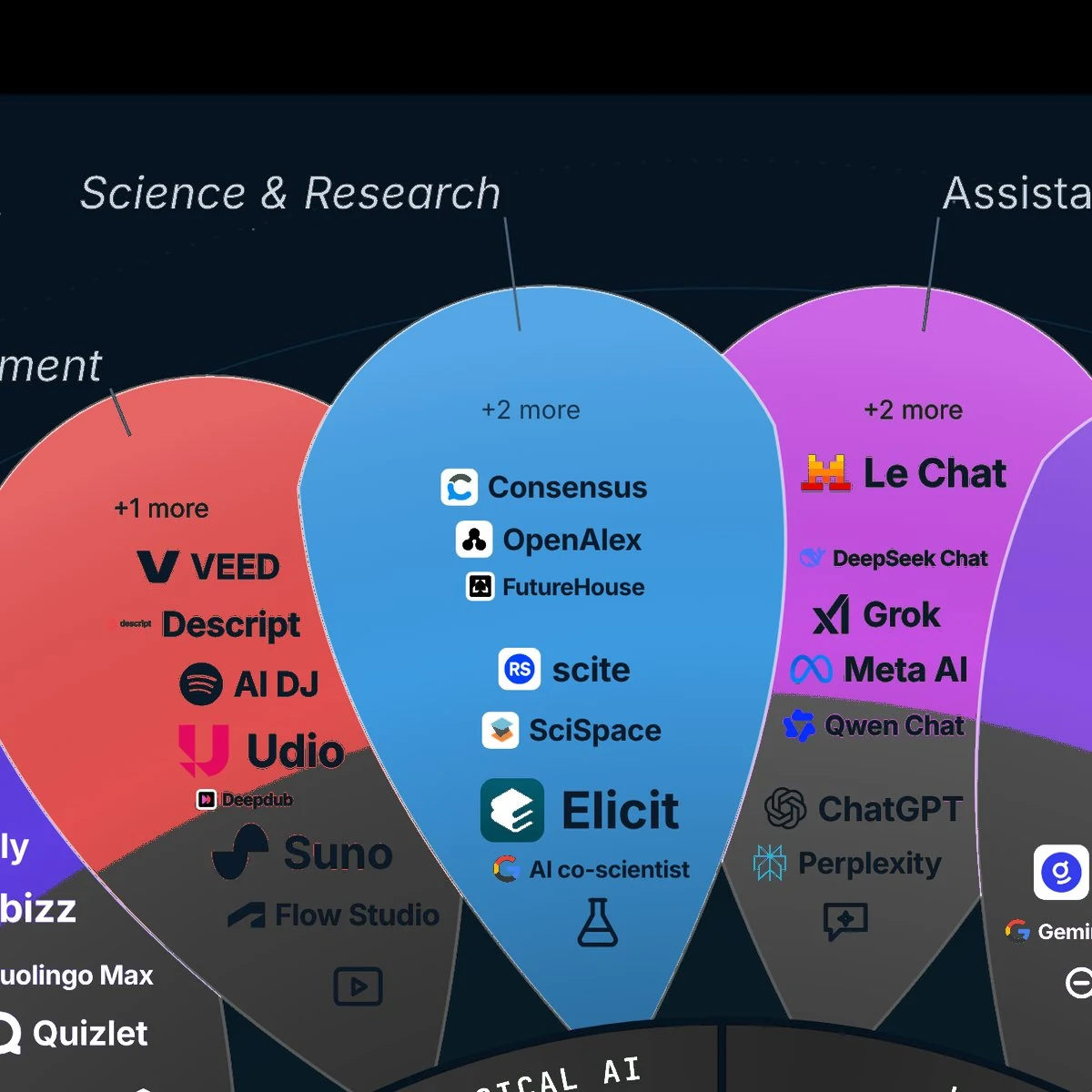
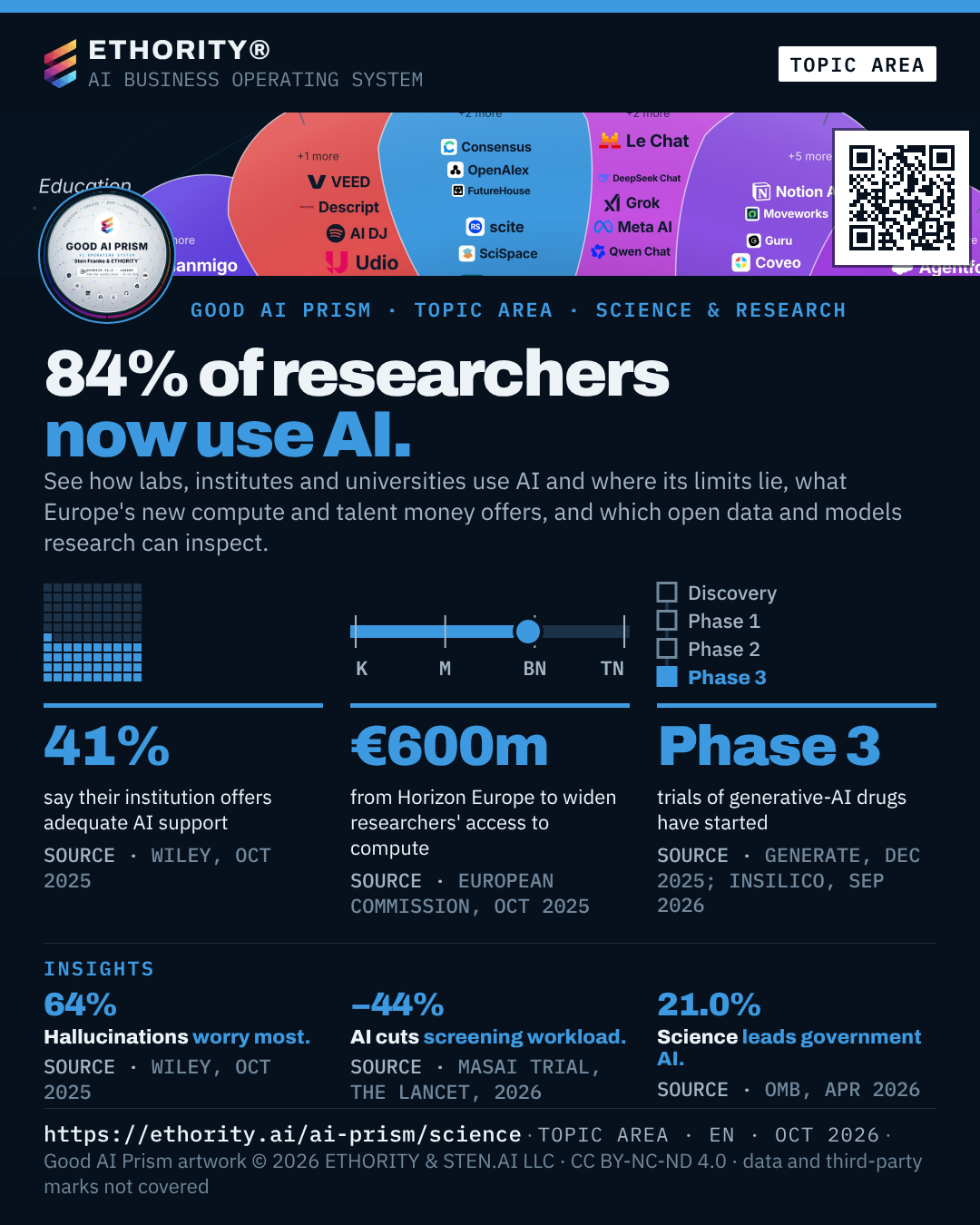
84% of researchers now use AI.
See how labs, institutes and universities use AI and where its limits lie, what Europe's new compute and talent money offers, and which open data and models research can inspect.
- 84%
- of researchers use AI in their work, up from 57% a year earlierWiley, Oct 2025 · newsroom.wiley.com ↗
- 41%
- say their institution offers adequate AI supportWiley, Oct 2025 · newsroom.wiley.com ↗
- €600m
- from Horizon Europe to widen researchers' access to computeEuropean Commission, Oct 2025 · research-and-innovation.ec.europa.eu ↗
- Phase 3
- trials of generative-AI drugs have startedGenerate, Dec 2025; Insilico, Sep 2026
Hallucinations worry most.
Concern about hallucinations rose from 51% to 64% while use jumped (Wiley researcher survey).
Wiley, Oct 2025
AI cuts screening workload.
AI-supported breast screening cut screen-reading workload by 44% with interval cancers non-inferior (our Pharma and Longevity study).
MASAI trial, The Lancet, 2026
Science leads government AI.
Science is the largest topic among 3,611 AI use cases of US federal agencies for 2025.
OMB, Apr 2026
How to use this page
Three tools and one offer turn this page into a decision.
- Open the Science & Research map: the area's offerings on one petal of the Good AI Prism, with logos and provider facts.
- Compare up to three offerings: decision facts side by side, each with its source and date.
- Run the Task economics calculator: turn saved hours into capacity you can attribute, before a pilot is approved.
- Offer: Scientific & Medical AI: AI evaluated for one defined research workflow, from literature and data to models and integrity checks.
Open data and models research can inspect
Datasets and open-weight models with licence, size and date on each card.
Common Crawl
Common Crawl · Dataset
Open repository of web crawl data that anyone can access and analyse; widely used to train language models.

FineWeb
Hugging Face · Dataset
Open dataset of more than 18.5 trillion tokens of cleaned, deduplicated English web text from Common Crawl, for language-model pretraining research.
Studies for research leaders
The Pharma, Biotech and Longevity study and the global market study.
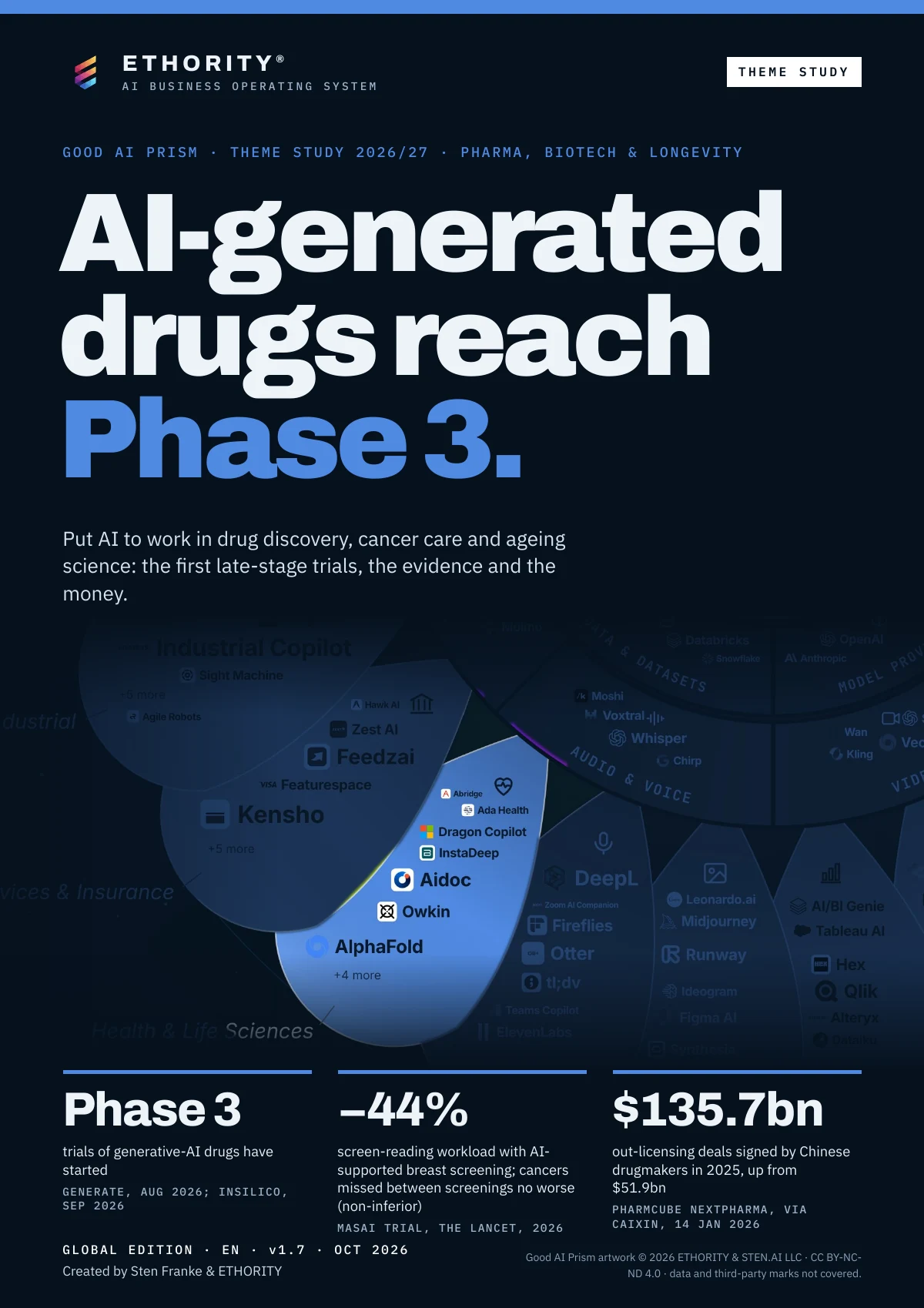
Global edition · EN
AI-generated drugs reach Phase 3.
AI-supported breast screening cut screen-reading workload by 44%. The first late-stage trials, the evidence and the money in drug discovery, cancer care and ageing science.
Version 1.7 · 40 pages
Open the study →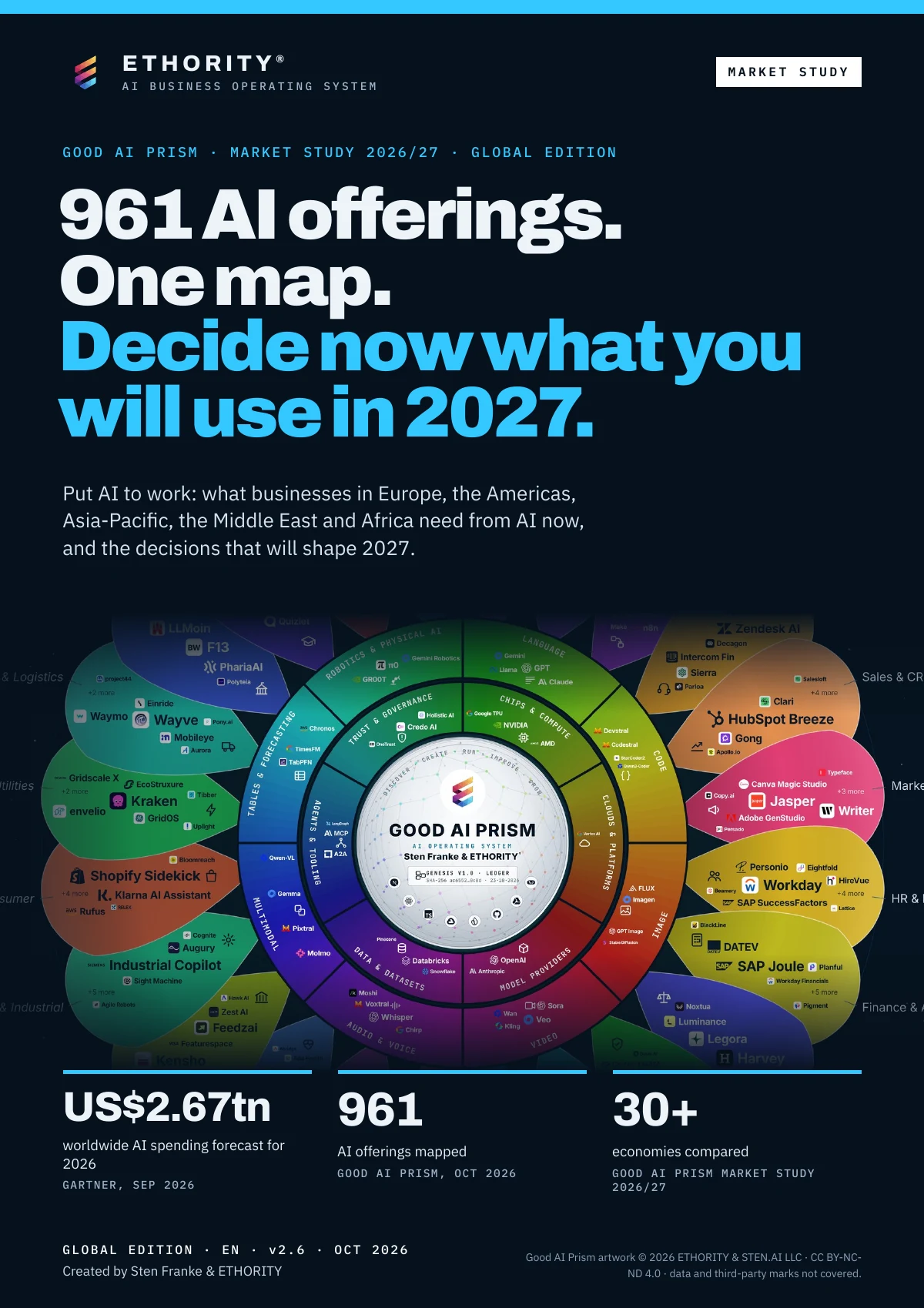
Global edition · EN
961 AI offerings. One map. Decide now what you will use in 2027.
The Good AI Prism helps you find useful AI and compare the evidence behind your options. For organisations already using AI, the question is moving from whether to use AI to which AI, how safely and whether it pays. This Global edition brings together 961 AI offerings across 24 topic areas, 8 data types and 6 technology layers, with sources, dates and limits to guide your next decision.
Version 2.6 · 90 pages
Open the study →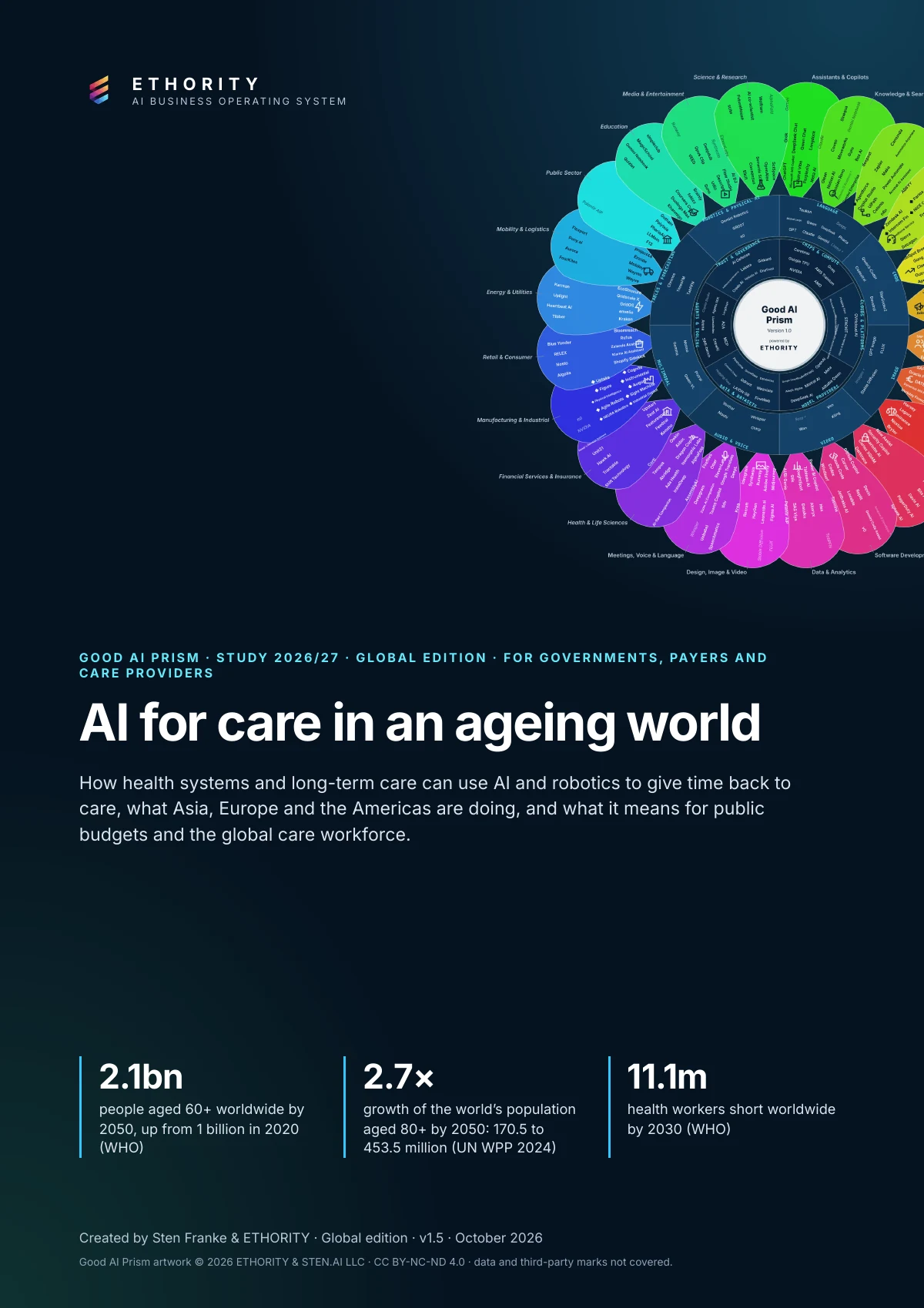
Global edition · EN
AI for care in an ageing world
The world will be short of 11.1 million health workers by 2030. How health systems and long-term care use AI and robotics to give time back to care.
Version 1.5 · 23 pages
Open the study →Read next
Three related analyses from ETHORITY; the long read for this area follows further down the page.
Ten AI ethics issues now have legal dates.
The ten AI ethics issues of 2024 now each have a legal date, a measurable control or published evidence.
See the map on one page →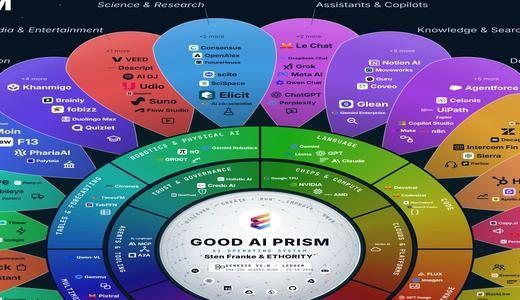
961 AI offerings. Start with the job, not the tool.
A method for going from one business need to a shortlist of AI offerings you can defend.
See the map on one page →
Check every vendor claim before you rely on it.
Tie every vendor claim to the exact product, version, contract and use before you rely on it.
See the map on one page →Where ETHORITY can start
From one research workflow to an inventory of every AI tool your groups use.
Scientific & Medical AI
Evaluate AI for a defined research workflow, from literature and data to models and integrity checks.
AI Opportunity Case
Priced after scoping
One use case assessed against evidence, cost and rules, ending in a decision: pilot, redesign, expand or stop.
Scope and delivery by agreement
See what this package includes →AI Estate Audit
€25,000 one-time · net
An inventory of every AI use, including tools staff bring themselves, with a scale, fix or stop view per use.
Date and place by agreement
See what this package includes →AI Literacy & Adoption
€2,400 one-time · net
Role-based AI literacy for the people who use, review and own AI outputs, documented for Article 4.
Scope and delivery by agreement
See what this package includes →Licensed Premium Sector Editions
Fee configured to agreed scope
The Good AI Prism for one sector under licence, with the area map and sourced profiles for your teams.
Scope and delivery by agreement
See what this package includes →Rules and dates
Dates and programmes that shape AI in research.
- 9 Oct 2024
Nobel Prize in Chemistry for protein design and AlphaFold.
Royal Swedish Academy of Sciences
- 8 Oct 2025
EU strategy for AI in science with RAISE, €600m for compute.
European Commission
- 3–4 Nov 2025
RAISE pilot launched in Copenhagen with €107m from Horizon Europe.
European Commission
- 2 Dec 2027
EU high-risk duties apply to Annex III uses once AI leaves the research-only exemption.
Reg. (EU) 2026/1744
Questions research leaders ask
Does the EU AI Act apply to our research models?
Not while a system is developed and used solely for scientific research and development (Article 2(6) of the AI Act). Once it enters a product or supports decisions about people, the ordinary rules apply.
Which datasets can we use for a commercial spin-off?
Check each licence. ImageNet is limited to non-commercial research and education; Dolma is ODC-BY; Wikipedia text is CC BY-SA. The Dolma registry card shows how licences are recorded.
How do we stop hallucinated references?
Keep a documented trail of model, version, prompt and data for each result, and check every citation against the source. 64% of researchers now worry about hallucinations.
How can we get compute for AI research in Europe?
Through the RAISE pilot and the €600m Horizon Europe programme for compute, including AI Gigafactories. Plan data management early; access depends on it.
What should we measure in a research AI pilot?
Time to publication, reproducibility and error rates, as the global market study proposes for science, not only hours saved.
The evidence at a glance
ETHORITY · LONG READ
84% of researchers use AI. Only 41% get support.
Research adopted AI faster than almost any profession, and trusts it less every year. Europe adds money for compute and talent; open data and models give science an edge. What research leaders should settle now.
Use jumped. Expectations fell.
In one year, AI went from a minority tool to a majority habit in research. 84% of researchers now use AI in their work, up from 57% a year earlier, according to Wiley's survey of 2,430 researchers, fielded in August 2025. That is one of the fastest adoption curves in any profession the Good AI Prism tracks.
The same survey records a sharp reality check. Researchers believed AI outperformed humans on less than one third of the tasks presented, down from more than half the year before. Concern about hallucinations rose from 51% to 64%. And only 41% say their institution offers adequate support.
84% of researchers use AI in their work, up from 57% (Wiley, Oct 2025)
Read together, the numbers describe a field that has adopted AI faster than it has learned to govern it. Researchers use general assistants for literature, writing and code. Institutions have not yet settled which tools, which data and which checks they stand behind.
| Measure | 2024 | 2025 |
|---|---|---|
| Researchers using AI | 57% | 84% |
| Concerned about hallucinations | 51% | 64% |
| Say institutional support is adequate | 41% |
Source: Wiley ExplanAItions survey, 2,430 researchers, published 7 Oct 2025.
Science is where AI already won a Nobel
Science is also where AI has the strongest proof of value. The 2024 Nobel Prize in Chemistry went to David Baker for computational protein design and to Demis Hassabis and John Jumper for AlphaFold, which predicts protein structures. A tool that took decades of methodological work became a standard instrument in biology within a few years.
The next stage is reaching the clinic. ETHORITY's Pharma, Biotech and Longevity study records that Phase 3 trials of drugs designed with generative AI have started: Generate in December 2025 and Insilico in September 2026. In cancer screening, the MASAI trial reported in The Lancet in 2026 that AI-supported breast screening cut screen-reading workload by 44%, with interval cancers non-inferior. Those are the outcomes research leaders can point to: fewer years to a candidate, fewer hours per read, the same or better safety.
Government research is a large share of public AI already. Science is the single largest topic among the 3,611 AI use cases US federal agencies reported for 2025, at 21.0%, according to the federal AI use-case inventory. The Public Sector topic area shows the rest of that portfolio.
Europe puts money on compute and talent
On 8 October 2025 the European Commission adopted a strategy for AI in science. Its centre is RAISE, the Resource for AI Science in Europe, launched as a pilot at the AI in Science Summit in Copenhagen on 3–4 November 2025 with €107 million under Horizon Europe, the Commission's strategy page states. €58 million of that funds networks of excellence and doctoral networks to train and keep AI and scientific talent.
€600m from Horizon Europe to widen researchers' access to compute, including AI Gigafactories (European Commission, Oct 2025)
A further €600 million from Horizon Europe widens access to computational power for science, including dedicated access to AI Gigafactories for EU researchers and start-ups. The stated aim is to double Horizon Europe's annual investment in AI to more than €3 billion. For a university or institute, that turns compute from a budget line into an application process, and data management into a condition for access.
Open data is the research advantage
Research runs on data that can be inspected. The Good AI Prism Registry documents the open corpora behind many models, each card with its licence, size and date. Common Crawl's registry card lists more than 300 billion web pages, released monthly. The Dolma dataset card records 2.3 trillion tokens of English text under ODC-BY, published by AllenAI for fully open model development. OpenWebMath's card holds 14.7 billion tokens of mathematical web text for reasoning research. Open-weight models such as gpt-oss-120b on its card run under Apache 2.0 on an institution's own hardware.
Licences differ more than most buyers expect. ImageNet's access agreement limits use to non-commercial research and education; Wikipedia's text is CC BY-SA. A model trained for a grant project may not be usable in a spin-off. The Good AI Prism Global Market Study proposes the measures that matter for science: time to publication and reproducibility, supported by open data and methods and documented model and data choices.
Support is the missing layer
The gap between 84% use and 41% support is where institutions can act. Researchers do not need another general chatbot licence. They need an approved set of tools for their discipline, clear rules on which data may leave the institution, and help to check what the tools produce. That is a service, not a purchase.
Three roles make the difference. A research-IT owner decides which assistants, coding tools and models are approved and where they run. A data steward decides which data classes may be processed by which tool, including patient data, unpublished results and data under third-party licences. And a methods lead, often in the library or a graduate school, teaches how to document AI use and check its output. None of these roles is new. What is new is that they now need to work together on every AI tool, before a lab adopts it on its own. Institutions that set this up early turn adoption into an advantage in grant applications, because funders increasingly ask how AI was used.
The rules give research room, not a free pass
The EU AI Act excludes AI systems developed and put into service for the sole purpose of scientific research and development, under Article 2(6) of the AI Act. The exemption ends where research ends. A model that leaves the lab, enters a product or supports decisions about people falls under the ordinary rules, including the high-risk duties from 2 December 2027 for uses listed in Annex III. Health uses add medical-device rules on top.
Research integrity rules do not wait for law. Journals, funders and universities increasingly ask authors to state how AI was used. Hallucinated references are the most visible failure, and 64% of researchers now worry about them. A documented model, prompt and data trail is the simplest defence.
In practice
Best practice: an AI statement in every manuscript. A lab records, for each paper, which model and version it used, for which step, with which prompts and data, and who checked the output. The statement goes into the methods section and the repository. It answers journals and funders, and it catches hallucinated references before a reviewer does.
Scenario: from grant project to spin-off. A group trains a model in a funded project under the research exemption of Article 2(6). Two years later it founds a spin-off to sell the model. At that point the exemption ends, and every dataset licence is checked again: research-only data such as ImageNet cannot follow the model into the product.
What to do Monday
- Inventory research AI. List the assistants, coding tools and models your groups use, including personal accounts, and record where research data goes.
- Choose documented models and data. Prefer models and datasets with stated licences, versions and training data, and keep the version used for each result.
- Write a usage statement. Agree how AI use is disclosed in papers, theses and grant reports, and how citations are checked.
- Plan compute access. Map which projects could apply for RAISE and EU compute, and what data management that requires.
- Measure what science values. Track time to publication, reproducibility and error rates before and after a pilot, not only hours saved.
Sources and further reading
- Wiley, AI adoption jumps to 84% among researchers (ExplanAItions, 2,430 researchers, Aug 2025) ↗ · 7 Oct 2025
- European Commission, European Strategy for AI in Science and the RAISE pilot ↗ · 8 Oct 2025
- The Royal Swedish Academy of Sciences, Nobel Prize in Chemistry 2024 press release ↗ · 9 Oct 2024
- Regulation (EU) 2024/1689 (AI Act), Art. 2(6) ↗ · 12 Jul 2024
- OMB, 2025 Federal Agency AI Use Case Inventory (raw data, status 13 Apr 2026) ↗ · 13 Apr 2026
- ETHORITY, AI in Pharma, Biotech and Longevity, Good AI Prism theme study 2026/27 → · 22 Oct 2026
- ETHORITY, Put AI to Work: The Good AI Prism Global Market Study 2026/27 → · 22 Oct 2026
- Good AI Prism Registry dataset and model cards (Common Crawl, FineWeb, Dolma, OpenWebMath, gpt-oss-120b) → · 25 Oct 2026
Put the thinking to work
AI Governance Setup →
A repeatable governance process people can operate and review. Framework mapping is not an ISO certificate or legal opinion.
A written comparison of up to three AI offerings · €195 net →
Start with one question and up to three offerings. Request a sourced comparison, provider questions and a cost sketch using your assumptions.
YOUR NEXT STEP
Discuss your question with Sten Franke.
Bring your business question or the figures you already know. ETHORITY investigates within the agreed scope; together with Sten Franke you agree the next piece of work.