 ETHORITY®
GOOD AI PRISM · TOPIC AREA · MANUFACTURING & INDUSTRIAL
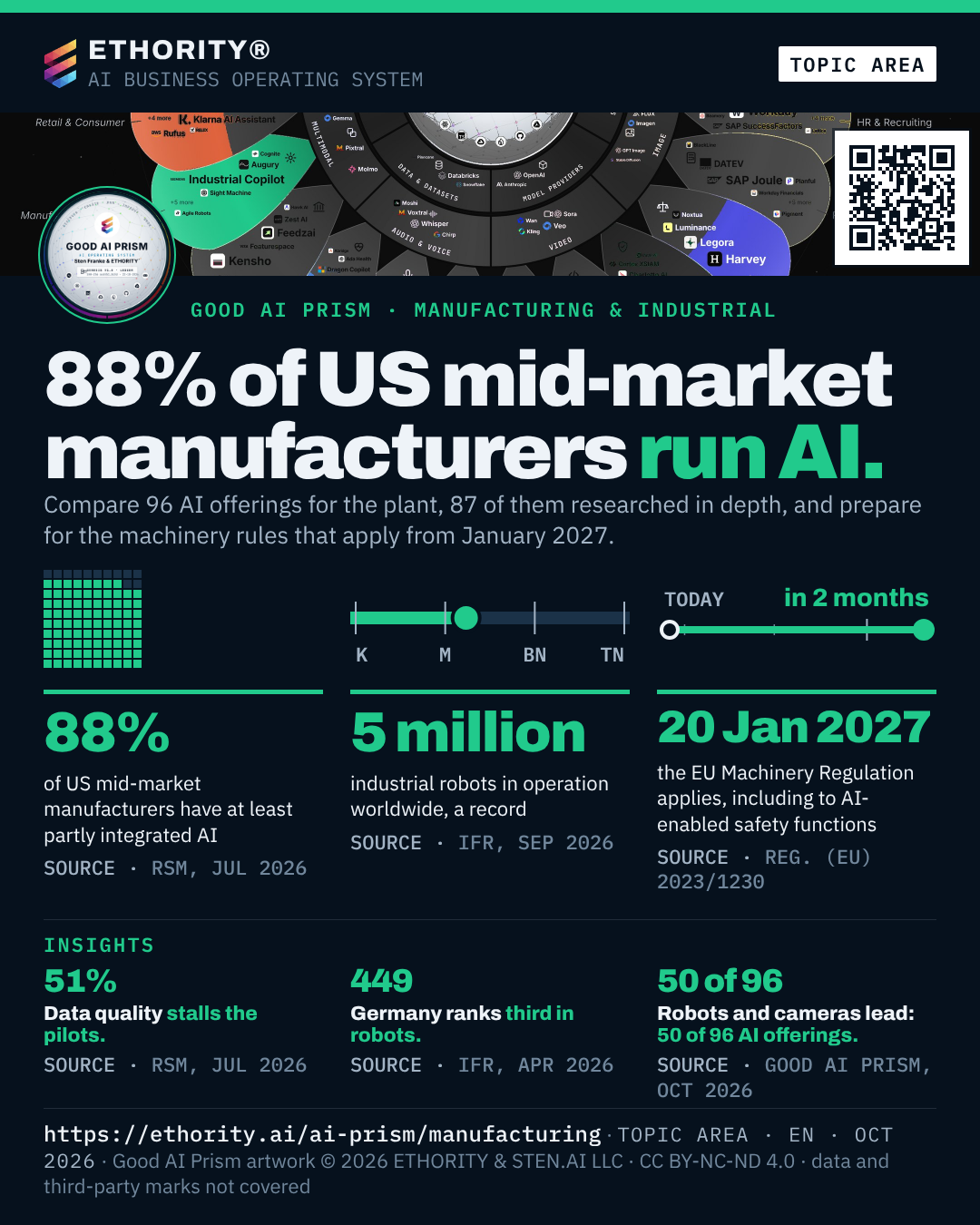
88% of US mid-market manufacturers run AI.
Compare 96 AI offerings for the plant, 87 of them researched in depth, and prepare for the machinery rules that apply from January 2027.
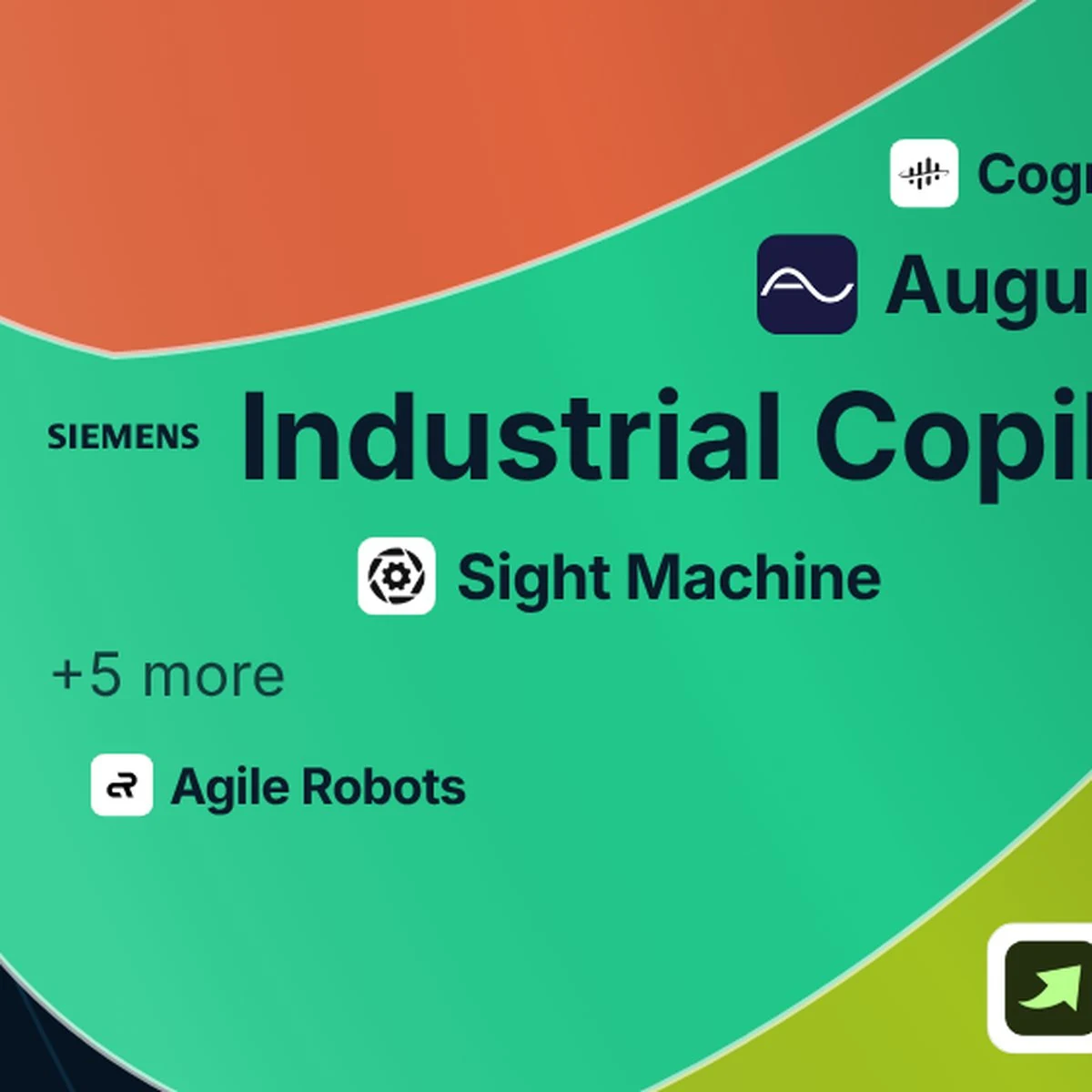
- 96
- manufacturing AI offerings mapped, 87 of them researched in depth, plus 3 provider records (NVIDIA, Agile Robots, Physical Intelligence)Good AI Prism, Oct 2026
- 88%
- of US mid-market manufacturers have at least partly integrated AIRSM, Jul 2026 · rsmus.com ↗
- 5 million
- industrial robots in operation worldwide, a recordIFR, Sep 2026 · ifr.org ↗
- 20 Jan 2027
- the EU Machinery Regulation applies, including to AI-enabled safety functionsReg. (EU) 2023/1230 · eur-lex.europa.eu ↗
Data quality stalls the pilots.
Data quality is behind 51% of manufacturing AI pilots with limited success; unclear ROI is behind 30%.
RSM, Jul 2026
Germany ranks third in robots.
Germany runs 449 robots per 10,000 manufacturing employees, third worldwide and almost twice the EU average.
IFR, Apr 2026
Robots and cameras lead: 50 of 96 AI offerings.
25 offerings bring AI into robots and 25 inspect quality by camera.
Good AI Prism, Oct 2026
How to use this page
Three tools and one offer turn this page into a decision.
- Open the Manufacturing & Industrial map: the area's offerings on one petal of the Good AI Prism, with logos and provider facts.
- Compare up to three offerings: decision facts side by side, each with its source and date.
- Run the Task economics calculator: turn saved hours into capacity you can attribute, before a pilot is approved.
- Offer: AI Opportunity Case: one use case assessed against evidence, cost and rules, with a baseline, a threshold and a pilot, redesign, expand or stop decision.
The briefs and the study
New: the Manufacturing & Industrial sector brief, first edition of 27 Oct 2026. The Robotics brief maps machines and rules; the Global Market Study sets manufacturing against ten other sectors.
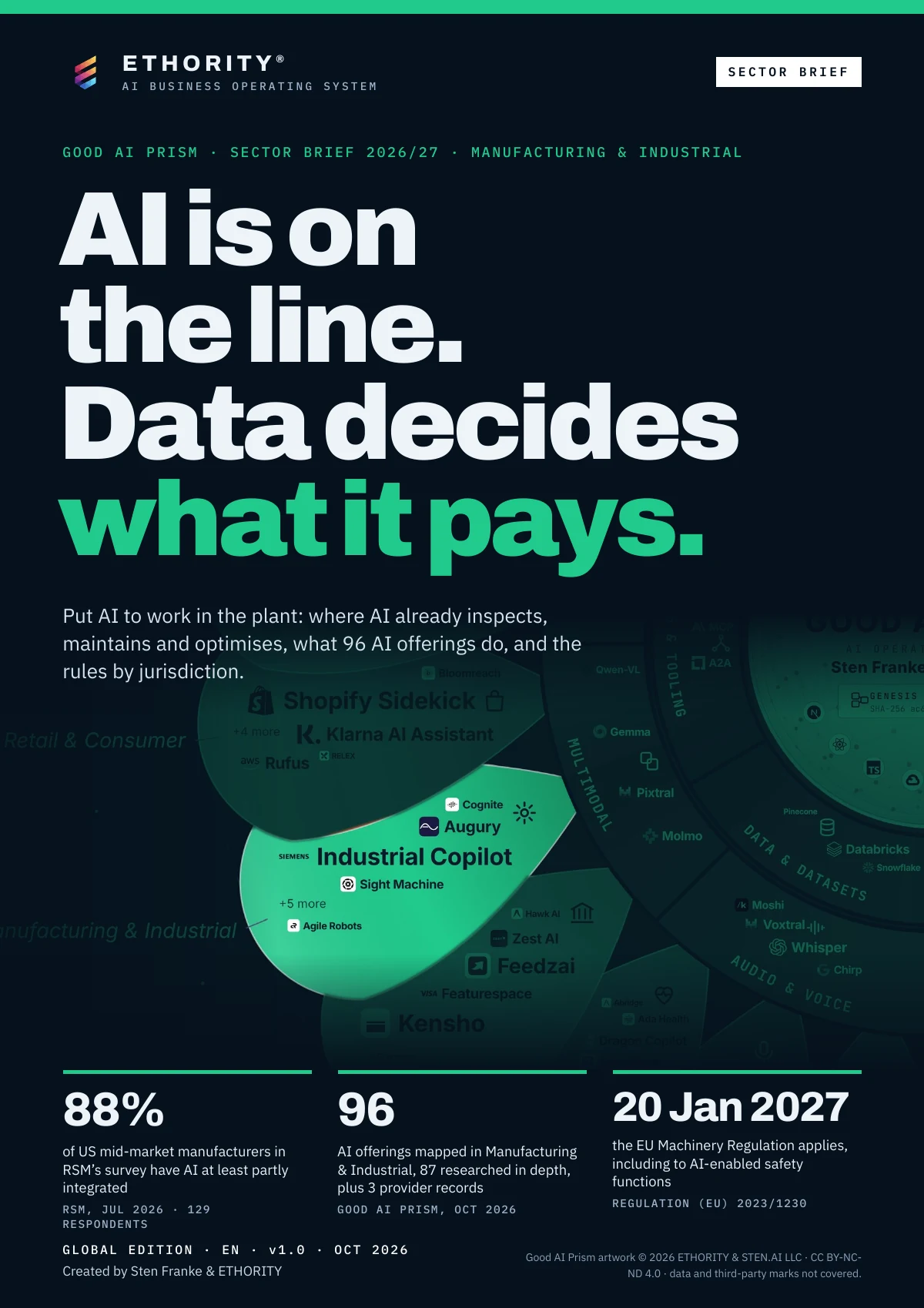
Global edition · EN
AI is on the line. Data decides what it pays.
Start where data already flows. Where AI already inspects, maintains and optimises in the plant, what the market offers and the rules by jurisdiction.
Version 1.0 · 42 pages
Open the study →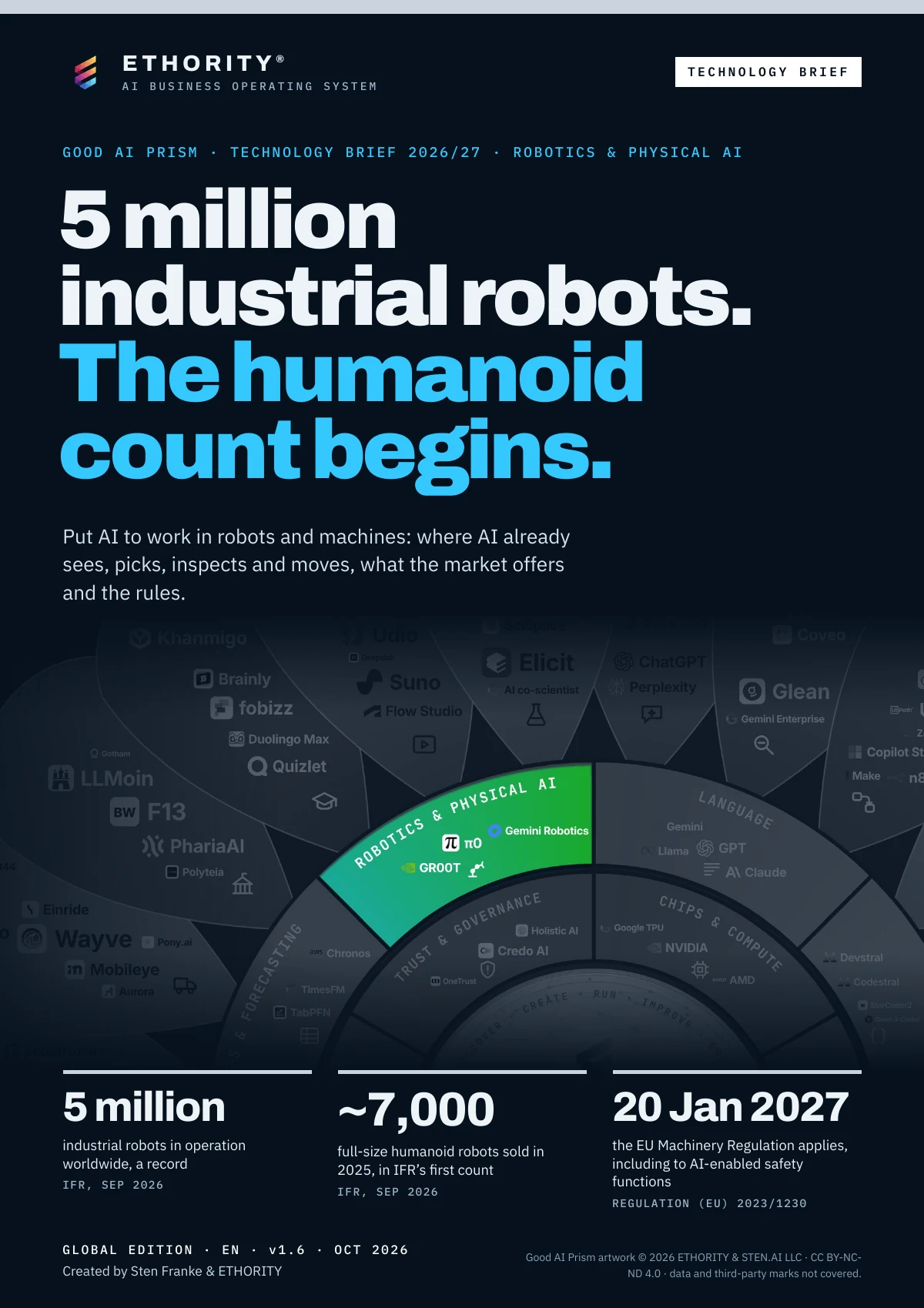
Global edition · EN
5 million industrial robots. The humanoid count begins.
Humanoids are counted for the first time: about 7,000 sold in 2025. Where AI already sees, picks, inspects and moves, what the market offers and the rules.
Version 1.6 · 40 pages
Open the study →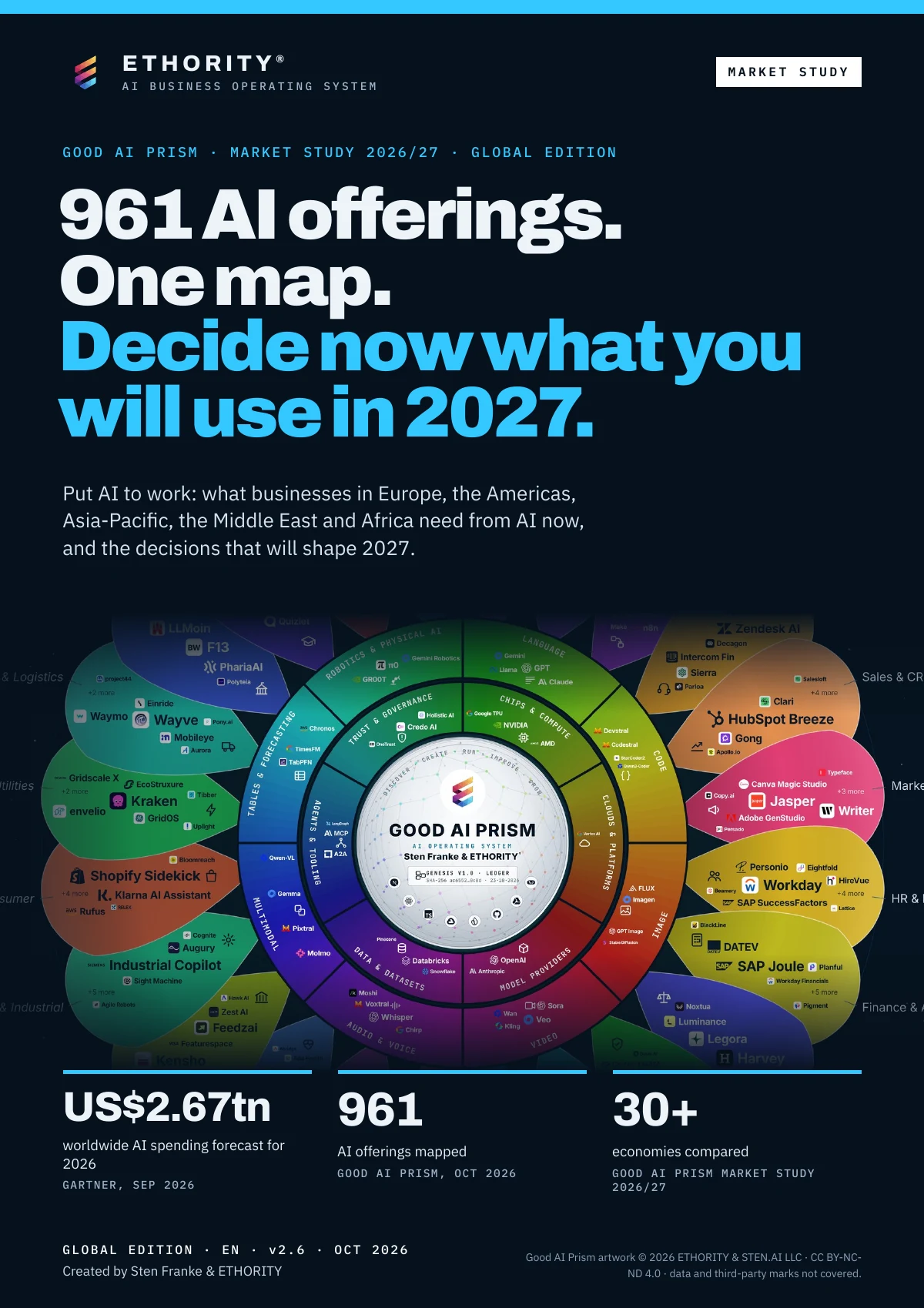
Global edition · EN
961 AI offerings. One map. Decide now what you will use in 2027.
The Good AI Prism helps you find useful AI and compare the evidence behind your options. For organisations already using AI, the question is moving from whether to use AI to which AI, how safely and whether it pays. This Global edition brings together 961 AI offerings across 24 topic areas, 8 data types and 6 technology layers, with sources, dates and limits to guide your next decision.
Version 2.6 · 90 pages
Open the study →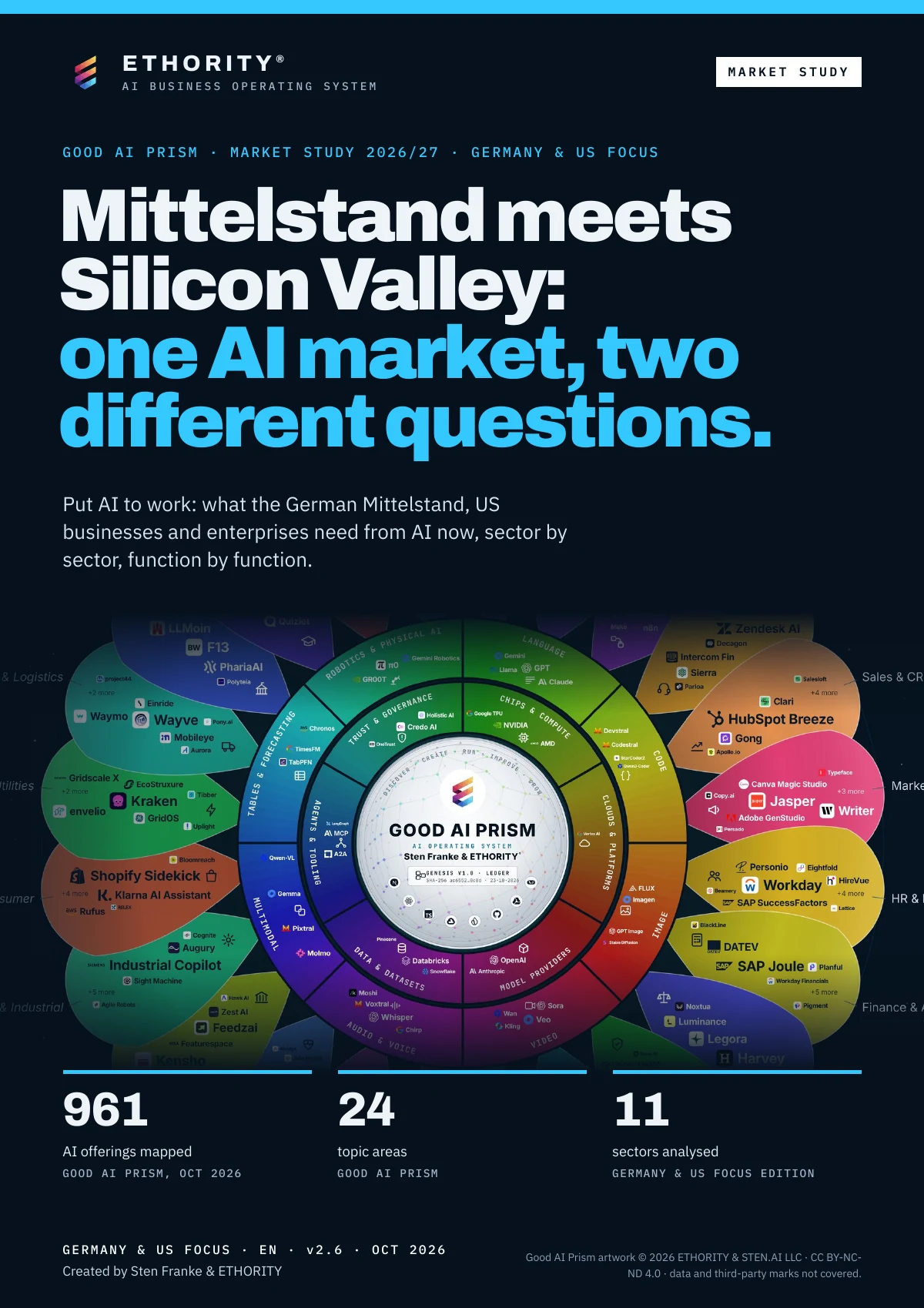
Germany & United States Focus · EN
Germany's mid-sized companies meet Silicon Valley: one AI market, two different questions.
The Mittelstand needs know-how; US firms need cost control. What German and US businesses need from AI now, sector by sector, function by function.
Version 2.6 · 72 pages
Open the study →Read on
Three related analyses from ETHORITY; the long read for this area follows further down the page.
AI spending is forecast to rise by half. 37% of surveyed organisations see an effect on profit.
Sourced figures for 2025–26 on AI spending, adoption, models, energy and value, for your 2027 planning.
See the map on one page →
AI does not scale by itself. Redesign the work.
Start with one objective, choose the simplest approach for each task and measure the cost of every result you accept.
See the map on one page →
Saved hours are not AI value.
Separate a better task, freed-up time and a business result, so you can show the value AI really delivers.
See the map on one page →Rules and dates
The Machinery Regulation (EU) 2023/1230 applies from 20 Jan 2027 and covers AI-enabled safety functions. AI Act high-risk duties for AI in products follow on 2 Aug 2028. In Germany, works councils co-determine systems that can monitor performance.
Where a manufacturing project can begin
AI Opportunity Case
Priced after scoping
One use, such as maintenance or inspection, with a data-readiness check and a stop/go gate on downtime, scrap and OEE.
Scope and delivery by agreement
See what this package includes →AI Readiness & Maturity Check
€3,500 one-time · net
Where the plant stands on data, skills and ownership before a use-case portfolio starts.
Date and place by agreement
See what this package includes →AI Estate Audit
€25,000 one-time · net
An inventory of AI across production, engineering and administration, with providers, data and owners.
Date and place by agreement
See what this package includes →AI Literacy & Adoption
€2,400 one-time · net
Training for shift leads, maintenance and engineering, with employee representatives and documented literacy measures.
Scope and delivery by agreement
See what this package includes →Questions buyers ask
Why do manufacturing AI pilots fail?
Mostly on data. RSM finds data quality behind 51% of pilots with limited success and unclear ROI behind 30%. A data-readiness check before each case filters early.
Which rules apply to AI in robots and machines?
The Machinery Regulation from 20 Jan 2027, with ISO 10218-1/-2:2025 as the reference standards, and AI Act duties for AI in products from 2 Aug 2028.
Where does AI pay first in a plant?
In uses with daily measurable outcomes: predictive maintenance against downtime, visual inspection against scrap rate, and copilots against engineering time, each tracked in OEE.
What does the Good AI Prism add?
87 manufacturing offerings researched in depth: application, pricing unit, integrations, prerequisites, hosting and limitations where documented. The Robotics & Physical AI brief adds the market map for machines.
Do we need the works council?
In Germany, yes, wherever a system can monitor performance (BetrVG § 87(1) no. 6), and early for new technical installations (§ 90).
The evidence at a glance
ETHORITY · LONG READ
88% of US mid-market manufacturers use AI. Data decides who scales.
Robots are at a record and AI sits in most mid-market plants. Pilots stall on data and unclear returns. What the market offers and which rules apply from January 2027.
The factory floor has quietly become one of the most AI-dense places in the economy. In RSM's 2026 survey of US mid-market manufacturers, 88% said AI is at least partly integrated into their organisation, 32% fully across core operations, and 56% already use agentic AI. The machines are ready too: the International Federation of Robotics counts 5 million industrial robots in operation worldwide, a record. And yet the same RSM survey names the reason pilots stall: data quality, behind 51% of pilots with limited success. Unclear return comes second, at 30%.
88% of US mid-market manufacturers have AI at least partly integrated; data quality is behind 51% of weak pilots (RSM, Jul 2026)
That is the manufacturing story of 2026. Adoption is no longer the question. Scale is, and scale depends on the data and the decision discipline behind each use.
Robots at record, models on the shop floor
More than 600,000 industrial robots were installed worldwide in 2025, up 11% (IFR, September 2026). Density is highest in Korea, with 1,220 robots per 10,000 manufacturing employees; Germany ranks third with 449, almost twice the EU average of 231, and the US stands at 307 (IFR, April 2026). Beyond the cell, growth is faster still: almost 250,000 professional service robots were sold in 2025, up 24%, and IFR counted about 7,000 full-size humanoids for the first time.
449 industrial robots per 10,000 manufacturing employees in Germany, third worldwide (IFR, Apr 2026)
What changes is the brain. Robot foundation models such as NVIDIA GR00T and Google DeepMind's Gemini Robotics make skills like grasping unfamiliar items available across many machines. Vision control, autonomous motion and natural-language programming move from research into products from Universal Robots, Yaskawa, Micropsi Industries and Wandelbots. The Robotics & Physical AI brief maps these offerings and the safety rules that apply.
Robots and cameras lead: 50 of 96 AI offerings
Manufacturing is one of two areas where the Good AI Prism goes beyond a listing. It places 99 entries in Manufacturing & Industrial, 96 AI offerings and three provider records (NVIDIA, Agile Robots, Physical Intelligence), and the research edition of 20 October 2026 holds 87 of the offerings researched in depth, each with a business application, pricing unit, integrations, deployment prerequisites, data hosting and limitations where the provider documents them. Robots and cameras lead: 25 offerings bring AI into robots and 25 inspect quality by camera. Eighteen predict maintenance needs, 11 optimise processes, nine are engineering copilots and knowledge assistants, and eight cover plant data, planning and edge AI.
Maintenance shows the range. AspenTech's Aspen Mtell, AVEVA Predictive Analytics, C3 AI Reliability, GE Vernova's asset performance management, Honeywell Forge and Festo AX sit next to specialists such as Nanoprecise, Petasense and Asystom. Engineering copilots come from the automation majors: Rockwell Automation's FactoryTalk Design Studio Copilot, Dassault Systèmes' LEO, KUKA's iiQWorks.Copilot and fruitcore robotics' horstOS.
The depth research also shows what buyers cannot see. Only 12 of the 87 records state a pricing unit on public pages; 51 document where data is hosted. For a buyer that means one thing: the decisive facts arrive in the sales conversation, so they must be asked for in writing.
Why pilots stall
Data quality sits behind half of the pilots that disappoint, according to RSM. In practice that means sensor data with gaps, quality records that do not link to process parameters, and maintenance logs written for people rather than models. A use-case portfolio with a data-readiness check in front of each case filters this early. The second reason, unclear return, is a decision problem: a pilot without a baseline and a threshold has no way to end.
The size gap makes it harder for smaller firms. In Germany a majority of firms now use AI (Bitkom survey, 2026), but the depth of use differs by size. In Korea, only 4.2% of small and mid-sized manufacturers use AI, and 80.7% have no AI talent (KCCI, cited in the Good AI Prism Global Market Study). Supplier programmes run by large manufacturers are one way to close that gap.
The rules: machinery law first
In Europe, robot safety rests on machinery law. From 20 January 2027, the Machinery Regulation (EU) 2023/1230 replaces the Machinery Directive. Its essential requirements cover self-evolving behaviour, AI-enabled safety functions and cyber-safety, with third-party assessment for listed high-risk machinery. The AI Act adds high-risk duties for AI in products under EU harmonisation law from 2 August 2028, as amended by Regulation (EU) 2026/1744; Commission guidance on the interplay is due by 1 August 2027.
Standards fill in the detail. ISO 10218-2:2025 for robot cells on robot applications and cells, with Part 1, is the reference for industrial robot safety, alongside ISO/TS 15066 for collaborative operation; the US adopted them as ANSI/A3 R15.06-2025. In Germany, works councils co-determine the introduction of technical systems that can monitor performance (BetrVG § 87(1) no. 6) and must be informed early about new technical installations (§ 90).
Seven questions before a pilot
Before AI touches a line, settle seven questions in writing. Which outcome should move, and what is today's baseline for downtime, scrap rate or OEE? Is the data there: complete sensor history, quality records linked to process parameters, maintenance logs a model can read? Does the system act on a safety function, so that the Machinery Regulation's conformity rules apply? Where is the data hosted, and does the provider train on it? How does it integrate with the control systems, the MES and the ERP, and can we exit? Who on the shift can override it, and how fast? And what result scales the case, and what result stops it? A provider who answers these in writing is ready for a pilot. The why AI does not scale article explains the operating model behind the answers, from ownership to measurement.
People and the plant
The evidence on jobs depends on how adoption is managed. In US labour markets, one more robot per 1,000 workers reduced the employment-to-population ratio by 0.2 percentage points (Acemoglu and Restrepo, 2020). In Germany, robots did not reduce total local employment between 1994 and 2014; manufacturing losses were offset in business services, although fewer young people entered manufacturing (Dauth et al.). The lesson for a plant manager: plan training, involvement and oversight with the technology, not after it.
In practice
Best practice: a data-readiness gate. Before a use case enters the portfolio, a short check asks three questions. Is there continuous sensor history for the asset? Are quality records linked to process parameters? Can a model read the maintenance logs? Cases that fail go to a data backlog, not to a pilot. That one gate addresses the cause RSM found behind half of the disappointing pilots.
Scenario: predictive maintenance on a press line. A mid-sized supplier pilots a maintenance model on one press line. The baseline is unplanned downtime and scrap rate over the past twelve months; the threshold is the reduction that pays for licence, integration and a planner's time. If the model misses it in the agreed window, the case stops and the data lessons move to the next line.
What to do Monday
- Build a portfolio, not a pilot. Pick three to five uses across maintenance, inspection and copilots, each with a data-readiness check.
- Fix the stop/go gate before the start. Agree the baseline and threshold for downtime, scrap rate and OEE; an AI Opportunity Case sets both.
- Ask for the hidden facts in writing: pricing unit, data hosting, training on customer data and integration with your control systems.
- Prepare the conformity file. Map every AI-enabled safety function to the Machinery Regulation before 20 January 2027.
- Involve the works council early, wherever a system can monitor performance.
This article describes market and regulation. It is not legal or safety-engineering advice.
Sources and further reading
- RSM, Middle Market AI Survey 2026: manufacturing snapshot ↗ · 21 Jul 2026
- IFR, Five million robots now operate in factories globally ↗ · 24 Sep 2026
- IFR, robot density press release ↗ · Apr 2026
- Regulation (EU) 2023/1230 (Machinery Regulation) ↗ · 29 Jun 2023
- ISO 10218-2:2025, Robotics: safety requirements, industrial robot applications and robot cells ↗ · Feb 2025
- Regulation (EU) 2026/1744 (Digital Omnibus on AI) ↗ · 27 Jul 2026
- Bitkom, For the first time a majority of companies use AI ↗ · 2026
- ETHORITY, Good AI Prism Global Market Study 2026/27 (KCCI) and Robotics & Physical AI brief (IFR service robots, Acemoglu and Restrepo, Dauth et al.); Good AI Prism research edition, manufacturing depth records → · 22 Oct 2026
Put the thinking to work
AI Opportunity Case →
A defensible proceed, test, redesign, defer or stop decision. The fee is independent of which outcome the evidence supports.
A written comparison of up to three AI offerings · €195 net →
Start with one question and up to three offerings. Request a sourced comparison, provider questions and a cost sketch using your assumptions.
YOUR NEXT STEP
Discuss your question with Sten Franke.
Bring your business question or the figures you already know. ETHORITY investigates within the agreed scope; together with Sten Franke you agree the next piece of work.