 ETHORITY®
GOOD AI PRISM · TECHNOLOGY LAYER · MODELS
Gemini prices double. GPT-4o retires 14 Jan 2027.
Choose the right model: 26 cards from 8 providers compare price per 1M tokens, context, licence and retirement date, each with source and read date.
- 26
- model cards from 8 providers (a card set separate from the Prism offering count)Good AI Prism Registry, read 25 Oct 2026
- 14 Jan 2027
- GPT-4o and GPT-4.1 snapshots shut downOpenAI deprecations, read 25 Oct 2026 · developers.openai.com ↗
- 2×
- Gemini 4 Argon list price from 1 Dec 2026 ($2 → $4 input per 1M)Google Gemini API pricing, read 25 Oct 2026 · ai.google.dev ↗
- 100×
- price span per 1M input tokens, $0.10 to $10Provider price pages, read 25 Oct 2026
Three makers, one price point.
Claude Sonnet 5.5, GPT-6 Sol and Gemini 4 Argon list at $2 input and $10 output per 1M tokens, until Argon doubles on 1 Dec 2026.
Provider price pages, read 25 Oct 2026
A minimum life is now a feature.
Anthropic commits not to retire Claude Opus 5.5 before 22 Sep 2027 and Sonnet 5.5 before 28 Sep 2027.
Anthropic model deprecations, read 25 Oct 2026
Long context is standard.
Fifteen of the 26 model cards list a context window of one million tokens or more.
Good AI Prism Registry, read 25 Oct 2026
Model and price signals
The dated changes behind the cards.
16 Sep 2026 · Models
Aleph Alpha · Cohere
Cohere and Aleph Alpha agree to merge; the combined company is to use the Cohere brand after approval.
SiliconANGLE, 16 Sep 2026 (third-party report)
22 Sep 2026 · Models
Claude Opus 5.5
Released at $4 input / $20 output per 1M tokens; Anthropic commits to no retirement before 22 Sep 2027.
Anthropic model overview and deprecations page, read 25 Oct 2026
6 Oct 2026 · Models
Mistral Large 4
Public preview at $1.36 input / $4.18 output per 1M tokens; stores API data in the EU by default; open weights announced for the end of October.
Mistral AI, 6 Oct 2026
12 Oct 2026 · Models
Meta Muse Wonder
Meta releases the Muse Wonder models through its Model API and Muse Code.
Meta, 12 Oct 2026
17 Oct 2026 · Models
DeepSeek V4.1 Flash
Released with off-peak and peak prices ($0.15 / $0.60 off-peak per 1M tokens); legacy model names retired. Data is stored in the PRC.
DeepSeek API docs, read 25 Oct 2026
23 Oct 2026 · Models
OpenAI legacy snapshots
The GPT-4.1 nano snapshot of April 2025 and the first GPT-4o snapshot of May 2024 are shut down; OpenAI names GPT-5.6 Luna and Sol as replacements.
OpenAI deprecations page, read 25 Oct 2026
30 Nov 2026 · Models
Claude Sonnet 4.5
claude-sonnet-4-5-20250929 retires; Claude Sonnet 5.5 is the successor at $2 / $10 per 1M tokens.
Anthropic model deprecations page, read 25 Oct 2026
1 Dec 2026 · Prices
Gemini 4 Argon
List price doubles from $2 / $10 to $4 / $20 per 1M input / output tokens.
Google Gemini API pricing, read 25 Oct 2026
1 Jan 2027 · Prices
Gemini 3.8 Flash
Price doubles from $0.75 / $3.75 to $1.50 / $7.50 per 1M tokens.
Google Gemini 3.8 Flash model page, read 25 Oct 2026
14 Jan 2027 · Models
GPT-4o and GPT-4.1
Five legacy snapshots shut down; the named replacement is gpt-6-luna at $0.10 / $0.50 per 1M tokens.
OpenAI deprecations page, read 25 Oct 2026
Read the evidence
Global edition · EN
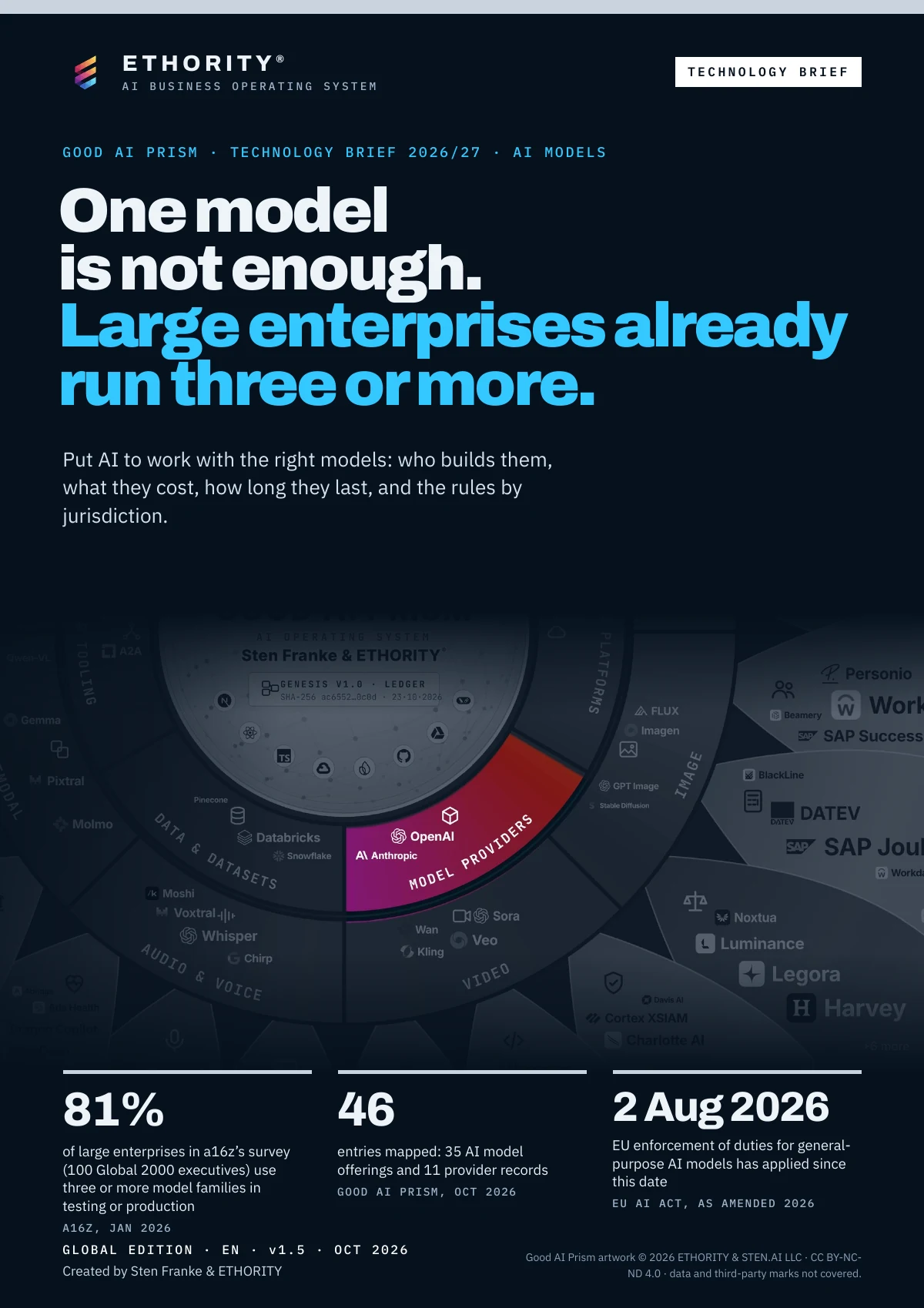
One model is not enough. Large enterprises already run three or more.
81% of large enterprises use three or more model families. Who builds AI models, what they cost, how long they last, and the rules by jurisdiction.
Version 1.5 · 38 pages
Open the study →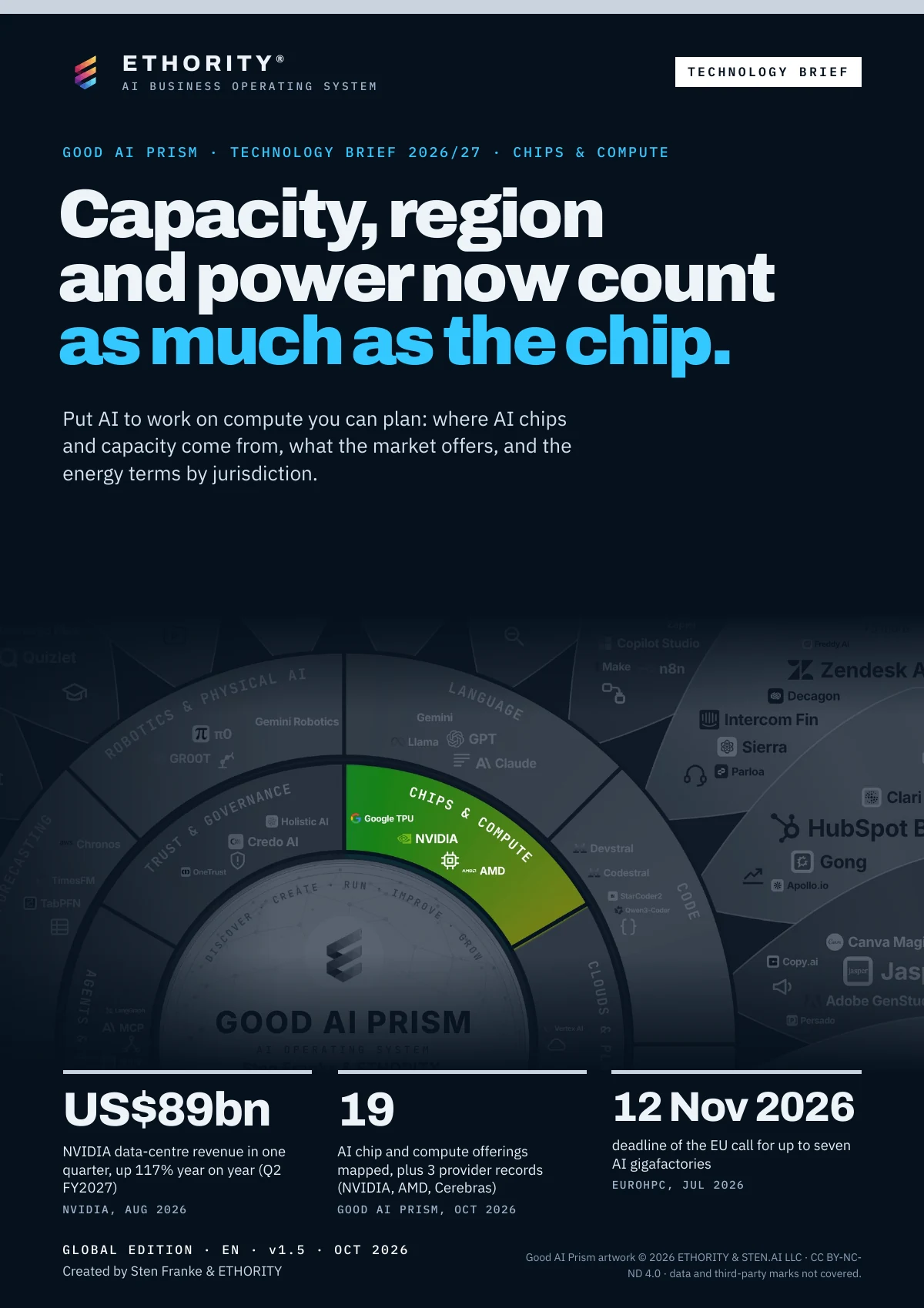
Global edition · EN
Compute that fits the work you run.
Capacity, region and energy terms count as much as chip performance. Where AI chips and capacity come from, what the market offers and the energy terms by jurisdiction.
Version 1.5 · 40 pages
Open the study →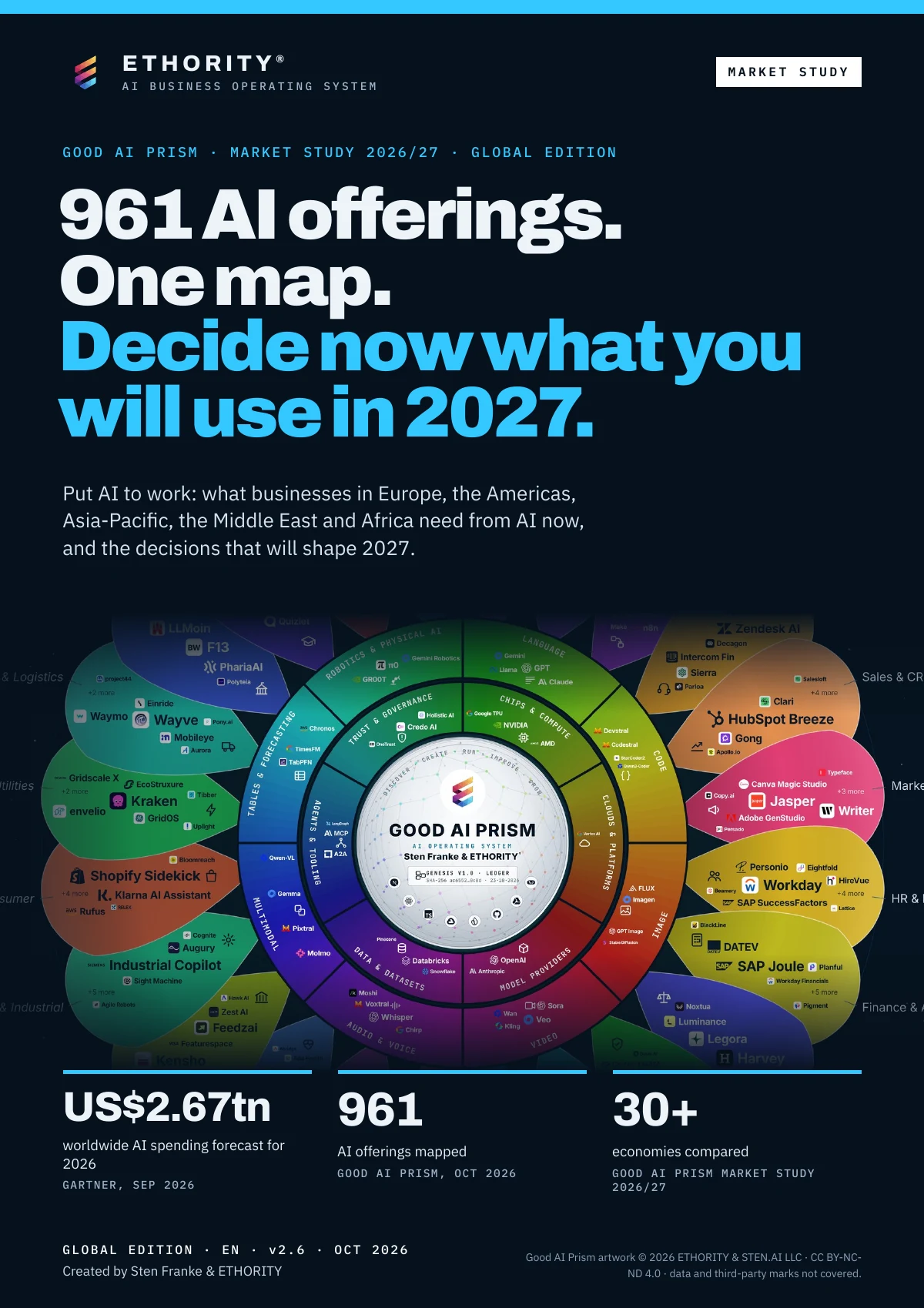
Global edition · EN
961 AI offerings. One map. Decide now what you will use in 2027.
The Good AI Prism helps you find useful AI and compare the evidence behind your options. For organisations already using AI, the question is moving from whether to use AI to which AI, how safely and whether it pays. This Global edition brings together 961 AI offerings across 24 topic areas, 8 data types and 6 technology layers, with sources, dates and limits to guide your next decision.
Version 2.6 · 90 pages
Open the study →Related insights
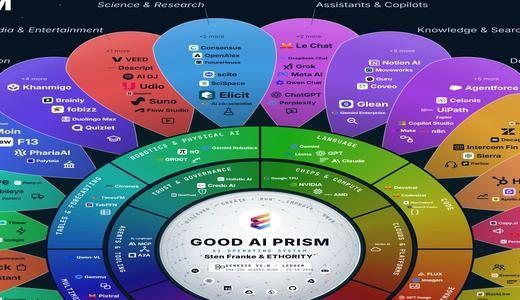
961 AI offerings. Start with the job, not the tool.
A method for going from one business need to a shortlist of AI offerings you can defend.
See the map on one page →
Check every vendor claim before you rely on it.
Tie every vendor claim to the exact product, version, contract and use before you rely on it.
See the map on one page →
Ten AI ethics issues now have legal dates.
The ten AI ethics issues of 2024 now each have a legal date, a measurable control or published evidence.
See the map on one page →Implement it with ETHORITY
AI Decision Brief
€195 net · one-time
Puts the facts that decide between two or three models side by side, each sourced and dated, with the questions to ask each provider.
Request scope and delivery
See what this package includes →Enterprise AI Opportunity Case
Priced after scoping
Compares real options, including doing nothing, models the economics and the assumptions that can break them, and recommends: start, change, test first or stop.
Scope and delivery by agreement
See what this package includes →Buyer questions
Which model should we use?
The cheapest one that passes a test set built from your own cases. Price the task, not the token, and keep a second model that passes the same test.
How do we compare prices fairly?
Use list prices per 1M input and output tokens, then multiply by tokens per task and volume. Batch and cached-input discounts change the result; the cards name them where providers publish them.
What happens when a model retires?
Calls to it stop working on the shutdown date. Tools built on it change, too. Record the date or the published minimum life in your contract, and test the named replacement early.
Are open-weight models free?
They have no list price, but hosting, operations and licence terms apply. Some licences, such as Pharia-1's, allow research and education only.
Can we keep data in the EU?
It depends on the provider and the route. Mistral stores API data in the EU by default; OpenAI offers regional data residency through sales; DeepSeek stores API data in China. EU storage does not by itself mean that all processing stays in the EU. Each card shows the stated storage location.
How current are the cards?
Every fact shows the date it was read and its source. The current cards were read on 25 Oct 2026; the AI Decision Brief refreshes them for your shortlist.
ETHORITY · LONG READ
Which model, for which job, until when
Model prices span a hundredfold, two Gemini prices double within a month and five GPT snapshots shut down on 14 Jan 2027. Pick by job, price the task and write the date into the contract.
Choosing a model used to be a one-time decision. In 2026 it is a calendar. Of the 26 models on the Good AI Prism model cards, several change price or disappear before the first quarter of 2027 ends, and most of the others carry no published end date at all. The useful question is no longer "which model is best?" but "which model, for which job, until when?".
Start with the job, then the price unit
Model prices are quoted per million tokens, input and output separately. That unit hides a wide range. At the top, GPT-6 Astra and Claude Fable 5.1 list at $10 input and $50 output. At the bottom, GPT-6 Luna and Claude Haiku 5.5 start at $0.10 input and $0.50 output. For the same million input tokens, that is a hundredfold span.
100×. The spread in list prices per million input tokens across the 26 models, from $0.10 to $10 (provider price pages, read 25 Oct 2026).
Most business jobs do not need the top of that range. Classification, routing, extraction and first-line answers run well on the low-cost tier; long reasoning, complex code and multi-step agents may justify the top. A sensible setup routes each task to the cheapest model that passes your own test set. That is also why 81% of large companies already use three or more model families (a16z, Jan 2026).
The middle of the market has converged on one price point. Claude Sonnet 5.5, GPT-6 Sol and Gemini 4 Argon all list at $2 input and $10 output per million tokens today. You can compare these three side by side,gemini-4-argon) on price, context, licence and retirement in the same units.
Then check the date
Retirement is where buyers get caught. OpenAI shut down two older snapshots on 23 October 2026 and retires five more GPT-4o and GPT-4.1 snapshots on 14 January 2027, according to its deprecations page. Any tool built on them changes with them, whether or not its vendor tells you. Anthropic retires Claude Sonnet 4.5 on 30 November 2026.
Prices move too. Google doubles the list price of Gemini 4 Argon on 1 December 2026, from $2 / $10 to $4 / $20, and Gemini 3.8 Flash doubles on 1 January 2027, per its published price list. A workload that is cheap in November can cost twice as much in January without a single line of code changing.
Some providers now publish the opposite: a floor. Anthropic states it will not retire Claude Opus 5.5 before 22 September 2027, Sonnet 5.5 before 28 September 2027 and Haiku 5.5 before 7 October 2027. A published minimum life is a buying criterion in its own right, because it tells you how long your evaluation stays valid.
Open weights buy control, not a free lunch
Eight of the 26 models offer open weights you can host yourself today, from gpt-oss-120b under Apache 2.0 to Llama 4 Scout with a 10-million-token context window. They carry no list price, but they do carry hosting, operations and licence terms. The Llama 4 licence is a custom commercial licence. Pharia-1 from Aleph Alpha is open for research and education only. Mistral Medium 3.5 uses a modified MIT licence. Read the licence before you read the benchmark.
Location matters as much as licence. Mistral stores API data in the EU by default. DeepSeek states that API data is stored in the People's Republic of China, under PRC law. OpenAI offers data residency in named regions through its sales team, and Anthropic's models also run on Amazon Bedrock, Google Vertex AI and Microsoft Foundry. If your data cannot leave the EU, that one fact removes options faster than any price.
The EU sets the frame
Since 2 August 2026, providers of general-purpose AI models face enforceable EU duties under the AI Act as amended in 2026. For buyers, the practical effect is documentation: model providers must supply technical information downstream. Ask for it. The AI Models technology brief explains which documents to request and how to use them.
Five checks before you commit
- Name the job and build a small test set from your own cases.
- Price the task, not the token: tokens per task × list price × volume, for input and output.
- Write down the retirement date or the published minimum life, and put it in the contract.
- Check licence and location for every model inside the tools you buy, not just the ones you call.
- Keep a second model ready that passes the same test set, so a retirement or price change is a switch, not a project.
The model cards are refreshed as providers change their pages. Each fact shows its source and the date we read it, so you can see when it was last true. Use the Compare tool to put two or three side by side, and the ETHORITY Intelligence signals to see the next date coming.
Sources and further reading
- OpenAI API deprecations ↗ · read 25 Oct 2026
- Anthropic model deprecations ↗ · read 25 Oct 2026
- Anthropic models overview (prices) ↗ · read 25 Oct 2026
- Google Gemini API pricing ↗ · read 25 Oct 2026
- OpenAI, Introducing GPT-6 Sol and Luna ↗ · read 25 Oct 2026
- Mistral pricing ↗ · read 25 Oct 2026
- DeepSeek API pricing ↗ · read 25 Oct 2026
- a16z, Leaders, gainers and unexpected winners in the enterprise AI arms race ↗ · Jan 2026
- Regulation (EU) 2026/1744 amending the AI Act ↗ · 2026
YOUR NEXT STEP
Discuss your question with Sten Franke.
Bring your business question or the figures you already know. ETHORITY investigates within the agreed scope; together with Sten Franke you agree the next piece of work.