 ETHORITY®
GOOD AI PRISM · TOPIC AREA · ENERGY & UTILITIES
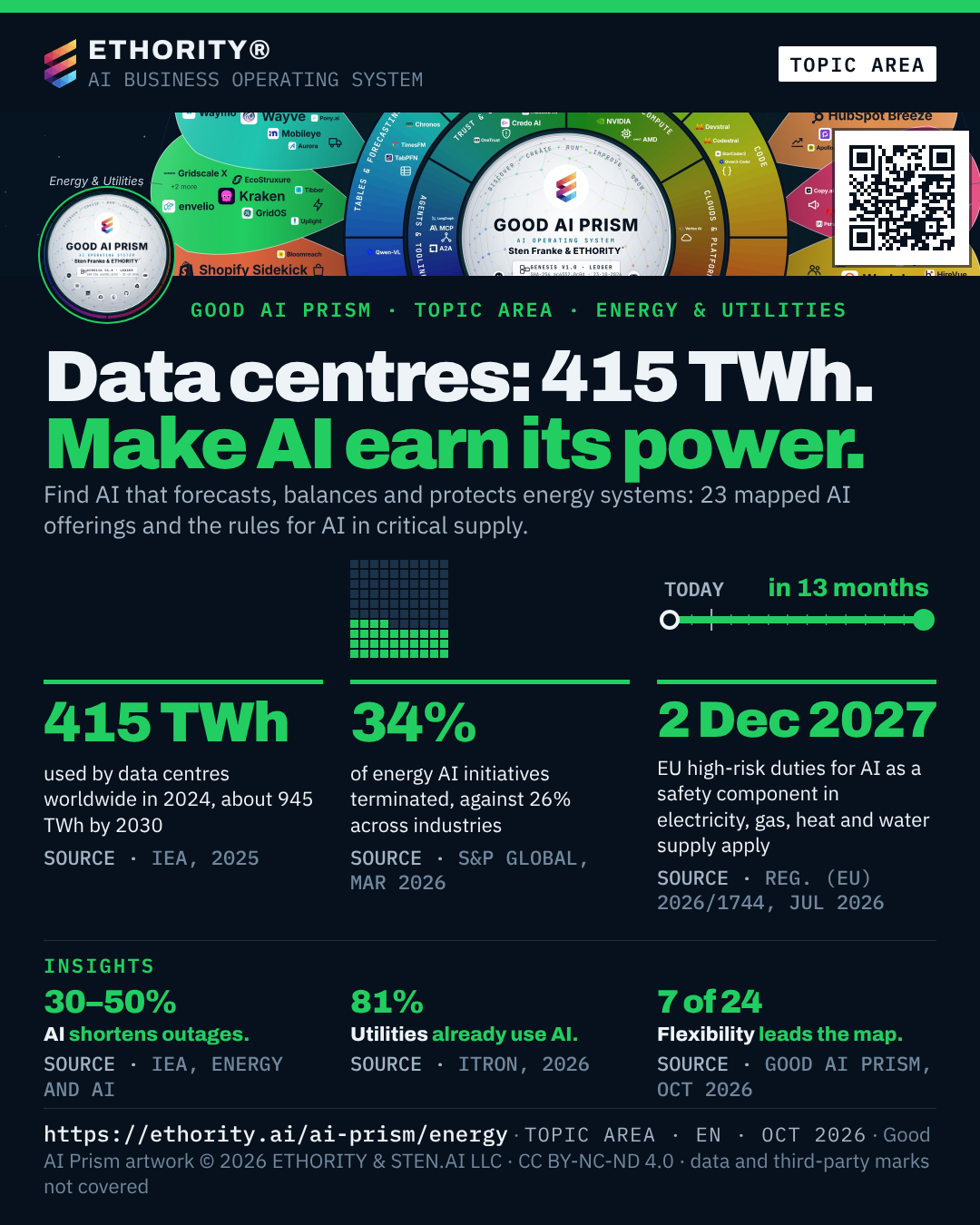
Data centres: 415 TWh. Make AI earn its power.
Find AI that forecasts, balances and protects energy systems: 23 mapped AI offerings and the rules for AI in critical supply.
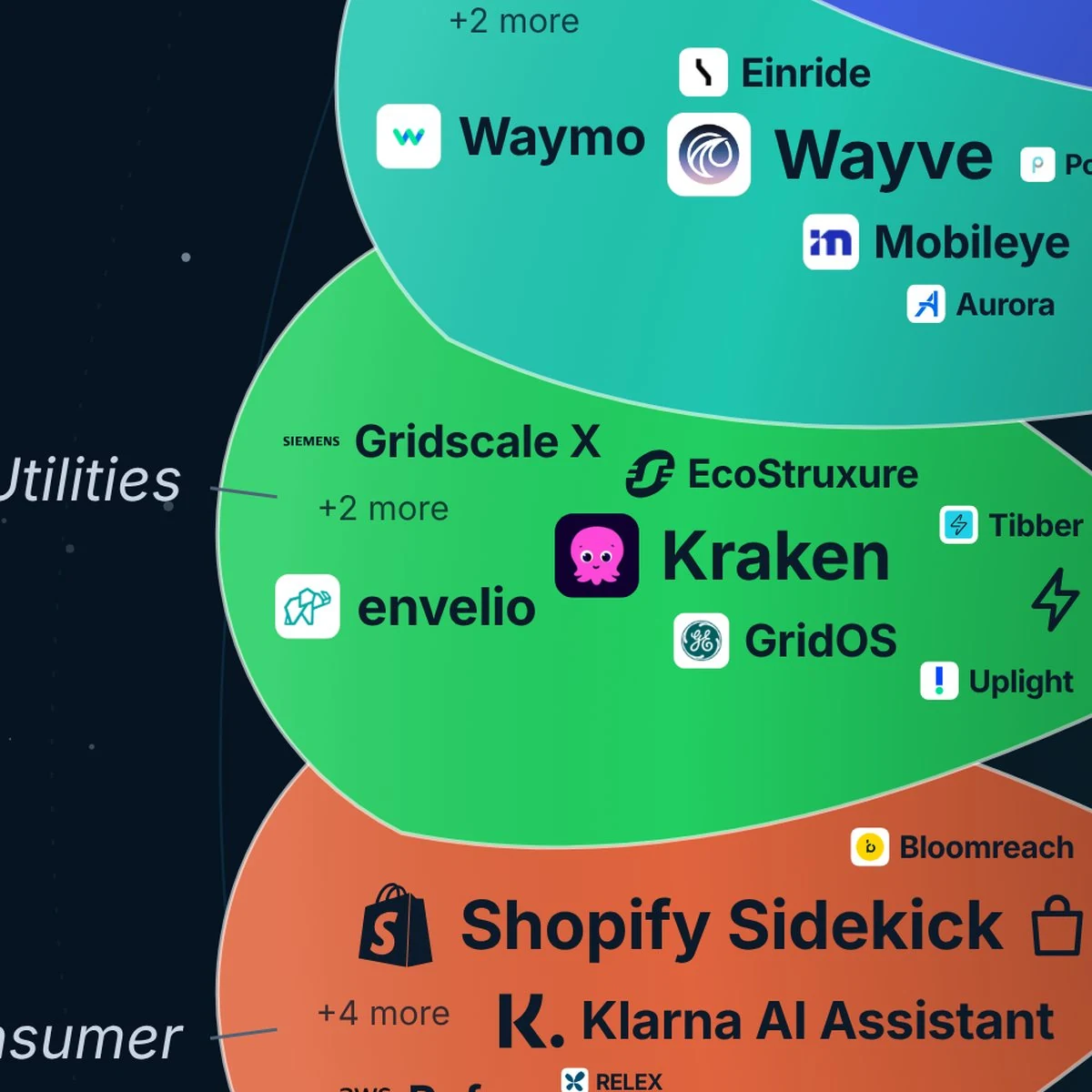
- 23
- AI offerings mapped in Energy & Utilities, plus 1 unclassified record (Tibber)Good AI Prism, Oct 2026
- 415 TWh
- used by data centres worldwide in 2024, about 945 TWh by 2030IEA, 2025 · iea.org ↗
- 34%
- of energy AI initiatives terminated, against 26% across industriesS&P Global, Mar 2026 · spglobal.com ↗
- 2 Dec 2027
- EU high-risk duties for AI as a safety component in electricity, gas, heat and water supply applyReg. (EU) 2026/1744, Jul 2026 · eur-lex.europa.eu ↗
AI shortens outages.
AI-based fault detection cuts outage duration by 30–50% where it is deployed well.
IEA, Energy and AI
Utilities already use AI.
81% of North American utilities use AI, most often for demand forecasting, maintenance and customer service.
Itron, 2026
Flexibility leads the map.
Seven of the 24 mapped entries manage flexibility, demand response and customer energy, the largest job group.
Good AI Prism, Oct 2026
How to use this page
Three tools and one offer turn this page into a decision.
- Open the Energy & Utilities map: 23 AI offerings and 1 unclassified record on one petal of the Good AI Prism, with logos and provider facts.
- Compare up to three offerings: decision facts side by side, each with its source and date.
- Run the Task economics calculator: turn saved hours into capacity you can attribute, before a pilot is approved.
- Offer: AI Opportunity Case: a business case and a stop/go gate for one use, set before money goes into scaling.
The briefs
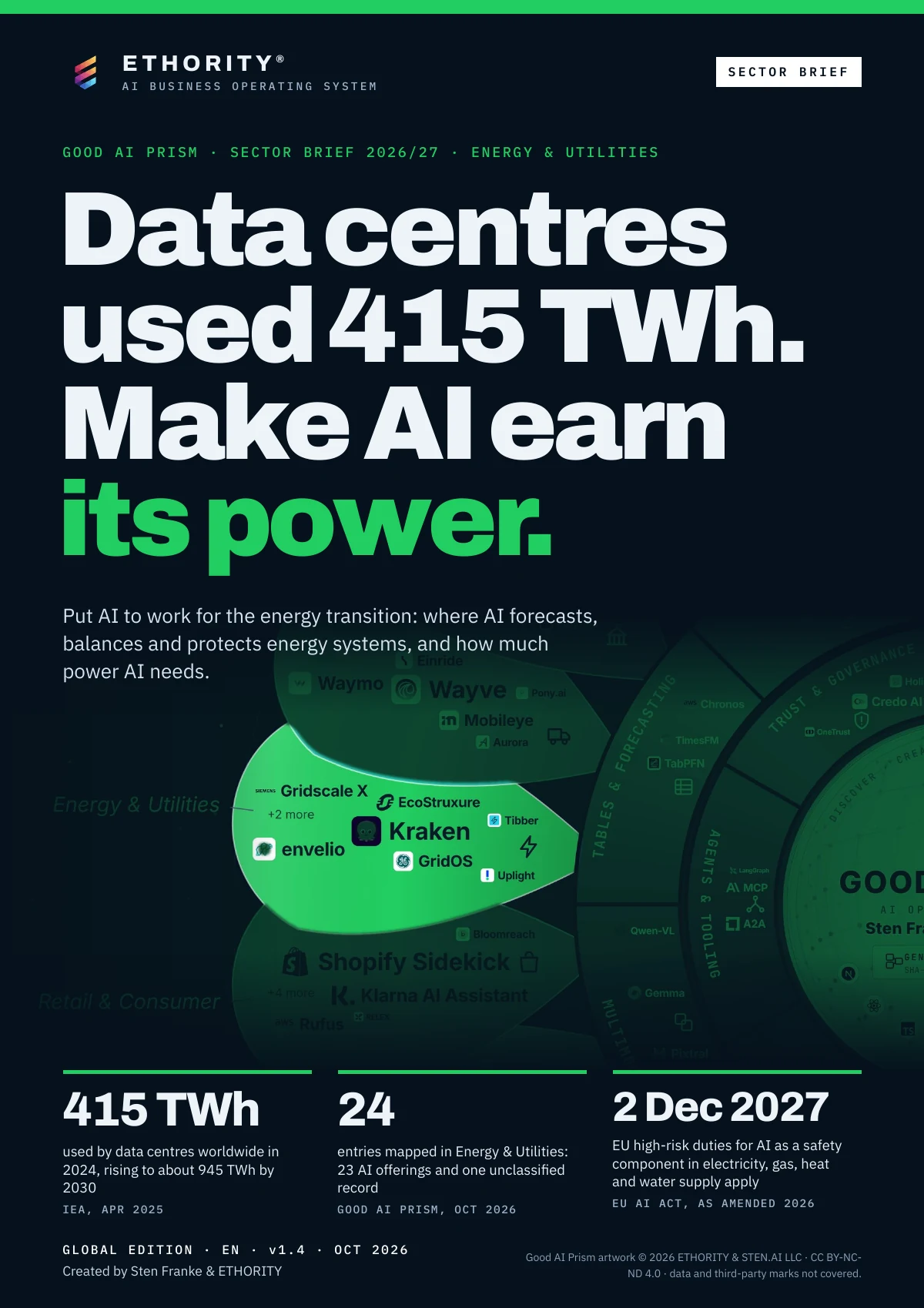
The sector brief maps the 24 entries and the rules by jurisdiction; the Compute brief covers the power AI itself needs.
Global edition · EN
Data centres used 415 TWh. Make AI earn its power.
Start where AI is measured daily: forecasts and maintenance. Where AI balances and protects energy systems, and how much power it needs itself.
Version 1.4 · 40 pages
Open the study →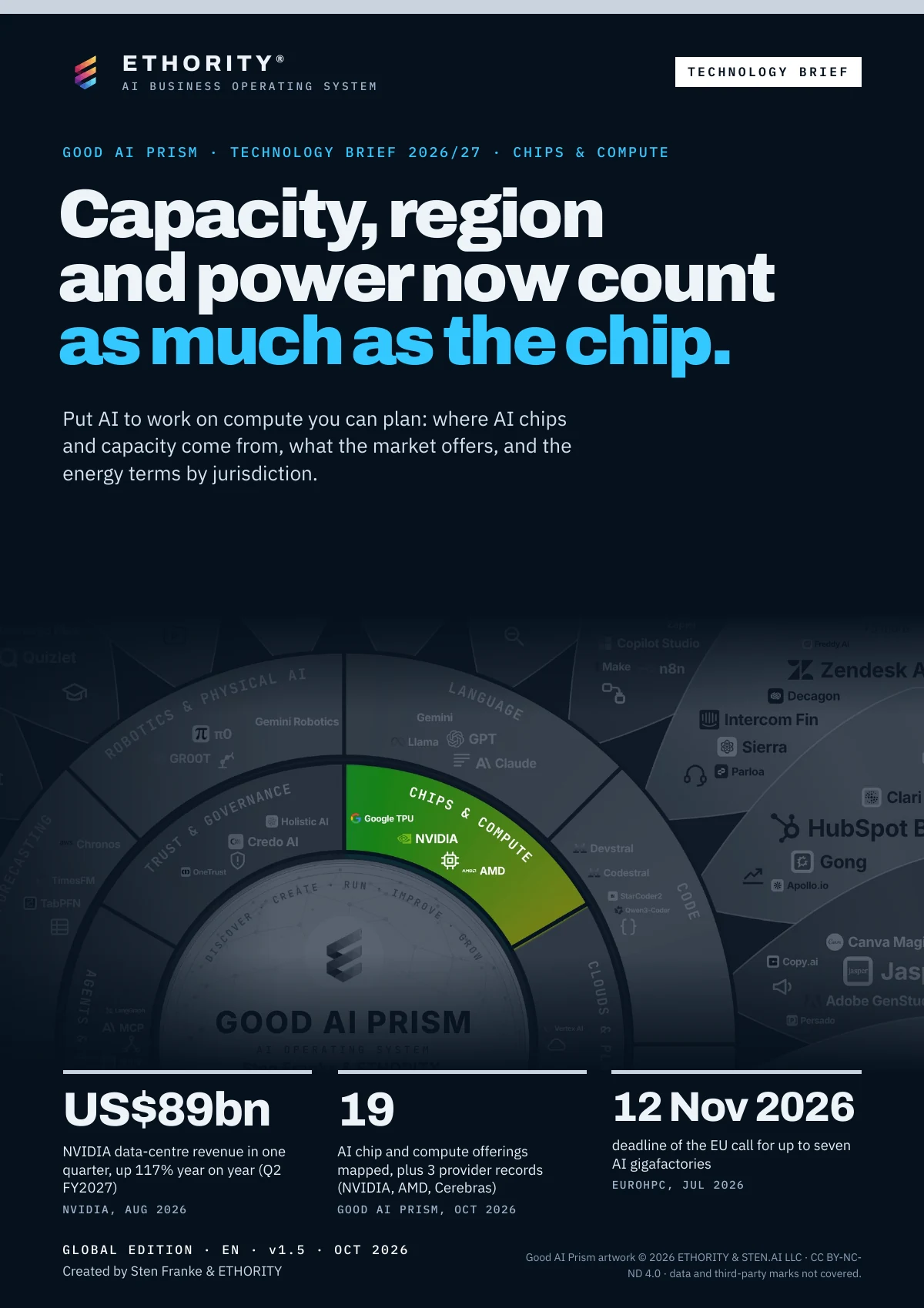
Global edition · EN
Compute that fits the work you run.
Capacity, region and energy terms count as much as chip performance. Where AI chips and capacity come from, what the market offers and the energy terms by jurisdiction.
Version 1.5 · 40 pages
Open the study →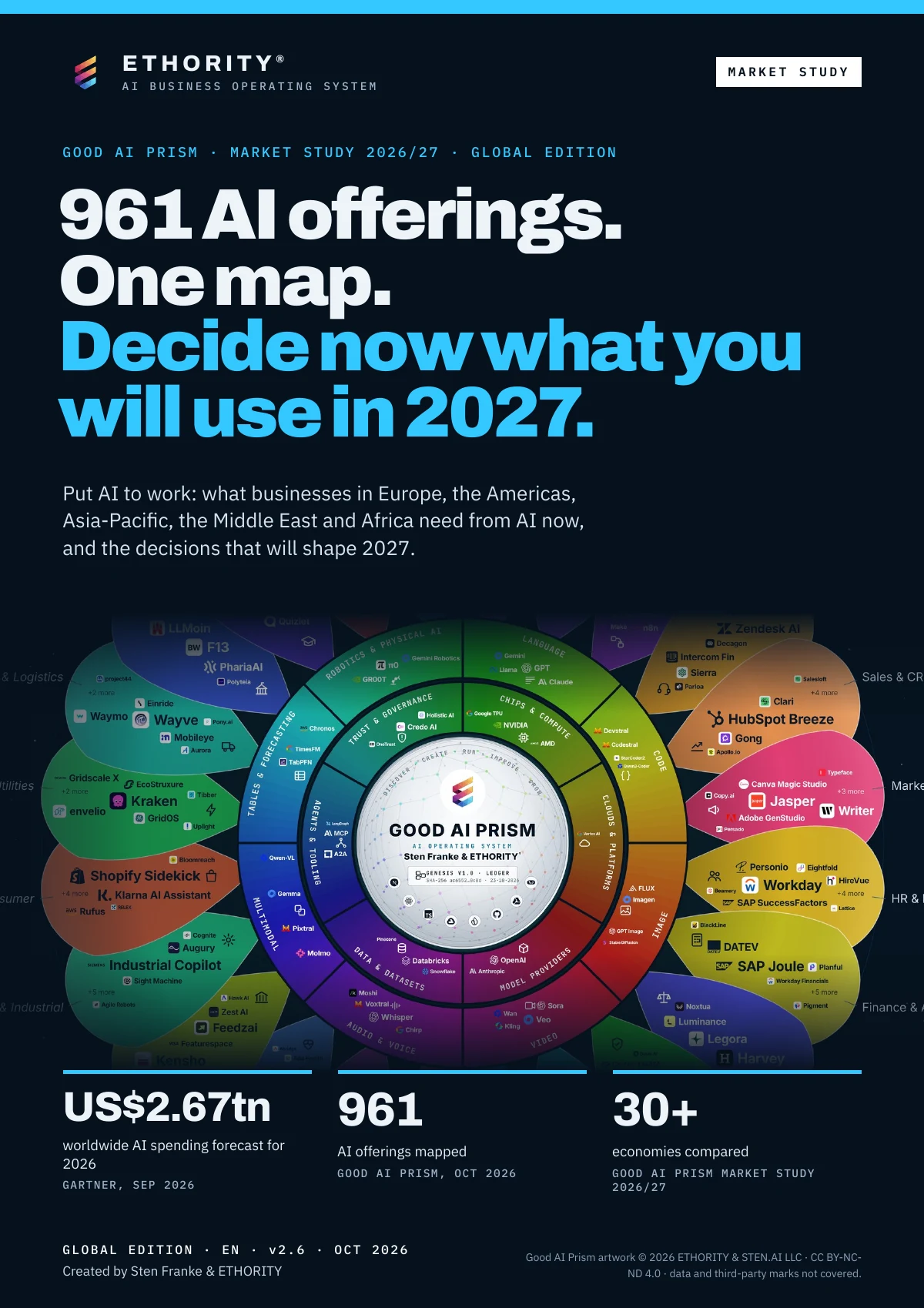
Global edition · EN
961 AI offerings. One map. Decide now what you will use in 2027.
The Good AI Prism helps you find useful AI and compare the evidence behind your options. For organisations already using AI, the question is moving from whether to use AI to which AI, how safely and whether it pays. This Global edition brings together 961 AI offerings across 24 topic areas, 8 data types and 6 technology layers, with sources, dates and limits to guide your next decision.
Version 2.6 · 90 pages
Open the study →Read on
Three related analyses from ETHORITY; the long read for this area follows further down the page.
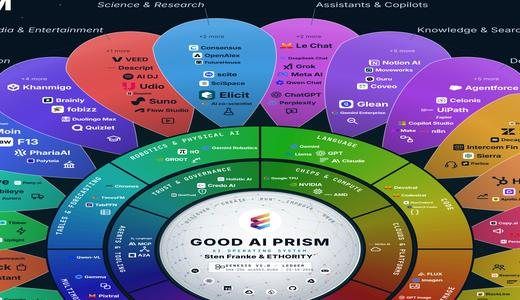
Saved hours are not AI value.
Separate a better task, freed-up time and a business result, so you can show the value AI really delivers.
See the map on one page →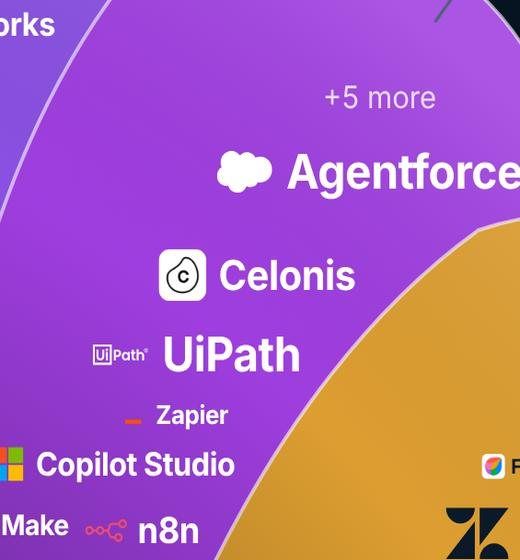
AI does not scale by itself. Redesign the work.
Start with one objective, choose the simplest approach for each task and measure the cost of every result you accept.
See the map on one page →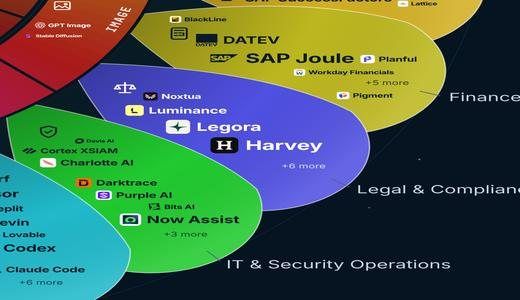
Preparing for the EU AI Act is the start; control happens in daily operation.
How to connect each EU AI Act duty to your systems, controls, evidence, monitoring and regular reassessment.
See the map on one page →Rules and dates
Customers must be told when they interact with AI since 2 Aug 2026. AI used as a safety component in supply carries high-risk duties from 2 Dec 2027 under the amended AI Act. NIS2 treats energy as highly critical; data centres from 500 kW report energy use under the Energy Efficiency Directive.
Where an energy project can begin
AI Opportunity Case
Priced after scoping
One use, such as forecasting or flexibility, with a business case and a stop/go gate before scaling.
Scope and delivery by agreement
See what this package includes →AI Governance Setup
€19,500 one-time · net
Roles, approvals and override rights for AI in critical infrastructure, aligned with NIS2 duties.
Scope and delivery by agreement
See what this package includes →AI Estate Audit
€25,000 one-time · net
An inventory of AI from the control room to customer service, marking uses that may act as safety components.
Date and place by agreement
See what this package includes →AI Act Readiness Sprint
€6,900 one-time · net
Each use checked against Annex III point 2 and the transparency duties, with an action plan to 2 Dec 2027.
Date and place by agreement
See what this package includes →Questions buyers ask
Is our forecasting tool high-risk under the AI Act?
Usually not. Annex III point 2 covers AI used as a safety component in managing and operating supply. Systems that only assist or optimise are not automatically safety components.
Why do so many energy AI projects stop?
S&P Global found 34% of energy AI initiatives terminated, against 26% across industries. A business case with a stop/go gate before scaling reduces sunk cost.
How much electricity does AI use?
Data centres used 415 TWh in 2024, about 1.5% of world electricity; the IEA projects about 945 TWh by 2030. Measure what each AI workload saves against what it costs in power.
Which offerings does the Good AI Prism map for energy?
24: seven for flexibility and customer energy, six for forecasting and trading, six for grid planning and operation, three for building and industrial efficiency and two for renewable assets. The Energy & Utilities brief lists them by job.
Where should a utility start?
With an inventory of every AI use, then one forecasting, maintenance or flexibility pilot with a baseline and named operators who can override the system.
The evidence at a glance
ETHORITY · LONG READ
Data centres used 415 TWh. Utilities must make AI pay.
Utilities run AI to forecast, balance and protect the grid, while AI's data centres drive new demand. What works, what fails and which rules apply from December 2027.
Energy meets AI from two sides at once. Utilities use it to forecast wind and sun, balance grids and serve customers. And AI's own data centres have become one of the fastest-growing sources of electricity demand. The International Energy Agency counts 415 TWh used by data centres worldwide in 2024, about 1.5% of world electricity, and projects about 945 TWh by 2030. The sector that keeps the lights on now has to power its own most demanding customer.
415 TWh used by data centres worldwide in 2024, about 1.5% of world electricity (IEA, 2025)
Adoption is high, results are mixed
On paper, AI is everywhere in the utility. 81% of North American utilities use AI, according to Itron. In Germany, 79% of energy suppliers have introduced it (PwC, 2026), and 82% of municipal utilities now see AI as an instrument of their digital transformation, up from 61% a year earlier (BDEW and EY). The most common uses are energy-demand forecasting (62% of utilities), predictive maintenance and asset monitoring (53%) and customer service (48%), according to L.E.K. Consulting's 2025 Global Energy Study.
In practice, many projects stall. 61% of AI uses at German energy suppliers are still at pilot stage (PwC). And energy has a higher failure rate than other industries: 34% of energy AI initiatives were terminated, against 26% across industries, according to S&P Global Market Intelligence. That is not a reason to stop. It is a reason to decide earlier, with a business case and a stop/go gate before money goes into scaling.
34% of energy AI initiatives were terminated, against 26% across industries (S&P Global Market Intelligence, Mar 2026)
Where AI pays on the grid
The IEA's evidence shows where the gains sit when AI is deployed well. AI-based fault detection shortens outages by 30–50%. Better use of existing lines could free up to 175 GW of transmission capacity without building new ones. Satellites and sensors with AI detect incidents up to 500 times faster.
These numbers matter because the grid is the bottleneck. Germany spends about €3 billion a year on grid congestion management (Bundesnetzagentur, 2025). In the United States, only 13% of grid connection requests filed between 2000 and 2019 reached operation (Lawrence Berkeley National Laboratory). A forecasting model that cuts error by a few points, or a grid tool that frees capacity on an existing line, translates directly into money and into faster connection for new renewables.
The demand AI brings
The other side is growing fast. Data-centre electricity use rose 17% in 2025, and the IEA expects it to double by 2030; the US, China and Europe account for 85% of today's use. In Ireland data centres took 22% of metered electricity in 2024 and 23% in 2025 (CSO). German data centres used about 20 TWh in 2024, with about 31 TWh expected by 2030 (Bitkom and Borderstep).
This sets a test every AI project in the sector should pass: does it earn its power? Worldwide AI spending is forecast at US$2.67 trillion in 2026 by Gartner. A utility that runs AI should be able to show what each workload saves in forecast error, congestion cost or outage minutes, against what it costs in compute and electricity. The Chips & Compute brief maps the supply side of that equation.
More than half of the 23 AI offerings forecast, trade or operate grids
The Good AI Prism places 24 entries in Energy & Utilities, 23 AI offerings and one unclassified record (Tibber), each with a dated source from the provider's own pages. Seven manage flexibility, demand response and customer energy: Bidgely, GridBeyond, 1KOMMA5°'s Heartbeat AI, Kraken, Sympower, Tibber and Uplight. Six forecast renewables and trade energy, among them enercast, Fluence Mosaic, Meteomatics, Rebase, Tesla Autobidder and Volue. Six plan and operate grids: AiDASH, envelio, GE Vernova's GridOS, Siemens' Gridscale X, Hitachi Energy's Nostradamus AI and Utilidata. Three optimise buildings and industrial energy, including Trane's BrainBox AI and Schneider Electric's EcoStruxure, and two monitor renewable asset performance. The Energy & Utilities sector brief lists each group with its rule.
The rules: safety component or not
In the EU the line is drawn by function. Under the AI Act as amended by Regulation (EU) 2026/1744, AI used as a safety component in managing and operating the supply of water, gas, heating or electricity carries high-risk duties from 2 December 2027 (Annex III, point 2). Systems that only assist or optimise are not automatically safety components. Customers must be told when they interact with an AI system since 2 August 2026.
Energy is also a highly critical sector under NIS2 and the Critical Entities Resilience Directive, and data centres from 500 kW report their energy use under the Energy Efficiency Directive. Germany adds its NIS2 implementation act with Bundesnetzagentur security catalogues, the KRITIS umbrella act and the smart-meter rollout. The UK regulator Ofgem published version 2 of its guidance on ethical AI in energy in May 2026; Texas lets grid operators curtail loads of 75 MW or more in emergencies; Korea treats energy supply as a high-impact area under its AI Basic Act since January 2026.
Seven questions before AI touches the grid
Before a pilot starts, settle seven questions in writing. Does the system act as a safety component in supply, or only advise? Which NIS2 and critical-infrastructure duties apply to the system and to its provider? Which meter and customer data does it use, and how is privacy protected? How is the model validated, and what is the fallback when it fails at three in the morning? How does it integrate with operational technology, and can we exit without rebuilding the control room? Do customers know when prices, offers or controls are set by AI? And which measures decide scaling: forecast error, congestion cost, outage minutes or energy saved? A provider that answers these in writing is ready for a pilot. One that answers with a demo is not. The why AI does not scale article explains the operating model behind the answers.
The people who run the grid
76 million people work in energy worldwide, and more than half of 700 organisations surveyed by the IEA report critical hiring bottlenecks. In advanced economies, 2.4 workers are near retirement for every new entrant under 25. 80% of German municipal utilities name the skills shortage as a challenge (BDEW and EY). AI can carry part of that load, but only if control-room operators keep the right to override it and are trained to do so.
In practice
Best practice: an energy ledger for every model. Each AI workload gets one line in a ledger: what it saves in forecast error, congestion cost or outage minutes, and what it consumes in compute and the electricity behind it. The ledger turns the question "does it earn its power?" into a figure reviewed each quarter, and gives the control room and the board the same view.
Scenario: a solar forecast at a municipal utility. A municipal utility replaces its day-ahead solar forecast with an AI model. The pilot runs in parallel with the old method for a full season, on the same data, and is scored on forecast error and balancing cost. The model advises traders and does not act on supply, so it stays outside Annex III, and the operator keeps the right to override it at any hour.
What to do Monday
- List every AI use and model, from forecasting to customer service, including tools staff bring themselves.
- Mark the safety components. Separate tools that act on supply from tools that advise; only the first group carries high-risk duties under Annex III.
- Set the stop/go gate first. Run an AI Opportunity Case with a business case before scaling, given the sector's high termination rate.
- Name operators with override rights and document their AI literacy training.
- Measure what decides: forecast error, congestion cost, outage minutes, energy saved and the electricity the AI itself uses.
This article describes market and regulation. It is not legal advice.
Sources and further reading
- IEA, Energy and AI, executive summary ↗ · 2025
- Itron, utilities and AI survey ↗ · 2026
- S&P Global Market Intelligence, Energy and utilities firms investing aggressively in AI despite mixed returns ↗ · Mar 2026
- Gartner, worldwide AI spending forecast · 16 Sep 2026
- Regulation (EU) 2026/1744 (Digital Omnibus on AI) ↗ · 27 Jul 2026
- ETHORITY, Good AI Prism Sector Brief: Energy & Utilities, Global edition (PwC, BDEW/EY, L.E.K., Bundesnetzagentur, LBNL, CSO, Bitkom/Borderstep, Ofgem) → · 22 Oct 2026
Put the thinking to work
AI Opportunity Case →
A defensible proceed, test, redesign, defer or stop decision. The fee is independent of which outcome the evidence supports.
A written comparison of up to three AI offerings · €195 net →
Start with one question and up to three offerings. Request a sourced comparison, provider questions and a cost sketch using your assumptions.
YOUR NEXT STEP
Discuss your question with Sten Franke.
Bring your business question or the figures you already know. ETHORITY investigates within the agreed scope; together with Sten Franke you agree the next piece of work.