 ETHORITY®
- 79%
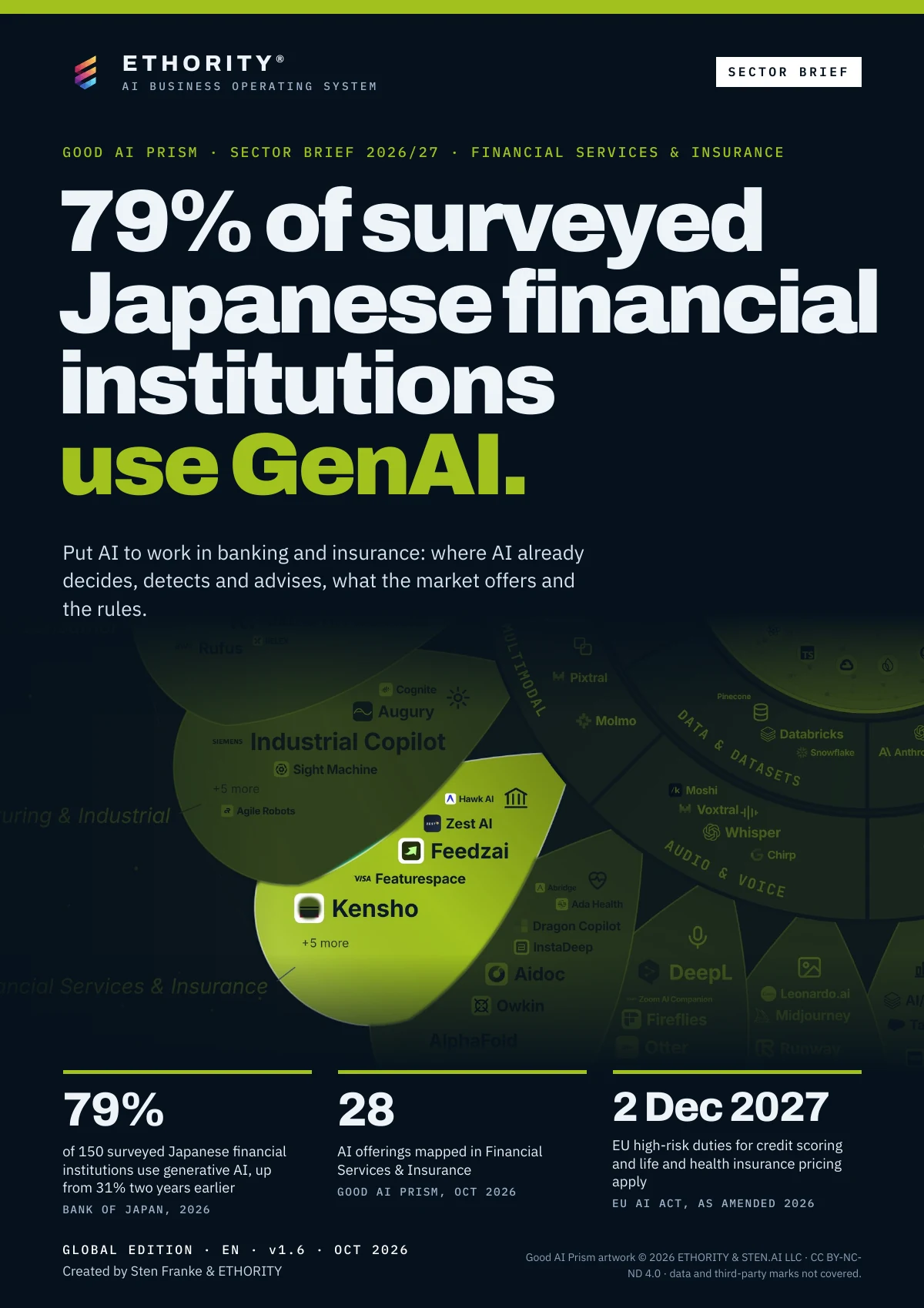
- of Japanese financial institutions use generative AI, up from 31% two years earlierBank of Japan, 2026 · boj.or.jp ↗
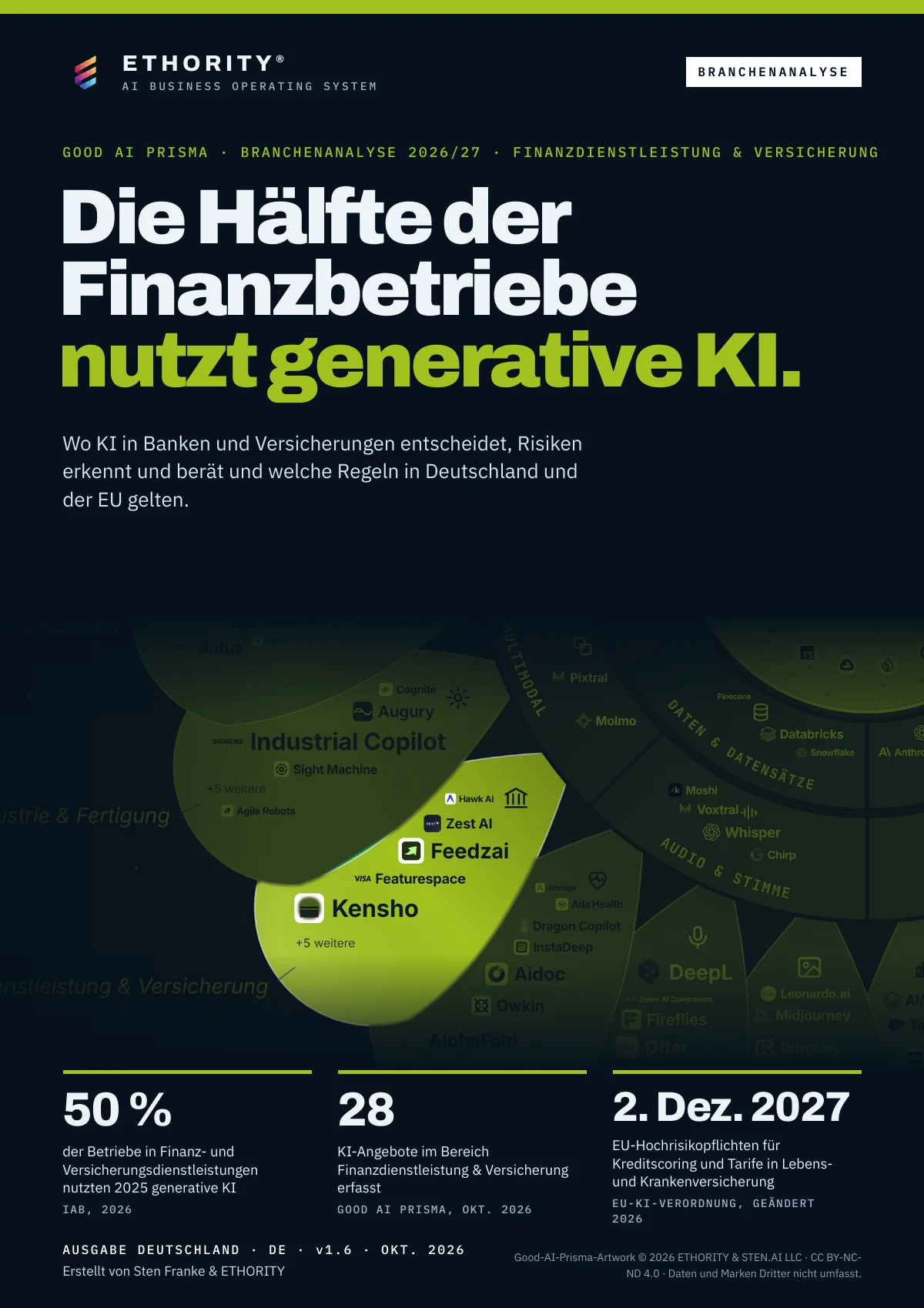
- 28
- AI offerings mapped in Financial Services & InsuranceGood AI Prism, Oct 2026
- 2 Dec 2027
- EU high-risk duties for credit scoring and life and health insurance pricing applyEU AI Act (as amended by Reg. (EU) 2026/1744) · eur-lex.europa.eu ↗
A retirement wave meets AI.
German insurers employed 215,600 people at the end of 2025, a workforce facing a wave of retirements as AI arrives.
AGV Versicherungen, Sozialstatistische Daten 2025
Fraud leads the market map.
Eight of the 28 offerings mapped fight fraud, financial crime and money laundering.
Good AI Prism 2026/27 study dataset, Oct 2026
Fraud makes the case for AI.
Fraud scams and bank fraud cost an estimated $486bn worldwide in 2023.
Nasdaq, Global Financial Crime Report, Jan 2024
What's inside
- AI moves from fraud models to generative assistants. Adoption in the UK, the EU, Germany and Japan, and where firms use AI today.
- AI changes work in finance, not yet the headcount. Workforces, hiring evidence and what customers already do with AI.
- Credit scoring and pricing: high-risk duties from Dec 2027. The EU clock from DORA to Annex III, Germany's building blocks and the rules across Europe, the Americas, Asia-Pacific and the Gulf.
- More than one in four offerings fights financial crime. The market map by job group and headquarters.
- Prove AI is accurate, fair and controlled. Seven questions before AI touches a customer decision, a workforce annex and a 90-day start.
The brief and the studies behind it
Global edition · EN
79% of surveyed Japanese financial institutions use generative AI.
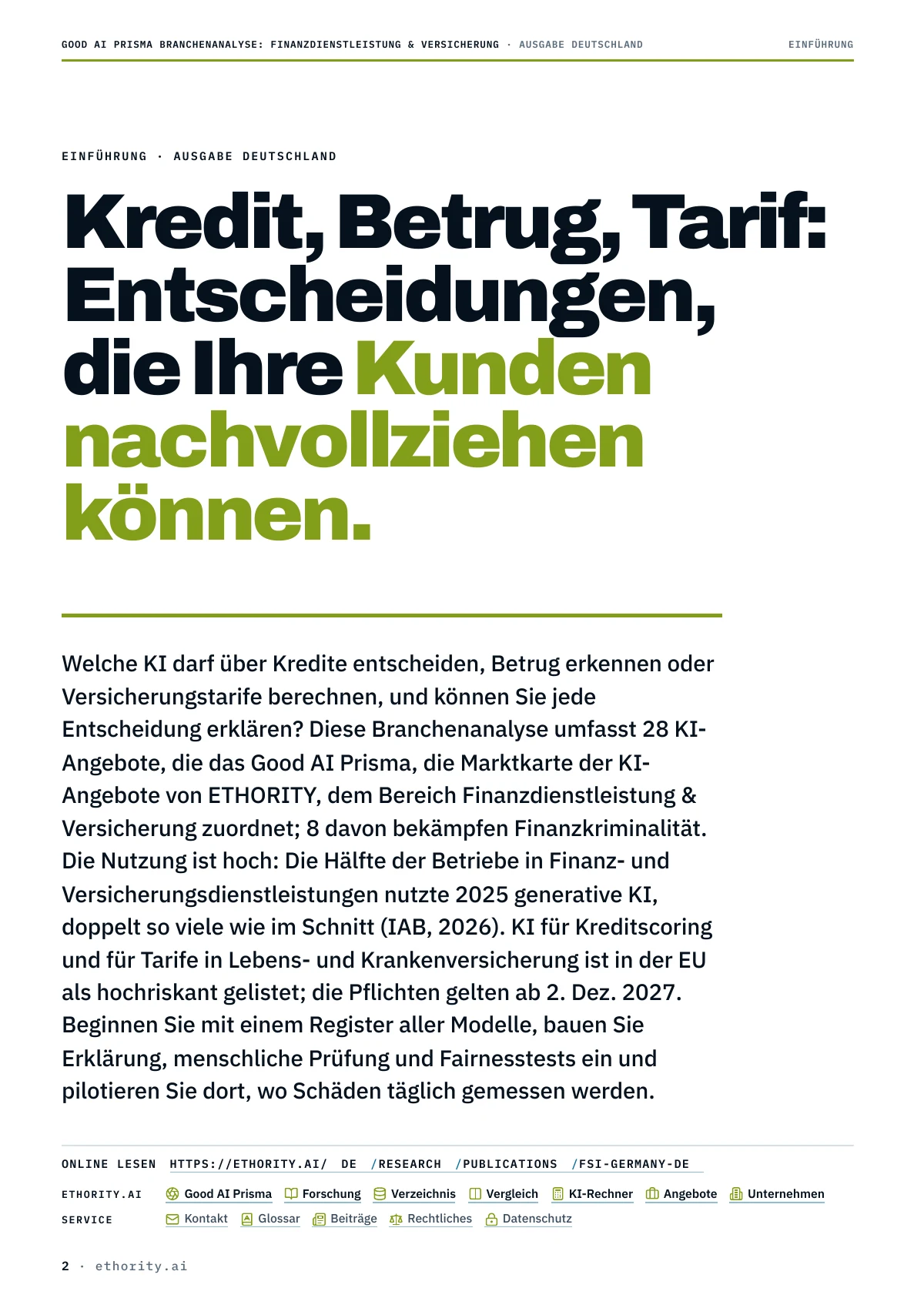
Credit, fraud, pricing: decisions your customers can understand. Where AI already decides, detects and advises in banking and insurance, and the rules.
Version 1.6 · 40 pages
Open the study →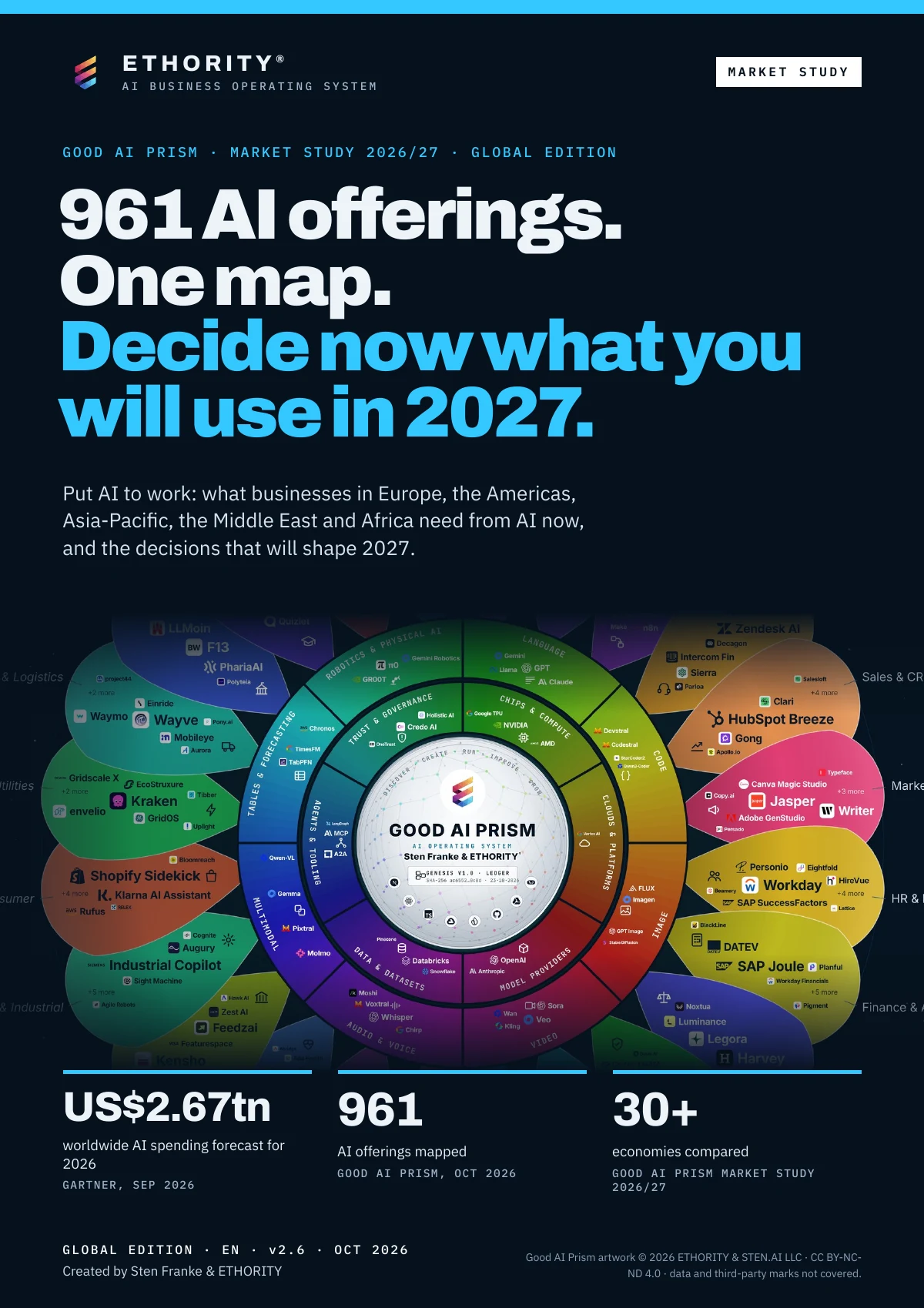
Global edition · EN
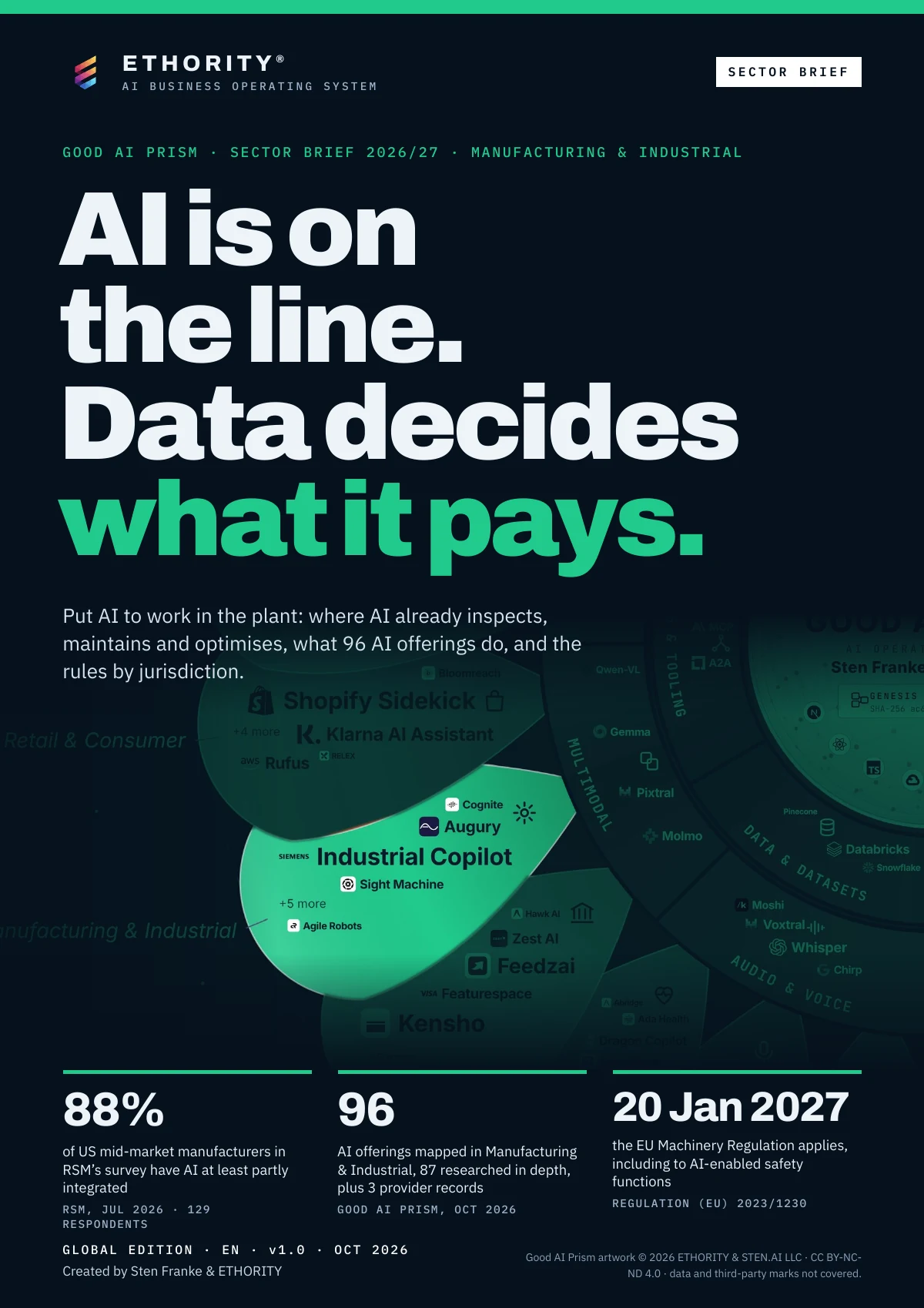
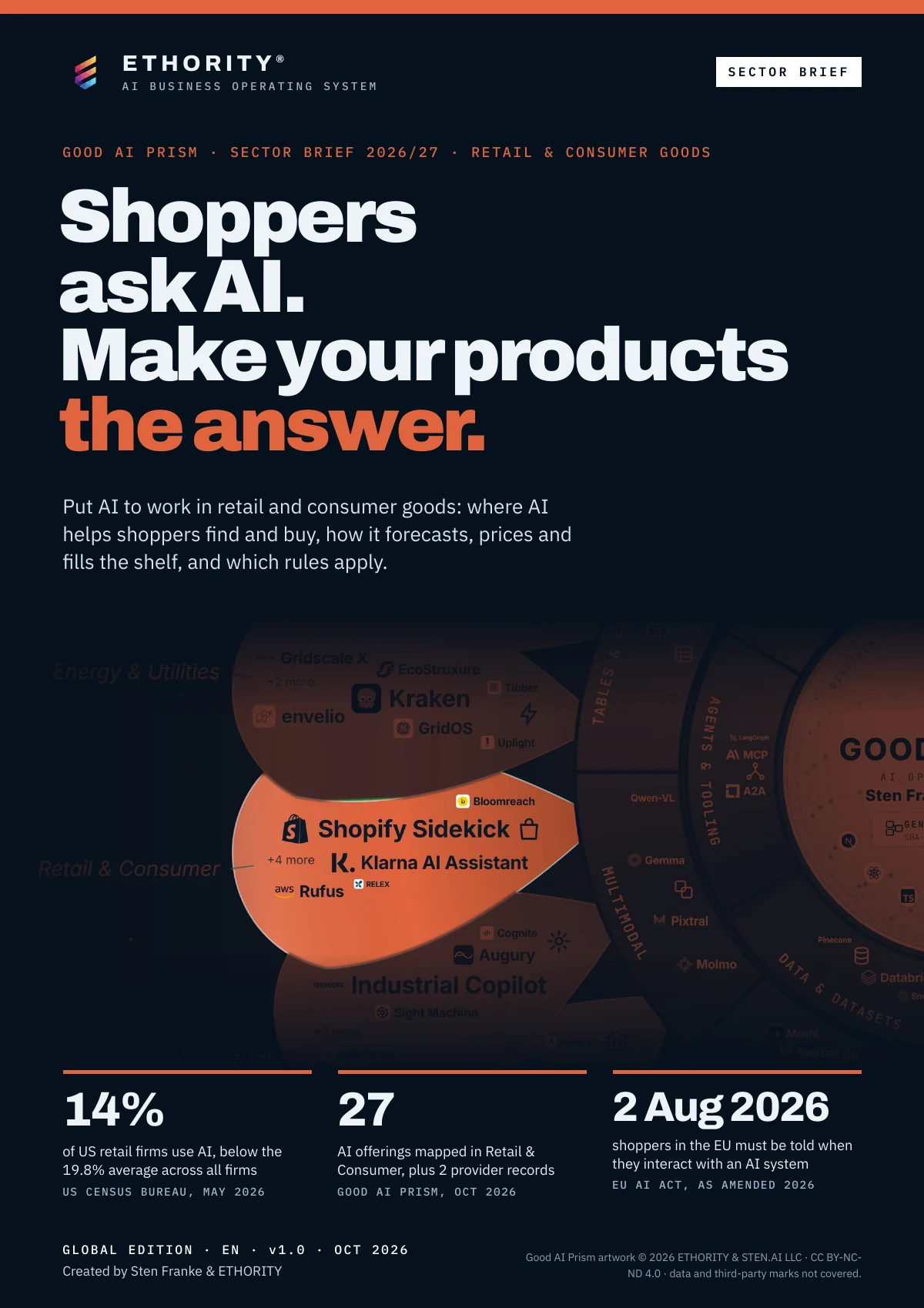
961 AI offerings. One map. Decide now what you will use in 2027.
The Good AI Prism helps you find useful AI and compare the evidence behind your options. For organisations already using AI, the question is moving from whether to use AI to which AI, how safely and whether it pays. This Global edition brings together 961 AI offerings across 24 topic areas, 8 data types and 6 technology layers, with sources, dates and limits to guide your next decision.
Version 2.6 · 90 pages
Open the study →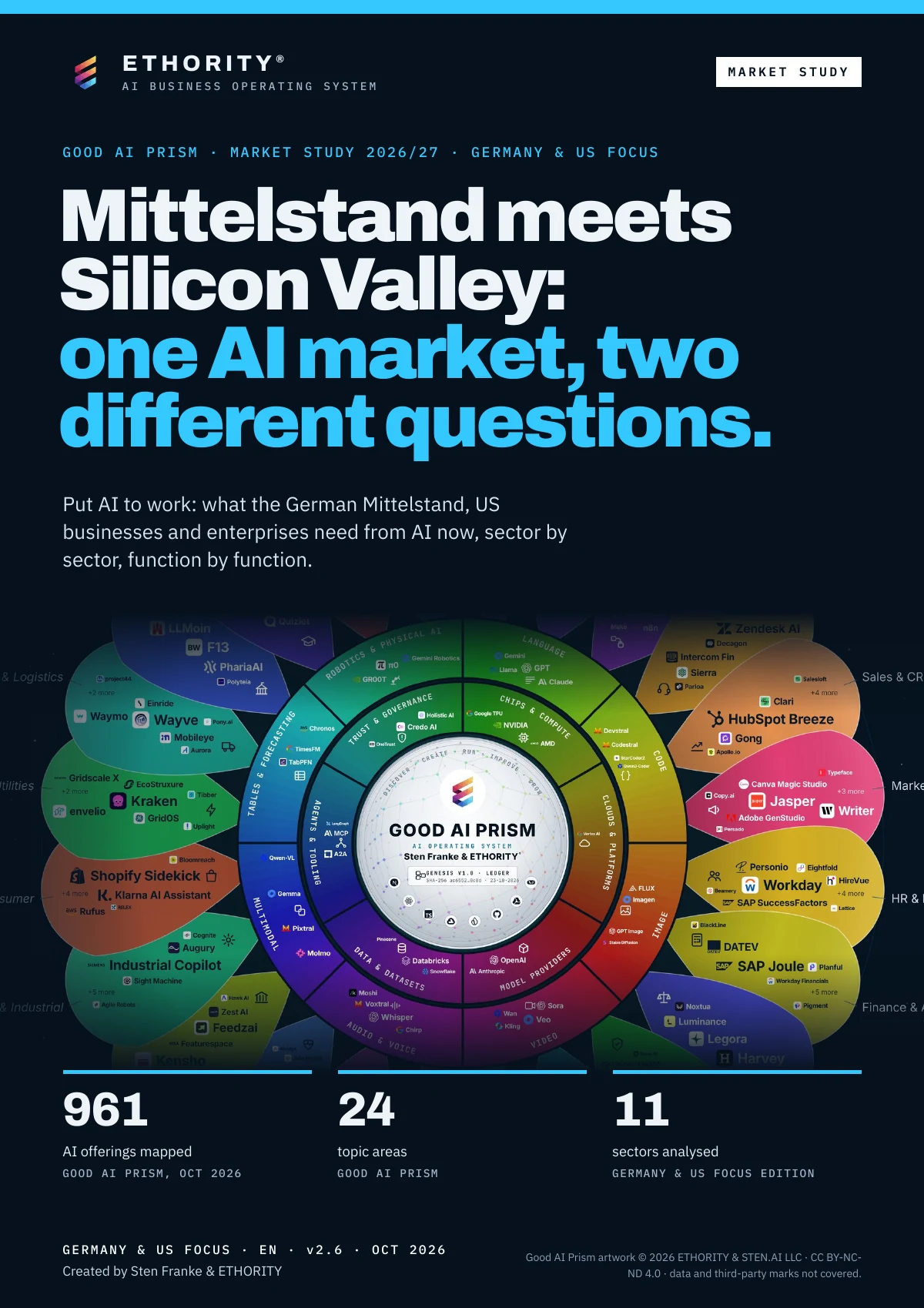
Germany & United States Focus · EN
Germany's mid-sized companies meet Silicon Valley: one AI market, two different questions.
The Mittelstand needs know-how; US firms need cost control. What German and US businesses need from AI now, sector by sector, function by function.
Version 2.6 · 72 pages
Open the study →About this brief
Who is this brief for?
For banks, savings and cooperative banks, insurers and brokers, payment and fintech companies, supervisors and associations deciding where AI belongs in fraud, credit, claims, pricing and service.
What does the Good AI Prism map?
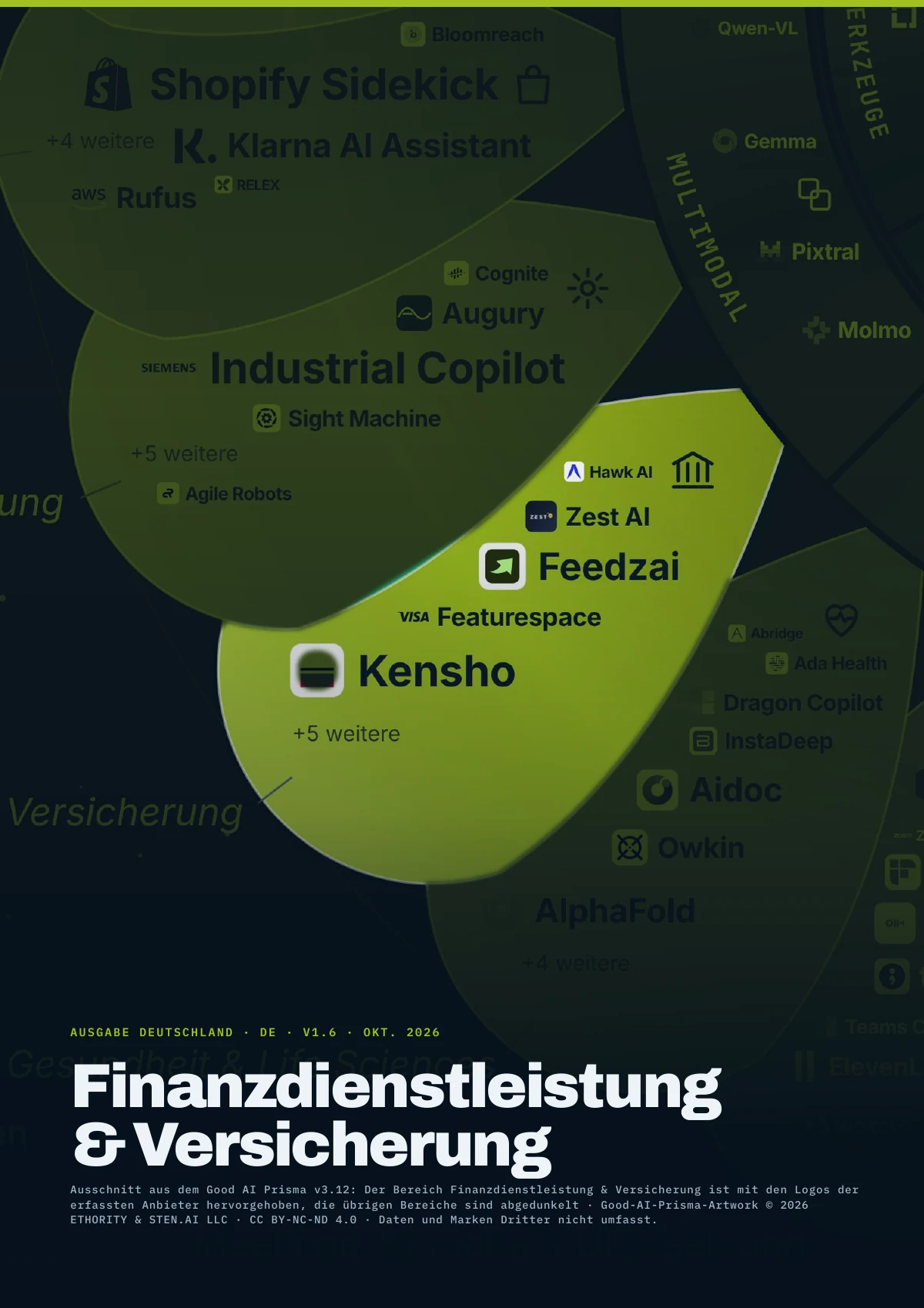
The Good AI Prism by Sten Franke & ETHORITY® maps the AI market on one wheel of 24 topic areas. In Financial Services & Insurance it places 28 offerings, each recorded with a dated source from the provider's own pages, grouped by job: fraud and financial crime, credit decisions, claims, insurance pricing, research, and banking assistants.
Which edition is this, and where are earlier ones?
This is the Global edition in English, version 1.6 of 27 Oct 2026. Editorial revision: openings, claim scope and legal wording; navigation to ethority.ai added. v1.2 of 25 Oct 2026 checked figures against primary sources (EIOPA, OCC); v1.0 appeared on 22 Oct 2026, and the imprint lists every edition since. Earlier editions remain available, and a German edition appears alongside.
How do I cite it?
ETHORITY (2026). Good AI Prism Sector Brief: Financial Services & Insurance. Global edition, v1.6, October 2026. https://ethority.ai/research/publications/fsi-global-en
ETHORITY · LONG READ
AI already runs through finance. Now it has to be provable.
From Tokyo to Frankfurt, banks and insurers use AI at scale. From 2 Dec 2027, EU high-risk duties apply to credit scoring and to life and health pricing. The brief shows what the market offers and how to prove AI is accurate, fair and controlled.
Finance already runs on AI
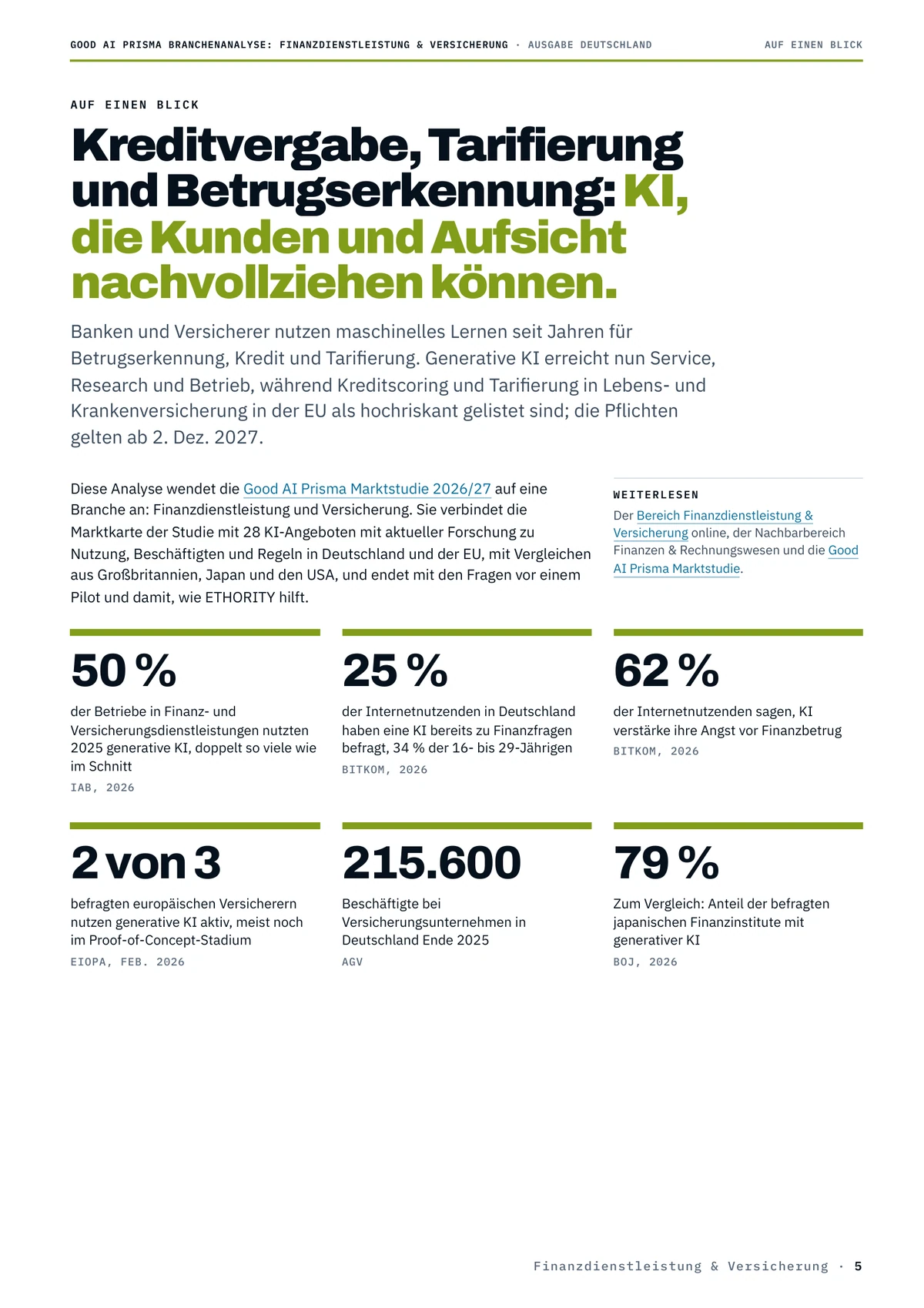
In two years, the share of Japanese financial institutions using generative AI rose from 31% to 79%, the Bank of Japan reports from a survey of 150 institutions. Three in four UK financial firms used AI in 2024, and foundation models already made up 17% of their use cases (Bank of England and FCA). Nearly two in three European insurers actively use generative AI, most still at proof-of-concept stage, across 957 reported use cases (EIOPA, 2 Feb 2026). In Germany, half of all finance and insurance establishments used generative AI in 2025, twice the average across the economy (IAB Kurzbericht 8/2026).
That is the starting point of the Good AI Prism Sector Brief: Financial Services & Insurance. The question is no longer whether banks and insurers use AI. It is whether they can prove it is accurate, fair and controlled, to supervisors, auditors and customers.
Fraud and process first, service next
Internal process optimisation (41%), cybersecurity (37%) and fraud detection (33%) lead today among UK firms, and firms expect the largest growth in customer support and compliance. The stakes are high: fraud scams and bank fraud cost an estimated $486bn worldwide in 2023 (Nasdaq Global Financial Crime Report).
Work changes before headcount does
Finance employs large, experienced workforces facing a wave of retirements; Germany's insurers alone employ 215,600 people (AGV Versicherungen). The European Central Bank finds no significant difference in hiring or firing between firms that use AI and those that do not; firms that use AI intensively are slightly more likely to hire (ECB Blog). Customers move faster than many institutions expect: a quarter of Germans have already asked an AI tool about money, a third of those aged 16 to 29, and 62% say AI raises their fear of fraud (Bitkom, Digital Finance 2026).
The rules: high-risk duties for credit scoring and pricing from Dec 2027
From 2 Dec 2027, creditworthiness assessment and credit scoring of natural persons, and risk assessment and pricing in life and health insurance, carry high-risk duties under the AI Act, with dates as amended by Regulation (EU) 2026/1744. Fraud detection is explicitly excluded. Deployers run a fundamental-rights impact assessment. Before that, DORA has applied since 17 Jan 2025 to ICT risk, incidents and third parties, and from 20 Nov 2026 the Consumer Credit Directive 2 lets consumers ask for human intervention and an explanation when credit is assessed automatically.
Supervisors elsewhere set expectations by guidance. In the US, the revised interagency model risk guidance replaced SR 11-7 in April 2026 and leaves generative and agentic AI outside its scope. 29 US jurisdictions have adopted the NAIC model bulletin on AI in insurance. Canada's OSFI Guideline E-23 covers AI models from 1 May 2027, and Singapore's MAS guidelines add board oversight, an AI inventory and lifecycle controls. Australia's regulator found governance lagging AI use at some licensees (ASIC REP 798).
What the market offers
The Good AI Prism places 28 offerings in Financial Services & Insurance. Eight fight fraud, financial crime and money laundering, among them Feedzai, Hawk AI and BioCatch. Five support credit decisions, such as Zest AI, Taktile and Provenir. Five handle claims and claims fraud, including Shift Technology and FRISS. Four price and underwrite insurance risk, such as Akur8 and Earnix. Three serve research, among them AlphaSense, and three power banking assistants and personalisation. 15 of the 28 offerings come from providers headquartered in Europe, three of them in Germany. The Financial Services & Insurance area shows every entry with its source and date.
What to do Monday
- Start an AI register: every model and AI use, including generative tools staff bring themselves, with purpose, owner and risk class.
- Mark the uses that score people or price life and health cover, and build explanation, human review and fairness testing in before 2 Dec 2027.
- Extend model risk management to language models and agents, with validation, monitoring and change control.
- Check that every AI provider sits in your DORA register of ICT third parties, with exit and incident plans.
- Pilot one fraud, claims or service use with a baseline and fairness tests, and scale only on measured losses, accuracy, handling time and customer outcomes.
Sources and further reading
- Bank of Japan, Financial System Report annex on generative AI ↗ · Aug 2026
- Bank of England and FCA, Artificial intelligence in UK financial services ↗ · 21 Nov 2024
- EIOPA, survey on generative AI in insurance ↗ · 2 Feb 2026
- IAB Kurzbericht 8/2026, generative AI in German establishments ↗ · 5 May 2026
- Nasdaq, Global Financial Crime Report ↗ · Jan 2024
- AGV Versicherungen, Sozialstatistische Daten 2025 ↗ · 2026
- ECB Blog, AI and hiring in the euro area ↗ · 4 Mar 2026
- Bitkom, Digital Finance 2026 ↗ · Aug 2026
- Regulation (EU) 2024/1689 (AI Act), Annex III 5(b), 5(c) ↗ · 2024
- Regulation (EU) 2026/1744, Digital Omnibus on AI ↗ · 2026
- Regulation (EU) 2022/2554 (DORA) ↗ · 2022
- Directive (EU) 2023/2225 (Consumer Credit Directive 2) ↗ · 2023
- OCC news release 2026-29, revised interagency model risk guidance ↗ · Apr 2026
- NAIC, AI Model Bulletin adoption map ↗ · 8 Oct 2026
- OSFI Guideline E-23, Model Risk Management ↗ · 2025
- MAS, guidelines for AI risk management ↗ · 2025
- ASIC, REP 798 ↗ · 29 Oct 2024
YOUR NEXT STEP
Discuss your question with Sten Franke.
Bring your business question or the figures you already know. ETHORITY investigates within the agreed scope; together with Sten Franke you agree the next piece of work.