 ETHORITY®
- 415 TWh
- used by data centres worldwide in 2024, rising to about 945 TWh by 2030IEA, Energy and AI · iea.org ↗
- 23
- AI offerings mapped in Energy & Utilities, plus 1 unclassified record (Tibber)Good AI Prism, Oct 2026
- 2 Dec 2027
- EU high-risk duties for AI as a safety component in electricity, gas, heat and water supply applyEU AI Act (as amended by Reg. (EU) 2026/1744) · eur-lex.europa.eu ↗
Four in five German suppliers have introduced AI.
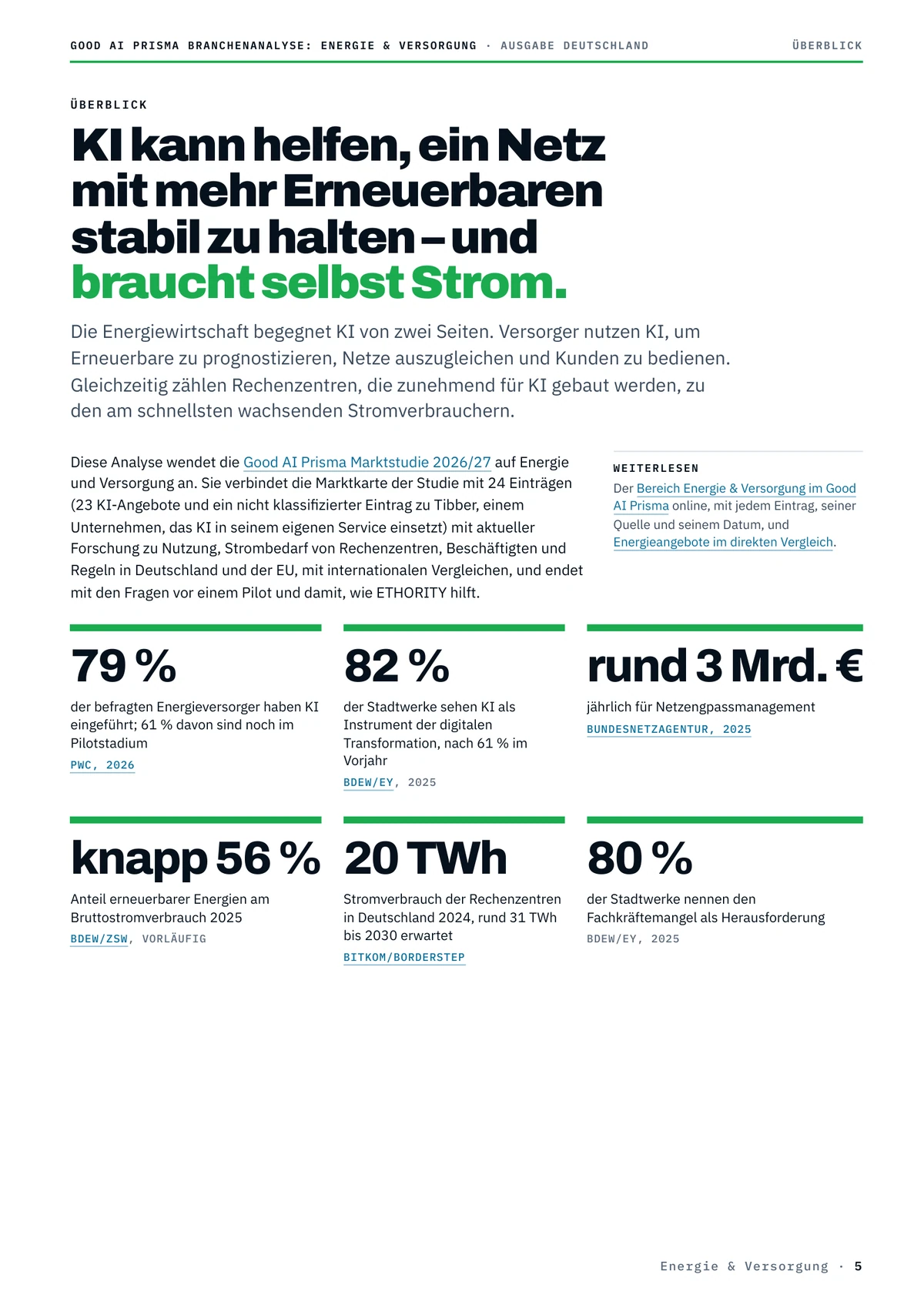
79% of German energy suppliers have introduced AI, and 61% of them are still at pilot stage.
PwC energy AI study, via ZfK, Apr 2026
Flexibility leads the market map.
Seven of the 24 mapped entries manage flexibility, demand response and customer energy.
Good AI Prism 2026/27 study dataset, Oct 2026
Most AI uses have yet to reach operations.
61% of AI uses at German energy suppliers are still pilots, so the value in operations is still ahead.
PwC energy AI study, via ZfK, Apr 2026
What's inside
- Forecasting first, the grid next. Where utilities use AI today and how many projects remain pilots.
- AI needs power, and power needs people. Data-centre electricity demand and the retiring energy workforce.
- AI as a grid safety component: high-risk duties from Dec 2027. The AI Act dates, Germany's cyber and critical-infrastructure rules, and seven jurisdictions compared.
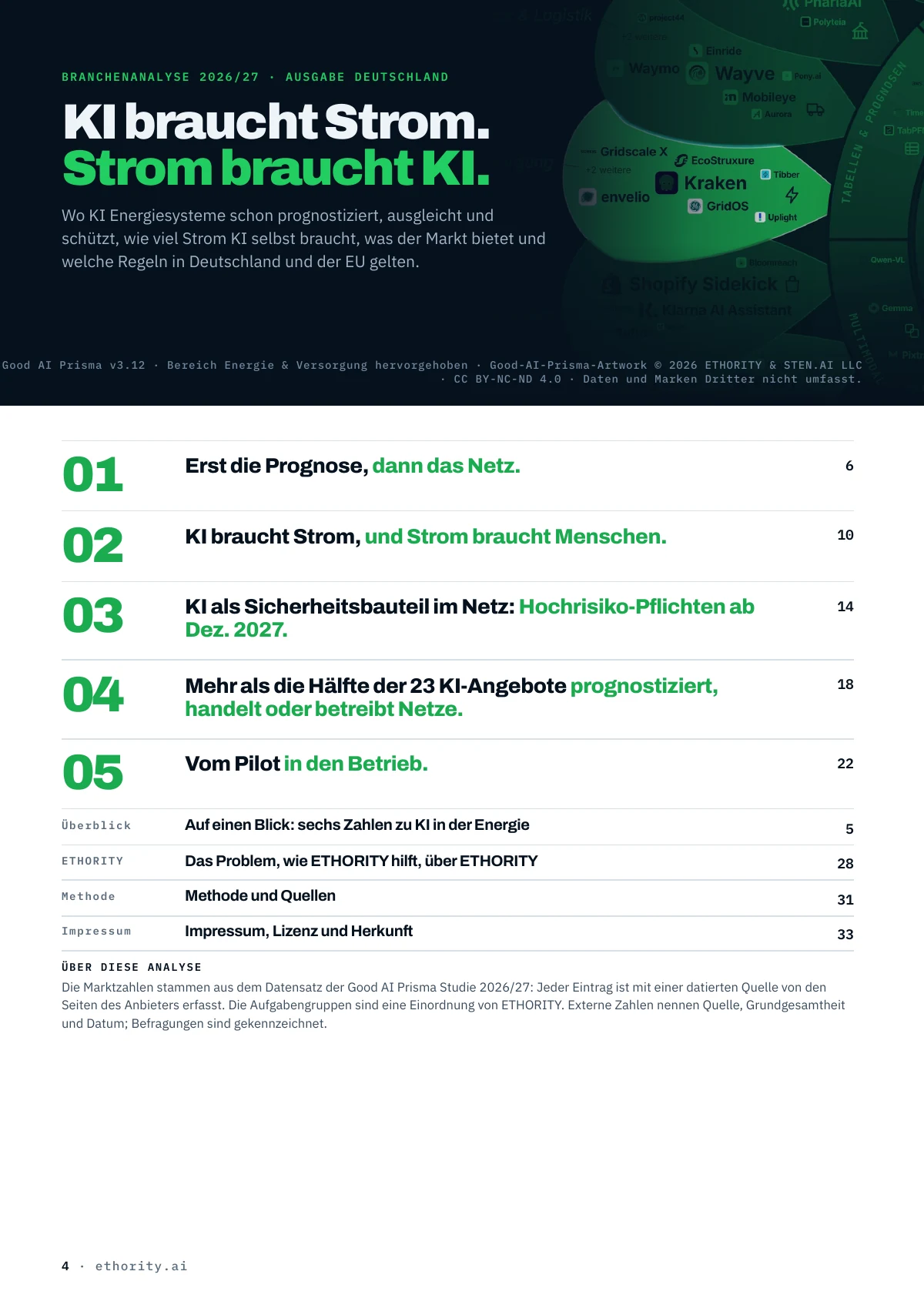
- More than half of the 23 AI offerings forecast, trade or operate grids. The market map by job group and headquarters.
- Move from pilots to operations. Seven questions before AI touches the grid, a workforce annex and a 90-day start.
The brief and the studies behind it
Global edition · EN
Data centres used 415 TWh. Make AI earn its power.
Start where AI is measured daily: forecasts and maintenance. Where AI balances and protects energy systems, and how much power it needs itself.
Version 1.4 · 40 pages
Open the study →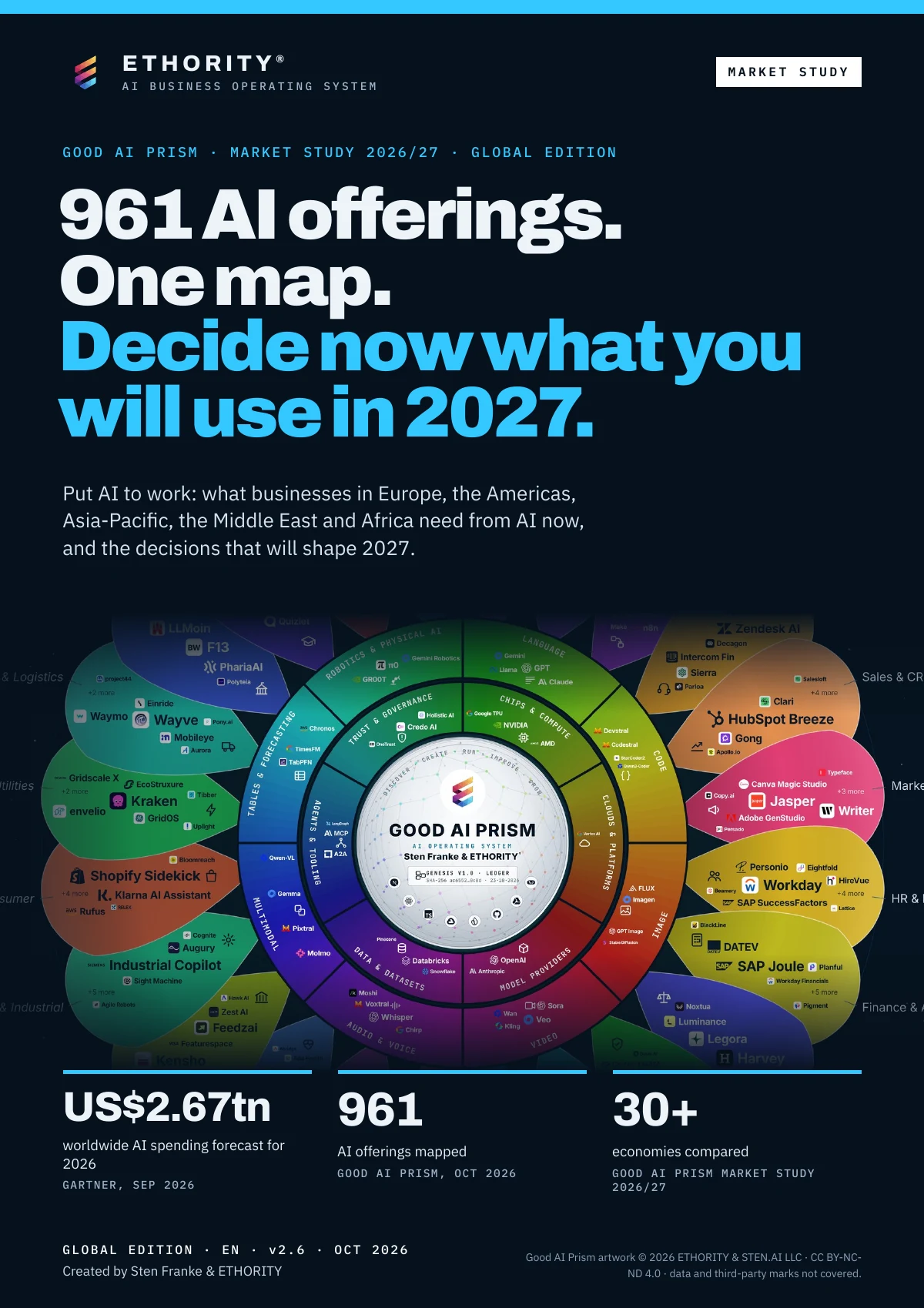
Global edition · EN
961 AI offerings. One map. Decide now what you will use in 2027.
The Good AI Prism helps you find useful AI and compare the evidence behind your options. For organisations already using AI, the question is moving from whether to use AI to which AI, how safely and whether it pays. This Global edition brings together 961 AI offerings across 24 topic areas, 8 data types and 6 technology layers, with sources, dates and limits to guide your next decision.
Version 2.6 · 90 pages
Open the study →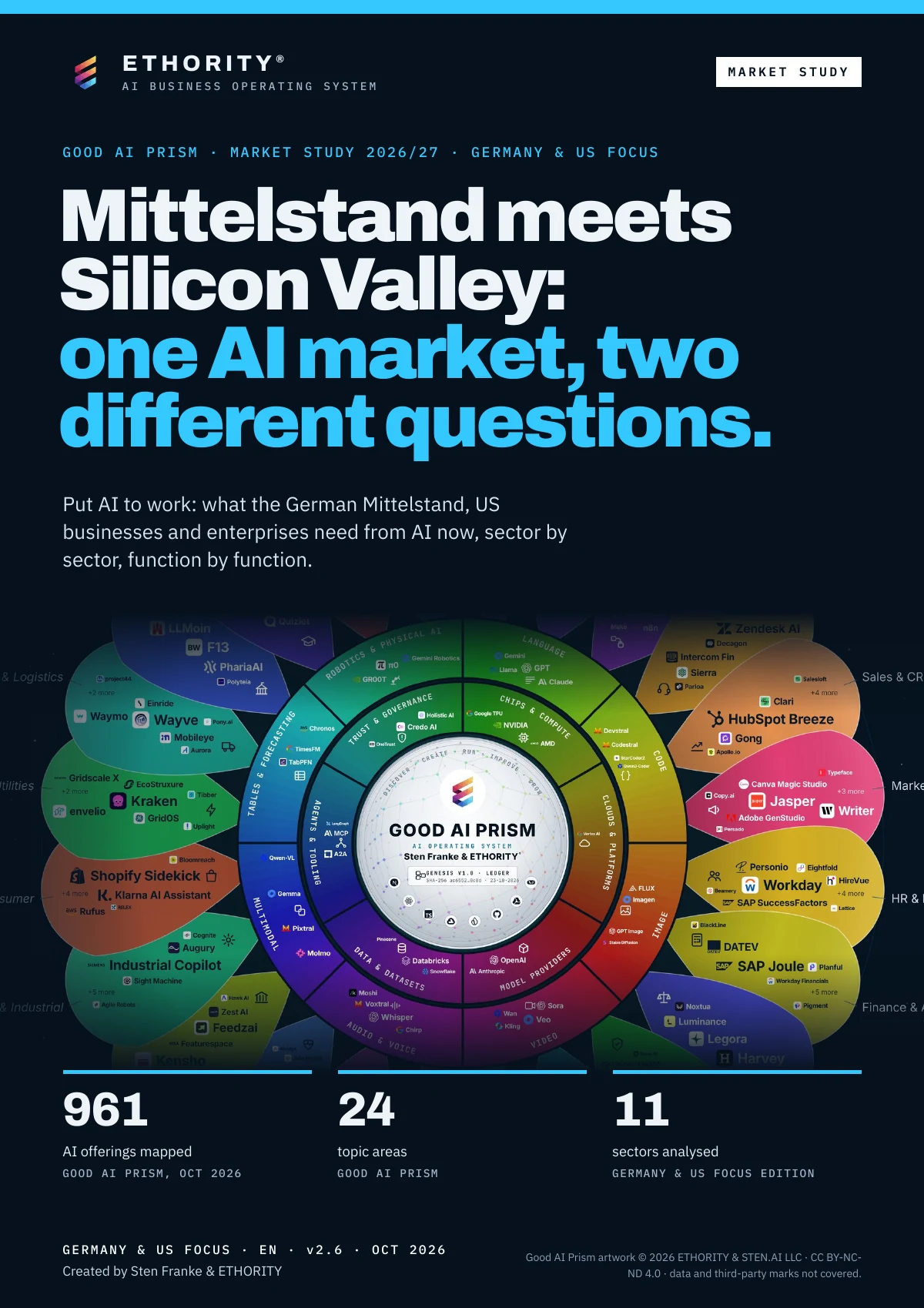
Germany & United States Focus · EN
Germany's mid-sized companies meet Silicon Valley: one AI market, two different questions.
The Mittelstand needs know-how; US firms need cost control. What German and US businesses need from AI now, sector by sector, function by function.
Version 2.6 · 72 pages
Open the study →About this brief
Who is this brief for?
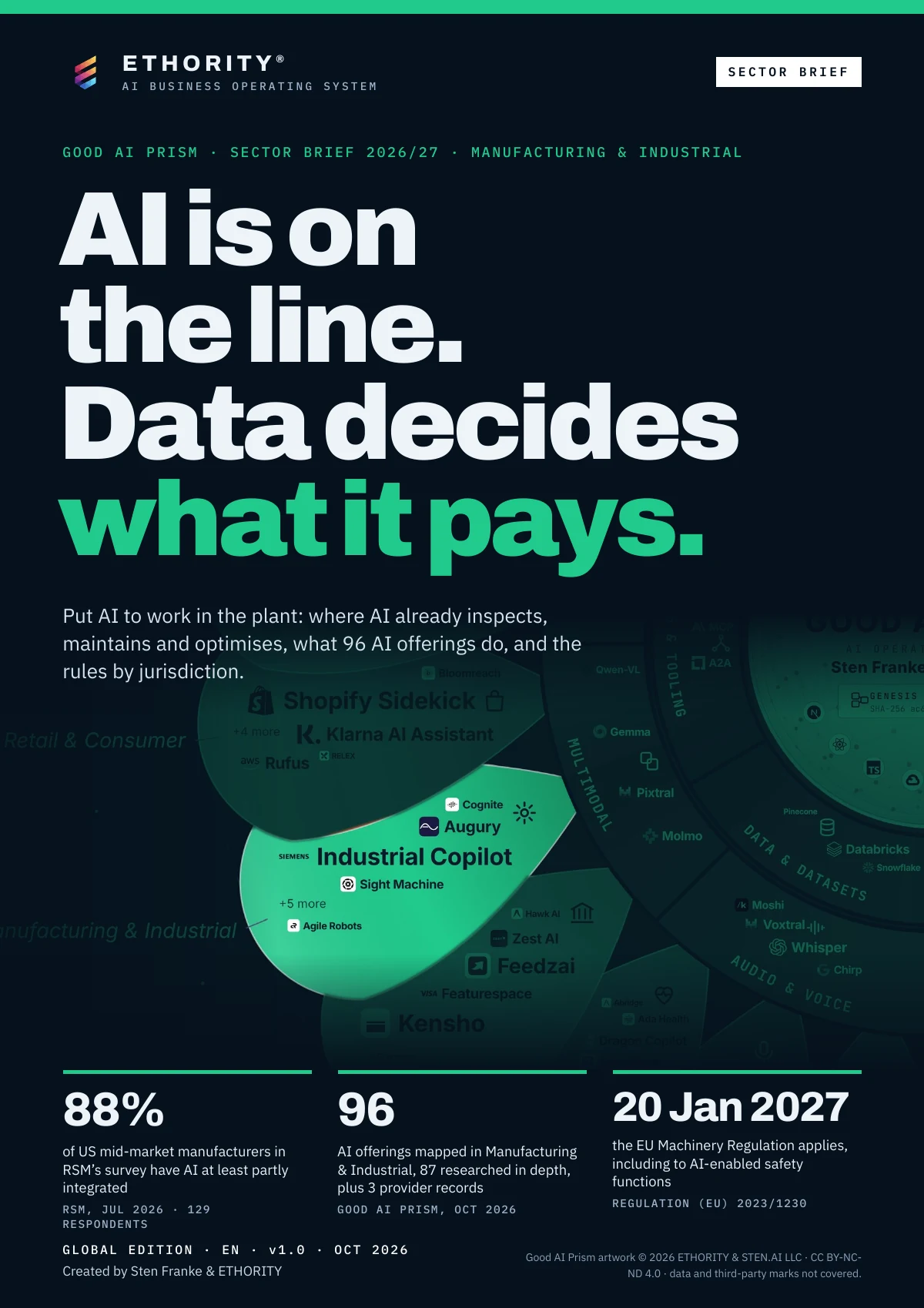
For grid operators, municipal utilities, energy suppliers, renewable operators, data-centre operators, regulators and associations deciding where AI belongs in forecasting, grid operation, trading and customer service.
What does the Good AI Prism map?
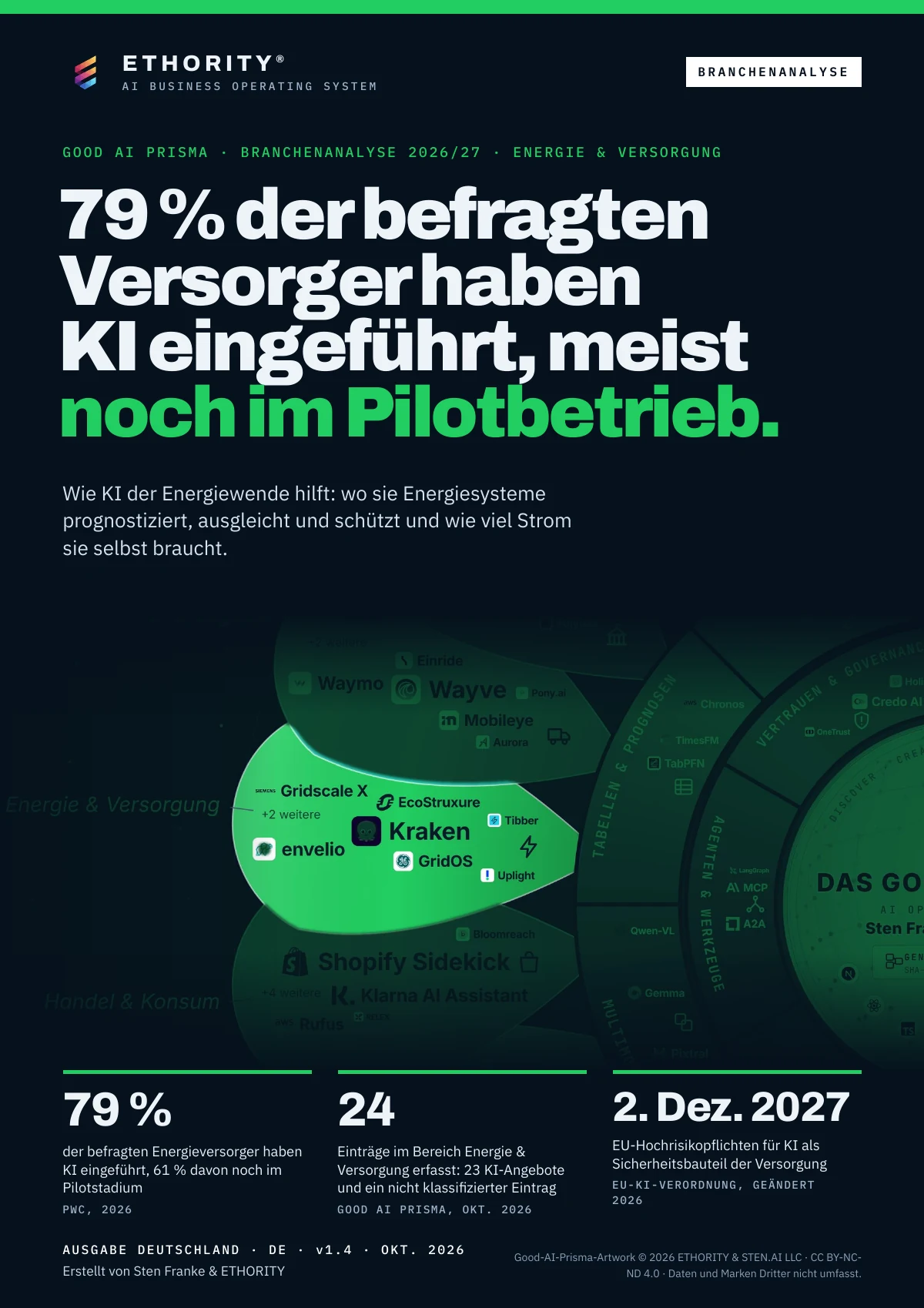
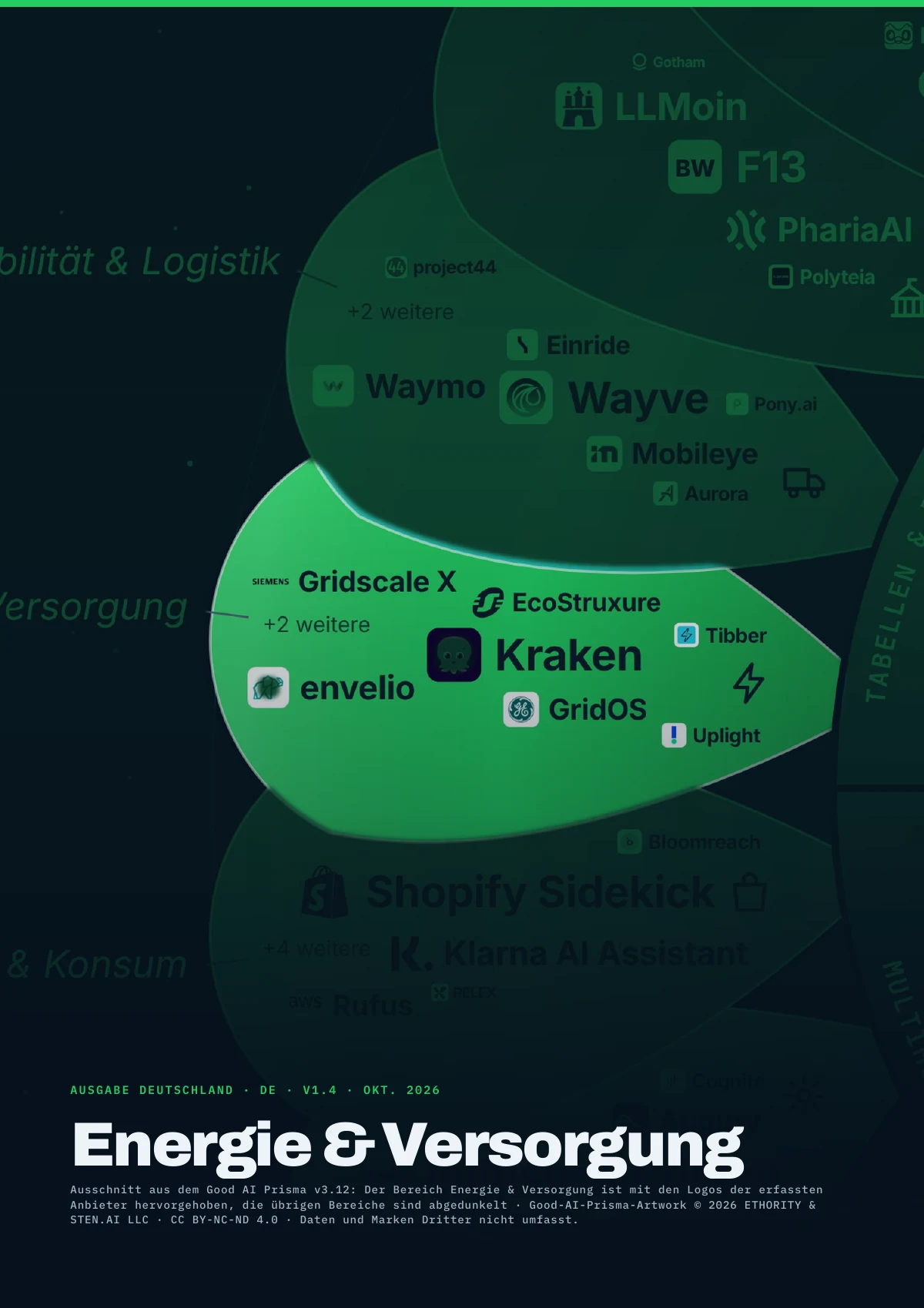
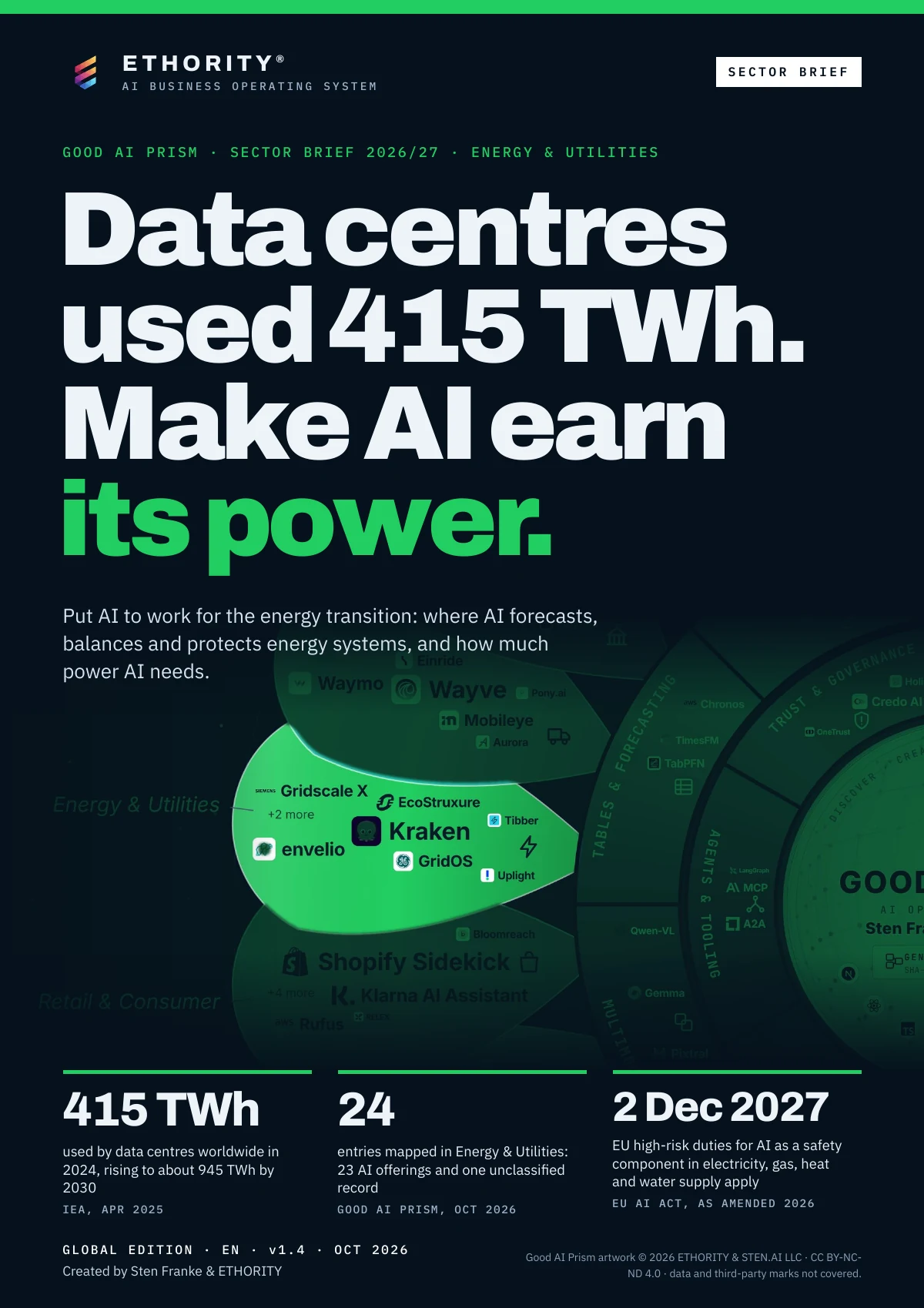
The Good AI Prism by Sten Franke & ETHORITY® maps the AI market on one wheel of 24 topic areas. In Energy & Utilities it places 24 entries, 23 AI offerings and one unclassified record, each recorded with a dated source from the provider's own pages, grouped by job: flexibility and customer energy, forecasting and trading, grid planning and operation, building and industrial efficiency, and renewable asset performance.
Which edition is this, and where are earlier ones?
This is the Global edition in English, version 1.4 of 27 Oct 2026. Editorial revision: openings, claim scope and legal wording; navigation to ethority.ai added. v1.0 appeared on 22 Oct 2026, and the imprint lists every edition since. Earlier editions remain available, and a German edition for Germany appears alongside.
How do I cite it?
ETHORITY (2026). Good AI Prism Sector Brief: Energy & Utilities. Global edition, v1.4, October 2026. https://ethority.ai/research/publications/energy-global-en
ETHORITY · LONG READ
AI can cut outages by 30–50%. In Germany, 61% of it is still a pilot.
Energy meets AI from two sides: as a tool to forecast, balance and protect the grid, and as a fast-growing load. The Energy & Utilities brief shows where AI pays, what the market offers and which rules apply from 2 Dec 2027.
Most energy AI is still a pilot
In Germany, 79% of energy suppliers have introduced AI, but 61% of those uses are still at pilot stage, according to PwC's energy AI study. That gap is the central finding of the Good AI Prism Sector Brief: Energy & Utilities. The value sits in operations, and most of the AI has not reached them yet.
The upside is large where AI is deployed well. The IEA's Energy and AI report finds 30–50% shorter outages with AI-based fault detection, up to 175 GW of additional transmission capacity without new lines, and incidents detected 500 times faster with satellites and sensors. Utilities use AI most for demand forecasting (62%), predictive maintenance and asset monitoring (53%) and customer service (48%), L.E.K. reports from a survey of more than 300 energy executives.
AI needs power, and power needs people
Energy meets AI from two sides. Data centres used 415 TWh in 2024, about 1.5% of world electricity, and the IEA projects about 945 TWh by 2030; their use grew 17% in 2025. In Ireland, data centres took 23% of metered electricity in 2025 (CSO). German data centres used about 20 TWh in 2024, with about 31 TWh expected by 2030 (Bitkom and Borderstep).
The workforce is the second bottleneck. 76 million people work in energy, but in advanced economies 2.4 workers near retirement for every new entrant under 25, and more than half of organisations report critical hiring bottlenecks (IEA, 2025). In Germany, 80% of municipal utilities name the skills shortage as a challenge, while 82% now see AI as an instrument of their digital transformation, up from 61% a year earlier (BDEW and EY).
The grid bottleneck has a price
Germany spends about €3bn a year on grid congestion management (Bundesnetzagentur, 2025). In the US, only 13% of grid connection requests filed between 2000 and 2019 reached operation (LBNL). Forecasting, congestion management and fault detection are where AI can show its value in the numbers a grid operator already tracks.
The rules: high-risk duties for safety components from Dec 2027
From 2 Dec 2027, AI used as a safety component in managing and operating the supply of electricity, gas, heat or water carries high-risk duties under Annex III of the AI Act, with dates as amended by Regulation (EU) 2026/1744. Systems that only assist or optimise are not automatically safety components. Data centres from 500 kW already report energy and sustainability indicators each year under EU energy-efficiency rules.
Germany adds cybersecurity and resilience duties: the NIS2 implementation act, the KRITIS umbrella act and the smart-meter rollout, where the Bundesnetzagentur opened proceedings against 77 operators in March 2026. In the UK, Ofgem set expectations on governance, explainability and human oversight; in Texas, Senate Bill 6 lets large loads of 75 MW or more be curtailed in emergencies.
What the market offers
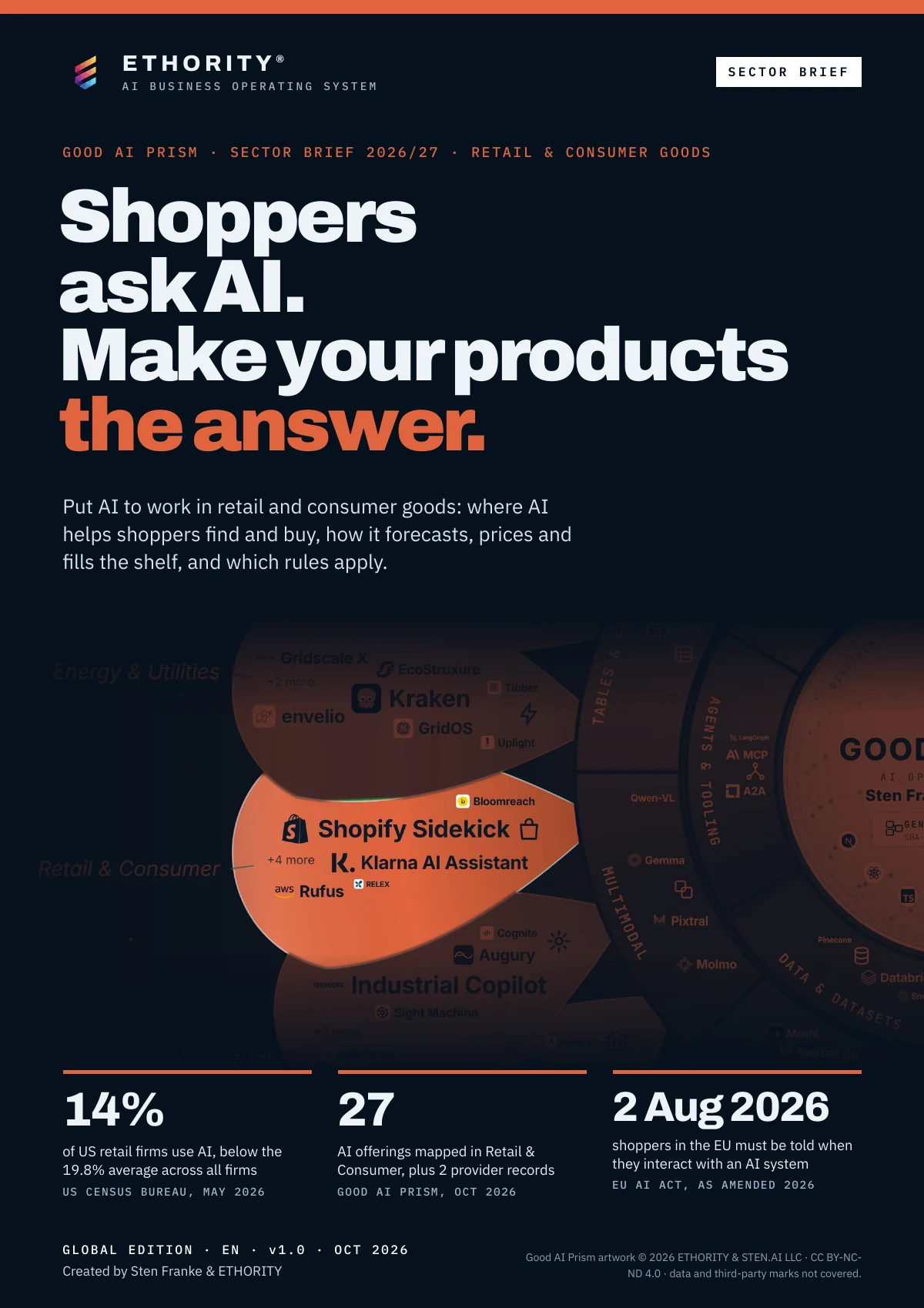
The Good AI Prism places 24 entries in Energy & Utilities: 23 AI offerings and one unclassified record (Tibber). Seven manage flexibility, demand response and customer energy, among them Kraken, Tibber and Sympower. Six forecast renewables and trade energy, such as enercast and Volue. Six plan and operate grids, including envelio, GridOS and Gridscale X. Three optimise buildings and industrial energy use, such as BrainBox AI and EcoStruxure, and two monitor renewable assets. 14 of the 24 entries come from providers headquartered in Europe, five of them in Germany. The Energy & Utilities area shows every entry with its source and date.
What to do Monday
- List every AI use and model, from forecasting to customer service, including tools staff bring themselves.
- Mark the uses that act as safety components in supply and map all uses to AI, cyber and critical-infrastructure rules.
- Bring in operations, IT/OT security, data protection and the works council before the pilot, not after.
- Name accountable operators with override rights and document AI literacy measures.
- Run one forecasting, maintenance or flexibility pilot with a baseline, and scale only on measured forecast error, congestion cost, outage minutes and customer outcomes.
Sources and further reading
- PwC energy AI study, via ZfK ↗ · 13 Apr 2026
- IEA, Energy and AI ↗ · Apr 2025; data-centre update 16 Apr 2026
- L.E.K. Consulting, 2025 Global Energy Study (survey) ↗ · 27 Feb 2026
- CSO Ireland, Data centres metered electricity consumption 2025 ↗ · 2026
- Bitkom and Borderstep, data centres in Germany ↗ · 21 Nov 2024
- IEA, World Energy Employment 2025 ↗ · 2025
- BDEW and EY, Stadtwerkestudie 2025 ↗ · Jun 2025
- Bundesnetzagentur, congestion management 2025 (via BWE) ↗ · 21 Apr 2026
- LBNL, Queued Up 2025 Edition ↗ · Dec 2025
- Regulation (EU) 2024/1689 (AI Act), Annex III point 2 ↗ · 2024
- Regulation (EU) 2026/1744, Digital Omnibus on AI ↗ · 2026
- Delegated Regulation (EU) 2024/1364, data-centre reporting ↗ · 2026
- NIS2 implementation act (NIS2UmsuCG) ↗ · Dec 2025
- KRITIS umbrella act ↗ · 9 Mar 2026
- Bundesnetzagentur, smart-meter proceedings ↗ · 27 Mar 2026
- Ofgem, Ethical AI use in the energy sector v2 ↗ · May 2026
- Texas Senate Bill 6 ↗ · 2025
YOUR NEXT STEP
Discuss your question with Sten Franke.
Bring your business question or the figures you already know. ETHORITY investigates within the agreed scope; together with Sten Franke you agree the next piece of work.