 ETHORITY®
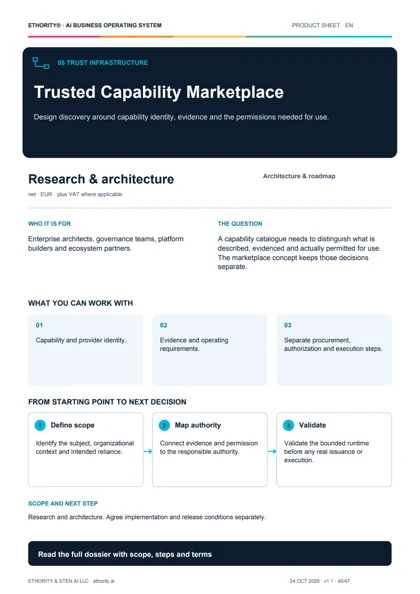
Trusted Capability Marketplace
Fee configured to agreed scope
Capability and provider identity.
Discover a capability without confusing discovery with authorization.
Trust Infrastructure
Discover a capability without confusing discovery with authorization.
Research & architecture
Architecture & roadmap
Enterprise architects, governance teams, platform builders and ecosystem partners.
A capability catalogue needs to distinguish what is described, evidenced and actually permitted for use. The marketplace concept keeps those decisions separate.
The Trust Infrastructure roadmap connects bounded evidence and cross-party authority. Profiles, passports, handshakes and network participation have distinct roles. The Handshake demonstrates a simulation; an architecture engagement can define the requirements for a particular use.
Identify the subject, organizational context and intended reliance.
Connect evidence and permission to the responsible authority.
Validate the bounded runtime before any real issuance or execution.
Name the capability need, buyer context and allowed operating boundary.
Bring the decision you need to make and your intended use. Agree the relevant users, product or organisation boundary, permitted evidence and acceptance conditions. Any service or subscription begins on its agreed start date.
A discovery architecture; no marketplace transaction or execution is activated.
Architecture and roadmap · Trust Handshake simulation. Live credential issuance, payments and cross-party execution are outside the demonstration.
Fee configured to agreed scope
Capability and provider identity.
Discover a capability without confusing discovery with authorization.
Fee configured to agreed scope
Subject identity and intended use.
Give a trust claim its subject and boundary.
Fee configured to agreed scope
Subject and scope reference.
Carry context with the evidence.
Fee configured to agreed scope
Participant identity and organizational context.
Establish the conditions before systems cooperate.
Fee configured to agreed scope
Participant and relationship model.
Connect participants without erasing responsibility.
Fee configured to agreed scope
Identity-bound authorization scope.
Make an agent’s permission narrower than its capability.
Fee configured to agreed scope
A connected purpose-to-operation architecture.
Connect business purpose, evidence and controlled operation.
Architecture and research. Describe the use and evidence question before agreeing any implementation work.
CTR-I owns identity; Verification determines verification; Registry publishes; TrustScore and AI3M retain their own authorities.
No. This is architecture and research; the responsible runtime and a separate release are required.
Name the capability need, buyer context and allowed operating boundary. Bring any procurement, confidentiality, language and accessibility requirements to the scoping conversation. Record the agreed deliverables and responsibilities in the order.
Name the capability need, buyer context and allowed operating boundary.