 ETHORITY®
Global edition · EN
Health AI goes clinical.
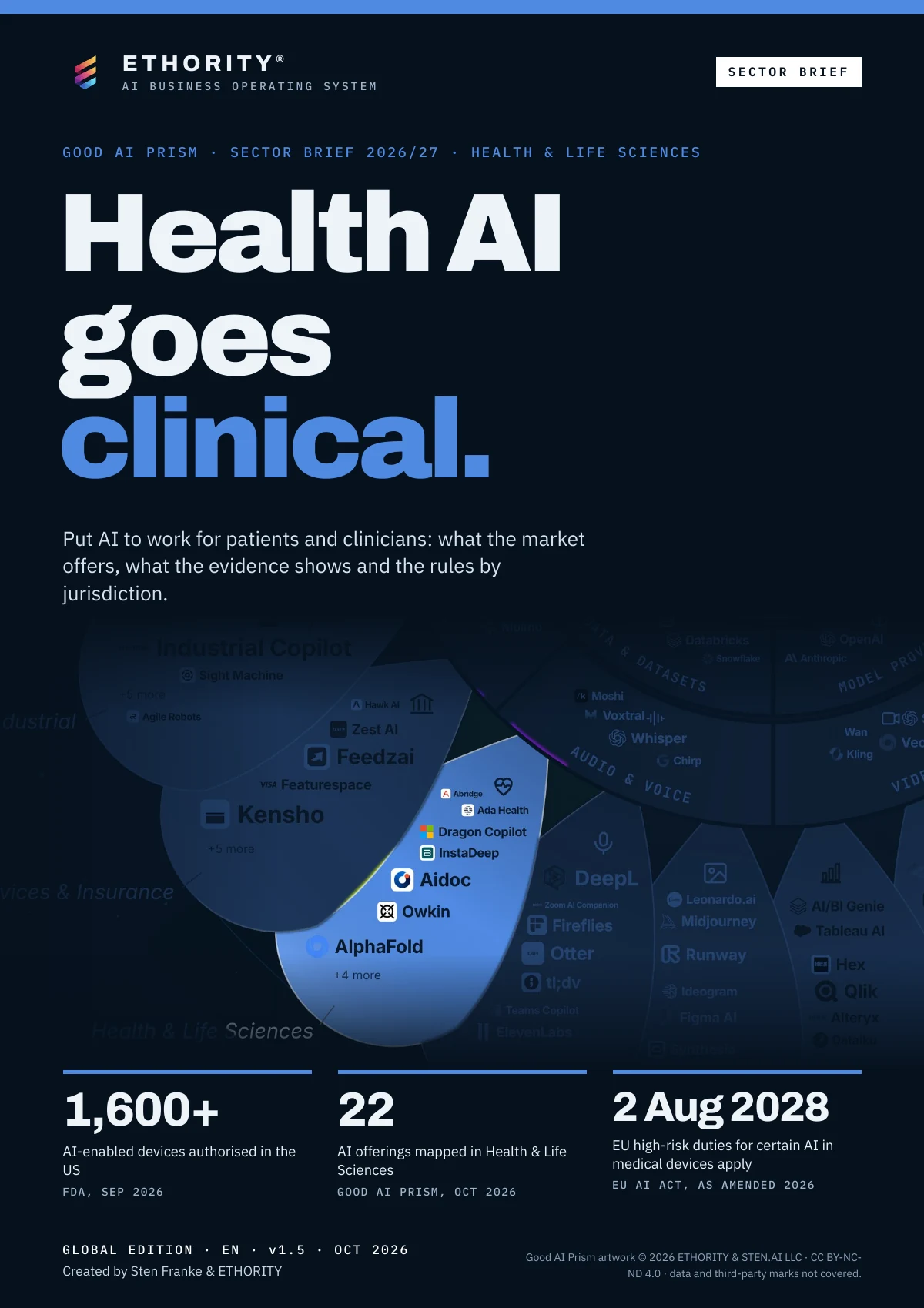
More than 1,600 AI-enabled devices are authorised in the US. What the market offers patients and clinicians, what the evidence shows and the rules by jurisdiction.
Version 1.5 · 40 pages
Open the study →Germany · DE
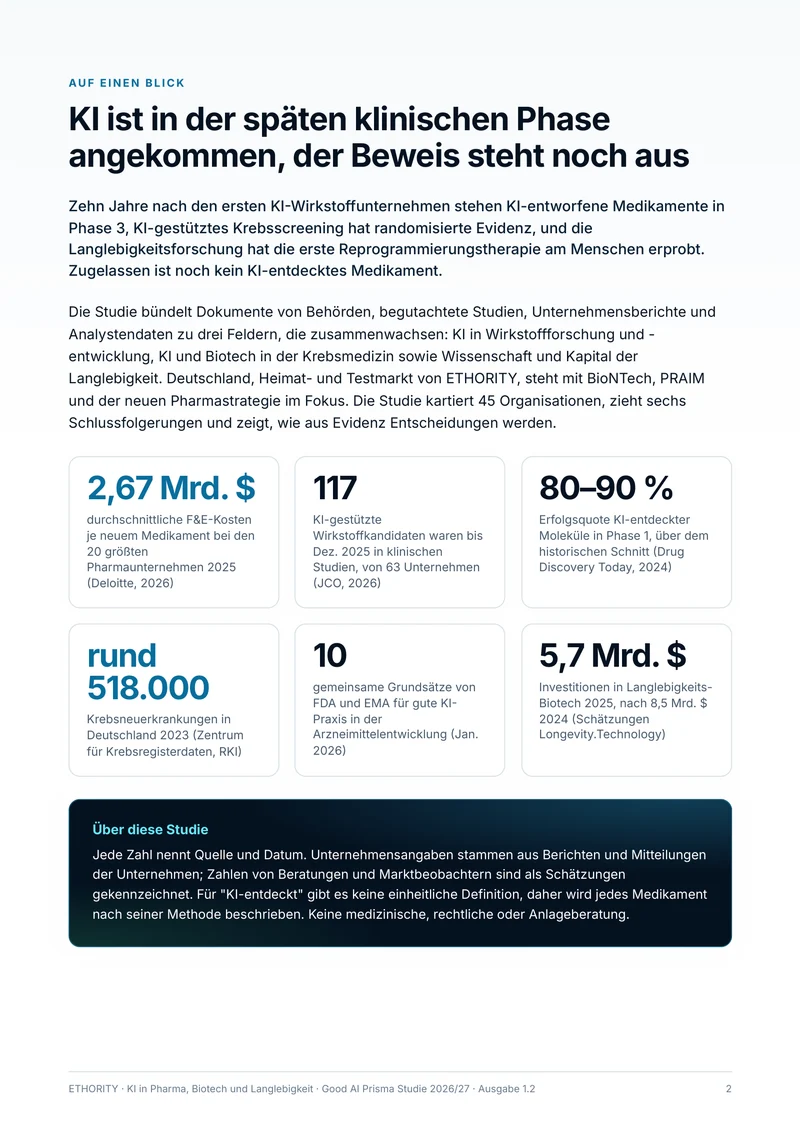
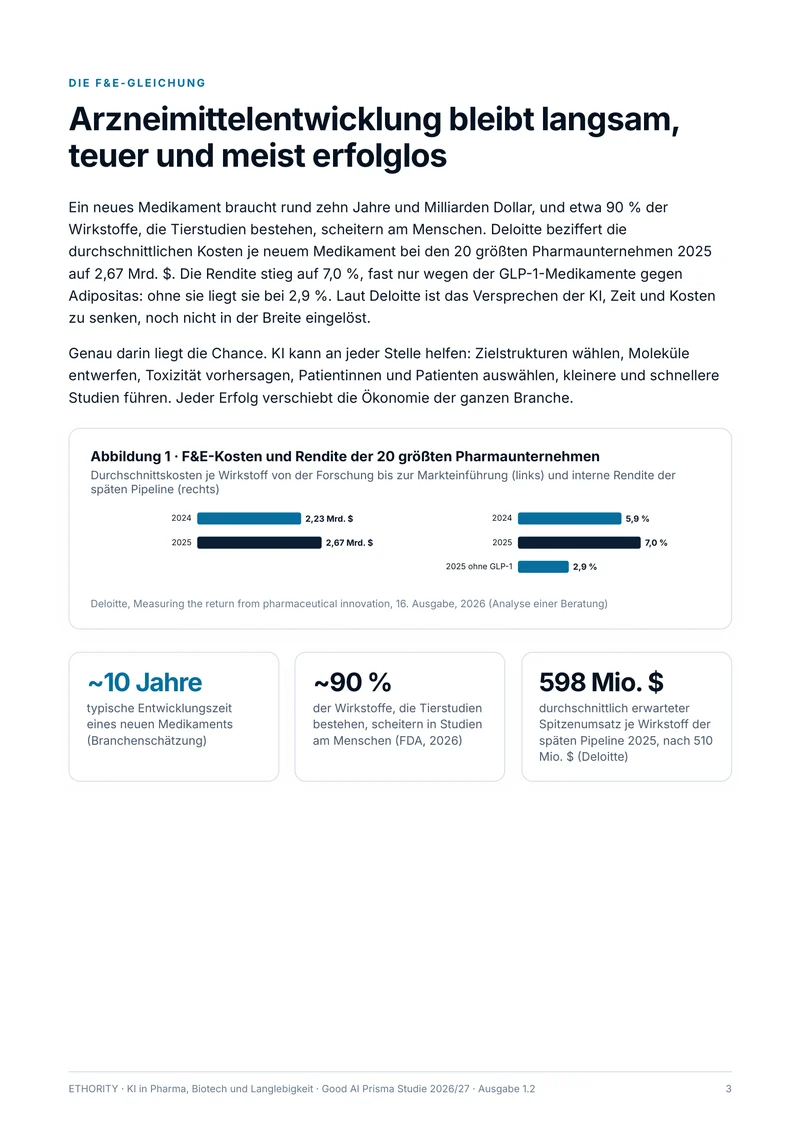
Separate scientific progress, clinical evidence and commercial questions in drug discovery, cancer and longevity.
v1.2 · 19 pages · 22 Oct 2026 · Edition
Research populations and source dates are specific to this edition. They are distinct from the live market catalogue.

pharma-germany-de.pdf · Edition 1.2
Research populations and source dates are specific to this edition. They are distinct from the live market catalogue.
Research method and catalogue coverage →EXECUTIVE SUMMARY
Drug discovery, cancer research and longevity bring different opportunities and different standards of proof. This study places them alongside one another without treating progress in one field as evidence for another. For a research or business team, the first decision is where a proposed AI application enters the work: target selection, molecular design, evidence analysis, a clinical workflow or an operational process. Define that use before comparing organisations. The selected edition provides a map of developments and sources; it is not a recommendation to invest in a company or adopt a treatment.
A promising computational result must pass through further tests before it establishes a useful intervention. Model performance, laboratory validation, clinical development and regulatory decisions are separate stages. The study discusses research methods and development programmes within those stages. Read terms such as AI-designed or computationally designed in their stated context; they do not describe one uniform method. Ask which part of the work used AI, what was compared and what changed. The practical bottleneck may lie in data access, experiments or evaluation rather than generating another candidate.
Regulator documents, peer-reviewed research, company releases and market estimates support different kinds of statement. The study identifies those sources so readers can distinguish observed results from reported plans and commercial interpretation. Inspect trial design, sample size, endpoints and the comparator before interpreting a clinical finding. An early-stage signal is not an approved indication. Likewise, an estimated market or investment total does not establish efficacy. Follow the original source from the page that interests you, and retain its observation date when discussing the result with colleagues.
For an organisation considering a tool, connect the scientific question with the operational case. Include data rights, reproducibility, integration, expert review and the cost of validation. Specify what an acceptable output would be and who is qualified to assess it. A faster intermediate step creates potential capacity; it does not on its own demonstrate a shorter development programme, a better patient outcome or a financial return. Define a baseline and a bounded test that can reveal whether the application improves the relevant work under your conditions.
Use the Health & Life Sciences area to investigate relevant offerings, then read their specific profiles and sources. Keep research initiatives, software services and clinical products distinct. Prepare provider questions about intended use, deployment, data and evidence before arranging a demonstration. A Decision Brief can organise the available alternatives around a defined business question; a further engagement needs agreed scope and expert responsibilities. This study supports research and business orientation. Medical, investment and legal decisions require their own qualified evaluation and the applicable permissions. For a first trial, specify the input dataset, access rights, evaluation method and expected output before processing begins. Retain enough information to reproduce the comparison and understand failed cases. Agree who reviews the scientific interpretation and who owns the operational decision. A successful demonstration should lead to a documented evaluation of the intended workflow, rather than an assumed endorsement of every use of the underlying model.
Source: selected study v1.2 · DE. This editorial reading guide preserves the source edition’s scope; practical next steps are recommendations, not observed outcomes. Read the source overview ↗
Global edition · EN
More than 1,600 AI-enabled devices are authorised in the US. What the market offers patients and clinicians, what the evidence shows and the rules by jurisdiction.
Version 1.5 · 40 pages
Open the study →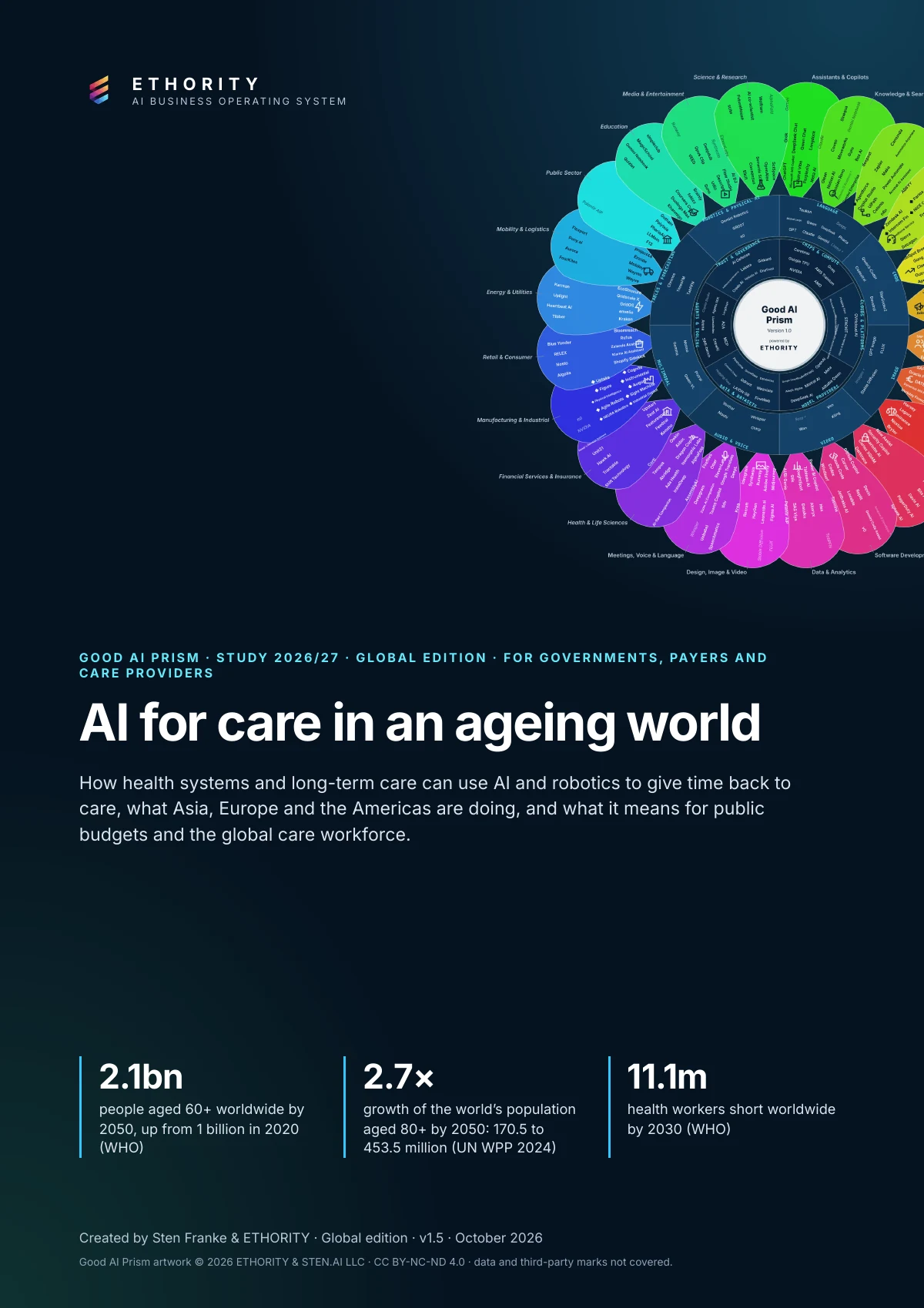
Global edition · EN
The world will be short of 11.1 million health workers by 2030. How health systems and long-term care use AI and robotics to give time back to care.
Version 1.5 · 23 pages
Open the study →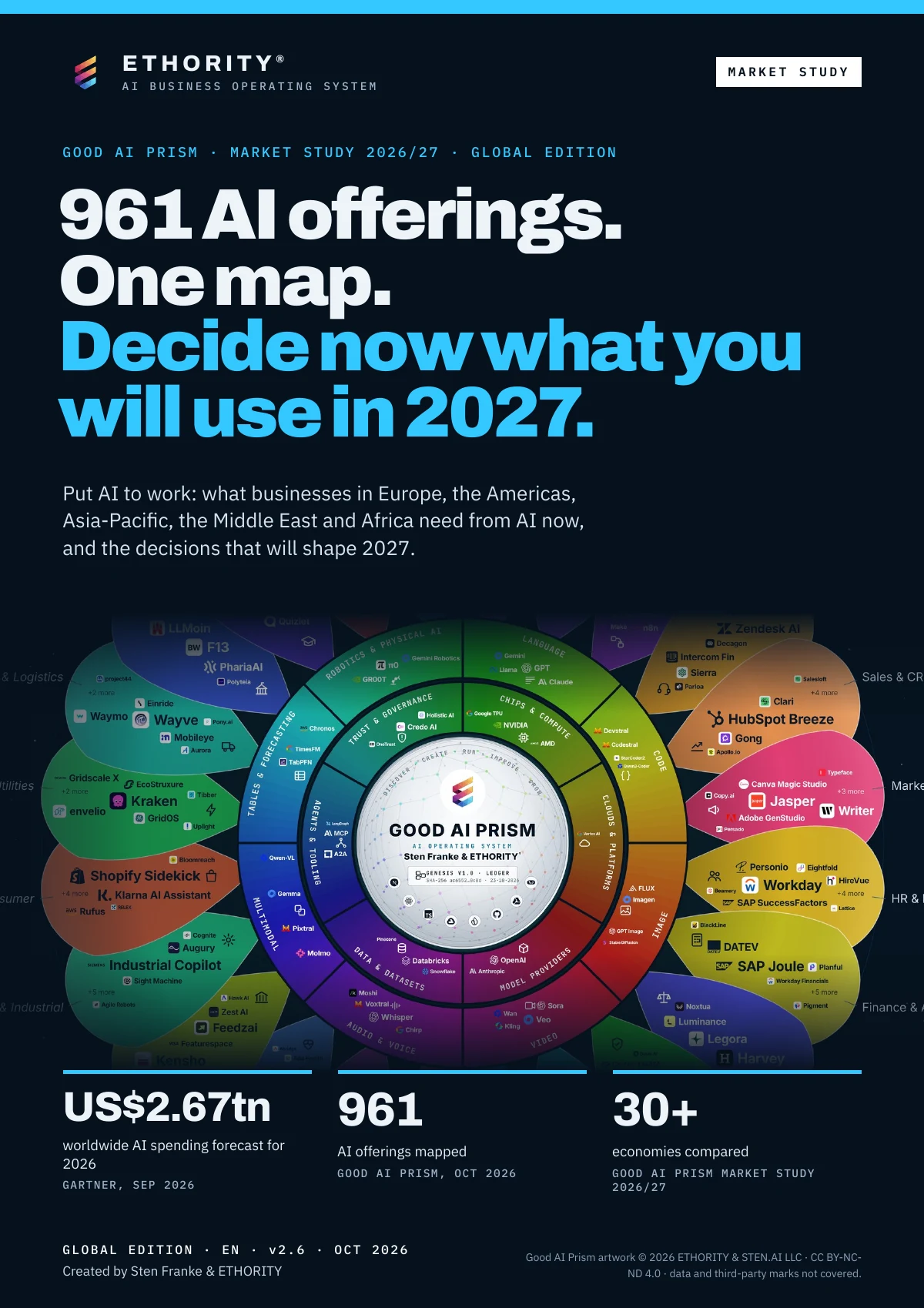
Global edition · EN
The Good AI Prism helps you find useful AI and compare the evidence behind your options. For organisations already using AI, the question is moving from whether to use AI to which AI, how safely and whether it pays. This Global edition brings together 961 AI offerings across 24 topic areas, 8 data types and 6 technology layers, with sources, dates and limits to guide your next decision.
Version 2.6 · 90 pages
Open the study →