 ETHORITY®
Global edition · EN
27 Oct 2026 · v2.6 · 90 pages · PDF
Open pre-release study PDF ↓THE GOOD AI PRISM · BY STEN & ETHORITY
Which AI belongs in your business—and what evidence supports that decision? The October 2026 research connects provider documentation with the practical questions of cost, data, people and responsibility.
Global edition · EN · v2.6 · Pre-release review edition
EXECUTIVE SUMMARY
The Global edition helps leaders place an AI decision within regional markets, industries and business functions. It brings together external adoption research and ETHORITY’s review of provider documentation. The useful starting point is one business process: what should improve, which alternatives deserve attention, and what evidence would justify changing the way work is done? Read market growth as context for that question. Investment, adoption and organisational results describe different things; a large market does not establish a return for an individual company.
The study separates sourced observations, the authors’ interpretation and proposed actions. That distinction matters when comparing offers. A capability claim, a contractual condition and a tested outcome answer different questions. Specify the product, plan, deployment region and intended workflow before drawing conclusions. The Good AI Prism provides a route into the market; individual profiles and their sources supply the detail. A provider’s headquarters cannot establish where your data is processed, and a certification claim needs its applicable scope. Keep unanswered material questions with the shortlist.
The selected edition examines what providers publicly document about price, hosting, training with customer data and integrations. Read each condition separately: a hosting option and a training-use clause do not establish the same thing. Provider documentation is a starting point for a shortlist, while operational assurance needs testing in the intended deployment. Ask suppliers to identify the product, plan, region and contractual terms that apply to your account. The study population, artwork selection and live website catalogue have different coverage. Keep each count with its source date and population, and retain the selected edition’s qualifications when sharing a finding.
A useful cost case includes licences or usage, integration, data preparation, human review, rework and change. Compare options at the volume and quality your business actually requires. Time released by a task is potential capacity; financial value depends on what happens to that capacity and which costs or outcomes change. The study’s buyer worksheet, pilot charter, workforce annex and scenario worksheet help make those assumptions explicit. Choose a responsible owner and define the evidence that would support continuing, redesigning or stopping a pilot before committing to a wider rollout.
Use the selected edition’s contents and source notes to pursue your question, then inspect the corresponding Prism area. Compare a small number of offerings against the same requirements. Carry their documented conditions and remaining questions into the calculator or an enquiry. Sten Franke contributes the business and systems perspective. A discussion can establish a bounded next piece of work. This review edition supports orientation and preparation; a customer engagement still needs its own agreed scope, responsibilities and acceptance criteria. Before a supplier conversation, write down the accepted outcome, expected volume, permitted data use and the person who can approve a trial. Ask each shortlisted provider to answer the same material questions in writing. Revisit the comparison when the product, price, integration or your operating assumptions change. The practical aim is a traceable decision that colleagues can examine, rather than a permanent ranking of suppliers.
Source: selected study v2.6 · EN. This editorial reading guide preserves the source edition’s scope; practical next steps are recommendations, not observed outcomes. Read the source overview ↗ · Inspect documented provider terms ↗
PROVIDER DOCUMENTATION · OCTOBER 2026
The selected study compares the conditions providers document: price, hosting, training with customer data and integrations. Read each condition within its stated research population, date and scope.
The practical implication: ask providers for the product, plan and region that meet your requirements. The two kinds of training disclosure are different conditions. This study cohort and the live Prism catalogue have different coverage.
Inspect the relevant sector and sources →ECONOMICS · EXTERNAL STUDY SYNTHESIS
Include usage or licence fees, integration, review and failed or escalated cases. Divide by the outcomes your business accepts. The calculator shows a range built from your assumptions. Realised value requires measured outcomes and attributable cost changes.
Explore task economics →The October 2026 round of ETHORITY’s longitudinal research programme documents provider information reviewed on 19–20 October 2026. Changes are recorded in subsequent research rounds. A separate synthesis of external market and buyer studies keeps each study’s population, date and method. Read each result within its own population, date and method.
Research edition of 20 October 2026: 998 market entries = 961 AI offerings, 33 provider records and four unclassified records. The 1,037 placements comprise 779 topic-area, 108 data-type and 150 technology-layer placements. The 194 unique depth-research IDs comprise 182 in this edition (95 Customer Service, 87 Manufacturing) plus 12 Customer Service records researched earlier. The resulting 107 Customer Service records are not a verified count of distinct commercial products. These populations differ from the 485 identities in the interactive website catalogue. Sources, dates and scope stay attached to each finding.
Research IDs identify the records. Each claim keeps the product, plan, region, source URL and observation date where supplied. Provider statements, documentary evidence and analysis remain distinct. The documentation finding counts only the stated criteria; it does not infer hosting from headquarters or certification from marketing.
Global and Focus are distinct editions. Both are available in EN and DE. Their research counts describe their own source edition, not the number of unique products, verified systems or customer outcomes in this website.
Research method and catalogue coverage →Global compares regional and sector conditions. Focus gives Germany and the United States a dedicated reading path. Each scope is available in both languages.
27 Oct 2026 · v2.6 · 90 pages · PDF
Open pre-release study PDF ↓Pre-release review edition. Preview selected pages here; open the PDF to zoom, read all pages or save a copy.
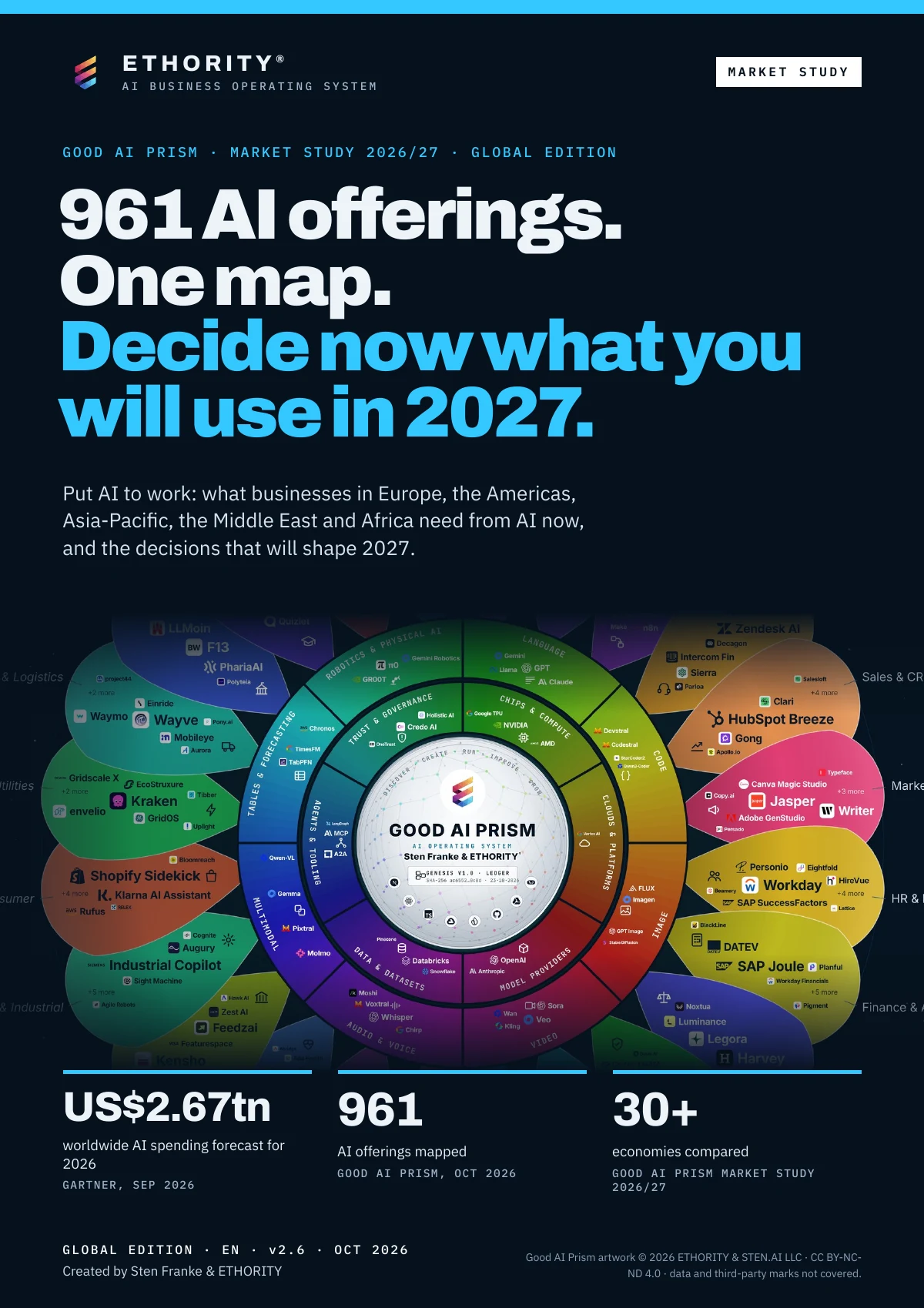
The A3 companion uses v3.11 artwork and the reference selection of 17 October 2026. Its placements are separate from the study cohort and interactive catalogue.

Founder & CEO
Sten Franke designs and builds AI systems, from model testing and cloud setup to the interfaces people use. He connects business decisions, software architecture and practical implementation.
AI architecture · Model testing · Cloud engineering · UX
His work spans programming, LLM evaluation, Google Cloud and AWS environments, and web applications built with Next.js and React. He connects business requirements, software architecture and practical implementation. Creator of the Good AI Prism, he brings market intelligence into AI decisions. Earlier, he created the Social Media Prisma, led a BVDW Social Media working group and contributed to its Social Media Kompass. His entrepreneurial work includes ethority, Gridpatrol and mediatime, following a practical foundation in electronics and industrial robotics.
sten@ethority.aiWhy task improvement, released capacity and business value require different evidence.
A practical method for assigning responsibility and measuring what changes.
FROM FINDING TO DECISION